Challenges to Solar as a Leading Solution to Climate and Energy ProblemsGeorge Washington University Solar Institute |  April 19, 2010John LushetskyProgram ManagerSolar Energy Technologies ProgramU.S. Department of Energy
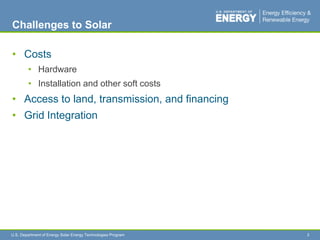
Challenges to SolarCostsHardwareInstallation and other soft costsAccess to land, transmission, and financingGrid Integration2
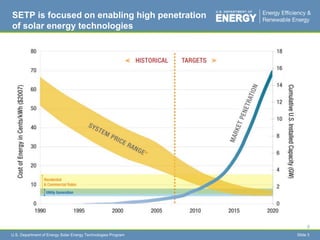
SETP is focused on enabling high penetration of solar energy technologies Slide 33
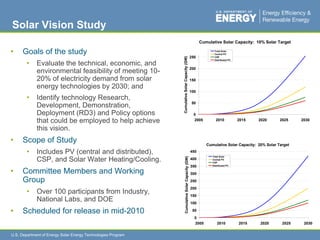
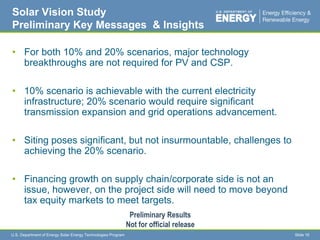
Solar Vision StudyGoals of the studyEvaluate the technical, economic, and environmental feasibility of meeting 10-20% of electricity demand from solar energy technologies by 2030; andIdentify technology Research, Development, Demonstration, Deployment (RD3) and Policy options that could be employed to help achieve this vision.Scope of StudyIncludes PV (central and distributed), CSP, and Solar Water Heating/Cooling.Committee Members and Working GroupOver 100 participants from Industry, National Labs, and DOEScheduled for release in mid-2010
Residential PV: LCOE Targets2015With the 30% ITC, PV is broadly competitive with residential electricity rates.
Without the ITC, PV is broadly competitive under all conditions except that with the most expensive financing and worst insolation. 2030Without the ITC, PV has levelized costs that are lower than most residential electricity rates.
Standard financial assumptions overestimate LCOE due to combination of tax effects and higher cost of capital than in the market.* No state, local or utility incentives are included.  The range in residential PV LCOE is due to different insolation and financing conditions.  For a complete list of assumptions, see DOE Solar Cost Targets (2009 – 2030), in process. ‡ The electricity rate range represents one standard deviation below and above the mean U.S. residential electricity prices. $ The system is located in Phoenix, AZ and financed with a real cost of capital of 7.0%.  The capital recovery factor does not take into account the ITC or financing tax preferences.
Utility PV: LCOE Targets2015With the 30% ITC, PV is broadly competitive with wholesale electricity rates.
With the 10% ITC, PV is equal to or below the CA MPR and competitive with high wholesale electricity rates under the best insolation and financing conditions 2030With the 10% ITC, PV is broadly competitive with wholesale electricity rates.
Standard financial assumptions yield LCOE estimates that are  towards the high end of the program’s range due to excluding the 10% ITC and depreciation* Assumes IOU or IPP ownership of PV, and thus the LCOE includes the taxes paid on electricity generated. Includes 5-year MACRS but not state or local incentives.  The range in utility PV LCOE is due to different insolation and financing conditions.  For a complete list of assumptions, see DOE Solar Cost Targets (2009 – 2030), in process. ‡ The electricity rate range represents one standard deviation below and above the mean U.S. wholesale electricity prices. § The 2009 CA MPR includes adjustments by utility for the time of delivery profile of solar (low case: SDG&E, mid case: PG&E, high case: SCE).
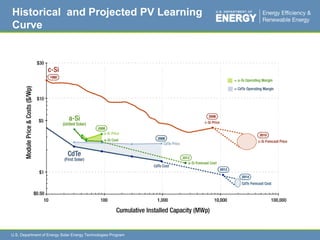
Historical  and Projected PV Learning Curve
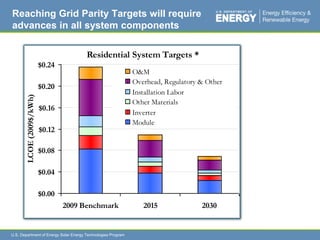
Reaching Grid Parity Targets will require advances in all system components
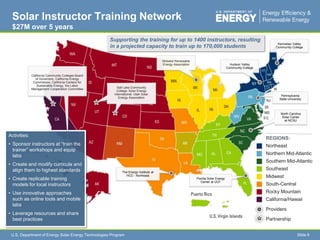
Solar Instructor Training Network$27M over 5 years  Slide 9Kennebec Valley Community CollegeSupporting the training for up to 1400 instructors, resulting in a projected capacity to train up to 170,000 students Midwest Renewable Energy AssociationHudson Valley Community CollegeCalifornia Community Colleges Board of Governors, California Energy Commission, California Centers for Sustainable Energy, the Labor Management Cooperation CommitteeSalt Lake Community College; Solar Energy International; Utah Solar Energy AssociationPennsylvania State UniversityNorth Carolina Solar Center at NCSUActivities: Sponsor instructors at “train the trainer” workshops and equip labs
Create and modify curricula and align them to highest standards

Lushetsky - Solar Vision Forum

  • 1.
    Challenges to Solaras a Leading Solution to Climate and Energy ProblemsGeorge Washington University Solar Institute | April 19, 2010John LushetskyProgram ManagerSolar Energy Technologies ProgramU.S. Department of Energy
  • 2.
    Challenges to SolarCostsHardwareInstallationand other soft costsAccess to land, transmission, and financingGrid Integration2
  • 3.
    SETP is focusedon enabling high penetration of solar energy technologies Slide 33
  • 4.
    Solar Vision StudyGoalsof the studyEvaluate the technical, economic, and environmental feasibility of meeting 10-20% of electricity demand from solar energy technologies by 2030; andIdentify technology Research, Development, Demonstration, Deployment (RD3) and Policy options that could be employed to help achieve this vision.Scope of StudyIncludes PV (central and distributed), CSP, and Solar Water Heating/Cooling.Committee Members and Working GroupOver 100 participants from Industry, National Labs, and DOEScheduled for release in mid-2010
  • 5.
    Residential PV: LCOETargets2015With the 30% ITC, PV is broadly competitive with residential electricity rates.
  • 6.
    Without the ITC,PV is broadly competitive under all conditions except that with the most expensive financing and worst insolation. 2030Without the ITC, PV has levelized costs that are lower than most residential electricity rates.
  • 7.
    Standard financial assumptionsoverestimate LCOE due to combination of tax effects and higher cost of capital than in the market.* No state, local or utility incentives are included. The range in residential PV LCOE is due to different insolation and financing conditions. For a complete list of assumptions, see DOE Solar Cost Targets (2009 – 2030), in process. ‡ The electricity rate range represents one standard deviation below and above the mean U.S. residential electricity prices. $ The system is located in Phoenix, AZ and financed with a real cost of capital of 7.0%. The capital recovery factor does not take into account the ITC or financing tax preferences.
  • 8.
    Utility PV: LCOETargets2015With the 30% ITC, PV is broadly competitive with wholesale electricity rates.
  • 9.
    With the 10%ITC, PV is equal to or below the CA MPR and competitive with high wholesale electricity rates under the best insolation and financing conditions 2030With the 10% ITC, PV is broadly competitive with wholesale electricity rates.
  • 10.
    Standard financial assumptionsyield LCOE estimates that are towards the high end of the program’s range due to excluding the 10% ITC and depreciation* Assumes IOU or IPP ownership of PV, and thus the LCOE includes the taxes paid on electricity generated. Includes 5-year MACRS but not state or local incentives. The range in utility PV LCOE is due to different insolation and financing conditions. For a complete list of assumptions, see DOE Solar Cost Targets (2009 – 2030), in process. ‡ The electricity rate range represents one standard deviation below and above the mean U.S. wholesale electricity prices. § The 2009 CA MPR includes adjustments by utility for the time of delivery profile of solar (low case: SDG&E, mid case: PG&E, high case: SCE).
  • 11.
    Historical andProjected PV Learning Curve
  • 12.
    Reaching Grid ParityTargets will require advances in all system components
  • 13.
    Solar Instructor TrainingNetwork$27M over 5 years Slide 9Kennebec Valley Community CollegeSupporting the training for up to 1400 instructors, resulting in a projected capacity to train up to 170,000 students Midwest Renewable Energy AssociationHudson Valley Community CollegeCalifornia Community Colleges Board of Governors, California Energy Commission, California Centers for Sustainable Energy, the Labor Management Cooperation CommitteeSalt Lake Community College; Solar Energy International; Utah Solar Energy AssociationPennsylvania State UniversityNorth Carolina Solar Center at NCSUActivities: Sponsor instructors at “train the trainer” workshops and equip labs
  • 14.
    Create and modifycurricula and align them to highest standards

Editor's Notes

  • #10 In Northeast, Hudson Valley will cover only PV and Kennebec Valley will cover only SHC