HANDWRITTEN DIGIT RECOGNITION
Handwritten Digit Recognition Project
 PROBLEM STATMENT
The MNIST dataset of handwritten digits is widespread among
the data scientists and machine learning enthusiasts. It is an
amazing project to get started with the data science and
understand the processes involved in a project. The project is
implemented using the Convolutional Neural Networks and then
for real-time prediction we also build a nice graphical user
interface to draw digits on a canvas and then the model will
predict the digit."
OBJECTIVES:
MNIST data set :
It is a large data collection of handwritten digits used to train and
test various supervised machine learning algorithms.
Tenserflow :
TensorFlow is a free and open-source software library for machine
learning and artificial intelligence. It can be used across a range of tasks but has
a particular focus on training and inference of deep neural networks.
Convolutional Neural Networks(CNN) :
Convolutional Neural Networks are a type of Deep Learning Algorithm that
take the image as an input and learn the various features of the image through filters.
 PAPERS SURVEYED FROM SCIENCE DIRECT :
1. Hierarchical Convolutional Neural Network for Handwritten Digits Recognition
(https://www.sciencedirect.com/science/article/pii/S1877050920311881)
2. Hybrid CNN-SVM Classifier for Handwritten Digit
Recognition(https://www.sciencedirect.com/science/article/pii/S1877050920307754)
3. Handwritten Data Digitization Using an Anchor based Multi-Channel CNN (MCCNN)
Trained on a Hybrid Dataset (h-
EH).(https://www.sciencedirect.com/science/article/pii/S1877050921012187).
Hierarchical Convolutional Neural Network for Handwritten Digits
Recognition
 ABSTRACTION:
The application of a combination of convolutional neural networks for the
recognition of handwritten digits is considered. Recognition is carried out by
two sets of the networks following each other. The first neural network
selects two digits with maximum activation functions. Depending on the
winners, the next network is activated, which selects one digit from two. The
proposed algorithm is tested on the data from MNIST.
INTRODUCTION
 Handwritten digit recognition is mainly based on Neural networks. Neural
networks are widely used in science , technology and many other fields . One of
the main applications of networks is image processing. This includes various tasks
related to the classification, localization and recognition of objects. Similar tasks
are associated with the development of principles and the construction of systems
designed to determine whether an object belongs to one of the classes of objects.
 In present work, we consider the recognition of handwritten digits from the MNIST
database by a hierarchical convolutional neural network that interprets the image
sequentially and obtaining the correct answer
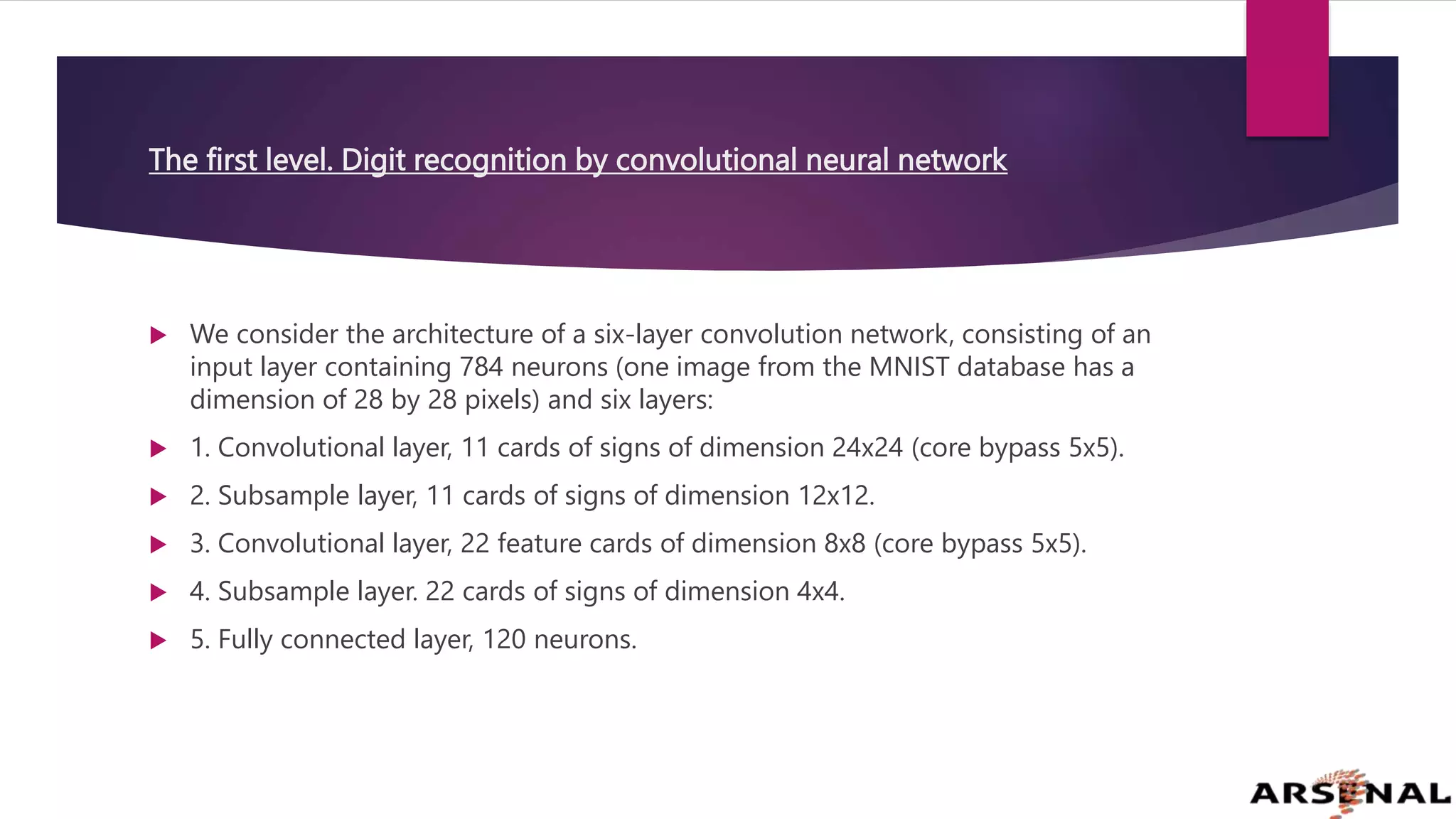
The first level. Digit recognition by convolutional neural network
 We consider the architecture of a six-layer convolution network, consisting of an
input layer containing 784 neurons (one image from the MNIST database has a
dimension of 28 by 28 pixels) and six layers:
 1. Convolutional layer, 11 cards of signs of dimension 24x24 (core bypass 5x5).
 2. Subsample layer, 11 cards of signs of dimension 12x12.
 3. Convolutional layer, 22 feature cards of dimension 8x8 (core bypass 5x5).
 4. Subsample layer. 22 cards of signs of dimension 4x4.
 5. Fully connected layer, 120 neurons.
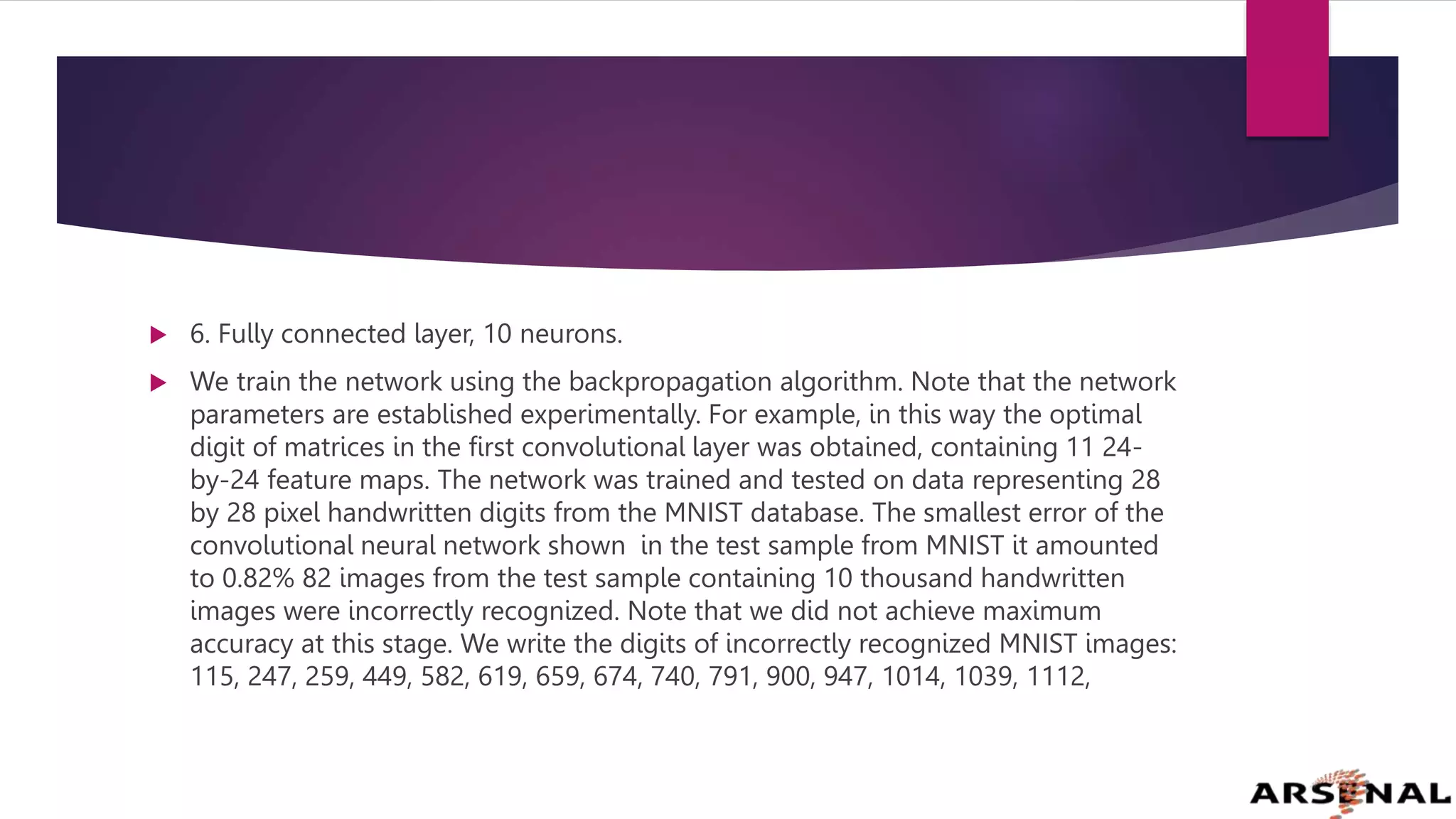
 6. Fully connected layer, 10 neurons.
 We train the network using the backpropagation algorithm. Note that the network
parameters are established experimentally. For example, in this way the optimal
digit of matrices in the first convolutional layer was obtained, containing 11 24-
by-24 feature maps. The network was trained and tested on data representing 28
by 28 pixel handwritten digits from the MNIST database. The smallest error of the
convolutional neural network shown in the test sample from MNIST it amounted
to 0.82% 82 images from the test sample containing 10 thousand handwritten
images were incorrectly recognized. Note that we did not achieve maximum
accuracy at this stage. We write the digits of incorrectly recognized MNIST images:
115, 247, 259, 449, 582, 619, 659, 674, 740, 791, 900, 947, 1014, 1039, 1112,
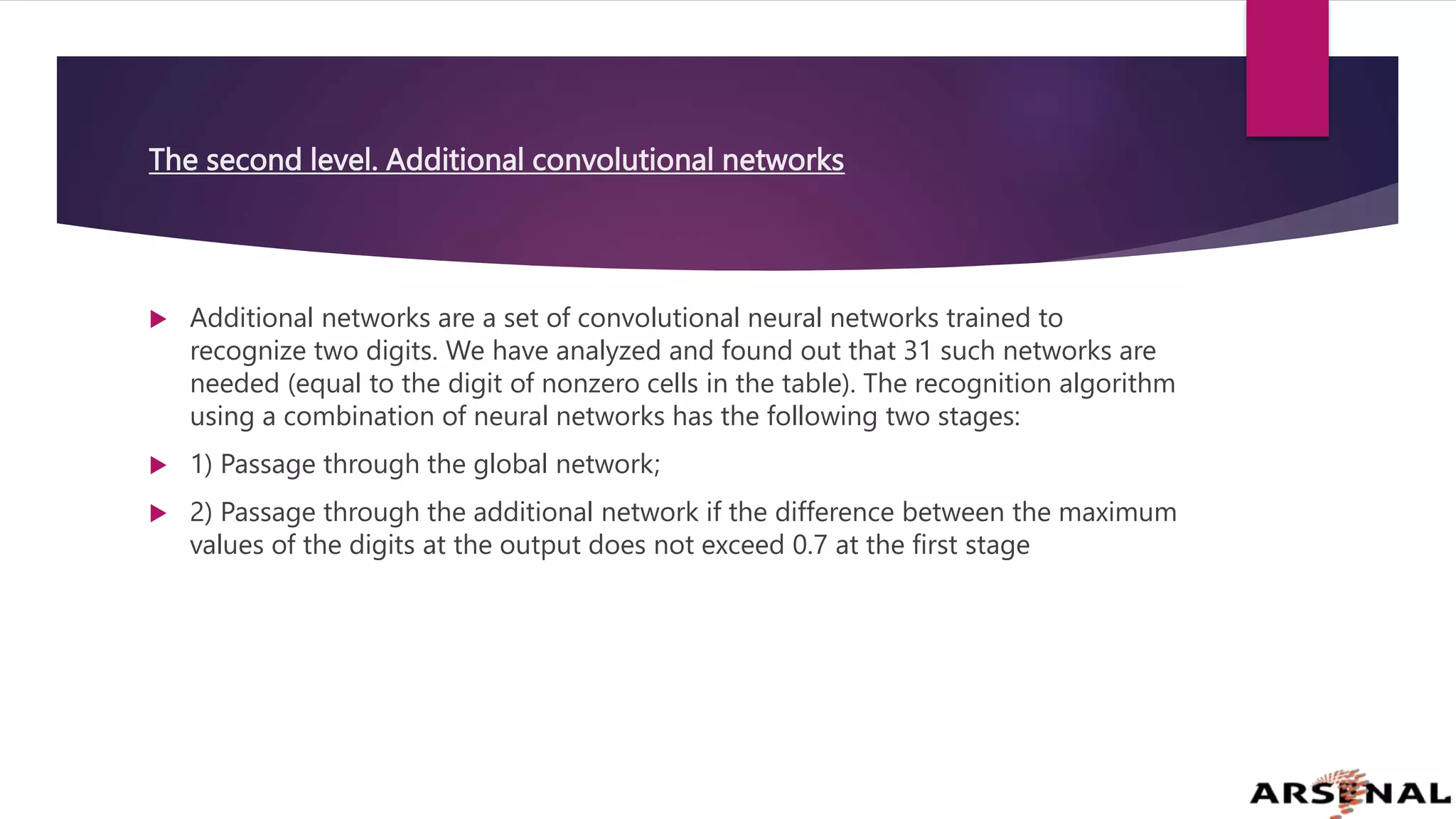
The second level. Additional convolutional networks
 Additional networks are a set of convolutional neural networks trained to
recognize two digits. We have analyzed and found out that 31 such networks are
needed (equal to the digit of nonzero cells in the table). The recognition algorithm
using a combination of neural networks has the following two stages:
 1) Passage through the global network;
 2) Passage through the additional network if the difference between the maximum
values of the digits at the output does not exceed 0.7 at the first stage
KEY FINDINGS
 Convolutional Neural Networks
 Heirarical Convolutional Neural Networks
 Training And Testing MNIST datraset using Neural Nrtworks
REFERENCES
 https://www.sciencedirect.com/science/article/pii/S1877050920307754
 https://www.sciencedirect.com/science/article/pii/S1877050920311881
 https://www.sciencedirect.com/science/article/pii/S1877050921012187
 https://data-flair.training/blogs/python-deep-learning-project-handwritten-digit-
recognition/
 CONCLUSION: The hierarchical convolutional neural network is proposed for the
task of recognizing handwritten numbers. The similar task can be used for
handwriting recognition on tablet computers, recognition of postal codes for
sorting mail, processing bank checks, entering numerical entries in manually filled
forms, etc. The proposed algorithm is tested on data from MNIST.

HANDWRITTEN DIGIT RECOGNITIONppt1.pptx

  • 1.
  • 2.
    Handwritten Digit RecognitionProject  PROBLEM STATMENT The MNIST dataset of handwritten digits is widespread among the data scientists and machine learning enthusiasts. It is an amazing project to get started with the data science and understand the processes involved in a project. The project is implemented using the Convolutional Neural Networks and then for real-time prediction we also build a nice graphical user interface to draw digits on a canvas and then the model will predict the digit."
  • 3.
    OBJECTIVES: MNIST data set: It is a large data collection of handwritten digits used to train and test various supervised machine learning algorithms. Tenserflow : TensorFlow is a free and open-source software library for machine learning and artificial intelligence. It can be used across a range of tasks but has a particular focus on training and inference of deep neural networks. Convolutional Neural Networks(CNN) : Convolutional Neural Networks are a type of Deep Learning Algorithm that take the image as an input and learn the various features of the image through filters.
  • 4.
     PAPERS SURVEYEDFROM SCIENCE DIRECT : 1. Hierarchical Convolutional Neural Network for Handwritten Digits Recognition (https://www.sciencedirect.com/science/article/pii/S1877050920311881) 2. Hybrid CNN-SVM Classifier for Handwritten Digit Recognition(https://www.sciencedirect.com/science/article/pii/S1877050920307754) 3. Handwritten Data Digitization Using an Anchor based Multi-Channel CNN (MCCNN) Trained on a Hybrid Dataset (h- EH).(https://www.sciencedirect.com/science/article/pii/S1877050921012187).
  • 5.
    Hierarchical Convolutional NeuralNetwork for Handwritten Digits Recognition  ABSTRACTION: The application of a combination of convolutional neural networks for the recognition of handwritten digits is considered. Recognition is carried out by two sets of the networks following each other. The first neural network selects two digits with maximum activation functions. Depending on the winners, the next network is activated, which selects one digit from two. The proposed algorithm is tested on the data from MNIST.
  • 6.
    INTRODUCTION  Handwritten digitrecognition is mainly based on Neural networks. Neural networks are widely used in science , technology and many other fields . One of the main applications of networks is image processing. This includes various tasks related to the classification, localization and recognition of objects. Similar tasks are associated with the development of principles and the construction of systems designed to determine whether an object belongs to one of the classes of objects.  In present work, we consider the recognition of handwritten digits from the MNIST database by a hierarchical convolutional neural network that interprets the image sequentially and obtaining the correct answer
  • 7.
    The first level.Digit recognition by convolutional neural network  We consider the architecture of a six-layer convolution network, consisting of an input layer containing 784 neurons (one image from the MNIST database has a dimension of 28 by 28 pixels) and six layers:  1. Convolutional layer, 11 cards of signs of dimension 24x24 (core bypass 5x5).  2. Subsample layer, 11 cards of signs of dimension 12x12.  3. Convolutional layer, 22 feature cards of dimension 8x8 (core bypass 5x5).  4. Subsample layer. 22 cards of signs of dimension 4x4.  5. Fully connected layer, 120 neurons.
  • 8.
     6. Fullyconnected layer, 10 neurons.  We train the network using the backpropagation algorithm. Note that the network parameters are established experimentally. For example, in this way the optimal digit of matrices in the first convolutional layer was obtained, containing 11 24- by-24 feature maps. The network was trained and tested on data representing 28 by 28 pixel handwritten digits from the MNIST database. The smallest error of the convolutional neural network shown in the test sample from MNIST it amounted to 0.82% 82 images from the test sample containing 10 thousand handwritten images were incorrectly recognized. Note that we did not achieve maximum accuracy at this stage. We write the digits of incorrectly recognized MNIST images: 115, 247, 259, 449, 582, 619, 659, 674, 740, 791, 900, 947, 1014, 1039, 1112,
  • 9.
    The second level.Additional convolutional networks  Additional networks are a set of convolutional neural networks trained to recognize two digits. We have analyzed and found out that 31 such networks are needed (equal to the digit of nonzero cells in the table). The recognition algorithm using a combination of neural networks has the following two stages:  1) Passage through the global network;  2) Passage through the additional network if the difference between the maximum values of the digits at the output does not exceed 0.7 at the first stage
  • 10.
    KEY FINDINGS  ConvolutionalNeural Networks  Heirarical Convolutional Neural Networks  Training And Testing MNIST datraset using Neural Nrtworks
  • 11.
    REFERENCES  https://www.sciencedirect.com/science/article/pii/S1877050920307754  https://www.sciencedirect.com/science/article/pii/S1877050920311881 https://www.sciencedirect.com/science/article/pii/S1877050921012187  https://data-flair.training/blogs/python-deep-learning-project-handwritten-digit- recognition/  CONCLUSION: The hierarchical convolutional neural network is proposed for the task of recognizing handwritten numbers. The similar task can be used for handwriting recognition on tablet computers, recognition of postal codes for sorting mail, processing bank checks, entering numerical entries in manually filled forms, etc. The proposed algorithm is tested on data from MNIST.