BY
GEETHAPRIYA
BLESSY
DEVADHARSHINI
SABURA YASMIN
YALINI
ANU
ABSTRACT
The handwritten digit recognition problem becomes one of the
most famous problems in machine learning and computer vision
applications. This paper focuses on Neural Network approaches.
The most three famous NN approaches are deep neural network,
deep belief network and convolutional neural network (CNN).
In this paper, the three NN approaches are compared and
evaluated in terms of many factors such as accuracy and
performance. Recognition accuracy rate and performance,
however, is not the only criterion in the evaluation process, but
there are interesting criteria such as execution time. Random
and standard dataset of handwritten digit have been used for
conducting the experiments. The results show that among the
three NN approaches, DNN is the most accurate algorithm; it
has 98.08% accuracy rate.On the other hand, each algorithm has
an error rate of 1-2% because of the similarity in digit shapes,
specially, with the digits (1,7), (3,5), (3,8), (8,5) and (6,9).
INTRODUCTION
 Handwriting recognition (HWR), also known as
handwritten text recognition (HTR), is the ability of a
computer to receive and interpret intelligible
handwritten input from sources such as paper
documents, photographs, touch-screens and
other devices.
CNN
 convolutional neural network (CNN) is a class of
artificial neural network (ANN), most commonly applied
to analyze visual imagery. CNNs are also known as Shift
Invariant or Space Invariant Artificial Neural Networks
(SIANN), based on the shared-weight architecture of the
convolution kernels or filters that slide along input features
and provide translation- equivalent responses known as
feature maps. Counter-intuitively, most convolutional
neural networks are not invariant to translation, due to the
down sampling operation they apply to the input. They
have applications in image and video recognition,
recommender systems, image classification, image
segmentation, medical image analysis, natural language
processing, brain–computer interfaces and financial time
series.
EXISTING SYSTEM
 Digit recognition system is the working of a machine
to train itself or recognizing the digits from different
sources like emails, bank cheque, papers, images, etc.
and in different real-world scenarios for online
handwriting recognition on computer tablets or
system, recognize number plates of vehicles,word and
letters processing bank cheque amounts, numeric
entries in forms filled up by hand and so on
PROPOSED SYSTEM
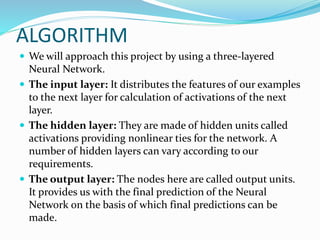
 In the existing model the letter and words such as
A,B,C (or) ball, bat, cat like they recognized but here
we have additionally included that our new upgreaded
model will also print the operation such +, - ,% and so
on with the help of conventional neural network
(CNN).
ALGORITHM
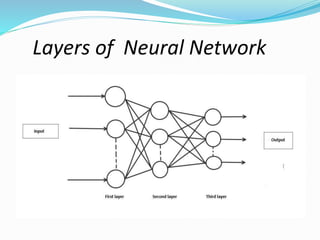
 We will approach this project by using a three-layered
Neural Network.
 The input layer: It distributes the features of our examples
to the next layer for calculation of activations of the next
layer.
 The hidden layer: They are made of hidden units called
activations providing nonlinear ties for the network. A
number of hidden layers can vary according to our
requirements.
 The output layer: The nodes here are called output units.
It provides us with the final prediction of the Neural
Network on the basis of which final predictions can be
made.
A neural network is a model inspired by how the brain
works. It consists of multiple layers having many
activations, this activation resembles neurons of our
brain. A neural network tries to learn a set of
parameters in a set of data which could help to
recognize the underlying relationships. Neural
networks can adapt to changing input; so the network
generates the best possible result without needing to
redesign the output criteria.
Methodology:
We have implemented a Neural Network with 1 hidden
layer having 100 activation units (excluding bias units).
The data is loaded from a .mat file, features(X) and
labels(y) were extracted.
Layers of Neural Network

Handwritten digit and symbol recognition using CNN.pptx

  • 1.
  • 2.
    ABSTRACT The handwritten digitrecognition problem becomes one of the most famous problems in machine learning and computer vision applications. This paper focuses on Neural Network approaches. The most three famous NN approaches are deep neural network, deep belief network and convolutional neural network (CNN). In this paper, the three NN approaches are compared and evaluated in terms of many factors such as accuracy and performance. Recognition accuracy rate and performance, however, is not the only criterion in the evaluation process, but there are interesting criteria such as execution time. Random and standard dataset of handwritten digit have been used for conducting the experiments. The results show that among the three NN approaches, DNN is the most accurate algorithm; it has 98.08% accuracy rate.On the other hand, each algorithm has an error rate of 1-2% because of the similarity in digit shapes, specially, with the digits (1,7), (3,5), (3,8), (8,5) and (6,9).
  • 3.
    INTRODUCTION  Handwriting recognition(HWR), also known as handwritten text recognition (HTR), is the ability of a computer to receive and interpret intelligible handwritten input from sources such as paper documents, photographs, touch-screens and other devices.
  • 4.
    CNN  convolutional neuralnetwork (CNN) is a class of artificial neural network (ANN), most commonly applied to analyze visual imagery. CNNs are also known as Shift Invariant or Space Invariant Artificial Neural Networks (SIANN), based on the shared-weight architecture of the convolution kernels or filters that slide along input features and provide translation- equivalent responses known as feature maps. Counter-intuitively, most convolutional neural networks are not invariant to translation, due to the down sampling operation they apply to the input. They have applications in image and video recognition, recommender systems, image classification, image segmentation, medical image analysis, natural language processing, brain–computer interfaces and financial time series.
  • 5.
    EXISTING SYSTEM  Digitrecognition system is the working of a machine to train itself or recognizing the digits from different sources like emails, bank cheque, papers, images, etc. and in different real-world scenarios for online handwriting recognition on computer tablets or system, recognize number plates of vehicles,word and letters processing bank cheque amounts, numeric entries in forms filled up by hand and so on
  • 6.
    PROPOSED SYSTEM  Inthe existing model the letter and words such as A,B,C (or) ball, bat, cat like they recognized but here we have additionally included that our new upgreaded model will also print the operation such +, - ,% and so on with the help of conventional neural network (CNN).
  • 7.
    ALGORITHM  We willapproach this project by using a three-layered Neural Network.  The input layer: It distributes the features of our examples to the next layer for calculation of activations of the next layer.  The hidden layer: They are made of hidden units called activations providing nonlinear ties for the network. A number of hidden layers can vary according to our requirements.  The output layer: The nodes here are called output units. It provides us with the final prediction of the Neural Network on the basis of which final predictions can be made.
  • 8.
    A neural networkis a model inspired by how the brain works. It consists of multiple layers having many activations, this activation resembles neurons of our brain. A neural network tries to learn a set of parameters in a set of data which could help to recognize the underlying relationships. Neural networks can adapt to changing input; so the network generates the best possible result without needing to redesign the output criteria. Methodology: We have implemented a Neural Network with 1 hidden layer having 100 activation units (excluding bias units). The data is loaded from a .mat file, features(X) and labels(y) were extracted.
  • 9.