Handshake
 Handshaking is commonly done upon meeting
,greeting ,parting , offering congratulations, or
completing an agreement.
 The purpose of handshake is to convey trust
, balance & equality.
 A handshake can give you some clues about the
person you are shaking hand with like , Personality
type.
 Learning to give a good handshake can go a long
way in helping restore self-esteem
TYPES OFHANDSHAKE
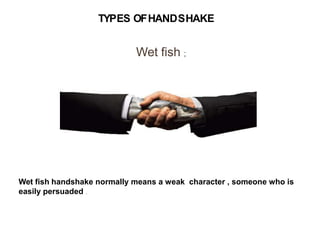
Wet fish ;
Wet fish handshake normally means a weak character , someone who is
easily persuaded .
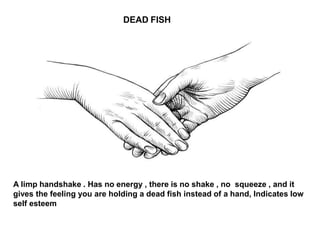
DEAD FISH
A limp handshake . Has no energy , there is no shake , no squeeze , and it
gives the feeling you are holding a dead fish instead of a hand, Indicates low
self esteem
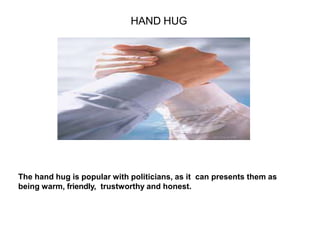
HAND HUG
The hand hug is popular with politicians, as it can presents them as
being warm, friendly, trustworthy and honest.
THE BONE CRUSHER
Shows overly aggressive personality types.
Is often performed by larger men that are trying to make up for smaller
things and is popular amongst politicians and lawyers and other
authoritative figures that think they have something to prove
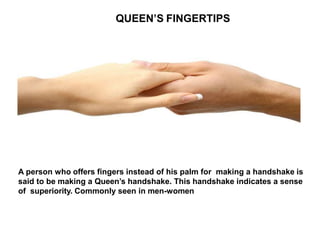
QUEEN’S FINGERTIPS
A person who offers fingers instead of his palm for making a handshake is
said to be making a Queen’s handshake. This handshake indicates a sense
of superiority. Commonly seen in men-women
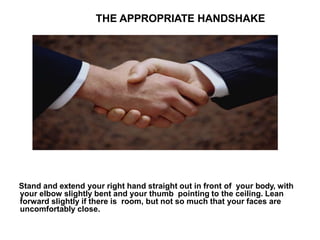
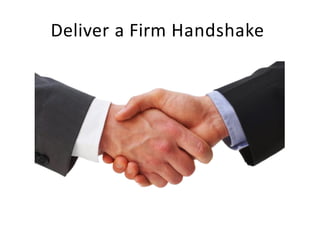
THE APPROPRIATE HANDSHAKE
Stand and extend your right hand straight out in front of your body, with
your elbow slightly bent and your thumb pointing to the ceiling. Lean
forward slightly if there is room, but not so much that your faces are
uncomfortably close.
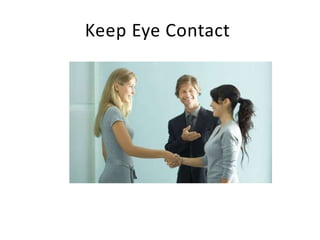
Keep eye contact; do not glance down at the hand offered as
you shake.
Keep a pleasant expression; not stiff or overeager.
Release the hand after 3-4 shakes.
Grip with slight firmness as you rise your hand slightly up
and down for the ‘shake’
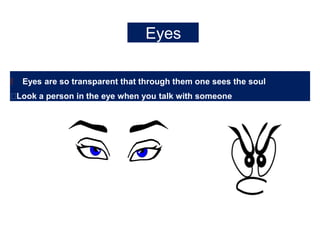
Eyes
🠶 Eyes are so transparent that through them one sees the soul
🠶Look a person in the eye when you talk with someone
Purpose for Eye Contact
🠶 Speaking information
🠶 Showing attention and interest
🠶 Inviting and controlling interaction
🠶 Revealing attitudes
What does it mean?
🠶 Too much eye contact: dominance, lack of respect,
threat, wish to insult
🠶 Too little eye contact: not paying attention, impolite,
insincere, shy
🠶 Withdrawing eyes: signal of submission
⦿ Biting nails: This may mean insecurity or
nerves.
⦿ Turning away: Looking away indicates
that you do not believe someone.
⦿ Pulling ears: Tugging at ears can indicate
indecision.
⦿ Head tilt: A brief head tilt means interest.
Holding a tilt equals boredom.
⦿ Open palms: Showing palms is a sign of
innocence or sincerity.
⦿ Rubbing hands together: Rubbing hands
together is a sign of excitement or anticipation.
⦿ Touching the chin: This signals that a
decision is being made.
⦿ Hand on the cheek: Touching the cheek
indicates someone is thinking.
⦿ Drumming fingers: This is a sign of
impatience.
⦿ Nodding: Nodding typically indicates agreement.
⦿ Head up: This position indicates that the person is listening
without bias.
⦿ Head down: This position indicates disinterest or rejection
for what is said. When done during an activity, it signals
weakness or tiredness.
⦿ Tilted to the side: This means a person is thoughtful or
vulnerable. It can signal trust.
⦿ Head high: Holding the head high signals confidence or
feelings of superiority.
⦿ Chin up: The chin up indicates defiance or confidence.
⦿ Head forward: Facing someone directly indicates interest. It
is a positive signal.
⦿ Tilted down: Tilting the head down signals disapproval.
⦿ Shaking: A shaking head indicates disagreement. The
faster the shaking, the stronger the disagreement.
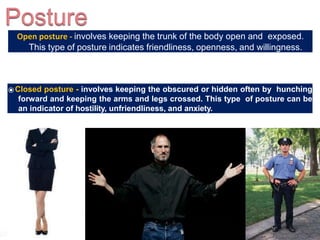
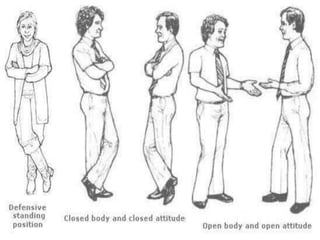
Open posture - involves keeping the trunk of the body open and exposed.
This type of posture indicates friendliness, openness, and willingness.
⦿Closed posture - involves keeping the obscured or hidden often by hunching
forward and keeping the arms and legs crossed. This type of posture can be
an indicator of hostility, unfriendliness, and anxiety.
The Do’s in Body Language
Walk Confidently
Deliver a Firm Handshake
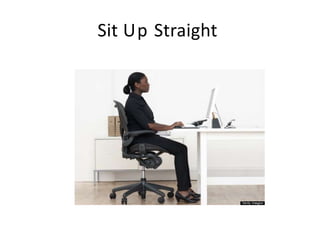
Sit Up Straight
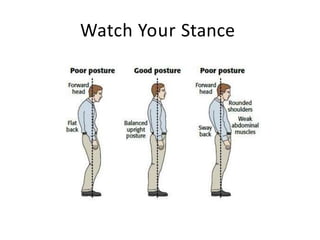
Watch Your Stance
Keep Eye Contact
Smile
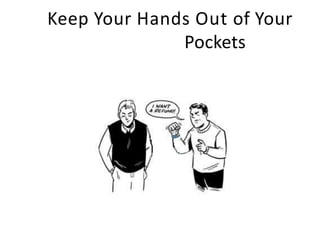
Keep Your Hands Out of Your
Pockets
Be Mindful of Your Head
Position
The Don'ts in Body Language
Holding Objects in Front of Your
Body
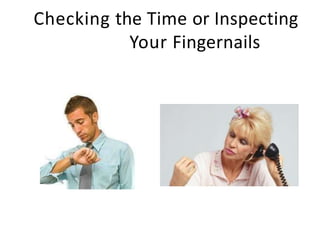
Checking the Time or Inspecting
Your Fingernails
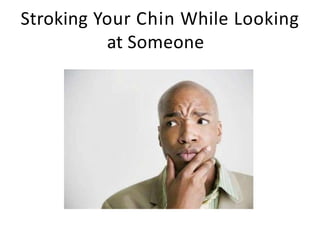
Stroking Your Chin While Looking
at Someone
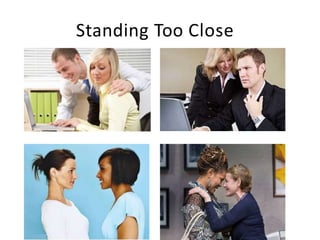
Standing Too Close
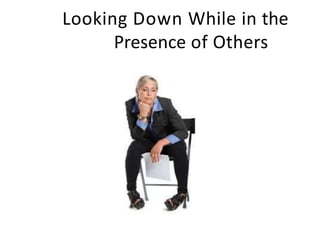
Looking Down While in the
Presence of Others
Faking a
Smile
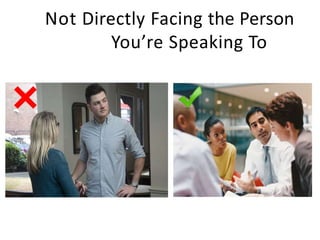
Not Directly Facing the Person
You’re Speaking To
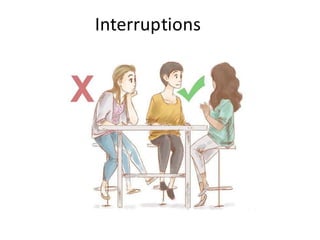
Interruptions
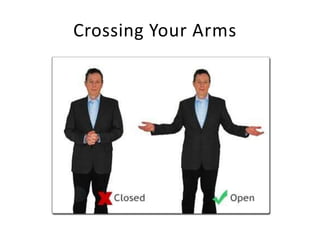
Crossing Your Arms
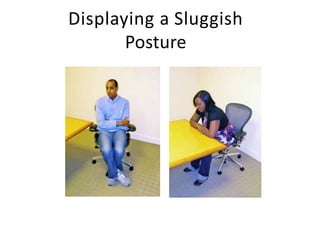
Displaying a Sluggish
Posture
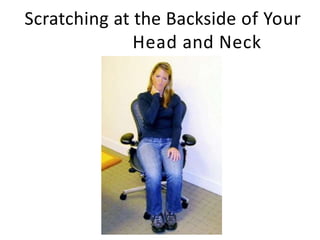
Scratching at the Backside of Your
Head and Neck
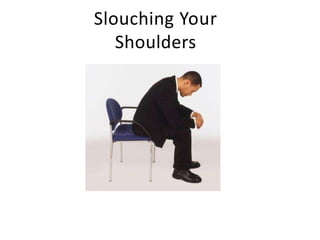
Slouching Your
Shoulders
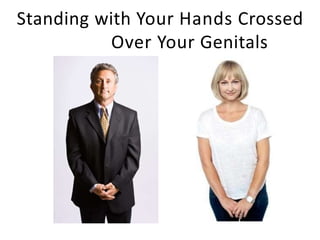
Standing with Your Hands Crossed
Over Your Genitals
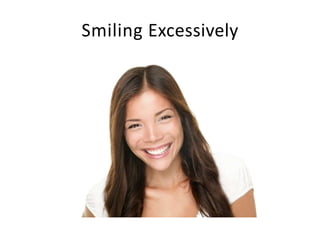
Smiling Excessively
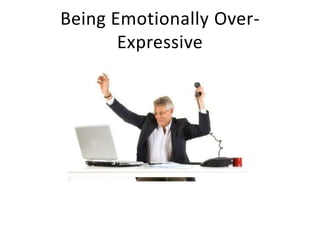
Being Emotionally Over-
Expressive
Nodding Too
Much.
Having a Delicate
Handshake
Staring
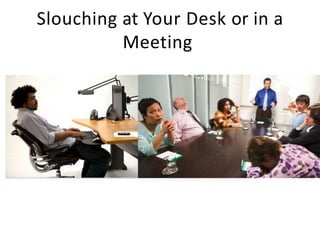
Slouching at Your Desk or in a
Meeting
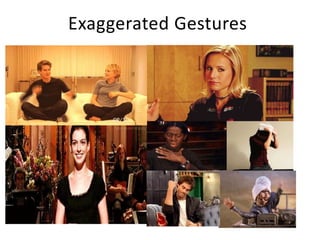
Exaggerated Gestures
BODY LANGUAGE.pptx

BODY LANGUAGE.pptx

  • 5.
    Handshake  Handshaking iscommonly done upon meeting ,greeting ,parting , offering congratulations, or completing an agreement.  The purpose of handshake is to convey trust , balance & equality.  A handshake can give you some clues about the person you are shaking hand with like , Personality type.  Learning to give a good handshake can go a long way in helping restore self-esteem
  • 6.
    TYPES OFHANDSHAKE Wet fish; Wet fish handshake normally means a weak character , someone who is easily persuaded .
  • 7.
    DEAD FISH A limphandshake . Has no energy , there is no shake , no squeeze , and it gives the feeling you are holding a dead fish instead of a hand, Indicates low self esteem
  • 8.
    HAND HUG The handhug is popular with politicians, as it can presents them as being warm, friendly, trustworthy and honest.
  • 9.
    THE BONE CRUSHER Showsoverly aggressive personality types. Is often performed by larger men that are trying to make up for smaller things and is popular amongst politicians and lawyers and other authoritative figures that think they have something to prove
  • 10.
    QUEEN’S FINGERTIPS A personwho offers fingers instead of his palm for making a handshake is said to be making a Queen’s handshake. This handshake indicates a sense of superiority. Commonly seen in men-women
  • 11.
    THE APPROPRIATE HANDSHAKE Standand extend your right hand straight out in front of your body, with your elbow slightly bent and your thumb pointing to the ceiling. Lean forward slightly if there is room, but not so much that your faces are uncomfortably close.
  • 12.
    Keep eye contact;do not glance down at the hand offered as you shake. Keep a pleasant expression; not stiff or overeager. Release the hand after 3-4 shakes. Grip with slight firmness as you rise your hand slightly up and down for the ‘shake’
  • 13.
    Eyes 🠶 Eyes areso transparent that through them one sees the soul 🠶Look a person in the eye when you talk with someone
  • 14.
    Purpose for EyeContact 🠶 Speaking information 🠶 Showing attention and interest 🠶 Inviting and controlling interaction 🠶 Revealing attitudes
  • 15.
    What does itmean? 🠶 Too much eye contact: dominance, lack of respect, threat, wish to insult 🠶 Too little eye contact: not paying attention, impolite, insincere, shy 🠶 Withdrawing eyes: signal of submission
  • 16.
    ⦿ Biting nails:This may mean insecurity or nerves. ⦿ Turning away: Looking away indicates that you do not believe someone. ⦿ Pulling ears: Tugging at ears can indicate indecision. ⦿ Head tilt: A brief head tilt means interest. Holding a tilt equals boredom. ⦿ Open palms: Showing palms is a sign of innocence or sincerity. ⦿ Rubbing hands together: Rubbing hands together is a sign of excitement or anticipation. ⦿ Touching the chin: This signals that a decision is being made. ⦿ Hand on the cheek: Touching the cheek indicates someone is thinking. ⦿ Drumming fingers: This is a sign of impatience.
  • 17.
    ⦿ Nodding: Noddingtypically indicates agreement. ⦿ Head up: This position indicates that the person is listening without bias. ⦿ Head down: This position indicates disinterest or rejection for what is said. When done during an activity, it signals weakness or tiredness. ⦿ Tilted to the side: This means a person is thoughtful or vulnerable. It can signal trust. ⦿ Head high: Holding the head high signals confidence or feelings of superiority. ⦿ Chin up: The chin up indicates defiance or confidence. ⦿ Head forward: Facing someone directly indicates interest. It is a positive signal. ⦿ Tilted down: Tilting the head down signals disapproval. ⦿ Shaking: A shaking head indicates disagreement. The faster the shaking, the stronger the disagreement.
  • 18.
    Open posture -involves keeping the trunk of the body open and exposed. This type of posture indicates friendliness, openness, and willingness. ⦿Closed posture - involves keeping the obscured or hidden often by hunching forward and keeping the arms and legs crossed. This type of posture can be an indicator of hostility, unfriendliness, and anxiety.
  • 20.
    The Do’s inBody Language
  • 21.
  • 22.
    Deliver a FirmHandshake
  • 23.
  • 24.
  • 25.
  • 26.
  • 27.
    Keep Your HandsOut of Your Pockets
  • 28.
    Be Mindful ofYour Head Position
  • 29.
    The Don'ts inBody Language
  • 30.
    Holding Objects inFront of Your Body
  • 31.
    Checking the Timeor Inspecting Your Fingernails
  • 32.
    Stroking Your ChinWhile Looking at Someone
  • 33.
  • 34.
    Looking Down Whilein the Presence of Others
  • 35.
  • 36.
    Not Directly Facingthe Person You’re Speaking To
  • 37.
  • 38.
  • 39.
  • 40.
    Scratching at theBackside of Your Head and Neck
  • 41.
  • 42.
    Standing with YourHands Crossed Over Your Genitals
  • 43.
  • 44.
  • 45.
  • 46.
  • 47.
  • 48.
    Slouching at YourDesk or in a Meeting
  • 49.