Types of Non Verbal Communication
- Facial expressions and eye contact-Kinesics (body
motion) , Eye movement (occulesics), Smells
(olfactics)
• Gesture and posture
• Vocal characteristics , Vocalics or Paralanguage
• Personal appearance/ Physical appearance
• Touching behaviour - Haptics (touch)
• Use of time and space
• Artifacts
• Environmental factors
• Proxemics -personal space, Chronemics (time)
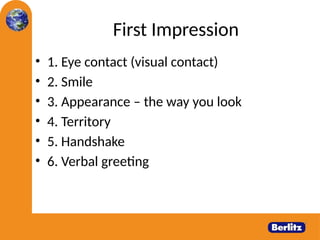
First Impression
• 1. Eye contact (visual contact)
• 2. Smile
• 3. Appearance – the way you look
• 4. Territory
• 5. Handshake
• 6. Verbal greeting
Eye Movement - Occulesics
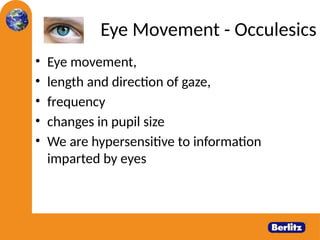
• Eye movement,
• length and direction of gaze,
• frequency
• changes in pupil size
• We are hypersensitive to information
imparted by eyes
How to Read Body Language
According to Karla Reed’s Article, “Reading Political
Body Language”, below are a few signals to look
for
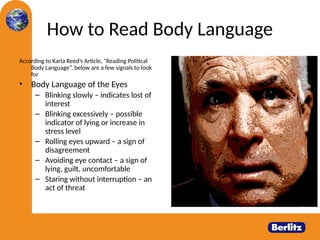
• Body Language of the Eyes
– Blinking slowly – indicates lost of
interest
– Blinking excessively – possible
indicator of lying or increase in
stress level
– Rolling eyes upward – a sign of
disagreement
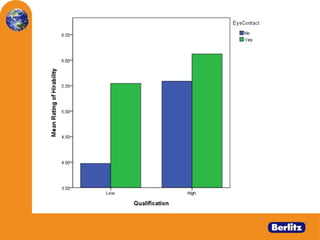
– Avoiding eye contact – a sign of
lying, guilt, uncomfortable
– Staring without interruption – an
act of threat
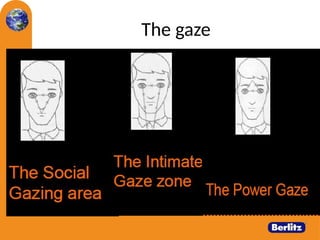
The gaze
• Intimate gaze
• Social gaze
• Business gaze
5
6
The gaze
First Impression
• 1. Eye contact (visual contact)
• 2. Smile
• 3. Appearance – the way you look
• 4. Territory
• 5. Handshake
• 6. Verbal greeting
First Impression
• 1. Eye contact (visual contact)
• 2. Smile
• 3. Appearance – the way you look
• 4. Territory
• 5. Handshake
• 6. Verbal greeting
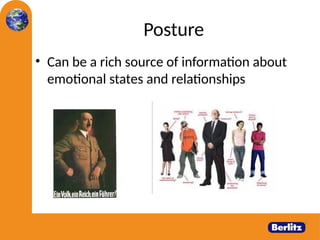
Posture
• Can be a rich source of information about
emotional states and relationships
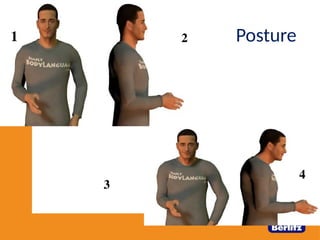
Posture
1 2
3
4
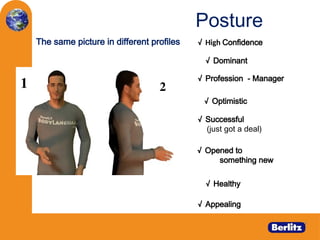
Posture
1 2
√ Profession - Manager
√ Dominant
√ High Confidence
√ Successful
(just got a deal)
√ Optimistic
√ Opened to
something new
√ Appealing
√ Healthy
The same picture in different profiles
Posture
3 4 √ Profession – IT
√ Submissive
√ Low Confidence
√ Less Successful
√ Pessimistic
√ Hiding something
√ Doesn’t like to do
sports
The same picture in different profiles
What can posture be used to transmit?
• Question
• Statement
• Interest
• Non- Interest
• Confidence
• Protection
• Inclusion
• Exclusion
• Power
• Insecurity
How Does Posture Communicate?
• Immediacy – postural behaviors that
represent an immediate attitude include direct
body orientation, symmetric positioning, and
forward leaning of the body
• Relaxation – backward leaning of the body,
reduced tension in the arms and legs, and
asymmetry of positioning
How Does Posture Communicate?
• Inclusive versus Noninclusive
• Face to Face versus Parallel Body Orientation
• Congruence versus Incongruence
Sitting, standing, walking
First Impression
• 1. Eye contact (visual contact)
• 2. Smile
• 3. Appearance – the way you look
• 4. Territory
• 5. Handshake
• 6. Verbal greeting
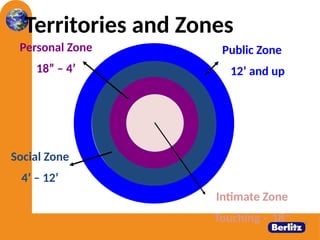
Territories and Zones
Public Zone
12’ and up
Social Zone
4’ – 12’
Personal Zone
18” – 4’
Intimate Zone
Touching – 18”
18
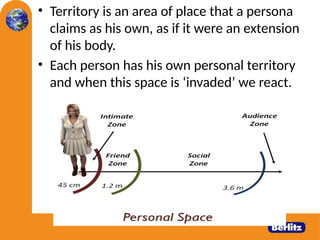
• Territory is an area of place that a persona
claims as his own, as if it were an extension
of his body.
• Each person has his own personal territory
and when this space is ‘invaded’ we react.
19
1. The intimate zone ( 15cm-45cm)
This is by far the most important zone as it is this zone that a persona
guards as if it were his on property. Only those who are emotionally
close to that person are permitted to enter. This includes lovers, parents,
children, close friends, etc.
2. Personal Zone ( 46cm-1.2 m)
This is the average distance we stand from others at parties, social functions
and friendly gatherings.
3. Social Zone ( 1.2m – 3.6m)
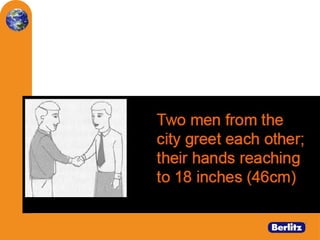
On average, we stand this distance from strangers. For example, a new
employee at work, a repair man in our home, etc.
4. Public Zone ( over 3.6m/12 feet)
This is usually the most comfortable distance at which we stand whenever
we address a large group of people.
20
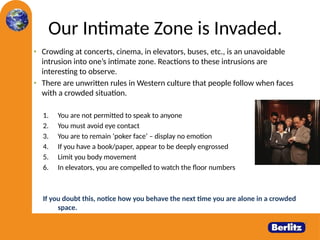
Our Intimate Zone is Invaded.
• Crowding at concerts, cinema, in elevators, buses, etc., is an unavoidable
intrusion into one’s intimate zone. Reactions to these intrusions are
interesting to observe.
• There are unwritten rules in Western culture that people follow when faces
with a crowded situation.
1. You are not permitted to speak to anyone
2. You must avoid eye contact
3. You are to remain ‘poker face’ – display no emotion
4. If you have a book/paper, appear to be deeply engrossed
5. Limit you body movement
6. In elevators, you are compelled to watch the floor numbers
If you doubt this, notice how you behave the next time you are alone in a crowded
space.
21
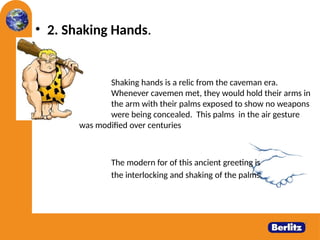
• 2. Shaking Hands.
Shaking hands is a relic from the caveman era.
Whenever cavemen met, they would hold their arms in
the arm with their palms exposed to show no weapons
were being concealed. This palms in the air gesture
was modified over centuries
The modern for of this ancient greeting is
the interlocking and shaking of the palms.
22
Culture and hand shaking
• Man – Man
• Man –woman
• Woman – woman
• Other ways of greeting : bow, fist to fist, etc
Peter Collett’s Handshake Theory
• The Bonecrusher
• The Limp Handshake
• The Firm Handshake
• The Limpet Handshake
• The Clammy Handshake
• The Reinforced Handshake
• The Relocated Handshake
• The Upper Handshake
Handshakes
• Three basic attitudes are
transmitted through the
handshake:
Submission
Equality
Dominance
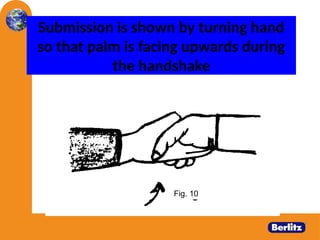
Submission is shown by turning hand
so that palm is facing upwards during
the handshake
Fig. 10
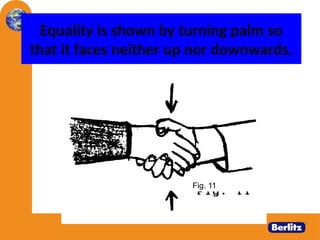
Equality is shown by turning palm so
that it faces neither up nor downwards.
Fig. 11
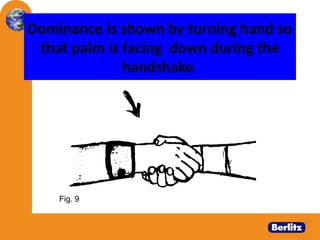
Dominance is shown by turning hand so
that palm is facing down during the
handshake.
Fig. 9
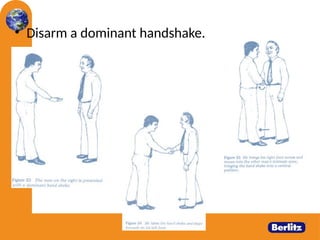
• Disarm a dominant handshake.
29
Hybrid
Handshakes
The Limp Handshake may seem the most likely to offer evidence of
submissiveness, but this is not necessarily so, as Collett’s more detailed
explanation reveals:
“A limp handshake occurs when someone offers a hand that is totally relaxed.
It doesn’t exert any pressure on the other person’s hand and it doesn’t
contribute to the mutual production of the handshake. A person who offers a
limp handshake is someone who, in more senses than one, doesn’t connect
with the other person. Like their hand, they remain passive and detached –
they’re simply not focused on the person they’re greeting. This often
happens with people who are self-important or who have to shake hands
with a lot of people…Women who want to cultivate an impression of languid
femininity often present a rather limp hand to the person they’re greeting.
Strong people often do the same, but in their case it’s to emphasise their
strength. It’s said that Mike Tyson offers a relaxed, almost tender hand when
he greets people outside the boxing ring – the complete opposite to what
happens inside the ring.”
(Collett, 2003)
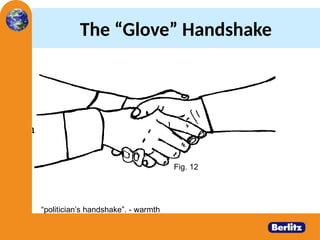
The “Glove” Handshake
Fig. 12
“politician’s handshake”. - warmth
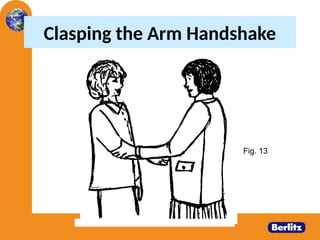
Clasping the Arm Handshake
Fig. 13
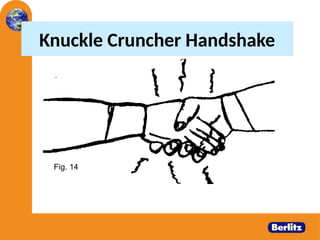
Knuckle Cruncher Handshake
Fig. 14
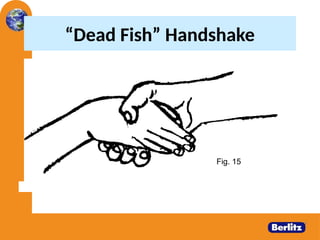
“Dead Fish” Handshake
Fig. 15
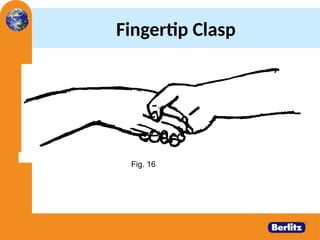
Fingertip Clasp
Fig. 16
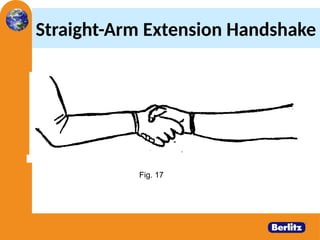
Straight-Arm Extension Handshake
Fig. 17
The Handshakes - review
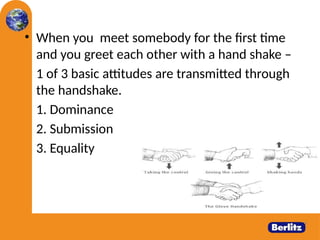
• When you meet somebody for the first time
and you greet each other with a hand shake –
1 of 3 basic attitudes are transmitted through
the handshake.
1. Dominance
2. Submission
3. Equality
41
Ingredients of a Good Handshake
• Make eye contact and smile.
• Hold the person's hand firmly.
• Shake web-to-web, three times maximum.
• Maintain constant eye contact.
• Radiate positive aura.
Meanings behind handshakes
• Controller
A person extends his hand to you, web-to-
web, and as soon as your hands are linked, he
purposely maneuvers his hand onto the top.
He's telling you he wants to be in charge.
Meanings behind handshakes—continued
• Sandwich
Use this one only with people you know.
When you envelop another person's hands,
you are invading their private space ... where
you are to be only when invited. This
handshake is also known as the politician's
handshake ... which may be cause enough for
most people to avoid it!
Meanings behind handshakes—continued
• Dead Fish
Imagine rubbing a scaly, dead fish in your
hands ... and you got the picture. Your
hands typically are wet for two reasons:
You are nervous or you have been holding a
cold beverage in your right hand and move
it to your left just before you shake hands.
In either case, it is extremely unpleasant for
the receiver. If you experience anxiety, wipe
your hands on a napkin, the tablecloth or
even lightly on your clothes. As for the
Meanings behind handshakes—continued
• Limp Fingers
Women, far more than men, extend their
fingers rather than their entire hand. It can be
painful for the extender, when she is greeted
by a man who shakes with his forceful grip.
One of the ways to combat this syndrome is to
always extend you full hand (never cup it)
horizontally, even if your grip is light.
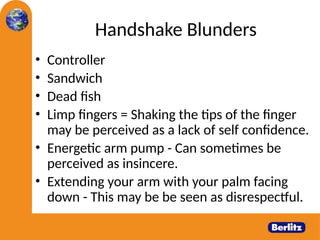
Handshake Blunders
• Controller
• Sandwich
• Dead fish
• Limp fingers = Shaking the tips of the finger
may be perceived as a lack of self confidence.
• Energetic arm pump - Can sometimes be
perceived as insincere.
• Extending your arm with your palm facing
down - This may be be seen as disrespectful.
Handshake video
http://www.youtube.com/watch?v=ZV_VpXV
MVqw
(meeting Pepsi race car driver, Jeff Gordon)

First impression in business using body language

  • 1.
    Types of NonVerbal Communication - Facial expressions and eye contact-Kinesics (body motion) , Eye movement (occulesics), Smells (olfactics) • Gesture and posture • Vocal characteristics , Vocalics or Paralanguage • Personal appearance/ Physical appearance • Touching behaviour - Haptics (touch) • Use of time and space • Artifacts • Environmental factors • Proxemics -personal space, Chronemics (time)
  • 2.
    First Impression • 1.Eye contact (visual contact) • 2. Smile • 3. Appearance – the way you look • 4. Territory • 5. Handshake • 6. Verbal greeting
  • 3.
    Eye Movement -Occulesics • Eye movement, • length and direction of gaze, • frequency • changes in pupil size • We are hypersensitive to information imparted by eyes
  • 4.
    How to ReadBody Language According to Karla Reed’s Article, “Reading Political Body Language”, below are a few signals to look for • Body Language of the Eyes – Blinking slowly – indicates lost of interest – Blinking excessively – possible indicator of lying or increase in stress level – Rolling eyes upward – a sign of disagreement – Avoiding eye contact – a sign of lying, guilt, uncomfortable – Staring without interruption – an act of threat
  • 5.
    The gaze • Intimategaze • Social gaze • Business gaze 5
  • 6.
  • 8.
    First Impression • 1.Eye contact (visual contact) • 2. Smile • 3. Appearance – the way you look • 4. Territory • 5. Handshake • 6. Verbal greeting
  • 9.
    First Impression • 1.Eye contact (visual contact) • 2. Smile • 3. Appearance – the way you look • 4. Territory • 5. Handshake • 6. Verbal greeting
  • 10.
    Posture • Can bea rich source of information about emotional states and relationships
  • 11.
  • 12.
    Posture 1 2 √ Profession- Manager √ Dominant √ High Confidence √ Successful (just got a deal) √ Optimistic √ Opened to something new √ Appealing √ Healthy The same picture in different profiles
  • 13.
    Posture 3 4 √Profession – IT √ Submissive √ Low Confidence √ Less Successful √ Pessimistic √ Hiding something √ Doesn’t like to do sports The same picture in different profiles
  • 14.
    What can posturebe used to transmit? • Question • Statement • Interest • Non- Interest • Confidence • Protection • Inclusion • Exclusion • Power • Insecurity
  • 15.
    How Does PostureCommunicate? • Immediacy – postural behaviors that represent an immediate attitude include direct body orientation, symmetric positioning, and forward leaning of the body • Relaxation – backward leaning of the body, reduced tension in the arms and legs, and asymmetry of positioning
  • 16.
    How Does PostureCommunicate? • Inclusive versus Noninclusive • Face to Face versus Parallel Body Orientation • Congruence versus Incongruence Sitting, standing, walking
  • 17.
    First Impression • 1.Eye contact (visual contact) • 2. Smile • 3. Appearance – the way you look • 4. Territory • 5. Handshake • 6. Verbal greeting
  • 18.
    Territories and Zones PublicZone 12’ and up Social Zone 4’ – 12’ Personal Zone 18” – 4’ Intimate Zone Touching – 18” 18
  • 19.
    • Territory isan area of place that a persona claims as his own, as if it were an extension of his body. • Each person has his own personal territory and when this space is ‘invaded’ we react. 19
  • 20.
    1. The intimatezone ( 15cm-45cm) This is by far the most important zone as it is this zone that a persona guards as if it were his on property. Only those who are emotionally close to that person are permitted to enter. This includes lovers, parents, children, close friends, etc. 2. Personal Zone ( 46cm-1.2 m) This is the average distance we stand from others at parties, social functions and friendly gatherings. 3. Social Zone ( 1.2m – 3.6m) On average, we stand this distance from strangers. For example, a new employee at work, a repair man in our home, etc. 4. Public Zone ( over 3.6m/12 feet) This is usually the most comfortable distance at which we stand whenever we address a large group of people. 20
  • 21.
    Our Intimate Zoneis Invaded. • Crowding at concerts, cinema, in elevators, buses, etc., is an unavoidable intrusion into one’s intimate zone. Reactions to these intrusions are interesting to observe. • There are unwritten rules in Western culture that people follow when faces with a crowded situation. 1. You are not permitted to speak to anyone 2. You must avoid eye contact 3. You are to remain ‘poker face’ – display no emotion 4. If you have a book/paper, appear to be deeply engrossed 5. Limit you body movement 6. In elevators, you are compelled to watch the floor numbers If you doubt this, notice how you behave the next time you are alone in a crowded space. 21
  • 22.
    • 2. ShakingHands. Shaking hands is a relic from the caveman era. Whenever cavemen met, they would hold their arms in the arm with their palms exposed to show no weapons were being concealed. This palms in the air gesture was modified over centuries The modern for of this ancient greeting is the interlocking and shaking of the palms. 22
  • 23.
    Culture and handshaking • Man – Man • Man –woman • Woman – woman • Other ways of greeting : bow, fist to fist, etc
  • 24.
    Peter Collett’s HandshakeTheory • The Bonecrusher • The Limp Handshake • The Firm Handshake • The Limpet Handshake • The Clammy Handshake • The Reinforced Handshake • The Relocated Handshake • The Upper Handshake
  • 25.
    Handshakes • Three basicattitudes are transmitted through the handshake: Submission Equality Dominance
  • 26.
    Submission is shownby turning hand so that palm is facing upwards during the handshake Fig. 10
  • 27.
    Equality is shownby turning palm so that it faces neither up nor downwards. Fig. 11
  • 28.
    Dominance is shownby turning hand so that palm is facing down during the handshake. Fig. 9
  • 29.
    • Disarm adominant handshake. 29
  • 30.
  • 31.
    The Limp Handshakemay seem the most likely to offer evidence of submissiveness, but this is not necessarily so, as Collett’s more detailed explanation reveals: “A limp handshake occurs when someone offers a hand that is totally relaxed. It doesn’t exert any pressure on the other person’s hand and it doesn’t contribute to the mutual production of the handshake. A person who offers a limp handshake is someone who, in more senses than one, doesn’t connect with the other person. Like their hand, they remain passive and detached – they’re simply not focused on the person they’re greeting. This often happens with people who are self-important or who have to shake hands with a lot of people…Women who want to cultivate an impression of languid femininity often present a rather limp hand to the person they’re greeting. Strong people often do the same, but in their case it’s to emphasise their strength. It’s said that Mike Tyson offers a relaxed, almost tender hand when he greets people outside the boxing ring – the complete opposite to what happens inside the ring.” (Collett, 2003)
  • 32.
    The “Glove” Handshake Fig.12 “politician’s handshake”. - warmth
  • 33.
    Clasping the ArmHandshake Fig. 13
  • 35.
  • 36.
  • 37.
  • 38.
  • 40.
  • 41.
    • When youmeet somebody for the first time and you greet each other with a hand shake – 1 of 3 basic attitudes are transmitted through the handshake. 1. Dominance 2. Submission 3. Equality 41
  • 42.
    Ingredients of aGood Handshake • Make eye contact and smile. • Hold the person's hand firmly. • Shake web-to-web, three times maximum. • Maintain constant eye contact. • Radiate positive aura.
  • 43.
    Meanings behind handshakes •Controller A person extends his hand to you, web-to- web, and as soon as your hands are linked, he purposely maneuvers his hand onto the top. He's telling you he wants to be in charge.
  • 44.
    Meanings behind handshakes—continued •Sandwich Use this one only with people you know. When you envelop another person's hands, you are invading their private space ... where you are to be only when invited. This handshake is also known as the politician's handshake ... which may be cause enough for most people to avoid it!
  • 45.
    Meanings behind handshakes—continued •Dead Fish Imagine rubbing a scaly, dead fish in your hands ... and you got the picture. Your hands typically are wet for two reasons: You are nervous or you have been holding a cold beverage in your right hand and move it to your left just before you shake hands. In either case, it is extremely unpleasant for the receiver. If you experience anxiety, wipe your hands on a napkin, the tablecloth or even lightly on your clothes. As for the
  • 46.
    Meanings behind handshakes—continued •Limp Fingers Women, far more than men, extend their fingers rather than their entire hand. It can be painful for the extender, when she is greeted by a man who shakes with his forceful grip. One of the ways to combat this syndrome is to always extend you full hand (never cup it) horizontally, even if your grip is light.
  • 47.
    Handshake Blunders • Controller •Sandwich • Dead fish • Limp fingers = Shaking the tips of the finger may be perceived as a lack of self confidence. • Energetic arm pump - Can sometimes be perceived as insincere. • Extending your arm with your palm facing down - This may be be seen as disrespectful.
  • 48.

Editor's Notes

  • #32 -Demonstrated by initiator clasping both hands around the recipient’s hand. -It is intended to give impression of companionship and warmth. -Sometimes referred to as “politician’s handshake”.
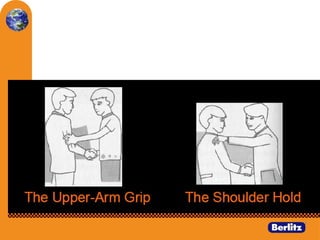
  • #33 -Variation of the glove handshake whereby initiator shakes person’s extended hand in conventional fashion while grasping receiver’s upper arm with free hand. -This too is intended to demonstrate sincerity and warmth but is often seen as a violation of personal space.
  • #35 -The hallmark of aggressive handshake whereby one or both participators firmly squeeze offered hand. -Sometimes referred to as the “Texas Vice”. -Thought to be due to socialization process which encourages boys to demonstrate their assertive, powerful, “manly” attributes.
  • #36 -The hallmark of passive handshakes. -Carries negative connotations and generally considered to demonstrate weak, apathetic, or submissive individual. -Traditionally an acceptable handshake for women.
  • #37 -Occurs when one party stops short of grasping other participant’s palm and instead clasps his/her fingers. -Sometimes happens when one party “misses his/her mark due to lack of confidence or nervousness. -Other times, this technique is used when people want to maintain spatial distance and less intimacy.
  • #38 -Initiator of this handshake will offer a straight, extended arm in greeting. -Primary purpose is to maintain distance and formality. -Sometimes people from rural areas who are used to keeping their distance will use this handshake.