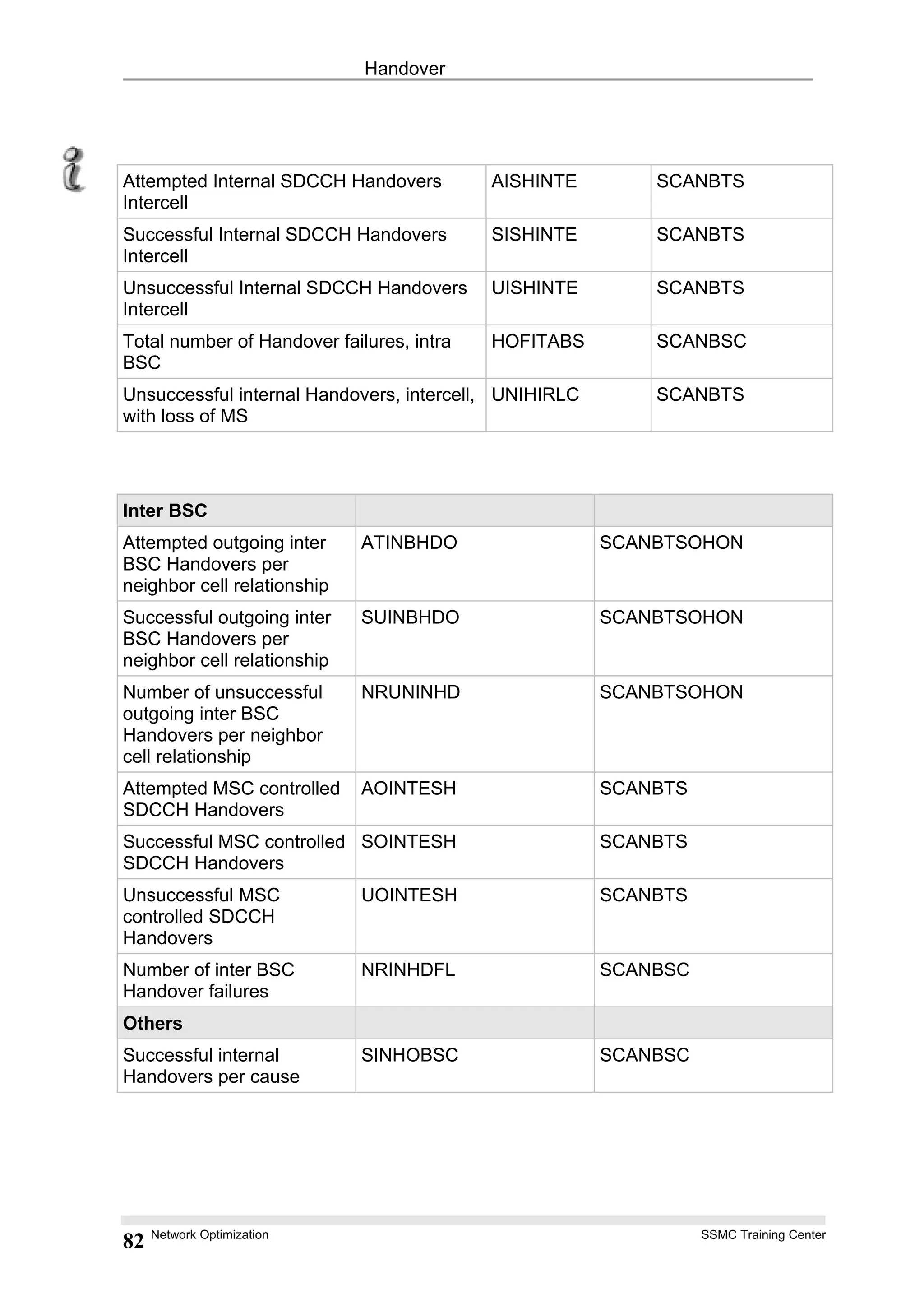
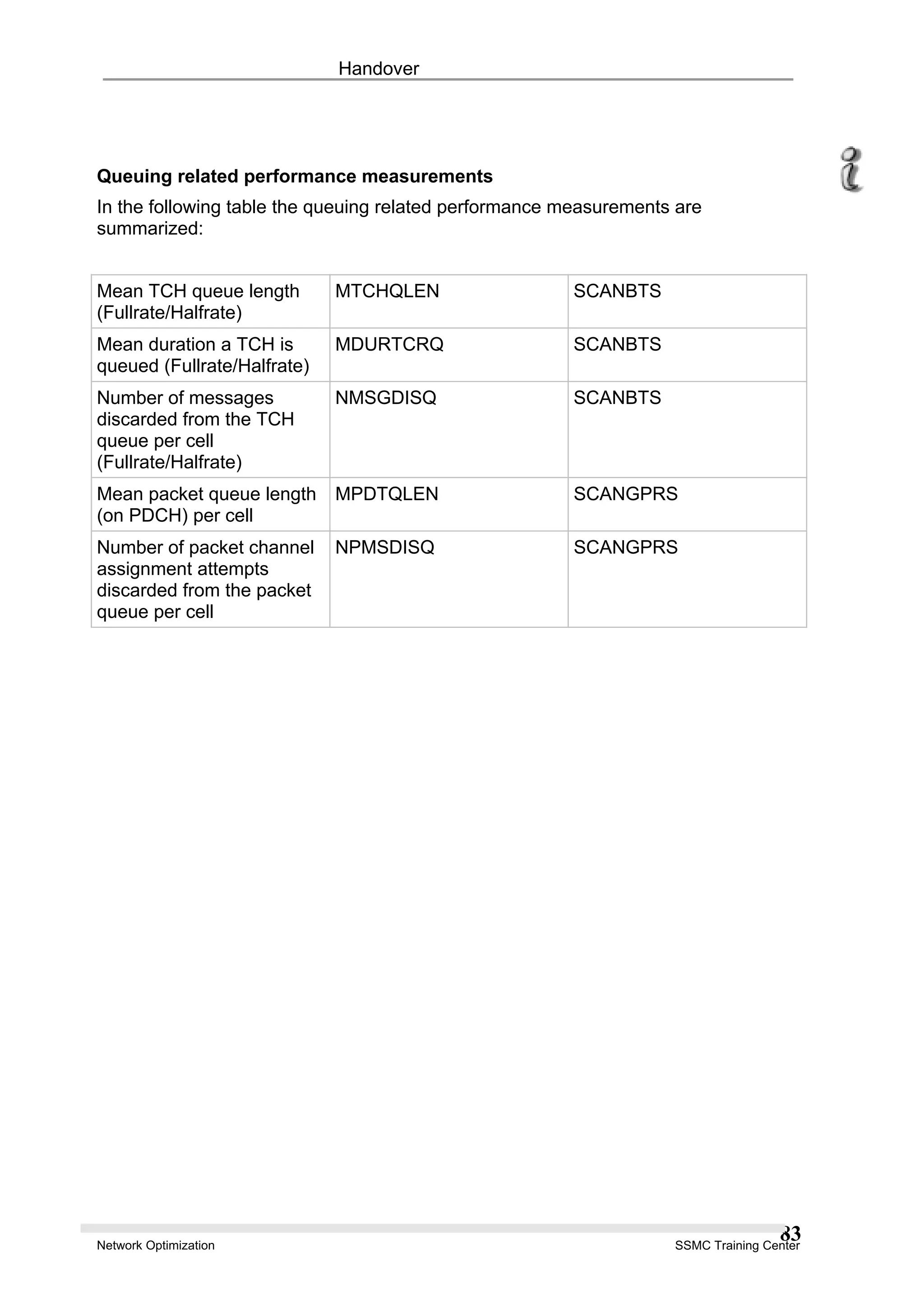
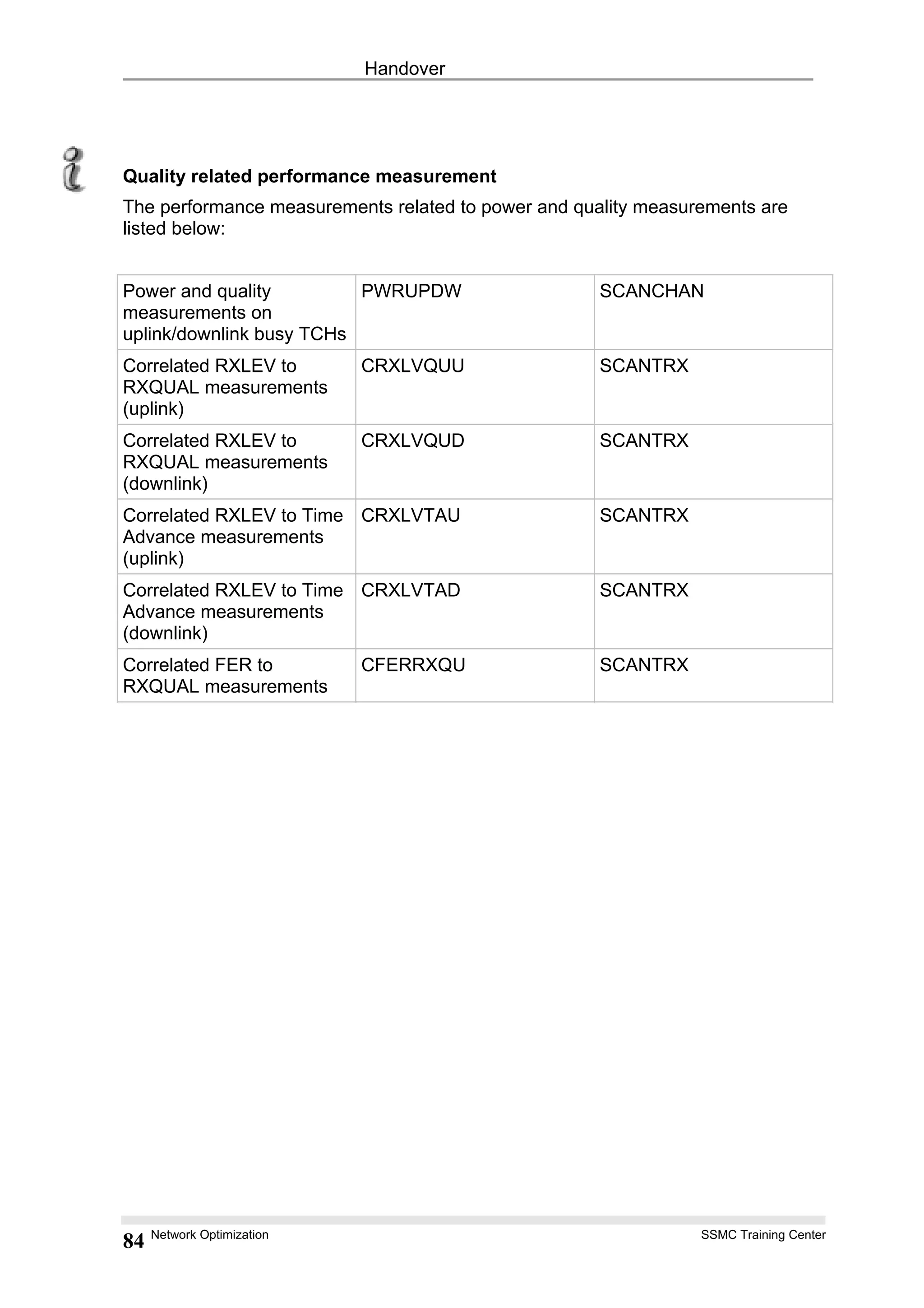
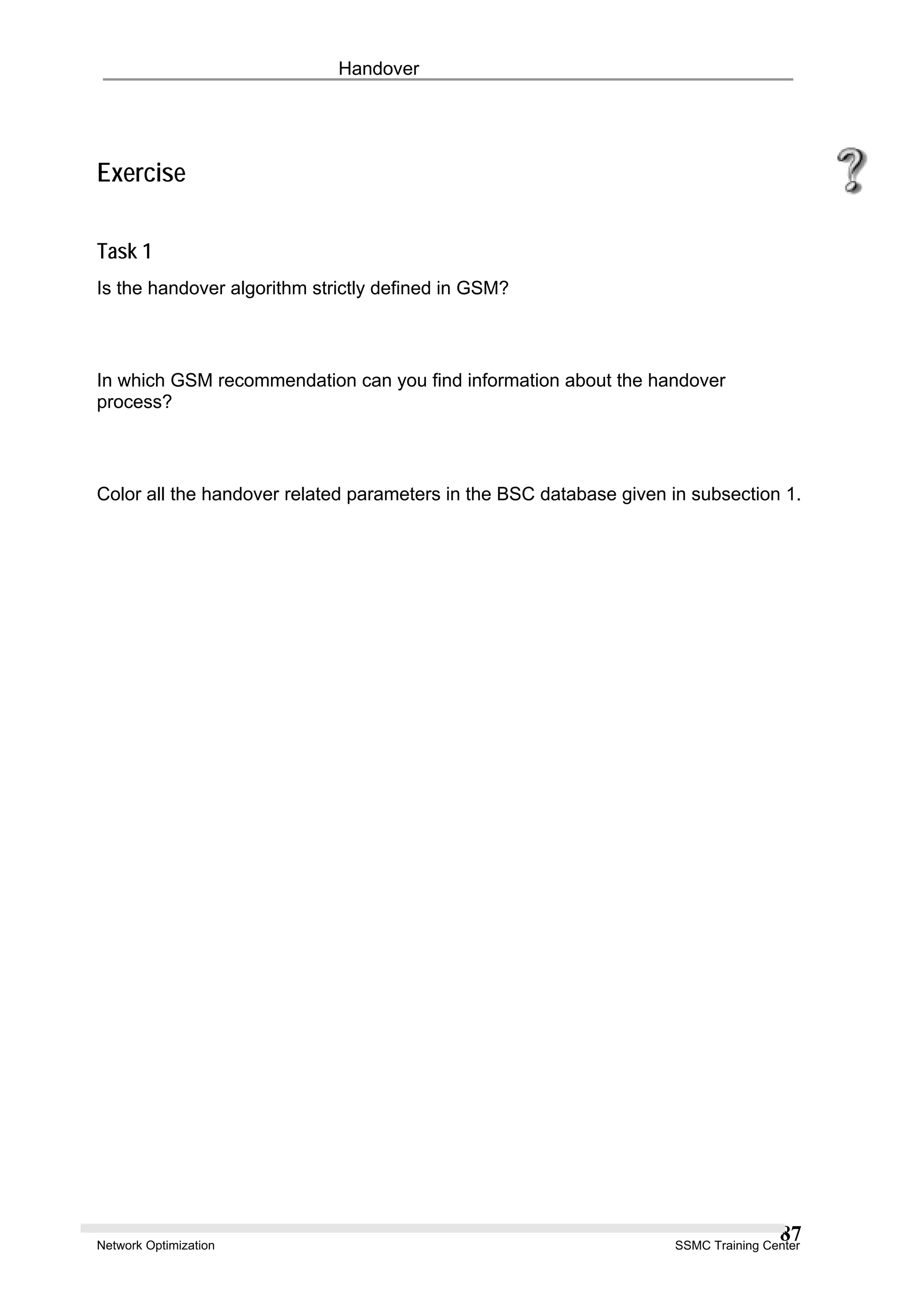
Handover
Network Optimization SSMC Training Center
1
Handover
Contents
1 General 3
1.1 Steps of the Handover Process 4
1.2 Types of Handover 5
1.3 Handover Causes 6
1.4 Flags to Enable/Disable Handover Types and Causes 8
1.5 Comments 9
2 Measurement Preprocessing 11
2.1 Measurement Values 12
2.2 Summary of Measurement Values for Handover 16
2.3 Measurement Reporting and Neighbor Cell Book-Keeping 17
2.4 Illustration of Measurement Preprocessing 21
2.5 Parameters for Measurement Preprocessing 22
2.6 Remarks 23
3 Threshold Comparisons and Handover Detection Algorithms 25
3.1 Decision Criteria 26
3.2 Handover Regions 27
3.3 Power Budget 28
3.4 Parameters for Handover Decision 29
3.5 Priorities of Handover Causes 31
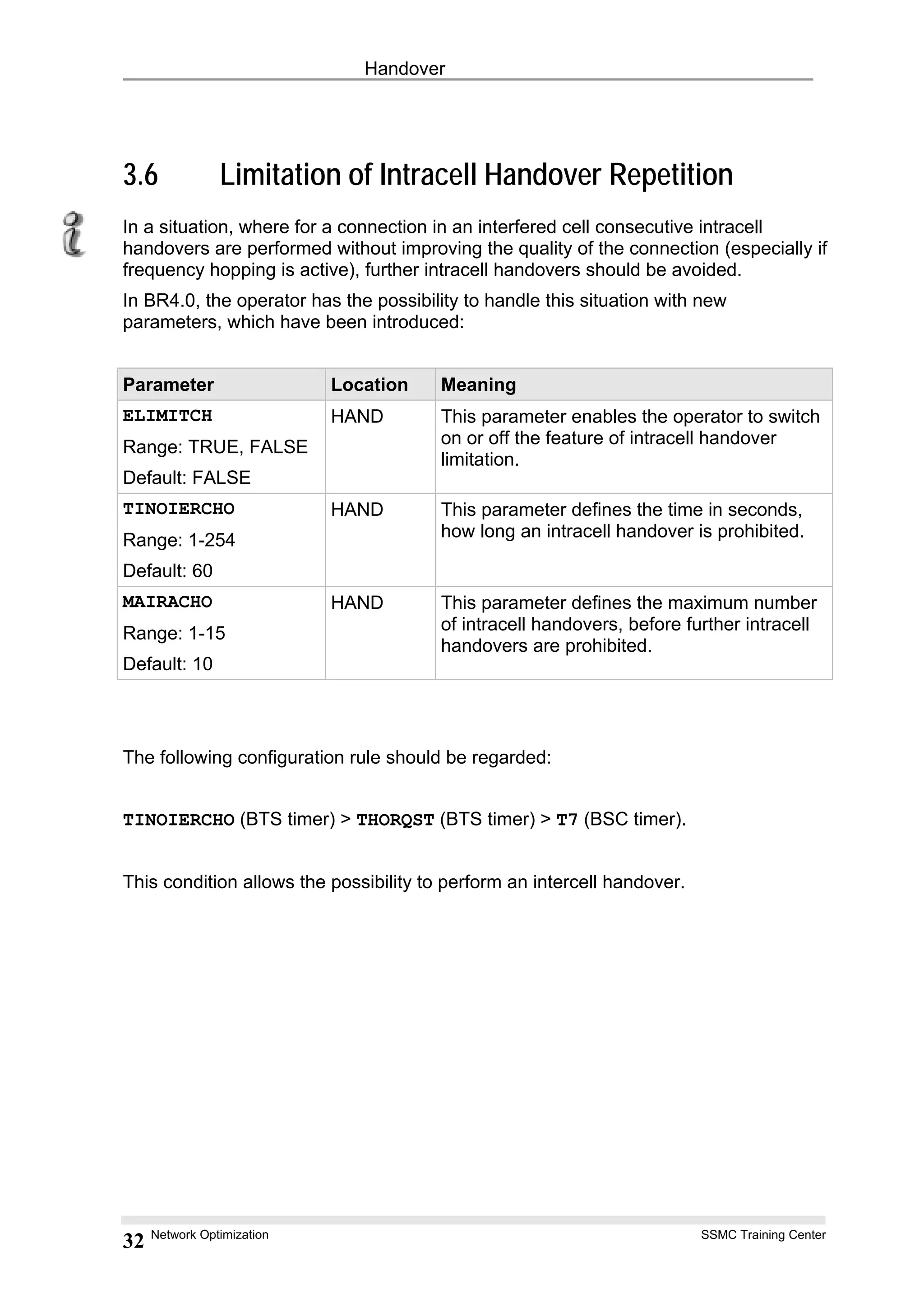
3.6 Limitation of Intracell Handover Repetition 32
3.7 Prevention of Back-Handover 34
3.8 Limitation of Handover Failure Repetition 36
3.9 Remarks 38
4 Target Cell List Generation 43
4.1 Conditions for Neighbor Cells to be included in the Target Cell List 44
4.2 Order Criterion for Handover Candidate Cells within the Target Cell
List 44
4.3 Evaluation of the Target Cell List 45
5 Handover Signaling and Timers 47
Handover
5.1 Parameters and Timers for Handover Signaling 48
6 Preemption, Directed Retry, Queuing 51
6.1 Parameters for Preemption and Queuing 53
6.2 Directed Retry 57
6.3 Parameters for Directed Retry 61
7 Enhancements introduced with BR6.0 63
7.1 HO Decision due to BSS Resource Management Criteria 64
7.2 Fast Uplink Handover 68
7.3 Introduction of "Level Handover Margin" Parameter 73
7.4 Enhanced Pairing for Half-Rate Channels 75
8 Handover related Performance Measurements 79
9 Exercise 85
Network Optimization SSMC Training Center
2
Handover
1 General
Network Optimization SSMC Training Center
3
Handover
The handover main objectives are:
maintaining a connection in case of a cell change (movement)
changing a channel in case of severe disturbance (interference)
designing cell borders and radio network structure
1.1 Steps of the Handover Process
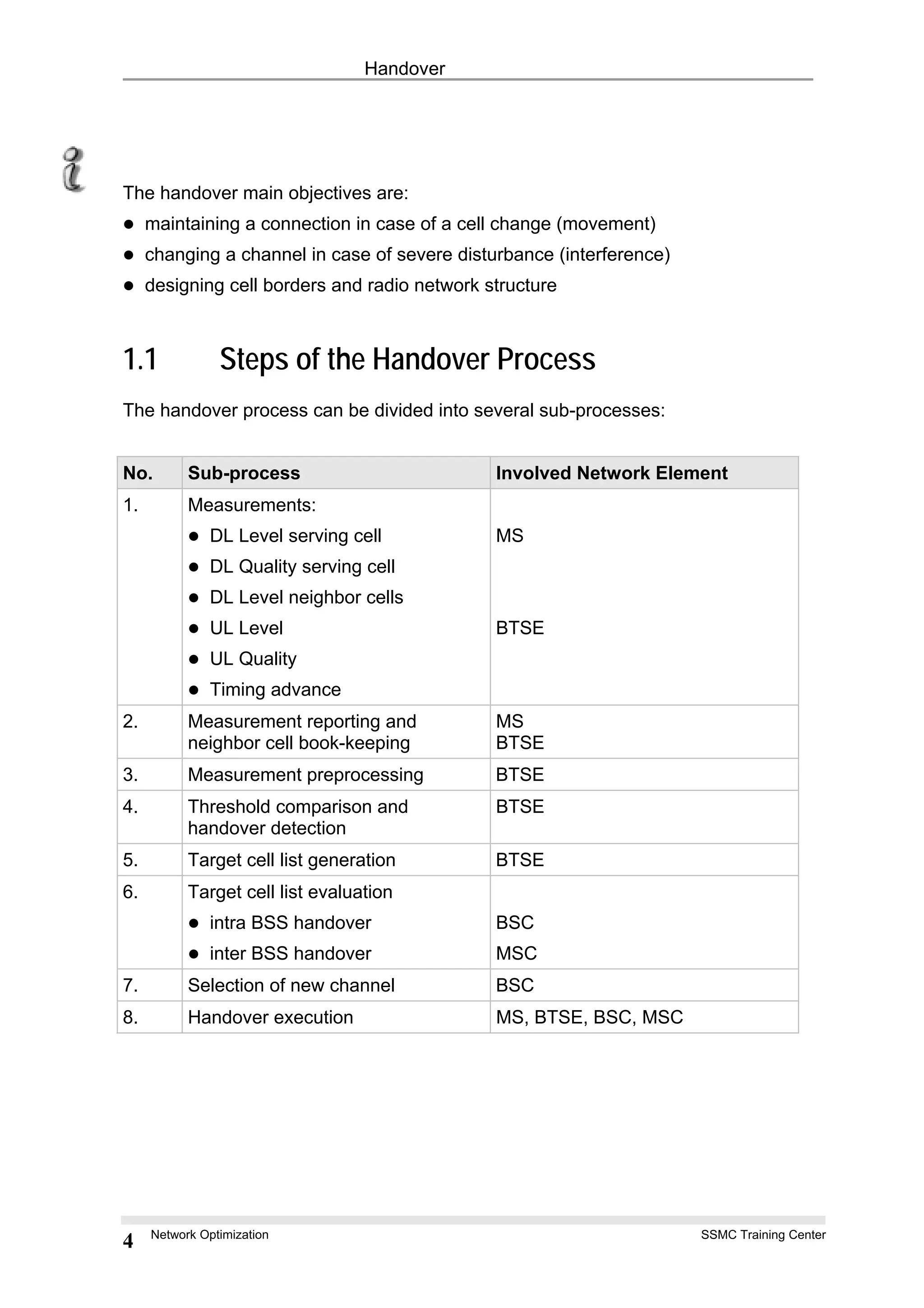
The handover process can be divided into several sub-processes:
No. Sub-process Involved Network Element
1. Measurements:
DL Level serving cell
DL Quality serving cell
DL Level neighbor cells
UL Level
UL Quality
Timing advance
MS
BTSE
2. Measurement reporting and
neighbor cell book-keeping
MS
BTSE
3. Measurement preprocessing BTSE
4. Threshold comparison and
handover detection
BTSE
5. Target cell list generation BTSE
6. Target cell list evaluation
intra BSS handover
inter BSS handover
BSC
MSC
7. Selection of new channel BSC
8. Handover execution MS, BTSE, BSC, MSC
Network Optimization SSMC Training Center
4
Handover
1.2 Types of Handover
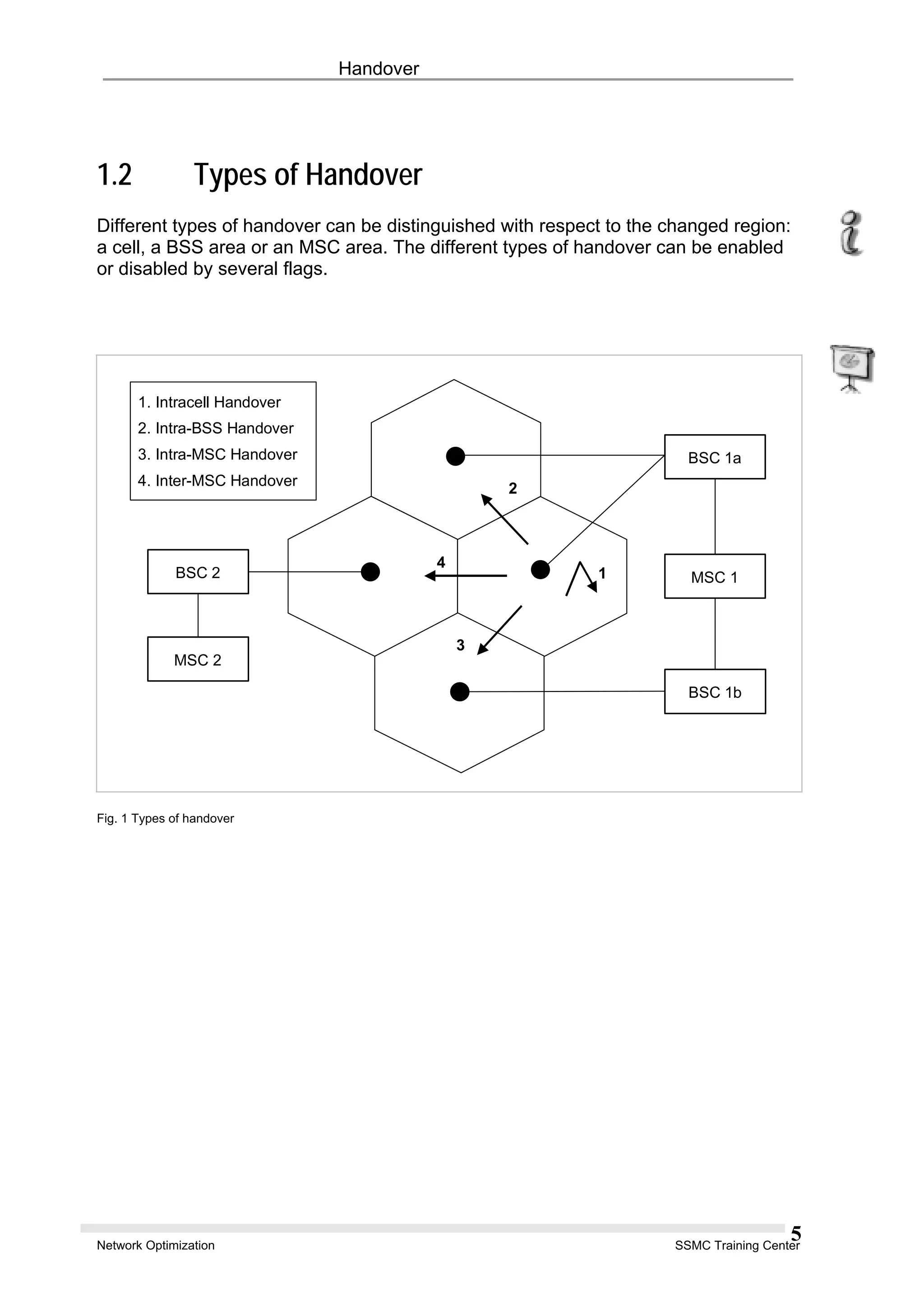
Different types of handover can be distinguished with respect to the changed region:
a cell, a BSS area or an MSC area. The different types of handover can be enabled
or disabled by several flags.
BSC 1b
BSC 1a
MSC 1
MSC 2
1. Intracell Handover
2. Intra-BSS Handover
3. Intra-MSC Handover
4. Inter-MSC Handover
BSC 2
4
3
1
2
Fig. 1 Types of handover
Network Optimization SSMC Training Center
5
Handover
1.3 Handover Causes
Two criteria groups of different handover causes are defined:
Radio Criteria received quality (too bad that
means bit error rate too high)
inter-/intracell HO
received level (too low) intercell HO
MS-BS distance (too high) intercell HO
better cell (power budget: relative
received level)
intercell HO
Network Criteria serving cell congestion -->
directed retry for call setup, traffic
handover for running calls
intercell HO
MS-BS distance (too high/low in
extended cells)
intracell HO
received level or MS-BS distance
(too low/high in concentric cells) intracell HO
Network Optimization SSMC Training Center
6
Handover
The first three causes are known as mandatory or imperative causes, i.e. if one of
these causes occurs, a handover is necessary to maintain the call. This may happen
because the MS is leaving the coverage area of the serving cell (intercell handover)
or because there is a strong interferer using the same channel in another cell
(intracell handover).
The fourth cause is an optional one, i.e. the link quality in the serving cell is
sufficiently good, but there are neighbor cells with better received level. Though its
not necessary for the link quality of this specific call, there is a benefit for overall
network performance to handover the call to the better cell: A call in the better cell
causes less interference, especially, if power control is applied. To achieve the same
received level in the better cell, a smaller transmit power can be used in this cell.
In a well planned radio network “better cell” should be the overwhelming handover
cause. Hence, the locations of a “better cell” handover determine the cell boundaries.
The fifth cause is named forced handover because it is triggered by the BSC due to a
congestion situation, and not due to radio conditions on the link. This handover
(directed retry) is performed from a SDCCH in the congested cell to a TCH in a
neighbor cell during call setup.
The last two causes are intracell handovers in special cell configurations:
in extended cells handovers are feasible from single to double timeslots and vice
versa.
In a concentric cell handovers are performed between the inner and complete
area.
These handover causes can be enabled/disabled separately by corresponding flags.
Network Optimization SSMC Training Center
7
Handover
1.4 Flags to Enable/Disable Handover Types and
Causes
The flags to enable (TRUE) / disable (FALSE) the different handover types and
causes are listed in the table below.
With one exception they are all administered in the object HAND.
Specification Name DB Name Meaning
EN_INTER_HO INTERCH Flag to enable/disable generally
intercell handover for this BTS.
EN_INTRA_HO INTRACH Flag to enable/disable generally
intracell handover for this BTS.
EN_BSS_INTER_HO LOTERCH Flag to determine weather inter cell
handover are controlled by BSC
(TRUE) or MSC (FALSE).
EN_BSS_INTRA_HO LOTRACH Flag to determine weather intra cell
handover are controlled by BSC
(TRUE) or MSC (FALSE).
EN_RXQUAL_HO RXQUALHO Flag to enable/disable intercell
handover due to quality.
EN_RXLEV_HO RXLEVHO Flag to enable/disable intercell
handover due to level.
EN_DIST_HO DISTHO Flag to enable/disable intercell
handover due to distance.
EN_PBGT_HO PBGTHO Flag to enable/disable better cell
(power budget) handover.
EN_FORCED_HO ENFORCHO
(PKG BSCB)
Flag to enable/disable forced
handover.
EN_EXTENDED_CELL_HO EXTCHO Flag to enable/disable extended cell
handover.
EN_CON_CELL_DIST_HO CCDIST Flag to enable/disable concentric
cell distance handover.
EN_INNER_INNER_HO ININHO Flag to enable/disable inner to inner
handover in a sectorized concentric
cell.
Network Optimization SSMC Training Center
8
Handover
1.5 Comments
Enabling BSS internal handover has the following advantages:
- reduction of signaling load on the A-interface
- reduction of processor load in the MSC
- faster handover execution.
Consequences:
- BSS internal handover should be enabled,
- BSS regions should be adapted to the real traffic flow to reduce the inter-BSS
handover rate.
Normally, intracell handover should be enabled to allow a handover from a
channel with high interference to another one with less interference within the
same cell. However, if random frequency hopping is applied, it may be reasonable
to disable intracell handover since interference is approximately the same on all
channels and no improvement can be achieved by intracell handover.
If distance handover is disabled, a MS could largely exceed the planned cell
boundaries in the case of favorable radio conditions at the serving cell without
causing a handover. As a consequence, neighboring cells may suffer from
excessive interference produced by this MS. Furthermore, there is a risk that link
quality decreases very suddenly (turn around a corner), i.e. there is the risk of a
call drop. Hence, distance handover should be switched on.
If power budget handover is disabled, no handovers with cause “better cell” are
generated. Nevertheless, power budget is calculated and evaluated for the ranking
of neighbor cells within the target cell list, which also has to be compiled for
mandatory handovers.
Network Optimization SSMC Training Center
9
Handover
Network Optimization SSMC Training Center
10
Handover
2 Measurement Preprocessing
Network Optimization SSMC Training Center
11
Handover
2.1 Measurement Values
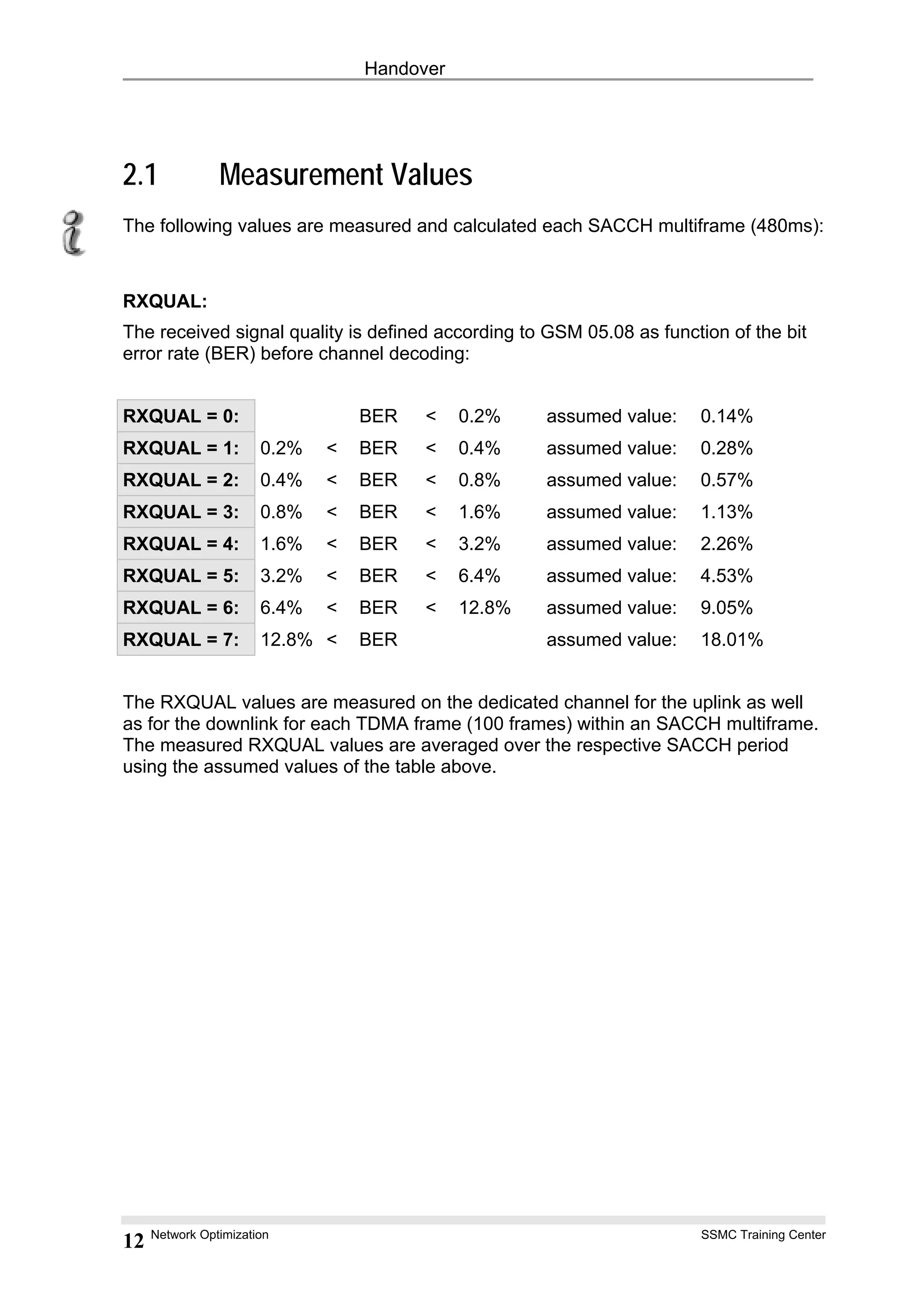
The following values are measured and calculated each SACCH multiframe (480ms):
RXQUAL:
The received signal quality is defined according to GSM 05.08 as function of the bit
error rate (BER) before channel decoding:
RXQUAL = 0: BER < 0.2% assumed value: 0.14%
RXQUAL = 1: 0.2% < BER < 0.4% assumed value: 0.28%
RXQUAL = 2: 0.4% < BER < 0.8% assumed value: 0.57%
RXQUAL = 3: 0.8% < BER < 1.6% assumed value: 1.13%
RXQUAL = 4: 1.6% < BER < 3.2% assumed value: 2.26%
RXQUAL = 5: 3.2% < BER < 6.4% assumed value: 4.53%
RXQUAL = 6: 6.4% < BER < 12.8% assumed value: 9.05%
RXQUAL = 7: 12.8% < BER assumed value: 18.01%
The RXQUAL values are measured on the dedicated channel for the uplink as well
as for the downlink for each TDMA frame (100 frames) within an SACCH multiframe.
The measured RXQUAL values are averaged over the respective SACCH period
using the assumed values of the table above.
Network Optimization SSMC Training Center
12
Handover
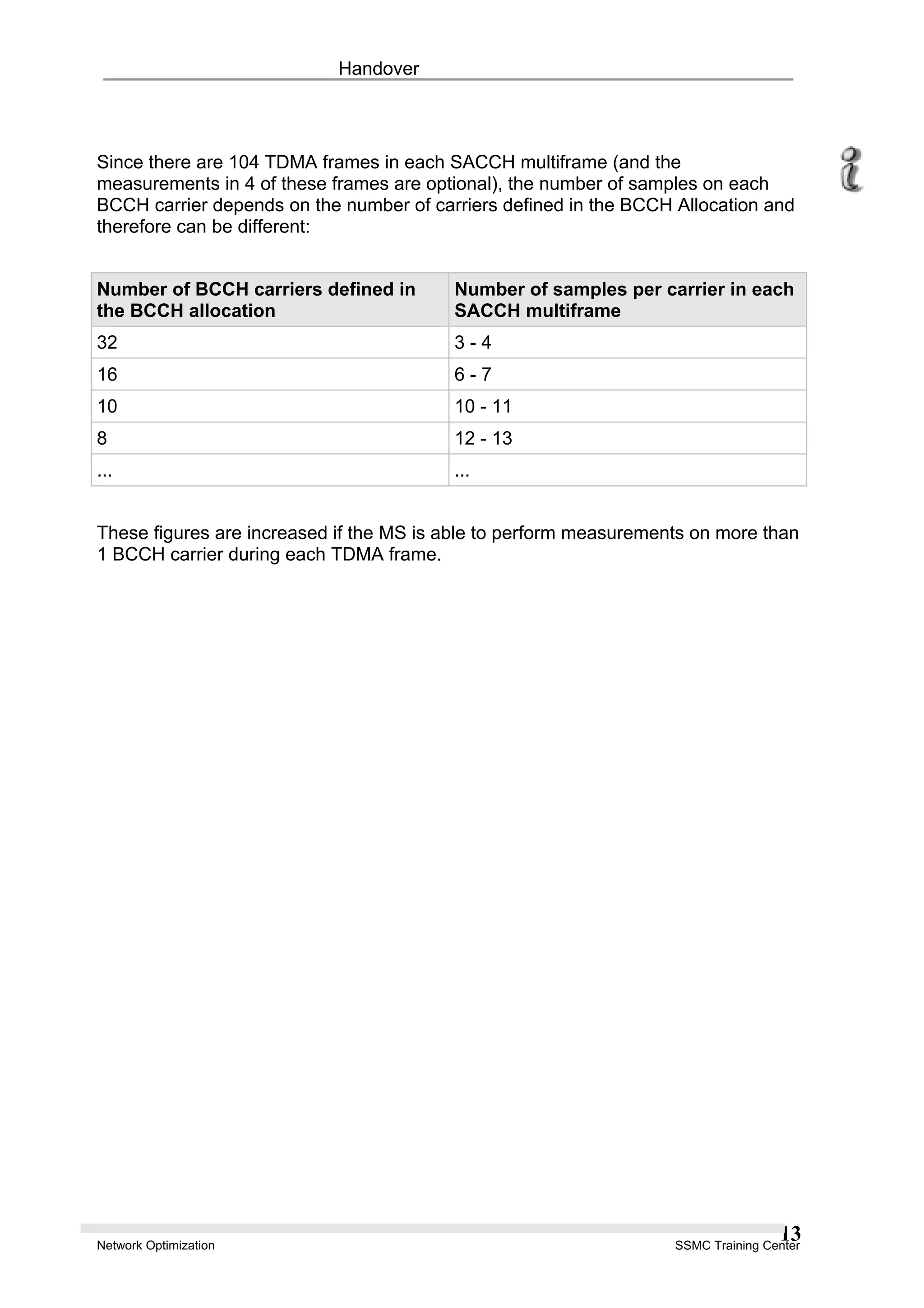
Since there are 104 TDMA frames in each SACCH multiframe (and the
measurements in 4 of these frames are optional), the number of samples on each
BCCH carrier depends on the number of carriers defined in the BCCH Allocation and
therefore can be different:
Number of BCCH carriers defined in
the BCCH allocation
Number of samples per carrier in each
SACCH multiframe
32 3 - 4
16 6 - 7
10 10 - 11
8 12 - 13
... ...
These figures are increased if the MS is able to perform measurements on more than
1 BCCH carrier during each TDMA frame.
Network Optimization SSMC Training Center
13
Handover
RXLEV:
The received signal level is measured on the dedicated channel for the uplink as well
as for the downlink for each TDMA frame (100 frames) within an SACCH multiframe.
The measured level values in [dBm] are averaged over the respective SACCH
period. The average value is mapped on an RXLEV value (refer to GSM 05.08):
RXLEV = 0: < -110 dBm
RXLEV = 1: -110 dBm ... -109 dBm
RXLEV = 2: -109 dBm ... -108 dBm
... ...
RXLEV = 62: -49 dBm ...-48 dBm
RXLEV = 63: > -48 dBm
RXLEV_NCELL(n):
The mobile measures the level received on the BCCH frequency of each neighbor
cell n. The mapping is as for RXLEV.
MS_BS_DIST:
The distance MS_BS_DIST between the MS and BS is calculated from the timing
advance (TA) value measured by the BS and is coded as follows:
MS_BS_DIST = 0, 1, ... 35. Distance[Km]
Network Optimization SSMC Training Center
14
Handover
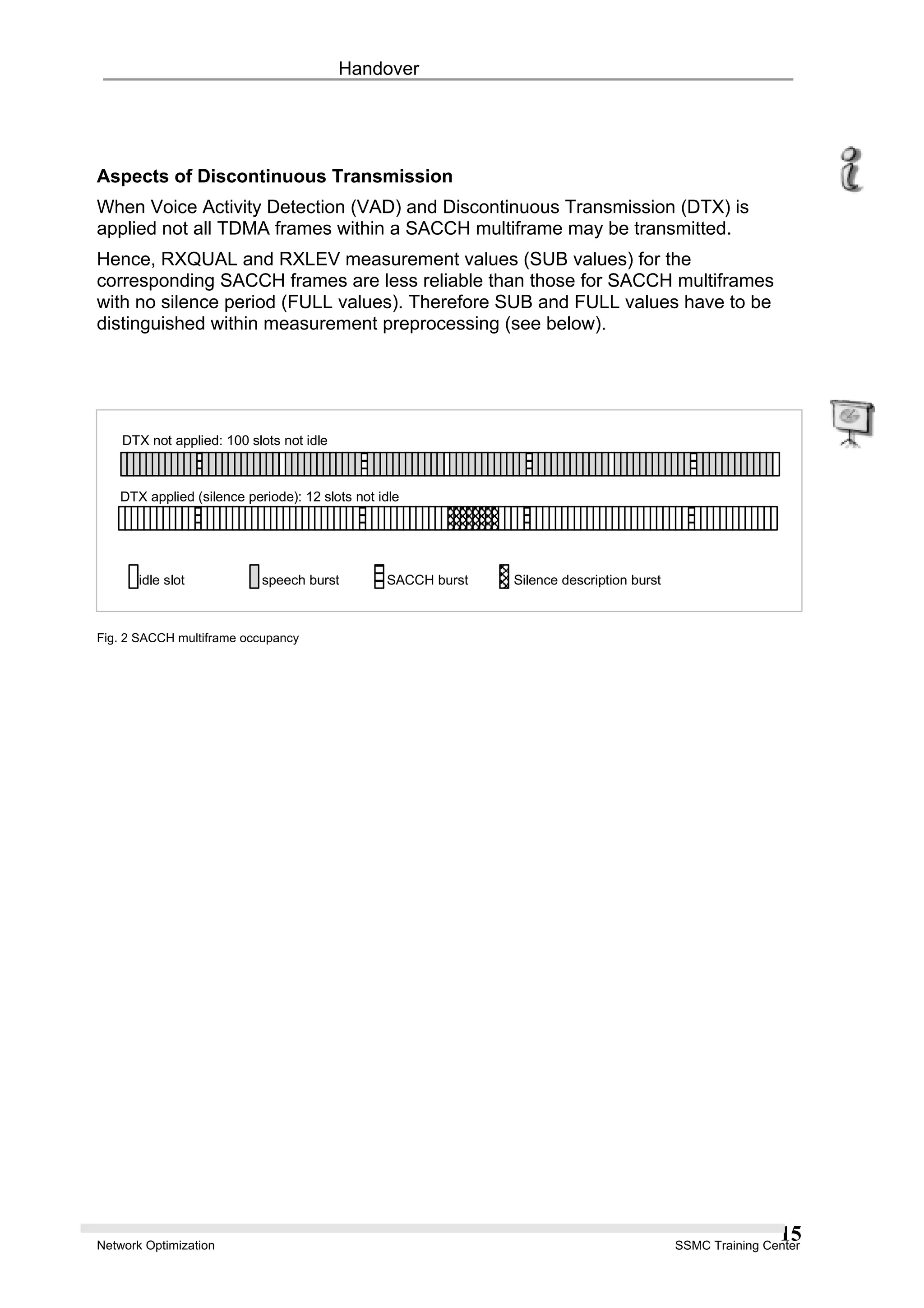
Aspects of Discontinuous Transmission
When Voice Activity Detection (VAD) and Discontinuous Transmission (DTX) is
applied not all TDMA frames within a SACCH multiframe may be transmitted.
Hence, RXQUAL and RXLEV measurement values (SUB values) for the
corresponding SACCH frames are less reliable than those for SACCH multiframes
with no silence period (FULL values). Therefore SUB and FULL values have to be
distinguished within measurement preprocessing (see below).
DTX not applied: 100 slots not idle
DTX applied (silence periode): 12 slots not idle
Silence description burstSACCH burstspeech burstidle slot
Fig. 2 SACCH multiframe occupancy
Network Optimization SSMC Training Center
15
Handover
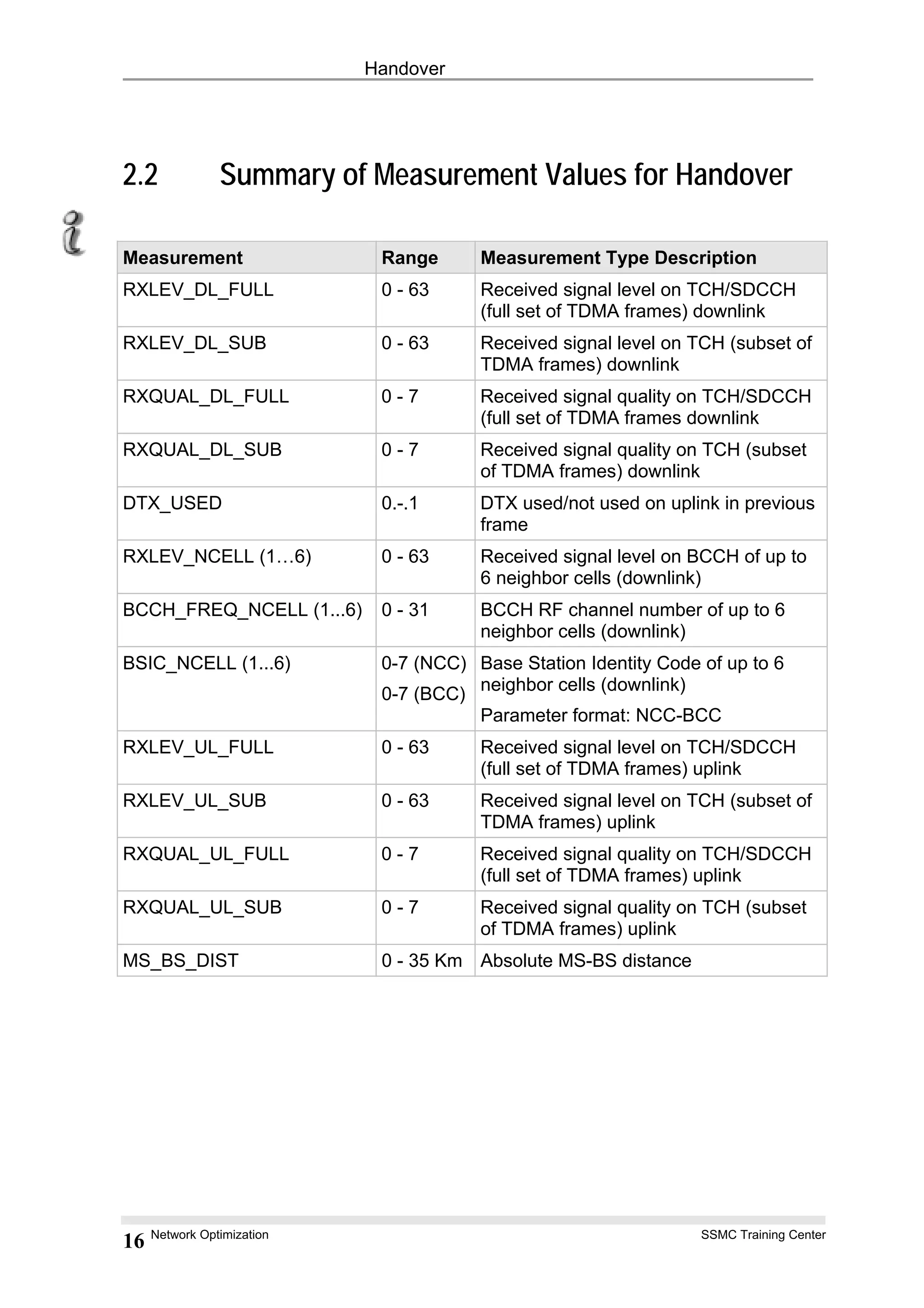
2.2 Summary of Measurement Values for Handover
Measurement Range Measurement Type Description
RXLEV_DL_FULL 0 - 63 Received signal level on TCH/SDCCH
(full set of TDMA frames) downlink
RXLEV_DL_SUB 0 - 63 Received signal level on TCH (subset of
TDMA frames) downlink
RXQUAL_DL_FULL 0 - 7 Received signal quality on TCH/SDCCH
(full set of TDMA frames downlink
RXQUAL_DL_SUB 0 - 7 Received signal quality on TCH (subset
of TDMA frames) downlink
DTX_USED 0.-.1 DTX used/not used on uplink in previous
frame
RXLEV_NCELL (1…6) 0 - 63 Received signal level on BCCH of up to
6 neighbor cells (downlink)
BCCH_FREQ_NCELL (1...6) 0 - 31 BCCH RF channel number of up to 6
neighbor cells (downlink)
BSIC_NCELL (1...6) 0-7 (NCC)
0-7 (BCC)
Base Station Identity Code of up to 6
neighbor cells (downlink)
Parameter format: NCC-BCC
RXLEV_UL_FULL 0 - 63 Received signal level on TCH/SDCCH
(full set of TDMA frames) uplink
RXLEV_UL_SUB 0 - 63 Received signal level on TCH (subset of
TDMA frames) uplink
RXQUAL_UL_FULL 0 - 7 Received signal quality on TCH/SDCCH
(full set of TDMA frames) uplink
RXQUAL_UL_SUB 0 - 7 Received signal quality on TCH (subset
of TDMA frames) uplink
MS_BS_DIST 0 - 35 Km Absolute MS-BS distance
Network Optimization SSMC Training Center
16
Handover
2.3 Measurement Reporting and Neighbor Cell Book-
Keeping
The MS needs the BCCH frequency of each neighbor cell n:
Absolute Radio Frequency Carrier Number BCCH_ARFCN_NCELL(n).
The MS reports to the BTSE the level measured on a certain ARFCN(n) together
with the relative BCCH frequency number BCCH_FREQ_NCELL_(n).
The MS also decodes the Base Station Identity Code BSIC(n).
Different neighbor cells n1 and n2 which use the same BCCH frequency
ARFCN(n1) = ARFCN(n2) have to have different Base Station Identity Codes.
BSIC = NCC - BCC
NCC: National Color Code (3 bits)
BCC: Base Station Color Code (3 bits), has to be chosen by the network
operator in accordance with rule given above.
Network Optimization SSMC Training Center
17
Handover
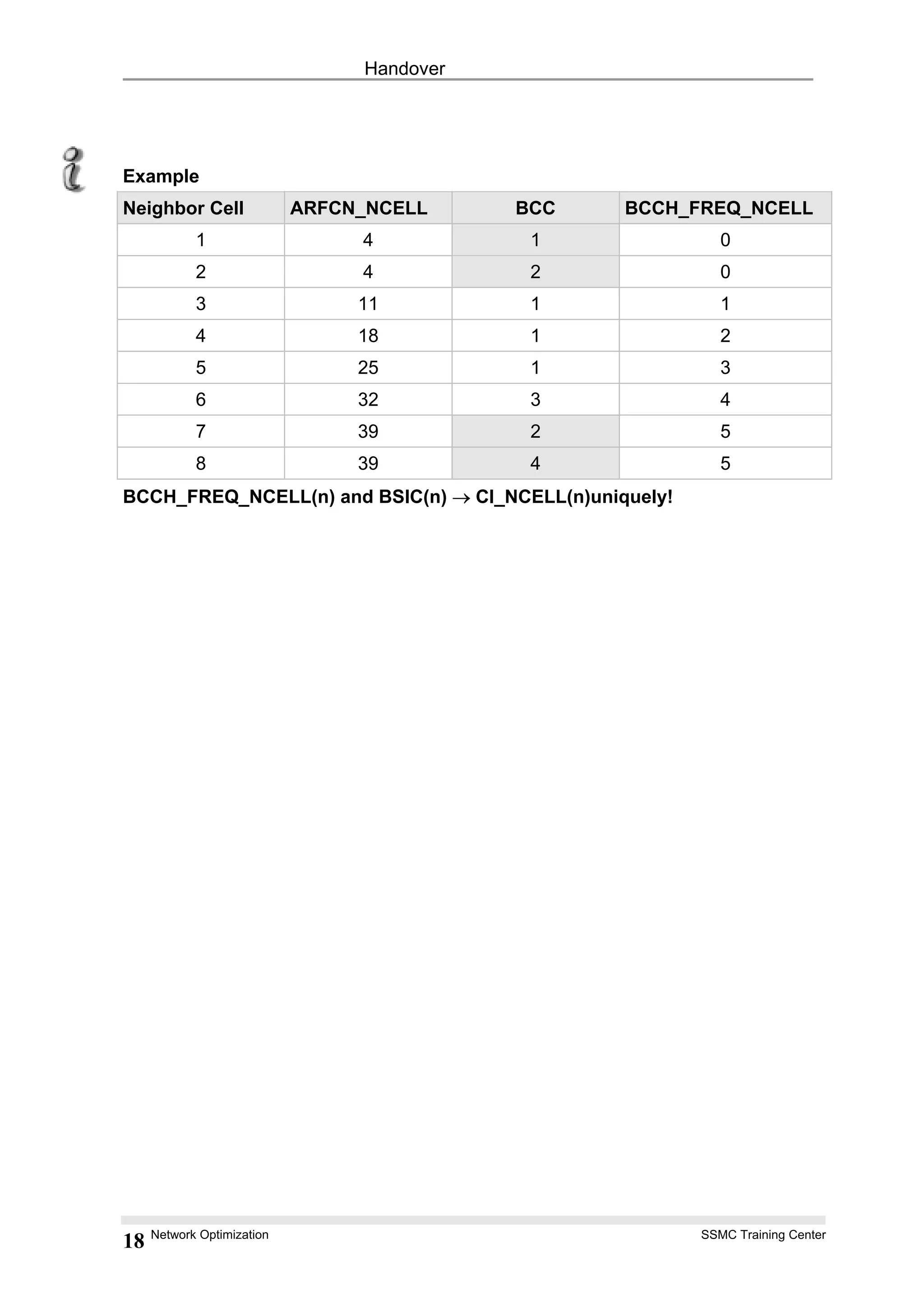
Example
Neighbor Cell ARFCN_NCELL BCC BCCH_FREQ_NCELL
1 4 1 0
2 4 2 0
3 11 1 1
4 18 1 2
5 25 1 3
6 32 3 4
7 39 2 5
8 39 4 5
BCCH_FREQ_NCELL(n) and BSIC(n) → CI_NCELL(n)uniquely!
Network Optimization SSMC Training Center
18
Handover
1
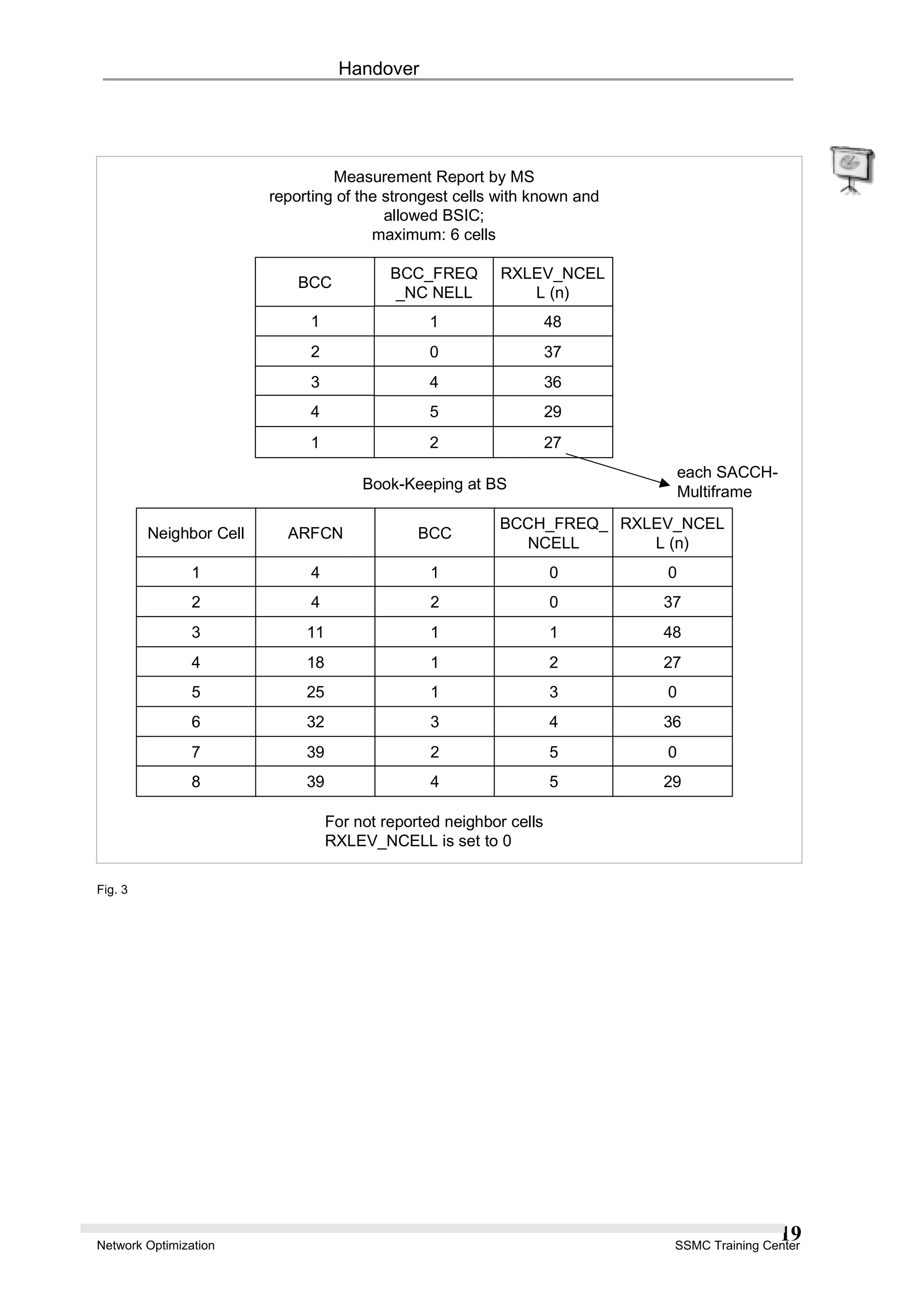
Measurement Report by MS
reporting of the strongest cells with known and
allowed BSIC;
maximum: 6 cells
2
3
4
1
BCC_FREQ
_NC NELL
1
0
4
5
2
RXLEV_NCEL
L (n)
48
37
36
29
27
Book-Keeping at BS
each SACCH-
Multiframe
Neighbor Cell ARFCN BCC
BCCH_FREQ_
NCELL
RXLEV_NCEL
L (n)
1 4 1 0 0
2 4 2 0 37
3 11 1 1 48
4 18 1 2 27
5 25 1 3 0
6 32 3 4 36
7 39 2 5 0
8 39 4 5 29
For not reported neighbor cells
RXLEV_NCELL is set to 0
BCC
Fig. 3
Network Optimization SSMC Training Center
19
Handover
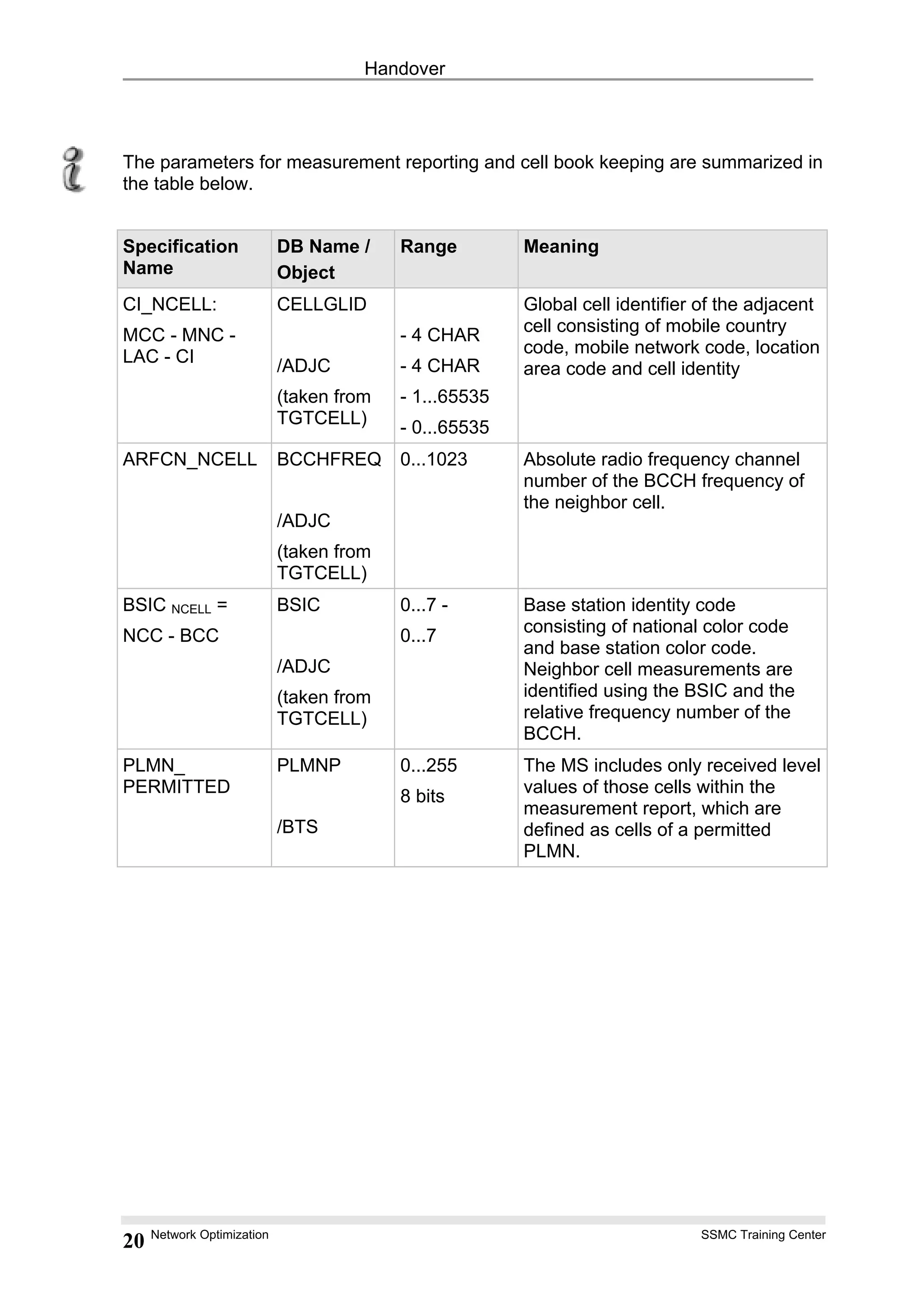
The parameters for measurement reporting and cell book keeping are summarized in
the table below.
Specification
Name
DB Name /
Object
Range Meaning
CI_NCELL:
MCC - MNC -
LAC - CI
CELLGLID
/ADJC
(taken from
TGTCELL)
- 4 CHAR
- 4 CHAR
- 1...65535
- 0...65535
Global cell identifier of the adjacent
cell consisting of mobile country
code, mobile network code, location
area code and cell identity
ARFCN_NCELL BCCHFREQ
/ADJC
(taken from
TGTCELL)
0...1023 Absolute radio frequency channel
number of the BCCH frequency of
the neighbor cell.
BSIC NCELL =
NCC - BCC
BSIC
/ADJC
(taken from
TGTCELL)
0...7 -
0...7
Base station identity code
consisting of national color code
and base station color code.
Neighbor cell measurements are
identified using the BSIC and the
relative frequency number of the
BCCH.
PLMN_
PERMITTED
PLMNP
/BTS
0...255
8 bits
The MS includes only received level
values of those cells within the
measurement report, which are
defined as cells of a permitted
PLMN.
Network Optimization SSMC Training Center
20
Handover
2.4 Illustration of Measurement Preprocessing
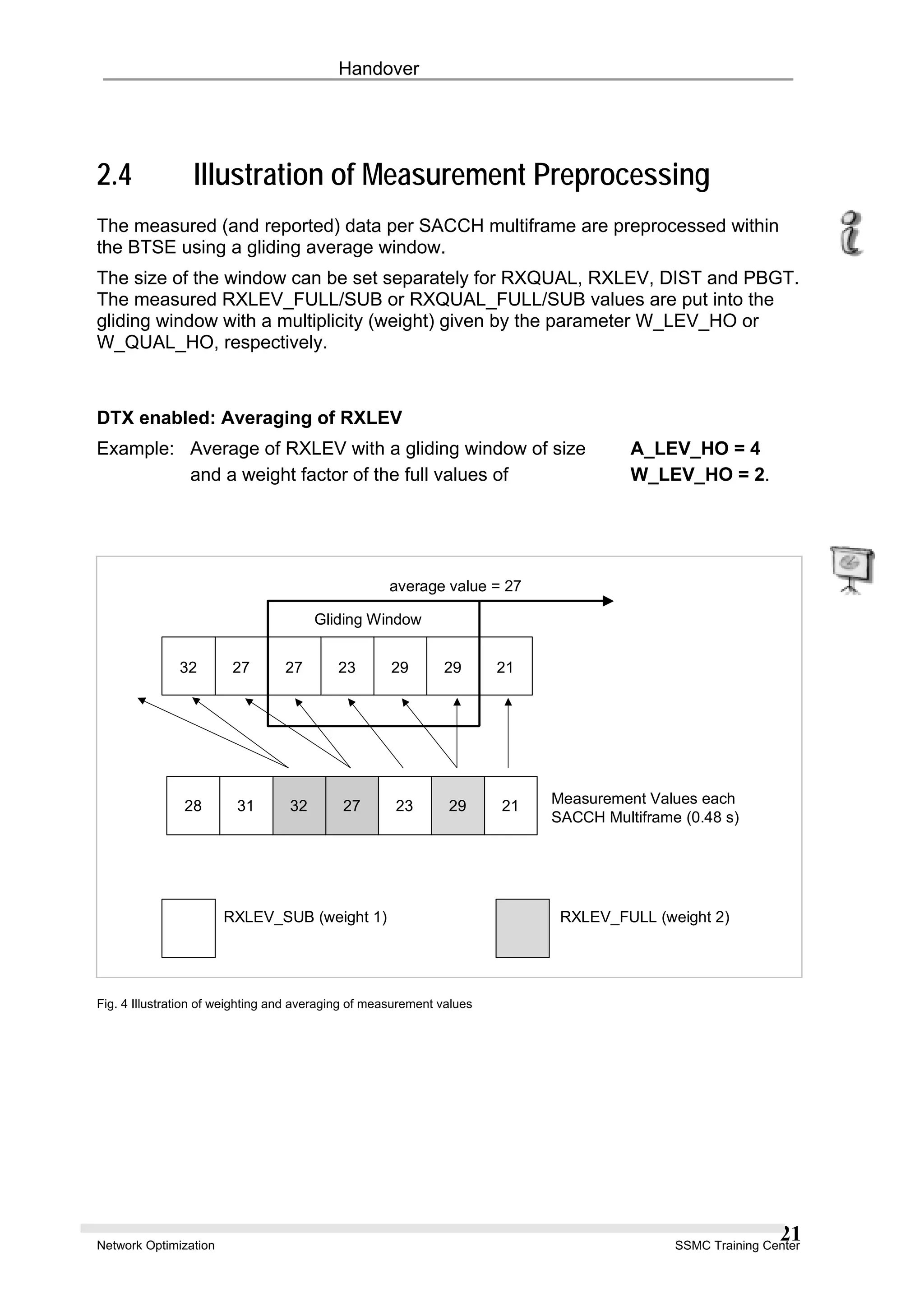
The measured (and reported) data per SACCH multiframe are preprocessed within
the BTSE using a gliding average window.
The size of the window can be set separately for RXQUAL, RXLEV, DIST and PBGT.
The measured RXLEV_FULL/SUB or RXQUAL_FULL/SUB values are put into the
gliding window with a multiplicity (weight) given by the parameter W_LEV_HO or
W_QUAL_HO, respectively.
DTX enabled: Averaging of RXLEV
Example: Average of RXLEV with a gliding window of size A_LEV_HO = 4
and a weight factor of the full values of W_LEV_HO = 2.
21292923272732
21292327323128 Measurement Values each
SACCH Multiframe (0.48 s)
RXLEV_SUB (weight 1) RXLEV_FULL (weight 2)
Gliding Window
average value = 27
Fig. 4 Illustration of weighting and averaging of measurement values
Network Optimization SSMC Training Center
21
Handover
2.5 Parameters for Measurement Preprocessing
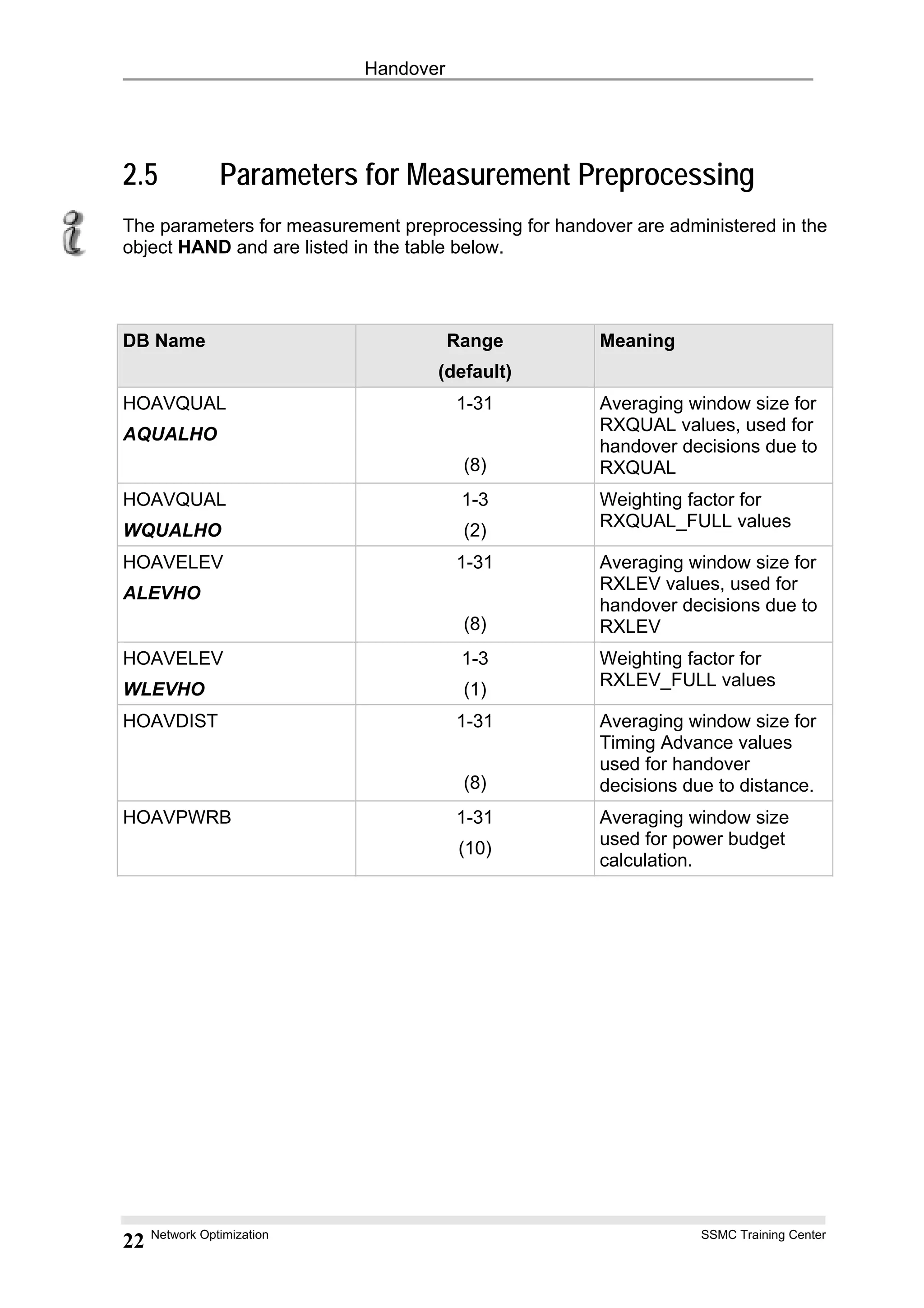
The parameters for measurement preprocessing for handover are administered in the
object HAND and are listed in the table below.
DB Name Range
(default)
Meaning
HOAVQUAL
AQUALHO
1-31
(8)
Averaging window size for
RXQUAL values, used for
handover decisions due to
RXQUAL
HOAVQUAL
WQUALHO
1-3
(2)
Weighting factor for
RXQUAL_FULL values
HOAVELEV
ALEVHO
1-31
(8)
Averaging window size for
RXLEV values, used for
handover decisions due to
RXLEV
HOAVELEV
WLEVHO
1-3
(1)
Weighting factor for
RXLEV_FULL values
HOAVDIST 1-31
(8)
Averaging window size for
Timing Advance values
used for handover
decisions due to distance.
HOAVPWRB 1-31
(10)
Averaging window size
used for power budget
calculation.
Network Optimization SSMC Training Center
22
Handover
2.6 Remarks
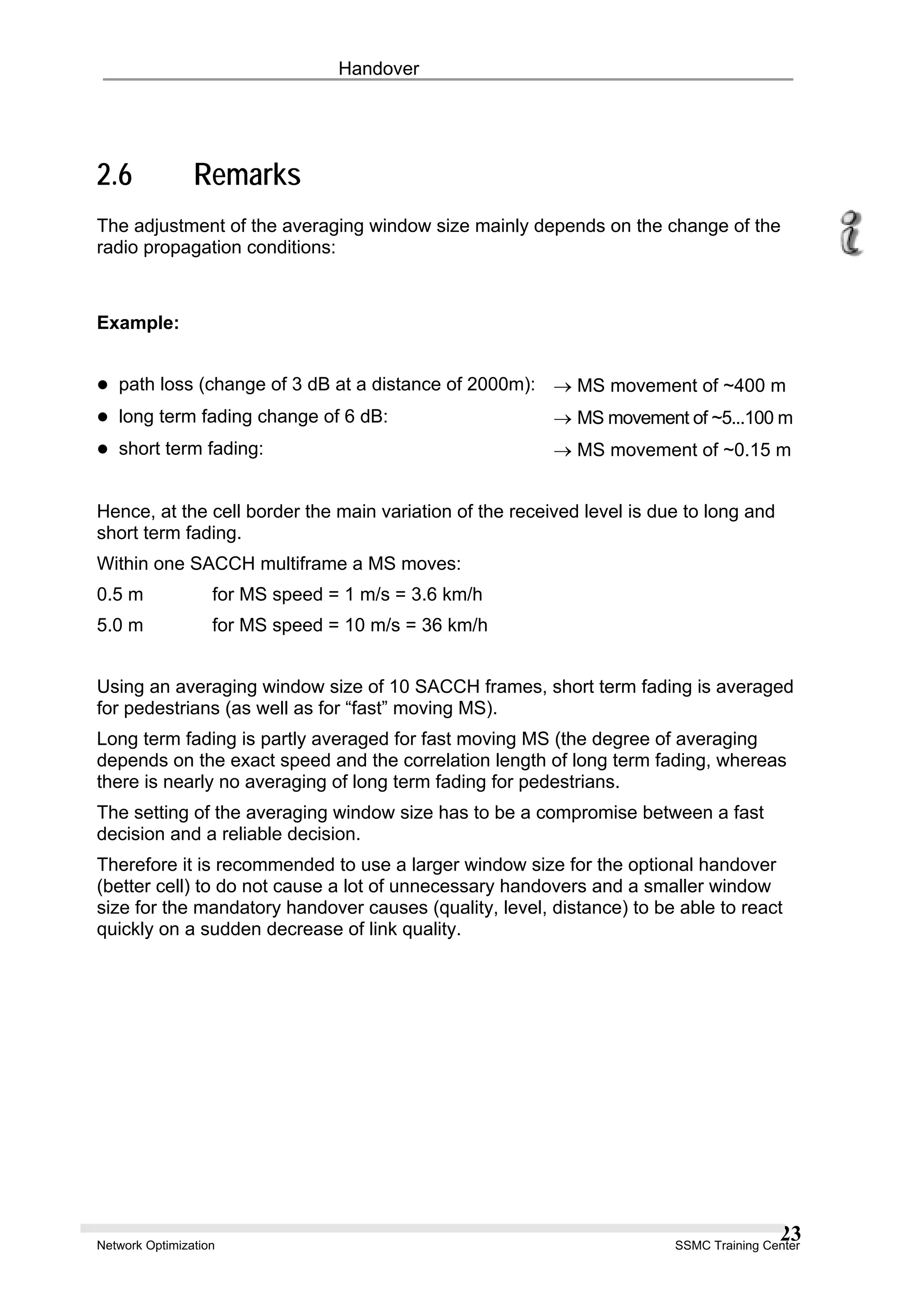
The adjustment of the averaging window size mainly depends on the change of the
radio propagation conditions:
Example:
path loss (change of 3 dB at a distance of 2000m): → MS movement of ~400 m
long term fading change of 6 dB: → MS movement of ~5...100 m
short term fading: → MS movement of ~0.15 m
Hence, at the cell border the main variation of the received level is due to long and
short term fading.
Within one SACCH multiframe a MS moves:
0.5 m for MS speed = 1 m/s = 3.6 km/h
5.0 m for MS speed = 10 m/s = 36 km/h
Using an averaging window size of 10 SACCH frames, short term fading is averaged
for pedestrians (as well as for “fast” moving MS).
Long term fading is partly averaged for fast moving MS (the degree of averaging
depends on the exact speed and the correlation length of long term fading, whereas
there is nearly no averaging of long term fading for pedestrians.
The setting of the averaging window size has to be a compromise between a fast
decision and a reliable decision.
Therefore it is recommended to use a larger window size for the optional handover
(better cell) to do not cause a lot of unnecessary handovers and a smaller window
size for the mandatory handover causes (quality, level, distance) to be able to react
quickly on a sudden decrease of link quality.
Network Optimization SSMC Training Center
23
Handover
Network Optimization SSMC Training Center
24
Handover
3 Threshold Comparisons and Handover
Detection Algorithms
Network Optimization SSMC Training Center
25
Handover
3.1 Decision Criteria
The standard handover algorithm for radio criteria uses the decision criteria listed in
the table below.
These criteria will be modified for a speed sensitive handover used within hierarchical
cells.
Handover Types Decision Criteria
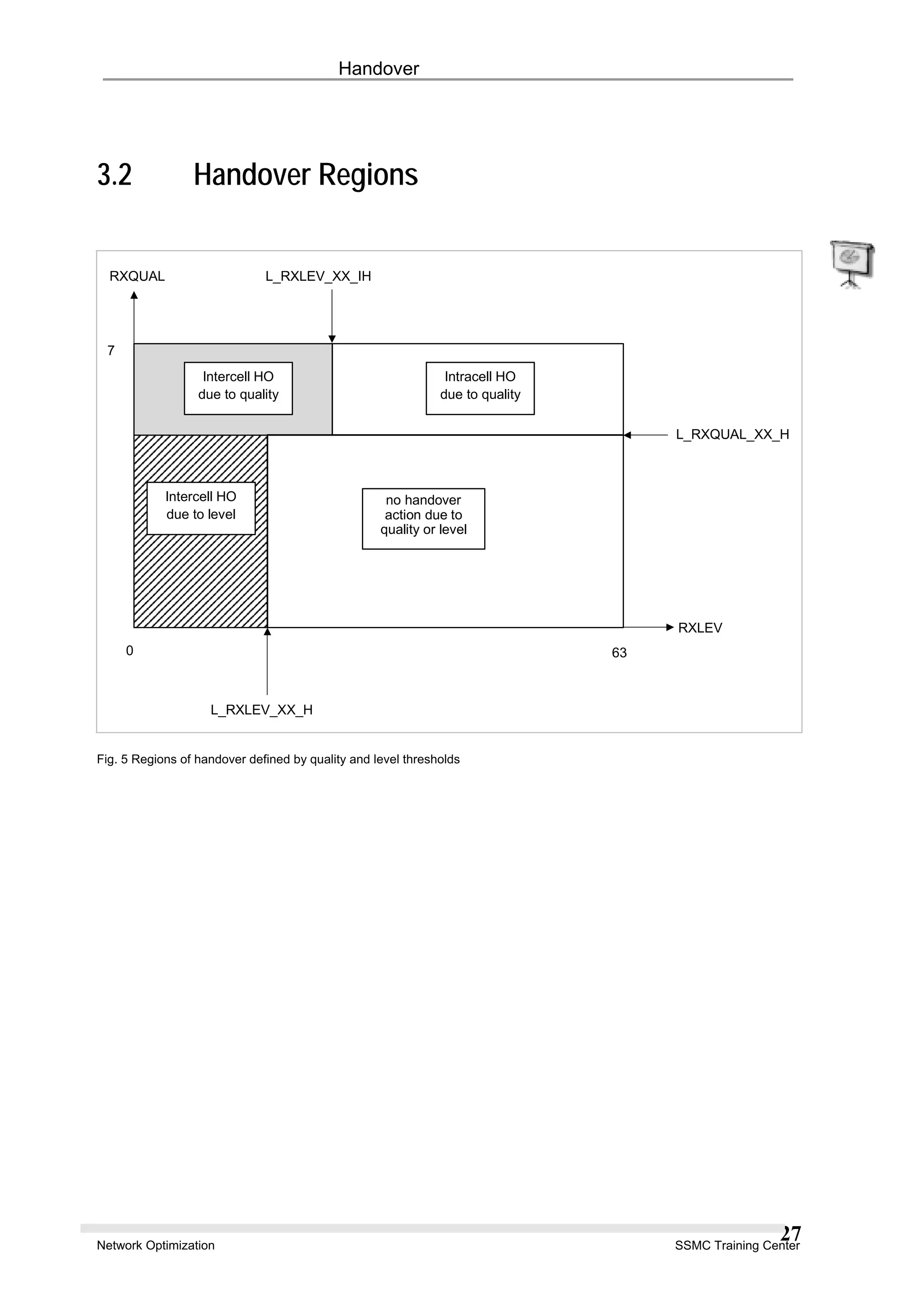
Intercell HO due to Quality 1. RXQUAL_XX > L_RXQUAL_XX_H
2. RXLEV_XX < L_RXLEV_XX_IH
3. XX_TXPWR = Min (XX_TXPWR_MAX, P)
HO due to Level 1. RXLEV_XX < L_RXLEV_XX_H
2. XX_TXPWR = Min (XX_TXPWR_MAX, P)
HO due to Distance 1. MS_BS_DIST > MS_RANGE_MAX
HO due to Power Budget 1. RXLEV_NCELL(n) > RXLEV_MIN(n) + Max
(0, MS_TXPWR_MAX(n) - P)
2. PBGT(n) > HO_MARGIN(n)
Intracell HO due to Quality 1. RXQUAL_XX > L_RXQUAL_XX_H
2. RXLEV_XX > L_RXLEV_XX_IH
Notes:
XX: used as variable for both UL (uplink) and DL (downlink)
MS_TXPWR_MAX: maximum allowed transmit power of the MS in the serving
cell,
MS_TXPWR_MAX(n): maximum allowed transmit power of the MS in the
adjacent cell “n“
P [dBm]: the maximum power capability of the MS (power class)
An intercell handover due quality or level is only performed if the transmit power of
the MS or BS respectively is on its maximum
Network Optimization SSMC Training Center
26
Handover
3.2 Handover Regions
63
L_RXQUAL_XX_H
L_RXLEV_XX_H
Intercell HO
due to level
Intercell HO
due to quality
RXQUAL L_RXLEV_XX_IH
7
0
RXLEV
no handover
action due to
quality or level
Intracell HO
due to quality
Fig. 5 Regions of handover defined by quality and level thresholds
Network Optimization SSMC Training Center
27
Handover
3.3 Power Budget
The power budget PBGT(n) is calculated in the following way:
PBGT(n) = RXLEV_NCELL(n) - (RXLEV_DL + PWR_C_D)
+ Min(MS_TXPWR_MAX, P) - Min(MS_TXPWR_MAX(n), P)
RXLEV_DL: averaged value of the measured downlink level in the serving
cell,
PWR_C_D: BS_TXPWR_MAX [dBm] - BS_TXPWR [dBm]
averaged difference between the maximum downlink RF power
BS_TXPWR_MAX and the actual downlink power BS_TXPWR
due to power control in the serving cell.
RXLEV_NCELL(n): averaged value of the measured downlink level of the adjacent
cell “n”
HO_MARGIN(n): handover margin; if path loss with respect to the serving cell
exceeds the path loss with respect to the adjacent cell “n” by this
margin, the adjacent cell is considered as the (much) better cell.
Network Optimization SSMC Training Center
28
Handover
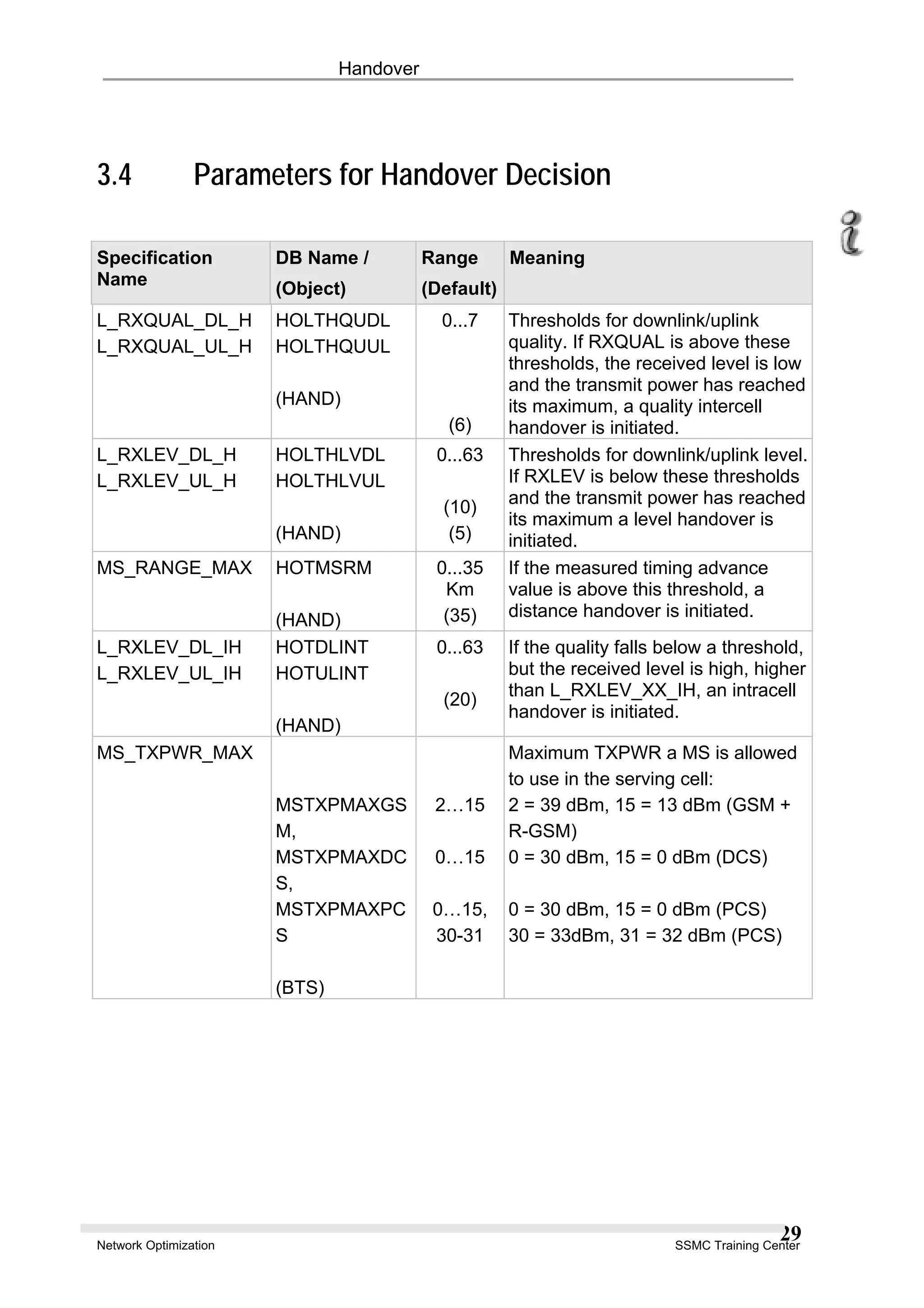
3.4 Parameters for Handover Decision
Specification
Name
DB Name /
(Object)
Range
(Default)
Meaning
L_RXQUAL_DL_H
L_RXQUAL_UL_H
HOLTHQUDL
HOLTHQUUL
(HAND)
0...7
(6)
Thresholds for downlink/uplink
quality. If RXQUAL is above these
thresholds, the received level is low
and the transmit power has reached
its maximum, a quality intercell
handover is initiated.
L_RXLEV_DL_H
L_RXLEV_UL_H
HOLTHLVDL
HOLTHLVUL
(HAND)
0...63
(10)
(5)
Thresholds for downlink/uplink level.
If RXLEV is below these thresholds
and the transmit power has reached
its maximum a level handover is
initiated.
MS_RANGE_MAX HOTMSRM
(HAND)
0...35
Km
(35)
If the measured timing advance
value is above this threshold, a
distance handover is initiated.
L_RXLEV_DL_IH
L_RXLEV_UL_IH
HOTDLINT
HOTULINT
(HAND)
0...63
(20)
If the quality falls below a threshold,
but the received level is high, higher
than L_RXLEV_XX_IH, an intracell
handover is initiated.
MS_TXPWR_MAX
MSTXPMAXGS
M,
MSTXPMAXDC
S,
MSTXPMAXPC
S
(BTS)
2…15
0…15
0…15,
30-31
Maximum TXPWR a MS is allowed
to use in the serving cell:
2 = 39 dBm, 15 = 13 dBm (GSM +
R-GSM)
0 = 30 dBm, 15 = 0 dBm (DCS)
0 = 30 dBm, 15 = 0 dBm (PCS)
30 = 33dBm, 31 = 32 dBm (PCS)
Network Optimization SSMC Training Center
29
Handover
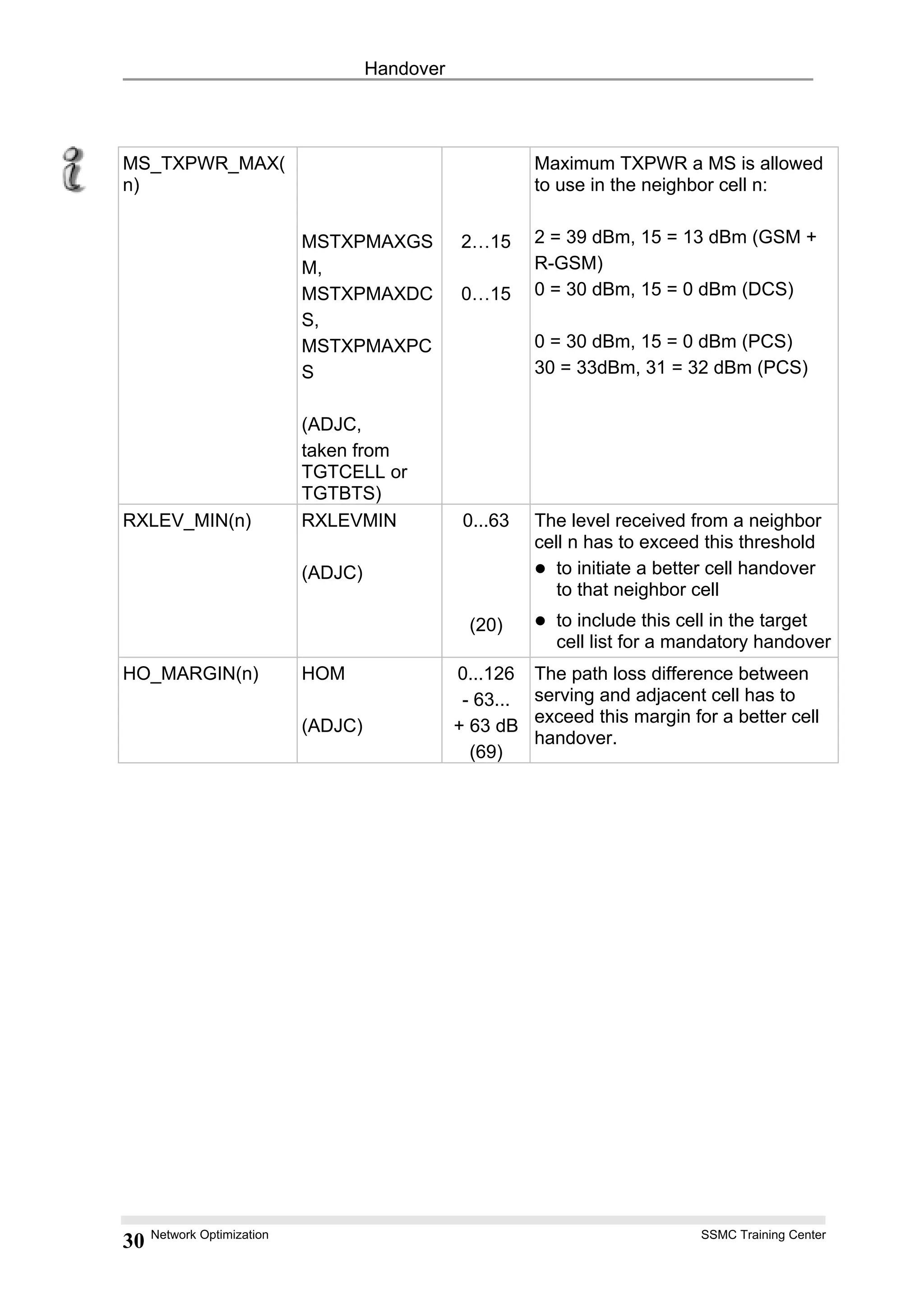
MS_TXPWR_MAX(
n)
MSTXPMAXGS
M,
MSTXPMAXDC
S,
MSTXPMAXPC
S
(ADJC,
taken from
TGTCELL or
TGTBTS)
2…15
0…15
Maximum TXPWR a MS is allowed
to use in the neighbor cell n:
2 = 39 dBm, 15 = 13 dBm (GSM +
R-GSM)
0 = 30 dBm, 15 = 0 dBm (DCS)
0 = 30 dBm, 15 = 0 dBm (PCS)
30 = 33dBm, 31 = 32 dBm (PCS)
RXLEV_MIN(n) RXLEVMIN
(ADJC)
0...63
(20)
The level received from a neighbor
cell n has to exceed this threshold
to initiate a better cell handover
to that neighbor cell
to include this cell in the target
cell list for a mandatory handover
HO_MARGIN(n) HOM
(ADJC)
0...126
- 63...
+ 63 dB
(69)
The path loss difference between
serving and adjacent cell has to
exceed this margin for a better cell
handover.
Network Optimization SSMC Training Center
30
Handover
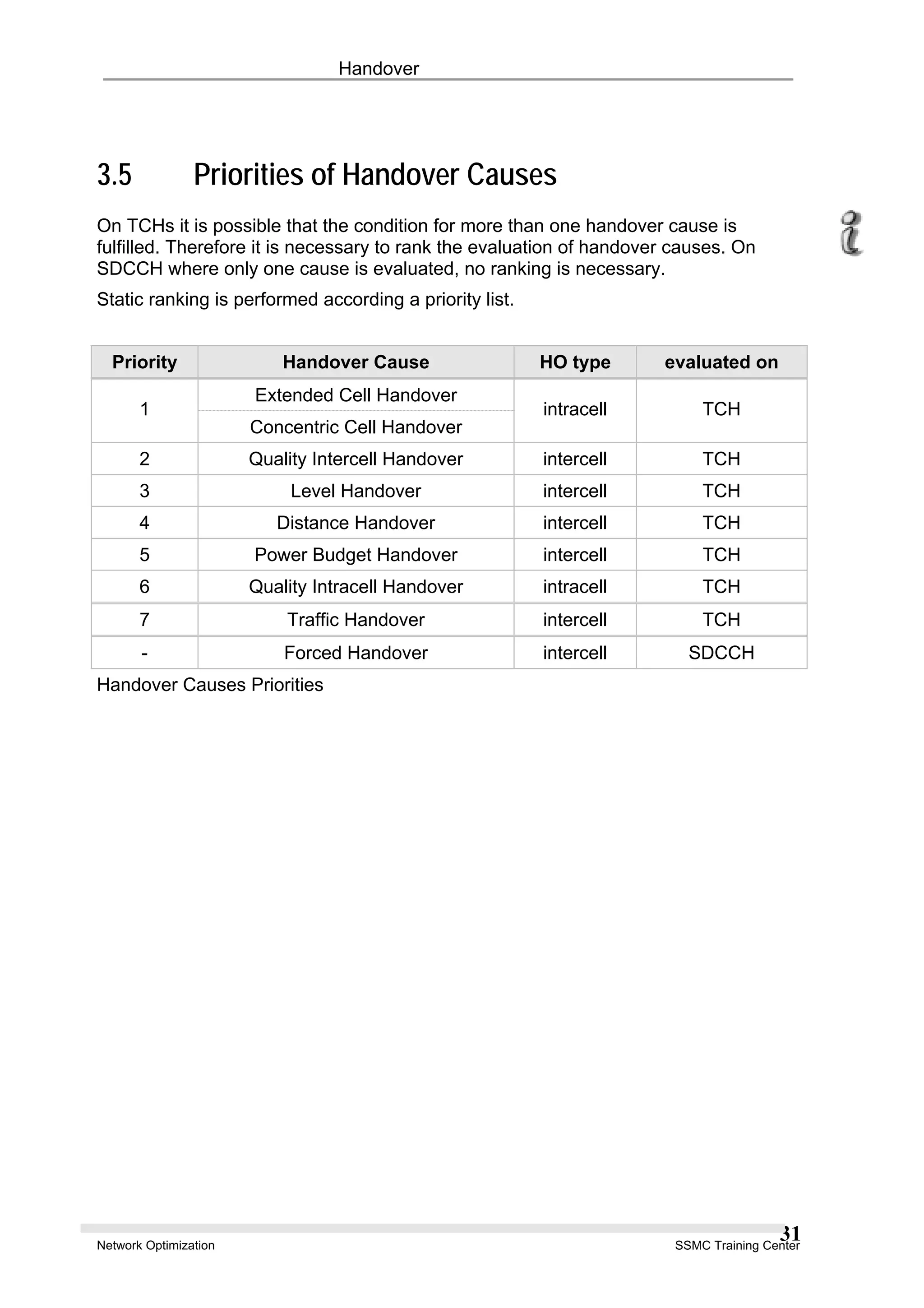
3.5 Priorities of Handover Causes
On TCHs it is possible that the condition for more than one handover cause is
fulfilled. Therefore it is necessary to rank the evaluation of handover causes. On
SDCCH where only one cause is evaluated, no ranking is necessary.
Static ranking is performed according a priority list.
Priority Handover Cause HO type evaluated on
Extended Cell Handover
1
Concentric Cell Handover
intracell TCH
2 Quality Intercell Handover intercell TCH
3 Level Handover intercell TCH
4 Distance Handover intercell TCH
5 Power Budget Handover intercell TCH
6 Quality Intracell Handover intracell TCH
7 Traffic Handover intercell TCH
- Forced Handover intercell SDCCH
Handover Causes Priorities
Network Optimization SSMC Training Center
31
Handover
3.6 Limitation of Intracell Handover Repetition
In a situation, where for a connection in an interfered cell consecutive intracell
handovers are performed without improving the quality of the connection (especially if
frequency hopping is active), further intracell handovers should be avoided.
In BR4.0, the operator has the possibility to handle this situation with new
parameters, which have been introduced:
Parameter Location Meaning
ELIMITCH
Range: TRUE, FALSE
Default: FALSE
HAND This parameter enables the operator to switch
on or off the feature of intracell handover
limitation.
TINOIERCHO
Range: 1-254
Default: 60
HAND This parameter defines the time in seconds,
how long an intracell handover is prohibited.
MAIRACHO
Range: 1-15
Default: 10
HAND This parameter defines the maximum number
of intracell handovers, before further intracell
handovers are prohibited.
The following configuration rule should be regarded:
TINOIERCHO (BTS timer) > THORQST (BTS timer) > T7 (BSC timer).
This condition allows the possibility to perform an intercell handover.
Network Optimization SSMC Training Center
32
Handover
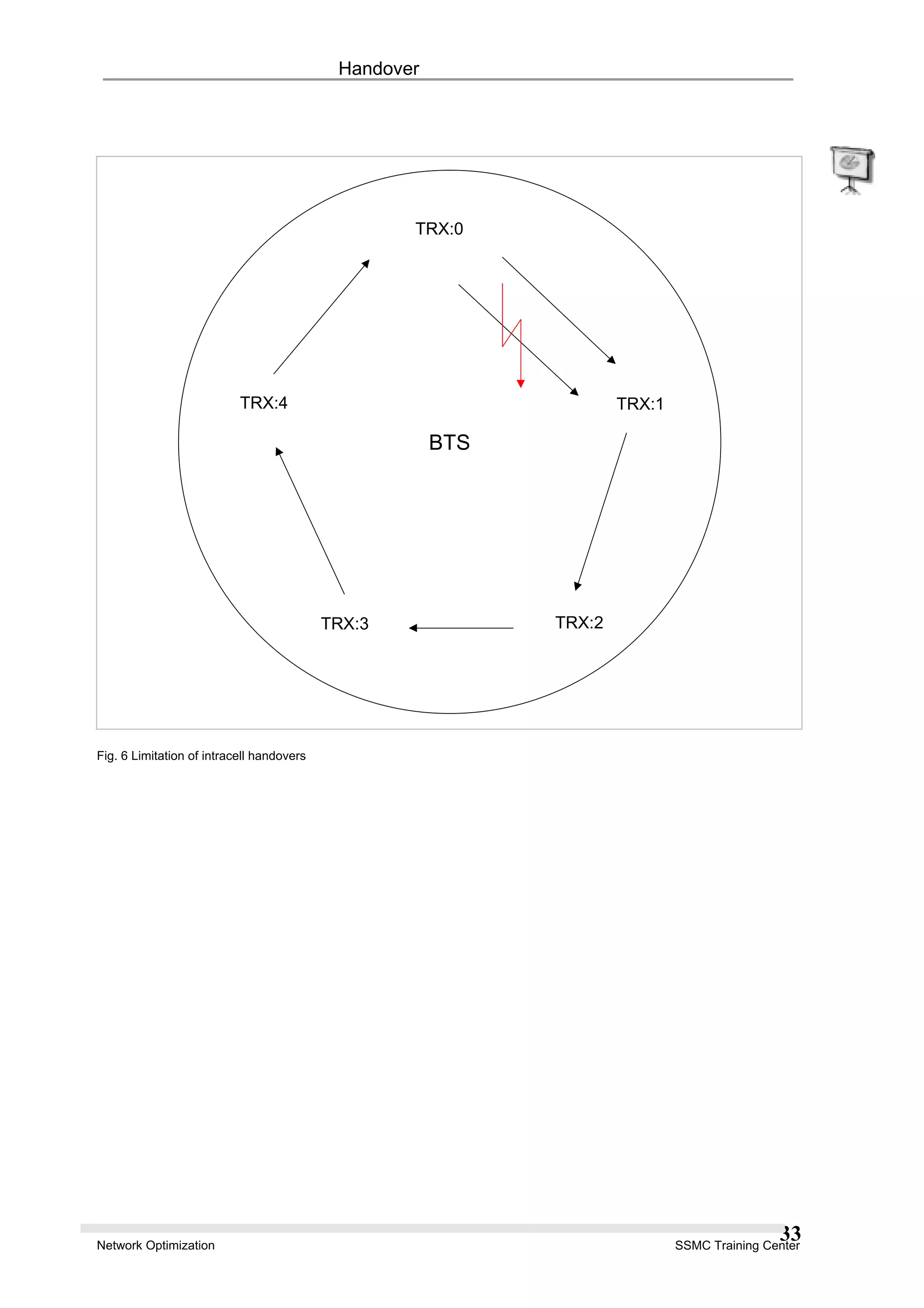
BTS
TRX:0
TRX:1
TRX:2TRX:3
TRX:4
Fig. 6 Limitation of intracell handovers
Network Optimization SSMC Training Center
33
Handover
3.7 Prevention of Back-Handover
In specific cases back handovers, i.e. handovers to a cell just left before, should be
avoided. Two different reasons for the first of the two handovers have to be
distinguished:
Imperative Handover
If an imperative handover occurs, i.e. a handover due to bad quality, excessive
distance or low signal level, then a back handover should be avoided if the reason
for this second handover is the power budget.
Forced Handover
In case of a forced handover, e.g. after a directed retry, a back handover should
be avoided only, if the reason for this second handover is the power budget. Up to
BR3.7, every back handover was prohibited for a time defined with the parameter
TIMERFHO. Since BR4.0 this timer refers only to handovers due to power budget.
DB Name Object Meaning
NOBAKHO
Range: TRUE, FALSE
Default: FALSE
HAND This parameter enables the operator to switch
on or off the feature of back handover
prevention.
TINHBAKHO
Range: 1-254
Default: 30
ADJC This parameter defines the time in seconds,
how long a power budget back handover is
prohibited to a cell just left with an imperative
handover.
TIMERFHO
Range: 0-320
Default: 12
ADJC This parameter defines the time in 10 seconds
intervals, how long a power budget back
handover is prohibited to a cell just left with a
forced handover.
Network Optimization SSMC Training Center
34
Handover
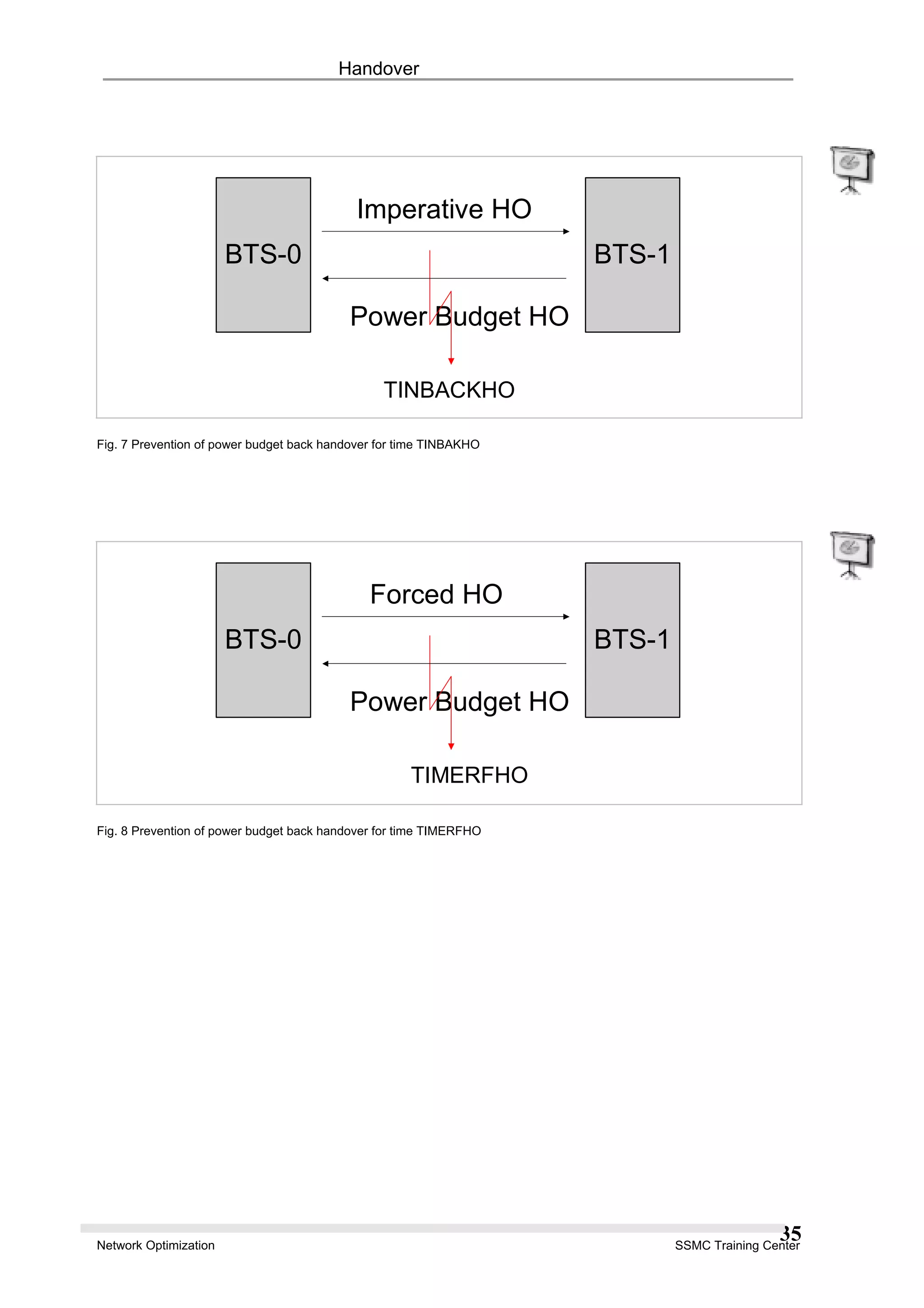
BTS-0 BTS-1
Imperative HO
Power Budget HO
TINBACKHO
Fig. 7 Prevention of power budget back handover for time TINBAKHO
BTS-0 BTS-1
Forced HO
Power Budget HO
TIMERFHO
Fig. 8 Prevention of power budget back handover for time TIMERFHO
Network Optimization SSMC Training Center
35
Handover
3.8 Limitation of Handover Failure Repetition
After consecutive handover failures further handovers towards the same cell should
be avoided. For this reason the BSC informs the BTS after a number of subsequent
Intra-BSC handover failures to exclude the cell from the target cell list. New
parameters have been introduced in BR4.0 to enable or disable this feature, to define
the maximum number of handover failures and the time period for which a cell is not
seen as target for handover.
Parameter Object Meaning
NOFREPHO
Range: TRUE, FALSE
Default: FALSE
HAND This parameter enables the operator to switch
on or off the feature of handover failure
repetition prevention.
TINHFAIHO
Range: 1-254
Default: 5
ADJC This parameter defines the time in seconds,
how long a cell is removed from the target cell
list after a sequence of handover failures.
MAXFAILHO
Range: 1-15
Default: 4
HAND This parameter defines the maximum number
of handover attempts, before a cell is removed
from the target cell list.
The following configuration rule should be regarded:
TINHFAIHO (BTS timer) > THORQST (BTS timer) > T7 (BSC timer).
This condition allows the possibility to perform the handover towards the second cell
indicated in the target cell list.
Network Optimization SSMC Training Center
36
Handover
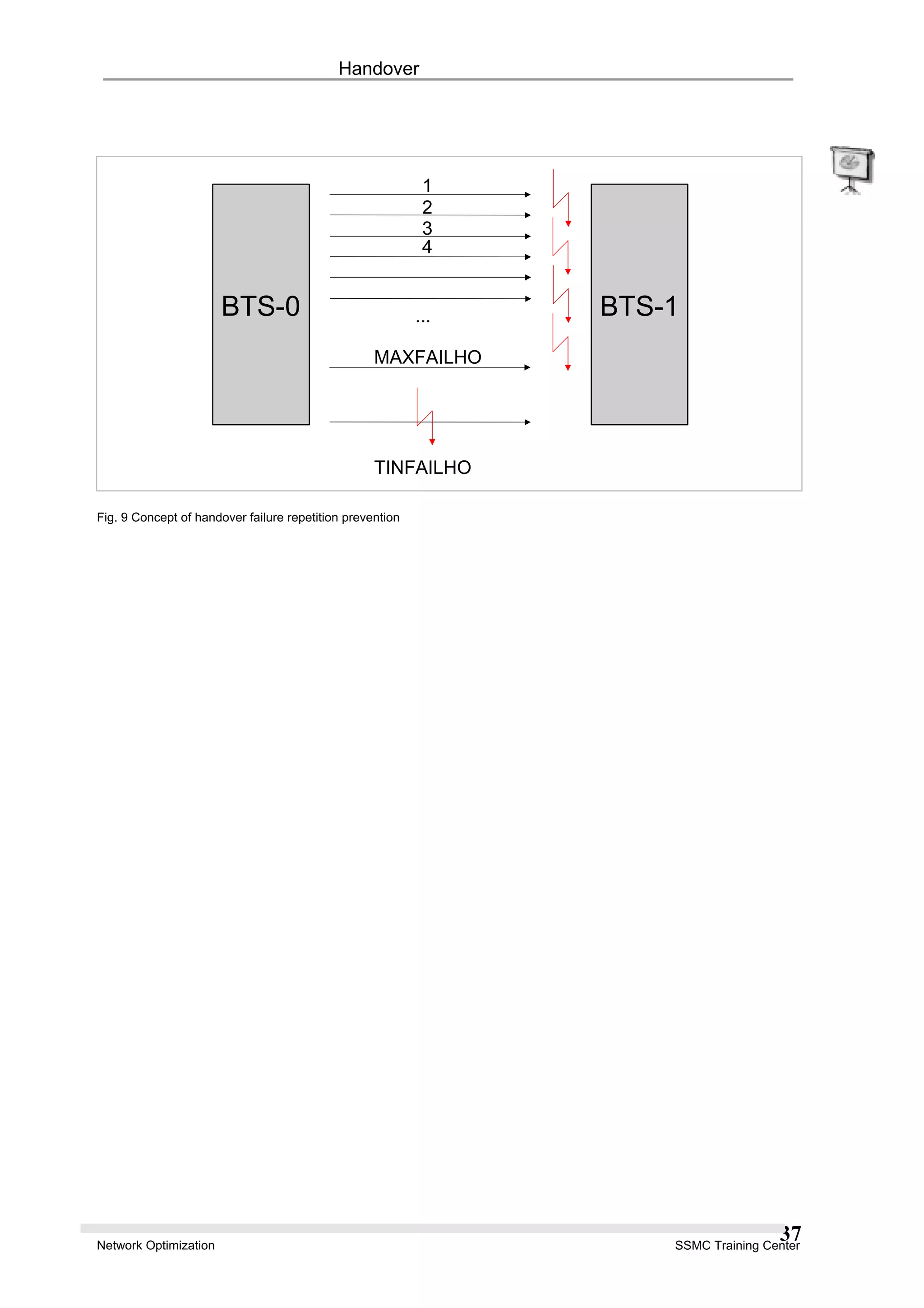
BTS-0 BTS-1
1
4
MAXFAILHO
...
TINFAILHO
2
3
Fig. 9 Concept of handover failure repetition prevention
Network Optimization SSMC Training Center
37
Handover
3.9 Remarks
For adjusting the handover thresholds two scenarios are distinguished:
Scenario A Noise Limited Scenario:
Large cells (in rural area) with low traffic load:
received level at the cell border is not much above the receiver limit sensitivity level.
Scenario B Interference Limited Scenario:
“Small” cells (in urban area) with high traffic load:
received level at cell border significantly exceeds the receiver sensitivity level, but C/I
is not much above the reference interference sensitivity.
In any case intercell handover due to quality should be avoided as far as possible.
Therefore:
set L_RXQUAL_XX_H to highest value for acceptable speech quality,
set L_RXLEV_XX_IH to a high value so that in case of low RXQUAL an intracell
handover is initiated for the locations within the cell area defined by the other
thresholds.
Scenario A:
In this scenario the main handover criterion is the level criterion and L_RXLEV_XX_H
has to be set to a value just some dB above the receiver limit sensitivity level.
Furthermore, there should be a hysteresis between the threshold RXLEV_MIN for
incoming handover and the corresponding threshold L_RXLEV_XX_H for outgoing
handover to avoid a lot of unnecessary forward and backward handover:
RXLEV_MIN - L_RXLEV_XX_H = level hysteresis > 0.
The order of magnitude for the level hysteresis is given by the standard deviation of
the long term fading,
i.e. RXLEV_MIN > L_RXLEV_XX_H + 4 ... 10 dB.
Network Optimization SSMC Training Center
38
Handover
Scenario B:
In this scenario the better cell criterion should be the main handover criterion,
because
it is the most suitable criterion for designing well defined cell borders,
it guarantees that the mobile is served by the cell with (nearly) the lowest path loss
and therefore offers the greatest potential for power control to reduce interference.
To avoid a lot of unnecessary forward and backward power budget handover caused
by long term fading fluctuations of the received levels from the respective BTS, a
hysteresis has to be introduced:
HO_MARGIN(cell1 -> cell2) + HO_MARGIN(cell2 -> cell1) = power budget
hysteresis > 0.
Usually, the handover margin is chosen symmetrically; its value should be a
compromise between ideal power budget handover (low value) and a low rate of
forward and backward handovers (high value).
By choosing unsymmetrical values for the handover margin, one can adapt the cell
area to the traffic load, e.g. increasing HO_MARGIN(cell1 -> cell2) while keeping the
power budget hysteresis constant (i.e. reducing HO_MARGIN(cell2 -> cell1) by the
same amount), increases the effective area of cell 1 while reducing that of cell 2.
RXLEV_MIN(n) should be set to a value so that RXLEV_NCELL(n) > RXLEV_MIN(n)
for almost all locations where PBGT(n) > HO_MARGIN(n), i.e. a better cell handover
is really initiated if the power budget condition is fulfilled.
This means that there should be an overlap of the outgoing power budget area of one
cell and the incoming RXLEV_MIN area of the neighbor cell n.
Furthermore, as for scenario A, there should be a level hysteresis between
RXLEV_MIN and L_RXLEV_XX_H.
Network Optimization SSMC Training Center
39
Handover
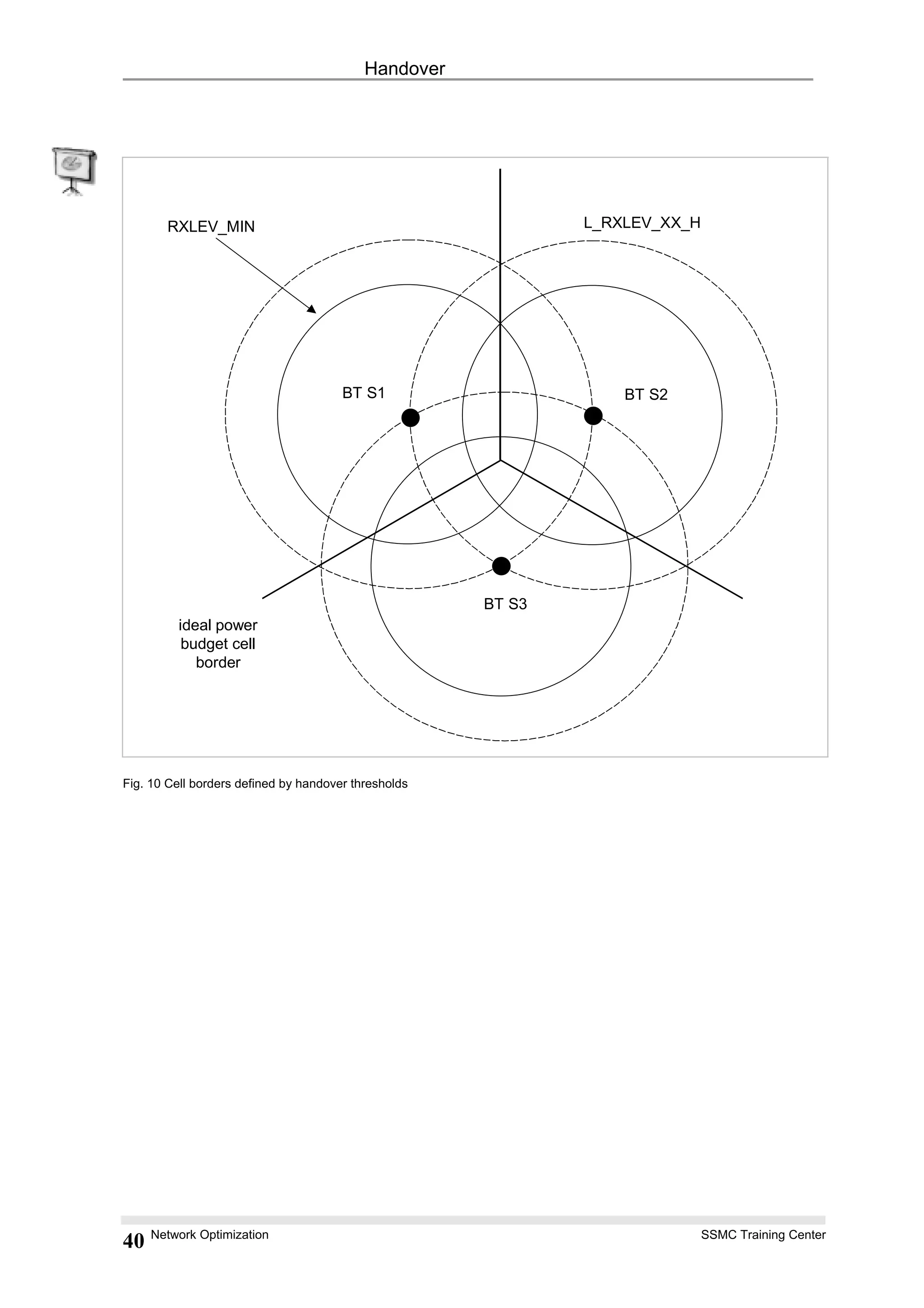
RXLEV_MIN L_RXLEV_XX_H
BT S2
BT S3
BT S1
ideal power
budget cell
border
Fig. 10 Cell borders defined by handover thresholds
Network Optimization SSMC Training Center
40
Handover
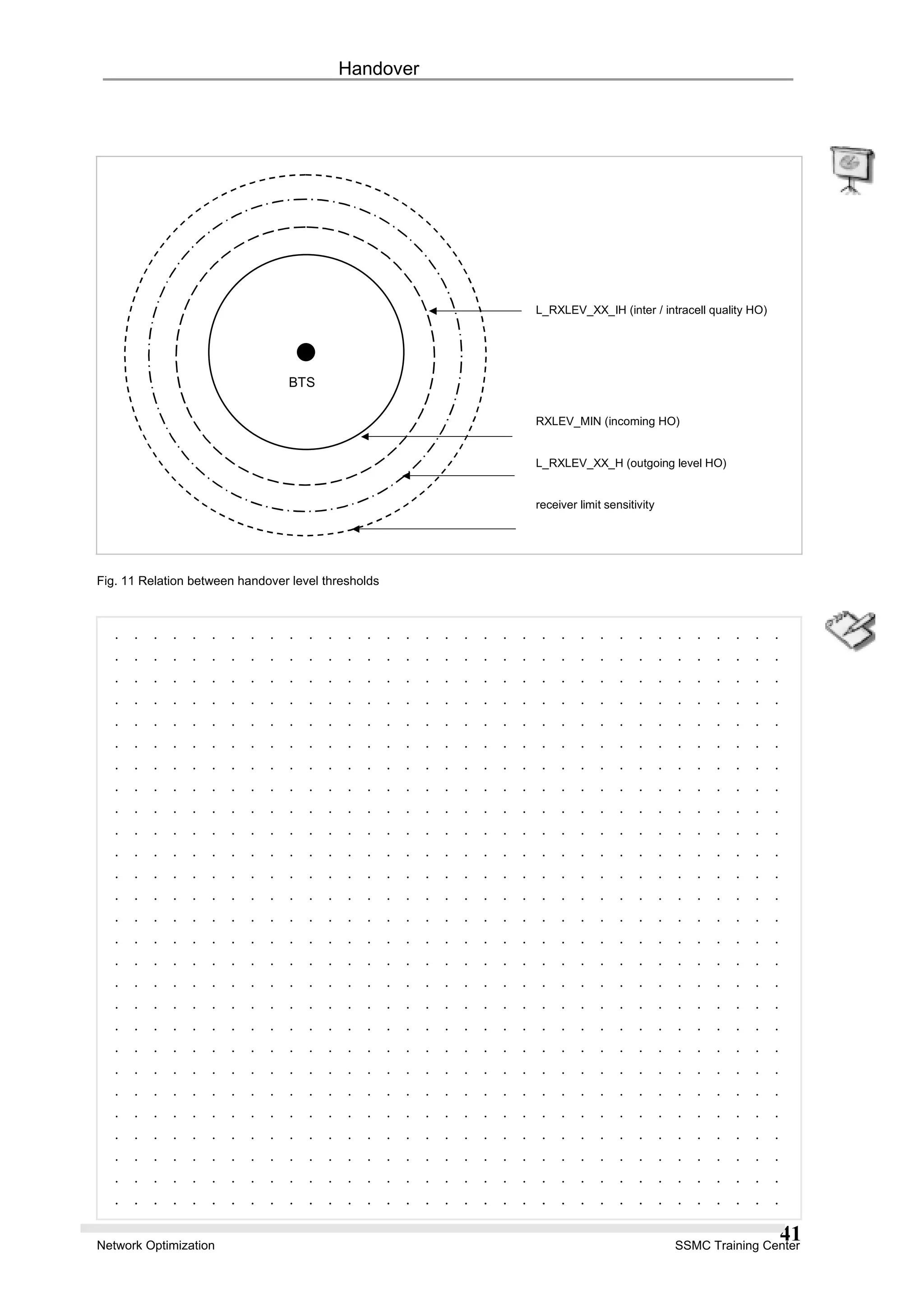
L_RXLEV_XX_IH (inter / intracell quality HO)
RXLEV_MIN (incoming HO)
L_RXLEV_XX_H (outgoing level HO)
receiver limit sensitivity
BTS
Fig. 11 Relation between handover level thresholds
. . . . . . . . . . . . . . . . . . . . . . . . . . . . . . . . . . .
. . . . . . . . . . . . . . . . . . . . . . . . . . . . . . . . . . .
. . . . . . . . . . . . . . . . . . . . . . . . . . . . . . . . . . .
. . . . . . . . . . . . . . . . . . . . . . . . . . . . . . . . . . .
. . . . . . . . . . . . . . . . . . . . . . . . . . . . . . . . . . .
. . . . . . . . . . . . . . . . . . . . . . . . . . . . . . . . . . .
. . . . . . . . . . . . . . . . . . . . . . . . . . . . . . . . . . .
. . . . . . . . . . . . . . . . . . . . . . . . . . . . . . . . . . .
. . . . . . . . . . . . . . . . . . . . . . . . . . . . . . . . . . .
. . . . . . . . . . . . . . . . . . . . . . . . . . . . . . . . . . .
. . . . . . . . . . . . . . . . . . . . . . . . . . . . . . . . . . .
. . . . . . . . . . . . . . . . . . . . . . . . . . . . . . . . . . .
. . . . . . . . . . . . . . . . . . . . . . . . . . . . . . . . . . .
. . . . . . . . . . . . . . . . . . . . . . . . . . . . . . . . . . .
. . . . . . . . . . . . . . . . . . . . . . . . . . . . . . . . . . .
. . . . . . . . . . . . . . . . . . . . . . . . . . . . . . . . . . .
. . . . . . . . . . . . . . . . . . . . . . . . . . . . . . . . . . .
. . . . . . . . . . . . . . . . . . . . . . . . . . . . . . . . . . .
. . . . . . . . . . . . . . . . . . . . . . . . . . . . . . . . . . .
. . . . . . . . . . . . . . . . . . . . . . . . . . . . . . . . . . .
. . . . . . . . . . . . . . . . . . . . . . . . . . . . . . . . . . .
. . . . . . . . . . . . . . . . . . . . . . . . . . . . . . . . . . .
. . . . . . . . . . . . . . . . . . . . . . . . . . . . . . . . . . .
. . . . . . . . . . . . . . . . . . . . . . . . . . . . . . . . . . .
. . . . . . . . . . . . . . . . . . . . . . . . . . . . . . . . . . .
. . . . . . . . . . . . . . . . . . . . . . . . . . . . . . . . . . .. . . . . . . . .
. . . . . . . . . . . . . . . . . . . . . . . . . . . . . . . . . . .. . . . . . . . . . . . . . . . . . . . . . . . . . . . . . . . . . .
Network Optimization SSMC Training Center
41
Handover
Network Optimization SSMC Training Center
42
Handover
4 Target Cell List Generation
Network Optimization SSMC Training Center
43
Handover
If the BTSE detects a handover cause it generates a target cell list. This list contains
possible handover candidates that mean neighbor cells to where the call can be
handed over. The cells in the target cell list are given by their Cell Global Identifier.
The maximum number of cells to be included in the target cell list is given by the
parameter
N_CELL (Parameter NCELL in object HAND, Range: 0 ... 15).
4.1 Conditions for Neighbor Cells to be included in
the Target Cell List
Only those neighbor cells are included in the target cell list which fulfill the following
conditions:
for Quality, Level and Distance Intercell Handover:
RXLEV_NCELL(n) > RXLEV_MIN(n) + MAX(0, MS_TXPWR_MAX(n) - P)
for Power Budget Handover:
RXLEV_NCELL(n) > RXLEV_MIN(n) + MAX(0, MS_TXPWR_MAX(n) - P)
& PBGT(n) - HO_MARGIN(n) > 0
4.2 Order Criterion for Handover Candidate Cells
within the Target Cell List
The ranking of the target cells in the target cell list is performed on the basis of the
power budget minus handover margin value:
PRIO_NCELL(n) = PBGT(n) - HO_MARGIN(n)
PBGT(n): averaged value of the power budget
The cell with the highest PRIO_NCELL(n) value will be listed first.
Network Optimization SSMC Training Center
44
Handover
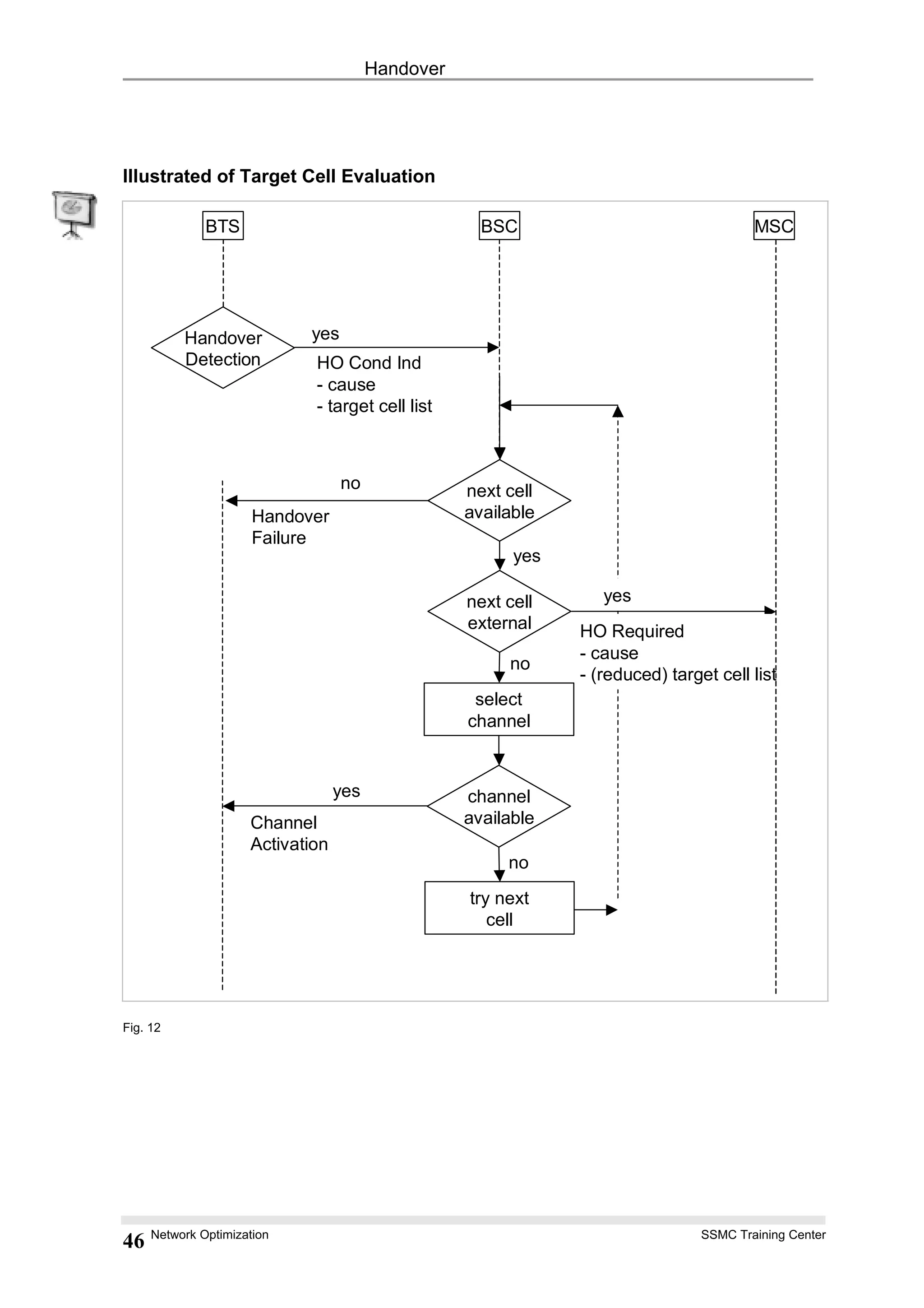
4.3 Evaluation of the Target Cell List
Intracell Handover:
A HO Condition Indication message with cause Intracell HO without target cell list is
sent from the BTSE to the BSC.
The BSC selects the new channel for the call within the same BTSE.
Intercell Handover
A HO Condition Indication message containing the HO cause and the target cell list is
sent from the BTSE to the BSC.
If the first cell within the target cell list is within its BSS area, the BSC selects a
channel at the corresponding BTS.
If no channel is available at that BTS, the next cell within the target cell is tried.
If the first target cell (or the ones tried in further steps) does not belong to the own
BSS area, a Handover Required message is sent to the MSC.
This message contains a reduced target cell list (without the cells tried internally).
Network Optimization SSMC Training Center
45
Handover
Illustrated of Target Cell Evaluation
BTS BSC MSC
Handover
Detection
yes
next cell
available
HO Cond Ind
- cause
- target cell list
next cell
external
yes
no
channel
available
try next
cell
no
no
Handover
Failure
yes
yes
HO Required
- cause
- (reduced) target cell list
select
channel
Channel
Activation
Fig. 12
Network Optimization SSMC Training Center
46
Handover
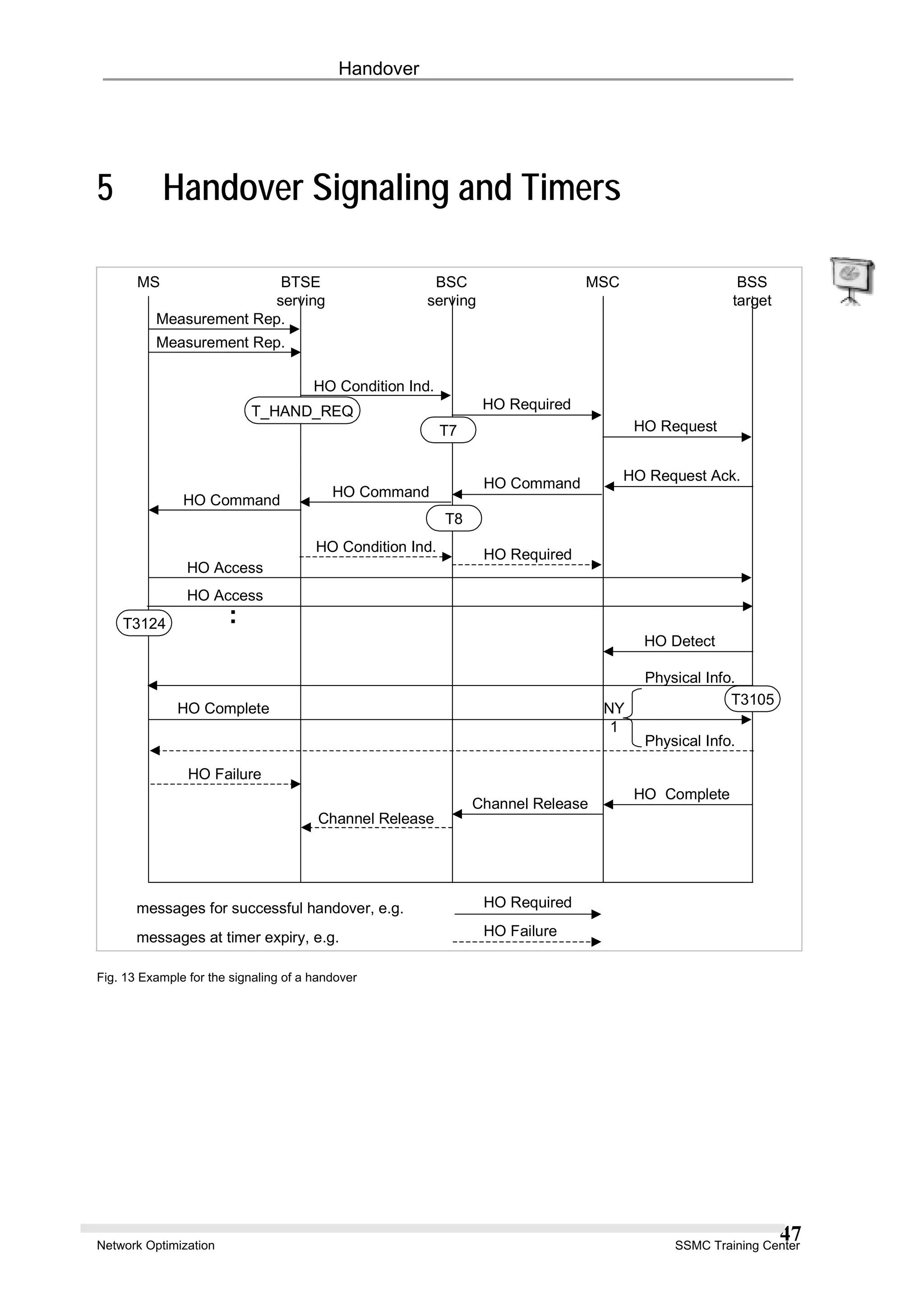
5 Handover Signaling and Timers
MS BTSE
serving
BSC
serving
MSC BSS
target
messages for successful handover, e.g.
messages at timer expiry, e.g.
HO Required
HO Failure
Channel Release
Channel Release
HO Complete
Physical Info.
HO Detect
T3105
HO Required
HO Condition Ind.
HO Access
HO Access
T3124
..
HO Complete
HO Failure
HO Command
HO Command
HO Command
HO Request Ack.
T8
T7 HO Request
HO Required
Physical Info.
HO Condition Ind.
Measurement Rep.
Measurement Rep.
T_HAND_REQ
NY
1
Fig. 13 Example for the signaling of a handover
Network Optimization SSMC Training Center
47
Handover
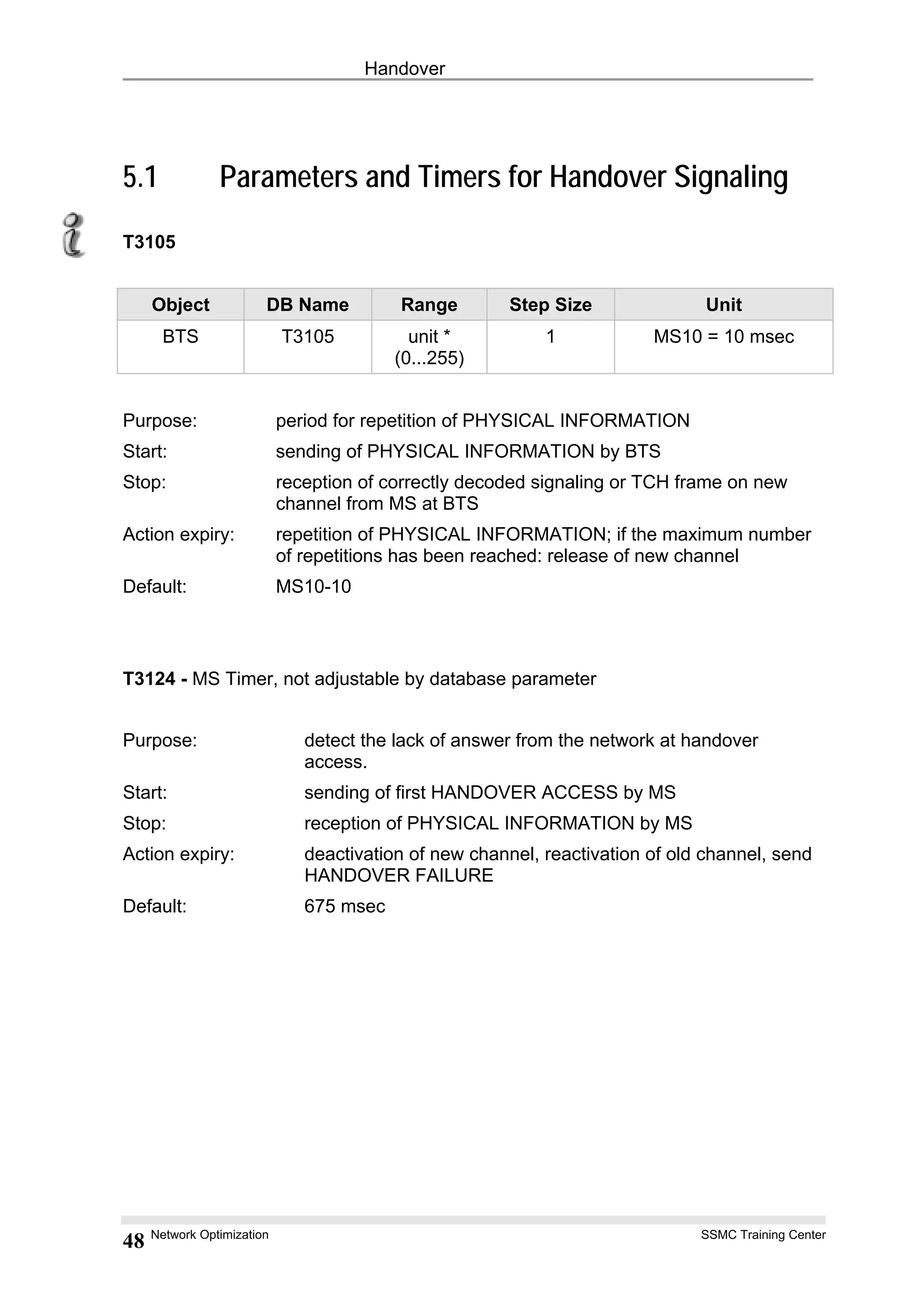
5.1 Parameters and Timers for Handover Signaling
T3105
Object DB Name Range Step Size Unit
BTS T3105 unit *
(0...255)
1 MS10 = 10 msec
Purpose: period for repetition of PHYSICAL INFORMATION
Start: sending of PHYSICAL INFORMATION by BTS
Stop: reception of correctly decoded signaling or TCH frame on new
channel from MS at BTS
Action expiry: repetition of PHYSICAL INFORMATION; if the maximum number
of repetitions has been reached: release of new channel
Default: MS10-10
T3124 - MS Timer, not adjustable by database parameter
Purpose: detect the lack of answer from the network at handover
access.
Start: sending of first HANDOVER ACCESS by MS
Stop: reception of PHYSICAL INFORMATION by MS
Action expiry: deactivation of new channel, reactivation of old channel, send
HANDOVER FAILURE
Default: 675 msec
Network Optimization SSMC Training Center
48
Handover
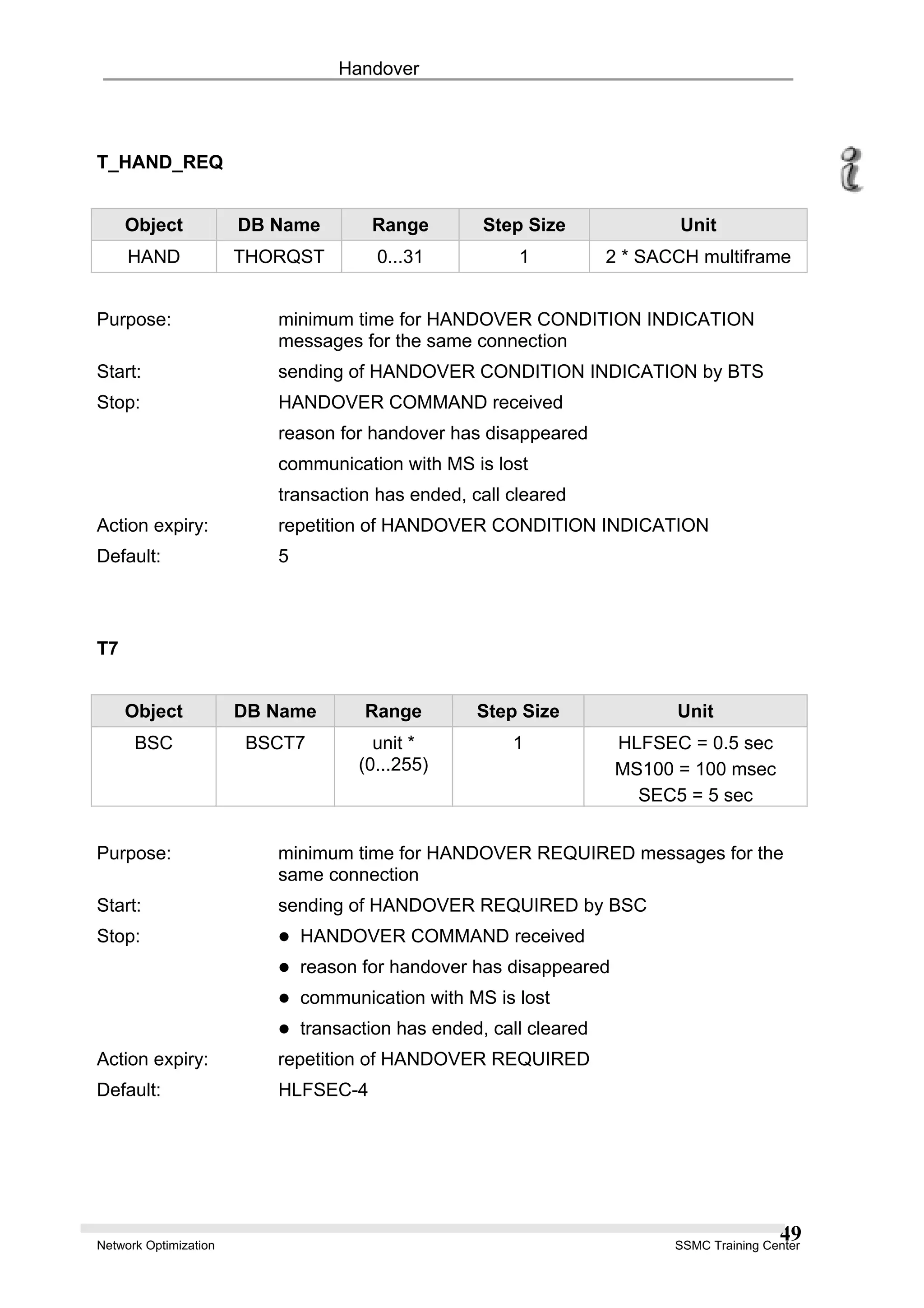
T_HAND_REQ
Object DB Name Range Step Size Unit
HAND THORQST 0...31 1 2 * SACCH multiframe
Purpose: minimum time for HANDOVER CONDITION INDICATION
messages for the same connection
Start: sending of HANDOVER CONDITION INDICATION by BTS
Stop: HANDOVER COMMAND received
reason for handover has disappeared
communication with MS is lost
transaction has ended, call cleared
Action expiry: repetition of HANDOVER CONDITION INDICATION
Default: 5
T7
Object DB Name Range Step Size Unit
BSC BSCT7 unit *
(0...255)
1 HLFSEC = 0.5 sec
MS100 = 100 msec
SEC5 = 5 sec
Purpose: minimum time for HANDOVER REQUIRED messages for the
same connection
Start: sending of HANDOVER REQUIRED by BSC
Stop: HANDOVER COMMAND received
reason for handover has disappeared
communication with MS is lost
transaction has ended, call cleared
Action expiry: repetition of HANDOVER REQUIRED
Default: HLFSEC-4
Network Optimization SSMC Training Center
49
Handover
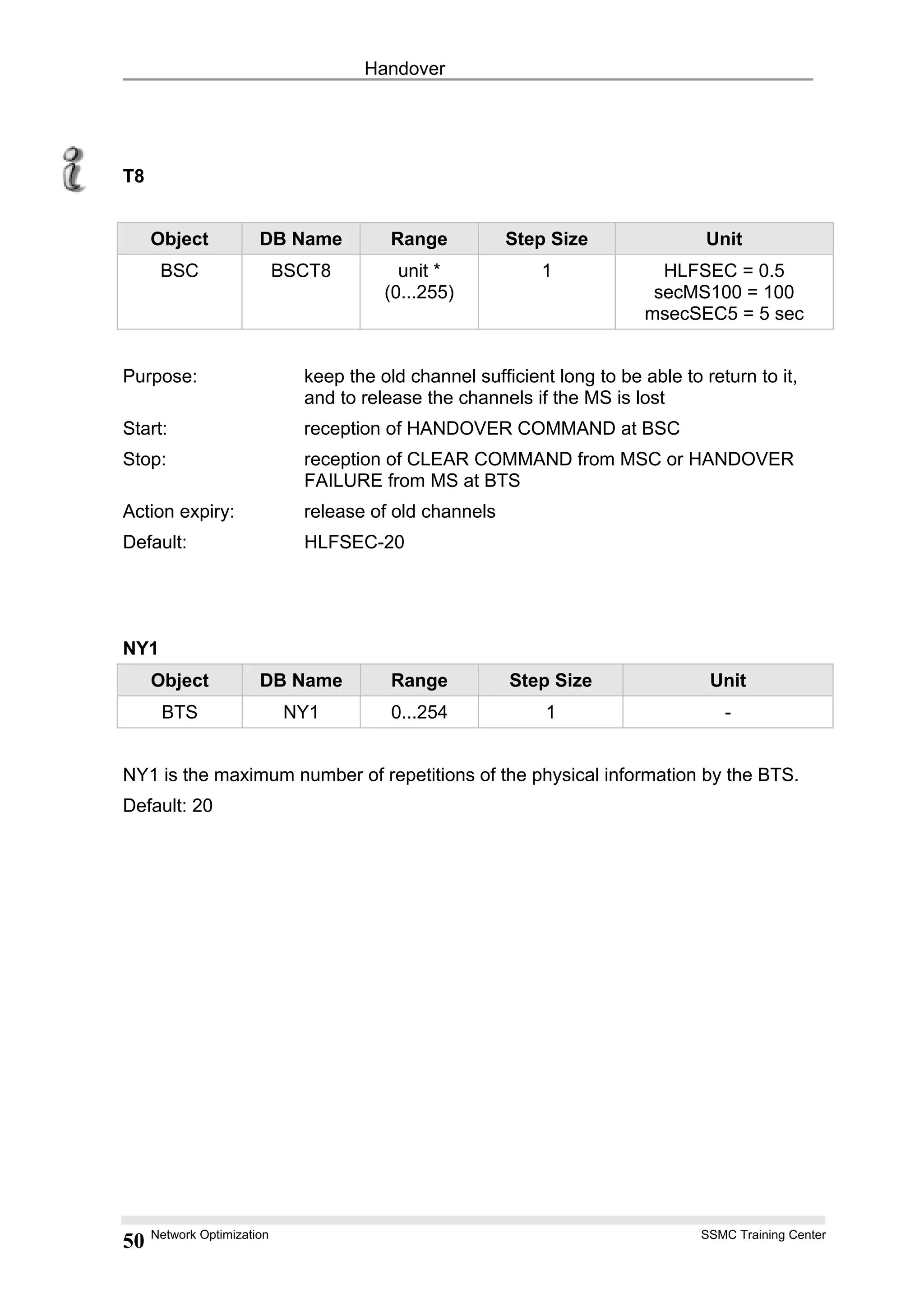
T8
Object DB Name Range Step Size Unit
BSC BSCT8 unit *
(0...255)
1 HLFSEC = 0.5
secMS100 = 100
msecSEC5 = 5 sec
Purpose: keep the old channel sufficient long to be able to return to it,
and to release the channels if the MS is lost
Start: reception of HANDOVER COMMAND at BSC
Stop: reception of CLEAR COMMAND from MSC or HANDOVER
FAILURE from MS at BTS
Action expiry: release of old channels
Default: HLFSEC-20
NY1
Object DB Name Range Step Size Unit
BTS NY1 0...254 1 -
NY1 is the maximum number of repetitions of the physical information by the BTS.
Default: 20
Network Optimization SSMC Training Center
50
Handover
6 Preemption, Directed Retry, Queuing
Network Optimization SSMC Training Center
51
Handover
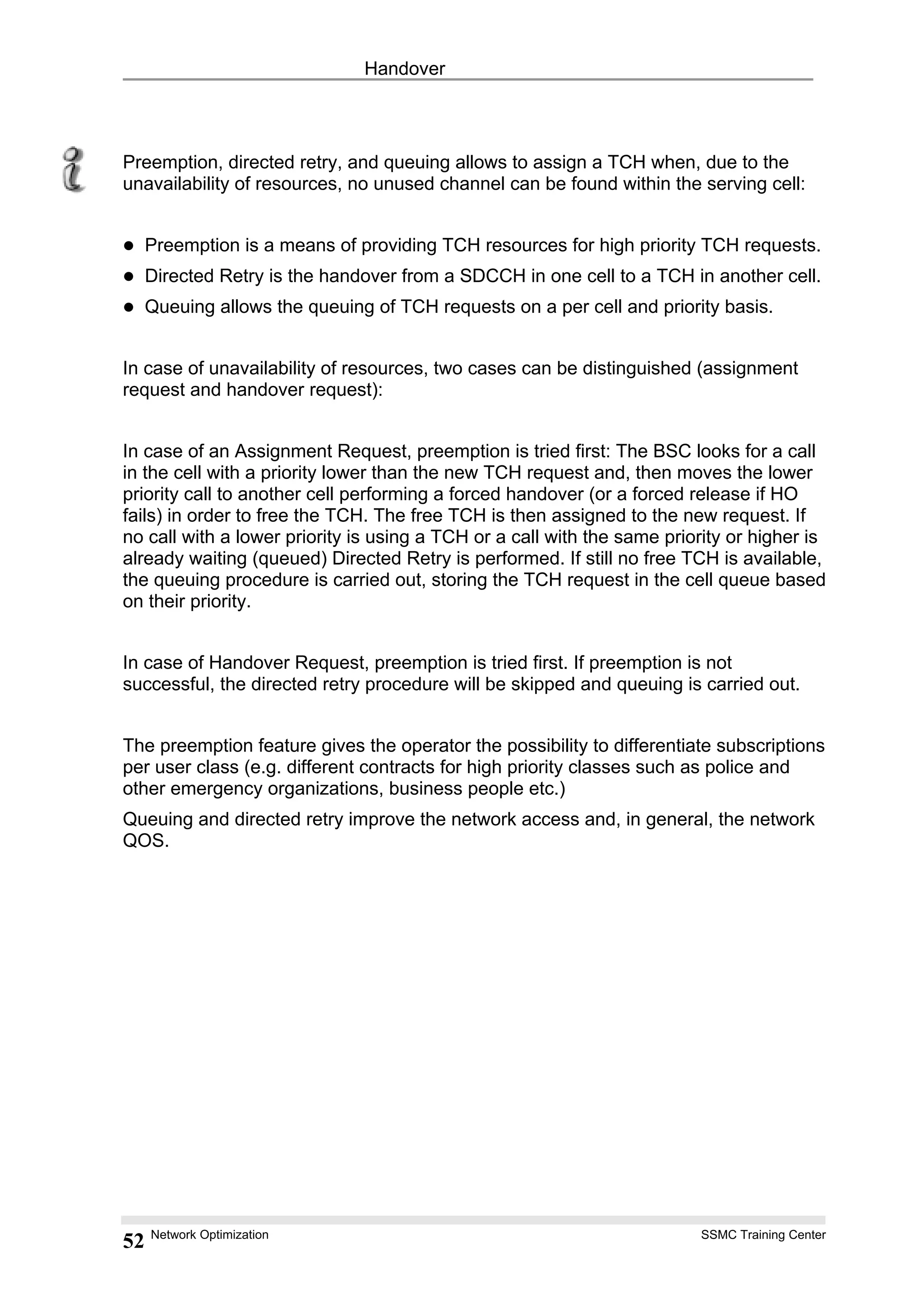
Preemption, directed retry, and queuing allows to assign a TCH when, due to the
unavailability of resources, no unused channel can be found within the serving cell:
Preemption is a means of providing TCH resources for high priority TCH requests.
Directed Retry is the handover from a SDCCH in one cell to a TCH in another cell.
Queuing allows the queuing of TCH requests on a per cell and priority basis.
In case of unavailability of resources, two cases can be distinguished (assignment
request and handover request):
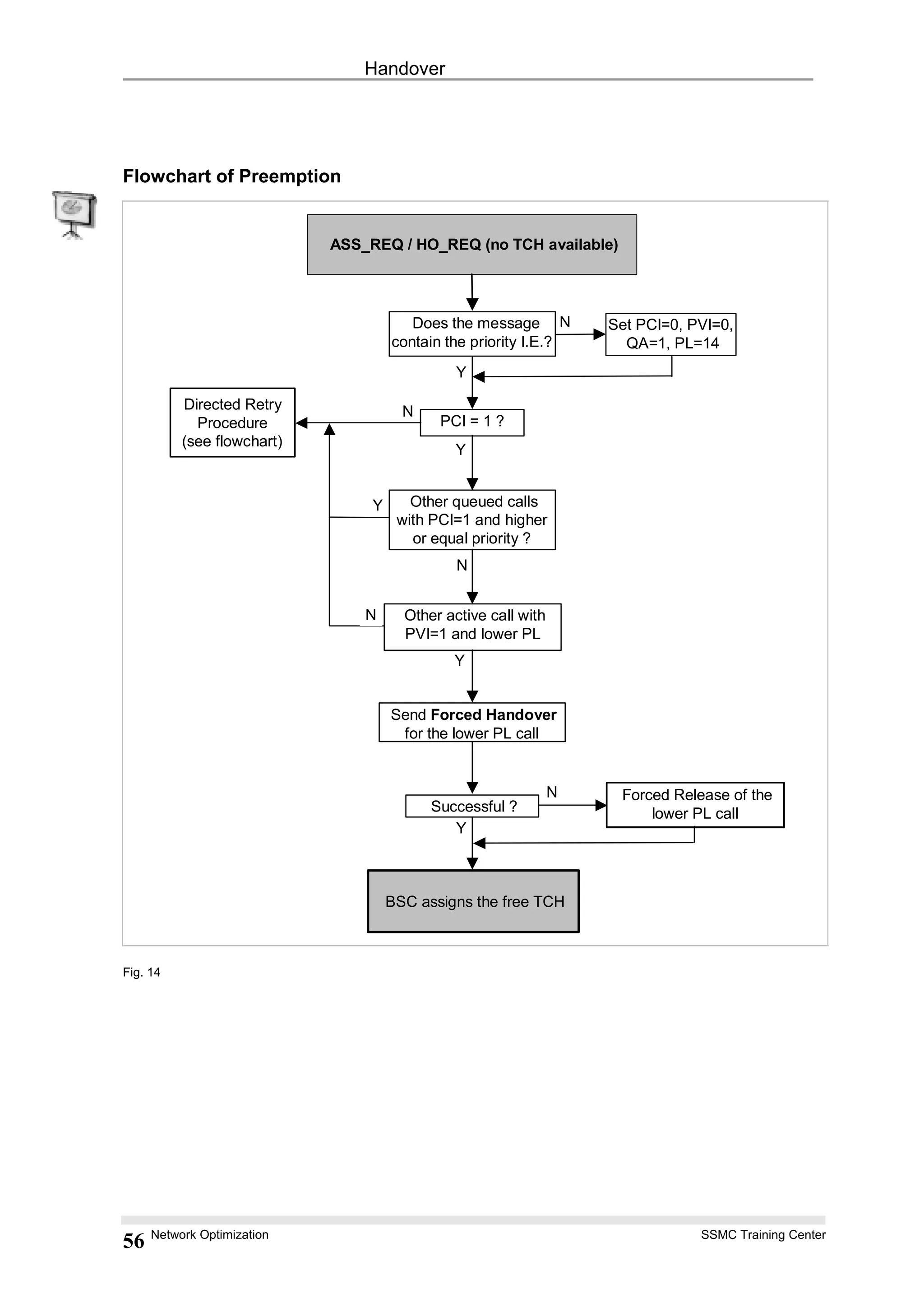
In case of an Assignment Request, preemption is tried first: The BSC looks for a call
in the cell with a priority lower than the new TCH request and, then moves the lower
priority call to another cell performing a forced handover (or a forced release if HO
fails) in order to free the TCH. The free TCH is then assigned to the new request. If
no call with a lower priority is using a TCH or a call with the same priority or higher is
already waiting (queued) Directed Retry is performed. If still no free TCH is available,
the queuing procedure is carried out, storing the TCH request in the cell queue based
on their priority.
In case of Handover Request, preemption is tried first. If preemption is not
successful, the directed retry procedure will be skipped and queuing is carried out.
The preemption feature gives the operator the possibility to differentiate subscriptions
per user class (e.g. different contracts for high priority classes such as police and
other emergency organizations, business people etc.)
Queuing and directed retry improve the network access and, in general, the network
QOS.
Network Optimization SSMC Training Center
52
Handover
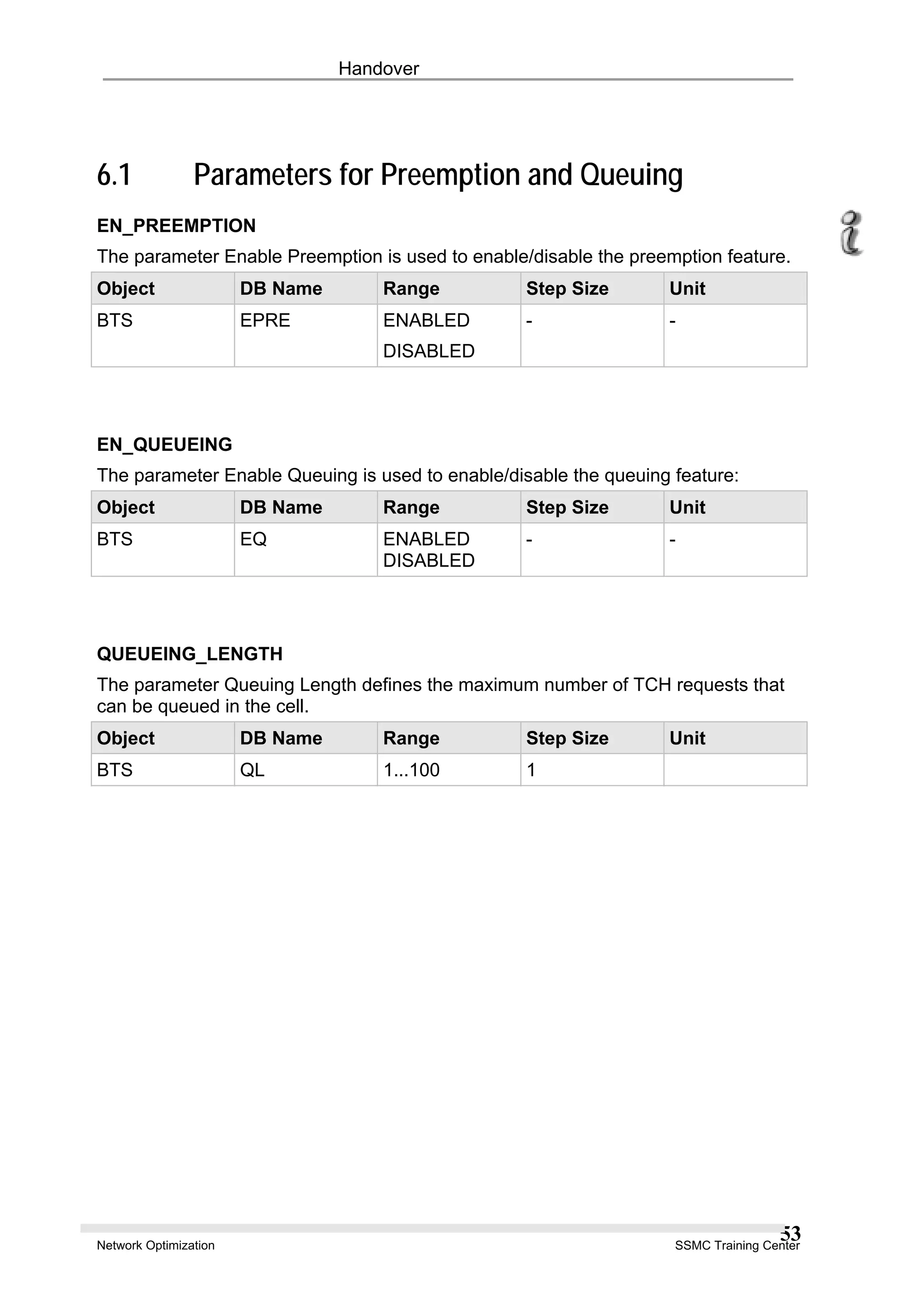
6.1 Parameters for Preemption and Queuing
EN_PREEMPTION
The parameter Enable Preemption is used to enable/disable the preemption feature.
Object DB Name Range Step Size Unit
BTS EPRE ENABLED
DISABLED
- -
EN_QUEUEING
The parameter Enable Queuing is used to enable/disable the queuing feature:
Object DB Name Range Step Size Unit
BTS EQ ENABLED
DISABLED
- -
QUEUEING_LENGTH
The parameter Queuing Length defines the maximum number of TCH requests that
can be queued in the cell.
Object DB Name Range Step Size Unit
BTS QL 1...100 1
Network Optimization SSMC Training Center
53
Handover
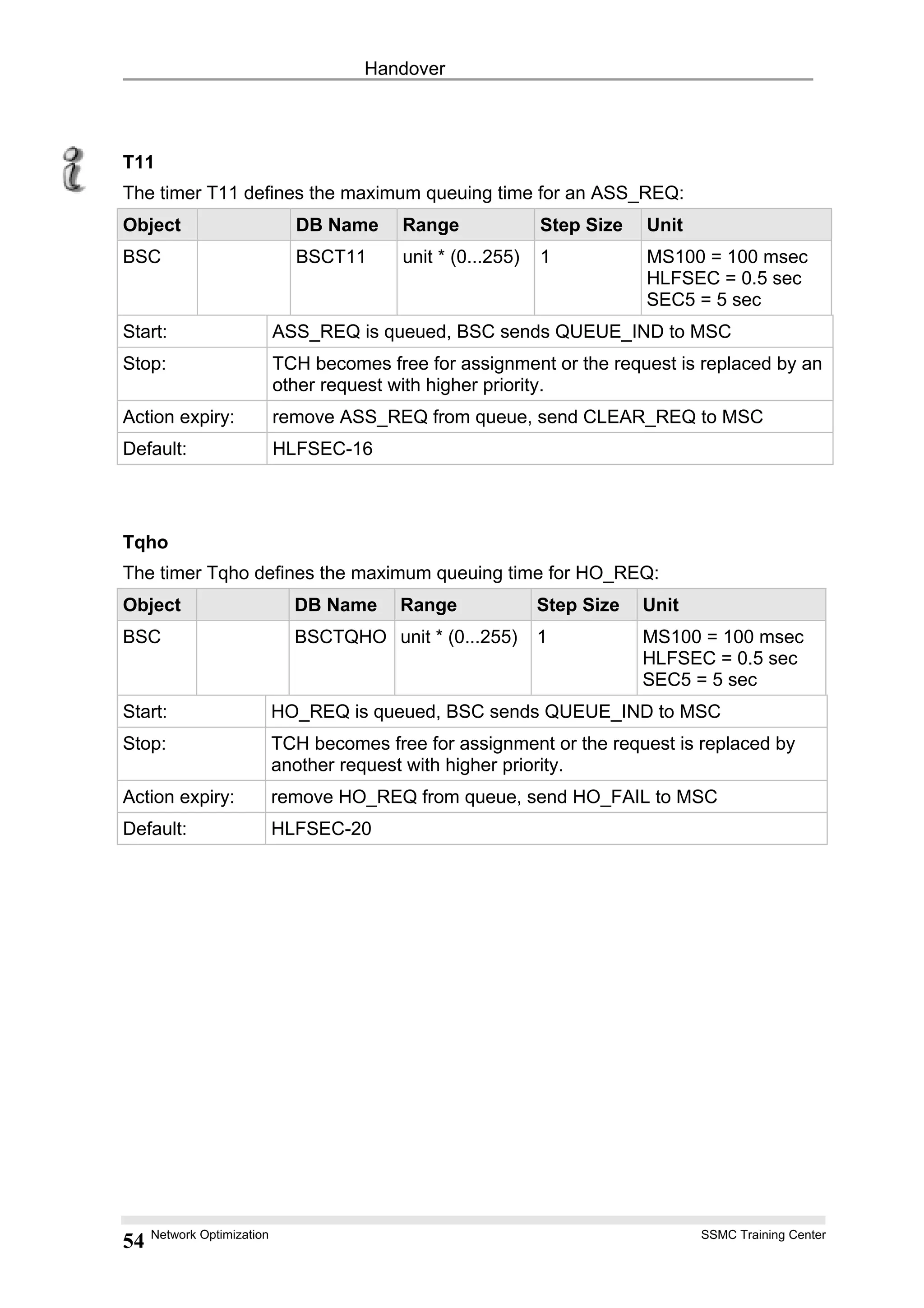
T11
The timer T11 defines the maximum queuing time for an ASS_REQ:
Object DB Name Range Step Size Unit
BSC BSCT11 unit * (0...255) 1 MS100 = 100 msec
HLFSEC = 0.5 sec
SEC5 = 5 sec
Start: ASS_REQ is queued, BSC sends QUEUE_IND to MSC
Stop: TCH becomes free for assignment or the request is replaced by an
other request with higher priority.
Action expiry: remove ASS_REQ from queue, send CLEAR_REQ to MSC
Default: HLFSEC-16
Tqho
The timer Tqho defines the maximum queuing time for HO_REQ:
Object DB Name Range Step Size Unit
BSC BSCTQHO unit * (0...255) 1 MS100 = 100 msec
HLFSEC = 0.5 sec
SEC5 = 5 sec
Start: HO_REQ is queued, BSC sends QUEUE_IND to MSC
Stop: TCH becomes free for assignment or the request is replaced by
another request with higher priority.
Action expiry: remove HO_REQ from queue, send HO_FAIL to MSC
Default: HLFSEC-20
Network Optimization SSMC Training Center
54
Handover
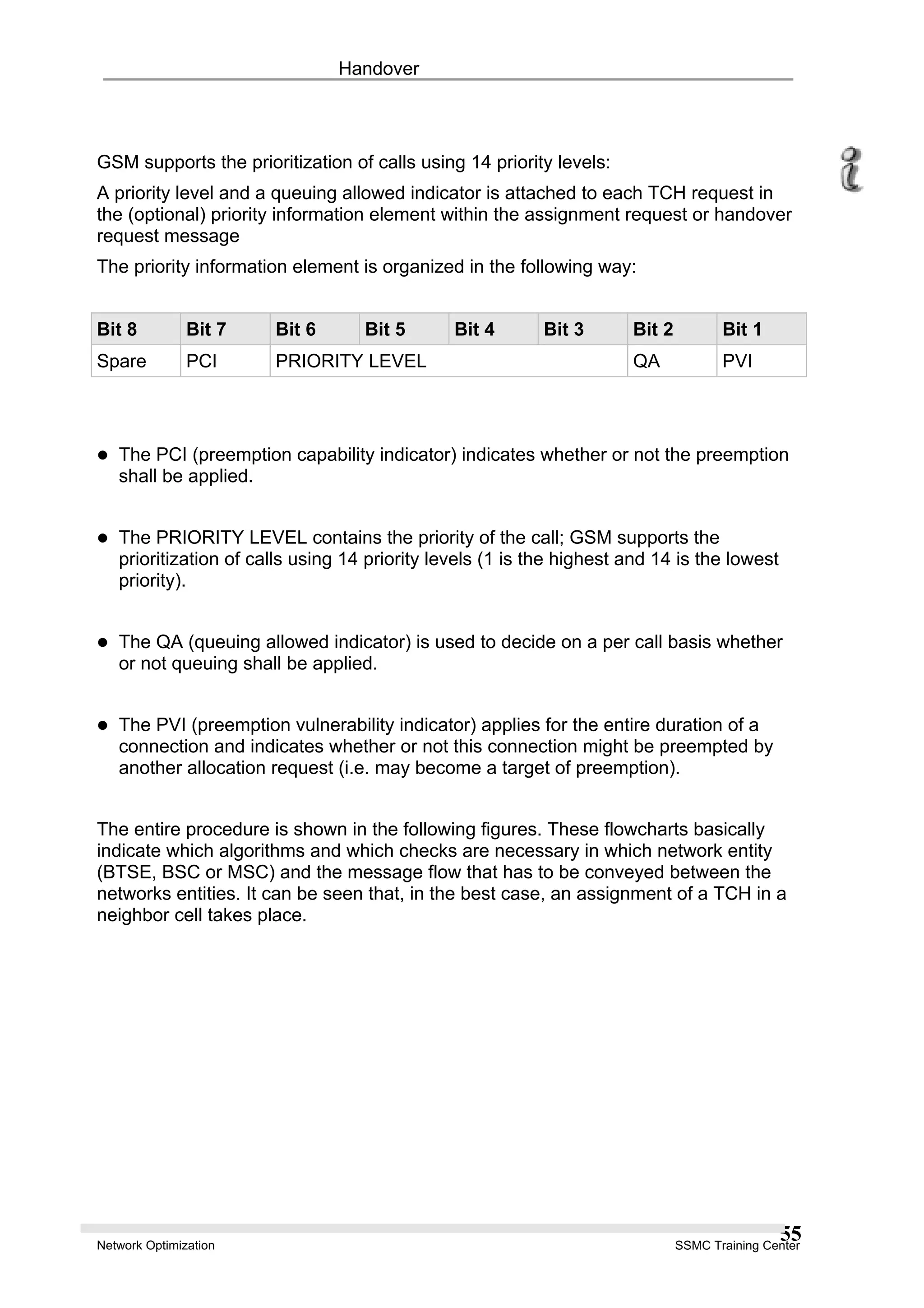
GSM supports the prioritization of calls using 14 priority levels:
A priority level and a queuing allowed indicator is attached to each TCH request in
the (optional) priority information element within the assignment request or handover
request message
The priority information element is organized in the following way:
Bit 8 Bit 7 Bit 6 Bit 5 Bit 4 Bit 3 Bit 2 Bit 1
Spare PCI PRIORITY LEVEL QA PVI
The PCI (preemption capability indicator) indicates whether or not the preemption
shall be applied.
The PRIORITY LEVEL contains the priority of the call; GSM supports the
prioritization of calls using 14 priority levels (1 is the highest and 14 is the lowest
priority).
The QA (queuing allowed indicator) is used to decide on a per call basis whether
or not queuing shall be applied.
The PVI (preemption vulnerability indicator) applies for the entire duration of a
connection and indicates whether or not this connection might be preempted by
another allocation request (i.e. may become a target of preemption).
The entire procedure is shown in the following figures. These flowcharts basically
indicate which algorithms and which checks are necessary in which network entity
(BTSE, BSC or MSC) and the message flow that has to be conveyed between the
networks entities. It can be seen that, in the best case, an assignment of a TCH in a
neighbor cell takes place.
Network Optimization SSMC Training Center
55
Handover
Flowchart of Preemption
ASS_REQ / HO_REQ (no TCH available)
Set PCI=0, PVI=0,
QA=1, PL=14
N
PCI = 1 ?
N
Y
Other queued calls
with PCI=1 and higher
or equal priority ?
Y
Other active call with
PVI=1 and lower PL
N
Send Forced Handover
for the lower PL call
Successful ?
Forced Release of the
lower PL call
BSC assigns the free TCH
Y
N
Y
Y
N
Directed Retry
Procedure
(see flowchart)
Does the message
contain the priority I.E.?
Fig. 14
Network Optimization SSMC Training Center
56
Handover
6.2 Directed Retry
Directed retry is the transition (handover) from a SDCCH in one cell to a TCH in
another cell during call setup because of unavailability of an empty TCH within the
first cell.
Directed retry is a means to control the traffic distribution between cells and to avoid
a call rejection because of congestion in one cell. If Queuing of ASS REQs is not
supported within a BSC Directed retry is merely triggered by the BSC by sending a
Forced HO Request message to the BTS, which has to respond with a "initiated"
Intercell HO Cond. Indic. message.
It can happen that the Intercell HO Cond. Indic. message does contain only an empty
target cell list (If triggered by a Forced HO Request message the BTS has to send a
Intercell HO Cond. Indic. message even if no suitable neighbor cell exists - in this
case the target cell list is empty!). In this case a TCH cannot be assigned and the
BSC shall not send a HO RQD message to the MSC of course but shall send an ASS
FAILURE (cause "no radio resource available").
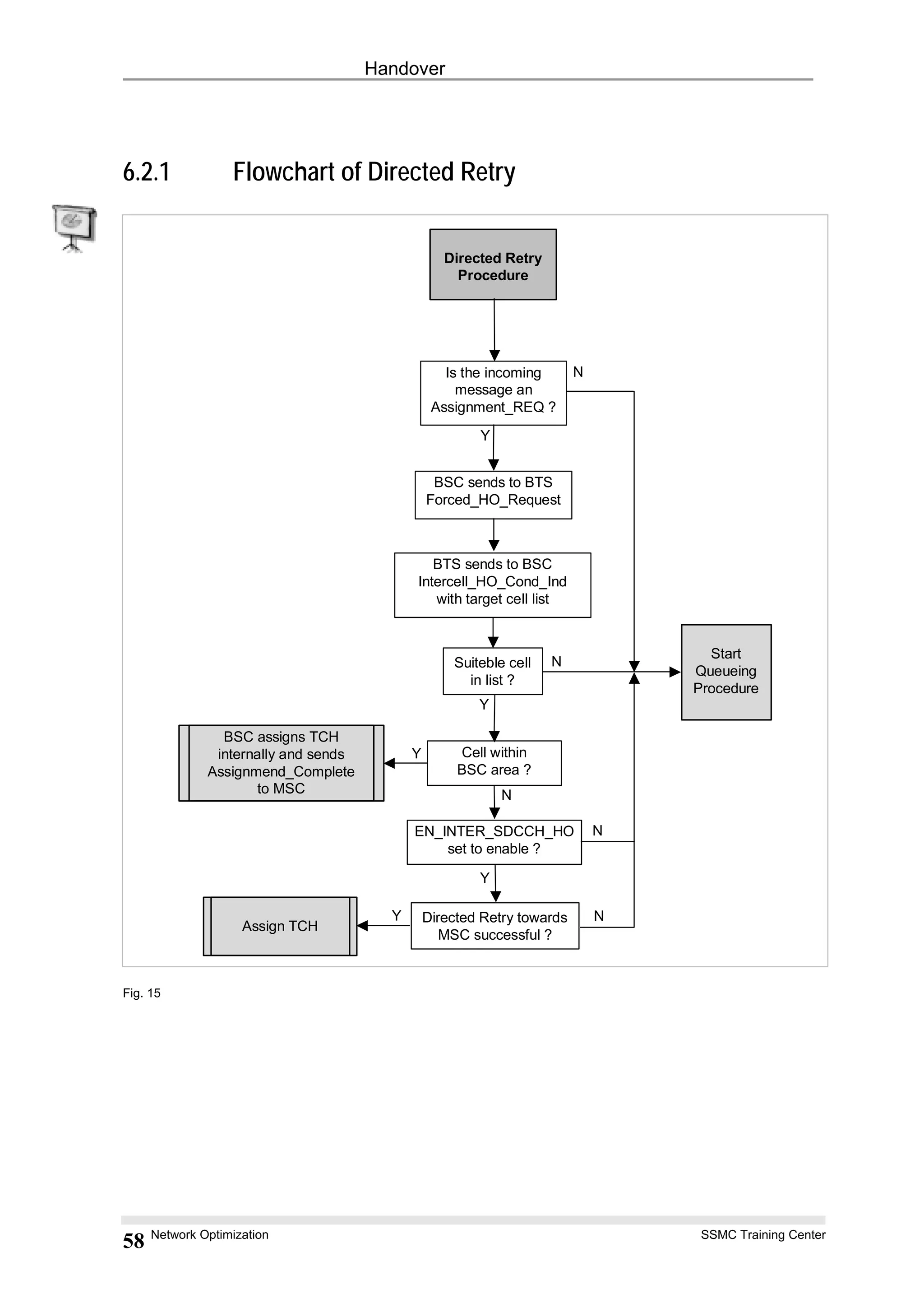
If the target cell list contains cells from inside and outside the BSC area and if e.g.
the first and second cell is inside, the third outside and the fourth inside the BSC area
than the Directed retry attempts shall be carried out as BSC controlled Directed
retries to the first and second one. If these Directed retries are not possible for any
reason (e.g. no empty TCH) than the third attempt and all following attempts
(independently whether the fourth and the following cells lie in- or outside the BSC
area) shall be executed as MSC controlled Directed retry.
If in case of a MSC controlled handover the MS cannot access the new cell and the
MSC receives a HO FAILURE (cause "radio interface failure, reversion to old
channel") from the old BSS, it can happen that the MSC generally releases this
SDCCH connection by sending a CLEAR CMD message (cause "radio interface
failure, reversion to old channel") to the BSC independently.
If the MSC does not support Directed retry HO´s the BSC may perform BSC
controlled Directed retries (approximately 75% of all Directed retries) only. In this
case the EN_INTER_SDCCH_HO flag in the BSC shall be set to "disabled" and the
BSC has to check the target cell list of Intercell HO_Cond_Ind messages belonging
to a SDCCH connection. All cell identifiers not belonging to the BSC area shall be
skipped and if there remain cell identifiers belonging to the BSC area the
corresponding HO shall be performed to strongest (if impossible to the second
strongest, third strongest etc.) remaining cell. If the target cell list does not contain a
remaining or any cell identifier of the same BSC area, this Intercell HO Cond. Indic.
message shall be discarded and the BSC shall release this SDCCH connection
(Sending of an ASS FAILURE with cause "no radio resource available").
Network Optimization SSMC Training Center
57
Handover
6.2.1 Flowchart of Directed Retry
Directed Retry
Procedure
Is the incoming
message an
Assignment_REQ ?
BSC sends to BTS
Forced_HO_Request
BTS sends to BSC
Intercell_HO_Cond_Ind
with target cell list
Cell within
BSC area ?
N
Y
N
Y
EN_INTER_SDCCH_HO
set to enable ?
N
Assign TCH
Start
Queueing
Procedure
BSC assigns TCH
internally and sends
Assignmend_Complete
to MSC
Suiteble cell
in list ?
Y
N
Directed Retry towards
MSC successful ?
Y
NY
Fig. 15
Network Optimization SSMC Training Center
58
Handover
6.2.2 HO Algorithm and Generation of the Target Cell List for
Directed Retry
The BTS has to send the Intercell HO Cond. Indic. messages toward the BSC. For
Directed retry the sending of an Intercell HO Cond. Indic. message for a SDCCH may
only be triggered by a BTS external event: The BSC sends a Forced HO Request
because of "no TCH available".
If an Intercell HO Cond. Indic. message is to be sent, the target cell list shall contain
all neighbor cells, which fulfill the following condition:
RXLEV > RXLEV_MIN + Max(0, MS_TXPWR_MAX-P) +
FHO_RXLEV_MIN_OFFSET
The ranking of the neighbor cells in the target cell list is performed in the order of
decreasing values of:
PBGT - HO_MARGIN
Additional parameters specific to speed sensitive HO shall be taken into account for
the ranking of the target cells.
Even if no suitable neighbor cell exists, the BTS shall send an Intercell HO Cond.
Indic. message. In this case the target cell list ("Cell Identif. List Pref. IE") shall be
empty!
The cause of the Intercell HO Cond. Indic. message shall be FORCED.
FHO_RXLEV_MIN_OFFSET is a cell specific O&M-parameter to select only target
cells for forced HO which the MS can access without any problems. It is a result of
radio planning for each individual cell. It allows to influence the amount of Forced
HOs failed because of empty target cell list, the amount of HO attempts back to the
"old" cell and the success rate of HO ACCESSes to the target cell
Network Optimization SSMC Training Center
59
Handover
6.2.3 Prevention of Back-Handovers
A major general problem of forced HO (Directed retry is one sort of forced HO!) is the
probability of HO due to PBGT back to the "old" (congested) cell. Its drawbacks are:
1. increased load at the Abis-interface because of periodic sending of Intercell
HO_Cond_Ind messages in intervals of T7
2. increased load at the A-interface in case of inter-BSC-HO because of the same
reason
3. additional processor capacity in BSC (and MSC) is required for HO trials for
which it is known in advance that they are useless
4. the load in the congested cell will not be reduced for a certain time, but it will be
kept at a permanent high level.
For the Channel Activation message a new optional information element "Cell
Identifier List (no target)" is defined. This information element contains the cell
identifier (CI) of a cell from which a handover request (intra- or inter-BSC) because of
forced HO was received. If this information element exists in the Channel Activation
message, the BTS
shall not trigger a (TCH-)HO due to PBGT for the time Tbho if the PBGT condition
is fulfilled for the indicated cell only and
shall not include the indicated CIs in the target cell list in this case for the time
Tbho (i.e. for the condition HO due QUAL/LEV/DIST the indicated cell identifier
may be part of the target cell list)
Tbho is a timer that limits the mentioned prohibitions. It has to be set by O&M
command.
If a HO is necessary the target BSC has to generate the Channel Activation
message. The target BSC shall insert the Cell Identifier List (no target) IE into this
message
The BSC shall derive the CI for the Cell Identifier List (no target) IE from the stored
context in case of intra BSC HO or from the mandatory Cell Identifier (serving) IE of
the HO REQ message in case of inter BSC HO with cause "Directed retry".
Network Optimization SSMC Training Center
60
Handover
6.3 Parameters for Directed Retry
EN_FORCED_HO
Object DB Name Range Step Size Unit
BSC ENFORCHO ENABLE
DISABLE
- -
This BSC specific O&M flag allows to enable/disable the sending of Forced HO
Request messages for running SDCCH connections (e.g. queued or not queued ASS
REQs which do not find an empty TCH). It is used to enable/disable Directed retry.
This flag should be set to "disable" by an operator if in a network the MSC which the
BSS is connected to or other adjacent BSS do not support the prevention of "back-
HO".
EN_INTER_SDCCH_HO
Object DB Name Range Step Size Unit
BSC ESDCCHHO ENABLE
DISABLE
- -
This BSC specific O&M flag allows to enable/disable inter BSC SDCCH-HO (i.e.
SDCCH-SDCCH-HO and Directed retry). It simply prevents the sending of HO RQD
messages for SDCCH connections to the MSC.
This flag should be set to disable by an operator if in the network the MSC to where
the BSS is connected to or other adjacent BSS do not support the prevention of
back-HO. If it set to disable the BSC shall skip all cell identifiers of the target cell list
of the Intercell HO Cond. Ind. message, which belong to another BSC area.
Network Optimization SSMC Training Center
61
Handover
FHO_RXLEV_MIN_OFFSET
Object DB Name Range Step Size Unit
ADJC FHORLMO 0...24 1 1 dB
FHO_RXLEV_MIN_OFFSET ("RXLEV_MIN offset for forced-handover") is a cell
specific O&M-parameter used within the BTS to select only target cells for forced HO,
which the MS can access without any problems. It is a result of radio planning for
each individual cell. It allows to influence the amount of Forced HO failed because of
empty target cell list, the amount of HO attempts back to the "old" cell and the
success rate of HO ACCESSes to the target cell.
Default: 6
Tbho
Object DB Name Range Step Size Unit
ADJC TIMERFHO 1...320 1 10 sec
Tbho (bho=back handover) is a network wide O&M parameter. It is the value of a
timer running in the BTS that controls the duration how long a former serving cell
from which forced HO was performed to the new serving cell may not be considered
in the HO decision algorithm of the new serving cell and may not be contained in the
target cell list. It is started at the reception of a Channel Activation message
containing a Cell Identifier (no target) IE.
Default: 12
Network Optimization SSMC Training Center
62
Handover
7 Enhancements introduced with BR6.0
Network Optimization SSMC Training Center
63
Handover
7.1 HO Decision due to BSS Resource
Management Criteria
7.1.1 General
H/O Decision due to BSS Resource Management Criteria allows to move a
connection for traffic reasons from one cell to an adjacent cell, even in case that a
handover due to radio conditions is not required.
Thus, the traffic during busy hours can be redistributed in the network. It enables to
serve a higher number of subscribers by existing equipment, thus increasing the
network capacity. H/O Decision due to BSS Resource Management Criteria also
provides higher cell planning flexibility and avoids the planning of new resources into
a cell or channel reservation in a cell for high traffic situations.
7.1.2 Basics
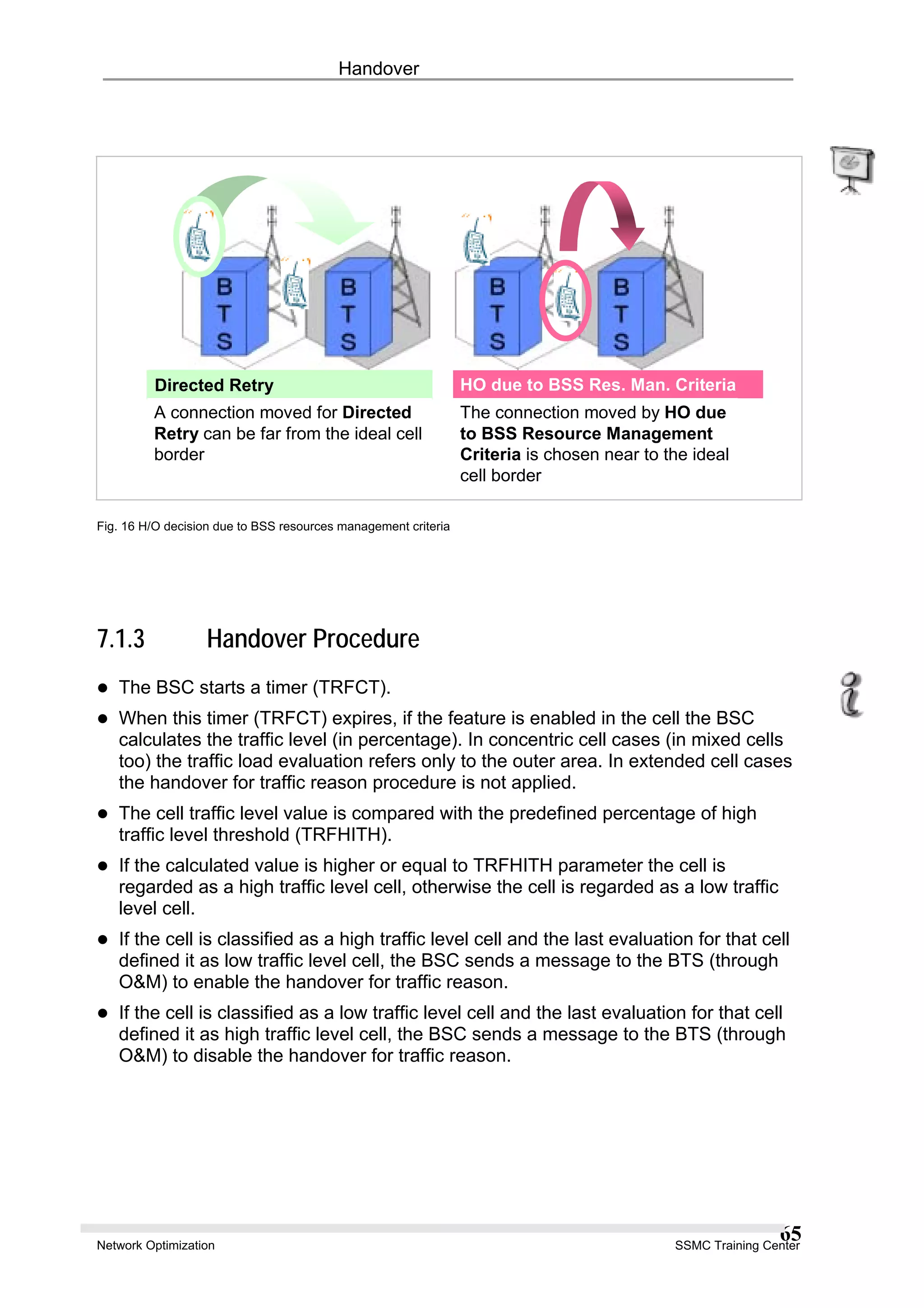
This feature as well as Directed Retry increases network capacity. Whereas Directed
Retry acts on new connections by moving them towards adjacent cells, H/O Decision
due to BSS Resource Management Criteria moves connected users towards
adjacent cells allowing in the previously used cells new connections to be set up. A
connection moved for Directed Retry can be far from the ideal cell border, while the
connection moved by H/O Decision due to BSS Resource Management Criteria is
chosen near to the ideal cell border.
The priority of H/O Decision due to BSS Resource Management Criteria is below
power budget handover cause evaluation. This implies no degradation of service,
since the priority of imperative handover is higher than the priority for H/O Decision
due to BSS Resource Management Criteria.
When the function is enabled (ETRFHO parameter) in a cell, the following procedure
is applied:
1. The BSC starts a timer TRAFCONTROL_TIME for this cell.
2. At the expiry of this timer, the traffic level is evaluated for that cell by the BSC. If
the percentage of busy TCHs is higher or equal to TRAFFICOUT, the cell is
regarded as high traffic level.
3. If there is a transition in the traffic level in respect to the previous evaluation, the
BSC sends via O&M command to the BTSE the indication that the handover due
to traffic reason has to be enabled/disabled in the specific cell.
The neighboring cells included in the candidate list are ranked. When the candidate
list is ready, the BTS sends to the BSC an inter cell handover condition message that
includes the preferred list of candidates and the cause traffic for the handover
request. When the BSC receives the request, the list is analyzed and the cells with
traffic higher than TRAFFICIN are discarded. In the target cell a back handover for
traffic reasons and power budget is inhibited for the TPENTR duration time.
Network Optimization SSMC Training Center
64
Handover
Directed Retry
A connection moved for Directed
Retry can be far from the ideal cell
border
HO due to BSS Res. Man. Criteria
The connection moved by HO due
to BSS Resource Management
Criteria is chosen near to the ideal
cell border
Fig. 16 H/O decision due to BSS resources management criteria
7.1.3 Handover Procedure
The BSC starts a timer (TRFCT).
When this timer (TRFCT) expires, if the feature is enabled in the cell the BSC
calculates the traffic level (in percentage). In concentric cell cases (in mixed cells
too) the traffic load evaluation refers only to the outer area. In extended cell cases
the handover for traffic reason procedure is not applied.
The cell traffic level value is compared with the predefined percentage of high
traffic level threshold (TRFHITH).
If the calculated value is higher or equal to TRFHITH parameter the cell is
regarded as a high traffic level cell, otherwise the cell is regarded as a low traffic
level cell.
If the cell is classified as a high traffic level cell and the last evaluation for that cell
defined it as low traffic level cell, the BSC sends a message to the BTS (through
O&M) to enable the handover for traffic reason.
If the cell is classified as a low traffic level cell and the last evaluation for that cell
defined it as high traffic level cell, the BSC sends a message to the BTS (through
O&M) to disable the handover for traffic reason.
Network Optimization SSMC Training Center
65
Handover
7.1.4 Database Parameters
DB
Name
Object Range Description
BHOFOT ADJC 1 … 120
(default: 100)
During run-time of this timer a back handover
due to PBGT or traffic reason is forbidden
(backHoForbiddenTimer).
TRFHOM ADJC 0 … 126 (step
in dB)
0=-63 dB,
126=63 dB,
default 67=4 dB
Specifies the nominal border between cells
(trafficHoMargin).
TRFHOE HAND TRUE, FALSE
(default)
Enable / disable the traffic HO feature
(trafficHOenabled)
TRFHITH HAND 50 … 100 %
(default: 90 %)
Defines the high traffic level threshold which
enables / disables traffic HO from a cell
(trafficHighThreshold)
TRFLTH HAND 0 … 85 %
(default: 70 %)
Defines the low traffic level threshold which
makes a cell into a candidate to receive
handover due to traffic (trafficLowThreshold)
TRFMS HAND 1 … 6 (dB),
default 3 (dB)
Used to establish the minimum reduction for
TRFHOM (trafficMarginStep).
TRFMMA HAND 1 … 48 (dB),
default 9 (dB)
Used to establish the maximum reduction for
TRFHOM (trafficMarginMaximum).
TRFKPRI HAND TRUE, FALSE
(default)
It is effective only when HCS is enabled and
determines whether candidate cells must be of
the same priority as the serving cell
(TRFKPRI=YES) or may be of the same or
higher priority (TRFKPRI=NO,
trafficKeepPriority).
Network Optimization SSMC Training Center
66
Handover
TRFHOT HAND 2 ... 20 (sec),
default: 10
Timer used to establish the period of time to
wait before updating the m value. The m value
is increased if the handover for traffic reason is
enabled and decreased if the handover for
traffic reason is disabled, m is updated until it
reaches the value 0 (trafficHoTimer).
Each time this timer expires, the internal
margin (m) for the traffic HO is altered. If
enableTrafficHo is set to TRUE then m is
increased, if enableTrafficHo is FALSE then it
is decreased. As long as m > 0 the BTS
evaluates the handover for traffic reason. If m
becomes "0" trafficHoTimer is stopped and the
handover for traffic reason is no longer
evaluated. The maximum value of m is
calculated by dividing trafficMarginMaximum by
trafficMarginStep.
TRFCT BSC 5 ... 100 sec,
step=0.5 sec
(default: 10
sec)
Timer establishing for each BTS the interval
between evaluating the traffic level
(trafficControlTimer)
7.1.5 Requirements
The "traffic" cause is not foreseen on the A interface and the serving BSC cannot
control the channel occupancy of a cell belonging to another BSC, consequently the
handover for traffic reason may be performed only between cells belonging to the
same BSC.
The handover for traffic reason is the lowest priority one because the technically
necessary handovers shall be performed first in order not to disturb the normal
network behavior too much.
The HO due to resource criteria is not triggered for extended cells. In concentric cells
only the outer area is checked for the resource criteria.
H/O Decision due to BSS Resource Management Criteria is a pure software feature.
Hardware modifications are not required. Mobile stations and SSS are not affected by
this feature.
Network Optimization SSMC Training Center
67
Handover
7.2 Fast Uplink Handover
7.2.1 General
When a mobile enters a shadow area caused by buildings or short tunnels, a call can
drop down because of long handover decision time or when the chosen cell is also
shadowed by the same building.
Fast Uplink Handover is used as high-speed handover to prevent from rapid uplink
level loss and is applied to save connections in special places with drop call
problems. This behavior is more likely for GSM1800 or GSM1900 MHz systems than
for GSM900 systems because of the different characteristics of the diffraction effects
depending on the wavelength. When the power level of a mobile decreases rapidly, a
handover can be performed to a predefined cell to save the connection.
In case that a mobile subscriber is moving out of a micro cell but all adjacent cells are
congested, the target cell list, which is generated for Fast Uplink Handover, allows
changing the margin to include a higher number of cells to which the handover can
be performed. This increased target cell list offers the possibility to save the call.
7.2.2 Basics
In case of an uplink level loss shorter than 3 s the normal handover triggering with
averaging windows is too slow (> 4 s). A moving mobile will be lost at cell boundary
or in shadowed areas.
The BTS maintains a Fast Uplink Handover specific bookkeeping list for each
possible adjacent cell (up to 32) in which the neighbor cell measurements of the
mobile, the downlink RXLEV (RXLEV of serving cell measured by the mobile) and the
BTS transmit power are compiled and averaged. This bookkeeping list is the basis for
generation and sorting of the target cell list.
The Fast Uplink Handover is performed independently of the capabilities of power
control when they have been exhausted, i.e. current transmit power of MS / BTS
have the maximum value. The handover detection is performed for the uplink path
and is based on a comparison of the uplink measurement receive level with a
(configurable) threshold. The Fast Uplink Handover is detected when the uplink
measurement receive level is lower than this threshold.
Because the Fast Uplink Handover provides the last opportunity to maintain a call,
the back handover to the old cell and the handover repetitions are allowed to act very
fast to changing radio conditions.
Network Optimization SSMC Training Center
68
Handover
7.2.3 SBS Implementation
7.2.3.1 Signal Level
Downlink measurements contain a signal level mapped to the RXLEV (Reception
LEVel) according to GSM 05.08. The Received Signal Strength Indication (RSSI)
values of uplink measurements sampled (via one multiframe) are mapped by the BTS
according to GSM 05.08.
RXLEV Range in dBm
00 -∞ ... ≤ -110
01 -110 < ... ≤ -109
02 -109 < ... ≤ -108
. . . . . .
62 -49 < ... ≤ -48
63 -48 < ... + ∞
7.2.3.2 Neighboring Cell Bookkeeping
When triggered by the reception of a SACCH report (either for a TCH or a SDCCH)
the BTS stores the downlink measurements in a bookkeeping list.
The hoAveragingPowerBudget averaging size (by default approx. 7.7 s) is not
suitable to reflect the current situation related to the event "Fast Uplink Handover"
because it is too long. When a FUHO is detected by evaluating the UL
measurements (e.g. during the last second), a target cell has to be found that was
good during that time (last second) and not during the last 7.7 seconds (during which
the measurements of the hoAveragingPowerBudget were averaged).
Thus, a separate average must be calculated for the FUHO, which is based on the
window-size for the FUHO on the received UL-level. The window-size in the FUHO's
bookkeeping list is one size smaller than that of the FUHO averaging window.
Network Optimization SSMC Training Center
69
Handover
7.2.3.3 Detection of FUHO
During the handover detection procedure, the average e.g. of the UL receive level is
calculated and must know which UL measurement to use; the full (in case the mobile
station didn't use a DTX) or the partial (in case the mobile station did use the DTX).
This is indicated by a "dtx_used" flag included in the SACCH report.
A SACCH report received during the reporting period #n contains data that the
mobile station collected during the reporting period #(n-1). Thus, the most recent data
for the detection of a normal handover within the measurement period #n (triggered
by the reception of the SACCH report) can use origins from the measurement period
#(n-1).
To seize the opportunity of saving approx. 400 ms, the FUHO detection is not
triggered by the arrival of a SACCH report (as "normal" HO) but by the “end of
measurements”. The BTS calculates the average over the averaging window for all of
the handover types to find out whether the calculated average is above a certain
threshold or not and, if appropriate, send a message to the BSC indicating the need
of a handover.
The time saved with this procedure is constant (approx. 400 ms), its gain is high for
short averaging windows and diminishes with growing averaging window sizes.
Due to the nature of the “Fast Uplink Handover”, its averaging window size (database
attribute averagedLevFastULHo.aLevFuHo; default value 2) is be significantly shorter
than the averaging window size hoAveragingPowerBudget (default value 16).
7.2.3.4 Handling of HSCSD Calls
When the condition for a FUHO is detected for any of the timeslots serving a HSCSD
call, a FUHO has to be initiated for the main-channel of this HSCSD call (max 4 TS).
7.2.3.5 Generation of the target Cell List
As a candidate for the target cell list, the minimum condition applies for the
neighboring cell n:
RXLEV_NCELL(n) > RXLEVMIN(n) + max(0; Pa) + FULRXLVMOFF;
where Pa = MTXPWAX – P
MTXPWAX: maximum RF transmission power that a mobile station is permitted to
use on a traffic channel in an adjacent cell.
P: maximum transmission power capabilities of the mobile station
The target cell list is sorted into two sections, the first (high priority) section contains
cells marked as "predefined cells" that have the attribute fastULHoCell set to TRUE.
The second section contains cells that are not "predefined cells".
Both sections are sorted in decreasing order by the power budget PBGT of the
neighboring cells, i.e. the cell with the lowest value of PBGT is ranked last.
Network Optimization SSMC Training Center
70
Handover
7.2.3.6 Prevention of a FUHO
The FUHO is not detected
until the averaging window averaging window is full (end of measurements)
as long as the timer for handovers is running (another handover has been
triggered and is pending)
when an assignment is pending (when the call is between assignment command
and establish indication and due to these measurements are explicitly not
compiled and averaged).
Other handover prevention algorithms (e.g. back-handover to the old cell) are not
explicitly implemented so as to reserve the FUHO as a last opportunity to maintain a
call.
7.2.3.7 Priority of FUHO
The FUHO is not ranked with the normal handover causes, because its detection is
not triggered by the reception of a SACCH_(NO_)REPORT but by the detection of
the "end of measurements".
Network Optimization SSMC Training Center
71
Handover
7.2.4 Database Parameters
DB Name Object Range Description
EFULHO HAND TRUE,
FALSE (default)
Flag used to enable/disable the FUHO.
(Note: also internal intercell HO must
be enabled, parameter INTERCH)
THLEVFULHO HAND 0 ... 63 FUHO is possible when (FUHO
average) RXLEVUL decreases below
THLEVFULHO.
ALEVFULHO HAND aLevFuHo=1-31
(1 SACCH
multiframe step
size, default: 2)
wLevFuHo=1-3
(step size 1,
default: 1)
Averaging parameters used for FUHO
signal strength measurements.
aLevFuHo gives averaging window
size (smaller than normal window
size), wLevFuHo indicates weighting
factor for "full" measurements
(optional)
FULHOC ADJC TRUE,
FALSE (default)
When searching for FUHO target cells,
cells with attribute FULHOC "TRUE"
are preferred to cells with FULHOC
"FALSE"
FULRXLVMOFF ADJC 0, ... , 126
step size 1 dB,
where 0=-63 dB,
126=63 dB,
default 69=6 dB
RX level necessary for a neighbor cell
to be included in the FUHO target cell
list.
7.2.5 Requirements
Fast Uplink Handover is a pure software feature. Hardware modifications are not
required. Mobile stations and SSS are not affected by this feature.
Network Optimization SSMC Training Center
72
Handover
7.3 Introduction of "Level Handover Margin"
Parameter
7.3.1 General
"Level Handover Margin" Parameter offers a new target cell criteria that takes the
different requirements for level handover and quality handover into consideration.
The creation of the target cell list is based on these new criteria.
With this feature there are fewer dropped calls in poor coverage areas. The new
algorithm works in a dynamic and more global way. The level handover is performed
to the better cell and is triggered quicker with more safety.
A cell may offer a good outdoor coverage but can also include a poorly covered area
for instance within a building or close to a corner. In these cases the previous
algorithm does not trigger a level handover if there are no target cells in a certain
area of coverage. Instead a quality handover or power budget handover is triggered
which are less reliable or slower. In such mixed situations, i.e. good covered and bad
covered areas, it is now possible to configure the level handover independently.
7.3.2 Basics
When the handover detection algorithm evaluates a handover condition, a target cell
list is generated, i.e. a list of all adjacent cells which are considered as handover
candidates. The target cell list is based on the neighbor cell measurements of the
mobile. The RXLEV_MIN(n) setting for level handover is optimized concerning the
level.
Since quality handover is mainly a protection against interference, not necessarily
linked to the level received, a quality handover to a cell with similar or even lower
level may save an interfered call. Previously any type of handover required a target
cell with a level higher than L_RXLEV_XX + x with 3 dBm ≤ x ≤ 6 dBm. This reduces
the chance of saving an interfered call in poorly covered (interference sensitive)
areas.
To guarantee that a level handover will be performed to a cell with a higher level than
that of the serving cell, the candidate cell will now be included in the target cell list if
additionally to the previously used condition
RXLEV_NCELL(n) > RXLEV_MIN(n) + max (0,Pa) also
RXLEV_NCELL(n) > RXLEV_DL + LHOMARGIN.
The operator on a cell basis can define this new parameter LHOMARGIN. The
implementation of both conditions offers the operator the choice to prevent level
handover below a certain level that the operator defines as not suitable for handover
by setting RXLEVMIN. This new algorithm is very flexible since the operator still has
the possibility to decide that RXLEVMIN does not impact the level handover by
setting it to a low level.
Network Optimization SSMC Training Center
73
Handover
7.3.3 Database Parameter
The operator has the possibility to enable or disable this feature. If this feature is
disabled, the traditional solution
RXLEV_NCELL(n) > RXLEV_MIN(n) + max(0,Pa)
is chosen.
Object DB Name Range
(Default)
Description
HAND ELEVHOM TRUE/
FALSE
(FALSE)
The attribute EnableLevHOMargin
indicates whether the level
handover margin
(RXLEV_NCELL(n) > RXLEV_DL
+ LHOMARGIN) is enabled or
disabled.
ADJC LEVHOM 0...126, steps
of 1 dB.
0 = - 63 dB,
126 = + 63 dB
(69= 6 dB)
The value of this attribute is used
as a threshold to guarantee a
handover to a target cell with a
higher level than the serving cell
(thus not meeting the conditions for
a subsequent level HO) without
altering the behavior of the other
imperative HO types. The path loss
difference between the serving and
the adjacent cell has to exceed this
margin for a level handover. In
general a positive value should be
chosen. But for special
applications its possible to choose
a negative value to force a HO
even in the case of a lower level in
the target cell in which case (to
avoid oscillating handovers) the
LevelhoMargin in the ADJC of the
new cell referring to the old cell
should be positive.
7.3.4 Requirements
Introduction of ‘Level Handover Margin’ Parameter is a pure software feature.
Hardware modifications are not required. The feature does not affect mobile stations
and SSS releases.
Network Optimization SSMC Training Center
74
Handover
7.4 Enhanced Pairing for Half-Rate Channels
7.4.1 General
Enhanced Pairing for TCH/H Channels provides the half rate channel pairing in case
a TCH/F is requested but (initially) unavailable. This is done by an intracell handover
of half rate channels providing capacity for a full rate channel. Enhanced Pairing for
TCH/H Channels is also provided for AMR half rate channels.
This feature provides an optimization of radio resources and therefore a reduced
blocking probability on the Um interface.
Before Enhanced Pairing
Intracell Handover
After Enhanced Pairing
0 1 0 1 1 0 1 0 1 1 0 1 0 100
0 1 0 1 1 0 1 0 1 1 0 1 0 100
0 Subslot used 0 Subslot empty
Fig. 17 Enhanced pairing for TCH/H channels: Example
Network Optimization SSMC Training Center
75
Handover
7.4.2 Basics
TCH half rate channels have been introduced to increase the number of traffic
channels available in the network. The possible configurations for traffic channels are
full rate only traffic channels and dual rate traffic channels. Due to static pairing of
half rate channels only at call set up, situations may occur in which the radio
resources are not fully exploited. If some half rate channels are released it might
happen that there is no possibility to allocate a full rate channel, although several half
rate channels are free.
In the following example in each dual rate timeslot, the sub slots are discriminated
with 0 and 1. Grey color indicated a busy channel, whereas white color indicates a
free channel. The time slots are identified as TS-0 to TS-7.
TS#0 TS#1 TS#2 TS#3 TS#4 TS#5 TS#6 TS#7
0 1 0 1 0 1 0 1 0 1 0 1 0 1 0 1
When all channels are busy (as half-rate) the occupation is
0 1 0 1 0 1 0 1 0 1 0 1 0 1 0 1
After some half-rate channels are released (e.g. 3), the new occupation is
0 1 0 1 0 1 0 1 0 1 0 1 0 1 0 1
Although there are three half-rate channels free, there is no possibility to allocate a
full rate channel if required. This is an inefficient management of radio resources.
A new algorithm avoids this situation and provides an efficient use of radio resources.
At the reception of a TCH/F channel request (normal assignment or handover) and if
no TCH/F is available, a reorganization of the half rate channel pairing is
performed in order to free an entire time slot for full rate.
The stable call is moved from TS2-1 to TS5-0 by a forced intra cell handover. After
the handover has been successfully completed, TS2 is available to satisfy the TCH/F
channel request previously received.
Network Optimization SSMC Training Center
76
Handover
7.4.3 Database Parameters
The ENPAIRINGINTRAHO BSC O&M parameter must be set to TRUE to enable the
described forced Intracell Handover procedure.
Parameter Object Range Description
EPA BSC TRUE, FALSE Enable channel pairing.
7.4.4 Requirements
Concentric Cells: The forced intra cell handover is allowed only in the same area
(inner or complete), i.e. it is not possible to force a "complete to inner" or "inner to
complete" intracell handover.
Extended Cells: The forced handover is only allowed between "single" channels
(inner area).
No modifications on existing mobiles are required. Dual mode mobiles (full rate/half
rate mobiles) are required for the assignment of half rate.
Enhanced Pairing for TCH/H Channels is a pure software feature. Hardware
modifications are not required. SSS releases are not affected.
Network Optimization SSMC Training Center
77
Handover
Network Optimization SSMC Training Center
78
Handover
8 Handover related Performance
Measurements
Network Optimization SSMC Training Center
79
Handover
In a running network the handover performance can be monitored using the
handover performance measurements.
On the one hand, handovers are important for mobility and traffic distribution, on the
other hand they are associated with a greater amount of signaling. The evaluation of
the handover performance measurements enables weak points to be identified and
corrected at an early stage:
For example in a well planned network handovers with certain reasons should
predominate those with other reasons.
By measuring the number of handovers between cells, locations with greater or
lesser handover activity can be localized, and also missing neighbor cell relations
in the database can be found out.
By varying handover threshold values it is possible to force traffic from highly
frequented cells into cells, which may be under less pressure earlier. A more
uniform distribution of traffic can be achieved in this way.
Network Optimization SSMC Training Center
80
Handover
Handover Performance Measurements
The following table summarizes the handover performance measurements:
Measurement Type Abbreviation Functional group
Intracell
Attempted internal Handovers, intracell,
per cause
ATINHIAC SCANBTS
Successful internal Handovers, intracell,
per cause
SINTHITA SCANBTS
Unsuccessful internal Handovers, intracell UNINHOIA SCANBTS
Attempted internal SDCCH Handovers
Intracell
AISHINTR SCANBTS
Successful internal SDCCH Handovers
Intracell
SISHINTR SCANBTS
Unsuccessful internal SDCCH Handovers
Intracell
UISHINTR SCANBTS
Unsuccessful internal Handover, intracell,
with loss of MS
UNIHIALC SCANBTS
Intercell
Attempted internal Handovers, intercell,
per cause
ATINHIRC SCANBTS
Successful internal Handovers, intercell,
per cause
SINTHINT SCANBTS
Attempted incoming internal intercell
Handovers per originating cell
AININIRH SCANBTSIHO
Successful incoming internal intercell
Handovers per originating cell
SININIRH SCANBTSIHO
Attempted outgoing intercell Handovers
per cause, per neighbor-cell relationship
AOUINIRH SCANBTSOHOI
Successful outgoing intercell Handovers
per cause, per neighbor-cell relationship
SOUINIRH SCANBTSOHOI
Unsuccessful internal Hos, intercell, with
reconnection to the old channel, cause, per
target cell
UNINHOIE SCANBTSOHOI
Network Optimization SSMC Training Center
81
Handover
Attempted Internal SDCCH Handovers
Intercell
AISHINTE SCANBTS
Successful Internal SDCCH Handovers
Intercell
SISHINTE SCANBTS
Unsuccessful Internal SDCCH Handovers
Intercell
UISHINTE SCANBTS
Total number of Handover failures, intra
BSC
HOFITABS SCANBSC
Unsuccessful internal Handovers, intercell,
with loss of MS
UNIHIRLC SCANBTS
Inter BSC
Attempted outgoing inter
BSC Handovers per
neighbor cell relationship
ATINBHDO SCANBTSOHON
Successful outgoing inter
BSC Handovers per
neighbor cell relationship
SUINBHDO SCANBTSOHON
Number of unsuccessful
outgoing inter BSC
Handovers per neighbor
cell relationship
NRUNINHD SCANBTSOHON
Attempted MSC controlled
SDCCH Handovers
AOINTESH SCANBTS
Successful MSC controlled
SDCCH Handovers
SOINTESH SCANBTS
Unsuccessful MSC
controlled SDCCH
Handovers
UOINTESH SCANBTS
Number of inter BSC
Handover failures
NRINHDFL SCANBSC
Others
Successful internal
Handovers per cause
SINHOBSC SCANBSC
Network Optimization SSMC Training Center
82
Handover
Queuing related performance measurements
In the following table the queuing related performance measurements are
summarized:
Mean TCH queue length
(Fullrate/Halfrate)
MTCHQLEN SCANBTS
Mean duration a TCH is
queued (Fullrate/Halfrate)
MDURTCRQ SCANBTS
Number of messages
discarded from the TCH
queue per cell
(Fullrate/Halfrate)
NMSGDISQ SCANBTS
Mean packet queue length
(on PDCH) per cell
MPDTQLEN SCANGPRS
Number of packet channel
assignment attempts
discarded from the packet
queue per cell
NPMSDISQ SCANGPRS
Network Optimization SSMC Training Center
83
Handover
Quality related performance measurement
The performance measurements related to power and quality measurements are
listed below:
Power and quality
measurements on
uplink/downlink busy TCHs
PWRUPDW SCANCHAN
Correlated RXLEV to
RXQUAL measurements
(uplink)
CRXLVQUU SCANTRX
Correlated RXLEV to
RXQUAL measurements
(downlink)
CRXLVQUD SCANTRX
Correlated RXLEV to Time
Advance measurements
(uplink)
CRXLVTAU SCANTRX
Correlated RXLEV to Time
Advance measurements
(downlink)
CRXLVTAD SCANTRX
Correlated FER to
RXQUAL measurements
CFERRXQU SCANTRX
Network Optimization SSMC Training Center
84
Handover
9 Exercise
Network Optimization SSMC Training Center
85
Handover
Network Optimization SSMC Training Center
86
Handover
Exercise
Task 1
Is the handover algorithm strictly defined in GSM?
In which GSM recommendation can you find information about the handover
process?
Color all the handover related parameters in the BSC database given in subsection 1.
Network Optimization SSMC Training Center
87
Handover
Task 2
Are all handover performance measurements defined by GSM?
In which GSM recommendation can you find information about performance
measurements?
Fill in the meaning of the following key words:
Keyword Meaning
Scanner
Performance measurement
Counter
Trigger event
Network Optimization SSMC Training Center
88

05 handover

  • 1.
    Handover Network Optimization SSMCTraining Center 1 Handover Contents 1 General 3 1.1 Steps of the Handover Process 4 1.2 Types of Handover 5 1.3 Handover Causes 6 1.4 Flags to Enable/Disable Handover Types and Causes 8 1.5 Comments 9 2 Measurement Preprocessing 11 2.1 Measurement Values 12 2.2 Summary of Measurement Values for Handover 16 2.3 Measurement Reporting and Neighbor Cell Book-Keeping 17 2.4 Illustration of Measurement Preprocessing 21 2.5 Parameters for Measurement Preprocessing 22 2.6 Remarks 23 3 Threshold Comparisons and Handover Detection Algorithms 25 3.1 Decision Criteria 26 3.2 Handover Regions 27 3.3 Power Budget 28 3.4 Parameters for Handover Decision 29 3.5 Priorities of Handover Causes 31 3.6 Limitation of Intracell Handover Repetition 32 3.7 Prevention of Back-Handover 34 3.8 Limitation of Handover Failure Repetition 36 3.9 Remarks 38 4 Target Cell List Generation 43 4.1 Conditions for Neighbor Cells to be included in the Target Cell List 44 4.2 Order Criterion for Handover Candidate Cells within the Target Cell List 44 4.3 Evaluation of the Target Cell List 45 5 Handover Signaling and Timers 47
  • 2.
    Handover 5.1 Parameters andTimers for Handover Signaling 48 6 Preemption, Directed Retry, Queuing 51 6.1 Parameters for Preemption and Queuing 53 6.2 Directed Retry 57 6.3 Parameters for Directed Retry 61 7 Enhancements introduced with BR6.0 63 7.1 HO Decision due to BSS Resource Management Criteria 64 7.2 Fast Uplink Handover 68 7.3 Introduction of "Level Handover Margin" Parameter 73 7.4 Enhanced Pairing for Half-Rate Channels 75 8 Handover related Performance Measurements 79 9 Exercise 85 Network Optimization SSMC Training Center 2
  • 3.
  • 4.
    Handover The handover mainobjectives are: maintaining a connection in case of a cell change (movement) changing a channel in case of severe disturbance (interference) designing cell borders and radio network structure 1.1 Steps of the Handover Process The handover process can be divided into several sub-processes: No. Sub-process Involved Network Element 1. Measurements: DL Level serving cell DL Quality serving cell DL Level neighbor cells UL Level UL Quality Timing advance MS BTSE 2. Measurement reporting and neighbor cell book-keeping MS BTSE 3. Measurement preprocessing BTSE 4. Threshold comparison and handover detection BTSE 5. Target cell list generation BTSE 6. Target cell list evaluation intra BSS handover inter BSS handover BSC MSC 7. Selection of new channel BSC 8. Handover execution MS, BTSE, BSC, MSC Network Optimization SSMC Training Center 4
  • 5.
    Handover 1.2 Types ofHandover Different types of handover can be distinguished with respect to the changed region: a cell, a BSS area or an MSC area. The different types of handover can be enabled or disabled by several flags. BSC 1b BSC 1a MSC 1 MSC 2 1. Intracell Handover 2. Intra-BSS Handover 3. Intra-MSC Handover 4. Inter-MSC Handover BSC 2 4 3 1 2 Fig. 1 Types of handover Network Optimization SSMC Training Center 5
  • 6.
    Handover 1.3 Handover Causes Twocriteria groups of different handover causes are defined: Radio Criteria received quality (too bad that means bit error rate too high) inter-/intracell HO received level (too low) intercell HO MS-BS distance (too high) intercell HO better cell (power budget: relative received level) intercell HO Network Criteria serving cell congestion --> directed retry for call setup, traffic handover for running calls intercell HO MS-BS distance (too high/low in extended cells) intracell HO received level or MS-BS distance (too low/high in concentric cells) intracell HO Network Optimization SSMC Training Center 6
  • 7.
    Handover The first threecauses are known as mandatory or imperative causes, i.e. if one of these causes occurs, a handover is necessary to maintain the call. This may happen because the MS is leaving the coverage area of the serving cell (intercell handover) or because there is a strong interferer using the same channel in another cell (intracell handover). The fourth cause is an optional one, i.e. the link quality in the serving cell is sufficiently good, but there are neighbor cells with better received level. Though its not necessary for the link quality of this specific call, there is a benefit for overall network performance to handover the call to the better cell: A call in the better cell causes less interference, especially, if power control is applied. To achieve the same received level in the better cell, a smaller transmit power can be used in this cell. In a well planned radio network “better cell” should be the overwhelming handover cause. Hence, the locations of a “better cell” handover determine the cell boundaries. The fifth cause is named forced handover because it is triggered by the BSC due to a congestion situation, and not due to radio conditions on the link. This handover (directed retry) is performed from a SDCCH in the congested cell to a TCH in a neighbor cell during call setup. The last two causes are intracell handovers in special cell configurations: in extended cells handovers are feasible from single to double timeslots and vice versa. In a concentric cell handovers are performed between the inner and complete area. These handover causes can be enabled/disabled separately by corresponding flags. Network Optimization SSMC Training Center 7
  • 8.
    Handover 1.4 Flags toEnable/Disable Handover Types and Causes The flags to enable (TRUE) / disable (FALSE) the different handover types and causes are listed in the table below. With one exception they are all administered in the object HAND. Specification Name DB Name Meaning EN_INTER_HO INTERCH Flag to enable/disable generally intercell handover for this BTS. EN_INTRA_HO INTRACH Flag to enable/disable generally intracell handover for this BTS. EN_BSS_INTER_HO LOTERCH Flag to determine weather inter cell handover are controlled by BSC (TRUE) or MSC (FALSE). EN_BSS_INTRA_HO LOTRACH Flag to determine weather intra cell handover are controlled by BSC (TRUE) or MSC (FALSE). EN_RXQUAL_HO RXQUALHO Flag to enable/disable intercell handover due to quality. EN_RXLEV_HO RXLEVHO Flag to enable/disable intercell handover due to level. EN_DIST_HO DISTHO Flag to enable/disable intercell handover due to distance. EN_PBGT_HO PBGTHO Flag to enable/disable better cell (power budget) handover. EN_FORCED_HO ENFORCHO (PKG BSCB) Flag to enable/disable forced handover. EN_EXTENDED_CELL_HO EXTCHO Flag to enable/disable extended cell handover. EN_CON_CELL_DIST_HO CCDIST Flag to enable/disable concentric cell distance handover. EN_INNER_INNER_HO ININHO Flag to enable/disable inner to inner handover in a sectorized concentric cell. Network Optimization SSMC Training Center 8
  • 9.
    Handover 1.5 Comments Enabling BSSinternal handover has the following advantages: - reduction of signaling load on the A-interface - reduction of processor load in the MSC - faster handover execution. Consequences: - BSS internal handover should be enabled, - BSS regions should be adapted to the real traffic flow to reduce the inter-BSS handover rate. Normally, intracell handover should be enabled to allow a handover from a channel with high interference to another one with less interference within the same cell. However, if random frequency hopping is applied, it may be reasonable to disable intracell handover since interference is approximately the same on all channels and no improvement can be achieved by intracell handover. If distance handover is disabled, a MS could largely exceed the planned cell boundaries in the case of favorable radio conditions at the serving cell without causing a handover. As a consequence, neighboring cells may suffer from excessive interference produced by this MS. Furthermore, there is a risk that link quality decreases very suddenly (turn around a corner), i.e. there is the risk of a call drop. Hence, distance handover should be switched on. If power budget handover is disabled, no handovers with cause “better cell” are generated. Nevertheless, power budget is calculated and evaluated for the ranking of neighbor cells within the target cell list, which also has to be compiled for mandatory handovers. Network Optimization SSMC Training Center 9
  • 10.
  • 11.
    Handover 2 Measurement Preprocessing NetworkOptimization SSMC Training Center 11
  • 12.
    Handover 2.1 Measurement Values Thefollowing values are measured and calculated each SACCH multiframe (480ms): RXQUAL: The received signal quality is defined according to GSM 05.08 as function of the bit error rate (BER) before channel decoding: RXQUAL = 0: BER < 0.2% assumed value: 0.14% RXQUAL = 1: 0.2% < BER < 0.4% assumed value: 0.28% RXQUAL = 2: 0.4% < BER < 0.8% assumed value: 0.57% RXQUAL = 3: 0.8% < BER < 1.6% assumed value: 1.13% RXQUAL = 4: 1.6% < BER < 3.2% assumed value: 2.26% RXQUAL = 5: 3.2% < BER < 6.4% assumed value: 4.53% RXQUAL = 6: 6.4% < BER < 12.8% assumed value: 9.05% RXQUAL = 7: 12.8% < BER assumed value: 18.01% The RXQUAL values are measured on the dedicated channel for the uplink as well as for the downlink for each TDMA frame (100 frames) within an SACCH multiframe. The measured RXQUAL values are averaged over the respective SACCH period using the assumed values of the table above. Network Optimization SSMC Training Center 12
  • 13.
    Handover Since there are104 TDMA frames in each SACCH multiframe (and the measurements in 4 of these frames are optional), the number of samples on each BCCH carrier depends on the number of carriers defined in the BCCH Allocation and therefore can be different: Number of BCCH carriers defined in the BCCH allocation Number of samples per carrier in each SACCH multiframe 32 3 - 4 16 6 - 7 10 10 - 11 8 12 - 13 ... ... These figures are increased if the MS is able to perform measurements on more than 1 BCCH carrier during each TDMA frame. Network Optimization SSMC Training Center 13
  • 14.
    Handover RXLEV: The received signallevel is measured on the dedicated channel for the uplink as well as for the downlink for each TDMA frame (100 frames) within an SACCH multiframe. The measured level values in [dBm] are averaged over the respective SACCH period. The average value is mapped on an RXLEV value (refer to GSM 05.08): RXLEV = 0: < -110 dBm RXLEV = 1: -110 dBm ... -109 dBm RXLEV = 2: -109 dBm ... -108 dBm ... ... RXLEV = 62: -49 dBm ...-48 dBm RXLEV = 63: > -48 dBm RXLEV_NCELL(n): The mobile measures the level received on the BCCH frequency of each neighbor cell n. The mapping is as for RXLEV. MS_BS_DIST: The distance MS_BS_DIST between the MS and BS is calculated from the timing advance (TA) value measured by the BS and is coded as follows: MS_BS_DIST = 0, 1, ... 35. Distance[Km] Network Optimization SSMC Training Center 14
  • 15.
    Handover Aspects of DiscontinuousTransmission When Voice Activity Detection (VAD) and Discontinuous Transmission (DTX) is applied not all TDMA frames within a SACCH multiframe may be transmitted. Hence, RXQUAL and RXLEV measurement values (SUB values) for the corresponding SACCH frames are less reliable than those for SACCH multiframes with no silence period (FULL values). Therefore SUB and FULL values have to be distinguished within measurement preprocessing (see below). DTX not applied: 100 slots not idle DTX applied (silence periode): 12 slots not idle Silence description burstSACCH burstspeech burstidle slot Fig. 2 SACCH multiframe occupancy Network Optimization SSMC Training Center 15
  • 16.
    Handover 2.2 Summary ofMeasurement Values for Handover Measurement Range Measurement Type Description RXLEV_DL_FULL 0 - 63 Received signal level on TCH/SDCCH (full set of TDMA frames) downlink RXLEV_DL_SUB 0 - 63 Received signal level on TCH (subset of TDMA frames) downlink RXQUAL_DL_FULL 0 - 7 Received signal quality on TCH/SDCCH (full set of TDMA frames downlink RXQUAL_DL_SUB 0 - 7 Received signal quality on TCH (subset of TDMA frames) downlink DTX_USED 0.-.1 DTX used/not used on uplink in previous frame RXLEV_NCELL (1…6) 0 - 63 Received signal level on BCCH of up to 6 neighbor cells (downlink) BCCH_FREQ_NCELL (1...6) 0 - 31 BCCH RF channel number of up to 6 neighbor cells (downlink) BSIC_NCELL (1...6) 0-7 (NCC) 0-7 (BCC) Base Station Identity Code of up to 6 neighbor cells (downlink) Parameter format: NCC-BCC RXLEV_UL_FULL 0 - 63 Received signal level on TCH/SDCCH (full set of TDMA frames) uplink RXLEV_UL_SUB 0 - 63 Received signal level on TCH (subset of TDMA frames) uplink RXQUAL_UL_FULL 0 - 7 Received signal quality on TCH/SDCCH (full set of TDMA frames) uplink RXQUAL_UL_SUB 0 - 7 Received signal quality on TCH (subset of TDMA frames) uplink MS_BS_DIST 0 - 35 Km Absolute MS-BS distance Network Optimization SSMC Training Center 16
  • 17.
    Handover 2.3 Measurement Reportingand Neighbor Cell Book- Keeping The MS needs the BCCH frequency of each neighbor cell n: Absolute Radio Frequency Carrier Number BCCH_ARFCN_NCELL(n). The MS reports to the BTSE the level measured on a certain ARFCN(n) together with the relative BCCH frequency number BCCH_FREQ_NCELL_(n). The MS also decodes the Base Station Identity Code BSIC(n). Different neighbor cells n1 and n2 which use the same BCCH frequency ARFCN(n1) = ARFCN(n2) have to have different Base Station Identity Codes. BSIC = NCC - BCC NCC: National Color Code (3 bits) BCC: Base Station Color Code (3 bits), has to be chosen by the network operator in accordance with rule given above. Network Optimization SSMC Training Center 17
  • 18.
    Handover Example Neighbor Cell ARFCN_NCELLBCC BCCH_FREQ_NCELL 1 4 1 0 2 4 2 0 3 11 1 1 4 18 1 2 5 25 1 3 6 32 3 4 7 39 2 5 8 39 4 5 BCCH_FREQ_NCELL(n) and BSIC(n) → CI_NCELL(n)uniquely! Network Optimization SSMC Training Center 18
  • 19.
    Handover 1 Measurement Report byMS reporting of the strongest cells with known and allowed BSIC; maximum: 6 cells 2 3 4 1 BCC_FREQ _NC NELL 1 0 4 5 2 RXLEV_NCEL L (n) 48 37 36 29 27 Book-Keeping at BS each SACCH- Multiframe Neighbor Cell ARFCN BCC BCCH_FREQ_ NCELL RXLEV_NCEL L (n) 1 4 1 0 0 2 4 2 0 37 3 11 1 1 48 4 18 1 2 27 5 25 1 3 0 6 32 3 4 36 7 39 2 5 0 8 39 4 5 29 For not reported neighbor cells RXLEV_NCELL is set to 0 BCC Fig. 3 Network Optimization SSMC Training Center 19
  • 20.
    Handover The parameters formeasurement reporting and cell book keeping are summarized in the table below. Specification Name DB Name / Object Range Meaning CI_NCELL: MCC - MNC - LAC - CI CELLGLID /ADJC (taken from TGTCELL) - 4 CHAR - 4 CHAR - 1...65535 - 0...65535 Global cell identifier of the adjacent cell consisting of mobile country code, mobile network code, location area code and cell identity ARFCN_NCELL BCCHFREQ /ADJC (taken from TGTCELL) 0...1023 Absolute radio frequency channel number of the BCCH frequency of the neighbor cell. BSIC NCELL = NCC - BCC BSIC /ADJC (taken from TGTCELL) 0...7 - 0...7 Base station identity code consisting of national color code and base station color code. Neighbor cell measurements are identified using the BSIC and the relative frequency number of the BCCH. PLMN_ PERMITTED PLMNP /BTS 0...255 8 bits The MS includes only received level values of those cells within the measurement report, which are defined as cells of a permitted PLMN. Network Optimization SSMC Training Center 20
  • 21.
    Handover 2.4 Illustration ofMeasurement Preprocessing The measured (and reported) data per SACCH multiframe are preprocessed within the BTSE using a gliding average window. The size of the window can be set separately for RXQUAL, RXLEV, DIST and PBGT. The measured RXLEV_FULL/SUB or RXQUAL_FULL/SUB values are put into the gliding window with a multiplicity (weight) given by the parameter W_LEV_HO or W_QUAL_HO, respectively. DTX enabled: Averaging of RXLEV Example: Average of RXLEV with a gliding window of size A_LEV_HO = 4 and a weight factor of the full values of W_LEV_HO = 2. 21292923272732 21292327323128 Measurement Values each SACCH Multiframe (0.48 s) RXLEV_SUB (weight 1) RXLEV_FULL (weight 2) Gliding Window average value = 27 Fig. 4 Illustration of weighting and averaging of measurement values Network Optimization SSMC Training Center 21
  • 22.
    Handover 2.5 Parameters forMeasurement Preprocessing The parameters for measurement preprocessing for handover are administered in the object HAND and are listed in the table below. DB Name Range (default) Meaning HOAVQUAL AQUALHO 1-31 (8) Averaging window size for RXQUAL values, used for handover decisions due to RXQUAL HOAVQUAL WQUALHO 1-3 (2) Weighting factor for RXQUAL_FULL values HOAVELEV ALEVHO 1-31 (8) Averaging window size for RXLEV values, used for handover decisions due to RXLEV HOAVELEV WLEVHO 1-3 (1) Weighting factor for RXLEV_FULL values HOAVDIST 1-31 (8) Averaging window size for Timing Advance values used for handover decisions due to distance. HOAVPWRB 1-31 (10) Averaging window size used for power budget calculation. Network Optimization SSMC Training Center 22
  • 23.
    Handover 2.6 Remarks The adjustmentof the averaging window size mainly depends on the change of the radio propagation conditions: Example: path loss (change of 3 dB at a distance of 2000m): → MS movement of ~400 m long term fading change of 6 dB: → MS movement of ~5...100 m short term fading: → MS movement of ~0.15 m Hence, at the cell border the main variation of the received level is due to long and short term fading. Within one SACCH multiframe a MS moves: 0.5 m for MS speed = 1 m/s = 3.6 km/h 5.0 m for MS speed = 10 m/s = 36 km/h Using an averaging window size of 10 SACCH frames, short term fading is averaged for pedestrians (as well as for “fast” moving MS). Long term fading is partly averaged for fast moving MS (the degree of averaging depends on the exact speed and the correlation length of long term fading, whereas there is nearly no averaging of long term fading for pedestrians. The setting of the averaging window size has to be a compromise between a fast decision and a reliable decision. Therefore it is recommended to use a larger window size for the optional handover (better cell) to do not cause a lot of unnecessary handovers and a smaller window size for the mandatory handover causes (quality, level, distance) to be able to react quickly on a sudden decrease of link quality. Network Optimization SSMC Training Center 23
  • 24.
  • 25.
    Handover 3 Threshold Comparisonsand Handover Detection Algorithms Network Optimization SSMC Training Center 25
  • 26.
    Handover 3.1 Decision Criteria Thestandard handover algorithm for radio criteria uses the decision criteria listed in the table below. These criteria will be modified for a speed sensitive handover used within hierarchical cells. Handover Types Decision Criteria Intercell HO due to Quality 1. RXQUAL_XX > L_RXQUAL_XX_H 2. RXLEV_XX < L_RXLEV_XX_IH 3. XX_TXPWR = Min (XX_TXPWR_MAX, P) HO due to Level 1. RXLEV_XX < L_RXLEV_XX_H 2. XX_TXPWR = Min (XX_TXPWR_MAX, P) HO due to Distance 1. MS_BS_DIST > MS_RANGE_MAX HO due to Power Budget 1. RXLEV_NCELL(n) > RXLEV_MIN(n) + Max (0, MS_TXPWR_MAX(n) - P) 2. PBGT(n) > HO_MARGIN(n) Intracell HO due to Quality 1. RXQUAL_XX > L_RXQUAL_XX_H 2. RXLEV_XX > L_RXLEV_XX_IH Notes: XX: used as variable for both UL (uplink) and DL (downlink) MS_TXPWR_MAX: maximum allowed transmit power of the MS in the serving cell, MS_TXPWR_MAX(n): maximum allowed transmit power of the MS in the adjacent cell “n“ P [dBm]: the maximum power capability of the MS (power class) An intercell handover due quality or level is only performed if the transmit power of the MS or BS respectively is on its maximum Network Optimization SSMC Training Center 26
  • 27.
    Handover 3.2 Handover Regions 63 L_RXQUAL_XX_H L_RXLEV_XX_H IntercellHO due to level Intercell HO due to quality RXQUAL L_RXLEV_XX_IH 7 0 RXLEV no handover action due to quality or level Intracell HO due to quality Fig. 5 Regions of handover defined by quality and level thresholds Network Optimization SSMC Training Center 27
  • 28.
    Handover 3.3 Power Budget Thepower budget PBGT(n) is calculated in the following way: PBGT(n) = RXLEV_NCELL(n) - (RXLEV_DL + PWR_C_D) + Min(MS_TXPWR_MAX, P) - Min(MS_TXPWR_MAX(n), P) RXLEV_DL: averaged value of the measured downlink level in the serving cell, PWR_C_D: BS_TXPWR_MAX [dBm] - BS_TXPWR [dBm] averaged difference between the maximum downlink RF power BS_TXPWR_MAX and the actual downlink power BS_TXPWR due to power control in the serving cell. RXLEV_NCELL(n): averaged value of the measured downlink level of the adjacent cell “n” HO_MARGIN(n): handover margin; if path loss with respect to the serving cell exceeds the path loss with respect to the adjacent cell “n” by this margin, the adjacent cell is considered as the (much) better cell. Network Optimization SSMC Training Center 28
  • 29.
    Handover 3.4 Parameters forHandover Decision Specification Name DB Name / (Object) Range (Default) Meaning L_RXQUAL_DL_H L_RXQUAL_UL_H HOLTHQUDL HOLTHQUUL (HAND) 0...7 (6) Thresholds for downlink/uplink quality. If RXQUAL is above these thresholds, the received level is low and the transmit power has reached its maximum, a quality intercell handover is initiated. L_RXLEV_DL_H L_RXLEV_UL_H HOLTHLVDL HOLTHLVUL (HAND) 0...63 (10) (5) Thresholds for downlink/uplink level. If RXLEV is below these thresholds and the transmit power has reached its maximum a level handover is initiated. MS_RANGE_MAX HOTMSRM (HAND) 0...35 Km (35) If the measured timing advance value is above this threshold, a distance handover is initiated. L_RXLEV_DL_IH L_RXLEV_UL_IH HOTDLINT HOTULINT (HAND) 0...63 (20) If the quality falls below a threshold, but the received level is high, higher than L_RXLEV_XX_IH, an intracell handover is initiated. MS_TXPWR_MAX MSTXPMAXGS M, MSTXPMAXDC S, MSTXPMAXPC S (BTS) 2…15 0…15 0…15, 30-31 Maximum TXPWR a MS is allowed to use in the serving cell: 2 = 39 dBm, 15 = 13 dBm (GSM + R-GSM) 0 = 30 dBm, 15 = 0 dBm (DCS) 0 = 30 dBm, 15 = 0 dBm (PCS) 30 = 33dBm, 31 = 32 dBm (PCS) Network Optimization SSMC Training Center 29
  • 30.
    Handover MS_TXPWR_MAX( n) MSTXPMAXGS M, MSTXPMAXDC S, MSTXPMAXPC S (ADJC, taken from TGTCELL or TGTBTS) 2…15 0…15 MaximumTXPWR a MS is allowed to use in the neighbor cell n: 2 = 39 dBm, 15 = 13 dBm (GSM + R-GSM) 0 = 30 dBm, 15 = 0 dBm (DCS) 0 = 30 dBm, 15 = 0 dBm (PCS) 30 = 33dBm, 31 = 32 dBm (PCS) RXLEV_MIN(n) RXLEVMIN (ADJC) 0...63 (20) The level received from a neighbor cell n has to exceed this threshold to initiate a better cell handover to that neighbor cell to include this cell in the target cell list for a mandatory handover HO_MARGIN(n) HOM (ADJC) 0...126 - 63... + 63 dB (69) The path loss difference between serving and adjacent cell has to exceed this margin for a better cell handover. Network Optimization SSMC Training Center 30
  • 31.
    Handover 3.5 Priorities ofHandover Causes On TCHs it is possible that the condition for more than one handover cause is fulfilled. Therefore it is necessary to rank the evaluation of handover causes. On SDCCH where only one cause is evaluated, no ranking is necessary. Static ranking is performed according a priority list. Priority Handover Cause HO type evaluated on Extended Cell Handover 1 Concentric Cell Handover intracell TCH 2 Quality Intercell Handover intercell TCH 3 Level Handover intercell TCH 4 Distance Handover intercell TCH 5 Power Budget Handover intercell TCH 6 Quality Intracell Handover intracell TCH 7 Traffic Handover intercell TCH - Forced Handover intercell SDCCH Handover Causes Priorities Network Optimization SSMC Training Center 31
  • 32.
    Handover 3.6 Limitation ofIntracell Handover Repetition In a situation, where for a connection in an interfered cell consecutive intracell handovers are performed without improving the quality of the connection (especially if frequency hopping is active), further intracell handovers should be avoided. In BR4.0, the operator has the possibility to handle this situation with new parameters, which have been introduced: Parameter Location Meaning ELIMITCH Range: TRUE, FALSE Default: FALSE HAND This parameter enables the operator to switch on or off the feature of intracell handover limitation. TINOIERCHO Range: 1-254 Default: 60 HAND This parameter defines the time in seconds, how long an intracell handover is prohibited. MAIRACHO Range: 1-15 Default: 10 HAND This parameter defines the maximum number of intracell handovers, before further intracell handovers are prohibited. The following configuration rule should be regarded: TINOIERCHO (BTS timer) > THORQST (BTS timer) > T7 (BSC timer). This condition allows the possibility to perform an intercell handover. Network Optimization SSMC Training Center 32
  • 33.
    Handover BTS TRX:0 TRX:1 TRX:2TRX:3 TRX:4 Fig. 6 Limitationof intracell handovers Network Optimization SSMC Training Center 33
  • 34.
    Handover 3.7 Prevention ofBack-Handover In specific cases back handovers, i.e. handovers to a cell just left before, should be avoided. Two different reasons for the first of the two handovers have to be distinguished: Imperative Handover If an imperative handover occurs, i.e. a handover due to bad quality, excessive distance or low signal level, then a back handover should be avoided if the reason for this second handover is the power budget. Forced Handover In case of a forced handover, e.g. after a directed retry, a back handover should be avoided only, if the reason for this second handover is the power budget. Up to BR3.7, every back handover was prohibited for a time defined with the parameter TIMERFHO. Since BR4.0 this timer refers only to handovers due to power budget. DB Name Object Meaning NOBAKHO Range: TRUE, FALSE Default: FALSE HAND This parameter enables the operator to switch on or off the feature of back handover prevention. TINHBAKHO Range: 1-254 Default: 30 ADJC This parameter defines the time in seconds, how long a power budget back handover is prohibited to a cell just left with an imperative handover. TIMERFHO Range: 0-320 Default: 12 ADJC This parameter defines the time in 10 seconds intervals, how long a power budget back handover is prohibited to a cell just left with a forced handover. Network Optimization SSMC Training Center 34
  • 35.
    Handover BTS-0 BTS-1 Imperative HO PowerBudget HO TINBACKHO Fig. 7 Prevention of power budget back handover for time TINBAKHO BTS-0 BTS-1 Forced HO Power Budget HO TIMERFHO Fig. 8 Prevention of power budget back handover for time TIMERFHO Network Optimization SSMC Training Center 35
  • 36.
    Handover 3.8 Limitation ofHandover Failure Repetition After consecutive handover failures further handovers towards the same cell should be avoided. For this reason the BSC informs the BTS after a number of subsequent Intra-BSC handover failures to exclude the cell from the target cell list. New parameters have been introduced in BR4.0 to enable or disable this feature, to define the maximum number of handover failures and the time period for which a cell is not seen as target for handover. Parameter Object Meaning NOFREPHO Range: TRUE, FALSE Default: FALSE HAND This parameter enables the operator to switch on or off the feature of handover failure repetition prevention. TINHFAIHO Range: 1-254 Default: 5 ADJC This parameter defines the time in seconds, how long a cell is removed from the target cell list after a sequence of handover failures. MAXFAILHO Range: 1-15 Default: 4 HAND This parameter defines the maximum number of handover attempts, before a cell is removed from the target cell list. The following configuration rule should be regarded: TINHFAIHO (BTS timer) > THORQST (BTS timer) > T7 (BSC timer). This condition allows the possibility to perform the handover towards the second cell indicated in the target cell list. Network Optimization SSMC Training Center 36
  • 37.
    Handover BTS-0 BTS-1 1 4 MAXFAILHO ... TINFAILHO 2 3 Fig. 9Concept of handover failure repetition prevention Network Optimization SSMC Training Center 37
  • 38.
    Handover 3.9 Remarks For adjustingthe handover thresholds two scenarios are distinguished: Scenario A Noise Limited Scenario: Large cells (in rural area) with low traffic load: received level at the cell border is not much above the receiver limit sensitivity level. Scenario B Interference Limited Scenario: “Small” cells (in urban area) with high traffic load: received level at cell border significantly exceeds the receiver sensitivity level, but C/I is not much above the reference interference sensitivity. In any case intercell handover due to quality should be avoided as far as possible. Therefore: set L_RXQUAL_XX_H to highest value for acceptable speech quality, set L_RXLEV_XX_IH to a high value so that in case of low RXQUAL an intracell handover is initiated for the locations within the cell area defined by the other thresholds. Scenario A: In this scenario the main handover criterion is the level criterion and L_RXLEV_XX_H has to be set to a value just some dB above the receiver limit sensitivity level. Furthermore, there should be a hysteresis between the threshold RXLEV_MIN for incoming handover and the corresponding threshold L_RXLEV_XX_H for outgoing handover to avoid a lot of unnecessary forward and backward handover: RXLEV_MIN - L_RXLEV_XX_H = level hysteresis > 0. The order of magnitude for the level hysteresis is given by the standard deviation of the long term fading, i.e. RXLEV_MIN > L_RXLEV_XX_H + 4 ... 10 dB. Network Optimization SSMC Training Center 38
  • 39.
    Handover Scenario B: In thisscenario the better cell criterion should be the main handover criterion, because it is the most suitable criterion for designing well defined cell borders, it guarantees that the mobile is served by the cell with (nearly) the lowest path loss and therefore offers the greatest potential for power control to reduce interference. To avoid a lot of unnecessary forward and backward power budget handover caused by long term fading fluctuations of the received levels from the respective BTS, a hysteresis has to be introduced: HO_MARGIN(cell1 -> cell2) + HO_MARGIN(cell2 -> cell1) = power budget hysteresis > 0. Usually, the handover margin is chosen symmetrically; its value should be a compromise between ideal power budget handover (low value) and a low rate of forward and backward handovers (high value). By choosing unsymmetrical values for the handover margin, one can adapt the cell area to the traffic load, e.g. increasing HO_MARGIN(cell1 -> cell2) while keeping the power budget hysteresis constant (i.e. reducing HO_MARGIN(cell2 -> cell1) by the same amount), increases the effective area of cell 1 while reducing that of cell 2. RXLEV_MIN(n) should be set to a value so that RXLEV_NCELL(n) > RXLEV_MIN(n) for almost all locations where PBGT(n) > HO_MARGIN(n), i.e. a better cell handover is really initiated if the power budget condition is fulfilled. This means that there should be an overlap of the outgoing power budget area of one cell and the incoming RXLEV_MIN area of the neighbor cell n. Furthermore, as for scenario A, there should be a level hysteresis between RXLEV_MIN and L_RXLEV_XX_H. Network Optimization SSMC Training Center 39
  • 40.
    Handover RXLEV_MIN L_RXLEV_XX_H BT S2 BTS3 BT S1 ideal power budget cell border Fig. 10 Cell borders defined by handover thresholds Network Optimization SSMC Training Center 40
  • 41.
    Handover L_RXLEV_XX_IH (inter /intracell quality HO) RXLEV_MIN (incoming HO) L_RXLEV_XX_H (outgoing level HO) receiver limit sensitivity BTS Fig. 11 Relation between handover level thresholds . . . . . . . . . . . . . . . . . . . . . . . . . . . . . . . . . . . . . . . . . . . . . . . . . . . . . . . . . . . . . . . . . . . . . . . . . . . . . . . . . . . . . . . . . . . . . . . . . . . . . . . . . . . . . . . . . . . . . . . . . . . . . . . . . . . . . . . . . . . . . . . . . . . . . . . . . . . . . . . . . . . . . . . . . . . . . . . . . . . . . . . . . . . . . . . . . . . . . . . . . . . . . . . . . . . . . . . . . . . . . . . . . . . . . . . . . . . . . . . . . . . . . . . . . . . . . . . . . . . . . . . . . . . . . . . . . . . . . . . . . . . . . . . . . . . . . . . . . . . . . . . . . . . . . . . . . . . . . . . . . . . . . . . . . . . . . . . . . . . . . . . . . . . . . . . . . . . . . . . . . . . . . . . . . . . . . . . . . . . . . . . . . . . . . . . . . . . . . . . . . . . . . . . . . . . . . . . . . . . . . . . . . . . . . . . . . . . . . . . . . . . . . . . . . . . . . . . . . . . . . . . . . . . . . . . . . . . . . . . . . . . . . . . . . . . . . . . . . . . . . . . . . . . . . . . . . . . . . . . . . . . . . . . . . . . . . . . . . . . . . . . . . . . . . . . . . . . . . . . . . . . . . . . . . . . . . . . . . . . . . . . . . . . . . . . . . . . . . . . . . . . . . . . . . . . . . . . . . . . . . . . . . . . . . . . . . . . . . . . . . . . . . . . . . . . . . . . . . . . . . . . . . . . . . . . . . . . . . . . . . . . . . . . . . . . . . . . . . . . . . . . . . . . . . . . . . . . . . . . . . . . . . . . . . . . . . . . . . . . . . . . . . . . . . . . . . . . . . . . . . . . . . . . . . . . . . . . . . . . . . . . . . . . . . . . . . . . . . . . . . . . . . . . . . . . . . . . . . . . . . . . . . . . . . . . . . . . . . . . . . . . . . . . . . . . . . . . . . . . . . . . . . . . . . . . . . . . . . . . . . . . . . . . . . . . . . . . . . . . . . . . . . . . . . .. . . . . . . . . . . . . . . . . . . . . . . . . . . . . . . . . . . . . . . . . . . .. . . . . . . . . . . . . . . . . . . . . . . . . . . . . . . . . . . Network Optimization SSMC Training Center 41
  • 42.
  • 43.
    Handover 4 Target CellList Generation Network Optimization SSMC Training Center 43
  • 44.
    Handover If the BTSEdetects a handover cause it generates a target cell list. This list contains possible handover candidates that mean neighbor cells to where the call can be handed over. The cells in the target cell list are given by their Cell Global Identifier. The maximum number of cells to be included in the target cell list is given by the parameter N_CELL (Parameter NCELL in object HAND, Range: 0 ... 15). 4.1 Conditions for Neighbor Cells to be included in the Target Cell List Only those neighbor cells are included in the target cell list which fulfill the following conditions: for Quality, Level and Distance Intercell Handover: RXLEV_NCELL(n) > RXLEV_MIN(n) + MAX(0, MS_TXPWR_MAX(n) - P) for Power Budget Handover: RXLEV_NCELL(n) > RXLEV_MIN(n) + MAX(0, MS_TXPWR_MAX(n) - P) & PBGT(n) - HO_MARGIN(n) > 0 4.2 Order Criterion for Handover Candidate Cells within the Target Cell List The ranking of the target cells in the target cell list is performed on the basis of the power budget minus handover margin value: PRIO_NCELL(n) = PBGT(n) - HO_MARGIN(n) PBGT(n): averaged value of the power budget The cell with the highest PRIO_NCELL(n) value will be listed first. Network Optimization SSMC Training Center 44
  • 45.
    Handover 4.3 Evaluation ofthe Target Cell List Intracell Handover: A HO Condition Indication message with cause Intracell HO without target cell list is sent from the BTSE to the BSC. The BSC selects the new channel for the call within the same BTSE. Intercell Handover A HO Condition Indication message containing the HO cause and the target cell list is sent from the BTSE to the BSC. If the first cell within the target cell list is within its BSS area, the BSC selects a channel at the corresponding BTS. If no channel is available at that BTS, the next cell within the target cell is tried. If the first target cell (or the ones tried in further steps) does not belong to the own BSS area, a Handover Required message is sent to the MSC. This message contains a reduced target cell list (without the cells tried internally). Network Optimization SSMC Training Center 45
  • 46.
    Handover Illustrated of TargetCell Evaluation BTS BSC MSC Handover Detection yes next cell available HO Cond Ind - cause - target cell list next cell external yes no channel available try next cell no no Handover Failure yes yes HO Required - cause - (reduced) target cell list select channel Channel Activation Fig. 12 Network Optimization SSMC Training Center 46
  • 47.
    Handover 5 Handover Signalingand Timers MS BTSE serving BSC serving MSC BSS target messages for successful handover, e.g. messages at timer expiry, e.g. HO Required HO Failure Channel Release Channel Release HO Complete Physical Info. HO Detect T3105 HO Required HO Condition Ind. HO Access HO Access T3124 .. HO Complete HO Failure HO Command HO Command HO Command HO Request Ack. T8 T7 HO Request HO Required Physical Info. HO Condition Ind. Measurement Rep. Measurement Rep. T_HAND_REQ NY 1 Fig. 13 Example for the signaling of a handover Network Optimization SSMC Training Center 47
  • 48.
    Handover 5.1 Parameters andTimers for Handover Signaling T3105 Object DB Name Range Step Size Unit BTS T3105 unit * (0...255) 1 MS10 = 10 msec Purpose: period for repetition of PHYSICAL INFORMATION Start: sending of PHYSICAL INFORMATION by BTS Stop: reception of correctly decoded signaling or TCH frame on new channel from MS at BTS Action expiry: repetition of PHYSICAL INFORMATION; if the maximum number of repetitions has been reached: release of new channel Default: MS10-10 T3124 - MS Timer, not adjustable by database parameter Purpose: detect the lack of answer from the network at handover access. Start: sending of first HANDOVER ACCESS by MS Stop: reception of PHYSICAL INFORMATION by MS Action expiry: deactivation of new channel, reactivation of old channel, send HANDOVER FAILURE Default: 675 msec Network Optimization SSMC Training Center 48
  • 49.
    Handover T_HAND_REQ Object DB NameRange Step Size Unit HAND THORQST 0...31 1 2 * SACCH multiframe Purpose: minimum time for HANDOVER CONDITION INDICATION messages for the same connection Start: sending of HANDOVER CONDITION INDICATION by BTS Stop: HANDOVER COMMAND received reason for handover has disappeared communication with MS is lost transaction has ended, call cleared Action expiry: repetition of HANDOVER CONDITION INDICATION Default: 5 T7 Object DB Name Range Step Size Unit BSC BSCT7 unit * (0...255) 1 HLFSEC = 0.5 sec MS100 = 100 msec SEC5 = 5 sec Purpose: minimum time for HANDOVER REQUIRED messages for the same connection Start: sending of HANDOVER REQUIRED by BSC Stop: HANDOVER COMMAND received reason for handover has disappeared communication with MS is lost transaction has ended, call cleared Action expiry: repetition of HANDOVER REQUIRED Default: HLFSEC-4 Network Optimization SSMC Training Center 49
  • 50.
    Handover T8 Object DB NameRange Step Size Unit BSC BSCT8 unit * (0...255) 1 HLFSEC = 0.5 secMS100 = 100 msecSEC5 = 5 sec Purpose: keep the old channel sufficient long to be able to return to it, and to release the channels if the MS is lost Start: reception of HANDOVER COMMAND at BSC Stop: reception of CLEAR COMMAND from MSC or HANDOVER FAILURE from MS at BTS Action expiry: release of old channels Default: HLFSEC-20 NY1 Object DB Name Range Step Size Unit BTS NY1 0...254 1 - NY1 is the maximum number of repetitions of the physical information by the BTS. Default: 20 Network Optimization SSMC Training Center 50
  • 51.
    Handover 6 Preemption, DirectedRetry, Queuing Network Optimization SSMC Training Center 51
  • 52.
    Handover Preemption, directed retry,and queuing allows to assign a TCH when, due to the unavailability of resources, no unused channel can be found within the serving cell: Preemption is a means of providing TCH resources for high priority TCH requests. Directed Retry is the handover from a SDCCH in one cell to a TCH in another cell. Queuing allows the queuing of TCH requests on a per cell and priority basis. In case of unavailability of resources, two cases can be distinguished (assignment request and handover request): In case of an Assignment Request, preemption is tried first: The BSC looks for a call in the cell with a priority lower than the new TCH request and, then moves the lower priority call to another cell performing a forced handover (or a forced release if HO fails) in order to free the TCH. The free TCH is then assigned to the new request. If no call with a lower priority is using a TCH or a call with the same priority or higher is already waiting (queued) Directed Retry is performed. If still no free TCH is available, the queuing procedure is carried out, storing the TCH request in the cell queue based on their priority. In case of Handover Request, preemption is tried first. If preemption is not successful, the directed retry procedure will be skipped and queuing is carried out. The preemption feature gives the operator the possibility to differentiate subscriptions per user class (e.g. different contracts for high priority classes such as police and other emergency organizations, business people etc.) Queuing and directed retry improve the network access and, in general, the network QOS. Network Optimization SSMC Training Center 52
  • 53.
    Handover 6.1 Parameters forPreemption and Queuing EN_PREEMPTION The parameter Enable Preemption is used to enable/disable the preemption feature. Object DB Name Range Step Size Unit BTS EPRE ENABLED DISABLED - - EN_QUEUEING The parameter Enable Queuing is used to enable/disable the queuing feature: Object DB Name Range Step Size Unit BTS EQ ENABLED DISABLED - - QUEUEING_LENGTH The parameter Queuing Length defines the maximum number of TCH requests that can be queued in the cell. Object DB Name Range Step Size Unit BTS QL 1...100 1 Network Optimization SSMC Training Center 53
  • 54.
    Handover T11 The timer T11defines the maximum queuing time for an ASS_REQ: Object DB Name Range Step Size Unit BSC BSCT11 unit * (0...255) 1 MS100 = 100 msec HLFSEC = 0.5 sec SEC5 = 5 sec Start: ASS_REQ is queued, BSC sends QUEUE_IND to MSC Stop: TCH becomes free for assignment or the request is replaced by an other request with higher priority. Action expiry: remove ASS_REQ from queue, send CLEAR_REQ to MSC Default: HLFSEC-16 Tqho The timer Tqho defines the maximum queuing time for HO_REQ: Object DB Name Range Step Size Unit BSC BSCTQHO unit * (0...255) 1 MS100 = 100 msec HLFSEC = 0.5 sec SEC5 = 5 sec Start: HO_REQ is queued, BSC sends QUEUE_IND to MSC Stop: TCH becomes free for assignment or the request is replaced by another request with higher priority. Action expiry: remove HO_REQ from queue, send HO_FAIL to MSC Default: HLFSEC-20 Network Optimization SSMC Training Center 54
  • 55.
    Handover GSM supports theprioritization of calls using 14 priority levels: A priority level and a queuing allowed indicator is attached to each TCH request in the (optional) priority information element within the assignment request or handover request message The priority information element is organized in the following way: Bit 8 Bit 7 Bit 6 Bit 5 Bit 4 Bit 3 Bit 2 Bit 1 Spare PCI PRIORITY LEVEL QA PVI The PCI (preemption capability indicator) indicates whether or not the preemption shall be applied. The PRIORITY LEVEL contains the priority of the call; GSM supports the prioritization of calls using 14 priority levels (1 is the highest and 14 is the lowest priority). The QA (queuing allowed indicator) is used to decide on a per call basis whether or not queuing shall be applied. The PVI (preemption vulnerability indicator) applies for the entire duration of a connection and indicates whether or not this connection might be preempted by another allocation request (i.e. may become a target of preemption). The entire procedure is shown in the following figures. These flowcharts basically indicate which algorithms and which checks are necessary in which network entity (BTSE, BSC or MSC) and the message flow that has to be conveyed between the networks entities. It can be seen that, in the best case, an assignment of a TCH in a neighbor cell takes place. Network Optimization SSMC Training Center 55
  • 56.
    Handover Flowchart of Preemption ASS_REQ/ HO_REQ (no TCH available) Set PCI=0, PVI=0, QA=1, PL=14 N PCI = 1 ? N Y Other queued calls with PCI=1 and higher or equal priority ? Y Other active call with PVI=1 and lower PL N Send Forced Handover for the lower PL call Successful ? Forced Release of the lower PL call BSC assigns the free TCH Y N Y Y N Directed Retry Procedure (see flowchart) Does the message contain the priority I.E.? Fig. 14 Network Optimization SSMC Training Center 56
  • 57.
    Handover 6.2 Directed Retry Directedretry is the transition (handover) from a SDCCH in one cell to a TCH in another cell during call setup because of unavailability of an empty TCH within the first cell. Directed retry is a means to control the traffic distribution between cells and to avoid a call rejection because of congestion in one cell. If Queuing of ASS REQs is not supported within a BSC Directed retry is merely triggered by the BSC by sending a Forced HO Request message to the BTS, which has to respond with a "initiated" Intercell HO Cond. Indic. message. It can happen that the Intercell HO Cond. Indic. message does contain only an empty target cell list (If triggered by a Forced HO Request message the BTS has to send a Intercell HO Cond. Indic. message even if no suitable neighbor cell exists - in this case the target cell list is empty!). In this case a TCH cannot be assigned and the BSC shall not send a HO RQD message to the MSC of course but shall send an ASS FAILURE (cause "no radio resource available"). If the target cell list contains cells from inside and outside the BSC area and if e.g. the first and second cell is inside, the third outside and the fourth inside the BSC area than the Directed retry attempts shall be carried out as BSC controlled Directed retries to the first and second one. If these Directed retries are not possible for any reason (e.g. no empty TCH) than the third attempt and all following attempts (independently whether the fourth and the following cells lie in- or outside the BSC area) shall be executed as MSC controlled Directed retry. If in case of a MSC controlled handover the MS cannot access the new cell and the MSC receives a HO FAILURE (cause "radio interface failure, reversion to old channel") from the old BSS, it can happen that the MSC generally releases this SDCCH connection by sending a CLEAR CMD message (cause "radio interface failure, reversion to old channel") to the BSC independently. If the MSC does not support Directed retry HO´s the BSC may perform BSC controlled Directed retries (approximately 75% of all Directed retries) only. In this case the EN_INTER_SDCCH_HO flag in the BSC shall be set to "disabled" and the BSC has to check the target cell list of Intercell HO_Cond_Ind messages belonging to a SDCCH connection. All cell identifiers not belonging to the BSC area shall be skipped and if there remain cell identifiers belonging to the BSC area the corresponding HO shall be performed to strongest (if impossible to the second strongest, third strongest etc.) remaining cell. If the target cell list does not contain a remaining or any cell identifier of the same BSC area, this Intercell HO Cond. Indic. message shall be discarded and the BSC shall release this SDCCH connection (Sending of an ASS FAILURE with cause "no radio resource available"). Network Optimization SSMC Training Center 57
  • 58.
    Handover 6.2.1 Flowchart ofDirected Retry Directed Retry Procedure Is the incoming message an Assignment_REQ ? BSC sends to BTS Forced_HO_Request BTS sends to BSC Intercell_HO_Cond_Ind with target cell list Cell within BSC area ? N Y N Y EN_INTER_SDCCH_HO set to enable ? N Assign TCH Start Queueing Procedure BSC assigns TCH internally and sends Assignmend_Complete to MSC Suiteble cell in list ? Y N Directed Retry towards MSC successful ? Y NY Fig. 15 Network Optimization SSMC Training Center 58
  • 59.
    Handover 6.2.2 HO Algorithmand Generation of the Target Cell List for Directed Retry The BTS has to send the Intercell HO Cond. Indic. messages toward the BSC. For Directed retry the sending of an Intercell HO Cond. Indic. message for a SDCCH may only be triggered by a BTS external event: The BSC sends a Forced HO Request because of "no TCH available". If an Intercell HO Cond. Indic. message is to be sent, the target cell list shall contain all neighbor cells, which fulfill the following condition: RXLEV > RXLEV_MIN + Max(0, MS_TXPWR_MAX-P) + FHO_RXLEV_MIN_OFFSET The ranking of the neighbor cells in the target cell list is performed in the order of decreasing values of: PBGT - HO_MARGIN Additional parameters specific to speed sensitive HO shall be taken into account for the ranking of the target cells. Even if no suitable neighbor cell exists, the BTS shall send an Intercell HO Cond. Indic. message. In this case the target cell list ("Cell Identif. List Pref. IE") shall be empty! The cause of the Intercell HO Cond. Indic. message shall be FORCED. FHO_RXLEV_MIN_OFFSET is a cell specific O&M-parameter to select only target cells for forced HO which the MS can access without any problems. It is a result of radio planning for each individual cell. It allows to influence the amount of Forced HOs failed because of empty target cell list, the amount of HO attempts back to the "old" cell and the success rate of HO ACCESSes to the target cell Network Optimization SSMC Training Center 59
  • 60.
    Handover 6.2.3 Prevention ofBack-Handovers A major general problem of forced HO (Directed retry is one sort of forced HO!) is the probability of HO due to PBGT back to the "old" (congested) cell. Its drawbacks are: 1. increased load at the Abis-interface because of periodic sending of Intercell HO_Cond_Ind messages in intervals of T7 2. increased load at the A-interface in case of inter-BSC-HO because of the same reason 3. additional processor capacity in BSC (and MSC) is required for HO trials for which it is known in advance that they are useless 4. the load in the congested cell will not be reduced for a certain time, but it will be kept at a permanent high level. For the Channel Activation message a new optional information element "Cell Identifier List (no target)" is defined. This information element contains the cell identifier (CI) of a cell from which a handover request (intra- or inter-BSC) because of forced HO was received. If this information element exists in the Channel Activation message, the BTS shall not trigger a (TCH-)HO due to PBGT for the time Tbho if the PBGT condition is fulfilled for the indicated cell only and shall not include the indicated CIs in the target cell list in this case for the time Tbho (i.e. for the condition HO due QUAL/LEV/DIST the indicated cell identifier may be part of the target cell list) Tbho is a timer that limits the mentioned prohibitions. It has to be set by O&M command. If a HO is necessary the target BSC has to generate the Channel Activation message. The target BSC shall insert the Cell Identifier List (no target) IE into this message The BSC shall derive the CI for the Cell Identifier List (no target) IE from the stored context in case of intra BSC HO or from the mandatory Cell Identifier (serving) IE of the HO REQ message in case of inter BSC HO with cause "Directed retry". Network Optimization SSMC Training Center 60
  • 61.
    Handover 6.3 Parameters forDirected Retry EN_FORCED_HO Object DB Name Range Step Size Unit BSC ENFORCHO ENABLE DISABLE - - This BSC specific O&M flag allows to enable/disable the sending of Forced HO Request messages for running SDCCH connections (e.g. queued or not queued ASS REQs which do not find an empty TCH). It is used to enable/disable Directed retry. This flag should be set to "disable" by an operator if in a network the MSC which the BSS is connected to or other adjacent BSS do not support the prevention of "back- HO". EN_INTER_SDCCH_HO Object DB Name Range Step Size Unit BSC ESDCCHHO ENABLE DISABLE - - This BSC specific O&M flag allows to enable/disable inter BSC SDCCH-HO (i.e. SDCCH-SDCCH-HO and Directed retry). It simply prevents the sending of HO RQD messages for SDCCH connections to the MSC. This flag should be set to disable by an operator if in the network the MSC to where the BSS is connected to or other adjacent BSS do not support the prevention of back-HO. If it set to disable the BSC shall skip all cell identifiers of the target cell list of the Intercell HO Cond. Ind. message, which belong to another BSC area. Network Optimization SSMC Training Center 61
  • 62.
    Handover FHO_RXLEV_MIN_OFFSET Object DB NameRange Step Size Unit ADJC FHORLMO 0...24 1 1 dB FHO_RXLEV_MIN_OFFSET ("RXLEV_MIN offset for forced-handover") is a cell specific O&M-parameter used within the BTS to select only target cells for forced HO, which the MS can access without any problems. It is a result of radio planning for each individual cell. It allows to influence the amount of Forced HO failed because of empty target cell list, the amount of HO attempts back to the "old" cell and the success rate of HO ACCESSes to the target cell. Default: 6 Tbho Object DB Name Range Step Size Unit ADJC TIMERFHO 1...320 1 10 sec Tbho (bho=back handover) is a network wide O&M parameter. It is the value of a timer running in the BTS that controls the duration how long a former serving cell from which forced HO was performed to the new serving cell may not be considered in the HO decision algorithm of the new serving cell and may not be contained in the target cell list. It is started at the reception of a Channel Activation message containing a Cell Identifier (no target) IE. Default: 12 Network Optimization SSMC Training Center 62
  • 63.
    Handover 7 Enhancements introducedwith BR6.0 Network Optimization SSMC Training Center 63
  • 64.
    Handover 7.1 HO Decisiondue to BSS Resource Management Criteria 7.1.1 General H/O Decision due to BSS Resource Management Criteria allows to move a connection for traffic reasons from one cell to an adjacent cell, even in case that a handover due to radio conditions is not required. Thus, the traffic during busy hours can be redistributed in the network. It enables to serve a higher number of subscribers by existing equipment, thus increasing the network capacity. H/O Decision due to BSS Resource Management Criteria also provides higher cell planning flexibility and avoids the planning of new resources into a cell or channel reservation in a cell for high traffic situations. 7.1.2 Basics This feature as well as Directed Retry increases network capacity. Whereas Directed Retry acts on new connections by moving them towards adjacent cells, H/O Decision due to BSS Resource Management Criteria moves connected users towards adjacent cells allowing in the previously used cells new connections to be set up. A connection moved for Directed Retry can be far from the ideal cell border, while the connection moved by H/O Decision due to BSS Resource Management Criteria is chosen near to the ideal cell border. The priority of H/O Decision due to BSS Resource Management Criteria is below power budget handover cause evaluation. This implies no degradation of service, since the priority of imperative handover is higher than the priority for H/O Decision due to BSS Resource Management Criteria. When the function is enabled (ETRFHO parameter) in a cell, the following procedure is applied: 1. The BSC starts a timer TRAFCONTROL_TIME for this cell. 2. At the expiry of this timer, the traffic level is evaluated for that cell by the BSC. If the percentage of busy TCHs is higher or equal to TRAFFICOUT, the cell is regarded as high traffic level. 3. If there is a transition in the traffic level in respect to the previous evaluation, the BSC sends via O&M command to the BTSE the indication that the handover due to traffic reason has to be enabled/disabled in the specific cell. The neighboring cells included in the candidate list are ranked. When the candidate list is ready, the BTS sends to the BSC an inter cell handover condition message that includes the preferred list of candidates and the cause traffic for the handover request. When the BSC receives the request, the list is analyzed and the cells with traffic higher than TRAFFICIN are discarded. In the target cell a back handover for traffic reasons and power budget is inhibited for the TPENTR duration time. Network Optimization SSMC Training Center 64
  • 65.
    Handover Directed Retry A connectionmoved for Directed Retry can be far from the ideal cell border HO due to BSS Res. Man. Criteria The connection moved by HO due to BSS Resource Management Criteria is chosen near to the ideal cell border Fig. 16 H/O decision due to BSS resources management criteria 7.1.3 Handover Procedure The BSC starts a timer (TRFCT). When this timer (TRFCT) expires, if the feature is enabled in the cell the BSC calculates the traffic level (in percentage). In concentric cell cases (in mixed cells too) the traffic load evaluation refers only to the outer area. In extended cell cases the handover for traffic reason procedure is not applied. The cell traffic level value is compared with the predefined percentage of high traffic level threshold (TRFHITH). If the calculated value is higher or equal to TRFHITH parameter the cell is regarded as a high traffic level cell, otherwise the cell is regarded as a low traffic level cell. If the cell is classified as a high traffic level cell and the last evaluation for that cell defined it as low traffic level cell, the BSC sends a message to the BTS (through O&M) to enable the handover for traffic reason. If the cell is classified as a low traffic level cell and the last evaluation for that cell defined it as high traffic level cell, the BSC sends a message to the BTS (through O&M) to disable the handover for traffic reason. Network Optimization SSMC Training Center 65
  • 66.
    Handover 7.1.4 Database Parameters DB Name ObjectRange Description BHOFOT ADJC 1 … 120 (default: 100) During run-time of this timer a back handover due to PBGT or traffic reason is forbidden (backHoForbiddenTimer). TRFHOM ADJC 0 … 126 (step in dB) 0=-63 dB, 126=63 dB, default 67=4 dB Specifies the nominal border between cells (trafficHoMargin). TRFHOE HAND TRUE, FALSE (default) Enable / disable the traffic HO feature (trafficHOenabled) TRFHITH HAND 50 … 100 % (default: 90 %) Defines the high traffic level threshold which enables / disables traffic HO from a cell (trafficHighThreshold) TRFLTH HAND 0 … 85 % (default: 70 %) Defines the low traffic level threshold which makes a cell into a candidate to receive handover due to traffic (trafficLowThreshold) TRFMS HAND 1 … 6 (dB), default 3 (dB) Used to establish the minimum reduction for TRFHOM (trafficMarginStep). TRFMMA HAND 1 … 48 (dB), default 9 (dB) Used to establish the maximum reduction for TRFHOM (trafficMarginMaximum). TRFKPRI HAND TRUE, FALSE (default) It is effective only when HCS is enabled and determines whether candidate cells must be of the same priority as the serving cell (TRFKPRI=YES) or may be of the same or higher priority (TRFKPRI=NO, trafficKeepPriority). Network Optimization SSMC Training Center 66
  • 67.
    Handover TRFHOT HAND 2... 20 (sec), default: 10 Timer used to establish the period of time to wait before updating the m value. The m value is increased if the handover for traffic reason is enabled and decreased if the handover for traffic reason is disabled, m is updated until it reaches the value 0 (trafficHoTimer). Each time this timer expires, the internal margin (m) for the traffic HO is altered. If enableTrafficHo is set to TRUE then m is increased, if enableTrafficHo is FALSE then it is decreased. As long as m > 0 the BTS evaluates the handover for traffic reason. If m becomes "0" trafficHoTimer is stopped and the handover for traffic reason is no longer evaluated. The maximum value of m is calculated by dividing trafficMarginMaximum by trafficMarginStep. TRFCT BSC 5 ... 100 sec, step=0.5 sec (default: 10 sec) Timer establishing for each BTS the interval between evaluating the traffic level (trafficControlTimer) 7.1.5 Requirements The "traffic" cause is not foreseen on the A interface and the serving BSC cannot control the channel occupancy of a cell belonging to another BSC, consequently the handover for traffic reason may be performed only between cells belonging to the same BSC. The handover for traffic reason is the lowest priority one because the technically necessary handovers shall be performed first in order not to disturb the normal network behavior too much. The HO due to resource criteria is not triggered for extended cells. In concentric cells only the outer area is checked for the resource criteria. H/O Decision due to BSS Resource Management Criteria is a pure software feature. Hardware modifications are not required. Mobile stations and SSS are not affected by this feature. Network Optimization SSMC Training Center 67
  • 68.
    Handover 7.2 Fast UplinkHandover 7.2.1 General When a mobile enters a shadow area caused by buildings or short tunnels, a call can drop down because of long handover decision time or when the chosen cell is also shadowed by the same building. Fast Uplink Handover is used as high-speed handover to prevent from rapid uplink level loss and is applied to save connections in special places with drop call problems. This behavior is more likely for GSM1800 or GSM1900 MHz systems than for GSM900 systems because of the different characteristics of the diffraction effects depending on the wavelength. When the power level of a mobile decreases rapidly, a handover can be performed to a predefined cell to save the connection. In case that a mobile subscriber is moving out of a micro cell but all adjacent cells are congested, the target cell list, which is generated for Fast Uplink Handover, allows changing the margin to include a higher number of cells to which the handover can be performed. This increased target cell list offers the possibility to save the call. 7.2.2 Basics In case of an uplink level loss shorter than 3 s the normal handover triggering with averaging windows is too slow (> 4 s). A moving mobile will be lost at cell boundary or in shadowed areas. The BTS maintains a Fast Uplink Handover specific bookkeeping list for each possible adjacent cell (up to 32) in which the neighbor cell measurements of the mobile, the downlink RXLEV (RXLEV of serving cell measured by the mobile) and the BTS transmit power are compiled and averaged. This bookkeeping list is the basis for generation and sorting of the target cell list. The Fast Uplink Handover is performed independently of the capabilities of power control when they have been exhausted, i.e. current transmit power of MS / BTS have the maximum value. The handover detection is performed for the uplink path and is based on a comparison of the uplink measurement receive level with a (configurable) threshold. The Fast Uplink Handover is detected when the uplink measurement receive level is lower than this threshold. Because the Fast Uplink Handover provides the last opportunity to maintain a call, the back handover to the old cell and the handover repetitions are allowed to act very fast to changing radio conditions. Network Optimization SSMC Training Center 68
  • 69.
    Handover 7.2.3 SBS Implementation 7.2.3.1Signal Level Downlink measurements contain a signal level mapped to the RXLEV (Reception LEVel) according to GSM 05.08. The Received Signal Strength Indication (RSSI) values of uplink measurements sampled (via one multiframe) are mapped by the BTS according to GSM 05.08. RXLEV Range in dBm 00 -∞ ... ≤ -110 01 -110 < ... ≤ -109 02 -109 < ... ≤ -108 . . . . . . 62 -49 < ... ≤ -48 63 -48 < ... + ∞ 7.2.3.2 Neighboring Cell Bookkeeping When triggered by the reception of a SACCH report (either for a TCH or a SDCCH) the BTS stores the downlink measurements in a bookkeeping list. The hoAveragingPowerBudget averaging size (by default approx. 7.7 s) is not suitable to reflect the current situation related to the event "Fast Uplink Handover" because it is too long. When a FUHO is detected by evaluating the UL measurements (e.g. during the last second), a target cell has to be found that was good during that time (last second) and not during the last 7.7 seconds (during which the measurements of the hoAveragingPowerBudget were averaged). Thus, a separate average must be calculated for the FUHO, which is based on the window-size for the FUHO on the received UL-level. The window-size in the FUHO's bookkeeping list is one size smaller than that of the FUHO averaging window. Network Optimization SSMC Training Center 69
  • 70.
    Handover 7.2.3.3 Detection ofFUHO During the handover detection procedure, the average e.g. of the UL receive level is calculated and must know which UL measurement to use; the full (in case the mobile station didn't use a DTX) or the partial (in case the mobile station did use the DTX). This is indicated by a "dtx_used" flag included in the SACCH report. A SACCH report received during the reporting period #n contains data that the mobile station collected during the reporting period #(n-1). Thus, the most recent data for the detection of a normal handover within the measurement period #n (triggered by the reception of the SACCH report) can use origins from the measurement period #(n-1). To seize the opportunity of saving approx. 400 ms, the FUHO detection is not triggered by the arrival of a SACCH report (as "normal" HO) but by the “end of measurements”. The BTS calculates the average over the averaging window for all of the handover types to find out whether the calculated average is above a certain threshold or not and, if appropriate, send a message to the BSC indicating the need of a handover. The time saved with this procedure is constant (approx. 400 ms), its gain is high for short averaging windows and diminishes with growing averaging window sizes. Due to the nature of the “Fast Uplink Handover”, its averaging window size (database attribute averagedLevFastULHo.aLevFuHo; default value 2) is be significantly shorter than the averaging window size hoAveragingPowerBudget (default value 16). 7.2.3.4 Handling of HSCSD Calls When the condition for a FUHO is detected for any of the timeslots serving a HSCSD call, a FUHO has to be initiated for the main-channel of this HSCSD call (max 4 TS). 7.2.3.5 Generation of the target Cell List As a candidate for the target cell list, the minimum condition applies for the neighboring cell n: RXLEV_NCELL(n) > RXLEVMIN(n) + max(0; Pa) + FULRXLVMOFF; where Pa = MTXPWAX – P MTXPWAX: maximum RF transmission power that a mobile station is permitted to use on a traffic channel in an adjacent cell. P: maximum transmission power capabilities of the mobile station The target cell list is sorted into two sections, the first (high priority) section contains cells marked as "predefined cells" that have the attribute fastULHoCell set to TRUE. The second section contains cells that are not "predefined cells". Both sections are sorted in decreasing order by the power budget PBGT of the neighboring cells, i.e. the cell with the lowest value of PBGT is ranked last. Network Optimization SSMC Training Center 70
  • 71.
    Handover 7.2.3.6 Prevention ofa FUHO The FUHO is not detected until the averaging window averaging window is full (end of measurements) as long as the timer for handovers is running (another handover has been triggered and is pending) when an assignment is pending (when the call is between assignment command and establish indication and due to these measurements are explicitly not compiled and averaged). Other handover prevention algorithms (e.g. back-handover to the old cell) are not explicitly implemented so as to reserve the FUHO as a last opportunity to maintain a call. 7.2.3.7 Priority of FUHO The FUHO is not ranked with the normal handover causes, because its detection is not triggered by the reception of a SACCH_(NO_)REPORT but by the detection of the "end of measurements". Network Optimization SSMC Training Center 71
  • 72.
    Handover 7.2.4 Database Parameters DBName Object Range Description EFULHO HAND TRUE, FALSE (default) Flag used to enable/disable the FUHO. (Note: also internal intercell HO must be enabled, parameter INTERCH) THLEVFULHO HAND 0 ... 63 FUHO is possible when (FUHO average) RXLEVUL decreases below THLEVFULHO. ALEVFULHO HAND aLevFuHo=1-31 (1 SACCH multiframe step size, default: 2) wLevFuHo=1-3 (step size 1, default: 1) Averaging parameters used for FUHO signal strength measurements. aLevFuHo gives averaging window size (smaller than normal window size), wLevFuHo indicates weighting factor for "full" measurements (optional) FULHOC ADJC TRUE, FALSE (default) When searching for FUHO target cells, cells with attribute FULHOC "TRUE" are preferred to cells with FULHOC "FALSE" FULRXLVMOFF ADJC 0, ... , 126 step size 1 dB, where 0=-63 dB, 126=63 dB, default 69=6 dB RX level necessary for a neighbor cell to be included in the FUHO target cell list. 7.2.5 Requirements Fast Uplink Handover is a pure software feature. Hardware modifications are not required. Mobile stations and SSS are not affected by this feature. Network Optimization SSMC Training Center 72
  • 73.
    Handover 7.3 Introduction of"Level Handover Margin" Parameter 7.3.1 General "Level Handover Margin" Parameter offers a new target cell criteria that takes the different requirements for level handover and quality handover into consideration. The creation of the target cell list is based on these new criteria. With this feature there are fewer dropped calls in poor coverage areas. The new algorithm works in a dynamic and more global way. The level handover is performed to the better cell and is triggered quicker with more safety. A cell may offer a good outdoor coverage but can also include a poorly covered area for instance within a building or close to a corner. In these cases the previous algorithm does not trigger a level handover if there are no target cells in a certain area of coverage. Instead a quality handover or power budget handover is triggered which are less reliable or slower. In such mixed situations, i.e. good covered and bad covered areas, it is now possible to configure the level handover independently. 7.3.2 Basics When the handover detection algorithm evaluates a handover condition, a target cell list is generated, i.e. a list of all adjacent cells which are considered as handover candidates. The target cell list is based on the neighbor cell measurements of the mobile. The RXLEV_MIN(n) setting for level handover is optimized concerning the level. Since quality handover is mainly a protection against interference, not necessarily linked to the level received, a quality handover to a cell with similar or even lower level may save an interfered call. Previously any type of handover required a target cell with a level higher than L_RXLEV_XX + x with 3 dBm ≤ x ≤ 6 dBm. This reduces the chance of saving an interfered call in poorly covered (interference sensitive) areas. To guarantee that a level handover will be performed to a cell with a higher level than that of the serving cell, the candidate cell will now be included in the target cell list if additionally to the previously used condition RXLEV_NCELL(n) > RXLEV_MIN(n) + max (0,Pa) also RXLEV_NCELL(n) > RXLEV_DL + LHOMARGIN. The operator on a cell basis can define this new parameter LHOMARGIN. The implementation of both conditions offers the operator the choice to prevent level handover below a certain level that the operator defines as not suitable for handover by setting RXLEVMIN. This new algorithm is very flexible since the operator still has the possibility to decide that RXLEVMIN does not impact the level handover by setting it to a low level. Network Optimization SSMC Training Center 73
  • 74.
    Handover 7.3.3 Database Parameter Theoperator has the possibility to enable or disable this feature. If this feature is disabled, the traditional solution RXLEV_NCELL(n) > RXLEV_MIN(n) + max(0,Pa) is chosen. Object DB Name Range (Default) Description HAND ELEVHOM TRUE/ FALSE (FALSE) The attribute EnableLevHOMargin indicates whether the level handover margin (RXLEV_NCELL(n) > RXLEV_DL + LHOMARGIN) is enabled or disabled. ADJC LEVHOM 0...126, steps of 1 dB. 0 = - 63 dB, 126 = + 63 dB (69= 6 dB) The value of this attribute is used as a threshold to guarantee a handover to a target cell with a higher level than the serving cell (thus not meeting the conditions for a subsequent level HO) without altering the behavior of the other imperative HO types. The path loss difference between the serving and the adjacent cell has to exceed this margin for a level handover. In general a positive value should be chosen. But for special applications its possible to choose a negative value to force a HO even in the case of a lower level in the target cell in which case (to avoid oscillating handovers) the LevelhoMargin in the ADJC of the new cell referring to the old cell should be positive. 7.3.4 Requirements Introduction of ‘Level Handover Margin’ Parameter is a pure software feature. Hardware modifications are not required. The feature does not affect mobile stations and SSS releases. Network Optimization SSMC Training Center 74
  • 75.
    Handover 7.4 Enhanced Pairingfor Half-Rate Channels 7.4.1 General Enhanced Pairing for TCH/H Channels provides the half rate channel pairing in case a TCH/F is requested but (initially) unavailable. This is done by an intracell handover of half rate channels providing capacity for a full rate channel. Enhanced Pairing for TCH/H Channels is also provided for AMR half rate channels. This feature provides an optimization of radio resources and therefore a reduced blocking probability on the Um interface. Before Enhanced Pairing Intracell Handover After Enhanced Pairing 0 1 0 1 1 0 1 0 1 1 0 1 0 100 0 1 0 1 1 0 1 0 1 1 0 1 0 100 0 Subslot used 0 Subslot empty Fig. 17 Enhanced pairing for TCH/H channels: Example Network Optimization SSMC Training Center 75
  • 76.
    Handover 7.4.2 Basics TCH halfrate channels have been introduced to increase the number of traffic channels available in the network. The possible configurations for traffic channels are full rate only traffic channels and dual rate traffic channels. Due to static pairing of half rate channels only at call set up, situations may occur in which the radio resources are not fully exploited. If some half rate channels are released it might happen that there is no possibility to allocate a full rate channel, although several half rate channels are free. In the following example in each dual rate timeslot, the sub slots are discriminated with 0 and 1. Grey color indicated a busy channel, whereas white color indicates a free channel. The time slots are identified as TS-0 to TS-7. TS#0 TS#1 TS#2 TS#3 TS#4 TS#5 TS#6 TS#7 0 1 0 1 0 1 0 1 0 1 0 1 0 1 0 1 When all channels are busy (as half-rate) the occupation is 0 1 0 1 0 1 0 1 0 1 0 1 0 1 0 1 After some half-rate channels are released (e.g. 3), the new occupation is 0 1 0 1 0 1 0 1 0 1 0 1 0 1 0 1 Although there are three half-rate channels free, there is no possibility to allocate a full rate channel if required. This is an inefficient management of radio resources. A new algorithm avoids this situation and provides an efficient use of radio resources. At the reception of a TCH/F channel request (normal assignment or handover) and if no TCH/F is available, a reorganization of the half rate channel pairing is performed in order to free an entire time slot for full rate. The stable call is moved from TS2-1 to TS5-0 by a forced intra cell handover. After the handover has been successfully completed, TS2 is available to satisfy the TCH/F channel request previously received. Network Optimization SSMC Training Center 76
  • 77.
    Handover 7.4.3 Database Parameters TheENPAIRINGINTRAHO BSC O&M parameter must be set to TRUE to enable the described forced Intracell Handover procedure. Parameter Object Range Description EPA BSC TRUE, FALSE Enable channel pairing. 7.4.4 Requirements Concentric Cells: The forced intra cell handover is allowed only in the same area (inner or complete), i.e. it is not possible to force a "complete to inner" or "inner to complete" intracell handover. Extended Cells: The forced handover is only allowed between "single" channels (inner area). No modifications on existing mobiles are required. Dual mode mobiles (full rate/half rate mobiles) are required for the assignment of half rate. Enhanced Pairing for TCH/H Channels is a pure software feature. Hardware modifications are not required. SSS releases are not affected. Network Optimization SSMC Training Center 77
  • 78.
  • 79.
    Handover 8 Handover relatedPerformance Measurements Network Optimization SSMC Training Center 79
  • 80.
    Handover In a runningnetwork the handover performance can be monitored using the handover performance measurements. On the one hand, handovers are important for mobility and traffic distribution, on the other hand they are associated with a greater amount of signaling. The evaluation of the handover performance measurements enables weak points to be identified and corrected at an early stage: For example in a well planned network handovers with certain reasons should predominate those with other reasons. By measuring the number of handovers between cells, locations with greater or lesser handover activity can be localized, and also missing neighbor cell relations in the database can be found out. By varying handover threshold values it is possible to force traffic from highly frequented cells into cells, which may be under less pressure earlier. A more uniform distribution of traffic can be achieved in this way. Network Optimization SSMC Training Center 80
  • 81.
    Handover Handover Performance Measurements Thefollowing table summarizes the handover performance measurements: Measurement Type Abbreviation Functional group Intracell Attempted internal Handovers, intracell, per cause ATINHIAC SCANBTS Successful internal Handovers, intracell, per cause SINTHITA SCANBTS Unsuccessful internal Handovers, intracell UNINHOIA SCANBTS Attempted internal SDCCH Handovers Intracell AISHINTR SCANBTS Successful internal SDCCH Handovers Intracell SISHINTR SCANBTS Unsuccessful internal SDCCH Handovers Intracell UISHINTR SCANBTS Unsuccessful internal Handover, intracell, with loss of MS UNIHIALC SCANBTS Intercell Attempted internal Handovers, intercell, per cause ATINHIRC SCANBTS Successful internal Handovers, intercell, per cause SINTHINT SCANBTS Attempted incoming internal intercell Handovers per originating cell AININIRH SCANBTSIHO Successful incoming internal intercell Handovers per originating cell SININIRH SCANBTSIHO Attempted outgoing intercell Handovers per cause, per neighbor-cell relationship AOUINIRH SCANBTSOHOI Successful outgoing intercell Handovers per cause, per neighbor-cell relationship SOUINIRH SCANBTSOHOI Unsuccessful internal Hos, intercell, with reconnection to the old channel, cause, per target cell UNINHOIE SCANBTSOHOI Network Optimization SSMC Training Center 81
  • 82.
    Handover Attempted Internal SDCCHHandovers Intercell AISHINTE SCANBTS Successful Internal SDCCH Handovers Intercell SISHINTE SCANBTS Unsuccessful Internal SDCCH Handovers Intercell UISHINTE SCANBTS Total number of Handover failures, intra BSC HOFITABS SCANBSC Unsuccessful internal Handovers, intercell, with loss of MS UNIHIRLC SCANBTS Inter BSC Attempted outgoing inter BSC Handovers per neighbor cell relationship ATINBHDO SCANBTSOHON Successful outgoing inter BSC Handovers per neighbor cell relationship SUINBHDO SCANBTSOHON Number of unsuccessful outgoing inter BSC Handovers per neighbor cell relationship NRUNINHD SCANBTSOHON Attempted MSC controlled SDCCH Handovers AOINTESH SCANBTS Successful MSC controlled SDCCH Handovers SOINTESH SCANBTS Unsuccessful MSC controlled SDCCH Handovers UOINTESH SCANBTS Number of inter BSC Handover failures NRINHDFL SCANBSC Others Successful internal Handovers per cause SINHOBSC SCANBSC Network Optimization SSMC Training Center 82
  • 83.
    Handover Queuing related performancemeasurements In the following table the queuing related performance measurements are summarized: Mean TCH queue length (Fullrate/Halfrate) MTCHQLEN SCANBTS Mean duration a TCH is queued (Fullrate/Halfrate) MDURTCRQ SCANBTS Number of messages discarded from the TCH queue per cell (Fullrate/Halfrate) NMSGDISQ SCANBTS Mean packet queue length (on PDCH) per cell MPDTQLEN SCANGPRS Number of packet channel assignment attempts discarded from the packet queue per cell NPMSDISQ SCANGPRS Network Optimization SSMC Training Center 83
  • 84.
    Handover Quality related performancemeasurement The performance measurements related to power and quality measurements are listed below: Power and quality measurements on uplink/downlink busy TCHs PWRUPDW SCANCHAN Correlated RXLEV to RXQUAL measurements (uplink) CRXLVQUU SCANTRX Correlated RXLEV to RXQUAL measurements (downlink) CRXLVQUD SCANTRX Correlated RXLEV to Time Advance measurements (uplink) CRXLVTAU SCANTRX Correlated RXLEV to Time Advance measurements (downlink) CRXLVTAD SCANTRX Correlated FER to RXQUAL measurements CFERRXQU SCANTRX Network Optimization SSMC Training Center 84
  • 85.
  • 86.
  • 87.
    Handover Exercise Task 1 Is thehandover algorithm strictly defined in GSM? In which GSM recommendation can you find information about the handover process? Color all the handover related parameters in the BSC database given in subsection 1. Network Optimization SSMC Training Center 87
  • 88.
    Handover Task 2 Are allhandover performance measurements defined by GSM? In which GSM recommendation can you find information about performance measurements? Fill in the meaning of the following key words: Keyword Meaning Scanner Performance measurement Counter Trigger event Network Optimization SSMC Training Center 88