Intelligent People. Uncommon Ideas.Handling Data in Mega Scale Web Apps(lessons learnt @ Directi)Vineet Gupta | GM – Software Engineering | Directihttp://vineetgupta.spaces.live.comLicensed under Creative Commons Attribution Sharealike Noncommercial
OutlineCharacteristicsApp Tier ScalingReplicationPartitioningConsistencyNormalizationCachingData Engine Types
Not CoveringOffline Processing (Batching / Queuing)Distributed Processing – Map ReduceNon-blocking IOFault Detection, Tolerance and Recovery
OutlineCharacteristicsApp Tier ScalingReplicationPartitioningConsistencyNormalizationCachingData Engine Types
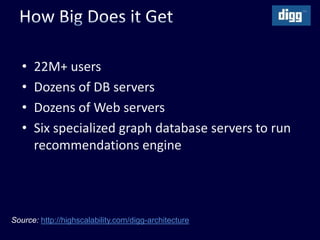
How Big Does it Get22M+ usersDozens of DB serversDozens of Web serversSix specialized graph database servers to run recommendations engineSource:http://highscalability.com/digg-architecture
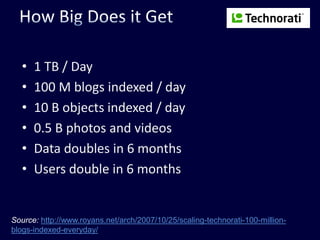
How Big Does it Get1 TB / Day100 M blogs indexed / day10 B objects indexed / day0.5 B photos and videosData doubles in 6 monthsUsers double in 6 monthsSource:http://www.royans.net/arch/2007/10/25/scaling-technorati-100-million-blogs-indexed-everyday/
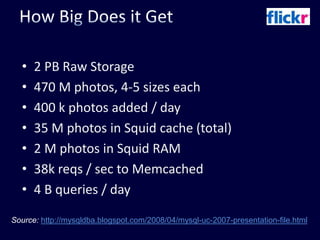
How Big Does it Get2 PB Raw Storage470 M photos, 4-5 sizes each400 k photos added / day35 M photos in Squid cache (total)2 M photos in Squid RAM38k reqs / sec to Memcached4 B queries / daySource:http://mysqldba.blogspot.com/2008/04/mysql-uc-2007-presentation-file.html
How Big Does it GetVirtualized database spans 600 production instances residing in 100+ server clusters distributed over 8 datacenters2 PB of data26 B SQL queries / day1 B page views / day3 B API calls / month15,000 App serversSource:http://highscalability.com/ebay-architecture/
How Big Does it Get450,000 low cost commodity servers in 2006Indexed 8 B web-pages in 2005200 GFS clusters (1 cluster = 1,000 – 5,000 machines)Read / write thruput = 40 GB / sec across a clusterMap-Reduce100k jobs / day20 PB of data processed / day10k MapReduce programsSource:http://highscalability.com/google-architecture/
Key TrendsData Size ~ PBData Growth ~ TB / dayNo of servers – 10s to 10,000No of datacenters – 1 to 10Queries – B+ / daySpecialized needs – more / other than RDBMS
OutlineCharacteristicsApp Tier ScalingReplicationPartitioningConsistencyNormalizationCachingData Engine Types
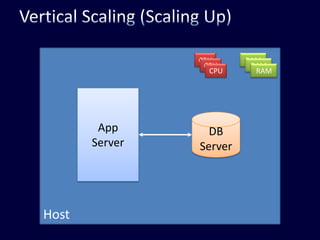
HostRAMCPUCPURAMCPURAMApp ServerDB ServerVertical Scaling (Scaling Up)
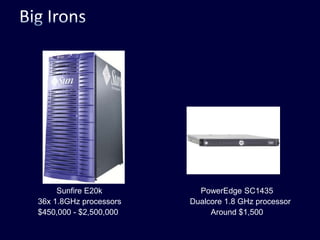
Big IronsSunfire E20kPowerEdge SC143536x 1.8GHz processorsDualcore 1.8 GHz processor$450,000 - $2,500,000Around $1,500
Vertical Scaling (Scaling Up)Increasing the hardware resources on a hostProsSimple to implementFast turnaround timeConsFinite limitHardware does not scale linearly (diminishing returns for each incremental unit)Requires downtimeIncreases Downtime ImpactIncremental costs increase exponentially
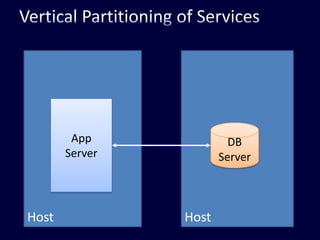
HostHostApp ServerDB ServerVertical Partitioning of Services
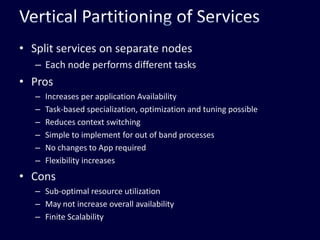
Vertical Partitioning of ServicesSplit services on separate nodesEach node performs different tasksProsIncreases per application AvailabilityTask-based specialization, optimization and tuning possibleReduces context switchingSimple to implement for out of band processesNo changes to App requiredFlexibility increasesConsSub-optimal resource utilizationMay not increase overall availabilityFinite Scalability
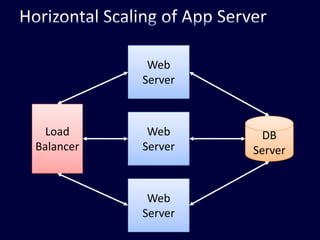
Horizontal Scaling of App ServerWeb ServerLoad BalancerWeb ServerDB ServerWeb Server
Horizontal Scaling of App ServerAdd more nodes for the same serviceIdentical, doing the same taskLoad BalancingHardware balancers are fasterSoftware balancers are more customizable
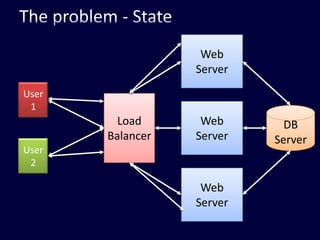
The problem - StateWeb ServerUser 1Load BalancerWeb ServerDB ServerUser 2Web Server
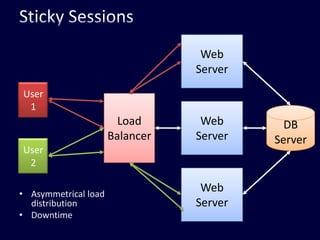
Sticky SessionsWeb ServerUser 1Load BalancerWeb ServerDB ServerUser 2Web ServerAsymmetrical load distributionDowntime
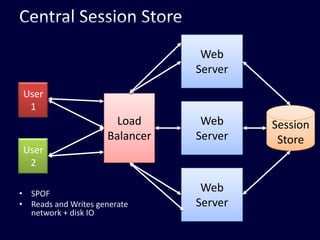
Central Session StoreWeb ServerUser 1Load BalancerWeb ServerSession StoreUser 2Web ServerSPOFReads and Writes generate network + disk IO
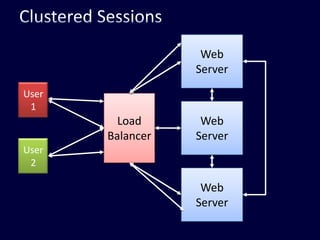
Clustered SessionsWeb ServerUser 1Load BalancerWeb ServerUser 2Web Server
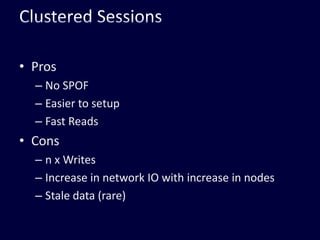
Clustered SessionsProsNo SPOFEasier to setupFast ReadsConsn x WritesIncrease in network IO with increase in nodesStale data (rare)
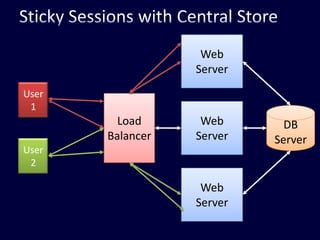
Sticky Sessions with Central StoreWeb ServerUser 1Load BalancerWeb ServerDB ServerUser 2Web Server
More Session ManagementNo SessionsStuff state in a cookie and sign it!Cookie is sent with every request / responseSuper Slim SessionsKeep small amount of frequently used data in cookiePull rest from DB (or central session store)
Sessions - RecommendationBadSticky sessionsGoodClustered sessions for small number of nodes and / or small write volumeCentral sessions for large number of nodes or large write volumeGreatNo Sessions!
App Tier Scaling - MoreHTTP Accelerators / Reverse ProxyStatic content caching, redirect to lighter HTTPAsync NIO on user-side, Keep-alive connection poolCDNGet closer to your userAkamai, LimelightIP AnycastingAsync NIO
Scaling a Web AppApp-LayerAdd more nodes and load balance!Avoid Sticky SessionsAvoid Sessions!!Data StoreTricky! Very Tricky!!!
OutlineCharacteristicsApp Tier ScalingReplicationPartitioningConsistencyNormalizationCachingData Engine Types
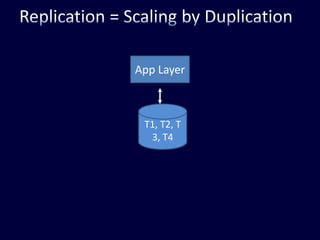
Replication = Scaling by DuplicationApp LayerT1, T2, T3, T4
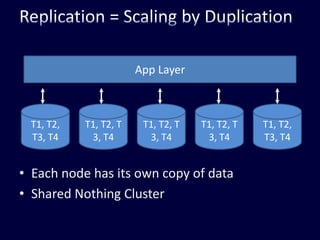
Replication = Scaling by DuplicationApp LayerT1, T2, T3, T4T1, T2, T3, T4T1, T2, T3, T4T1, T2, T3, T4T1, T2, T3, T4Each node has its own copy of dataShared Nothing Cluster
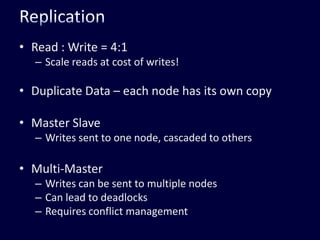
ReplicationRead : Write = 4:1Scale reads at cost of writes!Duplicate Data – each node has its own copyMaster SlaveWrites sent to one node, cascaded to othersMulti-MasterWrites can be sent to multiple nodesCan lead to deadlocksRequires conflict management
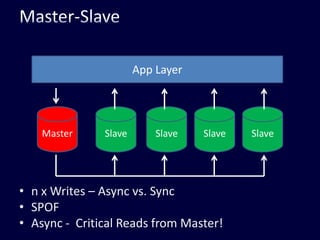
Master-SlaveApp LayerMasterSlaveSlaveSlaveSlaven x Writes – Async vs. SyncSPOFAsync -  Critical Reads from Master!
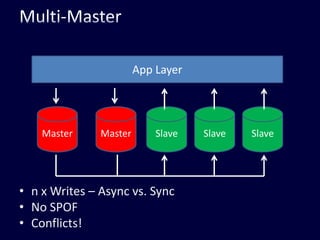
Multi-MasterApp LayerMasterMasterSlaveSlaveSlaven x Writes – Async vs. SyncNo SPOFConflicts!
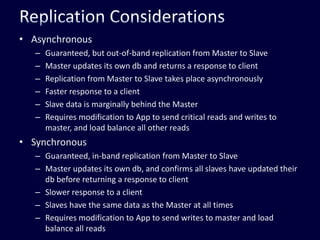
Replication ConsiderationsAsynchronousGuaranteed, but out-of-band replication from Master to SlaveMaster updates its own db and returns a response to clientReplication from Master to Slave takes place asynchronouslyFaster response to a client Slave data is marginally behind the MasterRequires modification to App to send critical reads and writes to master, and load balance all other readsSynchronousGuaranteed, in-band replication from Master to SlaveMaster updates its own db, and confirms all slaves have updated their db before returning a response to clientSlower response to a client Slaves have the same data as the Master at all timesRequires modification to App to send writes to master and load balance all reads
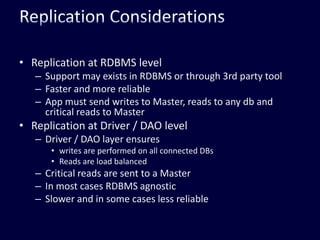
Replication ConsiderationsReplication at RDBMS levelSupport may exists in RDBMS or through 3rd party toolFaster and more reliableApp must send writes to Master, reads to any db and critical reads to MasterReplication at Driver / DAO levelDriver / DAO layer ensures writes are performed on all connected DBsReads are load balancedCritical reads are sent to a MasterIn most cases RDBMS agnosticSlower and in some cases less reliable
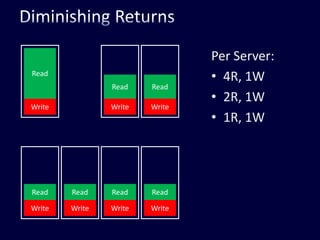
Diminishing ReturnsPer Server:4R, 1W2R, 1W1R, 1WReadReadReadWriteWriteWriteReadReadReadReadWriteWriteWriteWrite
OutlineCharacteristicsApp Tier ScalingReplicationPartitioningConsistencyNormalizationCachingData Engine Types
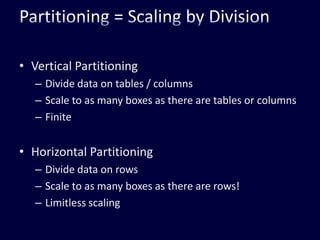
Partitioning = Scaling by DivisionVertical PartitioningDivide data on tables / columnsScale to as many boxes as there are tables or columnsFiniteHorizontal PartitioningDivide data on rowsScale to as many boxes as there are rows!Limitless scaling
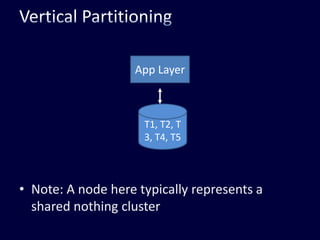
Vertical PartitioningApp LayerT1, T2, T3, T4, T5Note: A node here typically represents a shared nothing cluster
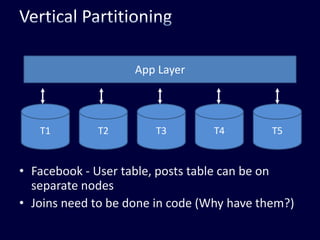
Vertical PartitioningApp LayerT3T4T5T2T1Facebook - User table, posts table can be on separate nodesJoins need to be done in code (Why have them?)
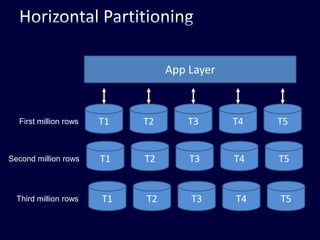
Horizontal PartitioningApp LayerT3T4T5T2T1First million rowsT3T4T5T2T1Second million rowsT3T4T5T2T1Third million rows
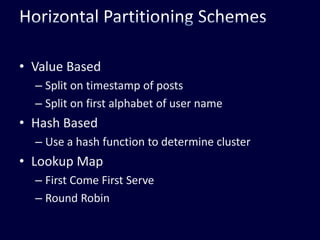
Horizontal Partitioning SchemesValue BasedSplit on timestamp of postsSplit on first alphabet of user nameHash BasedUse a hash function to determine clusterLookup MapFirst Come First ServeRound Robin
OutlineCharacteristicsApp Tier ScalingReplicationPartitioningConsistencyNormalizationCachingData Engine Types
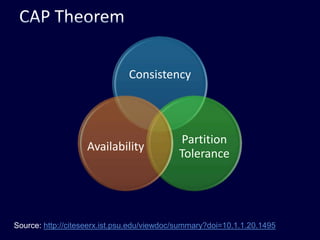
CAP TheoremSource:http://citeseerx.ist.psu.edu/viewdoc/summary?doi=10.1.1.20.1495
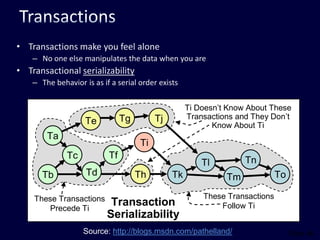
TransactionsTransactions make you feel aloneNo one else manipulates the data when you areTransactional serializabilityThe behavior is as if a serial order existsSource:http://blogs.msdn.com/pathelland/Slide 46
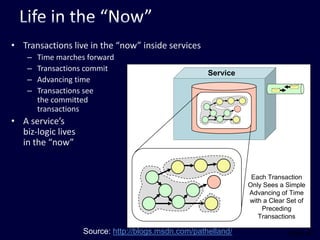
Life in the “Now”Transactions live in the “now” inside servicesTime marches forwardTransactions commit Advancing timeTransactions see the committed transactionsA service’s biz-logic lives in the “now”Source:http://blogs.msdn.com/pathelland/Slide 47
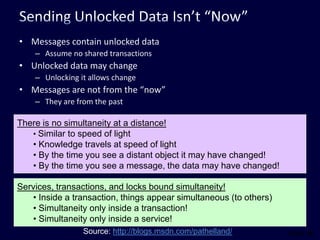
Sending Unlocked Data Isn’t “Now”Messages contain unlocked dataAssume no shared transactionsUnlocked data may changeUnlocking it allows changeMessages are not from the “now”They are from the pastThere is no simultaneity at a distance!Similar to speed of light
 Knowledge travels at speed of light
 By the time you see a distant object it may have changed!
 By the time you see a message, the data may have changed!Services, transactions, and locks bound simultaneity! Inside a transaction, things appear simultaneous (to others)
 Simultaneity only inside a transaction!
 Simultaneity only inside a service!Source:http://blogs.msdn.com/pathelland/Slide 48
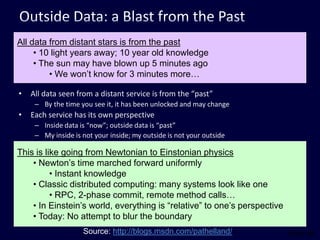
Outside Data: a Blast from the PastAll data from distant stars is from the past 10 light years away; 10 year old knowledge
 The sun may have blown up 5 minutes ago
 We won’t know for 3 minutes more…All data seen from a distant service is from the “past”By the time you see it, it has been unlocked and may changeEach service has its own perspectiveInside data is “now”; outside data is “past”My inside is not your inside; my outside is not your outsideThis is like going from Newtonian to Einstonian physics Newton’s time marched forward uniformly
 Instant knowledge
 Classic distributed computing: many systems look like one
 RPC, 2-phase commit, remote method calls…
 In Einstein’s world, everything is “relative” to one’s perspective
 Today: No attempt to blur the boundarySource:http://blogs.msdn.com/pathelland/Slide 49
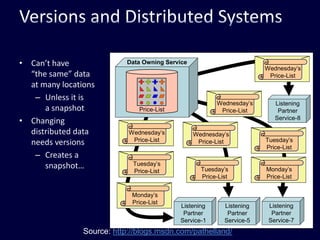
Versions and Distributed SystemsCan’t have “the same” dataat many locationsUnless it isa snapshotChanging distributed dataneeds versionsCreates asnapshot…Source:http://blogs.msdn.com/pathelland/
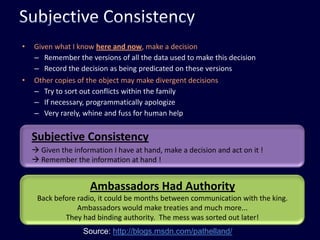
Subjective ConsistencyGiven what I know here and now, make a decisionRemember the versions of all the data used to make this decisionRecord the decision as being predicated on these versionsOther copies of the object may make divergent decisionsTry to sort out conflicts within the familyIf necessary, programmatically apologizeVery rarely, whine and fuss for human helpSubjective Consistency Given the information I have at hand, make a decision and act on it ! Remember the information at hand !Ambassadors Had AuthorityBack before radio, it could be months between communication with the king.  Ambassadors would make treaties and much more... They had binding authority.  The mess was sorted out later!Source:http://blogs.msdn.com/pathelland/
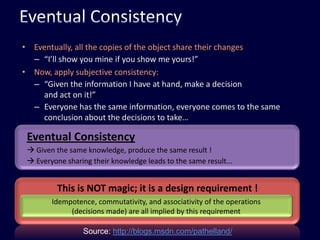
Eventual ConsistencyEventually, all the copies of the object share their changes“I’ll show you mine if you show me yours!”Now, apply subjective consistency:“Given the information I have at hand, make a decision and act on it!”Everyone has the same information, everyone comes to the same conclusion about the decisions to take…Eventual Consistency Given the same knowledge, produce the same result !
 Everyone sharing their knowledge leads to the same result...This is NOT magic; it is a design requirement !Idempotence, commutativity, and associativity of the operations(decisions made) are all implied by this requirementSource:http://blogs.msdn.com/pathelland/
OutlineCharacteristicsApp Tier ScalingReplicationPartitioningConsistencyNormalizationCachingData Engine Types
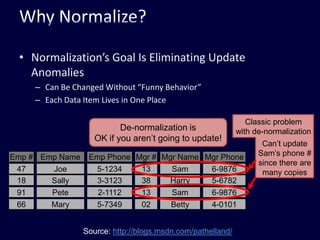
Why Normalize?Classic problemwith de-normalizationCan’t updateSam’s phone #since there aremany copiesEmp #Emp NameMgr #Mgr NameEmp Phone47Joe13Sam5-123418Sally38Harry3-312391Pete13Sam2-111266Mary02Betty5-7349Mgr Phone6-98765-67826-98764-0101Normalization’s Goal Is Eliminating Update AnomaliesCan Be Changed Without “Funny Behavior”Each Data Item Lives in One PlaceDe-normalization isOK if you aren’t going to update!Source:http://blogs.msdn.com/pathelland/
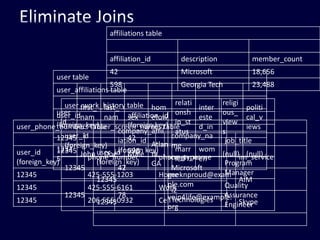
Eliminate Joins
Eliminate Joins6 joins for 1 query!Do you think FB would do this?And how would you do joins with partitioned data?De-normalization removes joinsBut increases data volumeBut disk is cheap and getting cheaperAnd can lead to inconsistent dataIf you are lazyHowever this is not really an issue
“Append-Only” DataMany Kinds of Computing are “Append-Only”Lots of observations are made about the worldDebits, credits, Purchase-Orders, Customer-Change-Requests, etcAs time moves on, more observations are addedYou can’t change the history but you can add new observationsDerived Results May Be CalculatedEstimate of the “current” inventoryFrequently inaccurateHistoric Rollups Are CalculatedMonthly bank statements
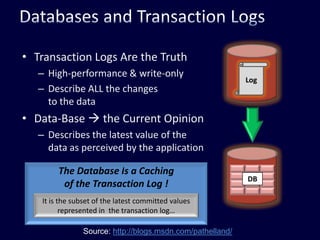
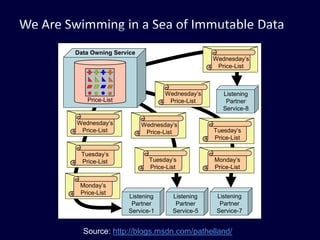
Databases and Transaction LogsTransaction Logs Are the TruthHigh-performance & write-onlyDescribe ALL the changes to the dataData-Base  the Current OpinionDescribes the latest value of the data as perceived by the applicationLogDBThe Database Is a Caching of the Transaction Log !It is the subset of the latest committed values represented in  the transaction log…Source:http://blogs.msdn.com/pathelland/
We Are Swimming in a Sea of Immutable Data Source:http://blogs.msdn.com/pathelland/
OutlineCharacteristicsApp Tier ScalingReplicationPartitioningConsistencyNormalizationCachingData Engine Types

Handling Data in Mega Scale Systems

  • 1.
    Intelligent People. UncommonIdeas.Handling Data in Mega Scale Web Apps(lessons learnt @ Directi)Vineet Gupta | GM – Software Engineering | Directihttp://vineetgupta.spaces.live.comLicensed under Creative Commons Attribution Sharealike Noncommercial
  • 2.
  • 3.
    Not CoveringOffline Processing(Batching / Queuing)Distributed Processing – Map ReduceNon-blocking IOFault Detection, Tolerance and Recovery
  • 4.
  • 5.
    How Big Doesit Get22M+ usersDozens of DB serversDozens of Web serversSix specialized graph database servers to run recommendations engineSource:http://highscalability.com/digg-architecture
  • 6.
    How Big Doesit Get1 TB / Day100 M blogs indexed / day10 B objects indexed / day0.5 B photos and videosData doubles in 6 monthsUsers double in 6 monthsSource:http://www.royans.net/arch/2007/10/25/scaling-technorati-100-million-blogs-indexed-everyday/
  • 7.
    How Big Doesit Get2 PB Raw Storage470 M photos, 4-5 sizes each400 k photos added / day35 M photos in Squid cache (total)2 M photos in Squid RAM38k reqs / sec to Memcached4 B queries / daySource:http://mysqldba.blogspot.com/2008/04/mysql-uc-2007-presentation-file.html
  • 8.
    How Big Doesit GetVirtualized database spans 600 production instances residing in 100+ server clusters distributed over 8 datacenters2 PB of data26 B SQL queries / day1 B page views / day3 B API calls / month15,000 App serversSource:http://highscalability.com/ebay-architecture/
  • 9.
    How Big Doesit Get450,000 low cost commodity servers in 2006Indexed 8 B web-pages in 2005200 GFS clusters (1 cluster = 1,000 – 5,000 machines)Read / write thruput = 40 GB / sec across a clusterMap-Reduce100k jobs / day20 PB of data processed / day10k MapReduce programsSource:http://highscalability.com/google-architecture/
  • 10.
    Key TrendsData Size~ PBData Growth ~ TB / dayNo of servers – 10s to 10,000No of datacenters – 1 to 10Queries – B+ / daySpecialized needs – more / other than RDBMS
  • 11.
  • 12.
  • 13.
    Big IronsSunfire E20kPowerEdgeSC143536x 1.8GHz processorsDualcore 1.8 GHz processor$450,000 - $2,500,000Around $1,500
  • 14.
    Vertical Scaling (ScalingUp)Increasing the hardware resources on a hostProsSimple to implementFast turnaround timeConsFinite limitHardware does not scale linearly (diminishing returns for each incremental unit)Requires downtimeIncreases Downtime ImpactIncremental costs increase exponentially
  • 15.
    HostHostApp ServerDB ServerVerticalPartitioning of Services
  • 16.
    Vertical Partitioning ofServicesSplit services on separate nodesEach node performs different tasksProsIncreases per application AvailabilityTask-based specialization, optimization and tuning possibleReduces context switchingSimple to implement for out of band processesNo changes to App requiredFlexibility increasesConsSub-optimal resource utilizationMay not increase overall availabilityFinite Scalability
  • 17.
    Horizontal Scaling ofApp ServerWeb ServerLoad BalancerWeb ServerDB ServerWeb Server
  • 18.
    Horizontal Scaling ofApp ServerAdd more nodes for the same serviceIdentical, doing the same taskLoad BalancingHardware balancers are fasterSoftware balancers are more customizable
  • 19.
    The problem -StateWeb ServerUser 1Load BalancerWeb ServerDB ServerUser 2Web Server
  • 20.
    Sticky SessionsWeb ServerUser1Load BalancerWeb ServerDB ServerUser 2Web ServerAsymmetrical load distributionDowntime
  • 21.
    Central Session StoreWebServerUser 1Load BalancerWeb ServerSession StoreUser 2Web ServerSPOFReads and Writes generate network + disk IO
  • 22.
    Clustered SessionsWeb ServerUser1Load BalancerWeb ServerUser 2Web Server
  • 23.
    Clustered SessionsProsNo SPOFEasierto setupFast ReadsConsn x WritesIncrease in network IO with increase in nodesStale data (rare)
  • 24.
    Sticky Sessions withCentral StoreWeb ServerUser 1Load BalancerWeb ServerDB ServerUser 2Web Server
  • 25.
    More Session ManagementNoSessionsStuff state in a cookie and sign it!Cookie is sent with every request / responseSuper Slim SessionsKeep small amount of frequently used data in cookiePull rest from DB (or central session store)
  • 26.
    Sessions - RecommendationBadStickysessionsGoodClustered sessions for small number of nodes and / or small write volumeCentral sessions for large number of nodes or large write volumeGreatNo Sessions!
  • 27.
    App Tier Scaling- MoreHTTP Accelerators / Reverse ProxyStatic content caching, redirect to lighter HTTPAsync NIO on user-side, Keep-alive connection poolCDNGet closer to your userAkamai, LimelightIP AnycastingAsync NIO
  • 28.
    Scaling a WebAppApp-LayerAdd more nodes and load balance!Avoid Sticky SessionsAvoid Sessions!!Data StoreTricky! Very Tricky!!!
  • 29.
  • 30.
    Replication = Scalingby DuplicationApp LayerT1, T2, T3, T4
  • 31.
    Replication = Scalingby DuplicationApp LayerT1, T2, T3, T4T1, T2, T3, T4T1, T2, T3, T4T1, T2, T3, T4T1, T2, T3, T4Each node has its own copy of dataShared Nothing Cluster
  • 32.
    ReplicationRead : Write= 4:1Scale reads at cost of writes!Duplicate Data – each node has its own copyMaster SlaveWrites sent to one node, cascaded to othersMulti-MasterWrites can be sent to multiple nodesCan lead to deadlocksRequires conflict management
  • 33.
    Master-SlaveApp LayerMasterSlaveSlaveSlaveSlaven xWrites – Async vs. SyncSPOFAsync - Critical Reads from Master!
  • 34.
    Multi-MasterApp LayerMasterMasterSlaveSlaveSlaven xWrites – Async vs. SyncNo SPOFConflicts!
  • 35.
    Replication ConsiderationsAsynchronousGuaranteed, butout-of-band replication from Master to SlaveMaster updates its own db and returns a response to clientReplication from Master to Slave takes place asynchronouslyFaster response to a client Slave data is marginally behind the MasterRequires modification to App to send critical reads and writes to master, and load balance all other readsSynchronousGuaranteed, in-band replication from Master to SlaveMaster updates its own db, and confirms all slaves have updated their db before returning a response to clientSlower response to a client Slaves have the same data as the Master at all timesRequires modification to App to send writes to master and load balance all reads
  • 36.
    Replication ConsiderationsReplication atRDBMS levelSupport may exists in RDBMS or through 3rd party toolFaster and more reliableApp must send writes to Master, reads to any db and critical reads to MasterReplication at Driver / DAO levelDriver / DAO layer ensures writes are performed on all connected DBsReads are load balancedCritical reads are sent to a MasterIn most cases RDBMS agnosticSlower and in some cases less reliable
  • 37.
    Diminishing ReturnsPer Server:4R,1W2R, 1W1R, 1WReadReadReadWriteWriteWriteReadReadReadReadWriteWriteWriteWrite
  • 38.
  • 39.
    Partitioning = Scalingby DivisionVertical PartitioningDivide data on tables / columnsScale to as many boxes as there are tables or columnsFiniteHorizontal PartitioningDivide data on rowsScale to as many boxes as there are rows!Limitless scaling
  • 40.
    Vertical PartitioningApp LayerT1,T2, T3, T4, T5Note: A node here typically represents a shared nothing cluster
  • 41.
    Vertical PartitioningApp LayerT3T4T5T2T1Facebook- User table, posts table can be on separate nodesJoins need to be done in code (Why have them?)
  • 42.
    Horizontal PartitioningApp LayerT3T4T5T2T1Firstmillion rowsT3T4T5T2T1Second million rowsT3T4T5T2T1Third million rows
  • 43.
    Horizontal Partitioning SchemesValueBasedSplit on timestamp of postsSplit on first alphabet of user nameHash BasedUse a hash function to determine clusterLookup MapFirst Come First ServeRound Robin
  • 44.
  • 45.
  • 46.
    TransactionsTransactions make youfeel aloneNo one else manipulates the data when you areTransactional serializabilityThe behavior is as if a serial order existsSource:http://blogs.msdn.com/pathelland/Slide 46
  • 47.
    Life in the“Now”Transactions live in the “now” inside servicesTime marches forwardTransactions commit Advancing timeTransactions see the committed transactionsA service’s biz-logic lives in the “now”Source:http://blogs.msdn.com/pathelland/Slide 47
  • 48.
    Sending Unlocked DataIsn’t “Now”Messages contain unlocked dataAssume no shared transactionsUnlocked data may changeUnlocking it allows changeMessages are not from the “now”They are from the pastThere is no simultaneity at a distance!Similar to speed of light
  • 49.
    Knowledge travelsat speed of light
  • 50.
    By thetime you see a distant object it may have changed!
  • 51.
    By thetime you see a message, the data may have changed!Services, transactions, and locks bound simultaneity! Inside a transaction, things appear simultaneous (to others)
  • 52.
    Simultaneity onlyinside a transaction!
  • 53.
    Simultaneity onlyinside a service!Source:http://blogs.msdn.com/pathelland/Slide 48
  • 54.
    Outside Data: aBlast from the PastAll data from distant stars is from the past 10 light years away; 10 year old knowledge
  • 55.
    The sunmay have blown up 5 minutes ago
  • 56.
    We won’tknow for 3 minutes more…All data seen from a distant service is from the “past”By the time you see it, it has been unlocked and may changeEach service has its own perspectiveInside data is “now”; outside data is “past”My inside is not your inside; my outside is not your outsideThis is like going from Newtonian to Einstonian physics Newton’s time marched forward uniformly
  • 57.
  • 58.
    Classic distributedcomputing: many systems look like one
  • 59.
    RPC, 2-phasecommit, remote method calls…
  • 60.
    In Einstein’sworld, everything is “relative” to one’s perspective
  • 61.
    Today: Noattempt to blur the boundarySource:http://blogs.msdn.com/pathelland/Slide 49
  • 62.
    Versions and DistributedSystemsCan’t have “the same” dataat many locationsUnless it isa snapshotChanging distributed dataneeds versionsCreates asnapshot…Source:http://blogs.msdn.com/pathelland/
  • 63.
    Subjective ConsistencyGiven whatI know here and now, make a decisionRemember the versions of all the data used to make this decisionRecord the decision as being predicated on these versionsOther copies of the object may make divergent decisionsTry to sort out conflicts within the familyIf necessary, programmatically apologizeVery rarely, whine and fuss for human helpSubjective Consistency Given the information I have at hand, make a decision and act on it ! Remember the information at hand !Ambassadors Had AuthorityBack before radio, it could be months between communication with the king. Ambassadors would make treaties and much more... They had binding authority. The mess was sorted out later!Source:http://blogs.msdn.com/pathelland/
  • 64.
    Eventual ConsistencyEventually, allthe copies of the object share their changes“I’ll show you mine if you show me yours!”Now, apply subjective consistency:“Given the information I have at hand, make a decision and act on it!”Everyone has the same information, everyone comes to the same conclusion about the decisions to take…Eventual Consistency Given the same knowledge, produce the same result !
  • 65.
    Everyone sharingtheir knowledge leads to the same result...This is NOT magic; it is a design requirement !Idempotence, commutativity, and associativity of the operations(decisions made) are all implied by this requirementSource:http://blogs.msdn.com/pathelland/
  • 66.
  • 67.
    Why Normalize?Classic problemwithde-normalizationCan’t updateSam’s phone #since there aremany copiesEmp #Emp NameMgr #Mgr NameEmp Phone47Joe13Sam5-123418Sally38Harry3-312391Pete13Sam2-111266Mary02Betty5-7349Mgr Phone6-98765-67826-98764-0101Normalization’s Goal Is Eliminating Update AnomaliesCan Be Changed Without “Funny Behavior”Each Data Item Lives in One PlaceDe-normalization isOK if you aren’t going to update!Source:http://blogs.msdn.com/pathelland/
  • 68.
  • 69.
    Eliminate Joins6 joinsfor 1 query!Do you think FB would do this?And how would you do joins with partitioned data?De-normalization removes joinsBut increases data volumeBut disk is cheap and getting cheaperAnd can lead to inconsistent dataIf you are lazyHowever this is not really an issue
  • 70.
    “Append-Only” DataMany Kindsof Computing are “Append-Only”Lots of observations are made about the worldDebits, credits, Purchase-Orders, Customer-Change-Requests, etcAs time moves on, more observations are addedYou can’t change the history but you can add new observationsDerived Results May Be CalculatedEstimate of the “current” inventoryFrequently inaccurateHistoric Rollups Are CalculatedMonthly bank statements
  • 71.
    Databases and TransactionLogsTransaction Logs Are the TruthHigh-performance & write-onlyDescribe ALL the changes to the dataData-Base  the Current OpinionDescribes the latest value of the data as perceived by the applicationLogDBThe Database Is a Caching of the Transaction Log !It is the subset of the latest committed values represented in the transaction log…Source:http://blogs.msdn.com/pathelland/
  • 72.
    We Are Swimmingin a Sea of Immutable Data Source:http://blogs.msdn.com/pathelland/
  • 73.