Vineet Gupta | GM – Software Engineering | Directi http://www.vineetgupta.com Licensed under Creative Commons Attribution Sharealike Noncommercial Intelligent People. Uncommon Ideas.
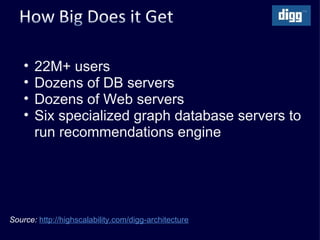
22M+ users Dozens of DB servers Dozens of Web servers Six specialized graph database servers to run recommendations engine Source:   http://highscalability.com/digg-architecture
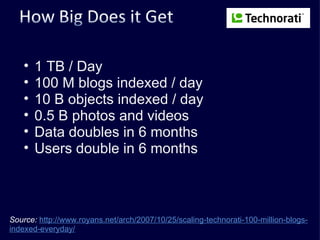
1 TB / Day 100 M blogs indexed / day 10 B objects indexed / day 0.5 B photos and videos Data doubles in 6 months Users double in 6 months Source:   http://www.royans.net/arch/2007/10/25/scaling-technorati-100-million-blogs-indexed-everyday/
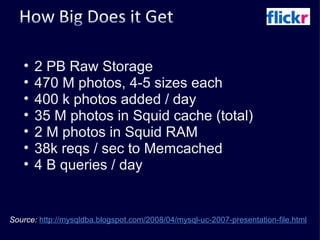
2 PB Raw Storage 470 M photos, 4-5 sizes each 400 k photos added / day 35 M photos in Squid cache (total) 2 M photos in Squid RAM 38k reqs / sec to Memcached 4 B queries / day Source:   http://mysqldba.blogspot.com/2008/04/mysql-uc-2007-presentation-file.html
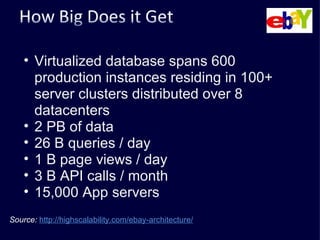
Virtualized database spans 600 production instances residing in 100+ server clusters distributed over 8 datacenters 2 PB of data 26 B queries / day 1 B page views / day 3 B API calls / month 15,000 App servers Source:   http://highscalability.com/ebay-architecture/
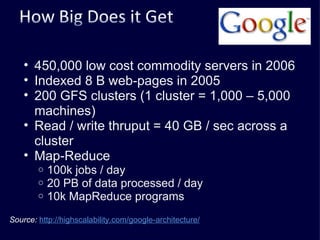
450,000 low cost commodity servers in 2006 Indexed 8 B web-pages in 2005 200 GFS clusters (1 cluster = 1,000 – 5,000 machines) Read / write thruput = 40 GB / sec across a cluster Map-Reduce 100k jobs / day 20 PB of data processed / day 10k MapReduce programs Source:   http://highscalability.com/google-architecture/
Data Size ~ PB Data Growth ~ TB / day No of servers – 10s to 10,000 No of datacenters – 1 to 10 Queries – B+ / day
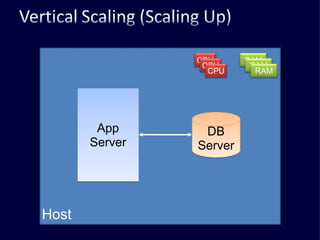
Host App Server DB Server RAM CPU CPU CPU RAM RAM
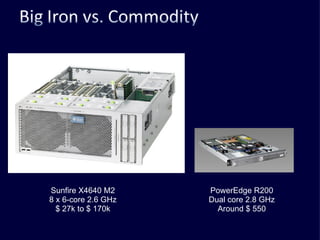
Sunfire X4640 M2 8 x 6-core 2.6 GHz $ 27k to $ 170k PowerEdge R200 Dual core 2.8 GHz Around $ 550
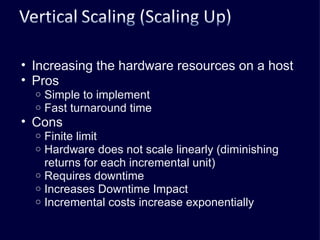
Increasing the hardware resources on a host Pros Simple to implement Fast turnaround time Cons Finite limit Hardware does not scale linearly (diminishing returns for each incremental unit) Requires downtime Increases Downtime Impact Incremental costs increase exponentially
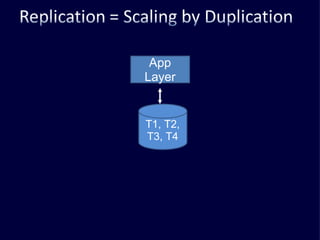
T1, T2, T3, T4 App Layer
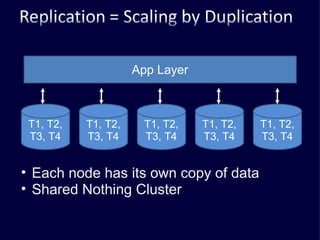
T1, T2, T3, T4 App Layer T1, T2, T3, T4 T1, T2, T3, T4 T1, T2, T3, T4 T1, T2, T3, T4 Each node has its own copy of data Shared Nothing Cluster
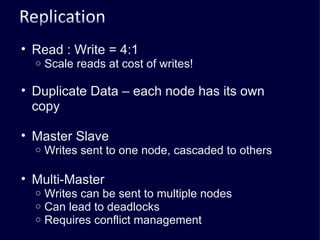
Read : Write = 4:1 Scale reads at cost of writes! Duplicate Data – each node has its own copy Master Slave Writes sent to one node, cascaded to others Multi-Master Writes can be sent to multiple nodes Can lead to deadlocks Requires conflict management
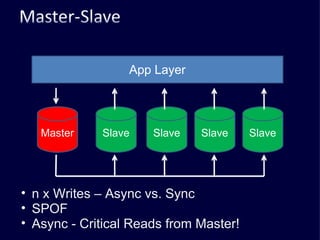
Master App Layer Slave Slave Slave Slave n x Writes – Async vs. Sync SPOF Async - Critical Reads from Master!
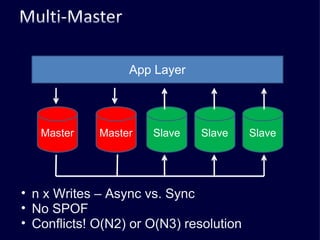
Master App Layer Master Slave Slave Slave n x Writes – Async vs. Sync No SPOF Conflicts! O(N2) or O(N3) resolution
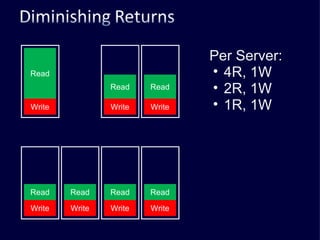
Write Read Write Read Write Read Write Read Write Read Write Read Write Read Per Server: 4R, 1W 2R, 1W 1R, 1W
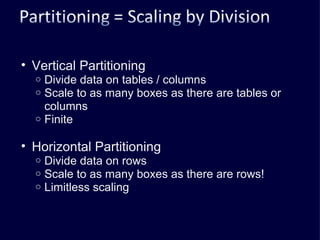
Vertical Partitioning Divide data on tables / columns Scale to as many boxes as there are tables or columns Finite Horizontal Partitioning Divide data on rows Scale to as many boxes as there are rows! Limitless scaling
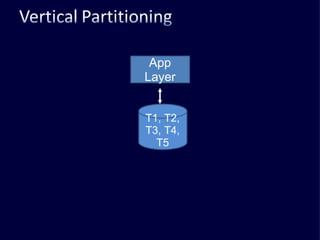
T1, T2, T3, T4, T5 App Layer
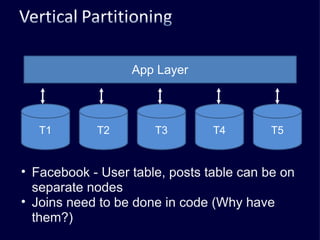
T3 App Layer T4 T5 T2 T1 Facebook - User table, posts table can be on separate nodes Joins need to be done in code (Why have them?)
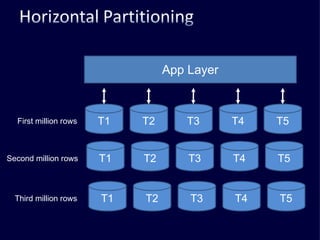
T3 App Layer T4 T5 T2 T1 First million rows T3 T4 T5 T2 T1 Second million rows T3 T4 T5 T2 T1 Third million rows
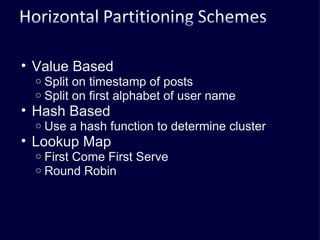
Value Based Split on timestamp of posts Split on first alphabet of user name Hash Based Use a hash function to determine cluster Lookup Map First Come First Serve Round Robin
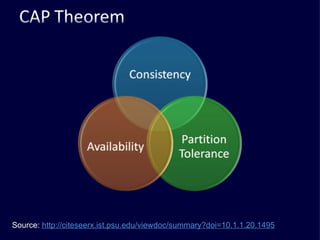
Source:   http://citeseerx.ist.psu.edu/viewdoc/summary?doi=10.1.1.20.1495
In distributed systems, much weaker forms of consistency are often acceptable, e.g., Only a few (or even one) possible writers of data, and/or Read-mostly data (seldom modified), and/or Stale data may be acceptable Eventual consistency If no updates take place for a long time, all replicas will eventually become consistent Implementation Need only ensure updates eventually reach all of the replicated copies of the data
Monotonic Reads If a node sees a version x at time t, it will never see an older version at a later time Monotonic Writes A write operation by a process on a data item x is completed before any successive write operation on x by the same process Read your writes The effect of a write operation by a process on data item x will always be seen by a successive read operation on x by the same process Writes follow Reads Write occurs on a copy of x that is at least as recent as the last copy read by the process
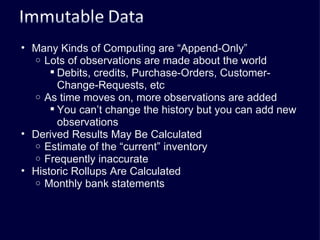
Many Kinds of Computing are “Append-Only” Lots of observations are made about the world Debits, credits, Purchase-Orders, Customer-Change-Requests, etc As time moves on, more observations are added You can’t change the history but you can add new observations Derived Results May Be Calculated Estimate of the “current” inventory Frequently inaccurate Historic Rollups Are Calculated Monthly bank statements
 
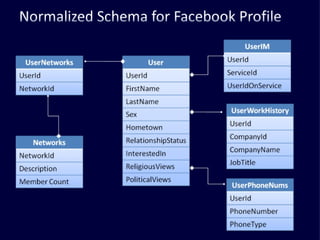
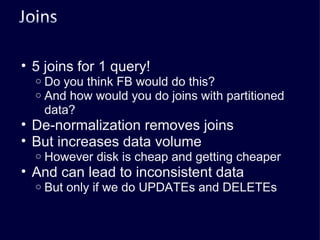
5 joins for 1 query! Do you think FB would do this? And how would you do joins with partitioned data? De-normalization removes joins But increases data volume However disk is cheap and getting cheaper And can lead to inconsistent data But only if we do UPDATEs and DELETEs
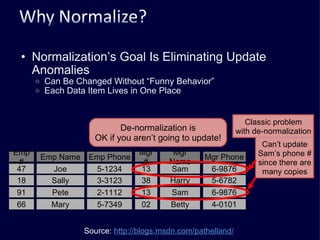
Normalization’s Goal Is Eliminating Update Anomalies Can Be Changed Without “Funny Behavior” Each Data Item Lives in One Place Emp # Emp Name Mgr # Mgr Name Emp Phone Mgr Phone 47 Joe 13 Sam 5-1234 6-9876 18 Sally 38 Harry 3-3123 5-6782 91 Pete 13 Sam 2-1112 6-9876 66 Mary 02 Betty 5-7349 4-0101 Classic problem with de-normalization Can’t update Sam’s phone # since there are many copies De-normalization is OK if you aren’t going to update! Source:   http://blogs.msdn.com/pathelland/
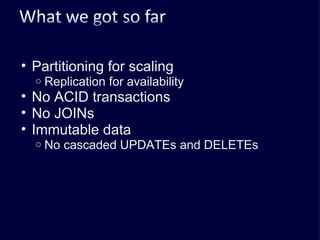
Partitioning for scaling Replication for availability No ACID transactions No JOINs Immutable data No cascaded UPDATEs and DELETEs
 
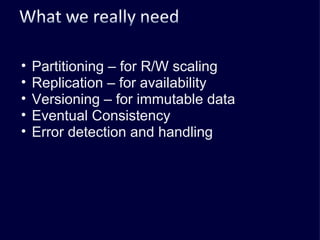
Partitioning – for R/W scaling Replication – for availability Versioning – for immutable data Eventual Consistency Error detection and handling
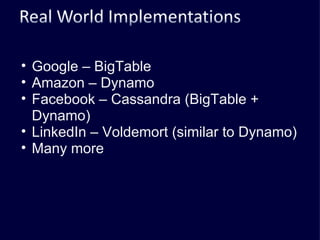
Google – BigTable Amazon – Dynamo Facebook – Cassandra (BigTable + Dynamo) LinkedIn – Voldemort (similar to Dynamo) Many more
Tens of millions of customers served at peak times Tens of thousands of servers Both customers and servers distributed world wide
http://www.allthingsdistributed.com/2007/10/amazons_dynamo.html   Eventually consistent data store Always writable Decentralized All nodes have the same responsibilities
 
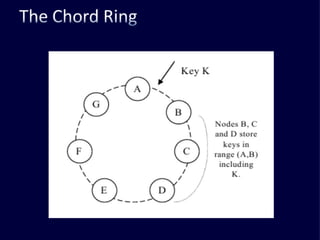
Similar to Chord Each node gets an ID from the space of keys Nodes are arranged in a ring Data stored on the first node clockwise of the current placement of the data key Replication Preference lists of N nodes following the associated node
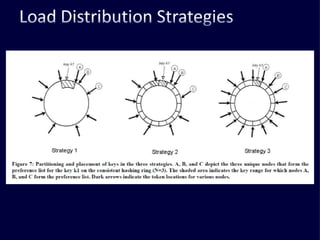
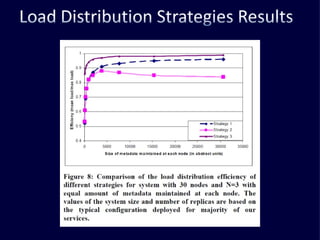
A problem with the Chord scheme Nodes placed randomly on ring Leads to uneven data & load distribution In Dynamo “ Virtual” nodes Each physical node has multiple virtual nodes More powerful machines have more virtual nodes Distribute virtual nodes across the ring
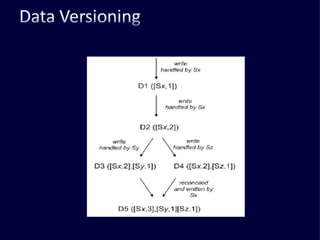
Updates generate a new timestamp Vector clocks are used Eventual consistency Multiple versions of the same object might co-exist Syntactic Reconciliation System might be able to resolve conflicts automatically Semantic Reconciliation Conflict resolution pushed to application
 
Request arrives at a node (coordinator) Ideally the node responsible for the particular key Else forwards request to the node responsible for that key and that node will become the coordinator The first N healthy and distinct nodes following the key position are considered for the request Application defines N = total number of participating nodes R = number of nodes required for successful Read W = number of nodes required for successful write R + W > N gives quorum
Writes Requires generation of a new vector clock by coordinator Coordinator writes locally Forwards to N nodes, if W-1 respond then the write was successful Reads Forwards to N nodes, if R-1 respond then forwards to user Only unique responses forwarded User handles merging if multiple versions exist
Sloppy Quorum Read write ops performed on first N healthy nodes Increases availability Hinted Handoff If node in preference list is not available, send replica to a node further down in the list With a hint containing the identity of the original node The receiving node keeps checking for the original If the original becomes available, transfers replica to it
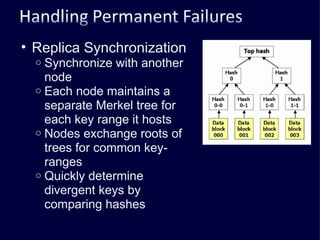
Replica Synchronization Synchronize with another node Each node maintains a separate Merkel tree for each key range it hosts Nodes exchange roots of trees for common key-ranges Quickly determine divergent keys by comparing hashes
Ring Membership Membership is explicit to avoid re-balancing of partition assignment Use background gossip to build 1-hop DHT Use external entity to bootstrap the system to avoid partitioned rings Failure Detection Node A finds node B unreachable (for servicing a request) A uses other nodes to service requests and periodically checks B A does not assume B to have failed No globally consistent view of failure (because of explicit ring membership)
Application Configurable (N, R, W) Every node is aware of the data hosted by its peers requiring the gossiping of the full routing table with other nodes scalability is limited by this to a few hundred nodes hierarchy may help to overcome the limitation
Typical configuration for the Dynamo (N, R, W) is (3, 2, 2) Some implementations vary (N, R, W) Always write might have W=1 (Shopping Cart) Product catalog might have R=1 and W=N Response requirement is 300ms for any request (read or write)
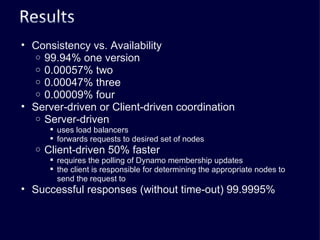
Consistency vs. Availability 99.94% one version 0.00057% two 0.00047% three 0.00009% four Server-driven or Client-driven coordination Server-driven  uses load balancers forwards requests to desired set of nodes Client-driven 50% faster requires the polling of Dynamo membership updates the client is responsible for determining the appropriate nodes to send the request to Successful responses (without time-out) 99.9995%


Enormous data (and high growth) Traditional solutions don’t work Distributed databases Lots of interesting work happening Great time for young programmers! Problem solving ability
 
Intelligent People. Uncommon Ideas. Licensed under Creative Commons Attribution Sharealike Noncommercial

Handling Data in Mega Scale Web Systems

  • 1.
    Vineet Gupta |GM – Software Engineering | Directi http://www.vineetgupta.com Licensed under Creative Commons Attribution Sharealike Noncommercial Intelligent People. Uncommon Ideas.
  • 2.
    22M+ users Dozensof DB servers Dozens of Web servers Six specialized graph database servers to run recommendations engine Source: http://highscalability.com/digg-architecture
  • 3.
    1 TB /Day 100 M blogs indexed / day 10 B objects indexed / day 0.5 B photos and videos Data doubles in 6 months Users double in 6 months Source: http://www.royans.net/arch/2007/10/25/scaling-technorati-100-million-blogs-indexed-everyday/
  • 4.
    2 PB RawStorage 470 M photos, 4-5 sizes each 400 k photos added / day 35 M photos in Squid cache (total) 2 M photos in Squid RAM 38k reqs / sec to Memcached 4 B queries / day Source: http://mysqldba.blogspot.com/2008/04/mysql-uc-2007-presentation-file.html
  • 5.
    Virtualized database spans600 production instances residing in 100+ server clusters distributed over 8 datacenters 2 PB of data 26 B queries / day 1 B page views / day 3 B API calls / month 15,000 App servers Source: http://highscalability.com/ebay-architecture/
  • 6.
    450,000 low costcommodity servers in 2006 Indexed 8 B web-pages in 2005 200 GFS clusters (1 cluster = 1,000 – 5,000 machines) Read / write thruput = 40 GB / sec across a cluster Map-Reduce 100k jobs / day 20 PB of data processed / day 10k MapReduce programs Source: http://highscalability.com/google-architecture/
  • 7.
    Data Size ~PB Data Growth ~ TB / day No of servers – 10s to 10,000 No of datacenters – 1 to 10 Queries – B+ / day
  • 8.
    Host App ServerDB Server RAM CPU CPU CPU RAM RAM
  • 9.
    Sunfire X4640 M28 x 6-core 2.6 GHz $ 27k to $ 170k PowerEdge R200 Dual core 2.8 GHz Around $ 550
  • 10.
    Increasing the hardwareresources on a host Pros Simple to implement Fast turnaround time Cons Finite limit Hardware does not scale linearly (diminishing returns for each incremental unit) Requires downtime Increases Downtime Impact Incremental costs increase exponentially
  • 11.
    T1, T2, T3,T4 App Layer
  • 12.
    T1, T2, T3,T4 App Layer T1, T2, T3, T4 T1, T2, T3, T4 T1, T2, T3, T4 T1, T2, T3, T4 Each node has its own copy of data Shared Nothing Cluster
  • 13.
    Read : Write= 4:1 Scale reads at cost of writes! Duplicate Data – each node has its own copy Master Slave Writes sent to one node, cascaded to others Multi-Master Writes can be sent to multiple nodes Can lead to deadlocks Requires conflict management
  • 14.
    Master App LayerSlave Slave Slave Slave n x Writes – Async vs. Sync SPOF Async - Critical Reads from Master!
  • 15.
    Master App LayerMaster Slave Slave Slave n x Writes – Async vs. Sync No SPOF Conflicts! O(N2) or O(N3) resolution
  • 16.
    Write Read WriteRead Write Read Write Read Write Read Write Read Write Read Per Server: 4R, 1W 2R, 1W 1R, 1W
  • 17.
    Vertical Partitioning Dividedata on tables / columns Scale to as many boxes as there are tables or columns Finite Horizontal Partitioning Divide data on rows Scale to as many boxes as there are rows! Limitless scaling
  • 18.
    T1, T2, T3,T4, T5 App Layer
  • 19.
    T3 App LayerT4 T5 T2 T1 Facebook - User table, posts table can be on separate nodes Joins need to be done in code (Why have them?)
  • 20.
    T3 App LayerT4 T5 T2 T1 First million rows T3 T4 T5 T2 T1 Second million rows T3 T4 T5 T2 T1 Third million rows
  • 21.
    Value Based Spliton timestamp of posts Split on first alphabet of user name Hash Based Use a hash function to determine cluster Lookup Map First Come First Serve Round Robin
  • 22.
    Source: http://citeseerx.ist.psu.edu/viewdoc/summary?doi=10.1.1.20.1495
  • 23.
    In distributed systems,much weaker forms of consistency are often acceptable, e.g., Only a few (or even one) possible writers of data, and/or Read-mostly data (seldom modified), and/or Stale data may be acceptable Eventual consistency If no updates take place for a long time, all replicas will eventually become consistent Implementation Need only ensure updates eventually reach all of the replicated copies of the data
  • 24.
    Monotonic Reads Ifa node sees a version x at time t, it will never see an older version at a later time Monotonic Writes A write operation by a process on a data item x is completed before any successive write operation on x by the same process Read your writes The effect of a write operation by a process on data item x will always be seen by a successive read operation on x by the same process Writes follow Reads Write occurs on a copy of x that is at least as recent as the last copy read by the process
  • 25.
    Many Kinds ofComputing are “Append-Only” Lots of observations are made about the world Debits, credits, Purchase-Orders, Customer-Change-Requests, etc As time moves on, more observations are added You can’t change the history but you can add new observations Derived Results May Be Calculated Estimate of the “current” inventory Frequently inaccurate Historic Rollups Are Calculated Monthly bank statements
  • 26.
  • 27.
    5 joins for1 query! Do you think FB would do this? And how would you do joins with partitioned data? De-normalization removes joins But increases data volume However disk is cheap and getting cheaper And can lead to inconsistent data But only if we do UPDATEs and DELETEs
  • 28.
    Normalization’s Goal IsEliminating Update Anomalies Can Be Changed Without “Funny Behavior” Each Data Item Lives in One Place Emp # Emp Name Mgr # Mgr Name Emp Phone Mgr Phone 47 Joe 13 Sam 5-1234 6-9876 18 Sally 38 Harry 3-3123 5-6782 91 Pete 13 Sam 2-1112 6-9876 66 Mary 02 Betty 5-7349 4-0101 Classic problem with de-normalization Can’t update Sam’s phone # since there are many copies De-normalization is OK if you aren’t going to update! Source: http://blogs.msdn.com/pathelland/
  • 29.
    Partitioning for scalingReplication for availability No ACID transactions No JOINs Immutable data No cascaded UPDATEs and DELETEs
  • 30.
  • 31.
    Partitioning – forR/W scaling Replication – for availability Versioning – for immutable data Eventual Consistency Error detection and handling
  • 32.
    Google – BigTableAmazon – Dynamo Facebook – Cassandra (BigTable + Dynamo) LinkedIn – Voldemort (similar to Dynamo) Many more
  • 33.
    Tens of millionsof customers served at peak times Tens of thousands of servers Both customers and servers distributed world wide
  • 34.
    http://www.allthingsdistributed.com/2007/10/amazons_dynamo.html Eventually consistent data store Always writable Decentralized All nodes have the same responsibilities
  • 35.
  • 36.
    Similar to ChordEach node gets an ID from the space of keys Nodes are arranged in a ring Data stored on the first node clockwise of the current placement of the data key Replication Preference lists of N nodes following the associated node
  • 37.
    A problem withthe Chord scheme Nodes placed randomly on ring Leads to uneven data & load distribution In Dynamo “ Virtual” nodes Each physical node has multiple virtual nodes More powerful machines have more virtual nodes Distribute virtual nodes across the ring
  • 38.
    Updates generate anew timestamp Vector clocks are used Eventual consistency Multiple versions of the same object might co-exist Syntactic Reconciliation System might be able to resolve conflicts automatically Semantic Reconciliation Conflict resolution pushed to application
  • 39.
  • 40.
    Request arrives ata node (coordinator) Ideally the node responsible for the particular key Else forwards request to the node responsible for that key and that node will become the coordinator The first N healthy and distinct nodes following the key position are considered for the request Application defines N = total number of participating nodes R = number of nodes required for successful Read W = number of nodes required for successful write R + W > N gives quorum
  • 41.
    Writes Requires generationof a new vector clock by coordinator Coordinator writes locally Forwards to N nodes, if W-1 respond then the write was successful Reads Forwards to N nodes, if R-1 respond then forwards to user Only unique responses forwarded User handles merging if multiple versions exist
  • 42.
    Sloppy Quorum Readwrite ops performed on first N healthy nodes Increases availability Hinted Handoff If node in preference list is not available, send replica to a node further down in the list With a hint containing the identity of the original node The receiving node keeps checking for the original If the original becomes available, transfers replica to it
  • 43.
    Replica Synchronization Synchronizewith another node Each node maintains a separate Merkel tree for each key range it hosts Nodes exchange roots of trees for common key-ranges Quickly determine divergent keys by comparing hashes
  • 44.
    Ring Membership Membershipis explicit to avoid re-balancing of partition assignment Use background gossip to build 1-hop DHT Use external entity to bootstrap the system to avoid partitioned rings Failure Detection Node A finds node B unreachable (for servicing a request) A uses other nodes to service requests and periodically checks B A does not assume B to have failed No globally consistent view of failure (because of explicit ring membership)
  • 45.
    Application Configurable (N,R, W) Every node is aware of the data hosted by its peers requiring the gossiping of the full routing table with other nodes scalability is limited by this to a few hundred nodes hierarchy may help to overcome the limitation
  • 46.
    Typical configuration forthe Dynamo (N, R, W) is (3, 2, 2) Some implementations vary (N, R, W) Always write might have W=1 (Shopping Cart) Product catalog might have R=1 and W=N Response requirement is 300ms for any request (read or write)
  • 47.
    Consistency vs. Availability99.94% one version 0.00057% two 0.00047% three 0.00009% four Server-driven or Client-driven coordination Server-driven uses load balancers forwards requests to desired set of nodes Client-driven 50% faster requires the polling of Dynamo membership updates the client is responsible for determining the appropriate nodes to send the request to Successful responses (without time-out) 99.9995%
  • 48.
  • 49.
  • 50.
  • 51.
  • 52.
    Enormous data (andhigh growth) Traditional solutions don’t work Distributed databases Lots of interesting work happening Great time for young programmers! Problem solving ability
  • 53.
  • 54.
    Intelligent People. UncommonIdeas. Licensed under Creative Commons Attribution Sharealike Noncommercial