1
OpenAPI 3.0, And What It Means for the
Future of Swagger
2
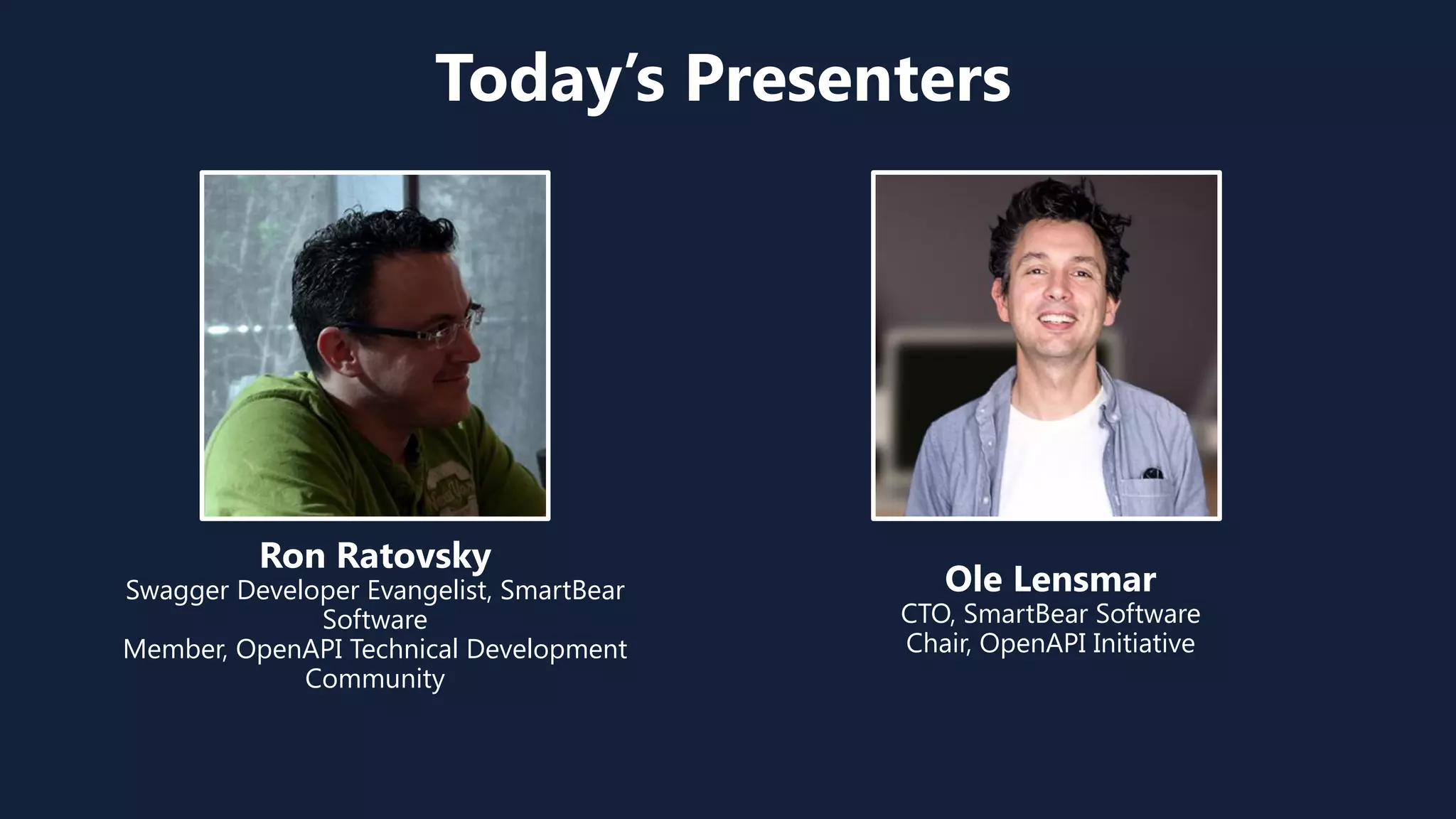
Today’s Presenters
Ole Lensmar
CTO, SmartBear Software
Chair, OpenAPI Initiative
Ron Ratovsky
Swagger Developer Evangelist, SmartBear
Software
Member, OpenAPI Technical Development
Community
3
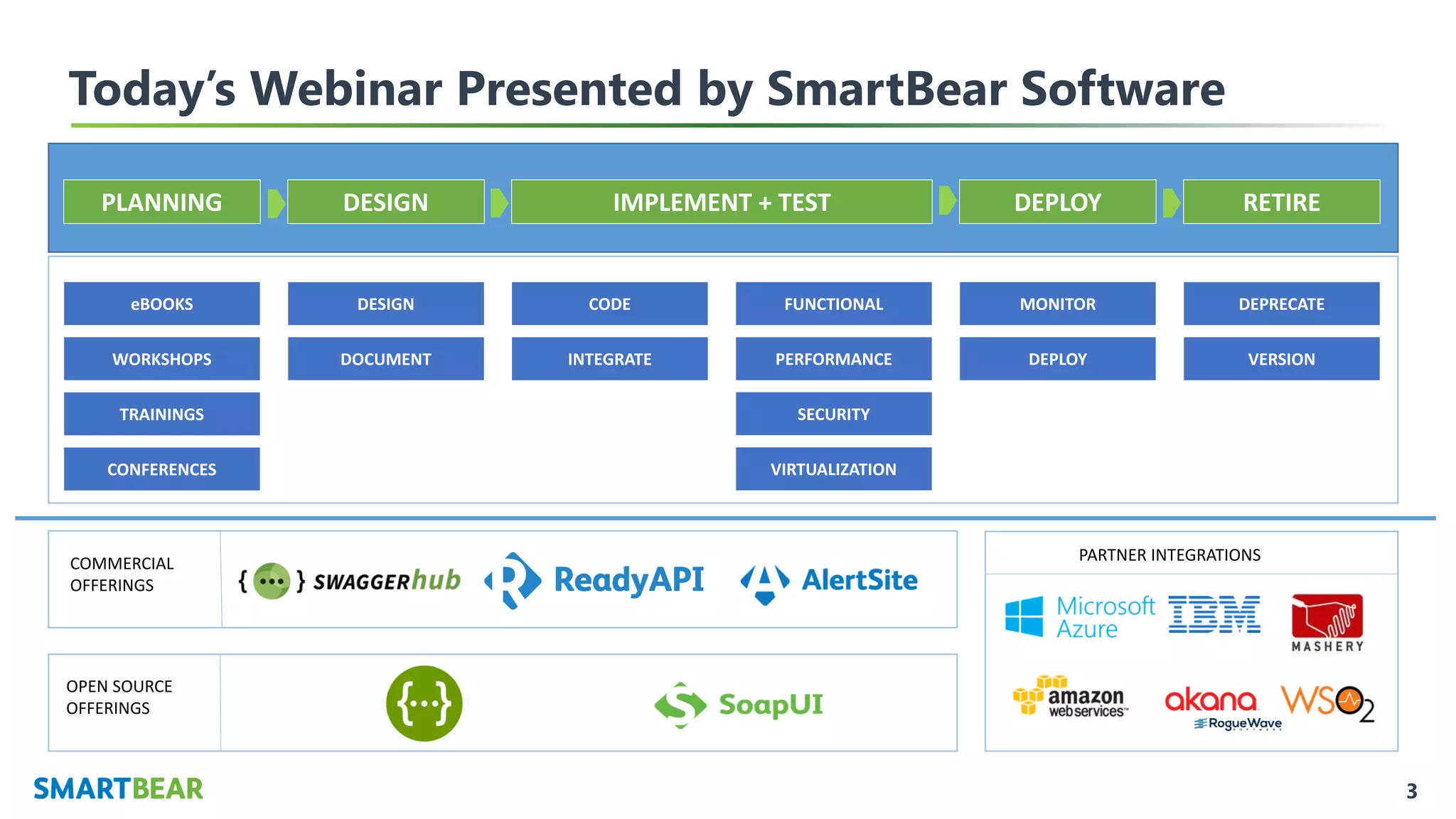
Today’s Webinar Presented by SmartBear Software
PLANNING DESIGN IMPLEMENT + TEST DEPLOY RETIRE
eBOOKS
WORKSHOPS
DESIGN
DOCUMENT
CODE
INTEGRATE
FUNCTIONAL
PERFORMANCE
SECURITY
VIRTUALIZATION
MONITOR
DEPLOY
DEPRECATE
VERSION
TRAININGS
CONFERENCES
PARTNER INTEGRATIONS
OPEN SOURCE
OFFERINGS
COMMERCIAL
OFFERINGS
4
Today’s Agenda
• OpenAPI Initiative Overview
• Why OAS 3.0 became the standard
• What’s new in OAS 3.0
• OAS 3.0 in the API Lifecycle
• What’s next for Swagger & SwaggerHub
• Live Swagger demo
• Q&A
55
OpenAPI Initiative Overview
6
History of OpenAPI Initiative
• Swagger Project founded in 2010 by Tony
Tam / Reverb to design and document API
interfaces
• Groups large & small drawn to Project
Interested in its simplicity, pragmatic
approach, potential open governance
• Acquired by SmartBear in early 2015
• Swagger 2.0 Spec donated by SmartBear
Software to the Open API Initiative
• OpenAPI Initiative reaches 27 members,
including software providers and industry
leaders in banking, healthcare, finance, & tech
• OpenAPI 3.0 officially released on 7/26
7
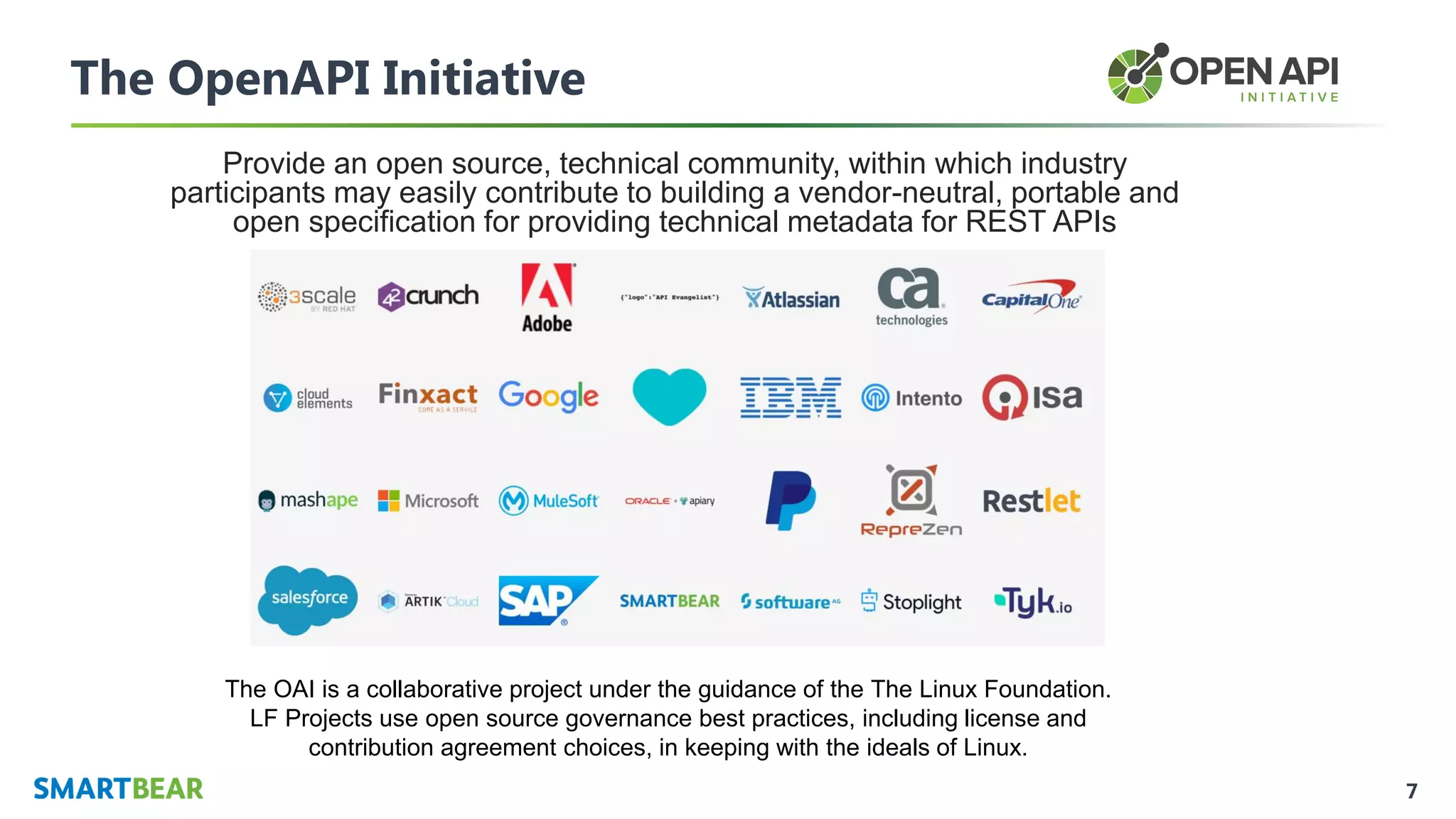
The OpenAPI Initiative
Provide an open source, technical community, within which industry
participants may easily contribute to building a vendor-neutral, portable and
open specification for providing technical metadata for REST APIs
The OAI is a collaborative project under the guidance of the The Linux Foundation.
LF Projects use open source governance best practices, including license and
contribution agreement choices, in keeping with the ideals of Linux.
8
The OpenAPI Initiative - 2 main bodies
• BGB - Provides governance for the OpenAPI Spec
• Evangelization / Events / Sponsorships
• Drives the APIStrat conference (new!)
• Expertise & Knowledge Sharing
• Licensing / Legal / Trademarks
• Does not have any influence on the technical direction of the spec
• TDC – Drives the evolution of the OpenAPI Spec
• Drives the technical direction of the specification
• Managed like any open-source project at https://github.com/OAI
• Anyone is welcome and encouraged to join and suggest, discuss, ask
and complain!
9
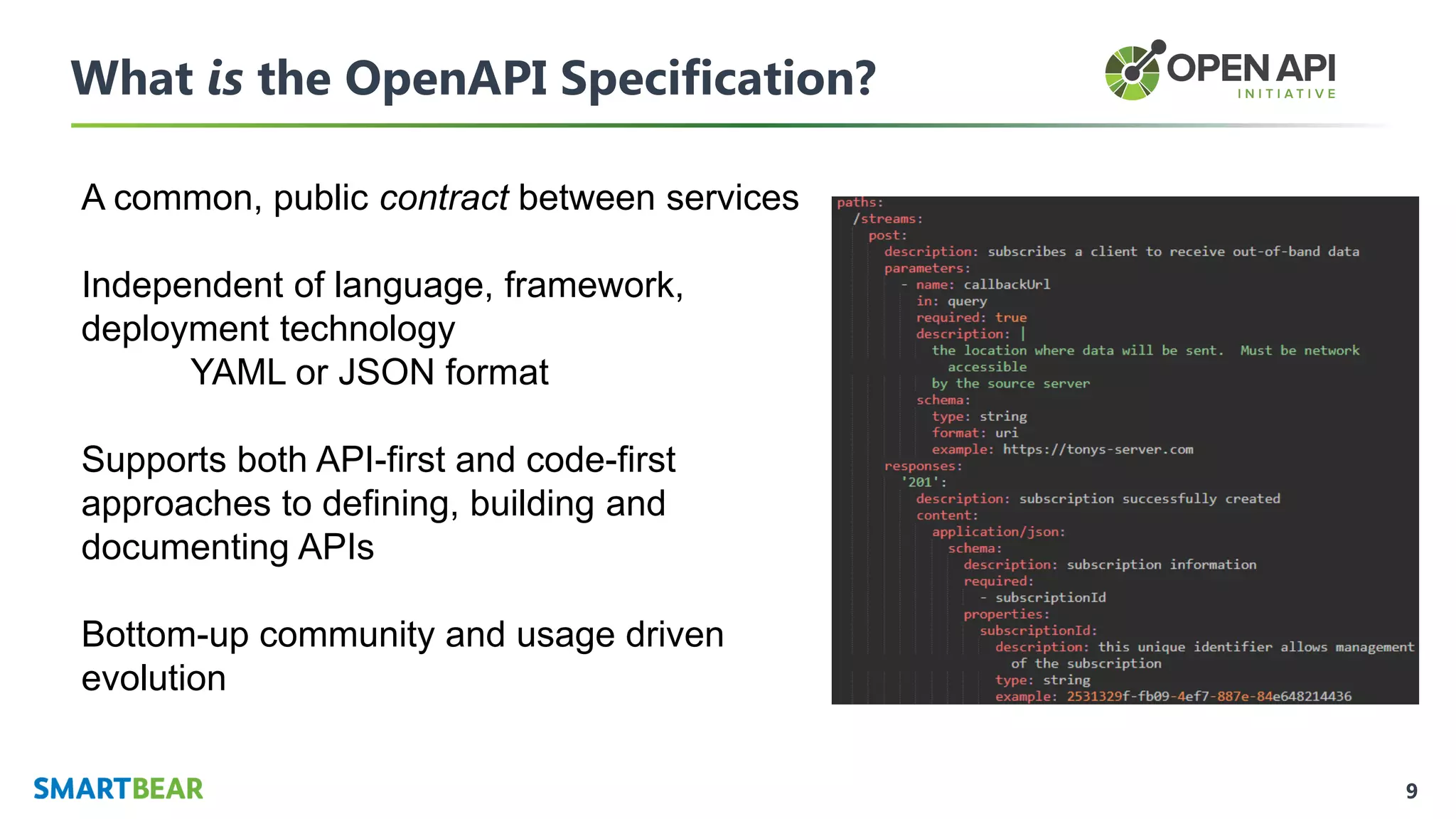
What is the OpenAPI Specification?
A common, public contract between services
Independent of language, framework,
deployment technology
YAML or JSON format
Supports both API-first and code-first
approaches to defining, building and
documenting APIs
Bottom-up community and usage driven
evolution
10
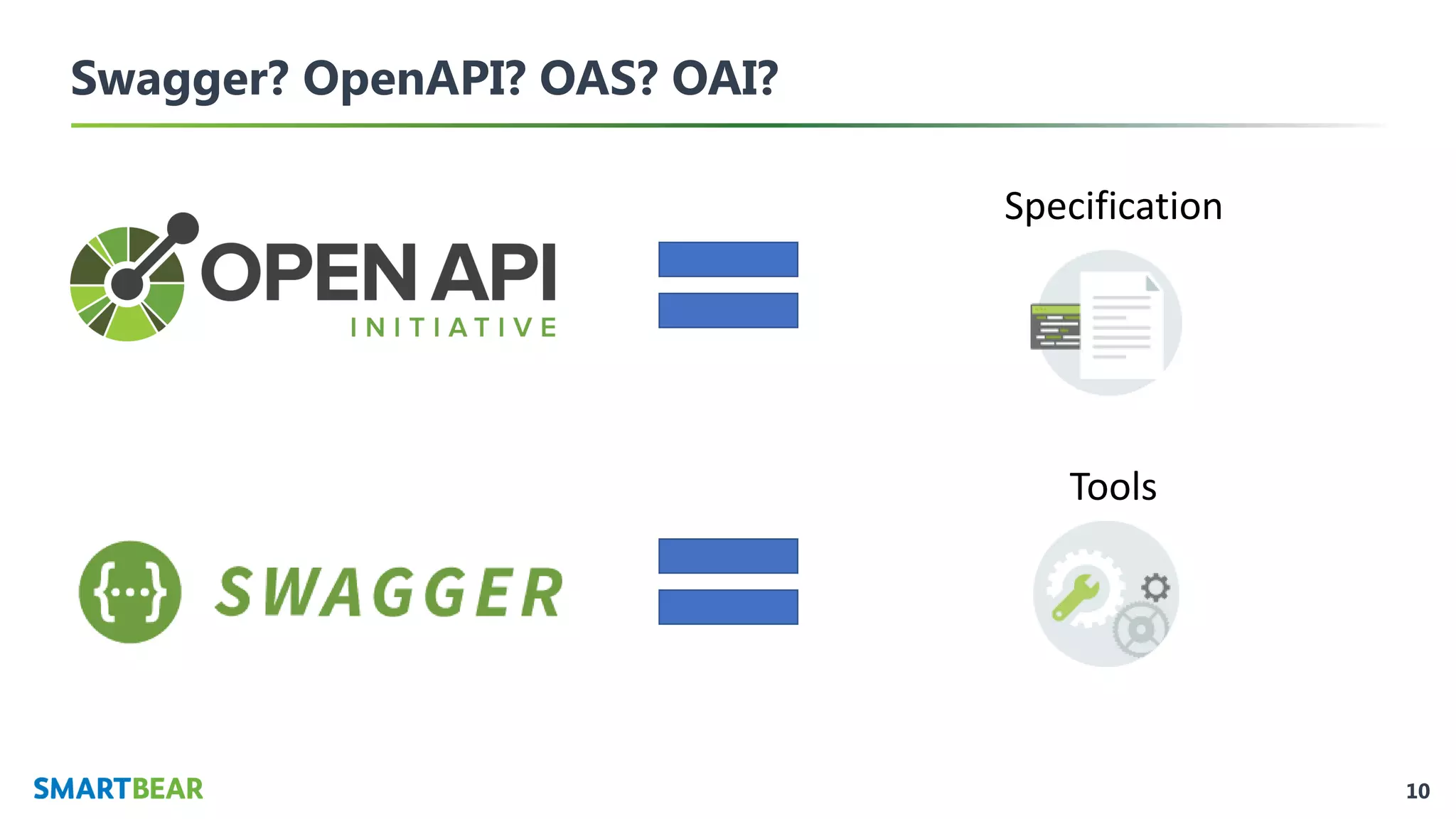
Swagger? OpenAPI? OAS? OAI?
Specification
Tools
1111
What’s New in OpenAPI 3.0?
12
OAS 3.0 Specification Change Criteria
• Clarity - The current "way" something is done doesn't make sense, is complicated, or not
clear
• Consistency - A portion of the specification is not consistent with the rest, or the industry
standard terminology
• Necessary functionality - We are missing functionality because of a certain design of the
specification
• Forward-looking designs - As usage of APIs evolves to new protocols, formats,
patterns, we should always be considering what the next important functionality should be
• Impact - A change will provide impact on a large number of use cases. We should not be
forced to accommodate every use case. We should strive to make the common and important
use cases both well supported and common in the definition of the OAI Spec.
13
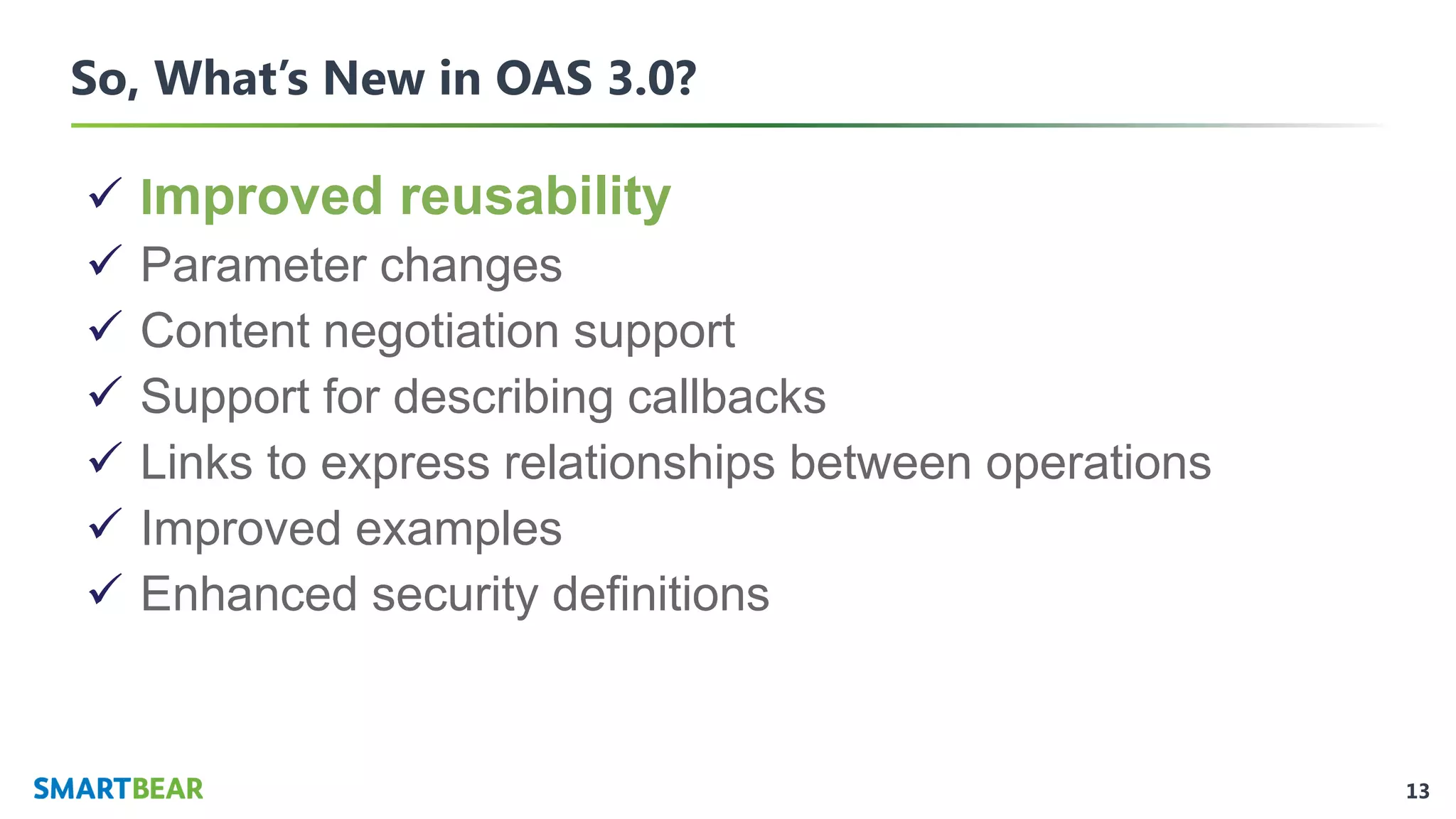
So, What’s New in OAS 3.0?
✓ Improved reusability
✓ Parameter changes
✓ Content negotiation support
✓ Support for describing callbacks
✓ Links to express relationships between operations
✓ Improved examples
✓ Enhanced security definitions
14
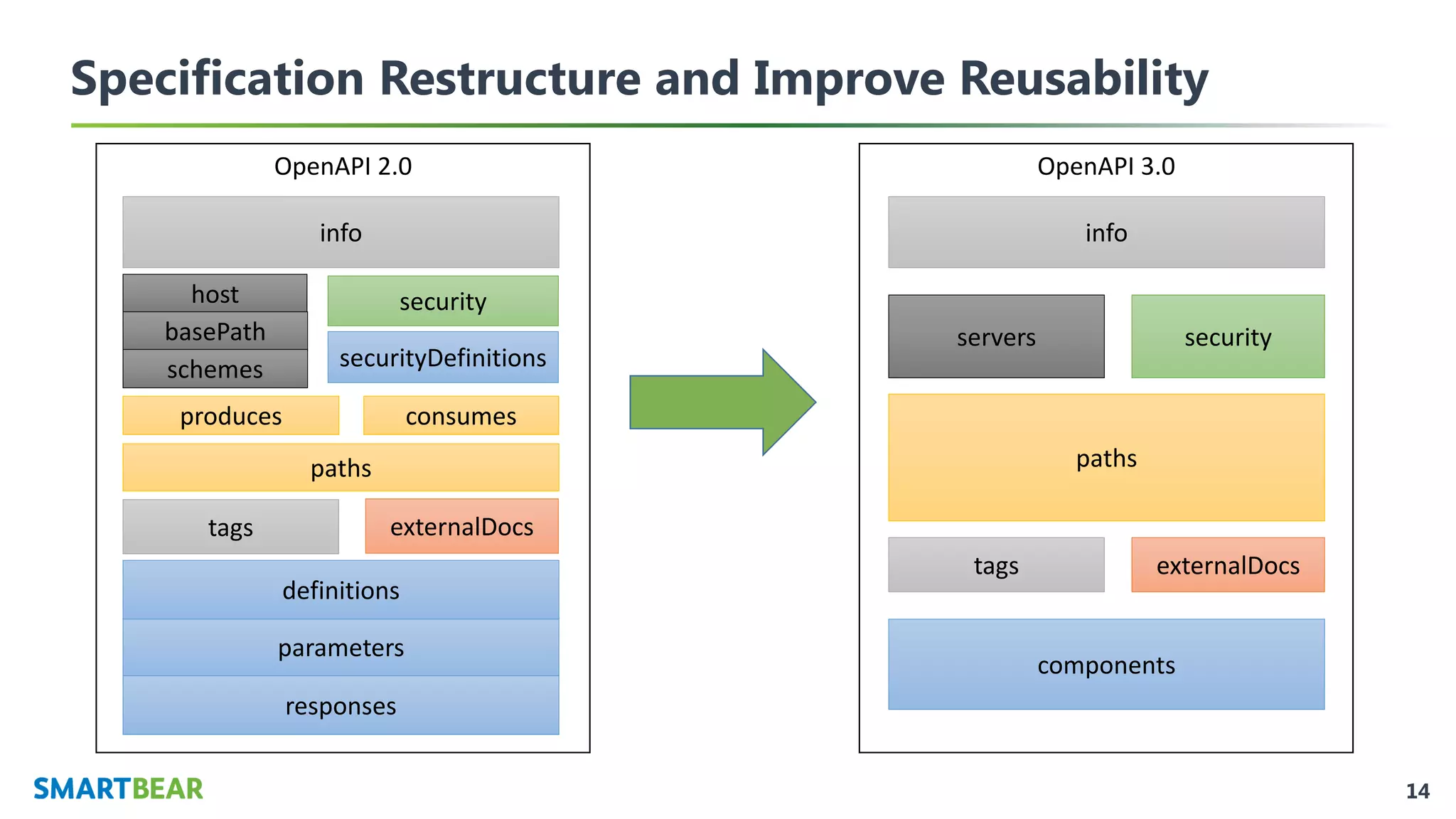
Specification Restructure and Improve Reusability
OpenAPI 2.0
info
host
paths
parameters
security
tags externalDocs
basePath
schemes securityDefinitions
responses
definitions
produces consumes
OpenAPI 3.0
info
servers
paths
components
security
tags externalDocs
15
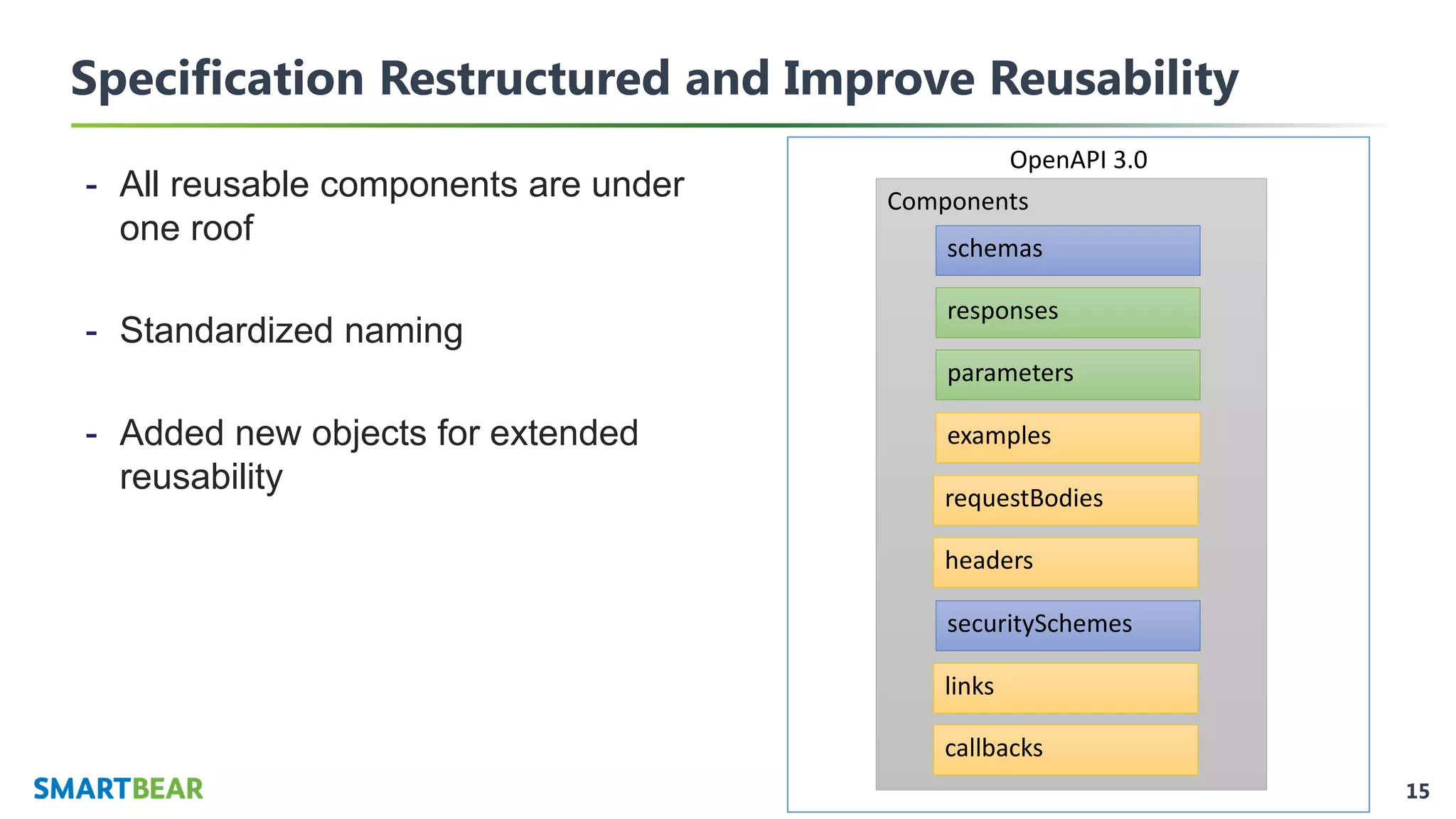
Specification Restructured and Improve Reusability
OpenAPI 3.0
Components
schemas
responses
parameters
examples
requestBodies
headers
securitySchemes
links
callbacks
- All reusable components are under
one roof
- Standardized naming
- Added new objects for extended
reusability
16
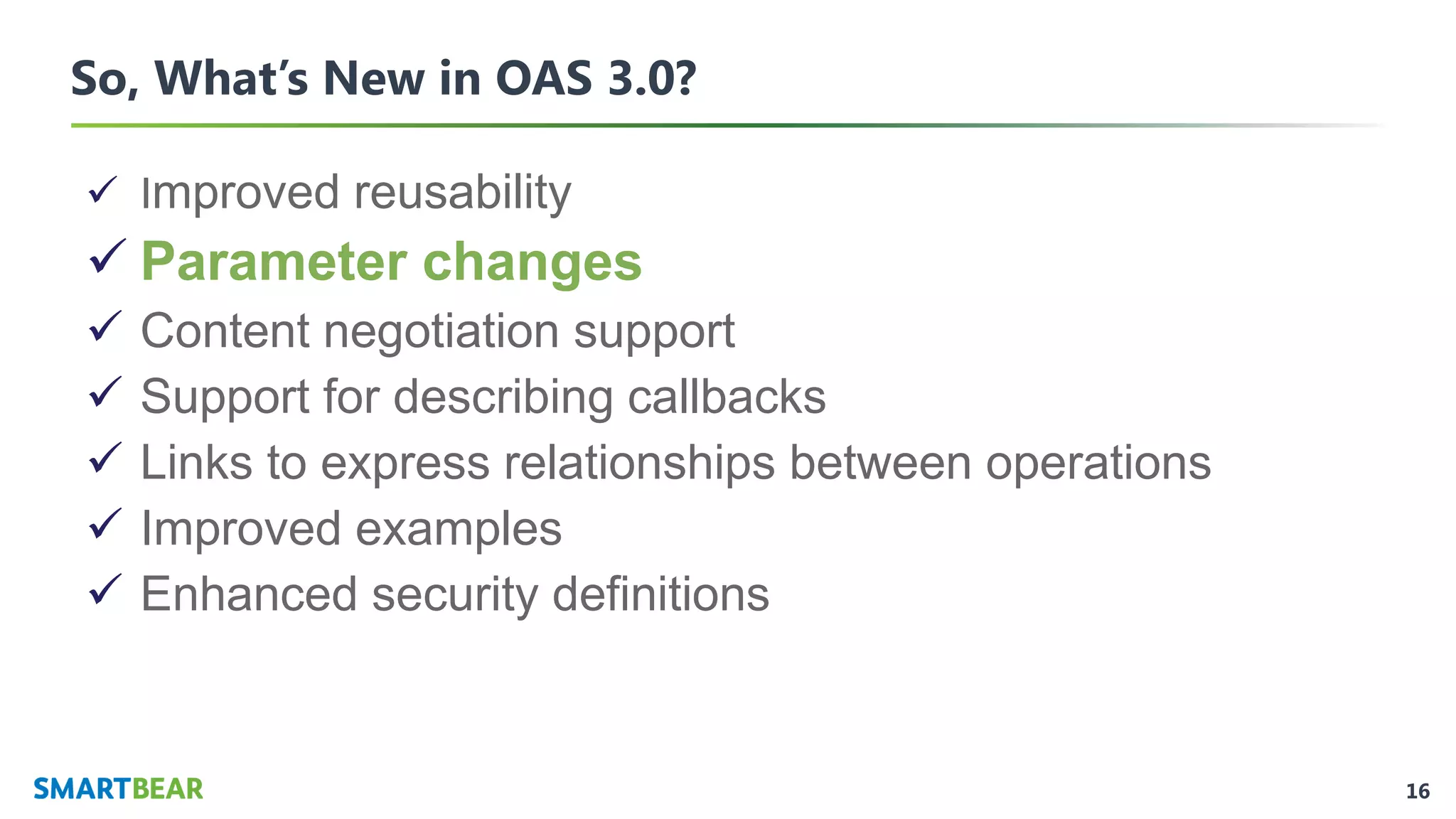
So, What’s New in OAS 3.0?
✓ Improved reusability
✓ Parameter changes
✓ Content negotiation support
✓ Support for describing callbacks
✓ Links to express relationships between operations
✓ Improved examples
✓ Enhanced security definitions
17
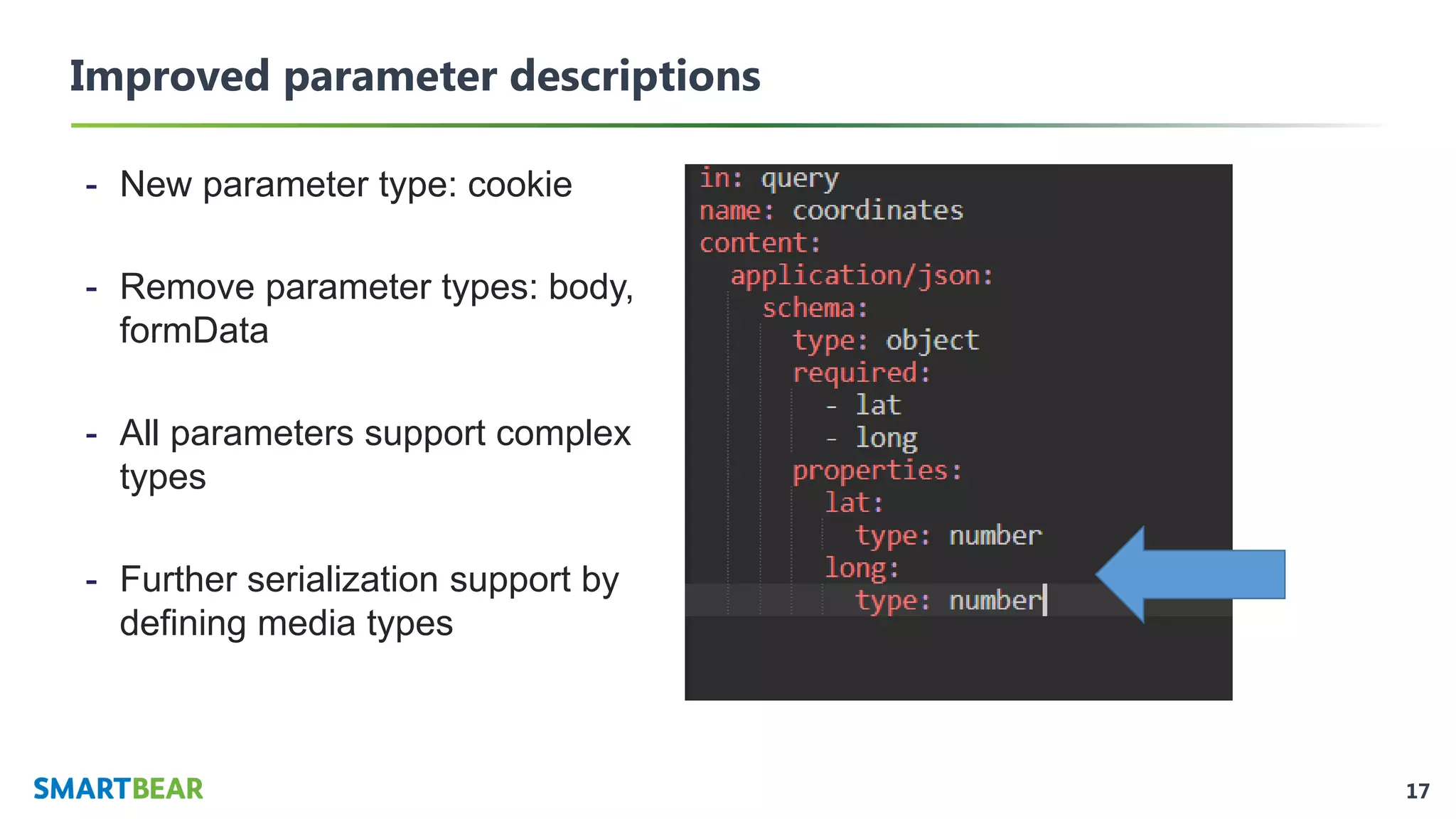
Improved parameter descriptions
- New parameter type: cookie
- Remove parameter types: body,
formData
- All parameters support complex
types
- Further serialization support by
defining media types
18
So, What’s New in OAS 3.0?
✓ Improved reusability
✓ Parameter changes
✓ Content negotiation support
✓ Support for describing callbacks
✓ Links to express relationships between operations
✓ Improved examples
✓ Enhanced security definitions
19
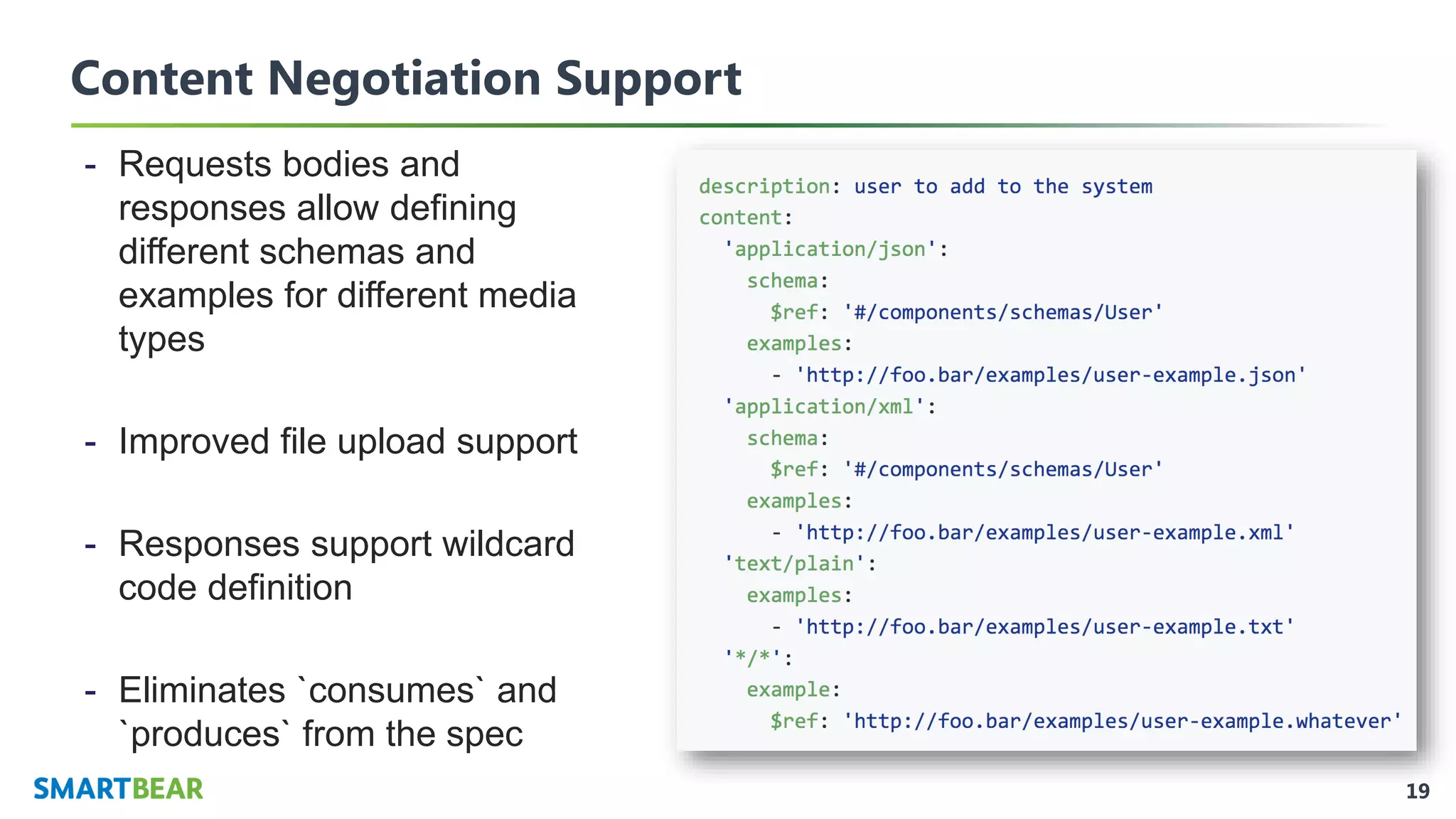
Content Negotiation Support
- Requests bodies and
responses allow defining
different schemas and
examples for different media
types
- Improved file upload support
- Responses support wildcard
code definition
- Eliminates `consumes` and
`produces` from the spec
20
So, What’s New in OAS 3.0?
✓ Improved reusability
✓ Parameter changes
✓ Content negotiation support
✓ Support for describing callbacks
✓ Links to express relationships between operations
✓ Improved examples
✓ Enhanced security definitions
21
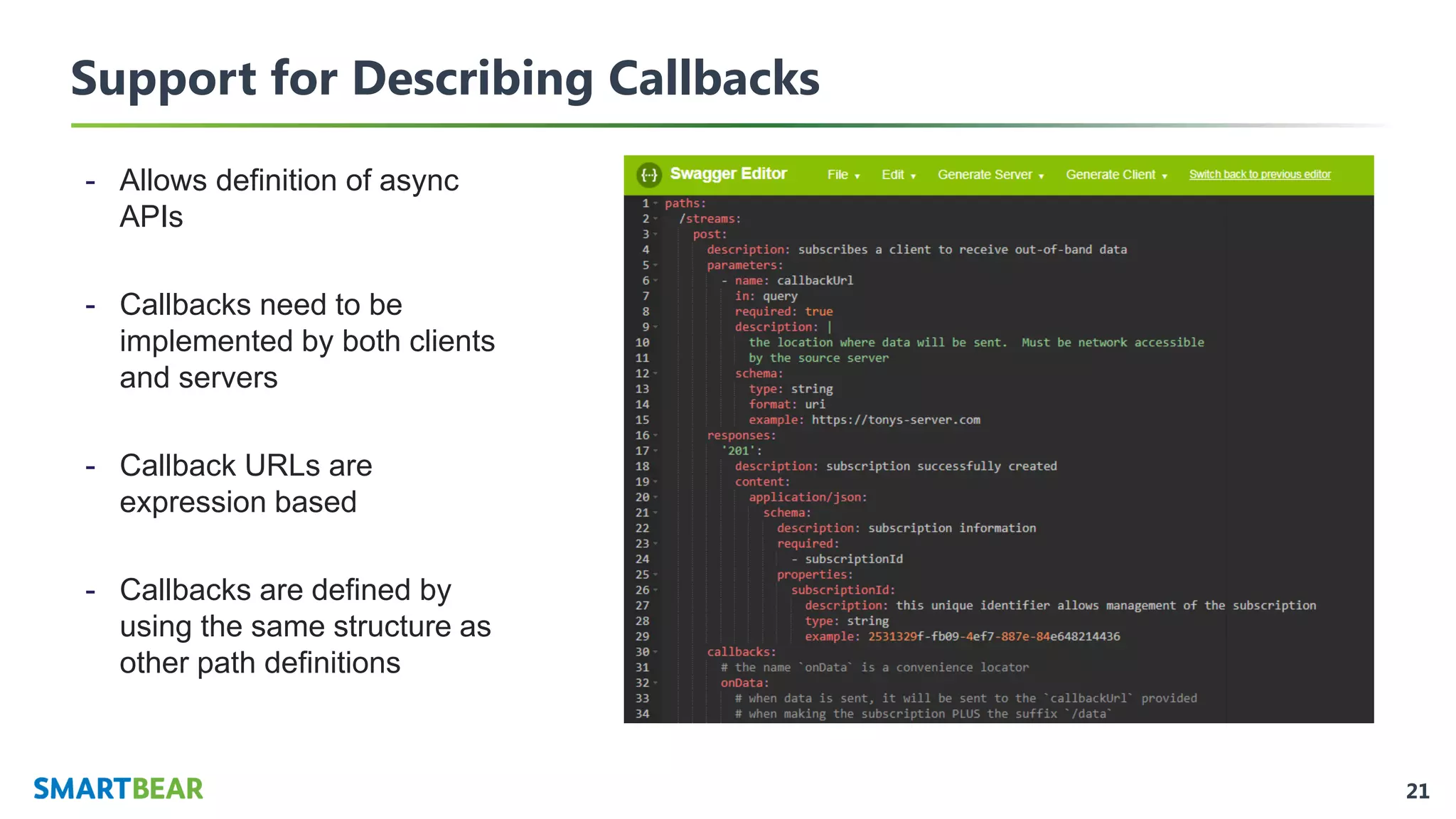
Support for Describing Callbacks
- Allows definition of async
APIs
- Callbacks need to be
implemented by both clients
and servers
- Callback URLs are
expression based
- Callbacks are defined by
using the same structure as
other path definitions
22
So, What’s New in OAS 3.0?
✓ Improved reusability
✓ Parameter changes
✓ Content negotiation support
✓ Support for describing callbacks
✓ Links to express relationships between
operations
✓ Improved examples
✓ Enhanced security definitions
23
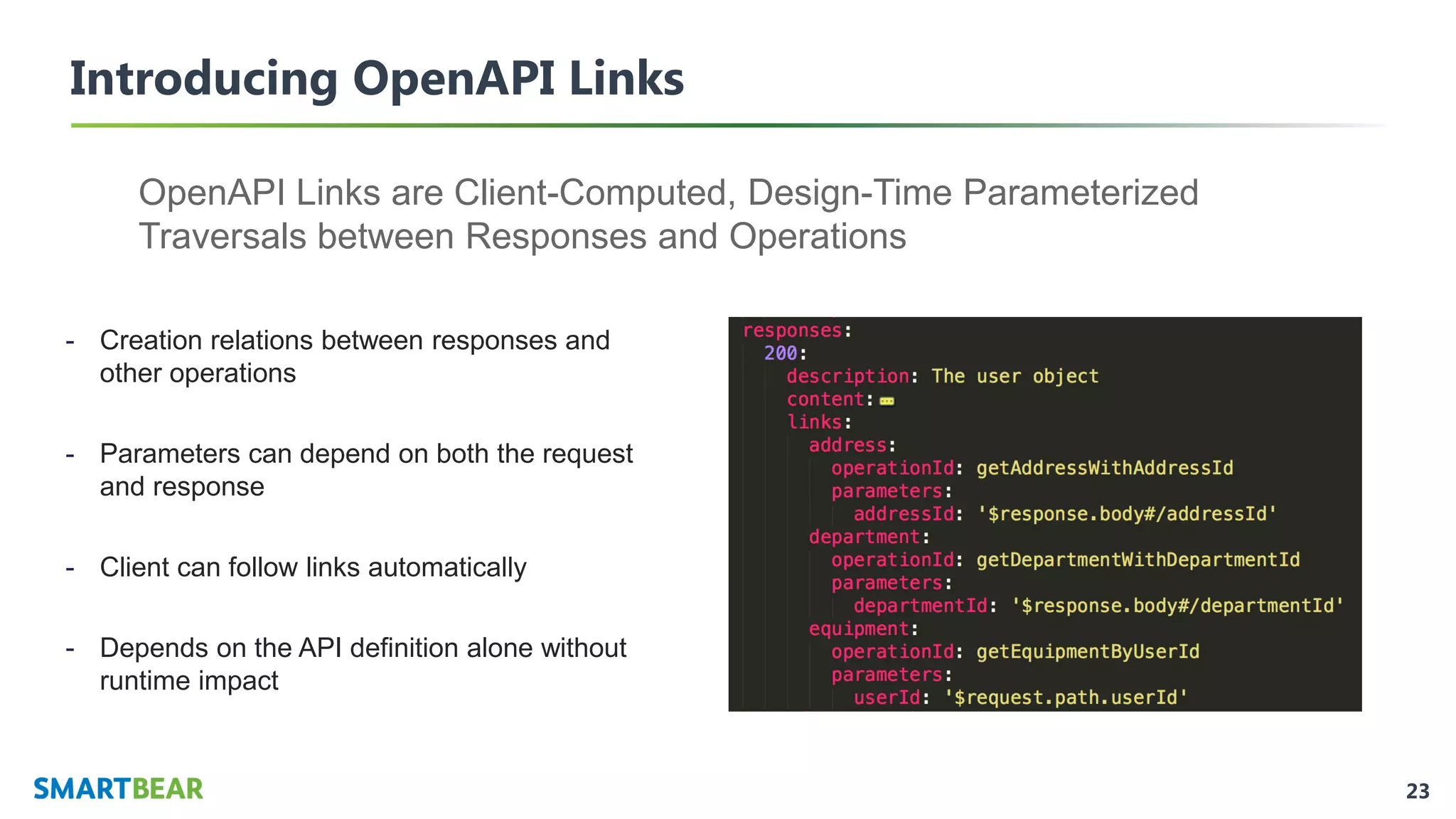
Introducing OpenAPI Links
OpenAPI Links are Client-Computed, Design-Time Parameterized
Traversals between Responses and Operations
- Creation relations between responses and
other operations
- Parameters can depend on both the request
and response
- Client can follow links automatically
- Depends on the API definition alone without
runtime impact
24
So, What’s New in OAS 3.0?
✓ Improved reusability
✓ Parameter changes
✓ Content negotiation support
✓ Support for describing callbacks
✓ Links to express relationships between operations
✓ Improved examples
✓ Enhanced security definitions
25
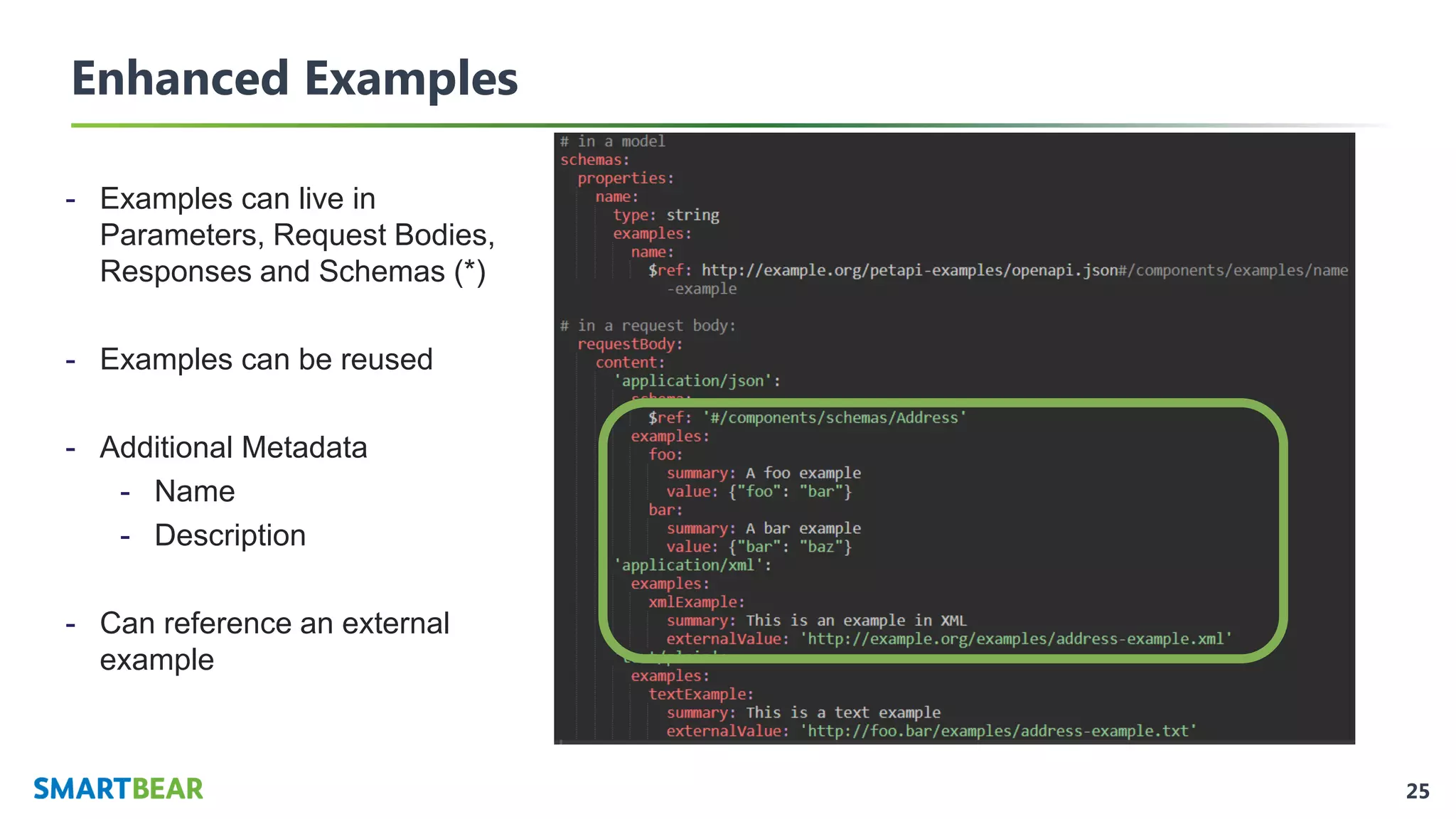
Enhanced Examples
- Examples can live in
Parameters, Request Bodies,
Responses and Schemas (*)
- Examples can be reused
- Additional Metadata
- Name
- Description
- Can reference an external
example
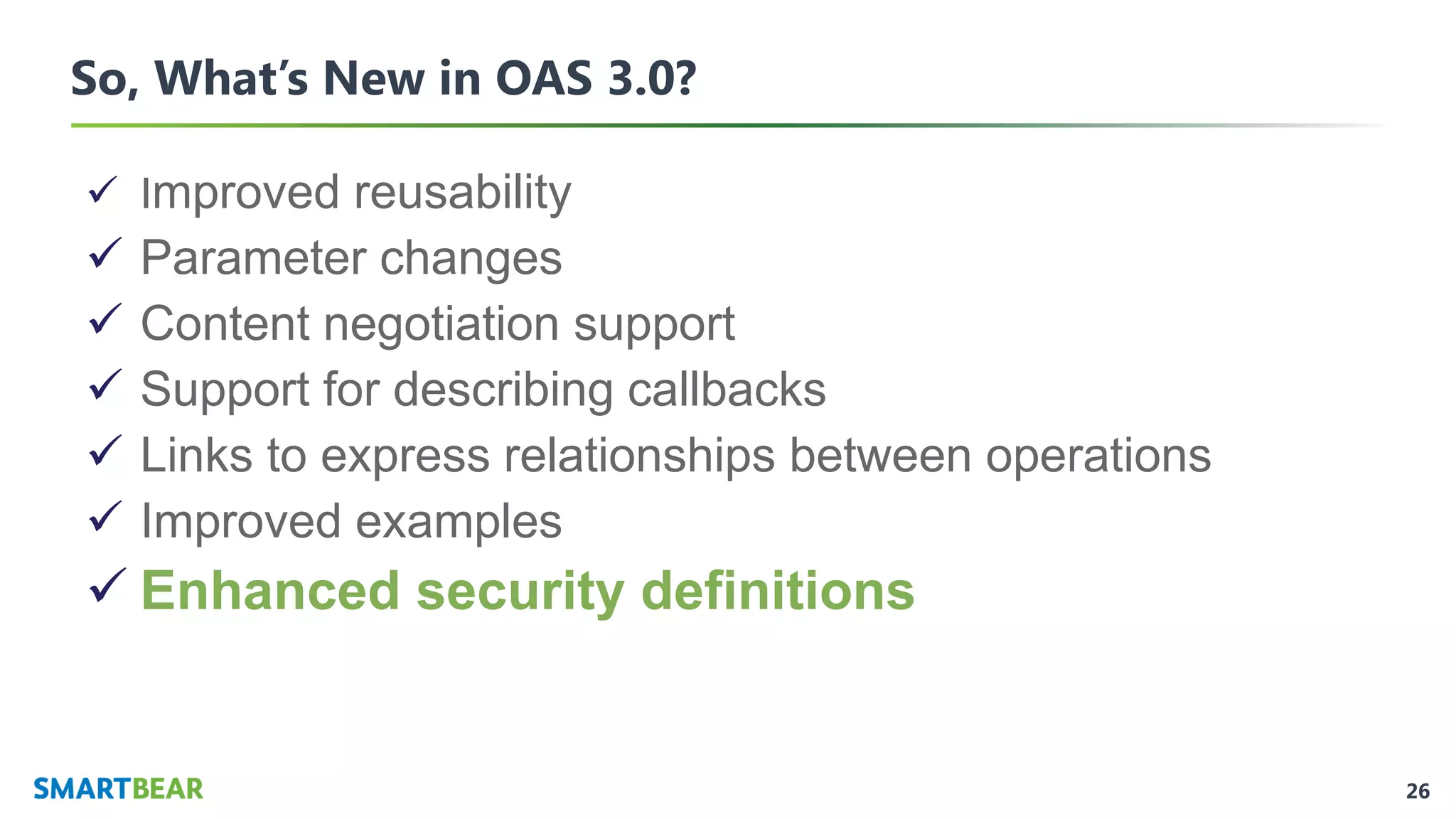
26
So, What’s New in OAS 3.0?
✓ Improved reusability
✓ Parameter changes
✓ Content negotiation support
✓ Support for describing callbacks
✓ Links to express relationships between operations
✓ Improved examples
✓ Enhanced security definitions
27
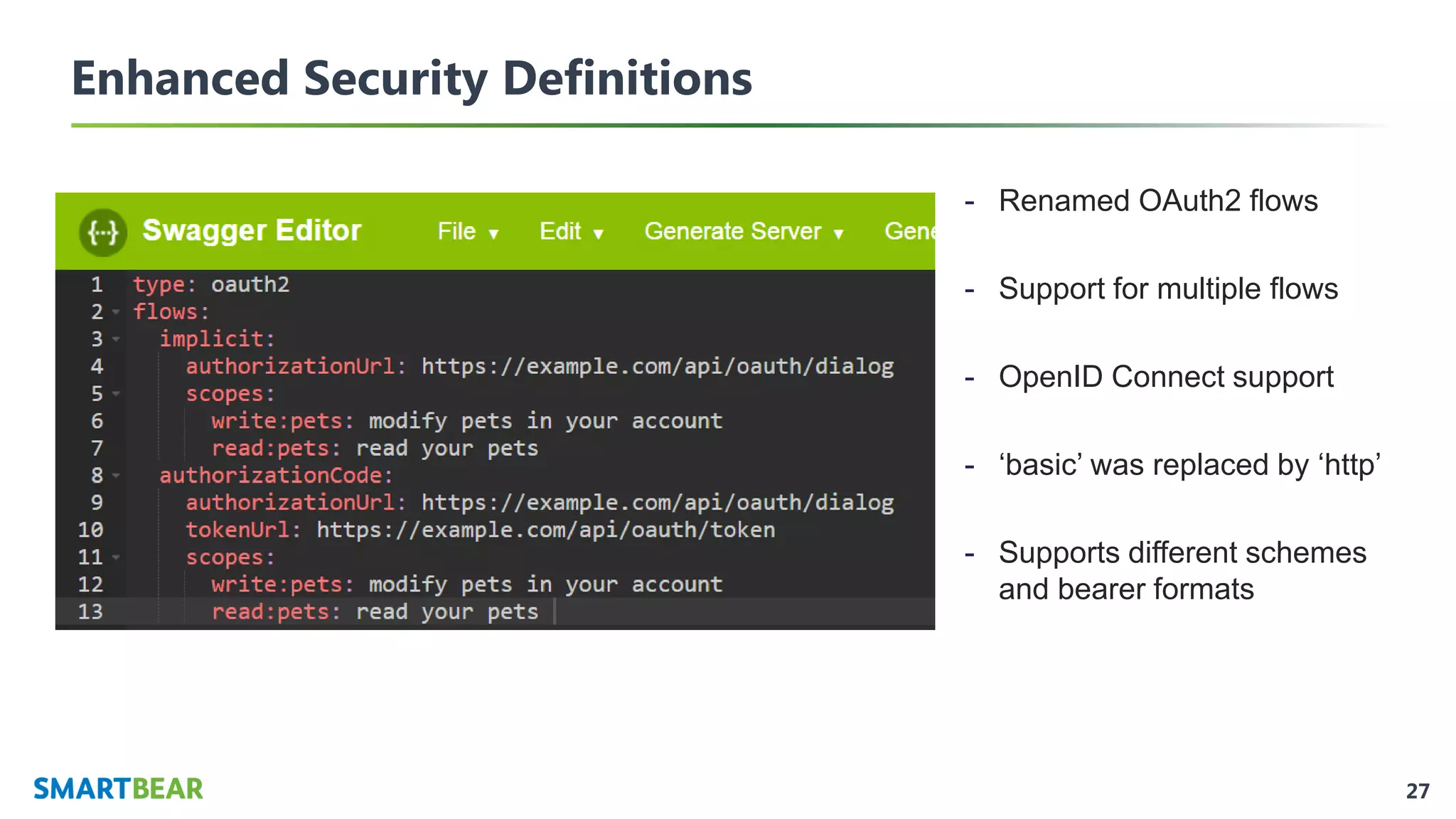
Enhanced Security Definitions
- Renamed OAuth2 flows
- Support for multiple flows
- OpenID Connect support
- ‘basic’ was replaced by ‘http’
- Supports different schemes
and bearer formats
28
OAS 3.0 – Additional Changes
- CommonMark support in descriptions
- Extended JSON Schema support
- Multiple and templated server definitions
- Support for TRACE method
- No payload support for DELETE, GET…
29
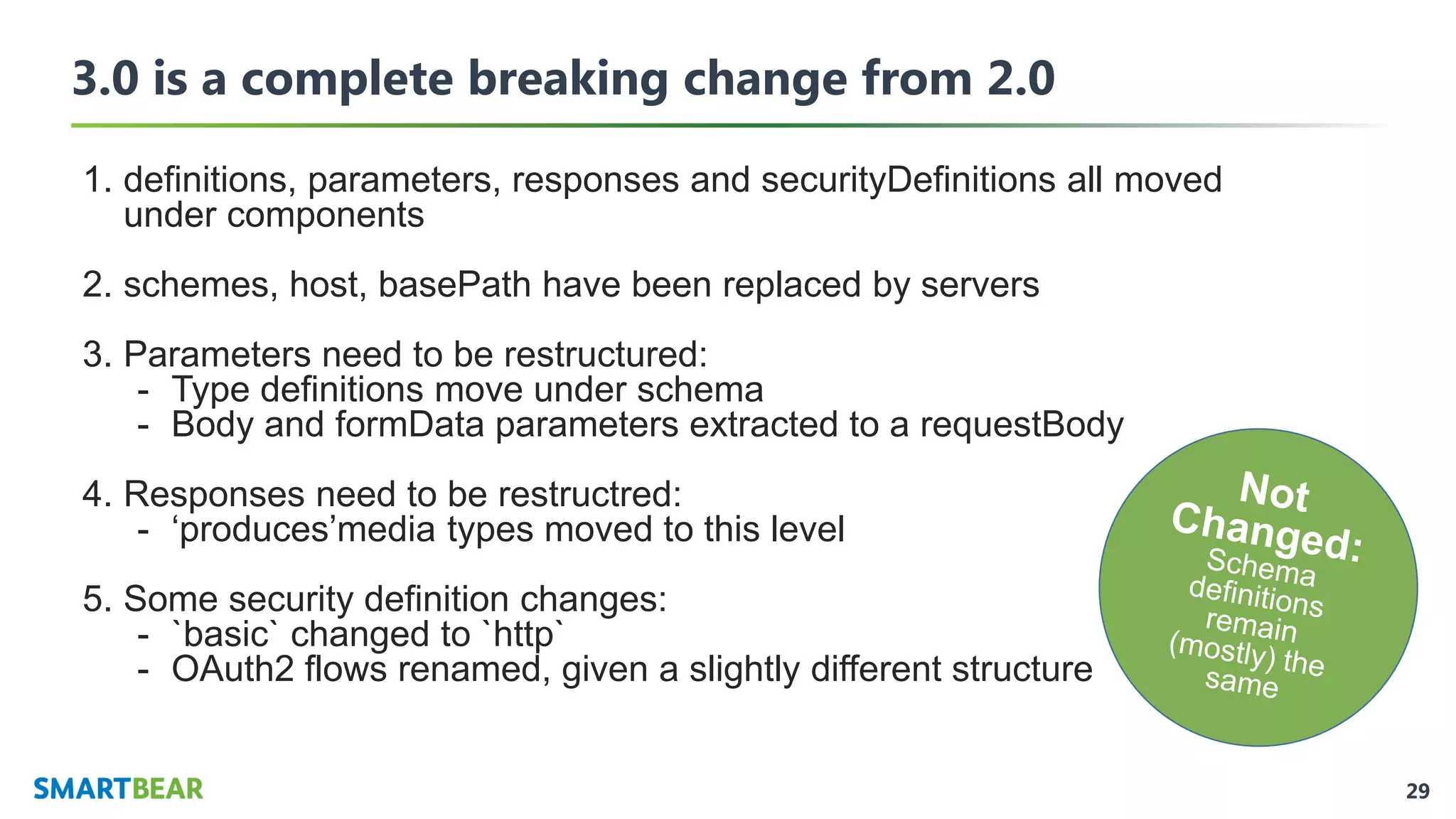
3.0 is a complete breaking change from 2.0
1. definitions, parameters, responses and securityDefinitions all moved
under components
2. schemes, host, basePath have been replaced by servers
3. Parameters need to be restructured:
- Type definitions move under schema
- Body and formData parameters extracted to a requestBody
4. Responses need to be restructred:
- ‘produces’media types moved to this level
5. Some security definition changes:
- `basic` changed to `http`
- OAuth2 flows renamed, given a slightly different structure
3030
OAS 3.0 in the API Lifecycle
31
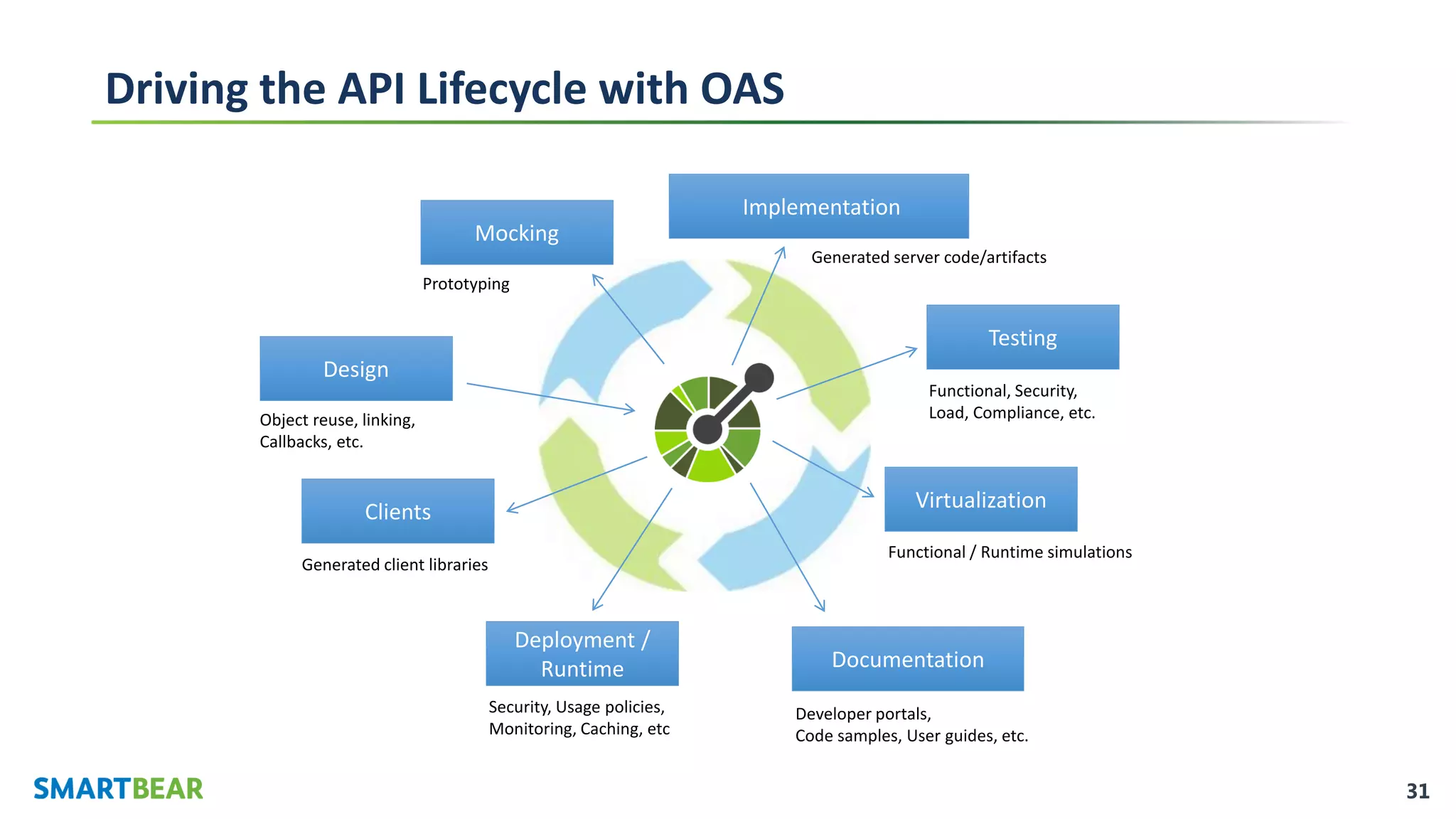
Driving the API Lifecycle with OAS
Design
Implementation
Testing
Mocking
Documentation
Virtualization
Deployment /
Runtime
Clients
Security, Usage policies,
Monitoring, Caching, etc
Developer portals,
Code samples, User guides, etc.
Functional / Runtime simulations
Functional, Security,
Load, Compliance, etc.
Generated server code/artifacts
Prototyping
Generated client libraries
Object reuse, linking,
Callbacks, etc.
3232
What’s Next for Swagger?
33
Swagger: The World’s Most Popular API Tooling for OpenAPI
• 10 Million Downloads Worldwide
• Combination of Swagger UI and Swagger
Editor downloaded once every 3
seconds
• SwaggerHub, launched 2015 – 60k API
developers, architects, devops, technical
writers, & managers use SwaggerHub to
design & document APIs
34
Built for OpenAPI Specification
Swagger Editor Swagger UI Swagger Codegen
HTML, Javascript, and CSS
assets that dynamically
generate documentation
The first open source
editor fully dedicated
to OAS-based APIs.
Turn your OAS definition
into code, generating
server stubs & client SDKs
35
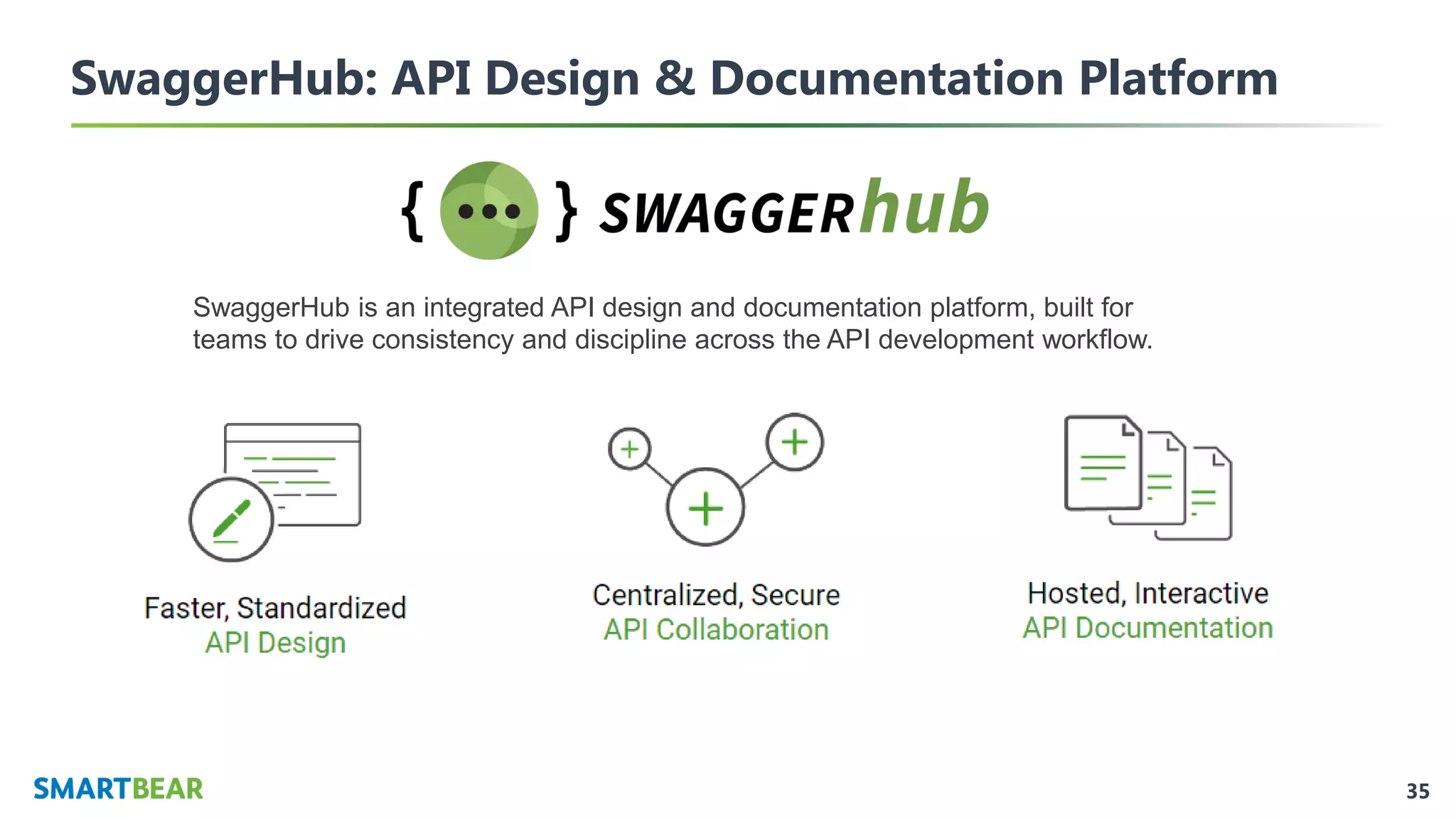
SwaggerHub: API Design & Documentation Platform
SwaggerHub is an integrated API design and documentation platform, built for
teams to drive consistency and discipline across the API development workflow.
36
Timeline of OAS 3.0 Support
AUGUST
• Swagger-UI/Editor
✓Editing/Viewing – out now!
▪ Sandbox functionality – end of August
• Swagger-JS – end of August
• Swagger-Core – mid August
• Swagger-Parser – mid August
• Swagger-Converter – end of August
• Swagger-Inflector – end of August
SEPTEMBER
• Swagger-Validator – mid September
• Swagger-Codegen – end of
September
• SwaggerHub – mid September
3737
Let’s See It in Action
38
Next Steps
Additional Resources
Swagger.io/docs/specification
Learn Try Connect
GitHub
SwaggerAPI
Twitter
@SwaggerAPI
Subscribe
swagger.io/blog
39
The Platform for Designing and Documenting
APIs with Swagger
Try SwaggerHub for Free
www.swaggerhub.com

OpenAPI 3.0, And What It Means for the Future of Swagger

  • 1.
    1 OpenAPI 3.0, AndWhat It Means for the Future of Swagger
  • 2.
    2 Today’s Presenters Ole Lensmar CTO,SmartBear Software Chair, OpenAPI Initiative Ron Ratovsky Swagger Developer Evangelist, SmartBear Software Member, OpenAPI Technical Development Community
  • 3.
    3 Today’s Webinar Presentedby SmartBear Software PLANNING DESIGN IMPLEMENT + TEST DEPLOY RETIRE eBOOKS WORKSHOPS DESIGN DOCUMENT CODE INTEGRATE FUNCTIONAL PERFORMANCE SECURITY VIRTUALIZATION MONITOR DEPLOY DEPRECATE VERSION TRAININGS CONFERENCES PARTNER INTEGRATIONS OPEN SOURCE OFFERINGS COMMERCIAL OFFERINGS
  • 4.
    4 Today’s Agenda • OpenAPIInitiative Overview • Why OAS 3.0 became the standard • What’s new in OAS 3.0 • OAS 3.0 in the API Lifecycle • What’s next for Swagger & SwaggerHub • Live Swagger demo • Q&A
  • 5.
  • 6.
    6 History of OpenAPIInitiative • Swagger Project founded in 2010 by Tony Tam / Reverb to design and document API interfaces • Groups large & small drawn to Project Interested in its simplicity, pragmatic approach, potential open governance • Acquired by SmartBear in early 2015 • Swagger 2.0 Spec donated by SmartBear Software to the Open API Initiative • OpenAPI Initiative reaches 27 members, including software providers and industry leaders in banking, healthcare, finance, & tech • OpenAPI 3.0 officially released on 7/26
  • 7.
    7 The OpenAPI Initiative Providean open source, technical community, within which industry participants may easily contribute to building a vendor-neutral, portable and open specification for providing technical metadata for REST APIs The OAI is a collaborative project under the guidance of the The Linux Foundation. LF Projects use open source governance best practices, including license and contribution agreement choices, in keeping with the ideals of Linux.
  • 8.
    8 The OpenAPI Initiative- 2 main bodies • BGB - Provides governance for the OpenAPI Spec • Evangelization / Events / Sponsorships • Drives the APIStrat conference (new!) • Expertise & Knowledge Sharing • Licensing / Legal / Trademarks • Does not have any influence on the technical direction of the spec • TDC – Drives the evolution of the OpenAPI Spec • Drives the technical direction of the specification • Managed like any open-source project at https://github.com/OAI • Anyone is welcome and encouraged to join and suggest, discuss, ask and complain!
  • 9.
    9 What is theOpenAPI Specification? A common, public contract between services Independent of language, framework, deployment technology YAML or JSON format Supports both API-first and code-first approaches to defining, building and documenting APIs Bottom-up community and usage driven evolution
  • 10.
    10 Swagger? OpenAPI? OAS?OAI? Specification Tools
  • 11.
  • 12.
    12 OAS 3.0 SpecificationChange Criteria • Clarity - The current "way" something is done doesn't make sense, is complicated, or not clear • Consistency - A portion of the specification is not consistent with the rest, or the industry standard terminology • Necessary functionality - We are missing functionality because of a certain design of the specification • Forward-looking designs - As usage of APIs evolves to new protocols, formats, patterns, we should always be considering what the next important functionality should be • Impact - A change will provide impact on a large number of use cases. We should not be forced to accommodate every use case. We should strive to make the common and important use cases both well supported and common in the definition of the OAI Spec.
  • 13.
    13 So, What’s Newin OAS 3.0? ✓ Improved reusability ✓ Parameter changes ✓ Content negotiation support ✓ Support for describing callbacks ✓ Links to express relationships between operations ✓ Improved examples ✓ Enhanced security definitions
  • 14.
    14 Specification Restructure andImprove Reusability OpenAPI 2.0 info host paths parameters security tags externalDocs basePath schemes securityDefinitions responses definitions produces consumes OpenAPI 3.0 info servers paths components security tags externalDocs
  • 15.
    15 Specification Restructured andImprove Reusability OpenAPI 3.0 Components schemas responses parameters examples requestBodies headers securitySchemes links callbacks - All reusable components are under one roof - Standardized naming - Added new objects for extended reusability
  • 16.
    16 So, What’s Newin OAS 3.0? ✓ Improved reusability ✓ Parameter changes ✓ Content negotiation support ✓ Support for describing callbacks ✓ Links to express relationships between operations ✓ Improved examples ✓ Enhanced security definitions
  • 17.
    17 Improved parameter descriptions -New parameter type: cookie - Remove parameter types: body, formData - All parameters support complex types - Further serialization support by defining media types
  • 18.
    18 So, What’s Newin OAS 3.0? ✓ Improved reusability ✓ Parameter changes ✓ Content negotiation support ✓ Support for describing callbacks ✓ Links to express relationships between operations ✓ Improved examples ✓ Enhanced security definitions
  • 19.
    19 Content Negotiation Support -Requests bodies and responses allow defining different schemas and examples for different media types - Improved file upload support - Responses support wildcard code definition - Eliminates `consumes` and `produces` from the spec
  • 20.
    20 So, What’s Newin OAS 3.0? ✓ Improved reusability ✓ Parameter changes ✓ Content negotiation support ✓ Support for describing callbacks ✓ Links to express relationships between operations ✓ Improved examples ✓ Enhanced security definitions
  • 21.
    21 Support for DescribingCallbacks - Allows definition of async APIs - Callbacks need to be implemented by both clients and servers - Callback URLs are expression based - Callbacks are defined by using the same structure as other path definitions
  • 22.
    22 So, What’s Newin OAS 3.0? ✓ Improved reusability ✓ Parameter changes ✓ Content negotiation support ✓ Support for describing callbacks ✓ Links to express relationships between operations ✓ Improved examples ✓ Enhanced security definitions
  • 23.
    23 Introducing OpenAPI Links OpenAPILinks are Client-Computed, Design-Time Parameterized Traversals between Responses and Operations - Creation relations between responses and other operations - Parameters can depend on both the request and response - Client can follow links automatically - Depends on the API definition alone without runtime impact
  • 24.
    24 So, What’s Newin OAS 3.0? ✓ Improved reusability ✓ Parameter changes ✓ Content negotiation support ✓ Support for describing callbacks ✓ Links to express relationships between operations ✓ Improved examples ✓ Enhanced security definitions
  • 25.
    25 Enhanced Examples - Examplescan live in Parameters, Request Bodies, Responses and Schemas (*) - Examples can be reused - Additional Metadata - Name - Description - Can reference an external example
  • 26.
    26 So, What’s Newin OAS 3.0? ✓ Improved reusability ✓ Parameter changes ✓ Content negotiation support ✓ Support for describing callbacks ✓ Links to express relationships between operations ✓ Improved examples ✓ Enhanced security definitions
  • 27.
    27 Enhanced Security Definitions -Renamed OAuth2 flows - Support for multiple flows - OpenID Connect support - ‘basic’ was replaced by ‘http’ - Supports different schemes and bearer formats
  • 28.
    28 OAS 3.0 –Additional Changes - CommonMark support in descriptions - Extended JSON Schema support - Multiple and templated server definitions - Support for TRACE method - No payload support for DELETE, GET…
  • 29.
    29 3.0 is acomplete breaking change from 2.0 1. definitions, parameters, responses and securityDefinitions all moved under components 2. schemes, host, basePath have been replaced by servers 3. Parameters need to be restructured: - Type definitions move under schema - Body and formData parameters extracted to a requestBody 4. Responses need to be restructred: - ‘produces’media types moved to this level 5. Some security definition changes: - `basic` changed to `http` - OAuth2 flows renamed, given a slightly different structure
  • 30.
    3030 OAS 3.0 inthe API Lifecycle
  • 31.
    31 Driving the APILifecycle with OAS Design Implementation Testing Mocking Documentation Virtualization Deployment / Runtime Clients Security, Usage policies, Monitoring, Caching, etc Developer portals, Code samples, User guides, etc. Functional / Runtime simulations Functional, Security, Load, Compliance, etc. Generated server code/artifacts Prototyping Generated client libraries Object reuse, linking, Callbacks, etc.
  • 32.
  • 33.
    33 Swagger: The World’sMost Popular API Tooling for OpenAPI • 10 Million Downloads Worldwide • Combination of Swagger UI and Swagger Editor downloaded once every 3 seconds • SwaggerHub, launched 2015 – 60k API developers, architects, devops, technical writers, & managers use SwaggerHub to design & document APIs
  • 34.
    34 Built for OpenAPISpecification Swagger Editor Swagger UI Swagger Codegen HTML, Javascript, and CSS assets that dynamically generate documentation The first open source editor fully dedicated to OAS-based APIs. Turn your OAS definition into code, generating server stubs & client SDKs
  • 35.
    35 SwaggerHub: API Design& Documentation Platform SwaggerHub is an integrated API design and documentation platform, built for teams to drive consistency and discipline across the API development workflow.
  • 36.
    36 Timeline of OAS3.0 Support AUGUST • Swagger-UI/Editor ✓Editing/Viewing – out now! ▪ Sandbox functionality – end of August • Swagger-JS – end of August • Swagger-Core – mid August • Swagger-Parser – mid August • Swagger-Converter – end of August • Swagger-Inflector – end of August SEPTEMBER • Swagger-Validator – mid September • Swagger-Codegen – end of September • SwaggerHub – mid September
  • 37.
  • 38.
    38 Next Steps Additional Resources Swagger.io/docs/specification LearnTry Connect GitHub SwaggerAPI Twitter @SwaggerAPI Subscribe swagger.io/blog
  • 39.
    39 The Platform forDesigning and Documenting APIs with Swagger Try SwaggerHub for Free www.swaggerhub.com