PARTE DOS
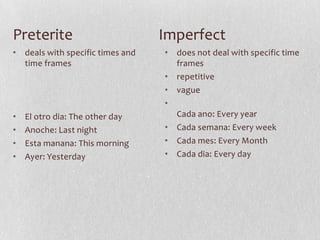
Preterite                         Imperfect
• deals with specific times and   • does not deal with specific time
  time frames                       frames
                                  • repetitive
                                  • vague
                                  •
•   El otro dia: The other day      Cada ano: Every year
•   Anoche: Last night            • Cada semana: Every week
•   Esta manana: This morning     • Cada mes: Every Month
•   Ayer: Yesterday               • Cada dia: Every day
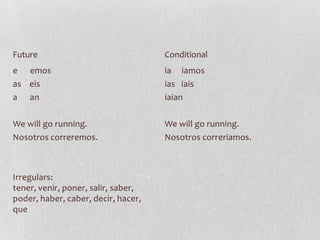
Future                               Conditional
e emos                               ia iamos
as eis                               ias iais
a an                                 iaian

We will go running.                  We will go running.
Nosotros correremos.                 Nosotros correriamos.


Irregulars:
tener, venir, poner, salir, saber,
poder, haber, caber, decir, hacer,
que
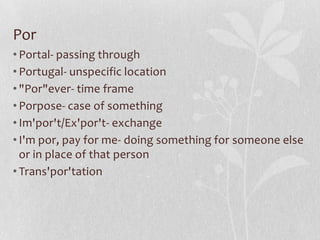
Por
• Portal- passing through
• Portugal- unspecific location
• "Por"ever- time frame
• Porpose- case of something
• Im'por't/Ex'por't- exchange
• I'm por, pay for me- doing something for someone else
  or in place of that person
• Trans'por'tation
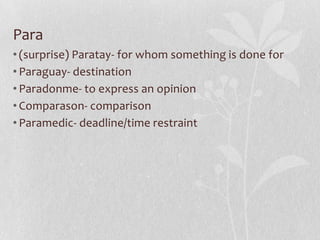
Para
• (surprise) Paratay- for whom something is done for
• Paraguay- destination
• Paradonme- to express an opinion
• Comparason- comparison
• Paramedic- deadline/time restraint
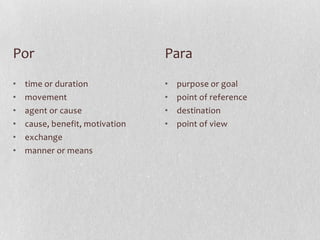
Por                              Para
•   time or duration             •   purpose or goal
•   movement                     •   point of reference
•   agent or cause               •   destination
•   cause, benefit, motivation   •   point of view
•   exchange
•   manner or means
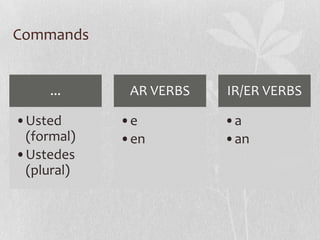
Commands


     ...     AR VERBS   IR/ER VERBS

•Usted      •e          •a
 (formal)   •en         •an
•Ustedes
 (plural)
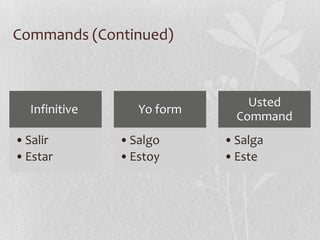
Commands (Continued)


                                Usted
  Infinitive      Yo form
                              Command
• Salir        • Salgo      • Salga
• Estar        • Estoy      • Este
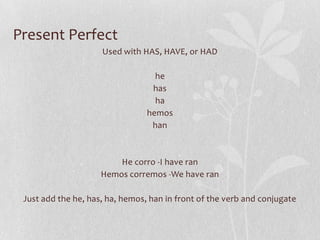
Present Perfect
                     Used with HAS, HAVE, or HAD

                                   he
                                  has
                                   ha
                                 hemos
                                  han


                         He corro -I have ran
                     Hemos corremos -We have ran

 Just add the he, has, ha, hemos, han in front of the verb and conjugate
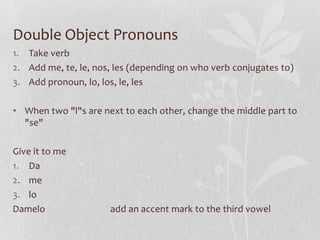
Double Object Pronouns
1. Take verb
2. Add me, te, le, nos, les (depending on who verb conjugates to)
3. Add pronoun, lo, los, le, les

• When two "l"s are next to each other, change the middle part to
  "se"

Give it to me
1. Da
2. me
3. lo
Damelo                add an accent mark to the third vowel
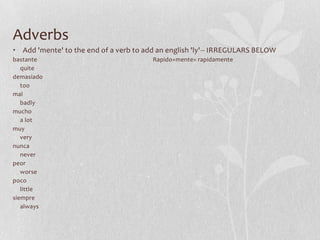
Adverbs
• Add 'mente' to the end of a verb to add an english 'ly'-- IRREGULARS BELOW
bastante                                Rapido+mente= rapidamente
   quite
demasiado
   too
mal
   badly
mucho
   a lot
muy
   very
nunca
   never
peor
   worse
poco
   little
siempre
   always
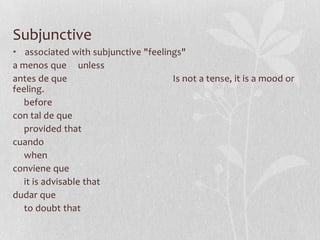
Subjunctive
• associated with subjunctive "feelings"
a menos que unless
antes de que                         Is not a tense, it is a mood or
feeling.
   before
con tal de que
   provided that
cuando
   when
conviene que
   it is advisable that
dudar que
   to doubt that
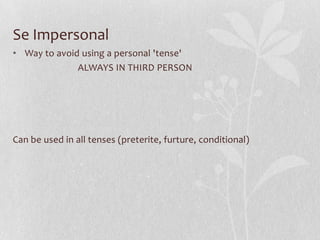
Se Impersonal
• Way to avoid using a personal 'tense'
              ALWAYS IN THIRD PERSON


Can be used in all tenses (preterite, furture, conditional)
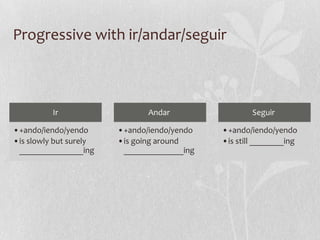
Progressive with ir/andar/seguir


          Ir                   Andar                 Seguir

•+ando/iendo/yendo      •+ando/iendo/yendo   •+ando/iendo/yendo
•is slowly but surely   •is going around     •is still ________ing
 _______________ing      ______________ing

Handbook de gramatica parte dos

  • 1.
  • 2.
    Preterite Imperfect • deals with specific times and • does not deal with specific time time frames frames • repetitive • vague • • El otro dia: The other day Cada ano: Every year • Anoche: Last night • Cada semana: Every week • Esta manana: This morning • Cada mes: Every Month • Ayer: Yesterday • Cada dia: Every day
  • 3.
    Future Conditional e emos ia iamos as eis ias iais a an iaian We will go running. We will go running. Nosotros correremos. Nosotros correriamos. Irregulars: tener, venir, poner, salir, saber, poder, haber, caber, decir, hacer, que
  • 4.
    Por • Portal- passingthrough • Portugal- unspecific location • "Por"ever- time frame • Porpose- case of something • Im'por't/Ex'por't- exchange • I'm por, pay for me- doing something for someone else or in place of that person • Trans'por'tation
  • 5.
    Para • (surprise) Paratay-for whom something is done for • Paraguay- destination • Paradonme- to express an opinion • Comparason- comparison • Paramedic- deadline/time restraint
  • 6.
    Por Para • time or duration • purpose or goal • movement • point of reference • agent or cause • destination • cause, benefit, motivation • point of view • exchange • manner or means
  • 7.
    Commands ... AR VERBS IR/ER VERBS •Usted •e •a (formal) •en •an •Ustedes (plural)
  • 8.
    Commands (Continued) Usted Infinitive Yo form Command • Salir • Salgo • Salga • Estar • Estoy • Este
  • 9.
    Present Perfect Used with HAS, HAVE, or HAD he has ha hemos han He corro -I have ran Hemos corremos -We have ran Just add the he, has, ha, hemos, han in front of the verb and conjugate
  • 10.
    Double Object Pronouns 1.Take verb 2. Add me, te, le, nos, les (depending on who verb conjugates to) 3. Add pronoun, lo, los, le, les • When two "l"s are next to each other, change the middle part to "se" Give it to me 1. Da 2. me 3. lo Damelo add an accent mark to the third vowel
  • 11.
    Adverbs • Add 'mente'to the end of a verb to add an english 'ly'-- IRREGULARS BELOW bastante Rapido+mente= rapidamente quite demasiado too mal badly mucho a lot muy very nunca never peor worse poco little siempre always
  • 12.
    Subjunctive • associated withsubjunctive "feelings" a menos que unless antes de que Is not a tense, it is a mood or feeling. before con tal de que provided that cuando when conviene que it is advisable that dudar que to doubt that
  • 13.
    Se Impersonal • Wayto avoid using a personal 'tense' ALWAYS IN THIRD PERSON Can be used in all tenses (preterite, furture, conditional)
  • 14.
    Progressive with ir/andar/seguir Ir Andar Seguir •+ando/iendo/yendo •+ando/iendo/yendo •+ando/iendo/yendo •is slowly but surely •is going around •is still ________ing _______________ing ______________ing