HANDBALL HANDBALL 
History:
Handball is a fast-paced team game that was first played in Scandinavia and Germany at
the end of the 19th century.
Indoor handball was presented for the first time at the 1972 Olympic Games in Munich.
Yugoslavia was victorious and won the first gold medal after a competition between 16
men’s teams.
The introduction of women’s handball to the Games took place in 1976 in Montreal. The
Soviet Union won this first women’s Olympic competition.
Objective:
To put the ball in the goal of the other team.
The team that scores the more goals wins.
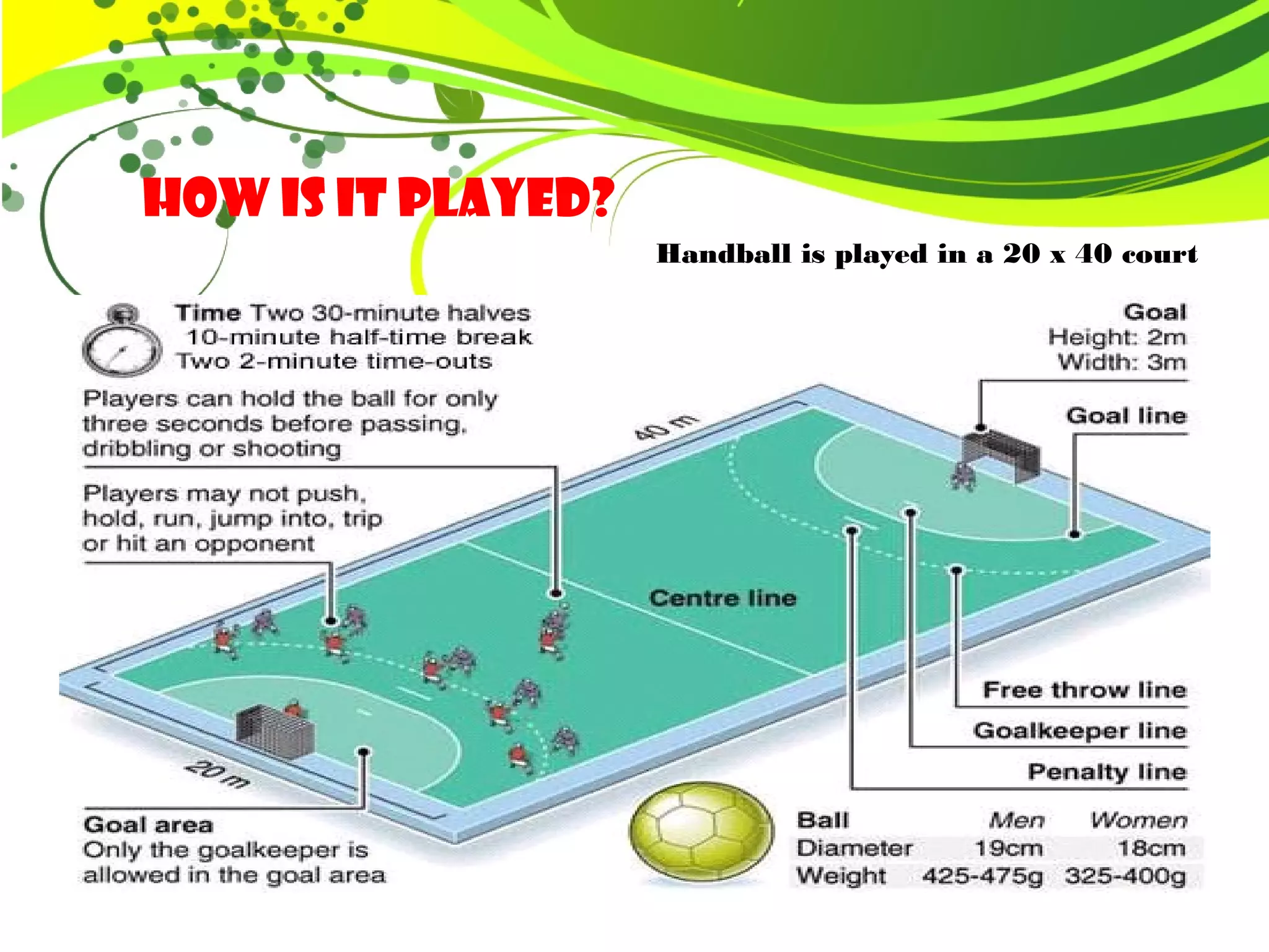
HOW IS IT PLAYED?
Handball is played in a 20 x 40 court
GENERAL INFORMATIONGENERAL INFORMATION
Length:
Two 30-minute halves with a 10 minute break in between. If there is a tie, overtime
period is played, consisting of 2 halves of 5 minutes with a 1-minute half-time break. If
this doesn’t break the tie, seven penalties are thrown in turns.
Teams:
Maximum of 14 players, but only six court players and one goalkeeper can be on the
court at the same time.
Players can be substituted at any time during the game.
COURTCOURT
MAIN RULESMAIN RULES
PASSIVE PLAY: when a referee realizes that a team does not want to
score a goal, he indicates passive play and gives the other team the ball.
A player cannot take more than 3 steps holding the ball without
bouncing. (TRAVELLING).
Players are allowed to dribble for an unlimited amount of time, and hold the
ball without moving for three seconds.
Players are not allowed to bounce the ball, catch it with both hands and
proceeding to bounce it again. (DOUBLE DRIBBLE).
A player cannot touch the ball with the knees or below. (KICKBALL)
Not enter the goal area to obtain an advantage. No one but the goalie is
allowed inside the goal area. A player may jump into the goal area before
shooting but must release the ball before landing.
MAIN RULESMAIN RULES
Foul: a player cannot hold, hit or embrace the other player or punch the
ball using their fist. The referee will award a free throw
The free throw is a shot from where the foul was committed. If it
happened in the free-throw area, the shot is taken from the 9-metre line.
In a free-throw each player of the other team has to stay three meters
away.
The shot can be taken by any player and in any direction, keeping at least
one foot planted on the ground.
MAIN RULESMAIN RULES
A penalty is a shot at a goal from the 7-metres line.
The goalkeeper can move, but not go beyond the 4 meters line.
A referee blows a penalty if:
- A player defends in the goal area on
purpose
- The ball is passed to the goalkeeper in
the goal area
- A foul occurs inside the goal area or
stops a clear scoring opportunity
HANDBALL SKILLS: BASICHANDBALL SKILLS: BASIC
ACTIONSACTIONS
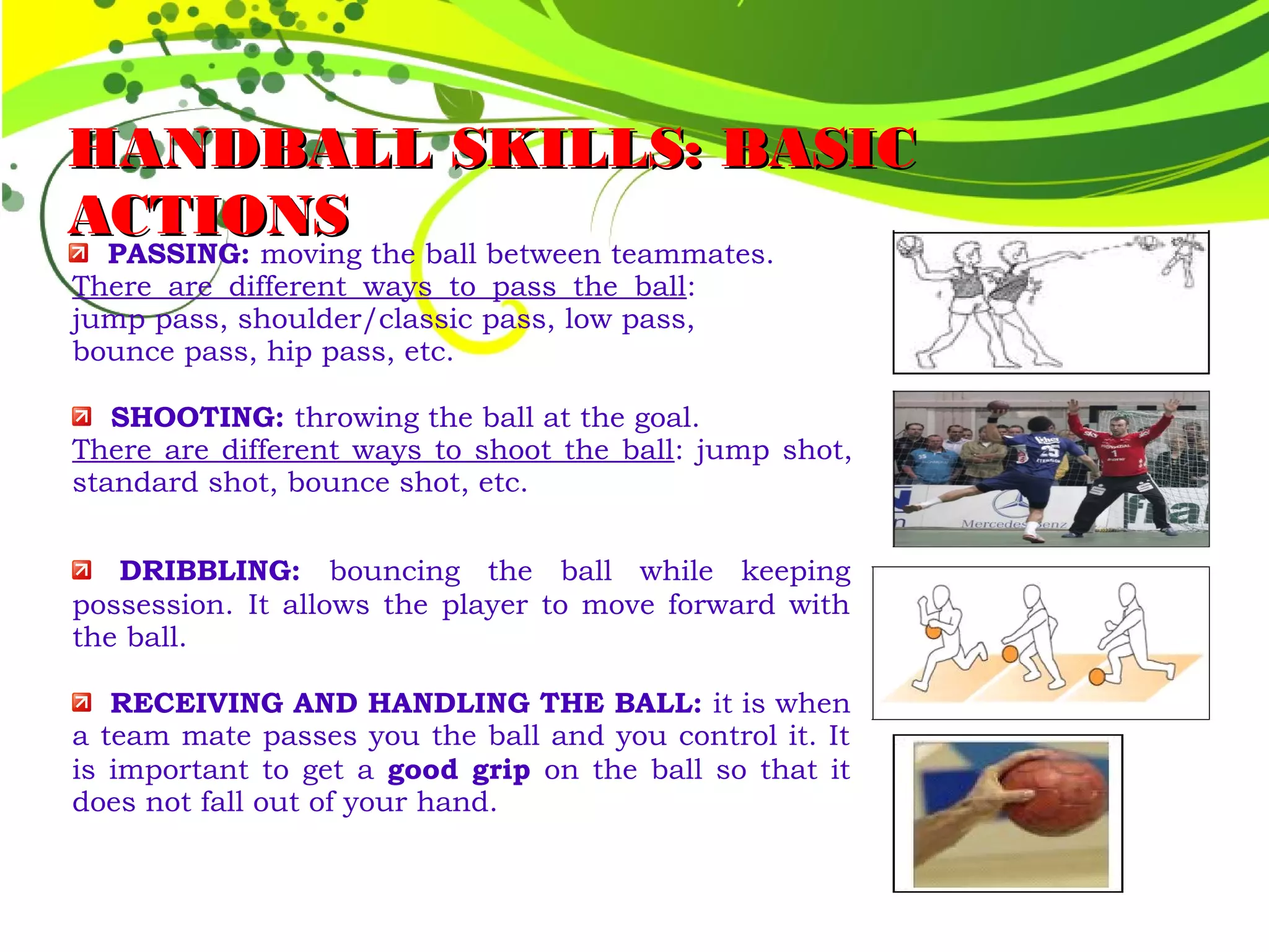
PASSING: moving the ball between teammates.
There are different ways to pass the ball:
jump pass, shoulder/classic pass, low pass,
bounce pass, hip pass, etc.
SHOOTING: throwing the ball at the goal.
There are different ways to shoot the ball: jump shot,
standard shot, bounce shot, etc.
DRIBBLING: bouncing the ball while keeping
possession. It allows the player to move forward with
the ball.
RECEIVING AND HANDLING THE BALL: it is when
a team mate passes you the ball and you control it. It
is important to get a good grip on the ball so that it
does not fall out of your hand.
POSITIONSPOSITIONSGoalkeeper: This is the
only player allowed to kick
the ball.
Center: also known as the
“playmaker” acts as a form
of offense and defense.
Left and Right backs or
sides: blocks shots from
the opposing team.
Left and right wings: the
fastest runners.
Pivot: plays in the centre
of the attack. This is a
strong player who fights
against the defence to try
to open spaces for his/her
temmates.
To learn more...To learn more...
CLICK THE IMAGE
To learn more...To learn more...
RESOURCES:
Ayuso, N. & Picó, D. (2015) 1 ESO Physical Education. Barcelona. Ed. Teide
Riera, O. & González, M. (2013) Physical Education 1º ESO. Strategy 1. Barcelona. Ed. Teide
IES Joaquín Turina-Mª Teresa GARCÍA PE teacher
IES Joan Miró-PE Department
CLICK THE IMAGE

HANDBALL NOTES

  • 1.
    HANDBALL HANDBALL  History: Handball is afast-paced team game that was first played in Scandinavia and Germany at the end of the 19th century. Indoor handball was presented for the first time at the 1972 Olympic Games in Munich. Yugoslavia was victorious and won the first gold medal after a competition between 16 men’s teams. The introduction of women’s handball to the Games took place in 1976 in Montreal. The Soviet Union won this first women’s Olympic competition. Objective: To put the ball in the goal of the other team. The team that scores the more goals wins.
  • 2.
    HOW IS ITPLAYED? Handball is played in a 20 x 40 court
  • 3.
    GENERAL INFORMATIONGENERAL INFORMATION Length: Two 30-minute halveswith a 10 minute break in between. If there is a tie, overtime period is played, consisting of 2 halves of 5 minutes with a 1-minute half-time break. If this doesn’t break the tie, seven penalties are thrown in turns. Teams: Maximum of 14 players, but only six court players and one goalkeeper can be on the court at the same time. Players can be substituted at any time during the game.
  • 4.
  • 5.
    MAIN RULESMAIN RULES PASSIVE PLAY: whena referee realizes that a team does not want to score a goal, he indicates passive play and gives the other team the ball. A player cannot take more than 3 steps holding the ball without bouncing. (TRAVELLING). Players are allowed to dribble for an unlimited amount of time, and hold the ball without moving for three seconds. Players are not allowed to bounce the ball, catch it with both hands and proceeding to bounce it again. (DOUBLE DRIBBLE). A player cannot touch the ball with the knees or below. (KICKBALL) Not enter the goal area to obtain an advantage. No one but the goalie is allowed inside the goal area. A player may jump into the goal area before shooting but must release the ball before landing.
  • 6.
    MAIN RULESMAIN RULES Foul: a playercannot hold, hit or embrace the other player or punch the ball using their fist. The referee will award a free throw The free throw is a shot from where the foul was committed. If it happened in the free-throw area, the shot is taken from the 9-metre line. In a free-throw each player of the other team has to stay three meters away. The shot can be taken by any player and in any direction, keeping at least one foot planted on the ground.
  • 7.
    MAIN RULESMAIN RULES A penalty isa shot at a goal from the 7-metres line. The goalkeeper can move, but not go beyond the 4 meters line. A referee blows a penalty if: - A player defends in the goal area on purpose - The ball is passed to the goalkeeper in the goal area - A foul occurs inside the goal area or stops a clear scoring opportunity
  • 8.
    HANDBALL SKILLS: BASICHANDBALLSKILLS: BASIC ACTIONSACTIONS PASSING: moving the ball between teammates. There are different ways to pass the ball: jump pass, shoulder/classic pass, low pass, bounce pass, hip pass, etc. SHOOTING: throwing the ball at the goal. There are different ways to shoot the ball: jump shot, standard shot, bounce shot, etc. DRIBBLING: bouncing the ball while keeping possession. It allows the player to move forward with the ball. RECEIVING AND HANDLING THE BALL: it is when a team mate passes you the ball and you control it. It is important to get a good grip on the ball so that it does not fall out of your hand.
  • 9.
    POSITIONSPOSITIONSGoalkeeper: This isthe only player allowed to kick the ball. Center: also known as the “playmaker” acts as a form of offense and defense. Left and Right backs or sides: blocks shots from the opposing team. Left and right wings: the fastest runners. Pivot: plays in the centre of the attack. This is a strong player who fights against the defence to try to open spaces for his/her temmates.
  • 10.
  • 11.
    To learn more...To learn more... RESOURCES: Ayuso, N. &Picó, D. (2015) 1 ESO Physical Education. Barcelona. Ed. Teide Riera, O. & González, M. (2013) Physical Education 1º ESO. Strategy 1. Barcelona. Ed. Teide IES Joaquín Turina-Mª Teresa GARCÍA PE teacher IES Joan Miró-PE Department CLICK THE IMAGE

Editor's Notes

  • #3 We should get through the first two points rather quickly. I'll be here all day in Booth 49 with the Ithaca Free Software Association should we run out of time.
  • #4 We should get through the first two points rather quickly. I'll be here all day in Booth 49 with the Ithaca Free Software Association should we run out of time.
  • #5 We should get through the first two points rather quickly. I'll be here all day in Booth 49 with the Ithaca Free Software Association should we run out of time.
  • #6 We should get through the first two points rather quickly. I'll be here all day in Booth 49 with the Ithaca Free Software Association should we run out of time.
  • #7 We should get through the first two points rather quickly. I'll be here all day in Booth 49 with the Ithaca Free Software Association should we run out of time.
  • #8 We should get through the first two points rather quickly. I'll be here all day in Booth 49 with the Ithaca Free Software Association should we run out of time.
  • #9 We should get through the first two points rather quickly. I'll be here all day in Booth 49 with the Ithaca Free Software Association should we run out of time.
  • #10 We should get through the first two points rather quickly. I'll be here all day in Booth 49 with the Ithaca Free Software Association should we run out of time.
  • #11 We should get through the first two points rather quickly. I'll be here all day in Booth 49 with the Ithaca Free Software Association should we run out of time.
  • #12 We should get through the first two points rather quickly. I'll be here all day in Booth 49 with the Ithaca Free Software Association should we run out of time.