FOOTB
HISTORY
Football is also known as soccer. Greeks, Roman and Chinese played games which
resembles football. Later, the modern version of game came from England in 1848, when
first match was played between two local teams.
Many football clubs were established, which has raised football standards.
Federation Internationale de Football Association(FIFA) was formed in 1904 which
regulates the rules and development of football.
The first World Cup of football was organized in 1930.
In India, the Britishers brought this game. Later, All India Football Federation(AIFF)
formed in 1937.
RULES OF FOOTBALL
The rule is basically to score the most number of goals by sending the ball into the opposing
team’s goal, by pushing it with the feet or any other part of the body but not with the arms or
hands.
Two teams, with a maximum of 11 players each (1 goalkeeper and 10 field players), play.
Game is started with push-pass in opponent’s field from centre circle.
Two halves of 45 minutes period each is the time. If there’s a tie at the end of regulation
time, the team plays for 30 minutes extra time for two halves of 15 minutes each. This
period is known as silver goal period. If there’s still a tie, a penalty shoot-out takes place.
Each team chooses 5 players to take the kicks in turn. If there’s still a tie, the teams keep
taking penalty kicks until one team wins, this period is known as the sudden-death.
PLAYING FIELD AND ITS
MESUREMENTS
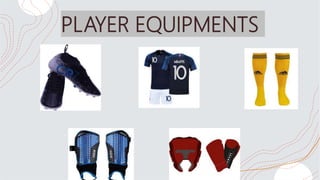
PLAYER EQUIPMENTS
TERMINOLOGY
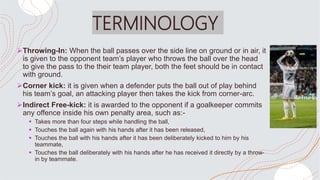
Throwing-In: When the ball passes over the side line on ground or in air, it
is given to the opponent team’s player who throws the ball over the head
to give the pass to the their team player, both the feet should be in contact
with ground.
Corner kick: it is given when a defender puts the ball out of play behind
his team’s goal, an attacking player then takes the kick from corner-arc.
Indirect Free-kick: it is awarded to the opponent if a goalkeeper commits
any offence inside his own penalty area, such as:-
 Takes more than four steps while handling the ball,
 Touches the ball again with his hands after it has been released,
 Touches the ball with his hands after it has been deliberately kicked to him by his
teammate,
 Touches the ball deliberately with his hands after he has received it directly by a throw-
in by teammate.
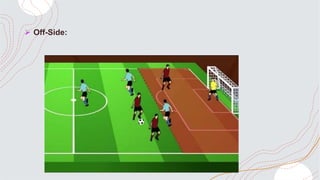
 Off-Side:
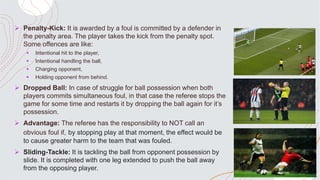
 Penalty-Kick: It is awarded by a foul is committed by a defender in
the penalty area. The player takes the kick from the penalty spot.
Some offences are like:
 Intentional hit to the player,
 Intentional handling the ball,
 Charging opponent,
 Holding opponent from behind.
 Dropped Ball: In case of struggle for ball possession when both
players commits simultaneous foul, in that case the referee stops the
game for some time and restarts it by dropping the ball again for it’s
possession.
 Advantage: The referee has the responsibility to NOT call an
obvious foul if, by stopping play at that moment, the effect would be
to cause greater harm to the team that was fouled.
 Sliding-Tackle: It is tackling the ball from opponent possession by
slide. It is completed with one leg extended to push the ball away
from the opposing player.
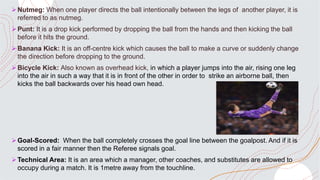
Nutmeg: When one player directs the ball intentionally between the legs of another player, it is
referred to as nutmeg.
Punt: It is a drop kick performed by dropping the ball from the hands and then kicking the ball
before it hits the ground.
Banana Kick: It is an off-centre kick which causes the ball to make a curve or suddenly change
the direction before dropping to the ground.
Bicycle Kick: Also known as overhead kick, in which a player jumps into the air, rising one leg
into the air in such a way that it is in front of the other in order to strike an airborne ball, then
kicks the ball backwards over his head own head.
Goal-Scored: When the ball completely crosses the goal line between the goalpost. And if it is
scored in a fair manner then the Referee signals goal.
Technical Area: It is an area which a manager, other coaches, and substitutes are allowed to
occupy during a match. It is 1metre away from the touchline.
Optional Mark: It is a type of a mark on the field which indicates the position of the
ball when a free kick is given in the game.
Injury-Time: The time for which game has been stopped temporarily due to injury of
the player, this duration of time is added in regular time after each half.
Goal-Kick: When the ball passes over the goal line without goal scoring by the
attacking player, then ball is kicked by placing from the penalty area.
Kick-Off: It is starting the game. During kick-off players remain in their own half,
except the kick-off player nobody else can enter the 10-yard centre circle. Kick-Off
player should not touch the ball consecutively second time until played by another
player. It is taken:
 in the beginning of the match,
 after half-time,
 after a goal has been scored,
 in extra time.
Substitution: There are five reserve players but only three substitutes are allowed
during match , with permission from the referee.
CARDS
Warning Card (yellow)
+ The player receive a warning if:
 They continue or regularly
breaks rules,
 Do not respect the Referee’s
decision,
 Delay the start of the play,
 Are argumentative or don’t
show sportsman conduct, etc..
Expulsion Card (red)
+ A player is expelled if:
 He commits a serious foul-
strikes, charges or is violent,
 Trips or holds opponent,
 Handles the ball intentionally,
 Uses abusive, offensive or
insulting language
 Receives a second yellow card
during the game
FUNDAMENTAL SKILLS
Passing: In this the ball is passed to own teammate who is close.
The ball is slightly pushed to reach the desire point. It is mainly of
2 types-Short pass and Long pass.
Dribbling: It is faking to the opponent in such a way that the
control of ball is kept. It is controlled via feet.
Shooting: It is the most common skill used to hit the ball with
power so that it reaches long and away to the desired position.
Trapping: It is controlling the lifted ball before it could bounce or
control the ball in air, so that it should fall near the body range.
There are many types of traps such as foot trap, sole trap, head
trap, chest trap, thigh trap etc.
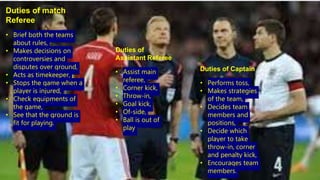
Duties of match
Referee
• Brief both the teams
about rules,
• Makes decisions on
controversies and
disputes over ground,
• Acts as timekeeper,
• Stops the game when a
player is injured,
• Check equipments of
the game,
• See that the ground is
fit for playing.
Duties of
Assistant Referee
• Assist main
referee,
• Corner kick,
• Throw-in,
• Goal kick,
• Of-side,
• Ball is out of
play
Duties of Captain
• Performs toss,
• Makes strategies
of the team,
• Decides team
members and
positions,
• Decide which
player to take
throw-in, corner
and penalty kick,
• Encourages team
members.
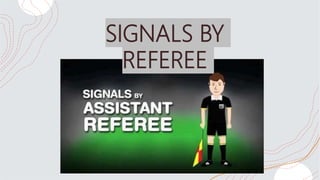
SIGNALS BY
REFEREE
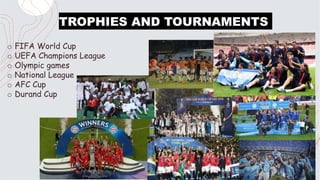
TROPHIES AND TOURNAMENTS
o FIFA World Cup
o UEFA Champions League
o Olympic games
o National League
o AFC Cup
o Durand Cup
THANK YOU
-Devadhiraj, Jenni,
Sneha, Poorva, Rounak, Vishakha

PE presentation on Football

  • 1.
  • 2.
    HISTORY Football is alsoknown as soccer. Greeks, Roman and Chinese played games which resembles football. Later, the modern version of game came from England in 1848, when first match was played between two local teams. Many football clubs were established, which has raised football standards. Federation Internationale de Football Association(FIFA) was formed in 1904 which regulates the rules and development of football. The first World Cup of football was organized in 1930. In India, the Britishers brought this game. Later, All India Football Federation(AIFF) formed in 1937.
  • 3.
    RULES OF FOOTBALL Therule is basically to score the most number of goals by sending the ball into the opposing team’s goal, by pushing it with the feet or any other part of the body but not with the arms or hands. Two teams, with a maximum of 11 players each (1 goalkeeper and 10 field players), play. Game is started with push-pass in opponent’s field from centre circle. Two halves of 45 minutes period each is the time. If there’s a tie at the end of regulation time, the team plays for 30 minutes extra time for two halves of 15 minutes each. This period is known as silver goal period. If there’s still a tie, a penalty shoot-out takes place. Each team chooses 5 players to take the kicks in turn. If there’s still a tie, the teams keep taking penalty kicks until one team wins, this period is known as the sudden-death.
  • 4.
    PLAYING FIELD ANDITS MESUREMENTS
  • 5.
  • 6.
    TERMINOLOGY Throwing-In: When theball passes over the side line on ground or in air, it is given to the opponent team’s player who throws the ball over the head to give the pass to the their team player, both the feet should be in contact with ground. Corner kick: it is given when a defender puts the ball out of play behind his team’s goal, an attacking player then takes the kick from corner-arc. Indirect Free-kick: it is awarded to the opponent if a goalkeeper commits any offence inside his own penalty area, such as:-  Takes more than four steps while handling the ball,  Touches the ball again with his hands after it has been released,  Touches the ball with his hands after it has been deliberately kicked to him by his teammate,  Touches the ball deliberately with his hands after he has received it directly by a throw- in by teammate.
  • 7.
  • 8.
     Penalty-Kick: Itis awarded by a foul is committed by a defender in the penalty area. The player takes the kick from the penalty spot. Some offences are like:  Intentional hit to the player,  Intentional handling the ball,  Charging opponent,  Holding opponent from behind.  Dropped Ball: In case of struggle for ball possession when both players commits simultaneous foul, in that case the referee stops the game for some time and restarts it by dropping the ball again for it’s possession.  Advantage: The referee has the responsibility to NOT call an obvious foul if, by stopping play at that moment, the effect would be to cause greater harm to the team that was fouled.  Sliding-Tackle: It is tackling the ball from opponent possession by slide. It is completed with one leg extended to push the ball away from the opposing player.
  • 9.
    Nutmeg: When oneplayer directs the ball intentionally between the legs of another player, it is referred to as nutmeg. Punt: It is a drop kick performed by dropping the ball from the hands and then kicking the ball before it hits the ground. Banana Kick: It is an off-centre kick which causes the ball to make a curve or suddenly change the direction before dropping to the ground. Bicycle Kick: Also known as overhead kick, in which a player jumps into the air, rising one leg into the air in such a way that it is in front of the other in order to strike an airborne ball, then kicks the ball backwards over his head own head. Goal-Scored: When the ball completely crosses the goal line between the goalpost. And if it is scored in a fair manner then the Referee signals goal. Technical Area: It is an area which a manager, other coaches, and substitutes are allowed to occupy during a match. It is 1metre away from the touchline.
  • 10.
    Optional Mark: Itis a type of a mark on the field which indicates the position of the ball when a free kick is given in the game. Injury-Time: The time for which game has been stopped temporarily due to injury of the player, this duration of time is added in regular time after each half. Goal-Kick: When the ball passes over the goal line without goal scoring by the attacking player, then ball is kicked by placing from the penalty area. Kick-Off: It is starting the game. During kick-off players remain in their own half, except the kick-off player nobody else can enter the 10-yard centre circle. Kick-Off player should not touch the ball consecutively second time until played by another player. It is taken:  in the beginning of the match,  after half-time,  after a goal has been scored,  in extra time. Substitution: There are five reserve players but only three substitutes are allowed during match , with permission from the referee.
  • 11.
    CARDS Warning Card (yellow) +The player receive a warning if:  They continue or regularly breaks rules,  Do not respect the Referee’s decision,  Delay the start of the play,  Are argumentative or don’t show sportsman conduct, etc.. Expulsion Card (red) + A player is expelled if:  He commits a serious foul- strikes, charges or is violent,  Trips or holds opponent,  Handles the ball intentionally,  Uses abusive, offensive or insulting language  Receives a second yellow card during the game
  • 12.
    FUNDAMENTAL SKILLS Passing: Inthis the ball is passed to own teammate who is close. The ball is slightly pushed to reach the desire point. It is mainly of 2 types-Short pass and Long pass. Dribbling: It is faking to the opponent in such a way that the control of ball is kept. It is controlled via feet. Shooting: It is the most common skill used to hit the ball with power so that it reaches long and away to the desired position. Trapping: It is controlling the lifted ball before it could bounce or control the ball in air, so that it should fall near the body range. There are many types of traps such as foot trap, sole trap, head trap, chest trap, thigh trap etc.
  • 13.
    Duties of match Referee •Brief both the teams about rules, • Makes decisions on controversies and disputes over ground, • Acts as timekeeper, • Stops the game when a player is injured, • Check equipments of the game, • See that the ground is fit for playing. Duties of Assistant Referee • Assist main referee, • Corner kick, • Throw-in, • Goal kick, • Of-side, • Ball is out of play Duties of Captain • Performs toss, • Makes strategies of the team, • Decides team members and positions, • Decide which player to take throw-in, corner and penalty kick, • Encourages team members.
  • 14.
  • 15.
    TROPHIES AND TOURNAMENTS oFIFA World Cup o UEFA Champions League o Olympic games o National League o AFC Cup o Durand Cup
  • 17.
    THANK YOU -Devadhiraj, Jenni, Sneha,Poorva, Rounak, Vishakha