TEAM HANDBALL
HISTORY
It was originated in Germany in the 1900’s
and became an Olympic sport for men in
Munich 1972.
At the beginning was played outdoors in a
football field, 11vs11. Years later was
started to play indoors 7vs7 to avoid cold
weather in winter.
Nowadays it´s a really important sport in
Europe and over 140 countries are
recognised members of the IHF
(International handball federation)
EQUIPMENT
BALL
GOAL
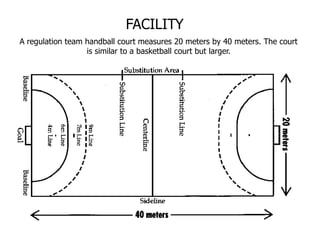
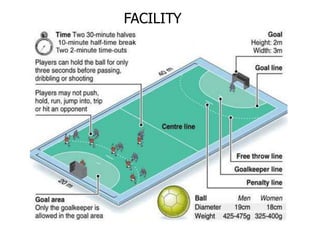
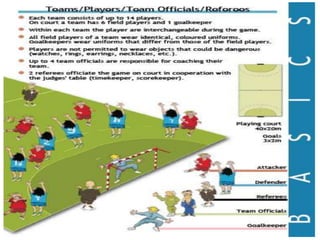
A regulation team handball court measures 20 meters by 40 meters. The court
is similar to a basketball court but larger.
FACILITY
FACILITY
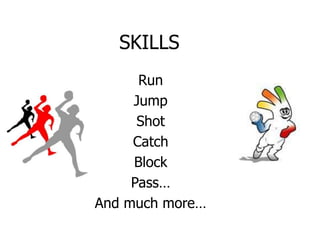
SKILLS
Run
Jump
Shot
Catch
Block
Pass…
And much more…
Kind of passes
- Chest pass
- Overhead pass
- Bounce pass.
- Wrist pass
- Baseballpass
(overarm)
GAME PLAY
-Players can take only 3 steps holding
the ball.
-Players can hold the ball only during3 or
5 seconds.
-They can’t bounce the ball, hold it and
bounce it again (Double dribble).
-Players can not pass theirselves (air
dribble).
-Players can`t step on the goal area
while holding the ball.
GAME PLAY
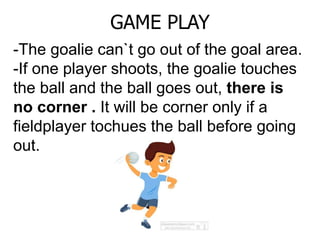
-The goalie can`t go out of the goal area.
-If one player shoots, the goalie touches
the ball and the ball goes out, there is
no corner . It will be corner only if a
fieldplayer tochues the ball before going
out.
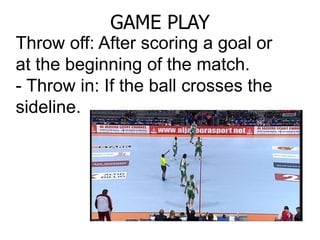
Throw off: After scoring a goal or
at the beginning of the match.
- Throw in: If the ball crosses the
sideline.
GAME PLAY
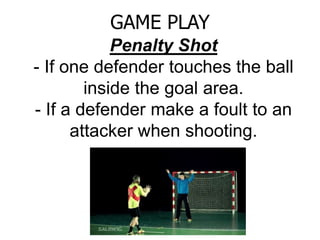
Penalty Shot
- If one defender touches the ball
inside the goal area.
- If a defender make a foult to an
attacker when shooting.
GAME PLAY
Free Throw
- If one defender touches the ball
from an opponents hand.
- If one playe hiits or push
another player.
- If one player touches
the ball
intentionally.
GAME PLAY
HANDBALL
VOCABULARY
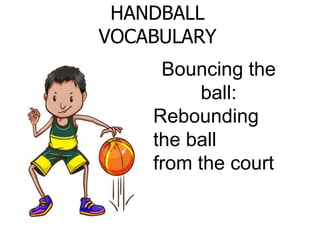
Bouncing the
ball:
Rebounding
the ball
from the court
HANDBALL
VOCABULARY
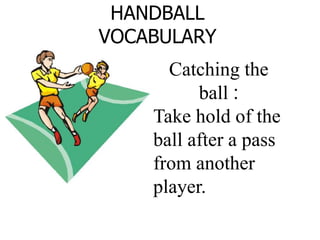
Catching the
ball :
Take hold of the
ball after a pass
from another
player.
HANDBALL
VOCABULARY
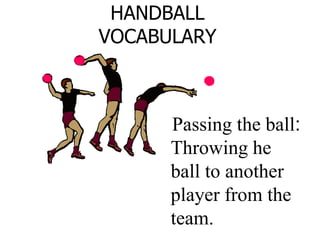
Passing the ball:
Throwing he
ball to another
player from the
team.
HANDBALL
VOCABULARY
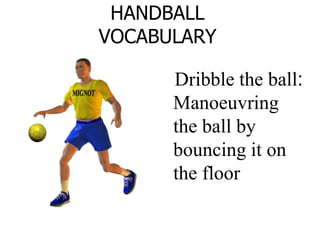
Dribble the ball:
Manoeuvring
the ball by
bouncing it on
the floor
HANDBALL VOCABULARY
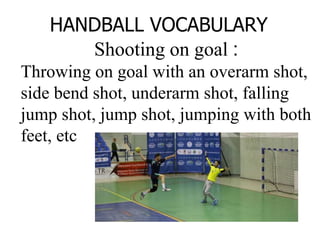
Shooting on goal :
Throwing on goal with an overarm shot,
side bend shot, underarm shot, falling
jump shot, jump shot, jumping with both
feet, etc
HANDBALL VOCABULARY
Overarm shot :A shooting technique carried out with the arm
moving above the shoulder level.
Underarm shot: A shooting technique carried out with the arm
moving below shoulder level.
Jump shot : A shooting technique performed having the players
feet off the floor.
Bounced shot : Shooting on goal with the ball hitting the floor on
its way.
Spin shot: A type of shot with the ball changing direction when
bounces back from the floor.
HANDBALL VOCABULARY
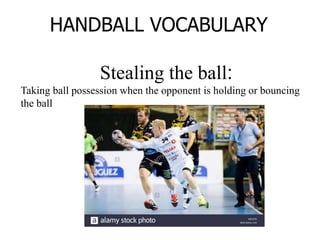
Stealing the ball:
Taking ball possession when the opponent is holding or bouncing
the ball
HANDBALL VOCABULARY
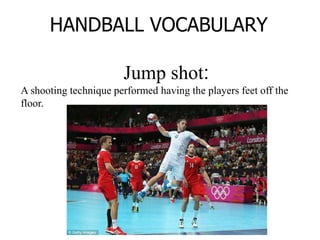
Jump shot:
A shooting technique performed having the players feet off the
floor.
HANDBALL VOCABULARY
- Changing direction or turning: Altering the position towards
which someone moves.
- Goalkeeper: A player positioned inside the goalkeeping area who
is – opposed to field players – allowed to use his legs.
- Handling the ball : Dribbling, catching or passing the ball.
- Left-handed player: Player using and throwing with his left hand.
- Tactics: A set of planned game elements to be used in attack and in
defence by a team during the given game
- Playing positions: The seven playing positions are: goalkeeper, left
wing, left back, middle back, line player, right back and right wing.
HANDBALL VOCABULARY
- Rebound: The ball bouncing back after e.g. hitting the bar of the
goal.
- To get a rebound: When a player catches a ball which is
bouncing.
- Sidestepping: A technical element of the attacker’s basic
movement executed by continually moving sideways mainly in
width.
- Man marking: Defensive strategy where a defender is assigned
a specific opposition player to guard rather than covering an area
of the court.
- Faking: Tricking the opponent with a hand or body movement,
e.g. body fake, pass fake, shooting fake, rotation fake, etc.
HANDBALL VOCABULARY
- Throw through/over the wall: Overtime free throw with the
defensive wall three metres from the shooting player.
- Coin toss Before the match the referees carry out a coin toss to
determine who will start the game and who can choose ends.
- Disallowing a goal : The referee decides not to validate a score
for any irregularity preceding it
- Endanger: To cause danger of injury to the opponent with any
physical contact.
- Out of play: When the ball is out of play, the game restarts with a
throw corresponding to the reason of the interruption.
HANDBALL VOCABULARY
- Passive play: Keeping the ball in a team's possession without
making a recognisable attempt to attack and score.
- Referees: A person in charge of a game who has to make sure
that the rules are followed.
- Sanction : Any form of penalisation by the referee
- Warning : Yellow card punishment awarded by the referee as a
first measure of progressive punishment.
- Serving a 2-minute suspension :The player stays on the
substitution bench for two minutes after receiving a suspension.
- Goal area: A D-shaped area six metres from the goal that is used
only by the goalkeeper.

Team handball powerpoint

  • 1.
  • 2.
    HISTORY It was originatedin Germany in the 1900’s and became an Olympic sport for men in Munich 1972. At the beginning was played outdoors in a football field, 11vs11. Years later was started to play indoors 7vs7 to avoid cold weather in winter. Nowadays it´s a really important sport in Europe and over 140 countries are recognised members of the IHF (International handball federation)
  • 3.
  • 4.
    A regulation teamhandball court measures 20 meters by 40 meters. The court is similar to a basketball court but larger. FACILITY
  • 5.
  • 6.
  • 7.
    Kind of passes -Chest pass - Overhead pass - Bounce pass. - Wrist pass - Baseballpass (overarm)
  • 9.
    GAME PLAY -Players cantake only 3 steps holding the ball. -Players can hold the ball only during3 or 5 seconds. -They can’t bounce the ball, hold it and bounce it again (Double dribble). -Players can not pass theirselves (air dribble). -Players can`t step on the goal area while holding the ball.
  • 10.
    GAME PLAY -The goaliecan`t go out of the goal area. -If one player shoots, the goalie touches the ball and the ball goes out, there is no corner . It will be corner only if a fieldplayer tochues the ball before going out.
  • 11.
    Throw off: Afterscoring a goal or at the beginning of the match. - Throw in: If the ball crosses the sideline. GAME PLAY
  • 12.
    Penalty Shot - Ifone defender touches the ball inside the goal area. - If a defender make a foult to an attacker when shooting. GAME PLAY
  • 13.
    Free Throw - Ifone defender touches the ball from an opponents hand. - If one playe hiits or push another player. - If one player touches the ball intentionally. GAME PLAY
  • 15.
  • 16.
    HANDBALL VOCABULARY Catching the ball : Takehold of the ball after a pass from another player.
  • 17.
    HANDBALL VOCABULARY Passing the ball: Throwinghe ball to another player from the team.
  • 18.
  • 19.
    HANDBALL VOCABULARY Shooting ongoal : Throwing on goal with an overarm shot, side bend shot, underarm shot, falling jump shot, jump shot, jumping with both feet, etc
  • 20.
    HANDBALL VOCABULARY Overarm shot:A shooting technique carried out with the arm moving above the shoulder level. Underarm shot: A shooting technique carried out with the arm moving below shoulder level. Jump shot : A shooting technique performed having the players feet off the floor. Bounced shot : Shooting on goal with the ball hitting the floor on its way. Spin shot: A type of shot with the ball changing direction when bounces back from the floor.
  • 21.
    HANDBALL VOCABULARY Stealing theball: Taking ball possession when the opponent is holding or bouncing the ball
  • 22.
    HANDBALL VOCABULARY Jump shot: Ashooting technique performed having the players feet off the floor.
  • 23.
    HANDBALL VOCABULARY - Changingdirection or turning: Altering the position towards which someone moves. - Goalkeeper: A player positioned inside the goalkeeping area who is – opposed to field players – allowed to use his legs. - Handling the ball : Dribbling, catching or passing the ball. - Left-handed player: Player using and throwing with his left hand. - Tactics: A set of planned game elements to be used in attack and in defence by a team during the given game - Playing positions: The seven playing positions are: goalkeeper, left wing, left back, middle back, line player, right back and right wing.
  • 24.
    HANDBALL VOCABULARY - Rebound:The ball bouncing back after e.g. hitting the bar of the goal. - To get a rebound: When a player catches a ball which is bouncing. - Sidestepping: A technical element of the attacker’s basic movement executed by continually moving sideways mainly in width. - Man marking: Defensive strategy where a defender is assigned a specific opposition player to guard rather than covering an area of the court. - Faking: Tricking the opponent with a hand or body movement, e.g. body fake, pass fake, shooting fake, rotation fake, etc.
  • 25.
    HANDBALL VOCABULARY - Throwthrough/over the wall: Overtime free throw with the defensive wall three metres from the shooting player. - Coin toss Before the match the referees carry out a coin toss to determine who will start the game and who can choose ends. - Disallowing a goal : The referee decides not to validate a score for any irregularity preceding it - Endanger: To cause danger of injury to the opponent with any physical contact. - Out of play: When the ball is out of play, the game restarts with a throw corresponding to the reason of the interruption.
  • 26.
    HANDBALL VOCABULARY - Passiveplay: Keeping the ball in a team's possession without making a recognisable attempt to attack and score. - Referees: A person in charge of a game who has to make sure that the rules are followed. - Sanction : Any form of penalisation by the referee - Warning : Yellow card punishment awarded by the referee as a first measure of progressive punishment. - Serving a 2-minute suspension :The player stays on the substitution bench for two minutes after receiving a suspension. - Goal area: A D-shaped area six metres from the goal that is used only by the goalkeeper.