Hazards
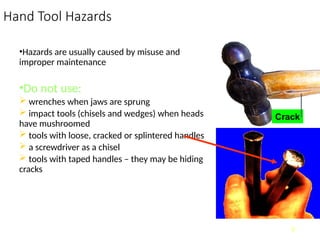
•Workers using handand power
tools may be exposed to these
hazards:
objects that fall, fly, are abrasive, or
splash
harmful dusts, fumes, mists, vapors, and
gases
frayed or damaged electrical cords,
hazardous connections and improper
grounding
2
3.
Basic Tool SafetyRules
• Maintain regularly
• Use right tool for the job
• Inspect before use
• Operate according to
manufacturers’ instructions
• Use the right personal protective
equipment (PPE)
• Use guards
3
4.
Hand Tool Hazards
•Hazardsare usually caused by misuse and
improper maintenance
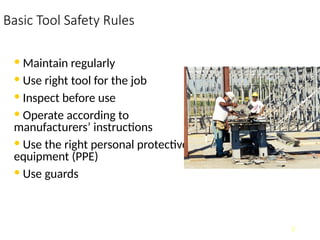
•Do not use:
wrenches when jaws are sprung
impact tools (chisels and wedges) when heads
have mushroomed
tools with loose, cracked or splintered handles
a screwdriver as a chisel
tools with taped handles – they may be hiding
cracks
4
Crack
5.
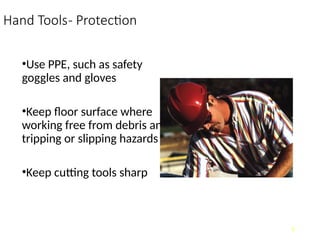
Hand Tools- Protection
•UsePPE, such as safety
goggles and gloves
•Keep floor surface where
working free from debris and
tripping or slipping hazards
•Keep cutting tools sharp
5
6.
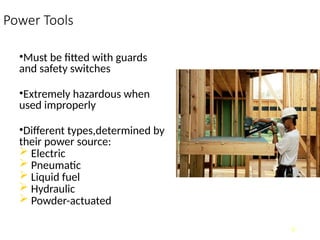
Power Tools
•Must befitted with guards
and safety switches
•Extremely hazardous when
used improperly
•Different types,determined by
their power source:
Electric
Pneumatic
Liquid fuel
Hydraulic
Powder-actuated
6
7.
Power Tools- Precautions
•Disconnect tools when not in use, before servicing and cleaning, and
when changing accessories
• Keep people not involved with the work away from the work
• Secure work with clamps or a vise, freeing both hands to operate the
tool
• Don’t hold the switch button while carrying a plugged-in tool
• Keep tools sharp and clean
• Consider what you wear – loose clothing and jewelry can get caught
in moving parts
• Remove damaged electric tools & tag them: “Do Not Use”
7
8.
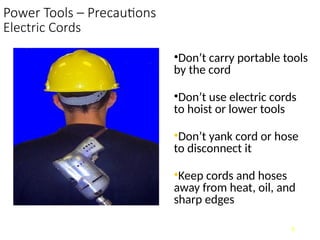
Power Tools –Precautions
Electric Cords
•Don’t carry portable tools
by the cord
•Don’t use electric cords
to hoist or lower tools
•Don’t yank cord or hose
to disconnect it
•Keep cords and hoses
away from heat, oil, and
sharp edges
8
9.
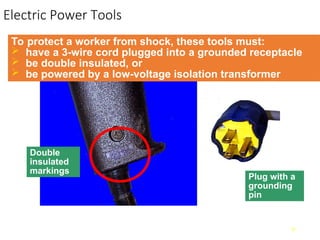
Electric Power Tools
9
Toprotect a worker from shock, these tools must:
have a 3-wire cord plugged into a grounded receptacle
be double insulated, or
be powered by a low-voltage isolation transformer
Double
insulated
markings
Plug with a
grounding
pin
10.
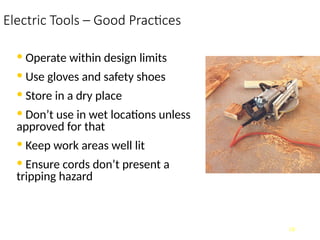
Electric Tools –Good Practices
• Operate within design limits
• Use gloves and safety shoes
• Store in a dry place
• Don’t use in wet locations unless
approved for that
• Keep work areas well lit
• Ensure cords don’t present a
tripping hazard
10
11.
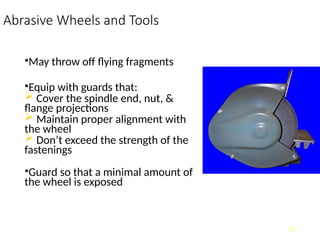
Abrasive Wheels andTools
•May throw off flying fragments
•Equip with guards that:
Cover the spindle end, nut, &
flange projections
Maintain proper alignment with
the wheel
Don’t exceed the strength of the
fastenings
•Guard so that a minimal amount of
the wheel is exposed
11
12.
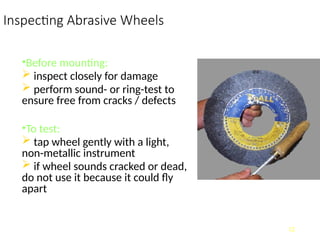
Inspecting Abrasive Wheels
•Beforemounting:
inspect closely for damage
perform sound- or ring-test to
ensure free from cracks / defects
•To test:
tap wheel gently with a light,
non-metallic instrument
if wheel sounds cracked or dead,
do not use it because it could fly
apart
12
13.
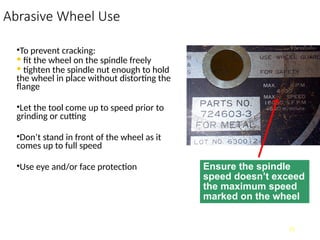
Abrasive Wheel Use
•Toprevent cracking:
• fit the wheel on the spindle freely
• tighten the spindle nut enough to hold
the wheel in place without distorting the
flange
•Let the tool come up to speed prior to
grinding or cutting
•Don’t stand in front of the wheel as it
comes up to full speed
•Use eye and/or face protection
13
Ensure the spindle
speed doesn’t exceed
the maximum speed
marked on the wheel
14.
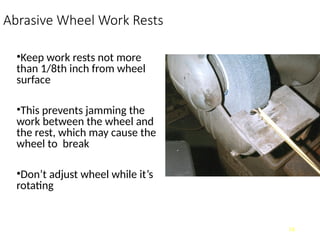
Abrasive Wheel WorkRests
•Keep work rests not more
than 1/8th inch from wheel
surface
•This prevents jamming the
work between the wheel and
the rest, which may cause the
wheel to break
•Don’t adjust wheel while it’s
rotating
14
15.
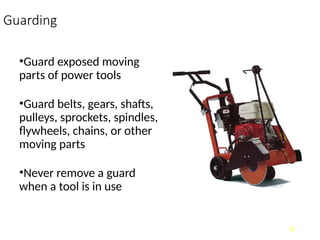
Guarding
•Guard exposed moving
partsof power tools
•Guard belts, gears, shafts,
pulleys, sprockets, spindles,
flywheels, chains, or other
moving parts
•Never remove a guard
when a tool is in use
15
16.
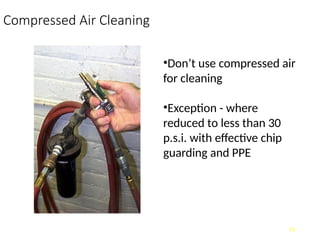
Compressed Air Cleaning
•Don’tuse compressed air
for cleaning
•Exception - where
reduced to less than 30
p.s.i. with effective chip
guarding and PPE
16
17.
Jacks
•To set upa jack, ensure:
• The base is on a firm, level surface
• It’s centered
• The jack head is placed against a
level surface
• You apply the lift force evenly
•Lubricate and inspect jacks
regularly
17
18.
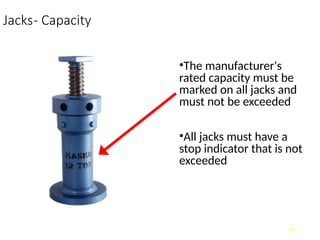
Jacks- Capacity
•The manufacturer's
ratedcapacity must be
marked on all jacks and
must not be exceeded
•All jacks must have a
stop indicator that is not
exceeded
18
19.
Summary
•Hazards are usuallythe result of improper tool use or
not following one or more of these protection
techniques:
Inspecting the tool before use
Using PPE (Personal Protective Equipment)
Using guards
Properly storing the tool
Using safe handling techniques
19
Editor's Notes
#1 1926 Subpart I - Tools – Hand and Power
This presentation is designed to assist trainers conducting OSHA 10-hour Construction Industry outreach training for workers. Since workers are the target audience, this presentation emphasizes hazard identification, avoidance, and control – not standards. No attempt has been made to treat the topic exhaustively. It is essential that trainers tailor their presentations to the needs and understanding of their audience.
This presentation is not a substitute for any of the provisions of the Occupational Safety and Health Act of 1970 or for any standards issued by the U.S. Department of Labor. Mention of trade names, commercial products, or organizations does not imply endorsement by the U.S. Department of Labor.
#2 Hand and power tools are a part of our everyday lives. These tools help us to perform tasks that otherwise would be difficult or impossible. However, even simple tools can be hazardous, and have the potential for causing severe injuries when used or maintained improperly. Special attention toward hand and power tool safety is necessary in order to reduce or eliminate these hazards.
#4 1926.301
• If a screwdriver is used as a chisel, the tip of the chisel may break and fly off, hitting the user or other employees.
• If a wooden handle on a tool, such as a hammer or an axe is loose, splintered, or cracked, the head of the tool may fly off and strike the user or other employees.
• If the jaws of a wrench are sprung, the wrench might slip.
• If impact tools, such as chisels, wedges, or drift pins have mushroomed heads, the heads might shatter on impact, sending sharp fragments flying toward the user or other employees.
#5 1926.300(c) and (a) and 1926.25
Provide the necessary PPE to employees using hand and power tools to protect them from hazards of falling, flying, abrasive, and splashing objects, or exposure to harmful dusts, fumes, mists, vapors, or gases.
#9 1926.302 (a)(1)
Three-wire cords contain two current-carrying conductors and a grounding conductor. Any time an adapter is used to accommodate a two-hole receptacle, the adapter wire must be attached to a known ground. The third prong must never be removed from the plug.
Double-insulated tools are available that provide protection against electrical shock without third-wire grounding. On double-insulated tools, an internal layer of protective insulation completely isolates the external housing of the tool.
#10 When using gloves, make sure they will not cause an amputation hazard by becoming loose clothing.
#14 1926.303(e)
On offhand grinding machines, use work rests to support the work.
They are to be equipped with adjustable work rests to compensate for wheel wear.
The work rest shall be securely clamped after each adjustment. The adjustment shall not be made with the wheel in motion.
1926.303(c)(2)
Floor and bench-mounted grinders shall be provided with work rests which are rigidly supported and readily adjustable. Keep these work rests not more than one-eighth inch from the surface of the wheel.
#16 1926.302(b)(4)
The 30 p.s.i. requirement does not apply for concrete form, mill scale and similar cleaning purposes.
#17 1926.305(d)(1)(iii), 1926.305(d)(1)(iv)
Inspect jacks according to this schedule:
(1) for jacks used continuously or intermittently at one site - at least once every 6 months,
(2) for jacks sent out of the shop for special work - inspect when sent out and inspect when returned
(3) for jacks subjected to abnormal loads or shock - inspect before use and immediately thereafter.