Hand Shape Classification
with a Wrist Contour Sensor
   Development of a Prototype Device


           Rui Fukui, Masahiko Watanabe, Tomoaki Gyota,
     Masamichi Shimosaka, Tomomasa Sato (Univ. of Tokyo)
Background

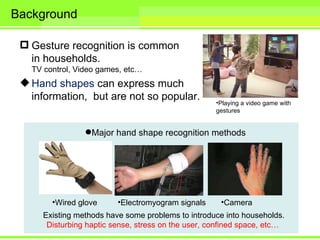
  Gesture recognition is common
   in households.
   TV control, Video games, etc…
  Hand shapes can express much
   information, but are not so popular.              •Playing a video game with
                                                     gestures


                 Major hand shape recognition methods


        •Wired glove      •Electromyogram signals     •Camera
      Existing methods have some problems to introduce into households.
       Disturbing haptic sense, stress on the user, confined space, etc…
Concept

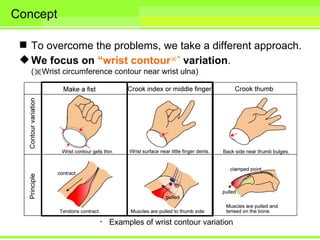
  To overcome the problems, we take a different approach.
  We focus on “wrist contour※ " variation.
   (※Wrist circumference contour near wrist ulna)


                     ・ Examples of wrist contour variation
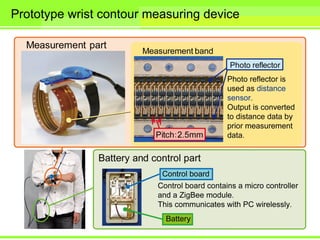
Prototype wrist contour measuring device
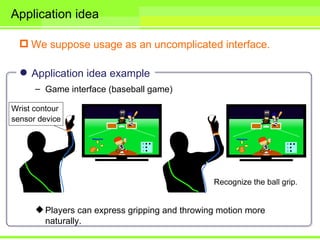
Application idea

  We suppose usage as an uncomplicated interface.

  Application idea example
    – Game interface (baseball game)


     Players can express gripping and throwing motion more
      naturally.
Demo movie
Problem: Individual differences

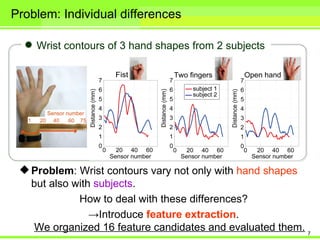
   Wrist contours of 3 hand shapes from 2 subjects


                             ※ 実データの例


  Problem: Wrist contours vary not only with hand shapes
   but also with subjects.
             How to deal with these differences?
                →Introduce feature extraction.
   We organized 16 feature candidates and evaluated them. 7
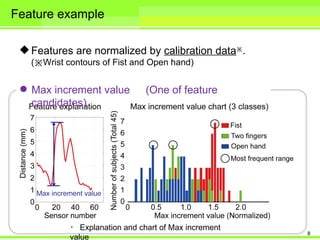
Feature example

  Features are normalized by calibration data※.
   (※Wrist contours of Fist and Open hand)


  Max increment value   (One of feature
   candidates)


            ・ Explanation and chart of Max increment
                                                       8
            value
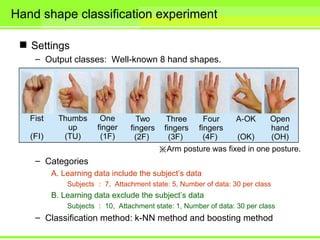
Hand shape classification experiment

  Settings
    – Output classes: Well-known 8 hand shapes.


                                       ※Arm posture was fixed in one posture.
    – Categories
       A. Learning data include the subject’s data
           Subjects : 7, Attachment state: 5, Number of data: 30 per class
       B. Learning data exclude the subject’s data
           Subjects : 10, Attachment state: 1, Number of data: 30 per class
    – Classification method: k-NN method and boosting method
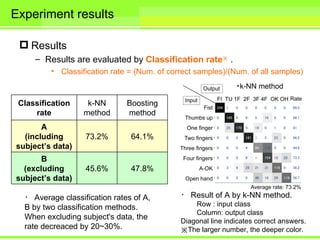
Experiment results

  Results
     – Results are evaluated by Classification rate※ .
         • Classification rate = (Num. of correct samples)/(Num. of all samples)


 Classification    k-NN        Boosting
     rate         method       method
       A
  (including       73.2%        64.1%
subject’s data)
       B
  (excluding       45.6%        47.8%
subject’s data)

  ・ Average classification rates of A,       ・ Result of A by k-NN method.
  B by two classification methods.               Row : input class
                                                 Column: output class
  When excluding subject's data, the
                                             Diagonal line indicates correct answers.
  rate decreaced by 20~30%.                  ※The larger number, the deeper color.
Conclusions & future works

  Conclusions
    – We developed a wrist contour measuring device with
      photo reflector arrays.
    – We collected wrist contour data and considered relationships
      with hand shapes.
    – With features as input and 8 hand shapes as output,
      we executed hand shape classification experiment
      and got around 70% classification rate.


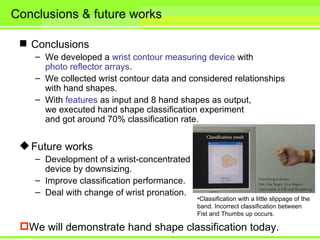
  Future works
    – Development of a wrist-concentrated
      device by downsizing.
    – Improve classification performance.
    – Deal with change of wrist pronation.
                                             •Classification with a little slippage of the
                                             band. Incorrect classification between
                                             Fist and Thumbs up occurs.

 We will demonstrate hand shape classification today.

Hand Shape Classification with a Wrist Contour Sensor: Development of a Prototype Device

  • 1.
    Hand Shape Classification witha Wrist Contour Sensor Development of a Prototype Device Rui Fukui, Masahiko Watanabe, Tomoaki Gyota, Masamichi Shimosaka, Tomomasa Sato (Univ. of Tokyo)
  • 2.
    Background  Gesturerecognition is common in households. TV control, Video games, etc…  Hand shapes can express much information, but are not so popular. •Playing a video game with gestures Major hand shape recognition methods •Wired glove •Electromyogram signals •Camera Existing methods have some problems to introduce into households. Disturbing haptic sense, stress on the user, confined space, etc…
  • 3.
    Concept  Toovercome the problems, we take a different approach.  We focus on “wrist contour※ " variation. (※Wrist circumference contour near wrist ulna) ・ Examples of wrist contour variation
  • 4.
    Prototype wrist contourmeasuring device
  • 5.
    Application idea We suppose usage as an uncomplicated interface.  Application idea example – Game interface (baseball game)  Players can express gripping and throwing motion more naturally.
  • 6.
  • 7.
    Problem: Individual differences  Wrist contours of 3 hand shapes from 2 subjects ※ 実データの例  Problem: Wrist contours vary not only with hand shapes but also with subjects. How to deal with these differences? →Introduce feature extraction. We organized 16 feature candidates and evaluated them. 7
  • 8.
    Feature example Features are normalized by calibration data※. (※Wrist contours of Fist and Open hand)  Max increment value   (One of feature candidates) ・ Explanation and chart of Max increment 8 value
  • 9.
    Hand shape classificationexperiment  Settings – Output classes: Well-known 8 hand shapes. ※Arm posture was fixed in one posture. – Categories A. Learning data include the subject’s data Subjects : 7, Attachment state: 5, Number of data: 30 per class B. Learning data exclude the subject’s data Subjects : 10, Attachment state: 1, Number of data: 30 per class – Classification method: k-NN method and boosting method
  • 10.
    Experiment results Results – Results are evaluated by Classification rate※ . • Classification rate = (Num. of correct samples)/(Num. of all samples) Classification k-NN Boosting rate method method A (including 73.2% 64.1% subject’s data) B (excluding 45.6% 47.8% subject’s data) ・ Average classification rates of A, ・ Result of A by k-NN method. B by two classification methods. Row : input class Column: output class When excluding subject's data, the Diagonal line indicates correct answers. rate decreaced by 20~30%. ※The larger number, the deeper color.
  • 11.
    Conclusions & futureworks  Conclusions – We developed a wrist contour measuring device with photo reflector arrays. – We collected wrist contour data and considered relationships with hand shapes. – With features as input and 8 hand shapes as output, we executed hand shape classification experiment and got around 70% classification rate.  Future works – Development of a wrist-concentrated device by downsizing. – Improve classification performance. – Deal with change of wrist pronation. •Classification with a little slippage of the band. Incorrect classification between Fist and Thumbs up occurs. We will demonstrate hand shape classification today.