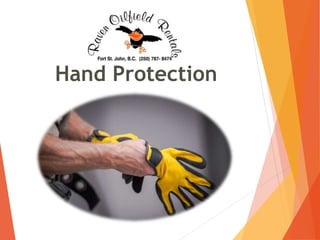
Hand Protection
 Overview
 Hand hazards
 Types of Gloves
 Limitations
 Use and Care
 Chemical
Resistant
Your Hands
 Don’t take them for granted
like I did
 Hands are one of our greatest assets, unique in the world.
 Majority of our work tasks involve using our hands
 Hands are often put ‘in the line of fire’ and are commonly injured.
3
Hand Injuries
 Approximately 20% of disabling workplace injuries involve hands.
 Hand injuries include cuts, burns, fractures, amputations, nerve
damage and dermatitis
 Skin irritation, dermatitis and poisoning can occur by handling
chemicals with bare hands.
 Your skin absorbs chemicals readily.
4
Hand Protection
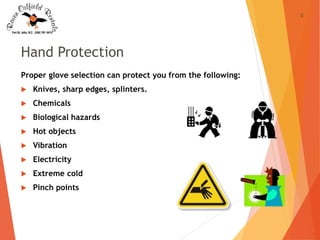
Proper glove selection can protect you from the following:
 Knives, sharp edges, splinters.
 Chemicals
 Biological hazards
 Hot objects
 Vibration
 Electricity
 Extreme cold
 Pinch points
5
Types of Gloves
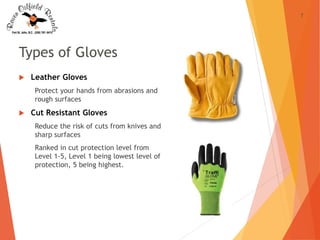
 Leather Gloves
Protect your hands from abrasions and
rough surfaces
 Cut Resistant Gloves
Reduce the risk of cuts from knives and
sharp surfaces
Ranked in cut protection level from
Level 1-5, Level 1 being lowest level of
protection, 5 being highest.
7
Types of Gloves
 Anti-vibration
Reduce the impact of vibrations
 Impact Resistant Gloves
Are reinforced gloves with padding
and/or rigid support to reduce damage
caused by impacts.
 Chemical Resistant gloves
Afford protection from specific
chemical hazards.
 Nitrile Gloves
Thin nitrile gloves offer minimal
protection.
8
Types of Gloves
 Electrically Insulated Gloves
There are specific types of electrically insulating gloves which
protect the wearer from electrical hazards.
Specialized training in the use and care of these gloves along
with electrical safety are required prior to working on live
electrical equipment.
Electrically insulating gloves must align with the requirements
of CSA Z462 which requires different levels of electrical
protective equipment depending on the type of equipment
being serviced.
9
Glove Limitations
It is important to remember that gloves can also add some
hazards to a job task – below are some key points to
remember:
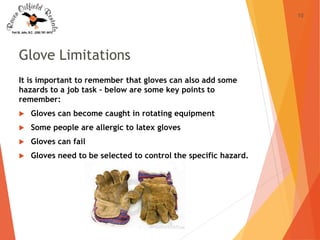
 Gloves can become caught in rotating equipment
 Some people are allergic to latex gloves
 Gloves can fail
 Gloves need to be selected to control the specific hazard.
10
Gloves – Size and Fit
 Gloves come in many sizes
 Use properly fitting gloves that give you the needed dexterity.
11
Too big A better fit
Gloves
 Use and Care
• Your hands should be clean prior to donning gloves.
• Fabric and leather gloves should be cleaned regularly or
discarded once they are to worn or dirty.
• Fabric and leather gloves should not be used where
protection from liquids or dangerous chemicals is
required as they absorb chemicals.
12
Gloves
 Use and Care
• Replace gloves if they have cuts, tears, holes, or
defects.
• Make sure the glove is the right length for the job.
• Gloves and PPE used to handle hazardous chemicals
must be cleaned after use.
• No gloves are chemical ‘proof’ only resistant – chemicals
will break down the gloves (swell, crack, or weaken)
over time.
13

Hand Protection.pptx

  • 1.
  • 2.
     Overview  Handhazards  Types of Gloves  Limitations  Use and Care  Chemical Resistant
  • 3.
    Your Hands  Don’ttake them for granted like I did  Hands are one of our greatest assets, unique in the world.  Majority of our work tasks involve using our hands  Hands are often put ‘in the line of fire’ and are commonly injured. 3
  • 4.
    Hand Injuries  Approximately20% of disabling workplace injuries involve hands.  Hand injuries include cuts, burns, fractures, amputations, nerve damage and dermatitis  Skin irritation, dermatitis and poisoning can occur by handling chemicals with bare hands.  Your skin absorbs chemicals readily. 4
  • 5.
    Hand Protection Proper gloveselection can protect you from the following:  Knives, sharp edges, splinters.  Chemicals  Biological hazards  Hot objects  Vibration  Electricity  Extreme cold  Pinch points 5
  • 7.
    Types of Gloves Leather Gloves Protect your hands from abrasions and rough surfaces  Cut Resistant Gloves Reduce the risk of cuts from knives and sharp surfaces Ranked in cut protection level from Level 1-5, Level 1 being lowest level of protection, 5 being highest. 7
  • 8.
    Types of Gloves Anti-vibration Reduce the impact of vibrations  Impact Resistant Gloves Are reinforced gloves with padding and/or rigid support to reduce damage caused by impacts.  Chemical Resistant gloves Afford protection from specific chemical hazards.  Nitrile Gloves Thin nitrile gloves offer minimal protection. 8
  • 9.
    Types of Gloves Electrically Insulated Gloves There are specific types of electrically insulating gloves which protect the wearer from electrical hazards. Specialized training in the use and care of these gloves along with electrical safety are required prior to working on live electrical equipment. Electrically insulating gloves must align with the requirements of CSA Z462 which requires different levels of electrical protective equipment depending on the type of equipment being serviced. 9
  • 10.
    Glove Limitations It isimportant to remember that gloves can also add some hazards to a job task – below are some key points to remember:  Gloves can become caught in rotating equipment  Some people are allergic to latex gloves  Gloves can fail  Gloves need to be selected to control the specific hazard. 10
  • 11.
    Gloves – Sizeand Fit  Gloves come in many sizes  Use properly fitting gloves that give you the needed dexterity. 11 Too big A better fit
  • 12.
    Gloves  Use andCare • Your hands should be clean prior to donning gloves. • Fabric and leather gloves should be cleaned regularly or discarded once they are to worn or dirty. • Fabric and leather gloves should not be used where protection from liquids or dangerous chemicals is required as they absorb chemicals. 12
  • 13.
    Gloves  Use andCare • Replace gloves if they have cuts, tears, holes, or defects. • Make sure the glove is the right length for the job. • Gloves and PPE used to handle hazardous chemicals must be cleaned after use. • No gloves are chemical ‘proof’ only resistant – chemicals will break down the gloves (swell, crack, or weaken) over time. 13

Editor's Notes

  • #2 “This presentation covers basic facts on the potential for hand injuries at this worksite, how gloves can protect you, what their limitations are, and how to take care of your gloves. It is important to remember throughout this presentation that PPE is the last line of defense in the control hierarchy, hazards should be controlled through engineering and administrative controls to eliminate, or mitigate the hazard. No gloves offer 100% protection from various hazards but they are an important control to protect your hands.
  • #4 The complex abilities of the hand are part of what make humans unique. Only humans have the ability to bring our thumbs across the hand to connect with our ring and pinkie fingers. This ability provides us with the dexterity to use tools. It also gives us a forceful grip. Each hand consists of 19 bones. The palm of the hand doesn’t contain melanin (skin pigment) or hair follicles. The only other place on the body that lacks both of these is the sole of the foot. These two surfaces also have thicker skin than other places of the body. Although fully functional hands can accomplish great things, they are susceptible to a number of ailments, including: Arthritis Deformities Nerve disorders Finger clubbing Tendinitis Carpal tunnel syndrome Fractured bones Sprains, strains, cuts, and bruises Our hands are often the body part put ‘in the line of fire’ and one of the most common work related injuries with one out of six disabling work injuries involve the fingers, most often due to the finger striking or being struck against a hard surface. (in the USA).
  • #5 Approximately 20% of disabling workplace injuries involve hands. Hand injuries can vary from a small cut, abrasion, to significant crush injuries or chemical burns. To see how easily chemicals can be absorbed into your skin at home – place your hand in a ziploc bag (so you cant smell it) with a garlic clove – crush the clove in your hand and you will likely be able to taste garlic in your mouth within a few minutes – your skin absorbs! The same will happen if you rub garlic on your feet.
  • #6 Proper glove selection can protect you from the following: Knives, sharp edges, splinters. Chemicals Biological hazards Hot objects Vibration Electricity Extreme cold Proper selection of gloves is key to protect you from these hazards. The next three slides will discuss types of gloves and the protection they offer.
  • #8 There is a variety of leather gloves available depending on personal preference and job tasks, these gloves protect from abrasions and rough surfaces. Cut resistant gloves are made of Kevlar, or have steel wire or fiberglass woven in – they are ranked from cut protection level 1 through 5, one offering the lowest level of protection to level 5 offering the highest level – these gloves are designed to afford protection from cutting motions but can be punctured. There are insulated versions of both leather and cut resistant gloves to offer protection from low temperatures.
  • #9 Anti vibration gloves – reduce the impact of vibrations through absorbing materials – these are specialty gloves used when working with high vibration equipment. Impact resistant gloves serve to reduce the damage caused by an impact through shock absorbing materials and rigid/hard sections – these can be used when there is a risk of impact, at all times there is a risk of impact all controls should be put in place to eliminate the hazard – PPE is the last line of defense. Chemical resistant gloves – there are a variety of different types of chemical resistant gloves which must be selected to control the hazards you are being exposed to, throughout our worksite there are chemicals and products which are pose significant hazards to a staff. It is important to check to ensure the gloves selected are appropriate to control the hazard – acid resistant gloves when working with acid, etc. Typically for chemical handling gauntlet style gloves which protect the wrist and forearm are the recommended style. Nitrile gloves – thin latex or nitrile gloves offer minimal protection from chemical hazards and no protection from abrasion, cutting, rough surfaces, impact, vibration, temperature extremes, or electricity. These gloves can be used as a liner. These gloves are not to be used as a PPE control as they offer minimal protection.
  • #10 Electrically Insulated Gloves There are specific types of electrically insulating gloves which protect the wearer from electrical hazards. Specialized training in the use and care of these gloves along with electrical safety are required prior to working on live electrical equipment. Electrically insulating gloves must align with the requirements of CSA Z462 which requires different levels of electrical protective equipment depending on the type of equipment being serviced.
  • #11 It is important to remember that gloves can also add some hazards to a job task – below are some key points to remember: Gloves can become caught in rotating equipment Some people are allergic to latex gloves Gloves can fail in conditions of extreme temperatures, high mechanical force, high vibrations, or due to chemical exposure over time. Gloves need to be selected to control the specific hazard.
  • #13 Your hands should be clean prior to donning gloves. Fabric and leather gloves should be cleaned regularly or discarded once they are to worn or dirty. Fabric and leather gloves should not be used where protection from liquids or dangerous chemicals is required as they absorb chemicals. They can then keep the chemical in contact with your skin. Replace gloves if they have cuts, tears, holes, or defects