Hand Gesture of Differents
Cultures
      Dr. Nirmala S. Padmavat
             Asst. Prof.
      Nutan Mahavidyalya, Selu
What are Hand Gestures?

    Hand gestures are a way of communicating
    with others and conveying your feelings.
    These gestures are most helpful when one is
    speaking to someone with no language in
    common. The meanings of hand gestures in
    different cultures may translate into different
    things. To explain my point, I take a very
    common example of former President
    George W. Bush who had to face a major
    faux pas during a visit to Australia. He tried to
    signal a peace sign by waving the two finger
    or V-sign at the crowd.
   You may think of this as a simple gesture, but
    he committed a major error. Instead of his
    palm facing outwards, it faced inwards. The
    meaning of this hand gesture in Australia
    meant he was asking the crowd to go screw
    themselves! A grave error committed by the
    then most powerful man in the world.
    Therefore, it is very important to understand
    the meanings of gestures before you travel to
    different countries.
   Before you communicate with people in
    different cultures, you need to understand the
    meaning of gestures. Those considered as a
    good gestures in one country may be termed
    as an offensive gesture in some countries.
    So, if you are a frequent flier to different
    countries, improve your communication skills
    by learning the meaning of hand gestures.
    The following paragraphs contain some
    information related to the meanings of
    common gestures.
Interpretation of Hand
Gestures

   The following slides will cover some of
    the common hand gestures with their
    meanings. You will be surprised to
    know that some gestures that you
    perform almost casually has a really
    different meaning in different cultures.
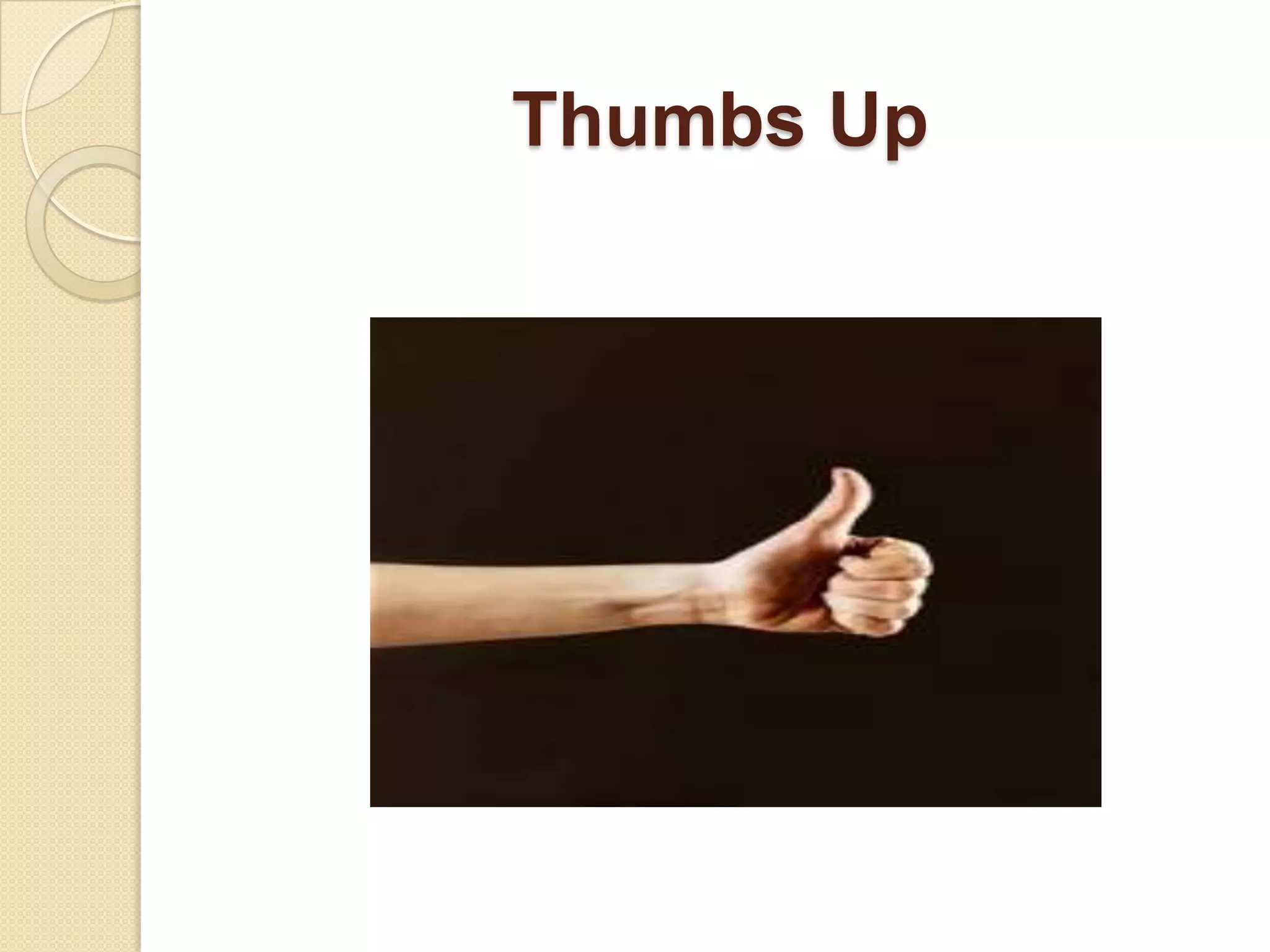
Thumbs Up
Thumbs Up

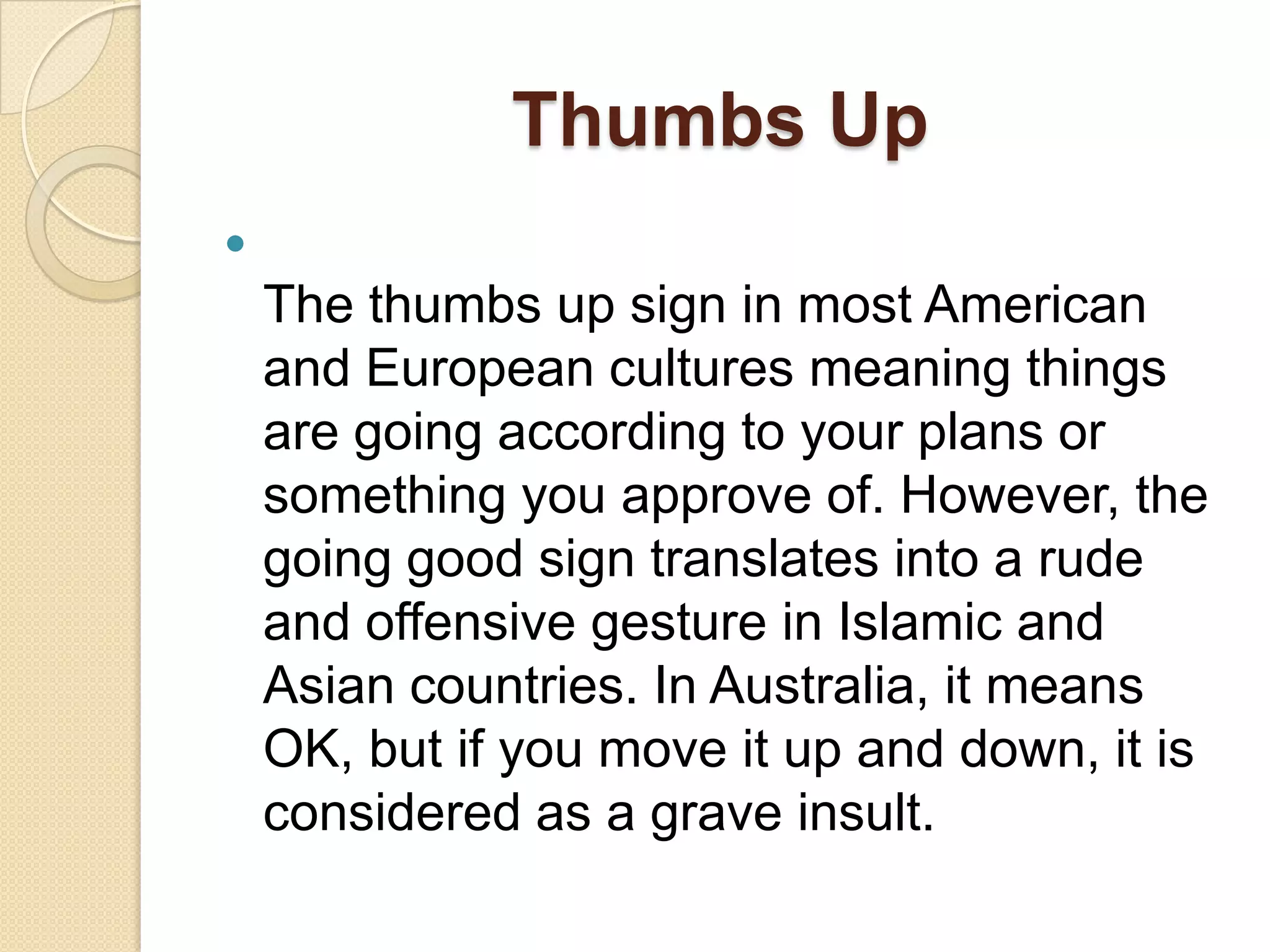
    The thumbs up sign in most American
    and European cultures meaning things
    are going according to your plans or
    something you approve of. However, the
    going good sign translates into a rude
    and offensive gesture in Islamic and
    Asian countries. In Australia, it means
    OK, but if you move it up and down, it is
    considered as a grave insult.
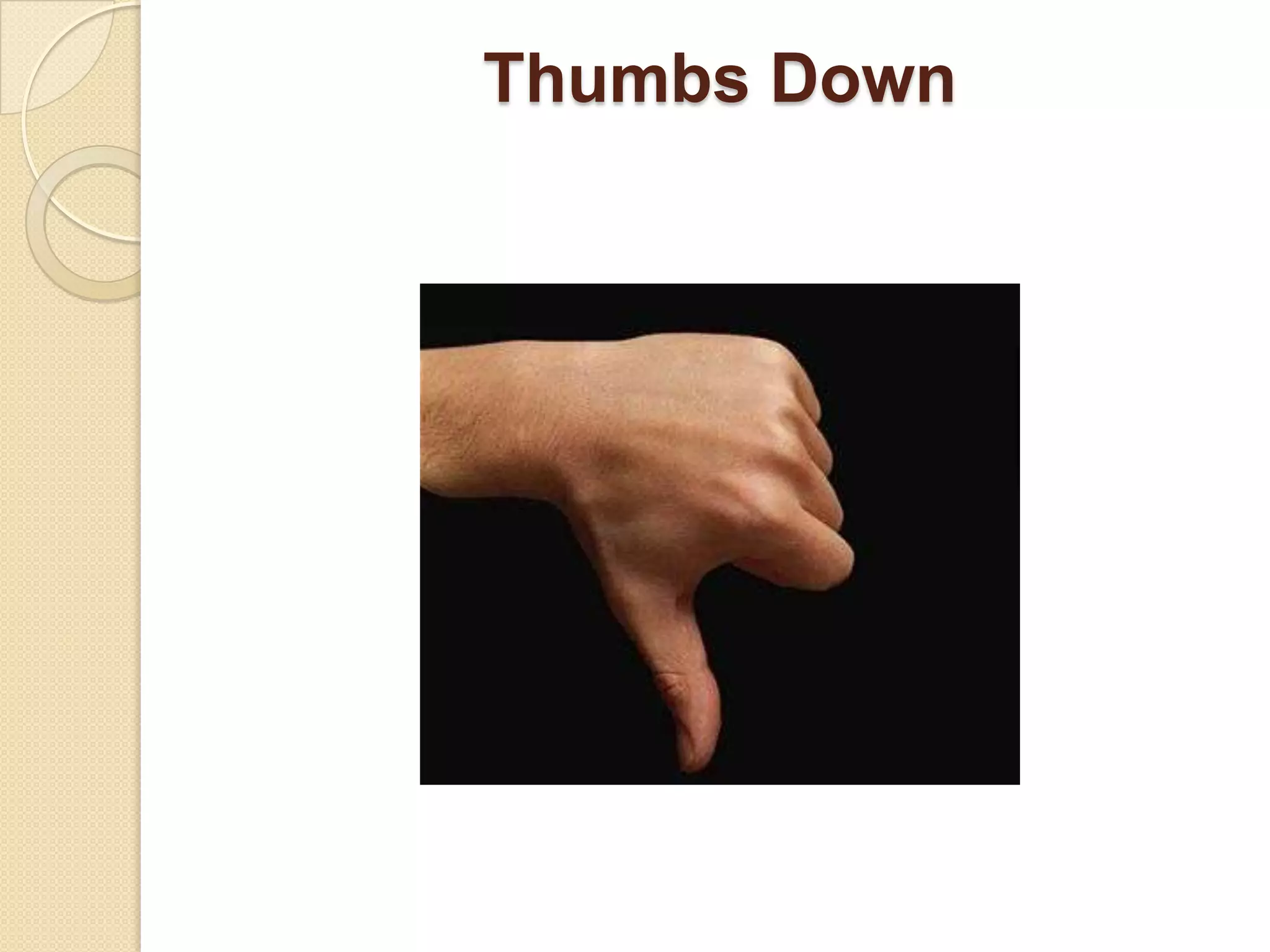
Thumbs Down
Thumbs Down

   The thumbs down sign obviously
    means the opposite of a thumbs up
    sign. It is an indication of something
    that is bad or something that you do
    not approve of. It also indicates that
    something or someone has failed. The
    thumbs down sign is not used as often
    as the thumbs up sign. This is a rude
    hand gesture and an arrogant way to
    indicate failure.
Thumbs Down Hand Sign
Fingers Crossed
Thumbs Down Hand Sign
Fingers Crossed
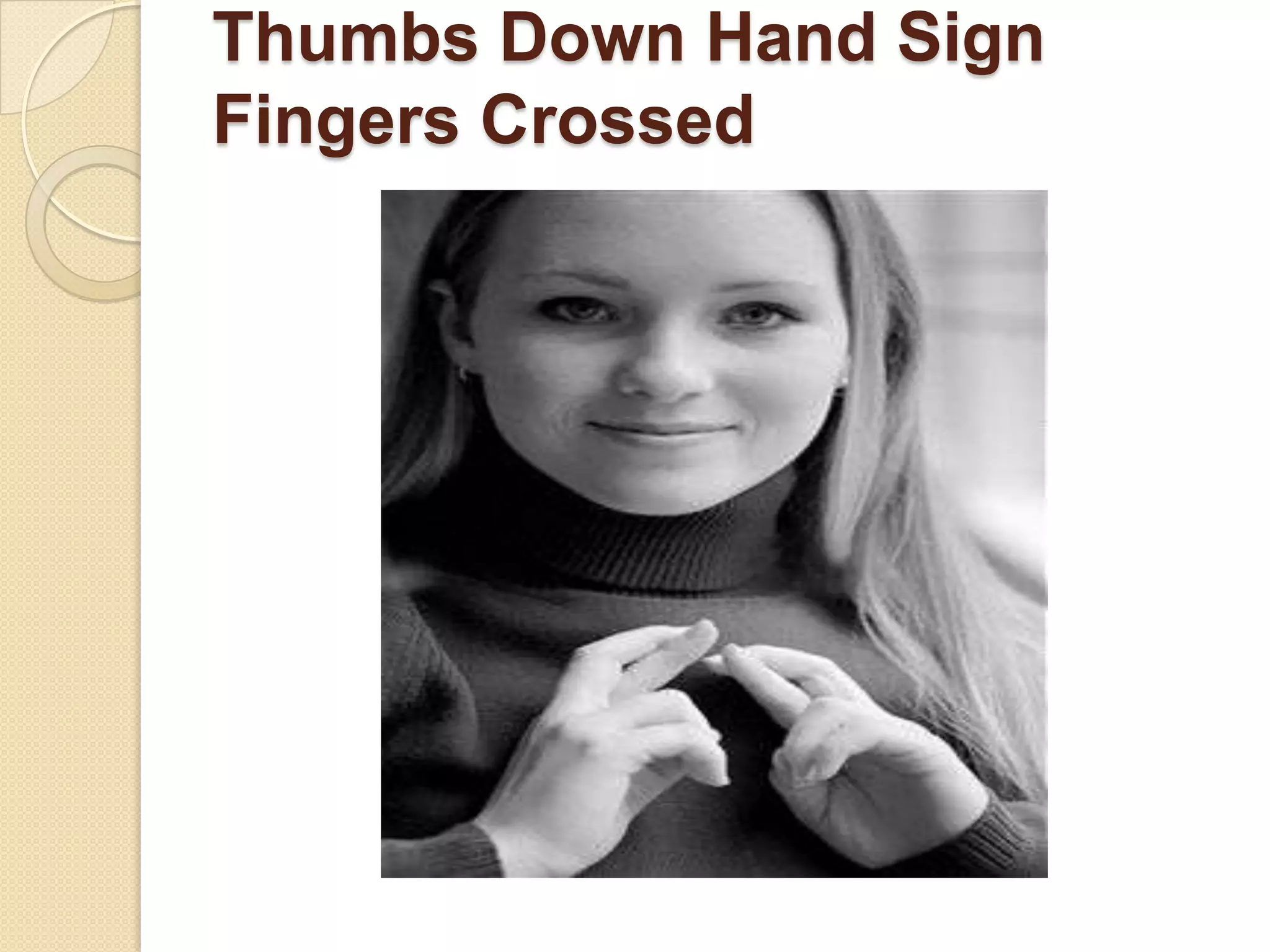
   Crossing of fingers is considered as a
    sign of wishing for good luck or fortune. It
    also may interpret that someone is
    hoping for something good to happen.
    The cross may have originated from the
    Pagan symbols that means to ward off
    evil. Many times people cross their
    fingers before telling a lie, as it is
    believed to countervail the evil that
    comes of the lie. It is a positive and
    negative symbol as it interprets both luck
    or lies.
Stop
Stop
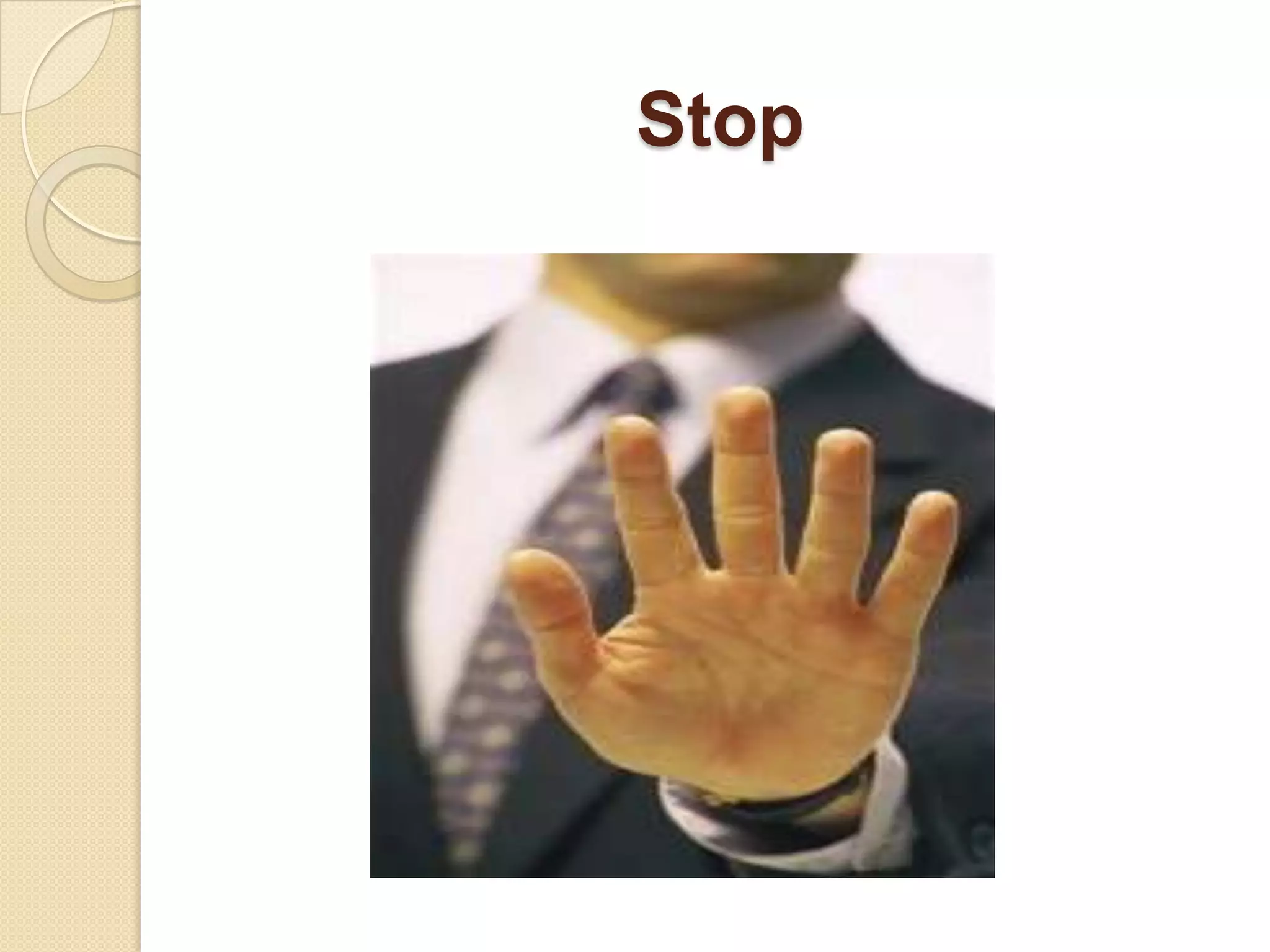
   When one raises the hand up with the palm
    facing towards the opposite person, it means 'to
    stop' in America and British countries. In a stop
    sign, the hand is tilted forward. This means the
    person is in an authoritative figure and asking
    one to 'Stop'. If the fingers are pushing down, it
    will indicate that the gesture is indicated for the
    person to sit down or settle. This is not a
    defensive hand gesture and is in fact a gesture to
    take control over the person it is intended for. If
    you were to use this sign in Singapore or
    Malaysia, it would mean that one is trying to 'hail'
    someone's attention like a waiter or asking for
    permission to speak.
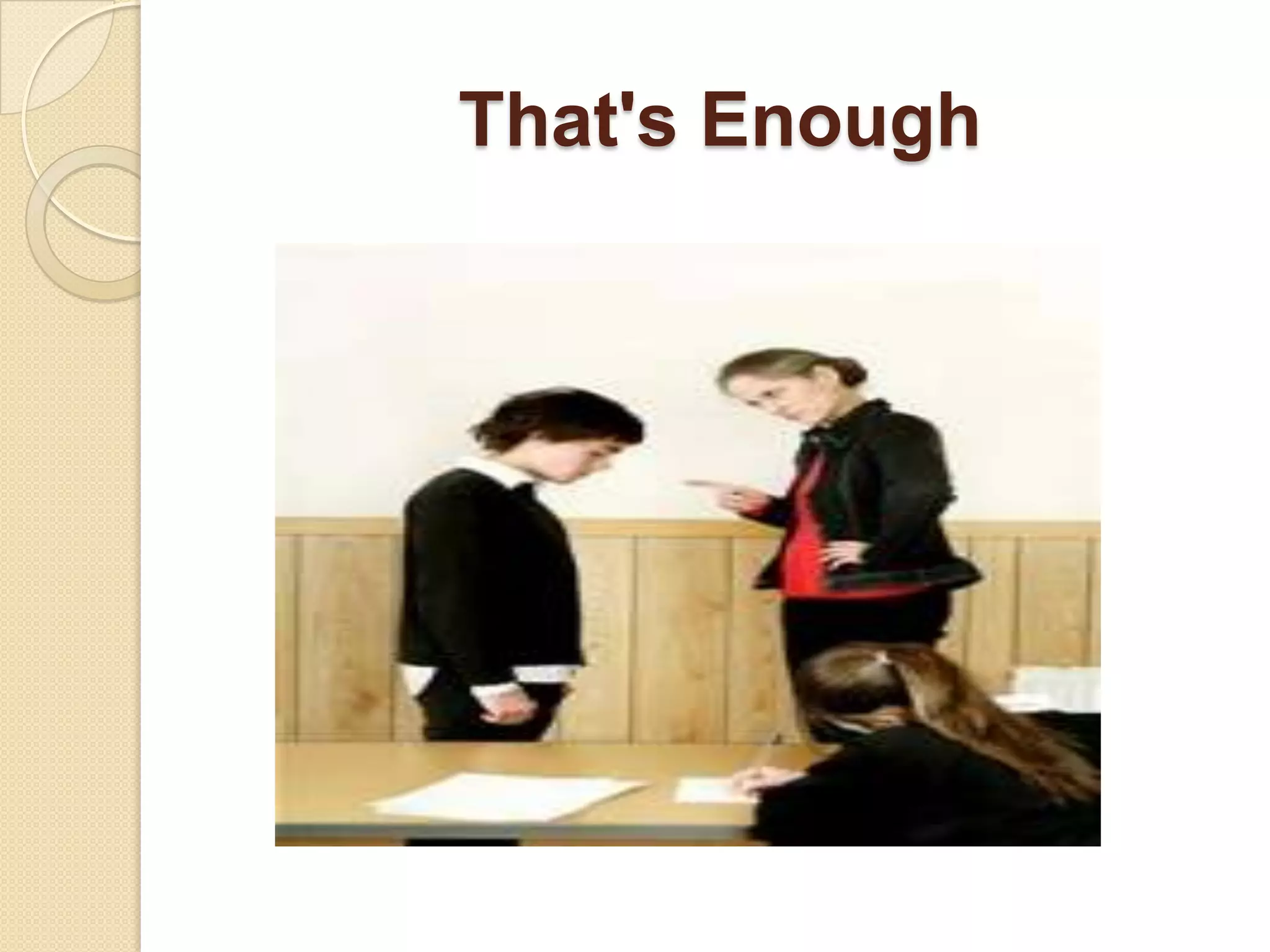
That's Enough
   There is one common meaning of this
    hand gesture in different cultures. This
    hand gesture is commonly used by
    mothers and teachers. This hand gesture
    is used to warn a single individual. It is a
    way to silent an individual and ask them
    to pay attention. This is considered as a
    rude gesture in a professional
    environment and termed as a
    domineering behavior.
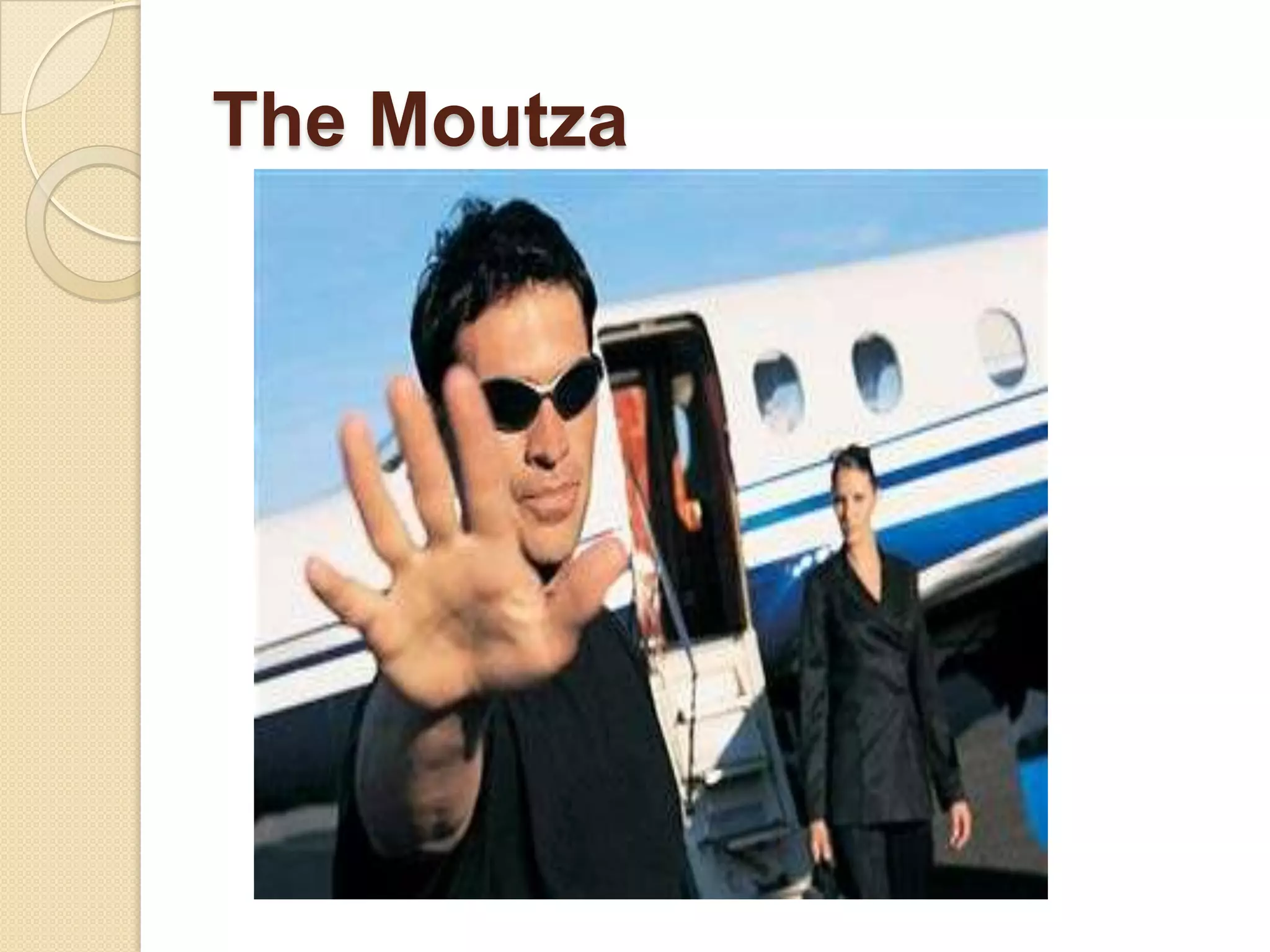
The Moutza
The Moutza
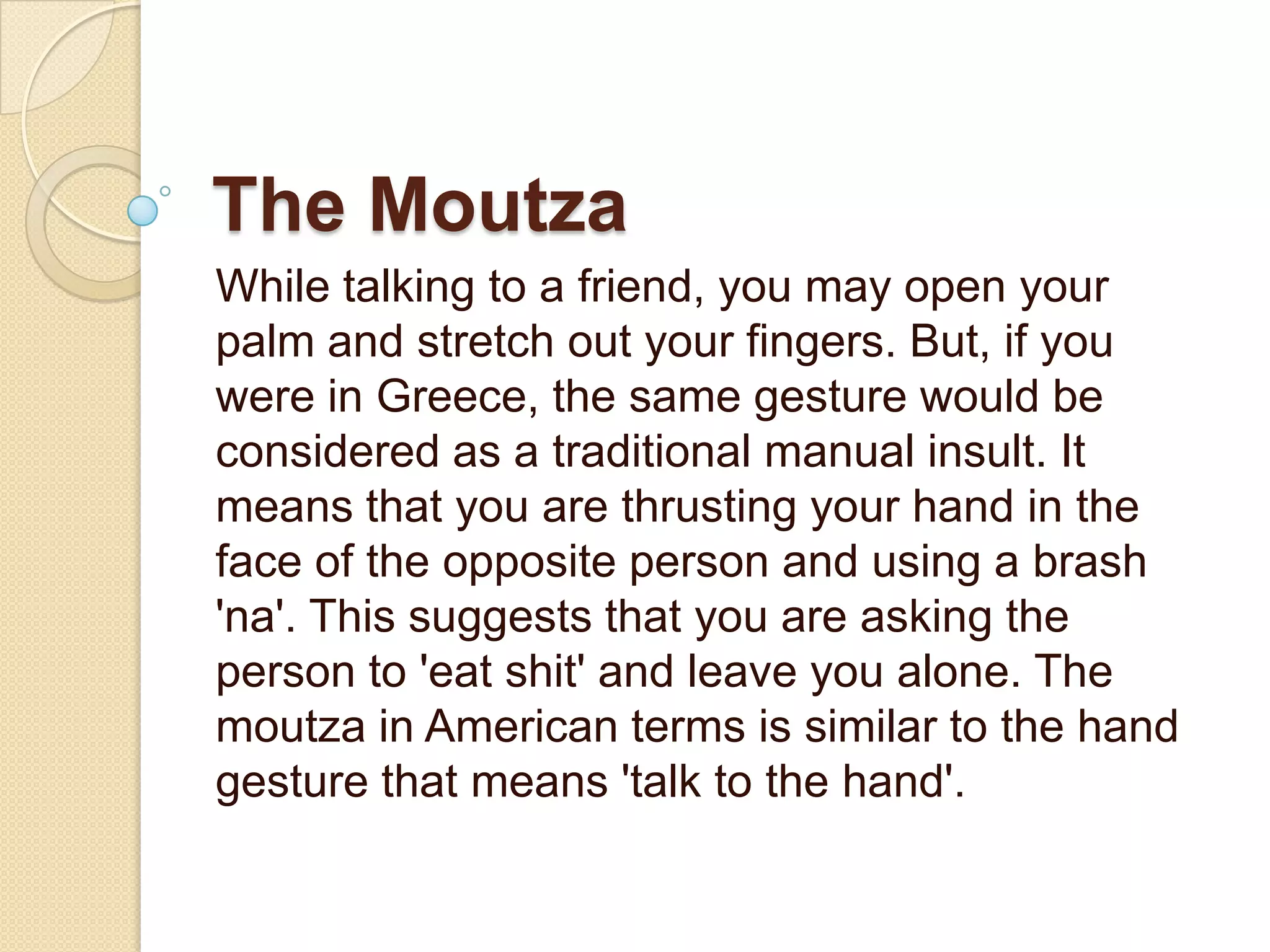
While talking to a friend, you may open your
palm and stretch out your fingers. But, if you
were in Greece, the same gesture would be
considered as a traditional manual insult. It
means that you are thrusting your hand in the
face of the opposite person and using a brash
'na'. This suggests that you are asking the
person to 'eat shit' and leave you alone. The
moutza in American terms is similar to the hand
gesture that means 'talk to the hand'.
The Dog Call
   The Dog Call
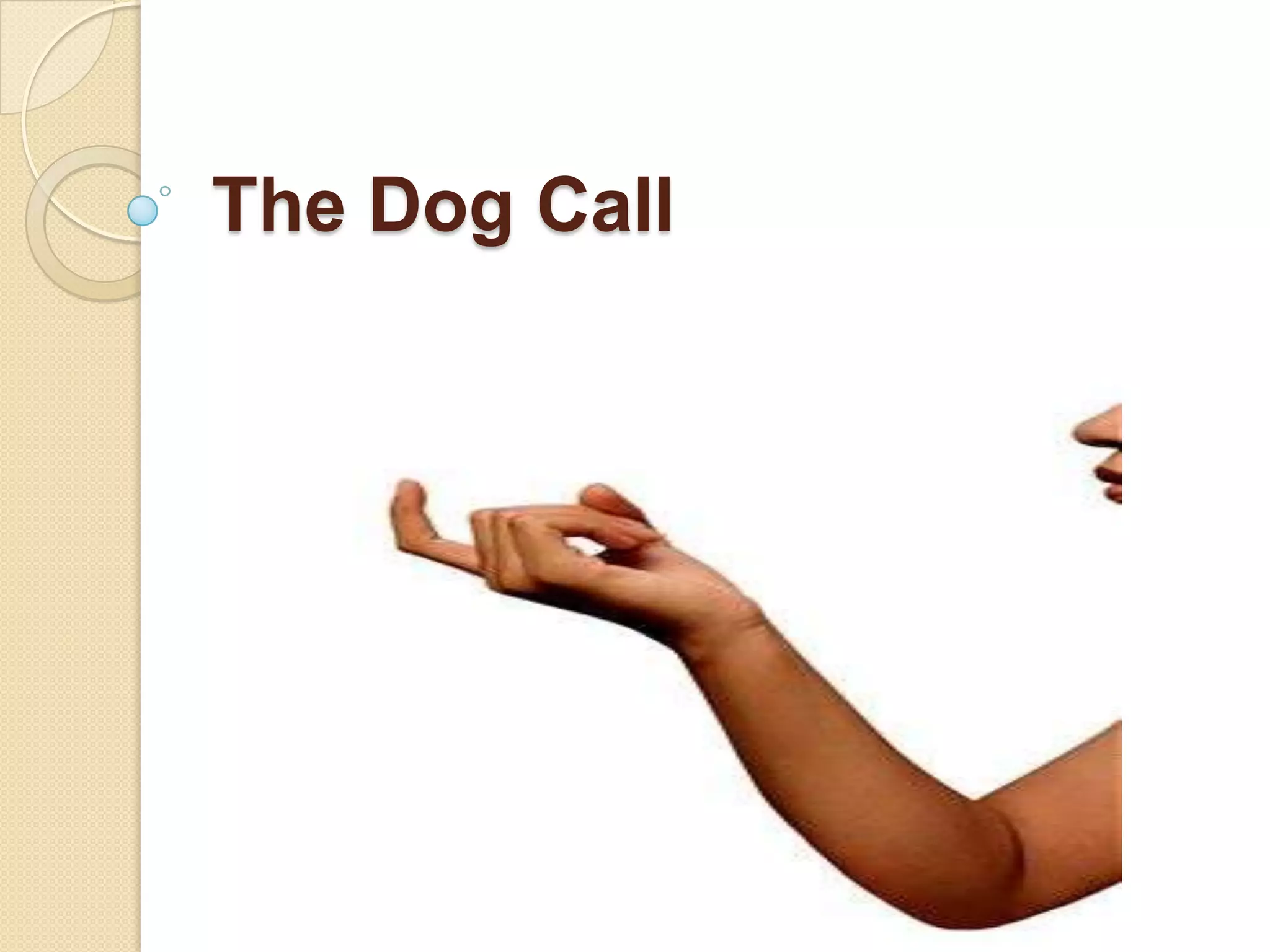
    The dog call is a gesture where you curl your finger and
    summon someone towards you. This movement is
    mostly seen carried out by a tempting woman to her
    man. However, do not use this seductive hand gesture
    in Philippines. This is because this is one of the worst
    forms of hand gesture that is to be used only for dogs.
    This hand gesture could get you arrested in Philippines
    or maybe even punishable by breaking your finger, so
    that you never ever attempt to try this offensive gesture
    again. In Asian countries like Japan, the dog call is
    considered a rude gesture. In Singapore, it is indication
    of death. countries like Japan, the dog call is
    considered a rude gesture. In Singapore, it is indication
    of death.
O.K
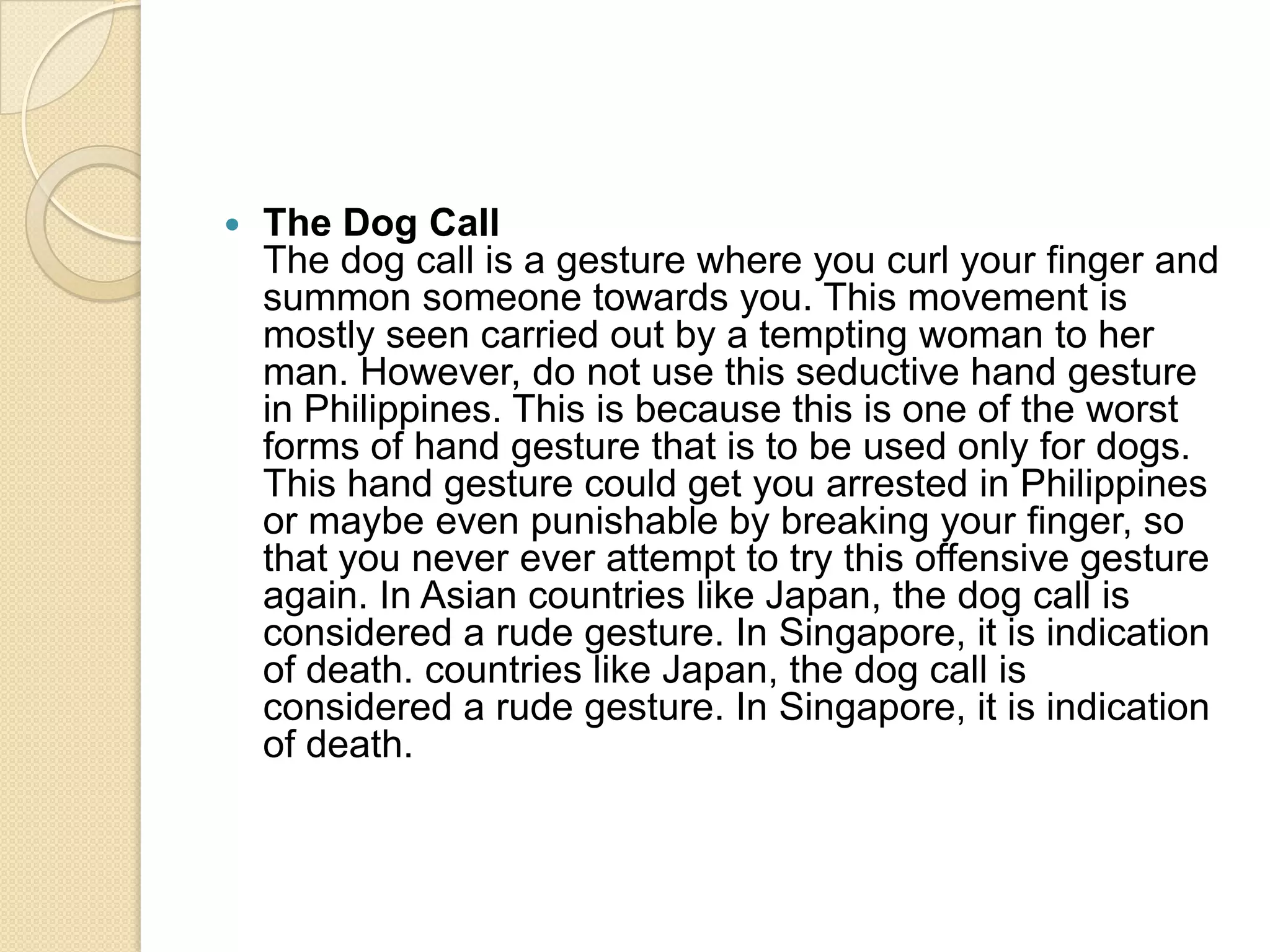
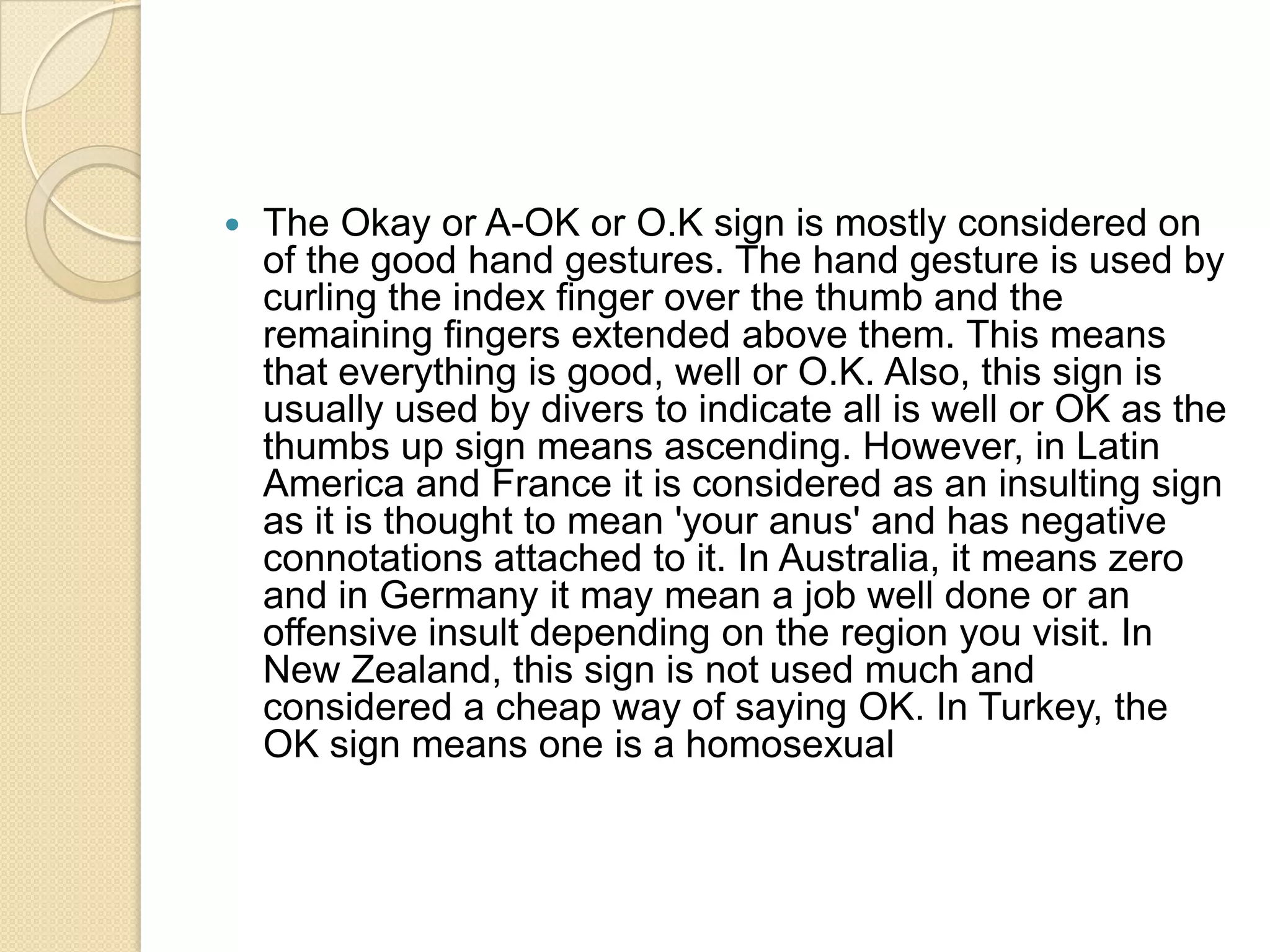
   The Okay or A-OK or O.K sign is mostly considered on
    of the good hand gestures. The hand gesture is used by
    curling the index finger over the thumb and the
    remaining fingers extended above them. This means
    that everything is good, well or O.K. Also, this sign is
    usually used by divers to indicate all is well or OK as the
    thumbs up sign means ascending. However, in Latin
    America and France it is considered as an insulting sign
    as it is thought to mean 'your anus' and has negative
    connotations attached to it. In Australia, it means zero
    and in Germany it may mean a job well done or an
    offensive insult depending on the region you visit. In
    New Zealand, this sign is not used much and
    considered a cheap way of saying OK. In Turkey, the
    OK sign means one is a homosexual
Fingers Snap
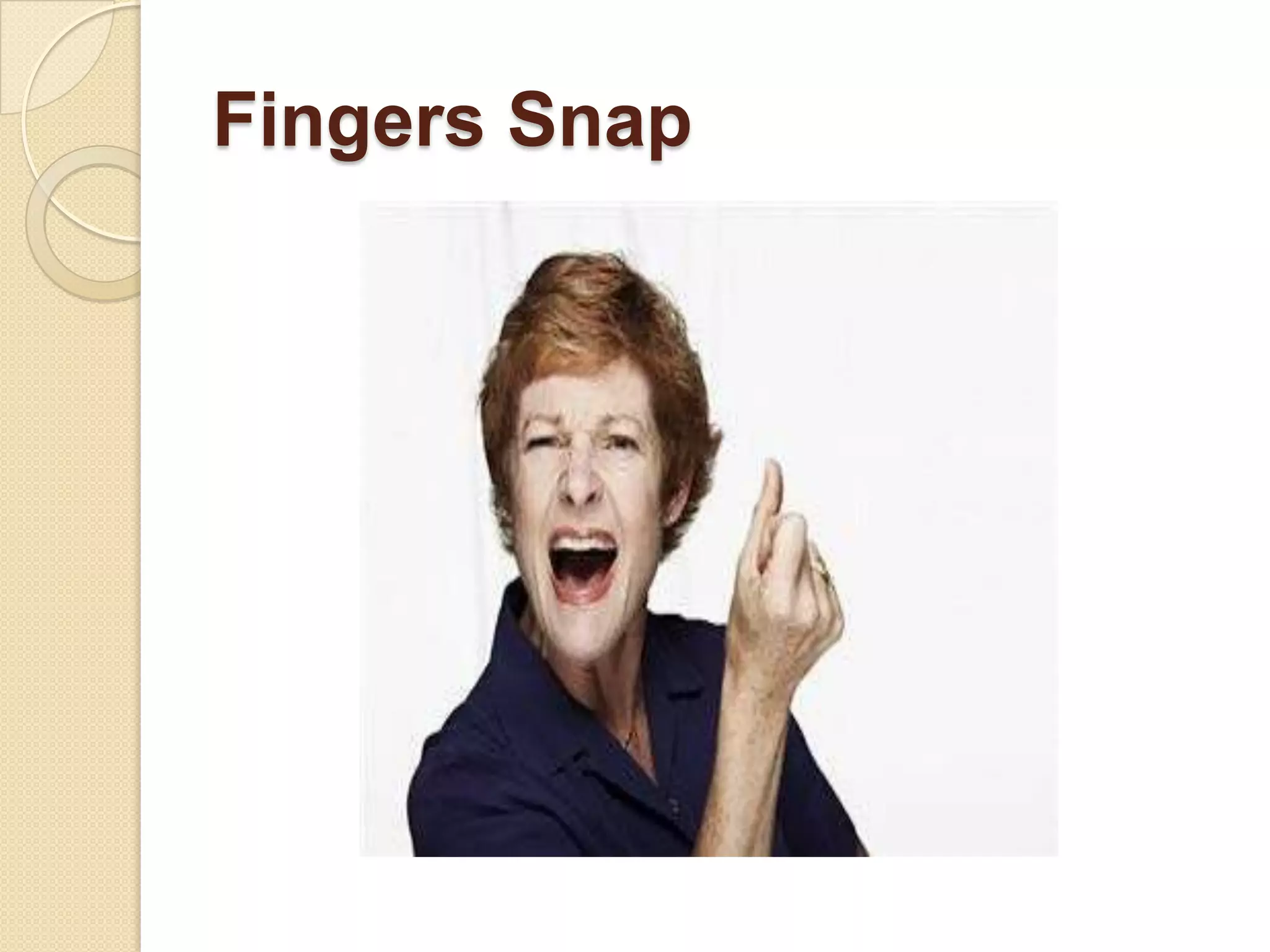
   Snapping fingers over and over may
    mean one is trying to remember
    something someone has forgotten. In
    Latin America, snapping fingers means
    asking one to hurry up. In Great Britain
    and America, one snaps fingers when
    one remembers something or gets an
    idea. However, in many cultures,
    snapping fingers close to someone's
    face is considered to be an offensive
    gesture.
I am Running Out of Time
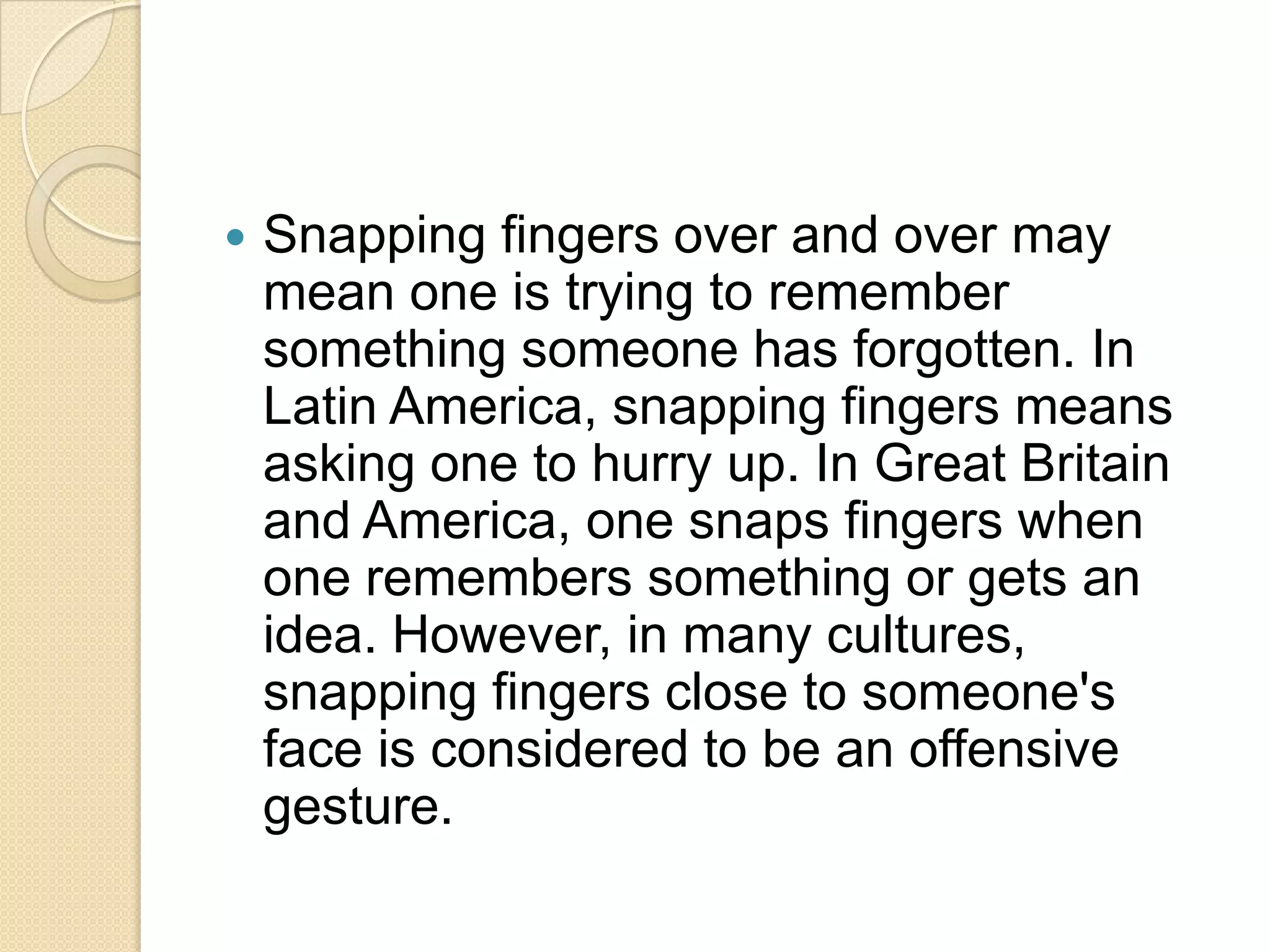
Many times when one is getting late or wants to
indicate running out of time, they tend to watch
their wrist. This is despite the fact that they may
or may not be wearing a watch on the wrist. This
is a subconscious gesture to indicate an end of
conversation or a subtle way that one should
take leave. However, do not attempt this gesture
in Middle Eastern countries. It is believed that
once a conversation starts, it should be allowed
to take its time to complete. Gesturing to end the
conversation is considered a rude insult.
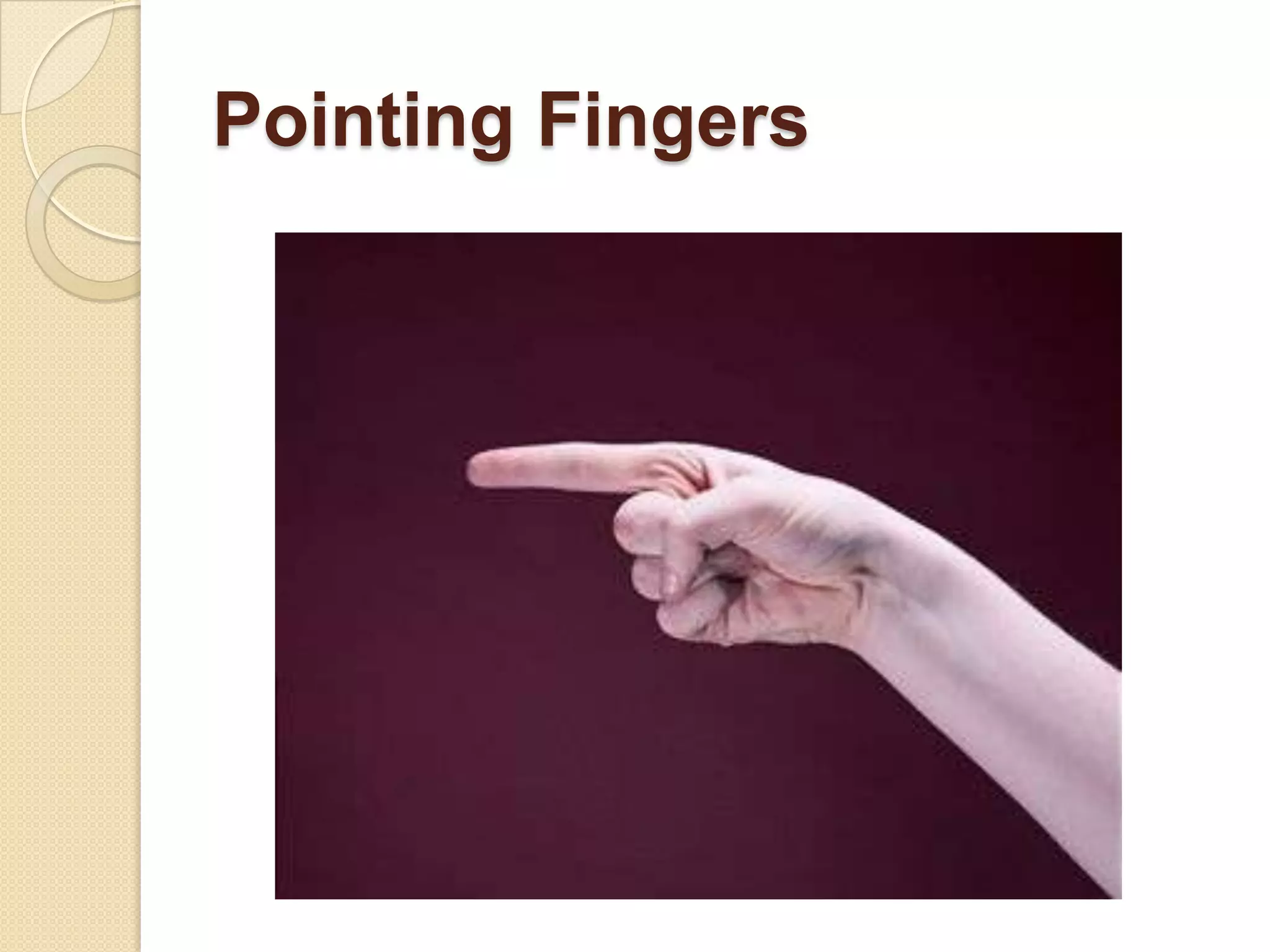
Pointing Fingers
   Pointing Fingers
    In America and European cultures, it is
    considered rude to point fingers at
    others. This hand gesture is an indication
    of a dominant - to - subordinate behavior
    in the professional world. It is considered
    a gesture to single out an individual from
    a crowd. This aggressive signal is not
    liked by many, as no one likes to be
    singled out.
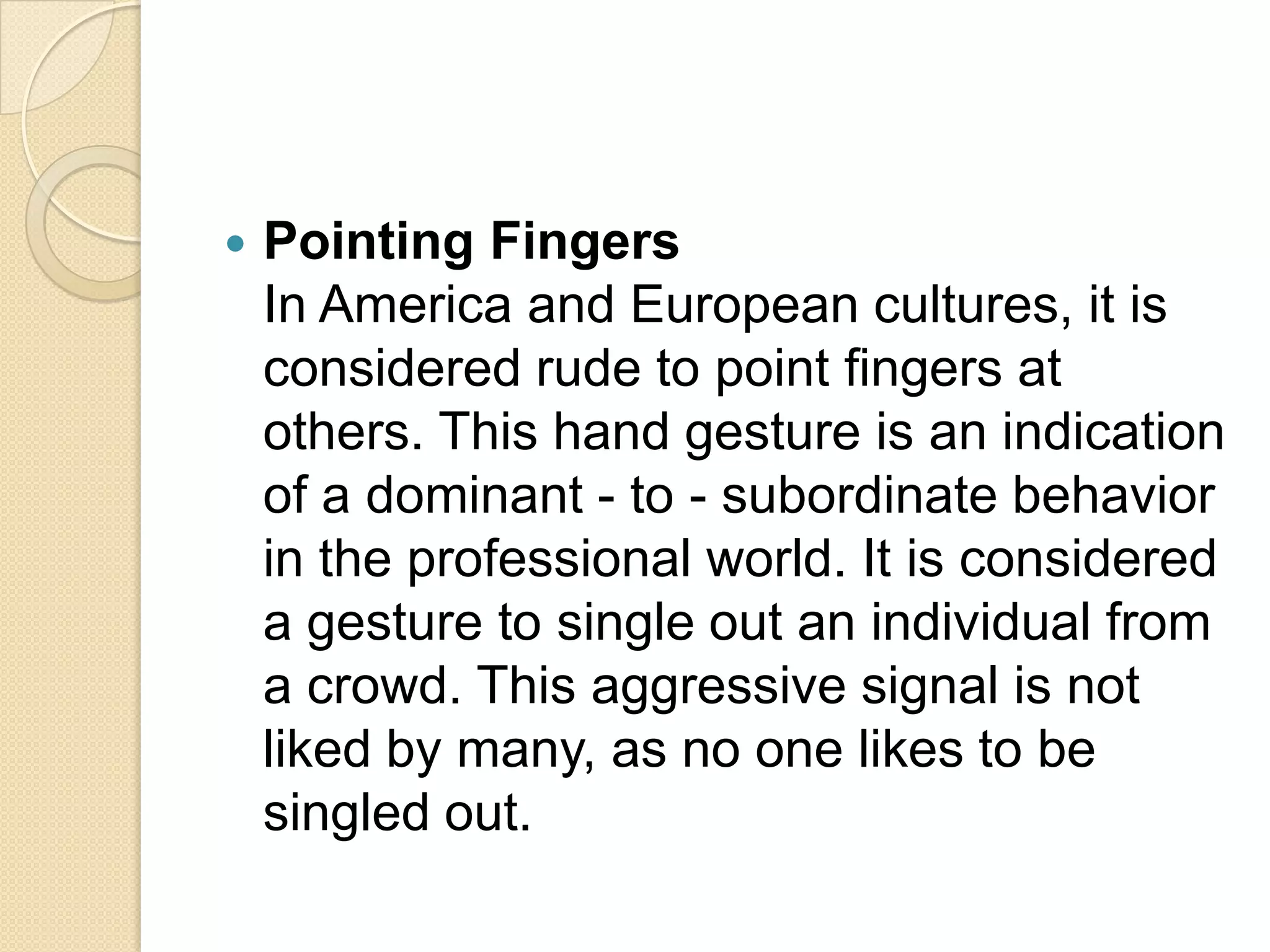
The Corona
   The corona is a hand gesture that is carried out by
    pointing the index and pinkie finger upwards and the
    two middle fingers and thumb curled towards the palm.
    This hand gesture is considered as the symbol of the
    devil in many cultures. The two pointing fingers indicate
    the horns of the Devil. This symbol is used the
    University of Texas to symbolize 'the Longhorn', their
    university mascot. The corona is also widely used by
    rock stars in as a positive hand gesture. This is also one
    of the good hand gestures in different cultures like
    Buddhism and Hinduism. This gestures means the
    Karana Mudra used to dispel the evil. In the
    Mediterranean, it an old symbol that means 'cuckold',
    that is, your wife is cheating on you.
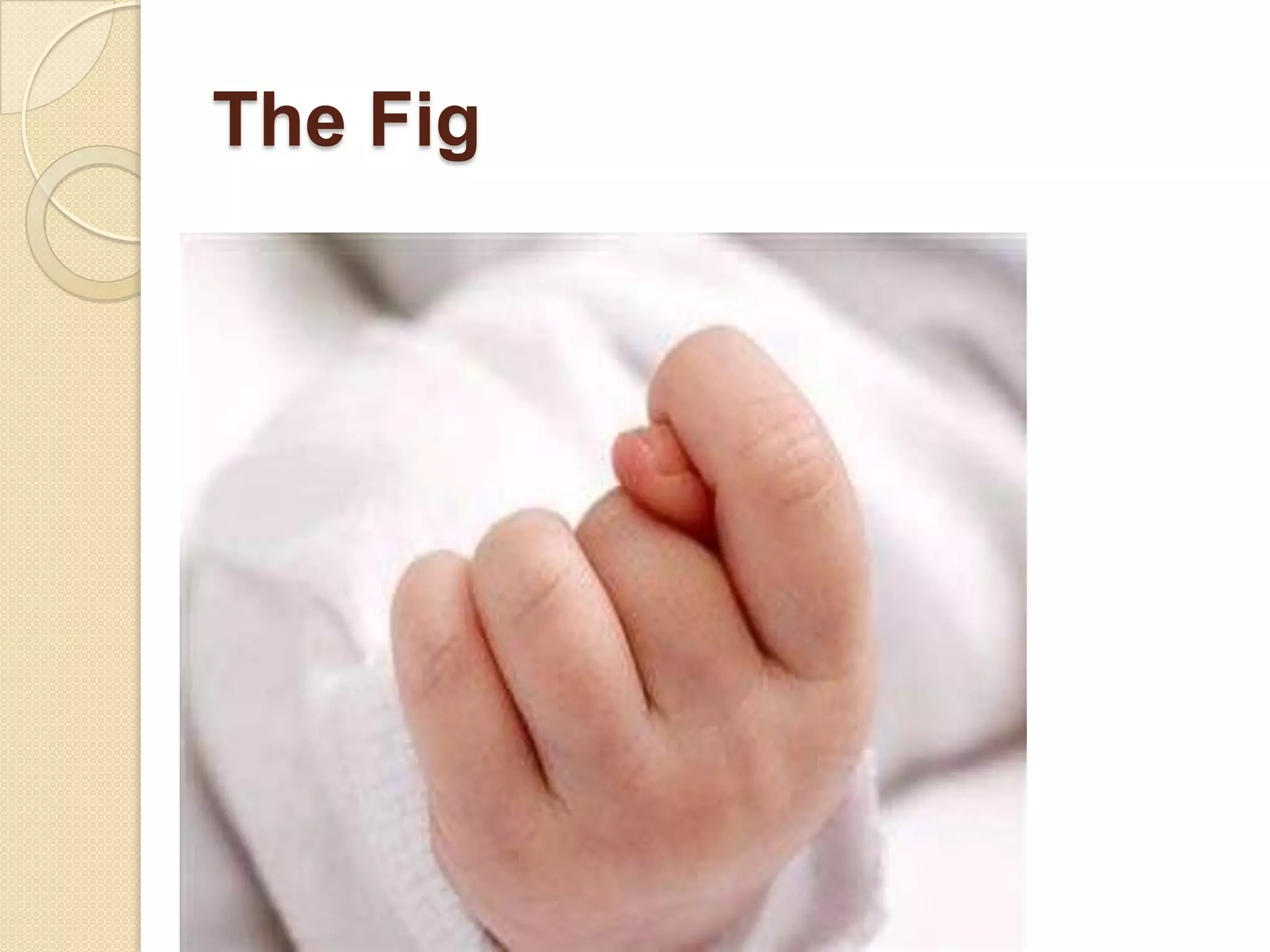
The Fig
   The fig is a gesture that is indicated by a fist.
    The thumb is seen poking out of the index
    and middle fingers. This gesture is known as
    mano fico or fig hand in Roman. This is one
    of the good hand gestures, as it indicates
    good luck and fertility and a way to ward off
    the evil eye. However, the fig is considered a
    gesture that mimics the female vulva in
    Italian. Thus, this is a very offensive gesture
    to the Italians and Turks. If this gesture is
    carried out by a person of Asian origin, it
    roughly translates as 'screw you'.
Clenched Fist
   One of the aggressive hand gestures
    is the clenched fist. This means one is
    trying to pick up a fight or trying to
    warn the opposite person to back off.
    In some militant groups, a clenched
    fist is used as a sign of defiance. In
    Asian countries, a clenched fist will
    surely land you into a fist fight.
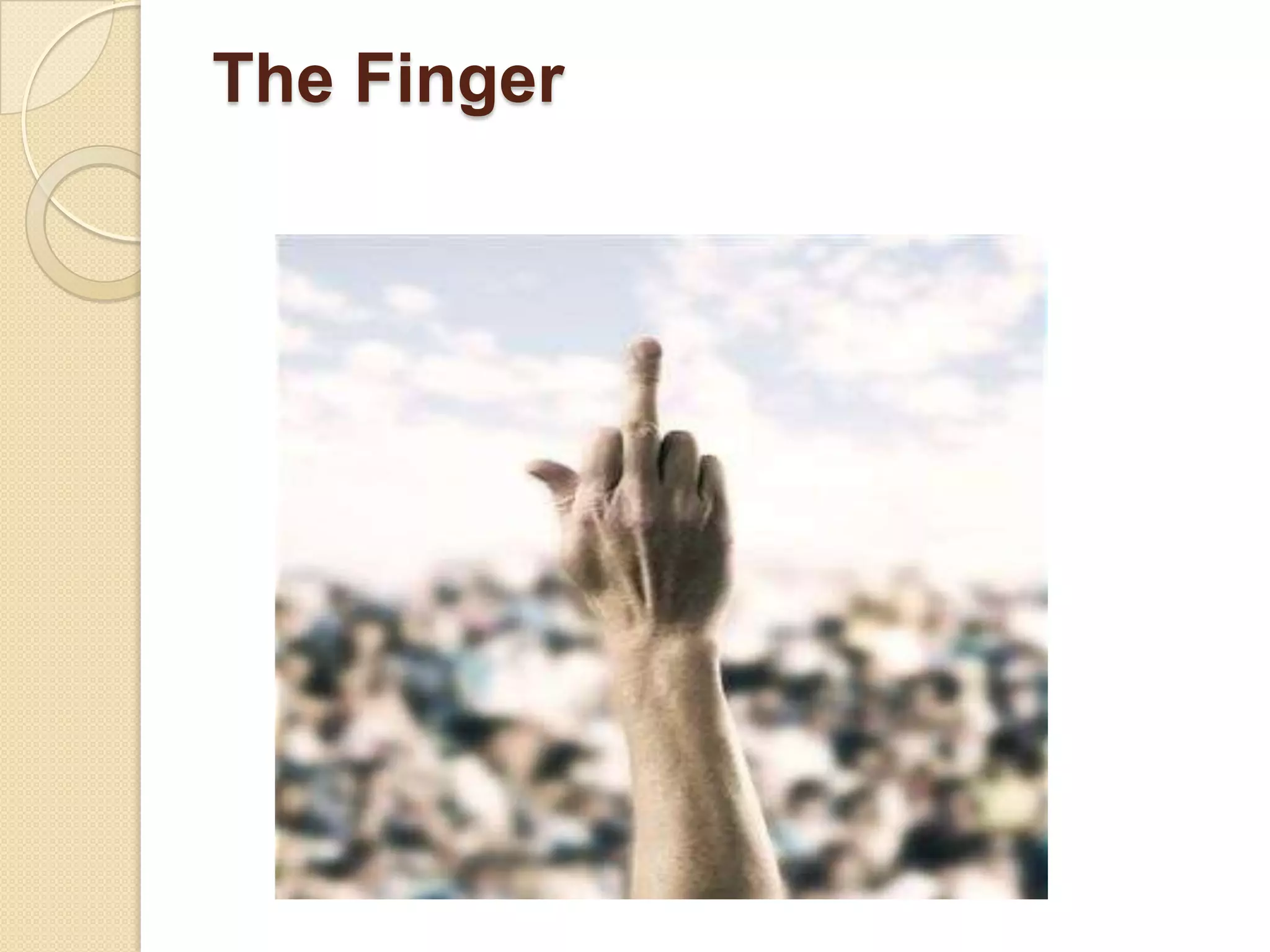
The Finger
   The Finger
    One of the most offensive and rude
    hand gestures around the world is the
    finger. The middle finger-pointing
    upwards is considered as an obscene
    gesture. In some Mediterranean and
    Arab countries, holding the index
    finger instead of the middle finger,
    implies the same obscene gesture.
Conclusion
   This was some information related to the
    meanings of gestures in different
    cultures. You should avoid using certain
    gestures in countries whose cultures are
    new to you. You do not want to offend
    anyone or anything in a new land that
    may put you in a soup. While you
    research some information related to
    travel tips, be sure you also learn
    something about the body language
    gestures too.
Thank You......

Hand gesture of differents cultures

  • 1.
    Hand Gesture ofDifferents Cultures Dr. Nirmala S. Padmavat Asst. Prof. Nutan Mahavidyalya, Selu
  • 2.
    What are HandGestures?  Hand gestures are a way of communicating with others and conveying your feelings. These gestures are most helpful when one is speaking to someone with no language in common. The meanings of hand gestures in different cultures may translate into different things. To explain my point, I take a very common example of former President George W. Bush who had to face a major faux pas during a visit to Australia. He tried to signal a peace sign by waving the two finger or V-sign at the crowd.
  • 3.
    You may think of this as a simple gesture, but he committed a major error. Instead of his palm facing outwards, it faced inwards. The meaning of this hand gesture in Australia meant he was asking the crowd to go screw themselves! A grave error committed by the then most powerful man in the world. Therefore, it is very important to understand the meanings of gestures before you travel to different countries.
  • 4.
    Before you communicate with people in different cultures, you need to understand the meaning of gestures. Those considered as a good gestures in one country may be termed as an offensive gesture in some countries. So, if you are a frequent flier to different countries, improve your communication skills by learning the meaning of hand gestures. The following paragraphs contain some information related to the meanings of common gestures.
  • 5.
    Interpretation of Hand Gestures  The following slides will cover some of the common hand gestures with their meanings. You will be surprised to know that some gestures that you perform almost casually has a really different meaning in different cultures.
  • 6.
  • 7.
    Thumbs Up  The thumbs up sign in most American and European cultures meaning things are going according to your plans or something you approve of. However, the going good sign translates into a rude and offensive gesture in Islamic and Asian countries. In Australia, it means OK, but if you move it up and down, it is considered as a grave insult.
  • 8.
  • 9.
    Thumbs Down  The thumbs down sign obviously means the opposite of a thumbs up sign. It is an indication of something that is bad or something that you do not approve of. It also indicates that something or someone has failed. The thumbs down sign is not used as often as the thumbs up sign. This is a rude hand gesture and an arrogant way to indicate failure.
  • 10.
    Thumbs Down HandSign Fingers Crossed
  • 11.
    Thumbs Down HandSign Fingers Crossed  Crossing of fingers is considered as a sign of wishing for good luck or fortune. It also may interpret that someone is hoping for something good to happen. The cross may have originated from the Pagan symbols that means to ward off evil. Many times people cross their fingers before telling a lie, as it is believed to countervail the evil that comes of the lie. It is a positive and negative symbol as it interprets both luck or lies.
  • 12.
  • 13.
    Stop  When one raises the hand up with the palm facing towards the opposite person, it means 'to stop' in America and British countries. In a stop sign, the hand is tilted forward. This means the person is in an authoritative figure and asking one to 'Stop'. If the fingers are pushing down, it will indicate that the gesture is indicated for the person to sit down or settle. This is not a defensive hand gesture and is in fact a gesture to take control over the person it is intended for. If you were to use this sign in Singapore or Malaysia, it would mean that one is trying to 'hail' someone's attention like a waiter or asking for permission to speak.
  • 14.
  • 15.
    There is one common meaning of this hand gesture in different cultures. This hand gesture is commonly used by mothers and teachers. This hand gesture is used to warn a single individual. It is a way to silent an individual and ask them to pay attention. This is considered as a rude gesture in a professional environment and termed as a domineering behavior.
  • 16.
  • 17.
    The Moutza While talkingto a friend, you may open your palm and stretch out your fingers. But, if you were in Greece, the same gesture would be considered as a traditional manual insult. It means that you are thrusting your hand in the face of the opposite person and using a brash 'na'. This suggests that you are asking the person to 'eat shit' and leave you alone. The moutza in American terms is similar to the hand gesture that means 'talk to the hand'.
  • 18.
  • 19.
    The Dog Call The dog call is a gesture where you curl your finger and summon someone towards you. This movement is mostly seen carried out by a tempting woman to her man. However, do not use this seductive hand gesture in Philippines. This is because this is one of the worst forms of hand gesture that is to be used only for dogs. This hand gesture could get you arrested in Philippines or maybe even punishable by breaking your finger, so that you never ever attempt to try this offensive gesture again. In Asian countries like Japan, the dog call is considered a rude gesture. In Singapore, it is indication of death. countries like Japan, the dog call is considered a rude gesture. In Singapore, it is indication of death.
  • 20.
  • 21.
    The Okay or A-OK or O.K sign is mostly considered on of the good hand gestures. The hand gesture is used by curling the index finger over the thumb and the remaining fingers extended above them. This means that everything is good, well or O.K. Also, this sign is usually used by divers to indicate all is well or OK as the thumbs up sign means ascending. However, in Latin America and France it is considered as an insulting sign as it is thought to mean 'your anus' and has negative connotations attached to it. In Australia, it means zero and in Germany it may mean a job well done or an offensive insult depending on the region you visit. In New Zealand, this sign is not used much and considered a cheap way of saying OK. In Turkey, the OK sign means one is a homosexual
  • 22.
  • 23.
    Snapping fingers over and over may mean one is trying to remember something someone has forgotten. In Latin America, snapping fingers means asking one to hurry up. In Great Britain and America, one snaps fingers when one remembers something or gets an idea. However, in many cultures, snapping fingers close to someone's face is considered to be an offensive gesture.
  • 24.
    I am RunningOut of Time
  • 25.
    I am RunningOut of Time Many times when one is getting late or wants to indicate running out of time, they tend to watch their wrist. This is despite the fact that they may or may not be wearing a watch on the wrist. This is a subconscious gesture to indicate an end of conversation or a subtle way that one should take leave. However, do not attempt this gesture in Middle Eastern countries. It is believed that once a conversation starts, it should be allowed to take its time to complete. Gesturing to end the conversation is considered a rude insult.
  • 26.
  • 27.
    Pointing Fingers In America and European cultures, it is considered rude to point fingers at others. This hand gesture is an indication of a dominant - to - subordinate behavior in the professional world. It is considered a gesture to single out an individual from a crowd. This aggressive signal is not liked by many, as no one likes to be singled out.
  • 28.
  • 29.
    The corona is a hand gesture that is carried out by pointing the index and pinkie finger upwards and the two middle fingers and thumb curled towards the palm. This hand gesture is considered as the symbol of the devil in many cultures. The two pointing fingers indicate the horns of the Devil. This symbol is used the University of Texas to symbolize 'the Longhorn', their university mascot. The corona is also widely used by rock stars in as a positive hand gesture. This is also one of the good hand gestures in different cultures like Buddhism and Hinduism. This gestures means the Karana Mudra used to dispel the evil. In the Mediterranean, it an old symbol that means 'cuckold', that is, your wife is cheating on you.
  • 30.
  • 31.
    The fig is a gesture that is indicated by a fist. The thumb is seen poking out of the index and middle fingers. This gesture is known as mano fico or fig hand in Roman. This is one of the good hand gestures, as it indicates good luck and fertility and a way to ward off the evil eye. However, the fig is considered a gesture that mimics the female vulva in Italian. Thus, this is a very offensive gesture to the Italians and Turks. If this gesture is carried out by a person of Asian origin, it roughly translates as 'screw you'.
  • 32.
  • 33.
    One of the aggressive hand gestures is the clenched fist. This means one is trying to pick up a fight or trying to warn the opposite person to back off. In some militant groups, a clenched fist is used as a sign of defiance. In Asian countries, a clenched fist will surely land you into a fist fight.
  • 34.
  • 35.
    The Finger One of the most offensive and rude hand gestures around the world is the finger. The middle finger-pointing upwards is considered as an obscene gesture. In some Mediterranean and Arab countries, holding the index finger instead of the middle finger, implies the same obscene gesture.
  • 36.
    Conclusion  This was some information related to the meanings of gestures in different cultures. You should avoid using certain gestures in countries whose cultures are new to you. You do not want to offend anyone or anything in a new land that may put you in a soup. While you research some information related to travel tips, be sure you also learn something about the body language gestures too.
  • 37.