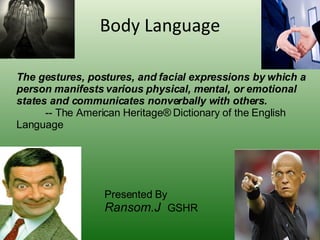
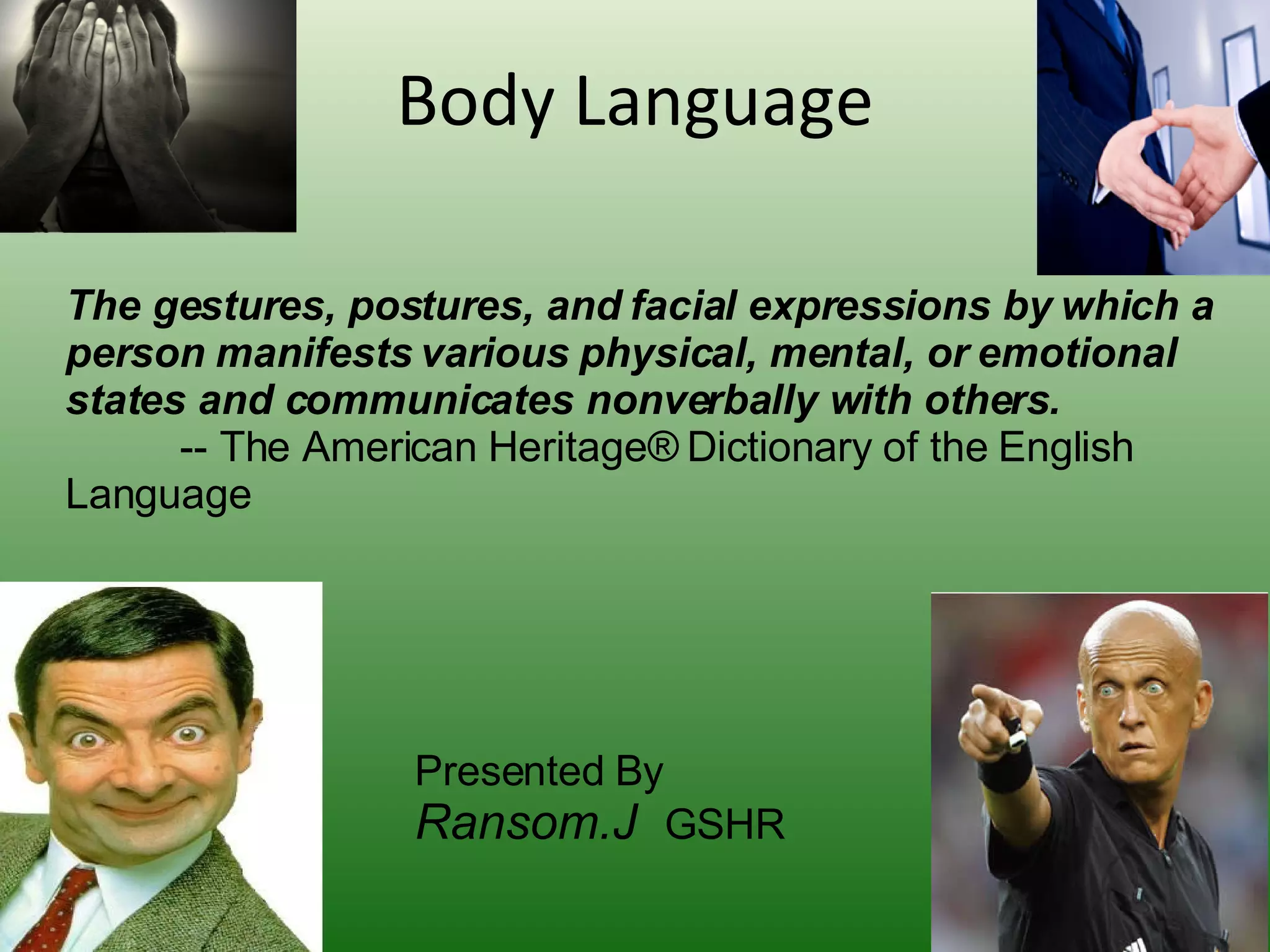
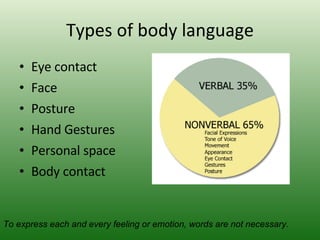
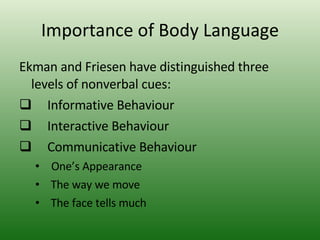
Body Language The gestures, postures, and facial expressions by which a person manifests various physical, mental, or emotional states and communicates nonverbally with others. -- The American Heritage® Dictionary of the English Language Presented By Ransom.J  GSHR
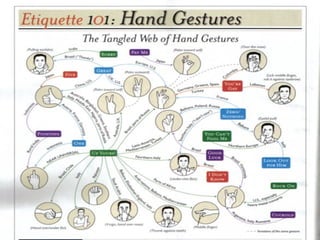
Types of body language Eye contact Face Posture Hand Gestures Personal space Body contact To express each and every feeling or emotion, words are not necessary.
Importance of Body Language Ekman and Friesen have distinguished three levels of nonverbal cues: Informative Behaviour Interactive Behaviour Communicative Behaviour One’s Appearance The way we move The face tells much
Reading Body Language How prevalent is Non verbal behaviour? Body Language in Groups Personal space as it relates to Body language Tactile communication –Its touching Nonverbal attributes Environmental Influences
Space: Distance doesn’t Lend Enchantment Intimate  Close phase (0-6”) Lovers embracing, soft whispering occurs Far phase(6”-18”) Mother-Child looking at book together; close friends discussing secret; audible whispering.  Personal  Close phase (18”-30”) Husband and wife planning a party; parent-child in friendly conversation; soft voice when indoors; full voice outdoors
Personal Far phase(30”-40”) Discussion of subjects of personal interest and involvement; social exchange over cup of coffee. Social -- Close phase 4’ – 7’ Impersonal business discussions; discussions with fellow workers on the job --Far phase 7’-12’ More formal business discussions Public --Close phase 12’-25’ voice is loud but not full volume; one person addressing a small group --Far phase 25’ or more. Public speeches before large group.
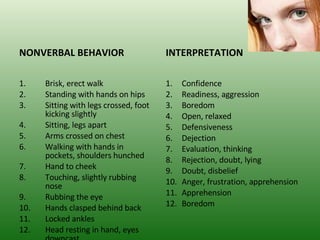
NONVERBAL BEHAVIOR Brisk, erect walk Standing with hands on hips Sitting with legs crossed, foot kicking slightly Sitting, legs apart Arms crossed on chest Walking with hands in pockets, shoulders hunched Hand to cheek Touching, slightly rubbing nose Rubbing the eye Hands clasped behind back Locked ankles Head resting in hand, eyes downcast INTERPRETATION Confidence Readiness, aggression Boredom Open, relaxed Defensiveness Dejection Evaluation, thinking Rejection, doubt, lying Doubt, disbelief Anger, frustration, apprehension Apprehension Boredom
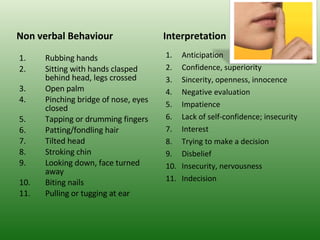
Non verbal Behaviour Rubbing hands Sitting with hands clasped behind head, legs crossed Open palm Pinching bridge of nose, eyes closed Tapping or drumming fingers Patting/fondling hair Tilted head Stroking chin Looking down, face turned away Biting nails Pulling or tugging at ear Interpretation Anticipation Confidence, superiority Sincerity, openness, innocence Negative evaluation Impatience Lack of self-confidence; insecurity Interest Trying to make a decision Disbelief Insecurity, nervousness Indecision
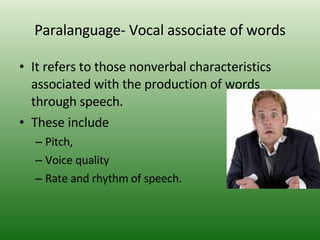
Paralanguage- Vocal associate of words It refers to those nonverbal characteristics associated with the production of words through speech. These include Pitch, Voice quality  Rate and rhythm of speech.
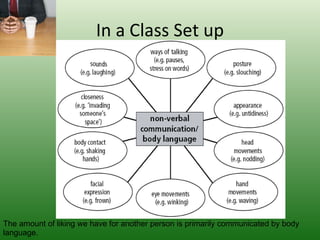
In a Class Set up The amount of liking we have for another person is primarily communicated by body language.
 
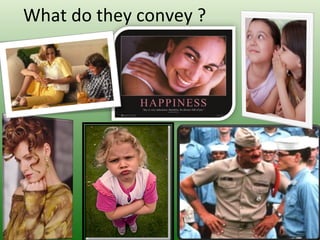
What do they convey ?
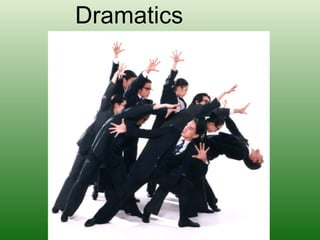
Dramatics
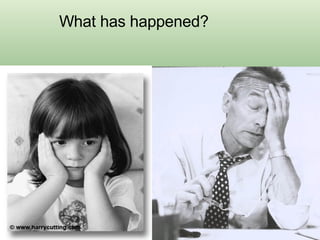
What has happened?
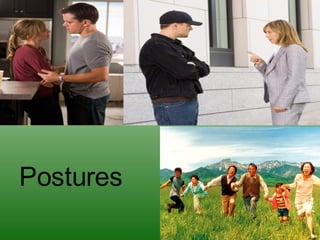
Postures
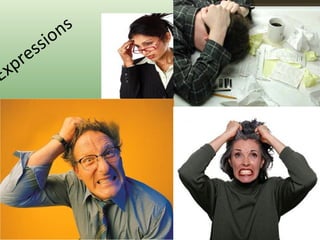
Expressions
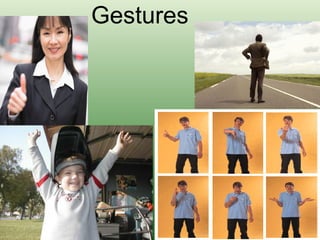
Gestures
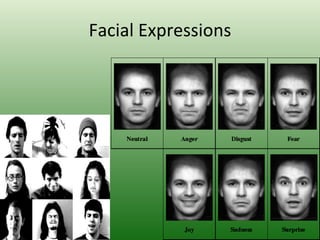
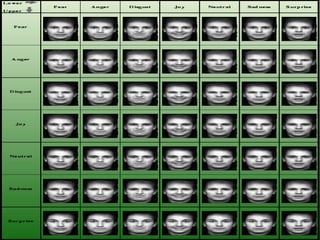
Facial Expressions
 
References William D. Brooks, Philip Emmert. Interpersonal Communications, Wm.C.Brown Company publishers. (Pages 117-143). Fast,Julius.Body language.New York:Pocket Books,1971 Mehrabian,Albert. Silent messages. Wadsworth publishing Co., 1971 Knapp,Mark L. Nonverbal Communication in Human Interaction. New York: Holt, Rinehart and Winston,1972. Search engines:  Images and Datas from Google, CUIL.com Nonverbal Communications  http://www.cultsock.ndirect.co.uk/MUHome/cshtml/index.html   Gestures: Body Language and Nonverbal Communication   http://www.csupomona.edu/~tassi/gestures.htm#gestures   About Body Language  http://www.angelfire.com/co/bodylanguage/   Body Language  http://www.rider.edu/users/suler/bodylang.html
Thank You Friends for being patient

Body Language

  • 1.
    Body Language Thegestures, postures, and facial expressions by which a person manifests various physical, mental, or emotional states and communicates nonverbally with others. -- The American Heritage® Dictionary of the English Language Presented By Ransom.J GSHR
  • 2.
    Types of bodylanguage Eye contact Face Posture Hand Gestures Personal space Body contact To express each and every feeling or emotion, words are not necessary.
  • 3.
    Importance of BodyLanguage Ekman and Friesen have distinguished three levels of nonverbal cues: Informative Behaviour Interactive Behaviour Communicative Behaviour One’s Appearance The way we move The face tells much
  • 4.
    Reading Body LanguageHow prevalent is Non verbal behaviour? Body Language in Groups Personal space as it relates to Body language Tactile communication –Its touching Nonverbal attributes Environmental Influences
  • 5.
    Space: Distance doesn’tLend Enchantment Intimate Close phase (0-6”) Lovers embracing, soft whispering occurs Far phase(6”-18”) Mother-Child looking at book together; close friends discussing secret; audible whispering. Personal Close phase (18”-30”) Husband and wife planning a party; parent-child in friendly conversation; soft voice when indoors; full voice outdoors
  • 6.
    Personal Far phase(30”-40”)Discussion of subjects of personal interest and involvement; social exchange over cup of coffee. Social -- Close phase 4’ – 7’ Impersonal business discussions; discussions with fellow workers on the job --Far phase 7’-12’ More formal business discussions Public --Close phase 12’-25’ voice is loud but not full volume; one person addressing a small group --Far phase 25’ or more. Public speeches before large group.
  • 7.
    NONVERBAL BEHAVIOR Brisk,erect walk Standing with hands on hips Sitting with legs crossed, foot kicking slightly Sitting, legs apart Arms crossed on chest Walking with hands in pockets, shoulders hunched Hand to cheek Touching, slightly rubbing nose Rubbing the eye Hands clasped behind back Locked ankles Head resting in hand, eyes downcast INTERPRETATION Confidence Readiness, aggression Boredom Open, relaxed Defensiveness Dejection Evaluation, thinking Rejection, doubt, lying Doubt, disbelief Anger, frustration, apprehension Apprehension Boredom
  • 8.
    Non verbal BehaviourRubbing hands Sitting with hands clasped behind head, legs crossed Open palm Pinching bridge of nose, eyes closed Tapping or drumming fingers Patting/fondling hair Tilted head Stroking chin Looking down, face turned away Biting nails Pulling or tugging at ear Interpretation Anticipation Confidence, superiority Sincerity, openness, innocence Negative evaluation Impatience Lack of self-confidence; insecurity Interest Trying to make a decision Disbelief Insecurity, nervousness Indecision
  • 9.
    Paralanguage- Vocal associateof words It refers to those nonverbal characteristics associated with the production of words through speech. These include Pitch, Voice quality Rate and rhythm of speech.
  • 10.
    In a ClassSet up The amount of liking we have for another person is primarily communicated by body language.
  • 11.
  • 12.
    What do theyconvey ?
  • 13.
  • 14.
  • 15.
  • 16.
  • 17.
  • 18.
  • 19.
  • 20.
    References William D.Brooks, Philip Emmert. Interpersonal Communications, Wm.C.Brown Company publishers. (Pages 117-143). Fast,Julius.Body language.New York:Pocket Books,1971 Mehrabian,Albert. Silent messages. Wadsworth publishing Co., 1971 Knapp,Mark L. Nonverbal Communication in Human Interaction. New York: Holt, Rinehart and Winston,1972. Search engines: Images and Datas from Google, CUIL.com Nonverbal Communications http://www.cultsock.ndirect.co.uk/MUHome/cshtml/index.html Gestures: Body Language and Nonverbal Communication  http://www.csupomona.edu/~tassi/gestures.htm#gestures About Body Language http://www.angelfire.com/co/bodylanguage/ Body Language http://www.rider.edu/users/suler/bodylang.html
  • 21.
    Thank You Friendsfor being patient

Editor's Notes

  • #2 We use gestures, facial expressions, smiles, and even eye contact to communicate that we like or don’t like someone. Even clothes we wear influence others, hair, kind of eye glasses we select can influence others….. Mehrabian’s formula indicates that, only 7% is communicated by words…38% is communicated by how we use our voice(rate, pitch, and volume of speech). 55% is result of facial expressions (smiles,eye contact, and frowns).