American Gestures
A lesson for Elementary Students
Gestures
• Every culture has its own unique set of
gestures and facial expression.
• Gestures and facial expressions are part
of what is called non-verbal
communication.
• Nonverbal communication is when people
do not need to talk to communicate their
ideas.
Fad Gestures
• Sometimes young people have their own
special gestures that only they and their
friends understand.
• They may use the special gesture for a
few weeks or a few years, but no one else
would understand the gesture.
Common Gestures
• Common gestures are gestures that most
people would understand. They stay the
same for many years.
• Gestures can show happiness,
encouragement, anger, sadness, boredom,
hope, and many other emotions.
• Some gestures are the same in America
and Japan.
• Some gestures mean something different
in Japan than they do in America.
Encouragement
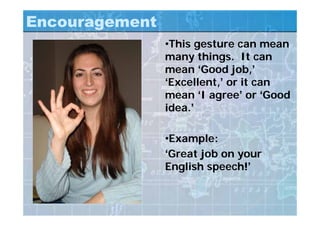
•This gesture can mean
many things. It can
mean ‘Good job,’
‘Excellent,’ or it can
mean ‘I agree’ or ‘Good
idea.’
•Example:
‘Great job on your
English speech!’
Money!
•In Japan, the sign for
money is similar to that
for encouragement in
America.
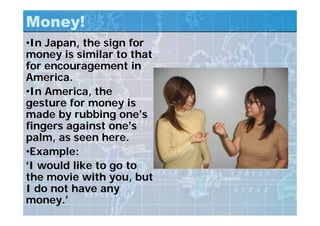
•In America, the
gesture for money is
made by rubbing one’s
fingers against one’s
palm, as seen here.
•Example:
‘I would like to go to
the movie with you, but
I do not have any
money.’
NO!
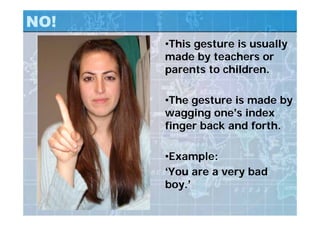
•This gesture is usually
made by teachers or
parents to children.
•The gesture is made by
wagging one’s index
finger back and forth.
•Example:
‘You are a very bad
boy.’
Polite Tea Drinking
•Tea cups in the West
are different from those
in Japan.
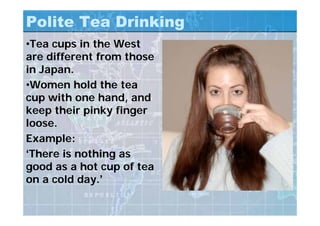
•Women hold the tea
cup with one hand, and
keep their pinky finger
loose.
Example:
‘There is nothing as
good as a hot cup of tea
on a cold day.’
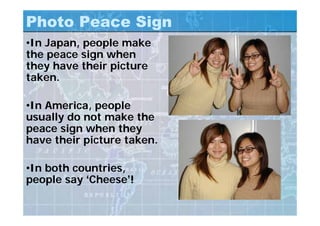
Photo Peace Sign
•In Japan, people make
the peace sign when
they have their picture
taken.
•In America, people
usually do not make the
peace sign when they
have their picture taken.
•In both countries,
people say ‘Cheese’!
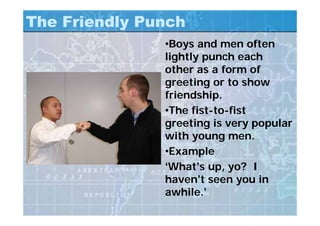
The Friendly Punch
•Boys and men often
lightly punch each
other as a form of
greeting or to show
friendship.
•The fist-to-fist
greeting is very popular
with young men.
•Example
‘What’s up, yo? I
haven’t seen you in
awhile.’
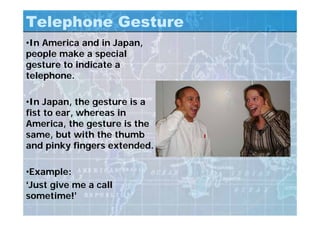
Telephone Gesture
•In America and in Japan,
people make a special
gesture to indicate a
telephone.
•In Japan, the gesture is a
fist to ear, whereas in
America, the gesture is the
same, but with the thumb
and pinky fingers extended.
•Example:
‘Just give me a call
sometime!’
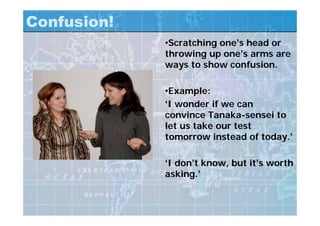
Confusion!
•Scratching one’s head or
throwing up one’s arms are
ways to show confusion.
•Example:
‘I wonder if we can
convince Tanaka-sensei to
let us take our test
tomorrow instead of today.’
‘I don’t know, but it’s worth
asking.’
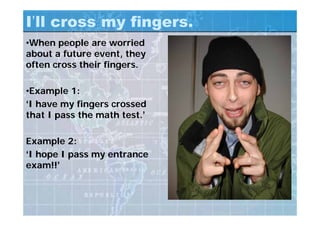
I’ll cross my fingers.
•When people are worried
about a future event, they
often cross their fingers.
•Example 1:
‘I have my fingers crossed
that I pass the math test.’
Example 2:
‘I hope I pass my entrance
exam!!’
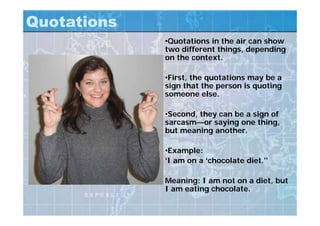
Quotations
•Quotations in the air can show
two different things, depending
on the context.
•First, the quotations may be a
sign that the person is quoting
someone else.
•Second, they can be a sign of
sarcasm—or saying one thing,
but meaning another.
•Example:
‘I am on a ‘chocolate diet.’’
Meaning: I am not on a diet, but
I am eating chocolate.
Come here!
•To say ‘Come here’ in Japan,
people often stick their hand in
front of them and make a pulling
motion with their fingers facing
down.
•In America, the gesture is the
same, but the fingers are
pointing up.
•Example:
‘Come here! I want to show you
something.’
[Note: The Japanese gesture
actually means ‘Shoo’ or ‘Go
away’ in America.]
Final Note
• Communication between people of different
cultures is sometimes difficult. However, by
watching gestures and facial expressions and
listening carefully, even the most difficult ideas
can be understood.
• However, words and gestures rarely have
completely fixed meanings. Gestures especially
are very flexible and can mean a variety of
different things.
• Having contact with people from other cultures
can help you to learn different gestures, and
how to use them in many situations.
• Learning the gestures of other cultures is fun!

American gestures

  • 1.
    American Gestures A lessonfor Elementary Students
  • 2.
    Gestures • Every culturehas its own unique set of gestures and facial expression. • Gestures and facial expressions are part of what is called non-verbal communication. • Nonverbal communication is when people do not need to talk to communicate their ideas.
  • 3.
    Fad Gestures • Sometimesyoung people have their own special gestures that only they and their friends understand. • They may use the special gesture for a few weeks or a few years, but no one else would understand the gesture.
  • 4.
    Common Gestures • Commongestures are gestures that most people would understand. They stay the same for many years. • Gestures can show happiness, encouragement, anger, sadness, boredom, hope, and many other emotions. • Some gestures are the same in America and Japan. • Some gestures mean something different in Japan than they do in America.
  • 5.
    Encouragement •This gesture canmean many things. It can mean ‘Good job,’ ‘Excellent,’ or it can mean ‘I agree’ or ‘Good idea.’ •Example: ‘Great job on your English speech!’
  • 6.
    Money! •In Japan, thesign for money is similar to that for encouragement in America. •In America, the gesture for money is made by rubbing one’s fingers against one’s palm, as seen here. •Example: ‘I would like to go to the movie with you, but I do not have any money.’
  • 7.
    NO! •This gesture isusually made by teachers or parents to children. •The gesture is made by wagging one’s index finger back and forth. •Example: ‘You are a very bad boy.’
  • 8.
    Polite Tea Drinking •Teacups in the West are different from those in Japan. •Women hold the tea cup with one hand, and keep their pinky finger loose. Example: ‘There is nothing as good as a hot cup of tea on a cold day.’
  • 9.
    Photo Peace Sign •InJapan, people make the peace sign when they have their picture taken. •In America, people usually do not make the peace sign when they have their picture taken. •In both countries, people say ‘Cheese’!
  • 10.
    The Friendly Punch •Boysand men often lightly punch each other as a form of greeting or to show friendship. •The fist-to-fist greeting is very popular with young men. •Example ‘What’s up, yo? I haven’t seen you in awhile.’
  • 11.
    Telephone Gesture •In Americaand in Japan, people make a special gesture to indicate a telephone. •In Japan, the gesture is a fist to ear, whereas in America, the gesture is the same, but with the thumb and pinky fingers extended. •Example: ‘Just give me a call sometime!’
  • 12.
    Confusion! •Scratching one’s heador throwing up one’s arms are ways to show confusion. •Example: ‘I wonder if we can convince Tanaka-sensei to let us take our test tomorrow instead of today.’ ‘I don’t know, but it’s worth asking.’
  • 13.
    I’ll cross myfingers. •When people are worried about a future event, they often cross their fingers. •Example 1: ‘I have my fingers crossed that I pass the math test.’ Example 2: ‘I hope I pass my entrance exam!!’
  • 14.
    Quotations •Quotations in theair can show two different things, depending on the context. •First, the quotations may be a sign that the person is quoting someone else. •Second, they can be a sign of sarcasm—or saying one thing, but meaning another. •Example: ‘I am on a ‘chocolate diet.’’ Meaning: I am not on a diet, but I am eating chocolate.
  • 15.
    Come here! •To say‘Come here’ in Japan, people often stick their hand in front of them and make a pulling motion with their fingers facing down. •In America, the gesture is the same, but the fingers are pointing up. •Example: ‘Come here! I want to show you something.’ [Note: The Japanese gesture actually means ‘Shoo’ or ‘Go away’ in America.]
  • 16.
    Final Note • Communicationbetween people of different cultures is sometimes difficult. However, by watching gestures and facial expressions and listening carefully, even the most difficult ideas can be understood. • However, words and gestures rarely have completely fixed meanings. Gestures especially are very flexible and can mean a variety of different things. • Having contact with people from other cultures can help you to learn different gestures, and how to use them in many situations. • Learning the gestures of other cultures is fun!