Spoken Communication: A Vital Tool for
Effective Interaction
Dr. Nirmala S.Padmavat
Director,
IQAC
Nutan Mahavidyalaya Selu
Spoken Communication: A
Vital Tool for Effective
Interaction
Spoken communication is a fundamental aspect of human interaction, encompassing the
verbal exchange of information through spoken words. It forms the basis of our daily
conversations, professional interactions, and public speaking engagements, making it crucial
for effective interpersonal and organizational functioning. Through spoken communication,
individuals can articulate thoughts, express emotions, and convey complex ideas with
immediacy and nuance. This dynamic form of communication allows for real-time feedback,
adaptation of messages, and the building of relationships, while also playing a pivotal role in
persuasion, conflict resolution, and cultural exchange. Mastering spoken communication
enhances clarity, fosters understanding, and facilitates successful interactions in various
contexts.
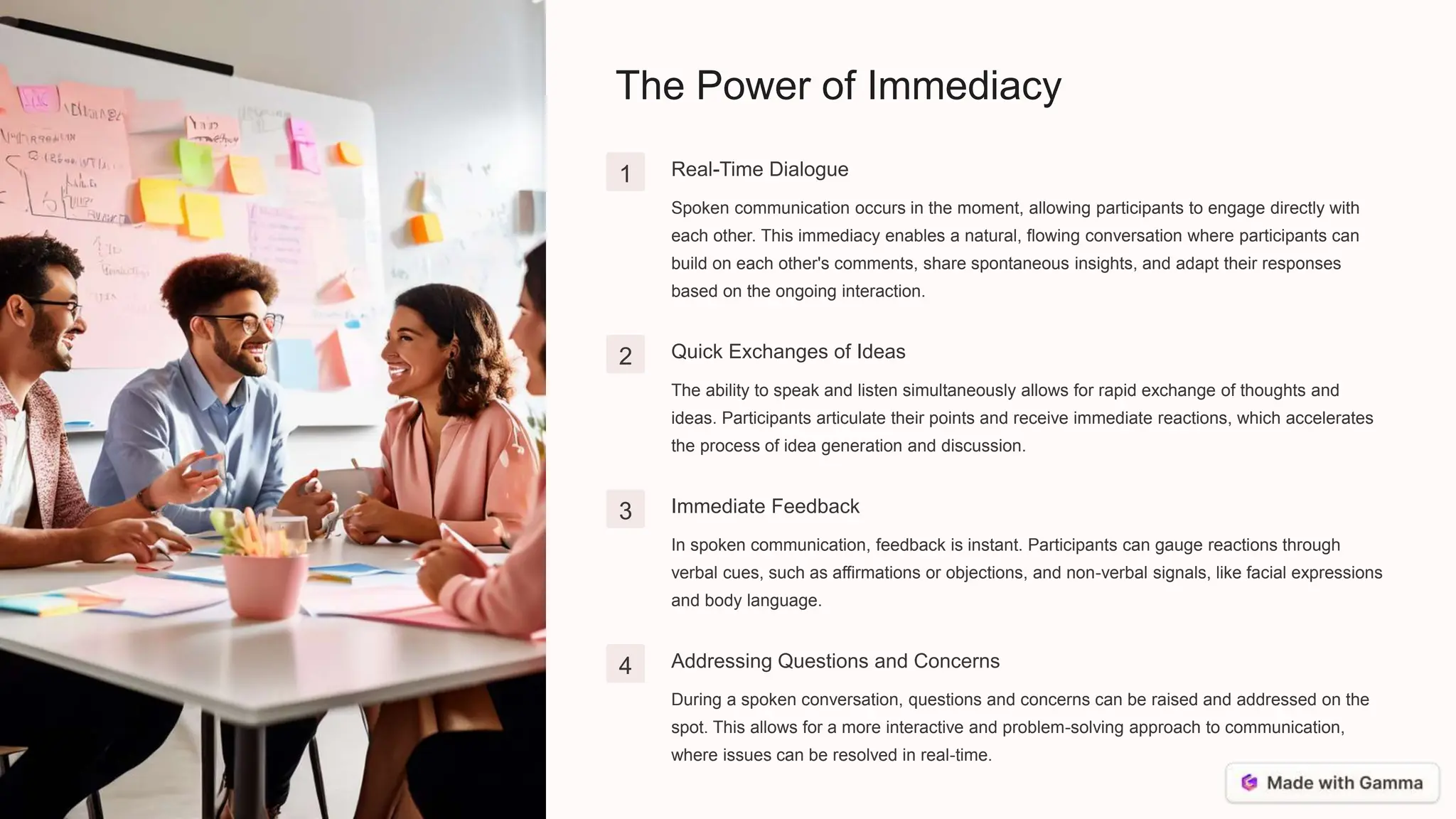
The Power of Immediacy
1 Real-Time Dialogue
Spoken communication occurs in the moment, allowing participants to engage directly with
each other. This immediacy enables a natural, flowing conversation where participants can
build on each other's comments, share spontaneous insights, and adapt their responses
based on the ongoing interaction.
2 Quick Exchanges of Ideas
The ability to speak and listen simultaneously allows for rapid exchange of thoughts and
ideas. Participants articulate their points and receive immediate reactions, which accelerates
the process of idea generation and discussion.
3 Immediate Feedback
In spoken communication, feedback is instant. Participants can gauge reactions through
verbal cues, such as affirmations or objections, and non-verbal signals, like facial expressions
and body language.
4 Addressing Questions and Concerns
During a spoken conversation, questions and concerns can be raised and addressed on the
spot. This allows for a more interactive and problem-solving approach to communication,
where issues can be resolved in real-time.
Building Relationships Through Spoken
Communication
Expression of Emotions
Spoken communication provides a unique opportunity to express emotions in a way that written
or non-verbal methods cannot fully replicate. The tone, pitch, and cadence of one’s voice convey
a range of feelings, from enthusiasm and empathy to frustration and concern.
Building Rapport
Building rapport is a fundamental aspect of establishing relationships, and spoken
communication is central to this process. Through verbal exchanges, individuals can find
common ground, share personal stories, and engage in mutual interests.
Fostering Trust
Trust is a critical component of any strong relationship, and spoken communication plays a key
role in developing and maintaining it. Trust is built through consistent and transparent
communication, where individuals demonstrate reliability, honesty, and integrity.
Clarification and Adaptation in Spoken
Communication
Real-Time Clarification
One of the key benefits of spoken communication is the ability to clarify points
instantly. During a conversation, participants can ask questions, request elaboration,
and seek further explanation as needed.
Immediate Feedback and Adaptation
Spoken communication allows for immediate feedback from the audience, which is
crucial for adapting the message effectively. Participants can gauge reactions through
verbal cues, such as questions or comments, as well as non-verbal signals, such as
facial expressions or body language.
Addressing Misunderstandings
Misunderstandings arise during conversations, but spoken communication facilitates
the swift resolution of these issues. When participants recognize that their message
has been misinterpreted or that there is a lack of understanding, they can immediately
address and correct these problems.
The Power of Persuasion in Spoken
Communication
Well-Articulated Arguments
At the core of persuasive spoken
communication is the ability to
present clear, logical, and well-
structured arguments.
Articulating your points with
precision helps to build credibility
and convince the audience of the
validity of your perspective.
Enthusiastic Delivery
The manner in which a message
is delivered can significantly
impact its persuasive power.
Enthusiasm and energy in
spoken communication can
engage the audience, make the
message more compelling, and
foster a sense of urgency or
excitement.
Effective Rhetoric
Rhetorical techniques, such as
the use of persuasive language,
rhetorical questions, and
analogies, play a crucial role in
influencing opinions through
spoken communication. Effective
rhetoric can enhance the
emotional appeal of your
message, make complex ideas
more accessible, and create a
memorable impact.
Resolving Conflicts Through Spoken
Communication
Direct Discussion of Issues Spoken communication enables parties to
address conflicts head-on through face-to-
face or verbal interactions.
Negotiating Solutions The immediacy of spoken communication
facilitates dynamic negotiation and problem-
solving.
Immediate Clarification and Feedback Spoken communication provides the
opportunity for immediate clarification and
feedback, which is crucial for resolving
misunderstandings and misinterpretations.
Building Empathy and Understanding Direct verbal interactions allow for the
expression of empathy and emotional
understanding, which are essential for
effective conflict resolution.
Cultural and Social Interaction Through
Spoken Communication
Engaging in Cultural Exchanges
Spoken communication allows individuals to actively participate in cultural exchanges, where they
can share and learn about different traditions, beliefs, and customs.
Participation in Social Activities
Effective spoken communication is essential for engaging in social activities and forming connections
within a community.
Understanding Social Norms and Practices
Spoken communication is crucial for understanding and adapting to social norms and practices within
different communities.
Spoken Communication and Professional
Success
1
Effective Leadership
Strong spoken communication is
fundamental to effective leadership.
Leaders rely on clear and articulate
speech to convey vision, set expectations,
and motivate their teams.
2 Successful Teamwork
In collaborative work settings, clear spoken
communication is crucial for successful
teamwork. It facilitates seamless
coordination, ensures that team members
understand their roles and responsibilities,
and helps resolve conflicts promptly.
3
Client Relations
Building and maintaining strong client
relationships relies heavily on effective
spoken communication. Professionals
must articulate their services, address
client needs, and negotiate agreements
with precision and professionalism.
4 Presenting Ideas and Delivering
Presentations
Articulate spoken communication is crucial
for presenting ideas and delivering
presentations. Professionals often need to
share complex information, persuade
audiences, and convey their messages
effectively.
5
Engaging with Stakeholders
Effective spoken communication is vital for
engaging with various stakeholders,
including colleagues, clients, and partners.

Spoken Communication: A Vital Tool for Effective Interaction

  • 1.
    Spoken Communication: AVital Tool for Effective Interaction Dr. Nirmala S.Padmavat Director, IQAC Nutan Mahavidyalaya Selu
  • 2.
    Spoken Communication: A VitalTool for Effective Interaction Spoken communication is a fundamental aspect of human interaction, encompassing the verbal exchange of information through spoken words. It forms the basis of our daily conversations, professional interactions, and public speaking engagements, making it crucial for effective interpersonal and organizational functioning. Through spoken communication, individuals can articulate thoughts, express emotions, and convey complex ideas with immediacy and nuance. This dynamic form of communication allows for real-time feedback, adaptation of messages, and the building of relationships, while also playing a pivotal role in persuasion, conflict resolution, and cultural exchange. Mastering spoken communication enhances clarity, fosters understanding, and facilitates successful interactions in various contexts.
  • 3.
    The Power ofImmediacy 1 Real-Time Dialogue Spoken communication occurs in the moment, allowing participants to engage directly with each other. This immediacy enables a natural, flowing conversation where participants can build on each other's comments, share spontaneous insights, and adapt their responses based on the ongoing interaction. 2 Quick Exchanges of Ideas The ability to speak and listen simultaneously allows for rapid exchange of thoughts and ideas. Participants articulate their points and receive immediate reactions, which accelerates the process of idea generation and discussion. 3 Immediate Feedback In spoken communication, feedback is instant. Participants can gauge reactions through verbal cues, such as affirmations or objections, and non-verbal signals, like facial expressions and body language. 4 Addressing Questions and Concerns During a spoken conversation, questions and concerns can be raised and addressed on the spot. This allows for a more interactive and problem-solving approach to communication, where issues can be resolved in real-time.
  • 4.
    Building Relationships ThroughSpoken Communication Expression of Emotions Spoken communication provides a unique opportunity to express emotions in a way that written or non-verbal methods cannot fully replicate. The tone, pitch, and cadence of one’s voice convey a range of feelings, from enthusiasm and empathy to frustration and concern. Building Rapport Building rapport is a fundamental aspect of establishing relationships, and spoken communication is central to this process. Through verbal exchanges, individuals can find common ground, share personal stories, and engage in mutual interests. Fostering Trust Trust is a critical component of any strong relationship, and spoken communication plays a key role in developing and maintaining it. Trust is built through consistent and transparent communication, where individuals demonstrate reliability, honesty, and integrity.
  • 5.
    Clarification and Adaptationin Spoken Communication Real-Time Clarification One of the key benefits of spoken communication is the ability to clarify points instantly. During a conversation, participants can ask questions, request elaboration, and seek further explanation as needed. Immediate Feedback and Adaptation Spoken communication allows for immediate feedback from the audience, which is crucial for adapting the message effectively. Participants can gauge reactions through verbal cues, such as questions or comments, as well as non-verbal signals, such as facial expressions or body language. Addressing Misunderstandings Misunderstandings arise during conversations, but spoken communication facilitates the swift resolution of these issues. When participants recognize that their message has been misinterpreted or that there is a lack of understanding, they can immediately address and correct these problems.
  • 6.
    The Power ofPersuasion in Spoken Communication Well-Articulated Arguments At the core of persuasive spoken communication is the ability to present clear, logical, and well- structured arguments. Articulating your points with precision helps to build credibility and convince the audience of the validity of your perspective. Enthusiastic Delivery The manner in which a message is delivered can significantly impact its persuasive power. Enthusiasm and energy in spoken communication can engage the audience, make the message more compelling, and foster a sense of urgency or excitement. Effective Rhetoric Rhetorical techniques, such as the use of persuasive language, rhetorical questions, and analogies, play a crucial role in influencing opinions through spoken communication. Effective rhetoric can enhance the emotional appeal of your message, make complex ideas more accessible, and create a memorable impact.
  • 7.
    Resolving Conflicts ThroughSpoken Communication Direct Discussion of Issues Spoken communication enables parties to address conflicts head-on through face-to- face or verbal interactions. Negotiating Solutions The immediacy of spoken communication facilitates dynamic negotiation and problem- solving. Immediate Clarification and Feedback Spoken communication provides the opportunity for immediate clarification and feedback, which is crucial for resolving misunderstandings and misinterpretations. Building Empathy and Understanding Direct verbal interactions allow for the expression of empathy and emotional understanding, which are essential for effective conflict resolution.
  • 8.
    Cultural and SocialInteraction Through Spoken Communication Engaging in Cultural Exchanges Spoken communication allows individuals to actively participate in cultural exchanges, where they can share and learn about different traditions, beliefs, and customs. Participation in Social Activities Effective spoken communication is essential for engaging in social activities and forming connections within a community. Understanding Social Norms and Practices Spoken communication is crucial for understanding and adapting to social norms and practices within different communities.
  • 9.
    Spoken Communication andProfessional Success 1 Effective Leadership Strong spoken communication is fundamental to effective leadership. Leaders rely on clear and articulate speech to convey vision, set expectations, and motivate their teams. 2 Successful Teamwork In collaborative work settings, clear spoken communication is crucial for successful teamwork. It facilitates seamless coordination, ensures that team members understand their roles and responsibilities, and helps resolve conflicts promptly. 3 Client Relations Building and maintaining strong client relationships relies heavily on effective spoken communication. Professionals must articulate their services, address client needs, and negotiate agreements with precision and professionalism. 4 Presenting Ideas and Delivering Presentations Articulate spoken communication is crucial for presenting ideas and delivering presentations. Professionals often need to share complex information, persuade audiences, and convey their messages effectively. 5 Engaging with Stakeholders Effective spoken communication is vital for engaging with various stakeholders, including colleagues, clients, and partners.