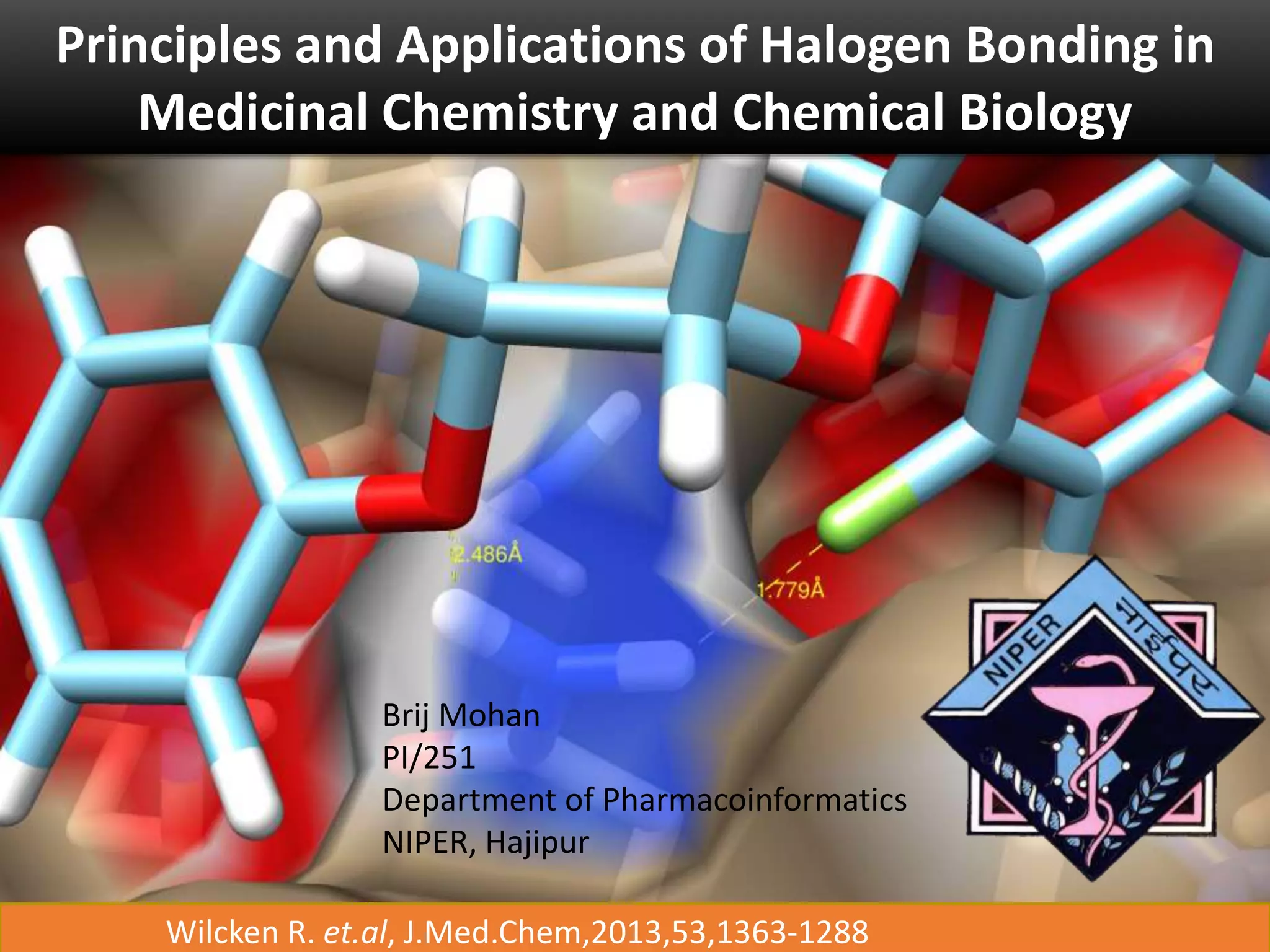
Principles and Applications of Halogen Bonding in
Medicinal Chemistry and Chemical Biology
Brij Mohan
PI/251
Department of Pharmacoinformatics
NIPER, Hajipur
Wilcken R. et.al, J.Med.Chem,2013,53,1363-1288
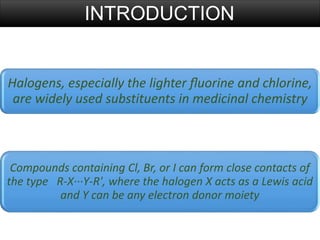
Halogens, especially the lighter fluorine and chlorine,
are widely used substituents in medicinal chemistry
INTRODUCTION
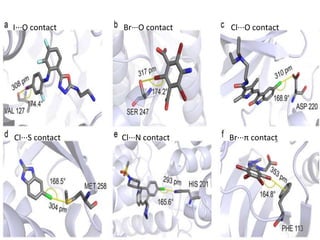
Compounds containing Cl, Br, or I can form close contacts of
the type R-X···Y-R', where the halogen X acts as a Lewis acid
and Y can be any electron donor moiety
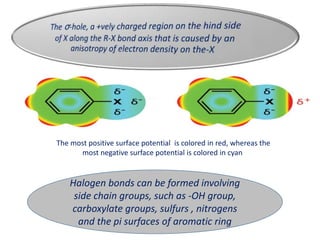
The most positive surface potential is colored in red, whereas the
most negative surface potential is colored in cyan
Halogen bonds can be formed involving
side chain groups, such as -OH group,
carboxylate groups, sulfurs , nitrogens
and the pi surfaces of aromatic ring
I···O contact Br···O contact Cl···O contact
Cl···S contact Cl···N contact Br···π contact
DRIVING FORCE OF HALOGEN
BONDING
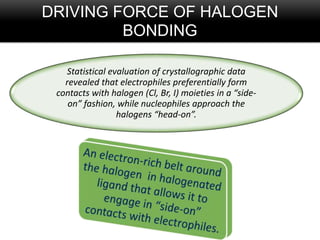
Statistical evaluation of crystallographic data
revealed that electrophiles preferentially form
contacts with halogen (Cl, Br, I) moieties in a “side-
on” fashion, while nucleophiles approach the
halogens “head-on”.
STRENGTH OF LIGAND-PROTEIN HALOGEN
BONDS
The strengths of halogen bonds can be evaluated theoretically through
quantum chemical model calculations
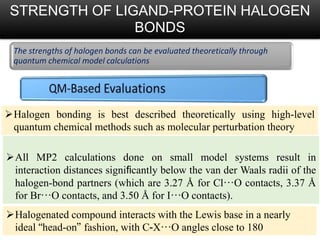
Halogen bonding is best described theoretically using high-level
quantum chemical methods such as molecular perturbation theory
All MP2 calculations done on small model systems result in
interaction distances significantly below the van der Waals radii of the
halogen-bond partners (which are 3.27 Å for Cl···O contacts, 3.37 Å
for Br···O contacts, and 3.50 Å for I···O contacts).
Halogenated compound interacts with the Lewis base in a nearly
ideal “head-on” fashion, with C-X···O angles close to 180
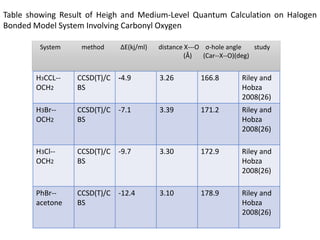
H3CCL--
OCH2
CCSD(T)/C
BS
-4.9 3.26 166.8 Riley and
Hobza
2008(26)
H3Br--
OCH2
CCSD(T)/C
BS
-7.1 3.39 171.2 Riley and
Hobza
2008(26)
H3Cl--
OCH2
CCSD(T)/C
BS
-9.7 3.30 172.9 Riley and
Hobza
2008(26)
PhBr--
acetone
CCSD(T)/C
BS
-12.4 3.10 178.9 Riley and
Hobza
2008(26)
System method ∆E(kj/ml) distance X---O σ-hole angle study
(Å) (Car--X--O)(deg)
Table showing Result of Heigh and Medium-Level Quantum Calculation on Halogen
Bonded Model System Involving Carbonyl Oxygen
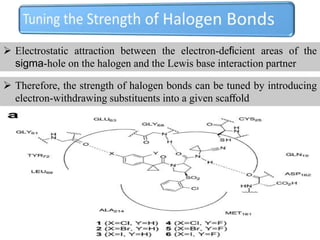
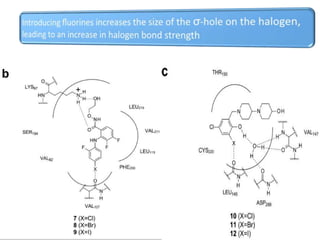
 Electrostatic attraction between the electron-deficient areas of the
sigma-hole on the halogen and the Lewis base interaction partner
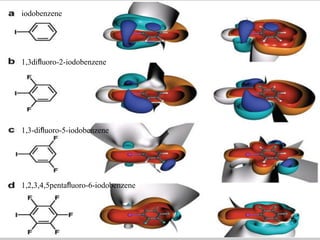
 Therefore, the strength of halogen bonds can be tuned by introducing
electron-withdrawing substituents into a given scaffold
iodobenzene
1,3difluoro-2-iodobenzene
1,3-difluoro-5-iodobenzene
1,2,3,4,5pentafluoro-6-iodobenzene
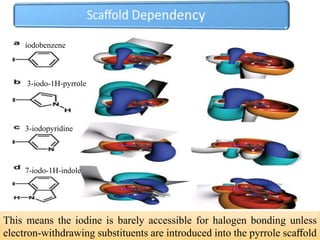
This means the iodine is barely accessible for halogen bonding unless
electron-withdrawing substituents are introduced into the pyrrole scaffold
iodobenzene
3-iodo-1H-pyrrole
3-iodopyridine
7-iodo-1H-indole
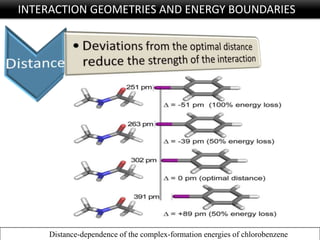
INTERACTION GEOMETRIES AND ENERGY BOUNDARIES
Distance-dependence of the complex-formation energies of chlorobenzene
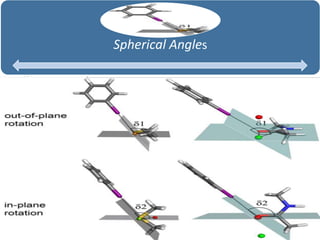
σ-Hole angle dependence of the complex-formation energies[kJ/mol] of the backbone model
system N-methylacetamide & (C6H5 Cl, green curve),(C6H5 Br,brown curve), or (C6H5I, purple
curve)
Spherical Angles
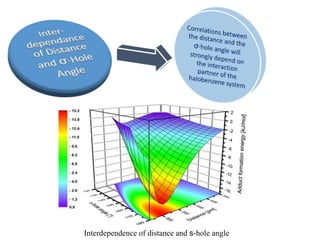
Interdependence of distance and s-hole angle
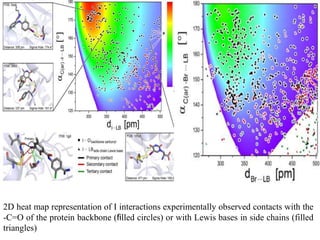
2D heat map representation of I interactions experimentally observed contacts with the
-C=O of the protein backbone (filled circles) or with Lewis bases in side chains (filled
triangles)
There are numerous examples where halogen bonding has been
successfully used in drug discovery in recent years, targeting a
diverse set of medicinally relevant proteins
Br--O--X bonds were found to increase the efficacy of agonists of the a4ß2 subtype of
the nicotinic acetylcholine receptor and of inhibitors of the hepatitis C virus NS3-NS4A
protease
Improved the potency of different classes of HIV reverse transcriptase inhibitors
Binding affinities of two classes of inhibitors of human cathepsin L and MEK1 kinase
are improved when a particular aryl ring is substituted with the heavier halogens Cl,
Br, and I
As we know I--O distance is 3.1 Å, much shorter than the sum of the van der Waals
radii of both atoms
In MEK1 kinase cocrystal structure, the I--O distance is longer with 3.6 Å, which has
been attributed to strong interactions by other parts of the ligand preventing optimal
I--O interaction
In cathepsin L, the X-binding
site is in a polar environment
at the surface of the
enzyme.While in MEK1 kinase
is buried within the enzyme
and has a hydrophobic
character. Hence, formation
of favorable halogen bonds is
not restricted by the overall
polarity of potential binding
sites
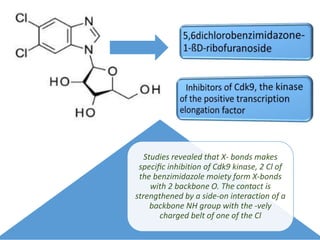
Studies revealed that X- bonds makes
specific inhibition of Cdk9 kinase, 2 Cl of
the benzimidazole moiety form X-bonds
with 2 backbone O. The contact is
strengthened by a side-on interaction of a
backbone NH group with the -vely
charged belt of one of the Cl
Nature of halogen bonding takes place
between receptor protein and halogenated
ligand approaches binding site and the main
criteria to be considered importanat for that
In this Perspective,
we have analyzed the
nature of halogen
bonding
Halogen bonding
can be weak to
strong depending
upon the our
practical aspect as
we have already
seen
In drug design halogen
bonding consideration
will be very
beneficial,and will help
a lot in designing new
molecule
Halogen bonding

Halogen bonding

  • 1.
    Principles and Applicationsof Halogen Bonding in Medicinal Chemistry and Chemical Biology Brij Mohan PI/251 Department of Pharmacoinformatics NIPER, Hajipur Wilcken R. et.al, J.Med.Chem,2013,53,1363-1288
  • 2.
    Halogens, especially thelighter fluorine and chlorine, are widely used substituents in medicinal chemistry INTRODUCTION Compounds containing Cl, Br, or I can form close contacts of the type R-X···Y-R', where the halogen X acts as a Lewis acid and Y can be any electron donor moiety
  • 3.
    The most positivesurface potential is colored in red, whereas the most negative surface potential is colored in cyan Halogen bonds can be formed involving side chain groups, such as -OH group, carboxylate groups, sulfurs , nitrogens and the pi surfaces of aromatic ring
  • 4.
    I···O contact Br···Ocontact Cl···O contact Cl···S contact Cl···N contact Br···π contact
  • 5.
    DRIVING FORCE OFHALOGEN BONDING Statistical evaluation of crystallographic data revealed that electrophiles preferentially form contacts with halogen (Cl, Br, I) moieties in a “side- on” fashion, while nucleophiles approach the halogens “head-on”.
  • 6.
    STRENGTH OF LIGAND-PROTEINHALOGEN BONDS The strengths of halogen bonds can be evaluated theoretically through quantum chemical model calculations Halogen bonding is best described theoretically using high-level quantum chemical methods such as molecular perturbation theory All MP2 calculations done on small model systems result in interaction distances significantly below the van der Waals radii of the halogen-bond partners (which are 3.27 Å for Cl···O contacts, 3.37 Å for Br···O contacts, and 3.50 Å for I···O contacts). Halogenated compound interacts with the Lewis base in a nearly ideal “head-on” fashion, with C-X···O angles close to 180
  • 7.
    H3CCL-- OCH2 CCSD(T)/C BS -4.9 3.26 166.8Riley and Hobza 2008(26) H3Br-- OCH2 CCSD(T)/C BS -7.1 3.39 171.2 Riley and Hobza 2008(26) H3Cl-- OCH2 CCSD(T)/C BS -9.7 3.30 172.9 Riley and Hobza 2008(26) PhBr-- acetone CCSD(T)/C BS -12.4 3.10 178.9 Riley and Hobza 2008(26) System method ∆E(kj/ml) distance X---O σ-hole angle study (Å) (Car--X--O)(deg) Table showing Result of Heigh and Medium-Level Quantum Calculation on Halogen Bonded Model System Involving Carbonyl Oxygen
  • 8.
     Electrostatic attractionbetween the electron-deficient areas of the sigma-hole on the halogen and the Lewis base interaction partner  Therefore, the strength of halogen bonds can be tuned by introducing electron-withdrawing substituents into a given scaffold
  • 10.
  • 11.
    This means theiodine is barely accessible for halogen bonding unless electron-withdrawing substituents are introduced into the pyrrole scaffold iodobenzene 3-iodo-1H-pyrrole 3-iodopyridine 7-iodo-1H-indole
  • 12.
    INTERACTION GEOMETRIES ANDENERGY BOUNDARIES Distance-dependence of the complex-formation energies of chlorobenzene
  • 13.
    σ-Hole angle dependenceof the complex-formation energies[kJ/mol] of the backbone model system N-methylacetamide & (C6H5 Cl, green curve),(C6H5 Br,brown curve), or (C6H5I, purple curve)
  • 14.
  • 15.
  • 16.
    2D heat maprepresentation of I interactions experimentally observed contacts with the -C=O of the protein backbone (filled circles) or with Lewis bases in side chains (filled triangles)
  • 17.
    There are numerousexamples where halogen bonding has been successfully used in drug discovery in recent years, targeting a diverse set of medicinally relevant proteins Br--O--X bonds were found to increase the efficacy of agonists of the a4ß2 subtype of the nicotinic acetylcholine receptor and of inhibitors of the hepatitis C virus NS3-NS4A protease Improved the potency of different classes of HIV reverse transcriptase inhibitors Binding affinities of two classes of inhibitors of human cathepsin L and MEK1 kinase are improved when a particular aryl ring is substituted with the heavier halogens Cl, Br, and I As we know I--O distance is 3.1 Å, much shorter than the sum of the van der Waals radii of both atoms In MEK1 kinase cocrystal structure, the I--O distance is longer with 3.6 Å, which has been attributed to strong interactions by other parts of the ligand preventing optimal I--O interaction
  • 18.
    In cathepsin L,the X-binding site is in a polar environment at the surface of the enzyme.While in MEK1 kinase is buried within the enzyme and has a hydrophobic character. Hence, formation of favorable halogen bonds is not restricted by the overall polarity of potential binding sites
  • 19.
    Studies revealed thatX- bonds makes specific inhibition of Cdk9 kinase, 2 Cl of the benzimidazole moiety form X-bonds with 2 backbone O. The contact is strengthened by a side-on interaction of a backbone NH group with the -vely charged belt of one of the Cl
  • 20.
    Nature of halogenbonding takes place between receptor protein and halogenated ligand approaches binding site and the main criteria to be considered importanat for that In this Perspective, we have analyzed the nature of halogen bonding Halogen bonding can be weak to strong depending upon the our practical aspect as we have already seen In drug design halogen bonding consideration will be very beneficial,and will help a lot in designing new molecule