WWW.HACKYALE.COM
NLP IN PYTHON
MANIPULATING TEXT
WEEK 0
NLP IN PYTHON
COURSE
INTRODUCTION
NATURAL LANGUAGE PROCESSING
Programs that:
“Understand” human speech or text
Mainly statistical
Natural vs. artificial languages
Programming languages are unambiguous
Human speech, not so much
YOU’LL LEARN
Text processing
Tokenization, stemming, built-in text corpora
Brown, Reuters, WordNet, make your own!
Text classification
Naive Bayes inference, n-gram language models, sentence
parsing, etc.
Classify by topic (Reuters) or by sentiment (imdb)
YOU’LL LEARN
Evaluating your models
F-scores, MaxEnt, selecting appropriate training and testing
sets
Applications, MOOCs, and books for further study
SOURCES
Natural Language Processing with Python, by
Steven Bird, Ewan Klein, and Edward Loper.
O'Reilly Media, 978-0-596-51649-9.
MOOC: Natural Language Processing with Dan
Jurafsky and Christopher Manning (Stanford,
Coursera)
APPLICATIONS
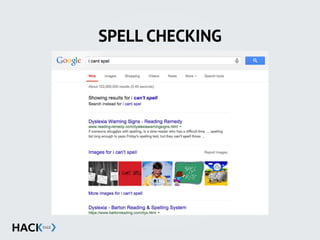
SPELL CHECKING
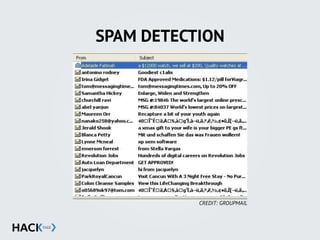
CREDIT: GROUPMAIL
SPAM DETECTION
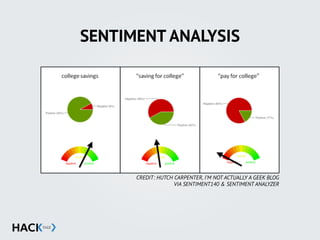
CREDIT: HUTCH CARPENTER, I’M NOT ACTUALLY A GEEK BLOG
VIA SENTIMENT140 & SENTIMENT ANALYZER
SENTIMENT ANALYSIS
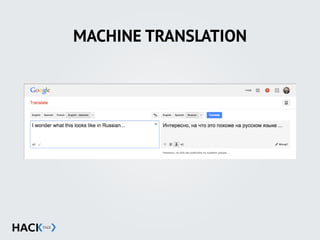
MACHINE TRANSLATION
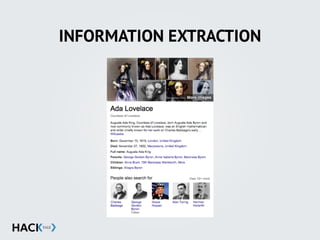
INFORMATION EXTRACTION
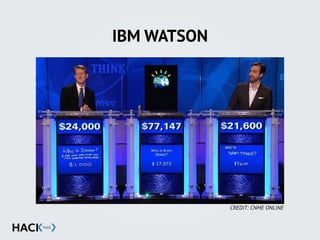
IBM WATSON
CREDIT: CNME ONLINE
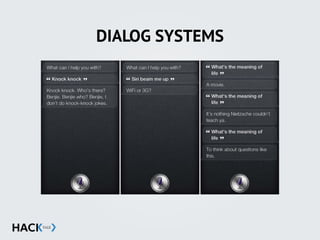
DIALOG SYSTEMS
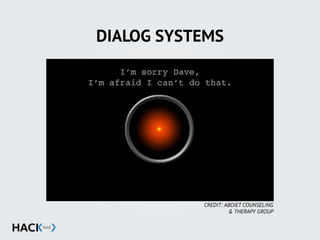
DIALOG SYSTEMS
CREDIT: ABOIET COUNSELING
& THERAPY GROUP
ELIMINATE ALL HUMANS
CREDIT: TERMINATOR FRANCHISE &
OUR FUTURE ROBOT OVERLORDS
GETTING
STARTED
WHY PYTHON?
String processing methods
Excellent statistical libraries
Pandas, numpy, etc.
Natural Language Toolkit
Created in 2002
> 50 text resources
ALTERNATIVES
Java
StanfordNLP, mallet, OpenNLP
Ruby
Treat, open-nlp
STRING MANIPULATION
string'='“This'is'a'great'sentence.”'
string'='string.split()'
string[:4]'
=>'[“This”,'“is”,'“a”,'“great”]'
string[;1:]'
=>'“sentence.”'
string[::;1]'
=>'[“sentence.”,'“great”,'“a”,'“is”,'“This”]'
FILE I/O
f'='open(‘sample.txt’,'‘r’)'
for'line'in'f:

' line'='line.split()'
' for'word'in'line:

' ' if'word'[;2:]'=='‘ly’:'
' ' ' print'word
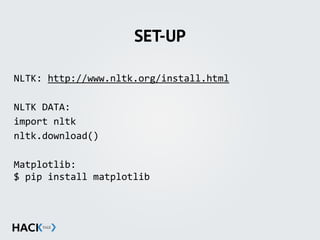
SET-UP
NLTK:'http://www.nltk.org/install.html'
NLTK'DATA:'
import'nltk'
nltk.download()'
Matplotlib:

$'pip'install'matplotlib'
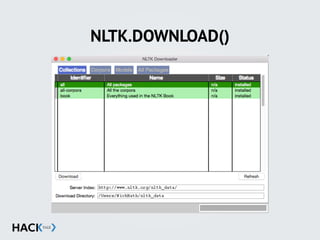
NLTK.DOWNLOAD()
WEEK 0
nltk.corpus
nltk.tokenize
nltk.chat
WHAT IS A
CORPUS?
TEXT CORPORA
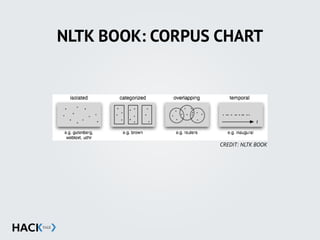
Large body of text
Some are general (Brown), others are domain specific
(nps_chat)
Some are tagged (Brown), others are raw
Some have very specific uses (movie_reviews - sentiment
analysis)
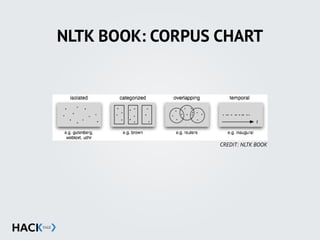
NLTK BOOK: CORPUS CHART
CREDIT: NLTK BOOK
BUILT-IN CORPORA
Sentences:

[“I”, “hate”, “cats”, “.”]
Paragraphs:
[[“I”, “hate”, “cats”, “.”], [“Dogs”, “are”, “worse”, “.”]]
Entire file:
List of paragraphs, which are lists of sentences
MANIPULATING
CORPORA
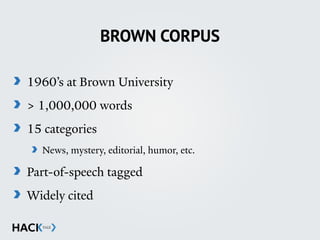
BROWN CORPUS
1960’s at Brown University
> 1,000,000 words
15 categories
News, mystery, editorial, humor, etc.
Part-of-speech tagged
Widely cited
NAVIGATING CORPORA
from'nltk.corpus'import'brown'
brown.categories()'
len(brown.categories())'#'num'categories'
brown.words(categories=[‘news’,'‘editorial’])'
brown.sents()'
brown.paras()'
brown.fileids()'
brown.words(fileids=[‘cr01’])'
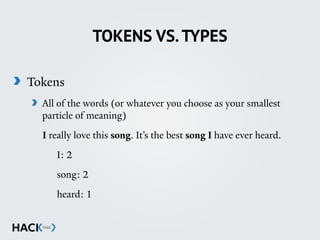
TOKENS VS.TYPES
Tokens
All of the words (or whatever you choose as your smallest
particle of meaning)
I really love this song. It’s the best song I have ever heard.
I: 2
song: 2
heard: 1
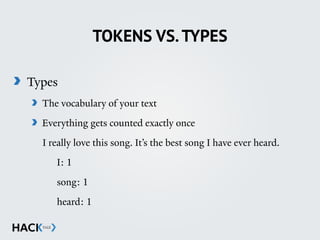
TOKENS VS.TYPES
Types
The vocabulary of your text
Everything gets counted exactly once
I really love this song. It’s the best song I have ever heard.
I: 1
song: 1
heard: 1
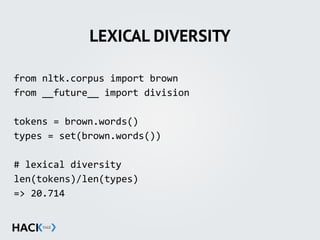
LEXICAL DIVERSITY
from'nltk.corpus'import'brown'
from'__future__'import'division'
tokens'='brown.words()'
types'='set(brown.words())'
#'lexical'diversity'
len(tokens)/len(types)'
=>'20.714'
'
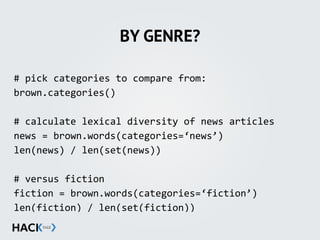
BY GENRE?
#'pick'categories'to'compare'from:'
brown.categories()'
#'calculate'lexical'diversity'of'news'articles'
news'='brown.words(categories=‘news’)'
len(news)'/'len(set(news))'
#'versus'fiction'
fiction'='brown.words(categories=‘fiction’)'
len(fiction)'/'len(set(fiction))'
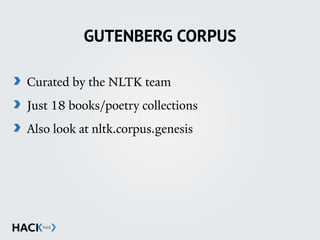
GUTENBERG CORPUS
Curated by the NLTK team
Just 18 books/poetry collections
Also look at nltk.corpus.genesis
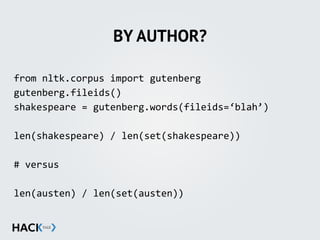
BY AUTHOR?
from'nltk.corpus'import'gutenberg'
gutenberg.fileids()'
shakespeare'='gutenberg.words(fileids=‘blah’)'
len(shakespeare)'/'len(set(shakespeare))'
#'versus''
len(austen)'/'len(set(austen))'
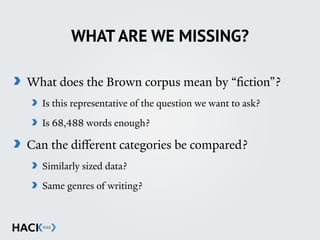
WHAT ARE WE MISSING?
What does the Brown corpus mean by “fiction”?
Is this representative of the question we want to ask?
Is 68,488 words enough?
Can the different categories be compared?
Similarly sized data?
Same genres of writing?
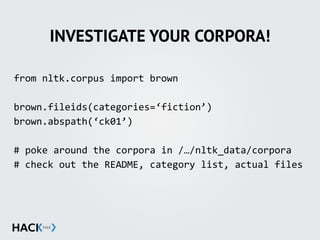
INVESTIGATE YOUR CORPORA!
from'nltk.corpus'import'brown'
brown.fileids(categories=‘fiction’)'
brown.abspath(‘ck01’)'
#'poke'around'the'corpora'in'/…/nltk_data/corpora'
#'check'out'the'README,'category'list,'actual'files
TEXT OBJECTS
VS. CORPORA
OBJECTS
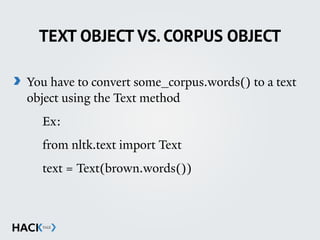
TEXT OBJECT VS. CORPUS OBJECT
You have to convert some_corpus.words() to a text
object using the Text method
Ex:
from nltk.text import Text
text = Text(brown.words())
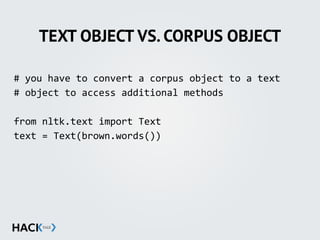
TEXT OBJECT VS. CORPUS OBJECT
#'you'have'to'convert'a'corpus'object'to'a'text''
#'object'to'access'additional'methods'
from'nltk.text'import'Text'
text'='Text(brown.words())'
TEXT METHODS
from'nltk.corpus'import'some_corpus'
from'nltk.text'import'Text'
text'='Text(some_corpus.words())'
text.concordance(“word”)'
text.similar(“word”)'
text.common_contexts([“word1”,'“word2”])'
text.count(“word”)'
text.collocations()
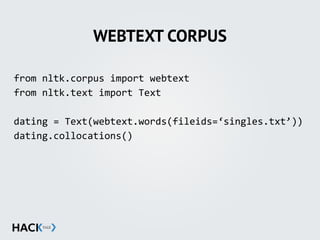
WEBTEXT CORPUS
from'nltk.corpus'import'webtext'
from'nltk.text'import'Text'
dating'='Text(webtext.words(fileids=‘singles.txt’))'
dating.collocations()
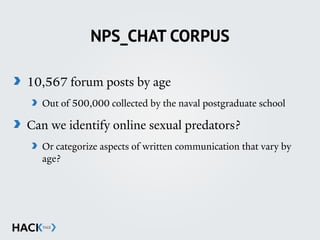
NPS_CHAT CORPUS
10,567 forum posts by age
Out of 500,000 collected by the naval postgraduate school
Can we identify online sexual predators?
Or categorize aspects of written communication that vary by
age?
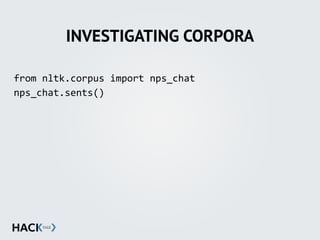
INVESTIGATING CORPORA
from'nltk.corpus'import'nps_chat'
nps_chat.sents()'
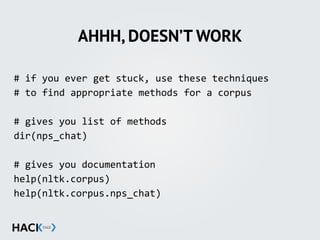
AHHH, DOESN’T WORK
#'if'you'ever'get'stuck,'use'these'techniques'
#'to'find'appropriate'methods'for'a'corpus'
#'gives'you'list'of'methods'
dir(nps_chat)'
#'gives'you'documentation'
help(nltk.corpus)'
help(nltk.corpus.nps_chat)
FREQUENCY
DISTRIBUTIONS
FREQUENCY DISTRIBUTIONS
from'nltk'import'FreqDist'
from'nltk.text'import'Text'
import'matplotlib'
text'='Text(some_corpus.words())'
fdist'='FreqDist(text)'
=>'dict'of'{‘token1’:count1,'‘token2’:count2,…}'
fdist[‘the’]''
=>'returns'the'#'of'times'‘the’'appears'in'text'
FREQUENCY DISTRIBUTIONS
#'top'50'words'
fdst.most_common(50)'
#'frequency'plot'
fdist.plot(25,'cumulative=[True'or'False])'
#'list'of'all'1;count'tokens'
fdist.hapaxes()
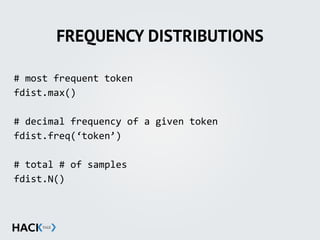
FREQUENCY DISTRIBUTIONS
#'most'frequent'token'
fdist.max()'
#'decimal'frequency'of'a'given'token'
fdist.freq(‘token’)'
#'total'#'of'samples'
fdist.N()
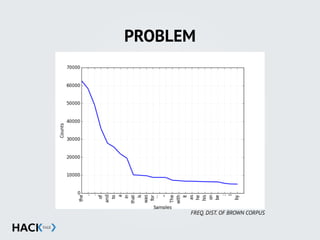
PROBLEM
FREQ. DIST. OF BROWN CORPUS
PROBLEM
We’re mostly counting words that don’t tell us
anything about the text
“The” is most frequent
Followed by ‘,’
We need stopwords
Commonly used words that you can remove from a corpus
before processing
STOPWORDS
from'nltk.corpus'import'stopwords'
sw'='stopwords.words(‘english’)'
old_brown'='brown.words()'
new'='[w'for'w'in'old_brown'if'w.lower()'not'in'sw]'
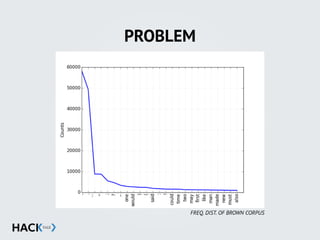
#'better,'but'we’re'still'counting'punctuation'
#'sample'code';'brown.py
PROBLEM
FREQ. DIST. OF BROWN CORPUS
STOPWORDS & PUNCTUATION
from'nltk.corpus'import'stopwords'
sw'='stopwords.words(‘english’)'
old_brown'='brown.words()'
new'='[w'for'w'in'old_brown'if'w.lower()'not'in'sw'
' ' ' ' ' ' ' ' ' ' ' and$w.isalnum()]'
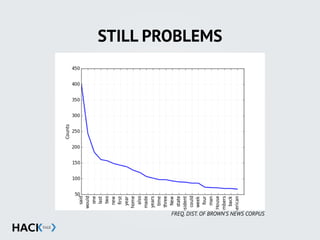
STILL PROBLEMS
FREQ. DIST. OF BROWN’S NEWS CORPUS
HOMEWORK
Play around with new corpora
What are the frequent words of diff. genres?
Look at webtext.fileids() for a diversity of text files
Find one in your area of interest
movie_reviews, udhr, wordnet, etc.
dir(some_corpus) => how do the methods differ?
some_corpus.abspath() => what’s actually in the corpus?
WWW.HACKYALE.COM
NLP IN PYTHON
CLASSIFYING TEXT
WEEK 1
NLP IN PYTHON
SOURCES
Natural Language Processing with Python, by
Steven Bird, Ewan Klein, and Edward Loper.
O'Reilly Media, 978-0-596-51649-9.
MOOC: Natural Language Processing with Dan
Jurafsky and Christopher Manning (Stanford,
Coursera)
REVIEW
NLTK BOOK: CORPUS CHART
CREDIT: NLTK BOOK
INAUGURAL CORPUS
from	
  nltk.corpus	
  import	
  inaugural	
  
import	
  matplotlib	
  
from	
  nltk	
  import	
  Text	
  
inaug	
  =	
  Text(inaugural.words())	
  
inaug.collocations()	
  
inaug.concordance(‘freedom’)	
  
inaug.dispersion_plot([‘freedom’,	
  ‘government’,	
  
‘liberty’,	
  ‘hope’])
WHAT IS TEXT
CLASSIFICATION?
TEXT CLASSIFICATION
Building a model on some features of a language
Assigning categories to unseen documents, given the
ones you’ve seen
Documents can mean anything:
Emails, news articles, tweets, etc.
Spam detection, article relevance, sentiment analysis, etc.

TEXT CLASSIFICATION
On different levels
By word, phoneme, author, genre
Identifying patterns and making predictions
TRAINING
Supervised
Hand-labeled documents (i.e. movie reviews with pos. or neg.)
Unsupervised
Completely unlabeled
Semi-supervised
Mixture of both
TRAINING
Supervised
Hand-labeled documents (i.e. movie reviews with pos. or neg.)
Unsupervised
Completely unlabeled
Semi-supervised
Mixture of both
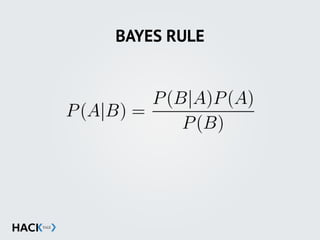
BAYES RULE
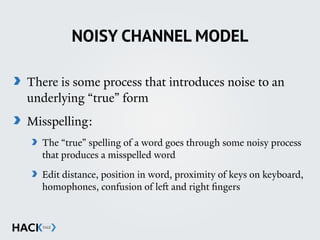
NOISY CHANNEL MODEL
There is some process that introduces noise to an
underlying “true” form
Misspelling:
The “true” spelling of a word goes through some noisy process
that produces a misspelled word
Edit distance, position in word, proximity of keys on keyboard,
homophones, confusion of left and right fingers

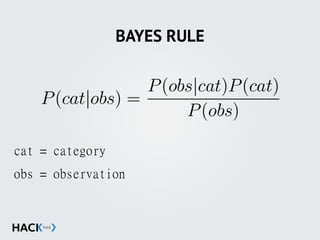
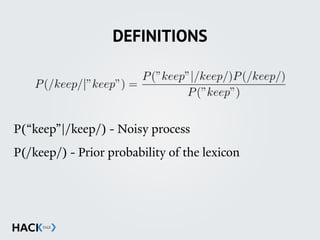
BAYES RULE
cat = category

obs = observation
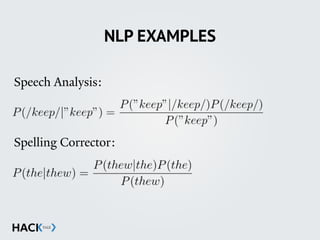
Speech Analysis:
Spelling Corrector:
NLP EXAMPLES
DEFINITIONS
P(“keep”|/keep/) - Noisy process
P(/keep/) - Prior probability of the lexicon
NAIVE BAYES INFERENCE
Independence assumptions
Noisy model can be interpreted without context
Our case:
Labeled categories
Look at inputs separately
Independence assumption applies to words in the topics

LANGUAGE
MODELS
LANGUAGE MODEL
N-gram
Simplest and “dumbest” model
Just counts words and their physical relation to each other in
the document
Or phonemes, or letters, etc.
Bag of words
Google n-grams example
N-GRAMS
Applications
Author identification
Federalist Papers
Genre identification
N-GRAMS
Unigram (simple count):

“This movie is great!”
{‘this’: 1, ‘movie’: 1, …}
Bigram:
“# This movie is great!”
[(‘#’, ‘this’), (‘this’, ‘movie’), (‘movie’, ‘is’), …]
N-GRAMS
Trigram:

“# # This movie is great”
[(‘#’, ‘#’, ‘this’), (‘#’, ‘this’, ‘movie’), …]
4-grams, 5-grams, etc, etc.
Trigrams are usually good for English
N-GRAMS
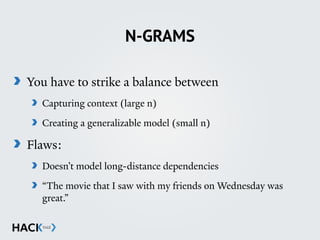
You have to strike a balance between
Capturing context (large n)
Creating a generalizable model (small n)
Flaws:
Doesn’t model long-distance dependencies
“The movie that I saw with my friends on Wednesday was
great.”
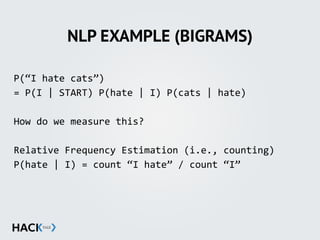
NLP EXAMPLE (BIGRAMS)
P(“I	
  hate	
  cats”)	
  
=	
  P(I	
  |	
  START)	
  P(hate	
  |	
  I)	
  P(cats	
  |	
  hate)	
  
How	
  do	
  we	
  measure	
  this?	
  
Relative	
  Frequency	
  Estimation	
  (i.e.,	
  counting)	
  
P(hate	
  |	
  I)	
  =	
  count	
  “I	
  hate”	
  /	
  count	
  “I”
PROBABILITY
OF A SENTENCE
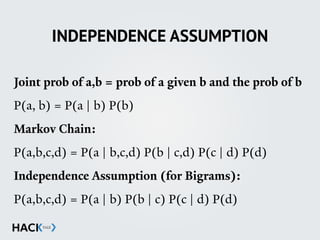
INDEPENDENCE ASSUMPTION
Joint prob of a,b = prob of a given b and the prob of b
P(a, b) = P(a | b) P(b)
Markov Chain:
P(a,b,c,d) = P(a | b,c,d) P(b | c,d) P(c | d) P(d)
Independence Assumption (for Bigrams):
P(a,b,c,d) = P(a | b) P(b | c) P(c | d) P(d)
N-GRAMS
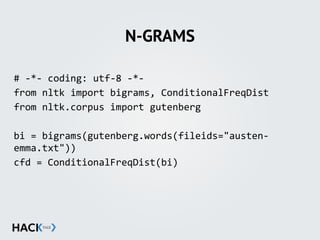
#	
  -­‐*-­‐	
  coding:	
  utf-­‐8	
  -­‐*-­‐	
  
from	
  nltk	
  import	
  bigrams,	
  ConditionalFreqDist	
  
from	
  nltk.corpus	
  import	
  gutenberg	
  
bi	
  =	
  bigrams(gutenberg.words(fileids="austen-­‐
emma.txt"))	


cfd	
  =	
  ConditionalFreqDist(bi)	
  
PROBLEMS WITH N-GRAMS
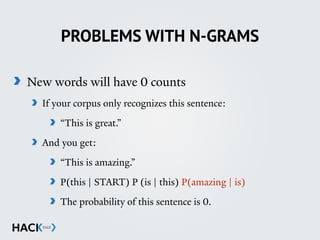
New words will have 0 counts
If your corpus only recognizes this sentence:
“This is great.”
And you get:
“This is amazing.”
P(this | START) P (is | this) P(amazing | is)
The probability of this sentence is 0. 

SMOOTHING
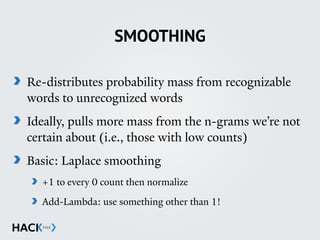
Re-distributes probability mass from recognizable
words to unrecognized words
Ideally, pulls more mass from the n-grams we’re not
certain about (i.e., those with low counts)
Basic: Laplace smoothing
+1 to every 0 count then normalize
Add-Lambda: use something other than 1!
SMOOTHING
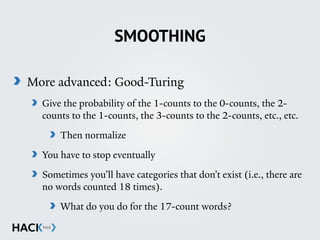
More advanced: Good-Turing
Give the probability of the 1-counts to the 0-counts, the 2-
counts to the 1-counts, the 3-counts to the 2-counts, etc., etc.
Then normalize
You have to stop eventually
Sometimes you’ll have categories that don’t exist (i.e., there are
no words counted 18 times).
What do you do for the 17-count words?
BASIC TEXT
CLASSIFICATION
IMPORTANT STEPS
Define a features function
{‘feature’ : count/bool, ‘feature2’ : count/bool}
Label words in your corpus with their categories
[(category, word), (category, word), (category, word)]
Create a features set
[(list_of_features, category), …]
IMPORTANT STEPS
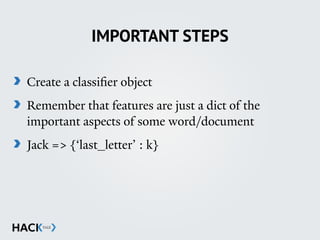
Create a classifier object
Remember that features are just a dict of the
important aspects of some word/document
Jack => {‘last_letter’ : k}
NAMES CORPUS
8000 names, separated into male and female
Think of appropriate features
Overfitting is a problem
Especially with a small data set
MOVIE REVIEWS
Mess around with corpus.movie_reviews
See sentiment.py
Play around with numbers in NLTK Book example
(i.e., size of test set vs. training set, # of most frequent words
we consider relevant)
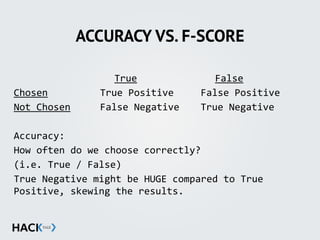
ACCURACY VS. F-SCORE


   True	


   False	
  
Chosen	


   True	
  Positive	
  	
  	
   False	
  Positive	
  
Not	
  Chosen	
  	
   	
   False	
  Negative	
  	
   True	
  Negative	
  
Accuracy:	
  
How	
  often	
  do	
  we	
  choose	
  correctly?	
  
(i.e.	
  True	
  /	
  False)	
  
True	
  Negative	
  might	
  be	
  HUGE	
  compared	
  to	
  True	
  
Positive,	
  skewing	
  the	
  results.	
  
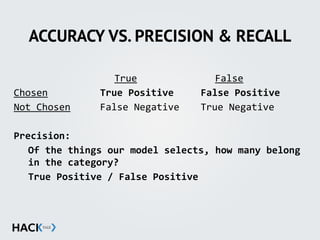
ACCURACY VS. PRECISION & RECALL


   True	


   False	
  
Chosen	


   True	
  Positive	
  	
  	
   False	
  Positive	
  
Not	
  Chosen	
  	
   	
   False	
  Negative	
  	
   True	
  Negative	
  
Precision:	
  
	
   Of	
  the	
  things	
  our	
  model	
  selects,	
  how	
  many	
  belong	
  
	
   in	
  the	
  category?	
  
	
   True	
  Positive	
  /	
  False	
  Positive	


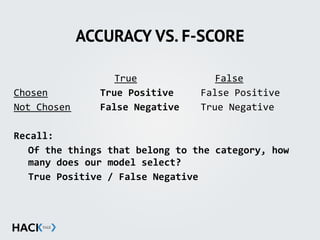
ACCURACY VS. F-SCORE


   True	


   False	
  
Chosen	


   True	
  Positive	
  	
  	
   False	
  Positive	
  
Not	
  Chosen	
  	
   	
   False	
  Negative	
  	
   True	
  Negative	
  
Recall:	
  
	
   Of	
  the	
  things	
  that	
  belong	
  to	
  the	
  category,	
  how	


   many	
  does	
  our	
  model	
  select?	
  
	
   True	
  Positive	
  /	
  False	
  Negative
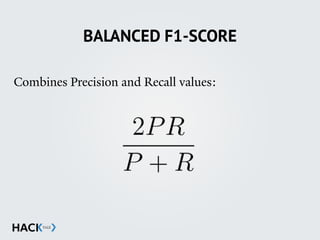
BALANCED F1-SCORE
Combines Precision and Recall values:

HackYale - Natural Language Processing (All Slides)