Text Processing, Tokenization,
&Characteristics
Thanks to:
Baldi, Frasconi, Smyth
M. Hearst
W. Arms
R. Krovetz
C. Manning, P. Raghavan, H. Schutze
2.
Previously
• Documents
– Corpus
–Tokens (terms)
• Evaluation
– Relevance
– Precision/recall
– F measure
– Competitions
• Web crawlers
– Crawler policy / breath vs depth first search
– Robots.txt
– Scrapy
3.
Text
• Text parsing
–Tokenization, terms
– A bit of linguistics
• Text characteristics
– Zipf’s law
– Heap’s law
4.
Why the focuson text?
• Language is the most powerful query model
• Language can be treated as text
• Others?
5.
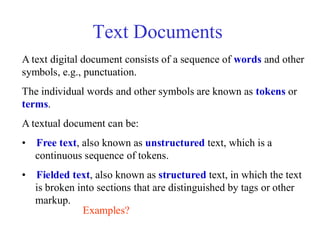
Text Documents
A textdigital document consists of a sequence of words and other
symbols, e.g., punctuation.
The individual words and other symbols are known as tokens or
terms.
A textual document can be:
• Free text, also known as unstructured text, which is a
continuous sequence of tokens.
• Fielded text, also known as structured text, in which the text
is broken into sections that are distinguished by tags or other
markup.
Examples?
Focus on documents
Decidewhat is an individual document
Can vary depending on problem
• Documents are basic units consisting of a
sequence of tokens or terms and are to be indexed.
• Terms (derived from tokens) are words or roots of
words, semantic units or phrases which are the
atoms of indexing
• Repositories (databases) and corpora are
collections of documents.
• Query is a request for documents on a query-
related topic.
8.
Building an index
•Collect documents to be indexed
– Create your corpora
• Tokenize the text
• Linguistic processing
• Build the inverted index from terms
9.
What is aDocument?
• A document is a digital object with an operational
definition
– Indexable (usually digital)
– Can be queried and retrieved.
• Many types of documents
– Text or part of text
– Web page
– Image
– Audio
– Video
– Data
– Email
– Etc.
10.
What is Text?
•Text is so common that we often ignore its
importance
• What is text?
– Strings of characters (alphabets, ideograms, ascii, unicode, etc.)
• Words
• . , : ; - ( ) _
• 1 2 3, 3.1415, 1010
• f = ma, H20
• Tables
• Figures
– Anything that is not an image, etc.
– Why is text important?
• Text is language capture
– an instantiation of language, culture, science, etc.
11.
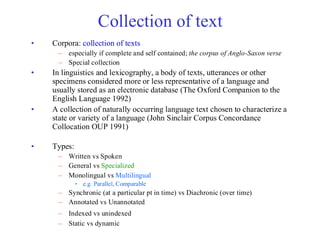
Collection of text
•Corpora: collection of texts
– especially if complete and self contained; the corpus of Anglo-Saxon verse
– Special collection
• In linguistics and lexicography, a body of texts, utterances or other
specimens considered more or less representative of a language and
usually stored as an electronic database (The Oxford Companion to the
English Language 1992)
• A collection of naturally occurring language text chosen to characterize a
state or variety of a language (John Sinclair Corpus Concordance
Collocation OUP 1991)
• Types:
– Written vs Spoken
– General vs Specialized
– Monolingual vs Multilingual
• e.g. Parallel, Comparable
– Synchronic (at a particular pt in time) vs Diachronic (over time)
– Annotated vs Unannotated
– Indexed vs unindexed
– Static vs dynamic
12.
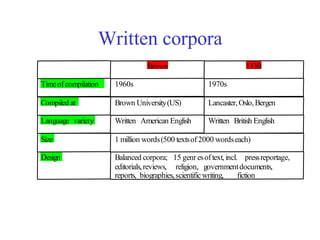
Written corpora
Brown LOB
Timeofcompilation 1960s 1970s
Compiled at Brown University(US) Lancaster,Oslo,Bergen
Language variety Written American English Written British English
Size 1 million words(500 textsof 2000 wordseach)
Design Balanced corpora; 15 genr esof text,incl. pressreportage,
editorials,reviews, religion, governmentdocuments,
reports, biographies,scientificwriting, fiction
13.
Text Processing –Lexical Analysis
• Standard Steps:
– Recognize language class [english] (very easy)
– Recognize document structure
• titles, sections, paragraphs, etc.
– Break into tokens – type of markup
• Tokens are delimited text
– Hello, how are you.
– _hello_,_how_are_you_._
• usually space and punctuation delineated
• special issues with Asian languages
– Lemmatization, stemming/morphological analysis
– What is left are terms
– Store in inverted index
• Lexical analysis is the process of converting a sequence of
characters into a sequence of tokens.
– A program or function which performs lexical analysis is called a
lexical analyzer, lexer or scanner.
14.
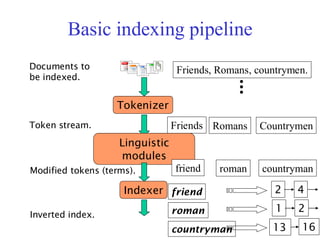
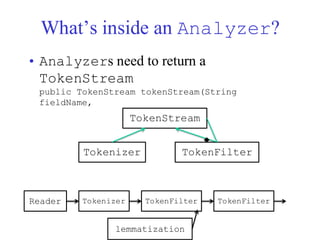
Basic indexing pipeline
Tokenizer
Tokenstream. Friends Romans Countrymen
Linguistic
modules
Modified tokens (terms). friend roman countryman
Indexer
Inverted index.
friend
roman
countryman
2 4
2
13 16
1
Documents to
be indexed.
Friends, Romans, countrymen.
15.
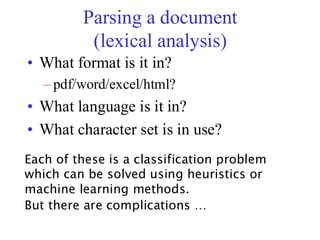
Parsing a document
(lexicalanalysis)
• What format is it in?
– pdf/word/excel/html?
• What language is it in?
• What character set is in use?
Each of these is a classification problem
which can be solved using heuristics or
machine learning methods.
But there are complications …
16.
Format/language stripping
• Documentsbeing indexed can include docs from
many different languages
– A single index may have to contain terms of several
languages.
• Sometimes a document or its components can
contain multiple languages/formats
– French email with a Portuguese pdf attachment.
• What is a unit document?
– An email?
– With attachments?
– An email with a zip containing documents?
17.
Tokenization is thebasic part of
document preprocessing
• Convert byte sequences into a linear sequence of
characters
• Trivial with ascii, but not so with Unicode or
others
– Use ML classifiers or heuristics.
• Crucial problem for commercial systems!
18.
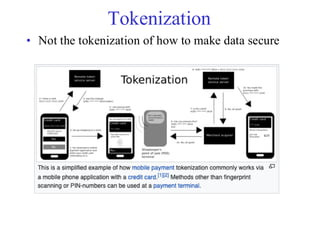
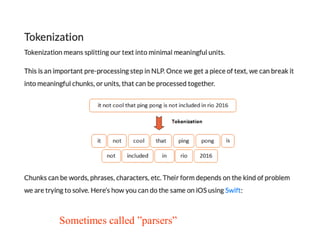
Tokenization
• Fundamental toNatural Language Processing
(NLP), IR, deep Learning and AI
• Parsing (chopping up) the document into basic
units that are candidates for later indexing
– What parts of text to use and what not
• Issues with
– Punctuation
– Numbers
– Special characters
– Equations
– Formula
– Languages
– Normalization (often by stemming)
What tokenization didyou use?
• For real problems always ask this!
• A fundamental question for all text
processing
– Natural language processing
– Text mining
– Machine learning and AI
– Information retrieval and search
23.
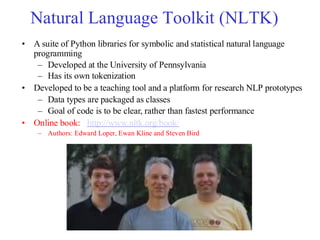
Natural Language Toolkit(NLTK)
• A suite of Python libraries for symbolic and statistical natural language
programming
– Developed at the University of Pennsylvania
– Has its own tokenization
• Developed to be a teaching tool and a platform for research NLP prototypes
– Data types are packaged as classes
– Goal of code is to be clear, rather than fastest performance
• Online book: http://www.nltk.org/book/
– Authors: Edward Loper, Ewan Kline and Steven Bird
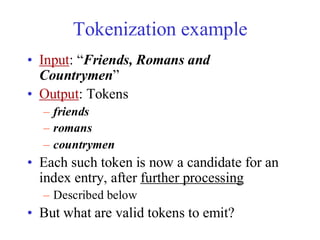
Tokenization example
• Input:“Friends, Romans and
Countrymen”
• Output: Tokens
– friends
– romans
– countrymen
• Each such token is now a candidate for an
index entry, after further processing
– Described below
• But what are valid tokens to emit?
26.
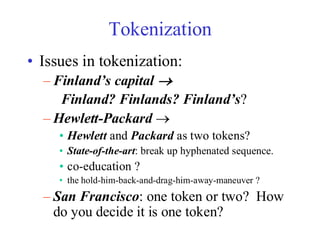
Tokenization
• Issues intokenization:
– Finland’s capital →
Finland? Finlands? Finland’s?
– Hewlett-Packard →
• Hewlett and Packard as two tokens?
• State-of-the-art: break up hyphenated sequence.
• co-education ?
• the hold-him-back-and-drag-him-away-maneuver ?
– San Francisco: one token or two? How
do you decide it is one token?
27.
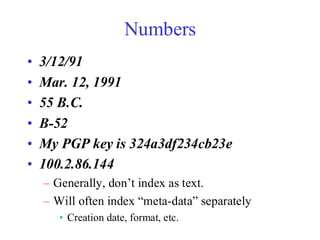
Numbers
• 3/12/91
• Mar.12, 1991
• 55 B.C.
• B-52
• My PGP key is 324a3df234cb23e
• 100.2.86.144
– Generally, don’t index as text.
– Will often index “meta-data” separately
• Creation date, format, etc.
28.
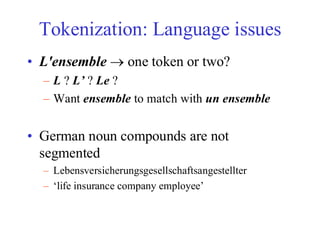
Tokenization: Language issues
•L'ensemble → one token or two?
– L ? L’ ? Le ?
– Want ensemble to match with un ensemble
• German noun compounds are not
segmented
– Lebensversicherungsgesellschaftsangestellter
– ‘life insurance company employee’
29.
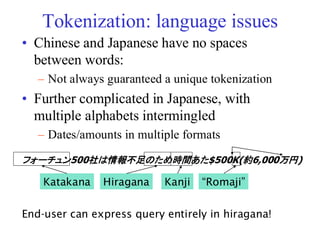
Tokenization: language issues
•Chinese and Japanese have no spaces
between words:
– Not always guaranteed a unique tokenization
• Further complicated in Japanese, with
multiple alphabets intermingled
– Dates/amounts in multiple formats
フォーチュン500社は情報不足のため時間あた$500K(約6,000万円)
Katakana Hiragana Kanji “Romaji”
End-user can express query entirely in hiragana!
30.
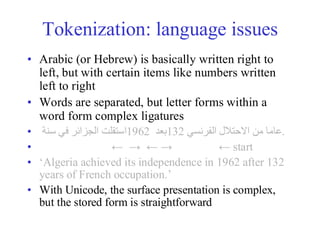
Tokenization: language issues
•Arabic (or Hebrew) is basically written right to
left, but with certain items like numbers written
left to right
• Words are separated, but letter forms within a
word form complex ligatures
• استقلت
الجزائر
في
سنة 1962 بعد132 عاما
من
االحتالل
الفرنسي .
• ← → ← → ← start
• ‘Algeria achieved its independence in 1962 after 132
years of French occupation.’
• With Unicode, the surface presentation is complex,
but the stored form is straightforward
31.
Normalization
• Need to“normalize” terms in indexed text as well
as query terms into the same form
– We want to match U.S.A. and USA
• We most commonly implicitly define equivalence
classes of terms
– e.g., by deleting periods in a term
• Alternative is to do limited expansion:
– Enter: window Search: window, windows
– Enter: windows Search: Windows, windows
– Enter: Windows Search: Windows
• Potentially more powerful, but less efficient
32.
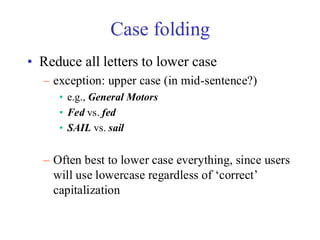
Case folding
• Reduceall letters to lower case
– exception: upper case (in mid-sentence?)
• e.g., General Motors
• Fed vs. fed
• SAIL vs. sail
– Often best to lower case everything, since users
will use lowercase regardless of ‘correct’
capitalization
33.
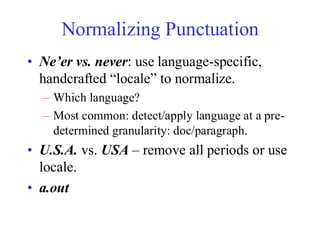
Normalizing Punctuation
• Ne’ervs. never: use language-specific,
handcrafted “locale” to normalize.
– Which language?
– Most common: detect/apply language at a pre-
determined granularity: doc/paragraph.
• U.S.A. vs. USA – remove all periods or use
locale.
• a.out
34.
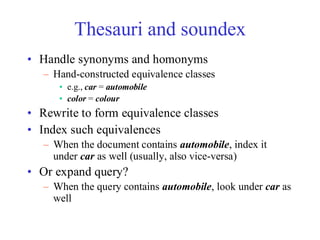
Thesauri and soundex
•Handle synonyms and homonyms
– Hand-constructed equivalence classes
• e.g., car = automobile
• color = colour
• Rewrite to form equivalence classes
• Index such equivalences
– When the document contains automobile, index it
under car as well (usually, also vice-versa)
• Or expand query?
– When the query contains automobile, look under car as
well
35.
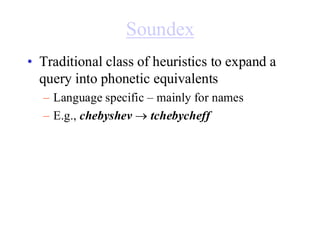
Soundex
• Traditional classof heuristics to expand a
query into phonetic equivalents
– Language specific – mainly for names
– E.g., chebyshev → tchebycheff
36.
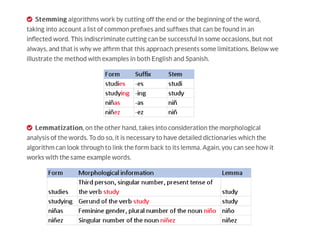
Stemming and MorphologicalAnalysis
• Goal: “normalize” similar words
• Morphology (“form” of words)
– Inflectional Morphology
• E.g,. inflect verb endings and noun number
• Never change grammatical class
– dog, dogs
– Derivational Morphology
• Derive one word from another,
• Often change grammatical class
– build, building; health, healthy
37.
Lemmatization
• Reduce inflectional/variantforms to base
form
• E.g.,
– am, are, is → be
– car, cars, car's, cars' → car
• the boy's cars are different colors → the
boy car be different color
• Lemmatization implies doing “proper”
reduction to dictionary headword form
38.
Stemming
Morphological variants ofa word (morphemes). Similar
terms derived from a common stem:
engineer, engineered, engineering
use, user, users, used, using
Stemming in Information Retrieval. Grouping words with a
common stem together.
For example, a search on reads, also finds read, reading, and
readable
Stemming consists of removing suffixes and conflating the
resulting morphemes. Occasionally, prefixes are also removed.
39.
Stemming
• Reduce termsto their “roots” before
indexing
• “Stemming” suggest crude affix chopping
– language dependent
– e.g., automate(s), automatic, automation all
reduced to automat.
for example compressed
and compression are both
accepted as equivalent to
compress.
for exampl compress and
compress ar both accept
as equival to compress
40.
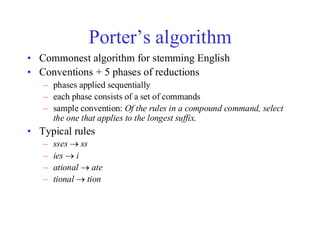
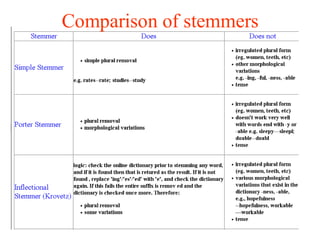
Porter’s algorithm
• Commonestalgorithm for stemming
English
– Results suggest at least as good as other
stemming options
• Conventions + 5 phases of reductions
– phases applied sequentially
– each phase consists of a set of commands
– sample convention: Of the rules in a compound
command, select the one that applies to the
longest suffix.
41.
Typical rules inPorter
• sses → ss
• ies → i
• ational → ate
• tional → tion
• Weight of word sensitive rules
• (m>1) EMENT →
• replacement → replac
• cement → cement
42.
Other stemmers
• Otherstemmers exist, e.g., Lovins stemmer
http://www.comp.lancs.ac.uk/computing/research/stemming/general/lovins.htm
– Single-pass, longest suffix removal (about 250 rules)
– Motivated by Linguistics as well as IR
• Full morphological analysis – at most modest
benefits for retrieval
• Do stemming and other normalizations help?
– Often very mixed results: really help recall for some
queries but harm precision on others
43.
Automated Methods arethe norm
• Powerful multilingual tools exist for
morphological analysis
– PCKimmo, Xerox Lexical technology
– Require a grammar and dictionary
– Use “two-level” automata
• Stemmers:
– Very dumb rules work well (for English)
– Porter Stemmer: Iteratively remove suffixes
– Improvement: pass results through a lexicon
44.
Porter’s algorithm
• Commonestalgorithm for stemming English
• Conventions + 5 phases of reductions
– phases applied sequentially
– each phase consists of a set of commands
– sample convention: Of the rules in a compound command, select
the one that applies to the longest suffix.
• Typical rules
– sses → ss
– ies → i
– ational → ate
– tional → tion
45.
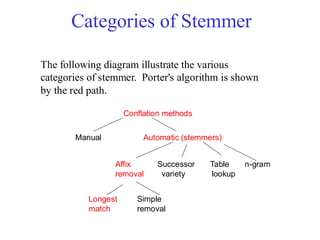
Categories of Stemmer
Thefollowing diagram illustrate the various
categories of stemmer. Porter's algorithm is shown
by the red path.
Conflation methods
Manual Automatic (stemmers)
Affix Successor Table n-gram
removal variety lookup
Longest Simple
match removal
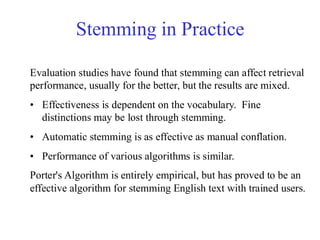
Stemming in Practice
Evaluationstudies have found that stemming can affect retrieval
performance, usually for the better, but the results are mixed.
• Effectiveness is dependent on the vocabulary. Fine
distinctions may be lost through stemming.
• Automatic stemming is as effective as manual conflation.
• Performance of various algorithms is similar.
Porter's Algorithm is entirely empirical, but has proved to be an
effective algorithm for stemming English text with trained users.
48.
Language-specificity
• Many ofthe above features embody
transformations that are
– Language-specific and
– Often, application-specific
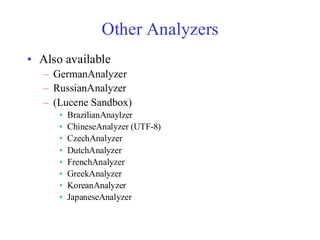
• These are “plug-in” addenda to the indexing
process
• Both open source and commercial plug-ins
available for handling these
49.
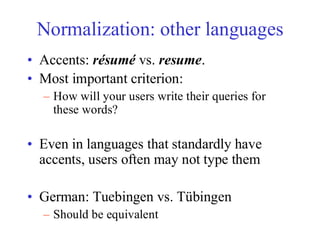
Normalization: other languages
•Accents: résumé vs. resume.
• Most important criterion:
– How will your users write their queries for
these words?
• Even in languages that standardly have
accents, users often may not type them
• German: Tuebingen vs. Tübingen
– Should be equivalent
50.
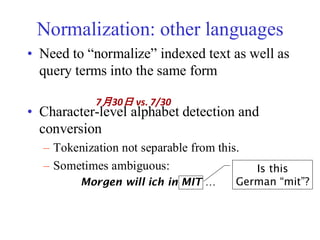
Normalization: other languages
•Need to “normalize” indexed text as well as
query terms into the same form
• Character-level alphabet detection and
conversion
– Tokenization not separable from this.
– Sometimes ambiguous:
7月30日 vs. 7/30
Morgen will ich in MIT …
Is this
German “mit”?
51.
•Very common words,such as of, and, the, are rarely of use
in information retrieval.
•A stop list is a list of such words that are removed during
lexical analysis.
•NOT INDEXED
•A long stop list saves space in indexes, speeds processing,
and eliminates many false hits.
•However, common words are sometimes significant in
information retrieval, which is an argument for a short stop
list. (Consider the query, "To be or not to be?")
Stop Lists
52.
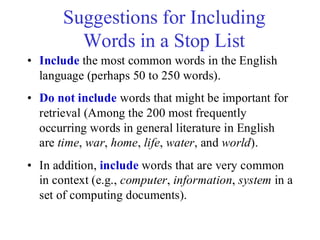
Suggestions for Including
Wordsin a Stop List
• Include the most common words in the English
language (perhaps 50 to 250 words).
• Do not include words that might be important for
retrieval (Among the 200 most frequently
occurring words in general literature in English
are time, war, home, life, water, and world).
• In addition, include words that are very common
in context (e.g., computer, information, system in a
set of computing documents).
53.
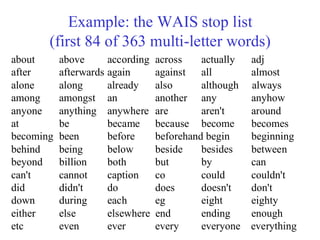
Example: the WAISstop list
(first 84 of 363 multi-letter words)
about above according across actually adj
after afterwards again against all almost
alone along already also although always
among amongst an another any anyhow
anyone anything anywhere are aren't around
at be became because become becomes
becoming been before beforehand begin beginning
behind being below beside besides between
beyond billion both but by can
can't cannot caption co could couldn't
did didn't do does doesn't don't
down during each eg eight eighty
either else elsewhere end ending enough
etc even ever every everyone everything
54.
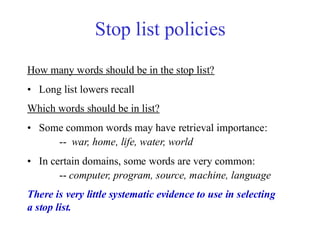
Stop list policies
Howmany words should be in the stop list?
• Long list lowers recall
Which words should be in list?
• Some common words may have retrieval importance:
-- war, home, life, water, world
• In certain domains, some words are very common:
-- computer, program, source, machine, language
There is very little systematic evidence to use in selecting
a stop list.
55.
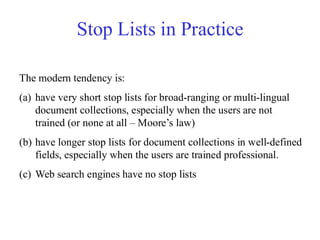
Stop Lists inPractice
The modern tendency is:
(a) have very short stop lists for broad-ranging or multi-lingual
document collections, especially when the users are not
trained (or none at all – Moore’s law)
(b) have longer stop lists for document collections in well-defined
fields, especially when the users are trained professional.
(c) Web search engines have no stop lists
56.
Token generation -stemming
• What are tokens for documents?
– Words (things between spaces)
• Some words equivalent
• Stemming finds equivalences among words
• Removal of grammatical suffixes
57.
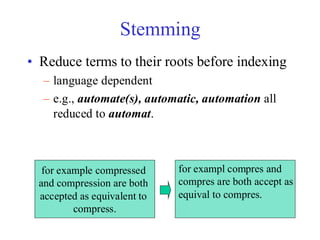
Stemming
• Reduce termsto their roots before indexing
– language dependent
– e.g., automate(s), automatic, automation all
reduced to automat.
for example compressed
and compression are both
accepted as equivalent to
compress.
for exampl compres and
compres are both accept as
equival to compres.
59.
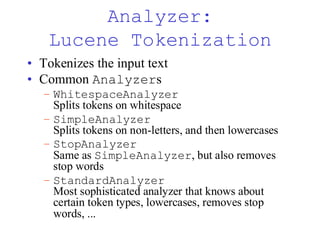
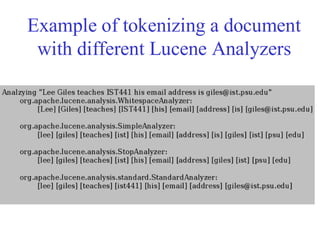
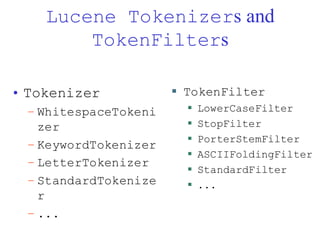
Analyzer:
Lucene Tokenization
• Tokenizesthe input text
• Common Analyzers
– WhitespaceAnalyzer
Splits tokens on whitespace
– SimpleAnalyzer
Splits tokens on non-letters, and then lowercases
– StopAnalyzer
Same as SimpleAnalyzer, but also removes
stop words
– StandardAnalyzer
Most sophisticated analyzer that knows about
certain token types, lowercases, removes stop
words, ...
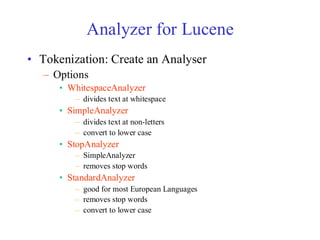
Analyzer for Lucene
•Tokenization: Create an Analyser
– Options
• WhitespaceAnalyzer
– divides text at whitespace
• SimpleAnalyzer
– divides text at non-letters
– convert to lower case
• StopAnalyzer
– SimpleAnalyzer
– removes stop words
• StandardAnalyzer
– good for most European Languages
– removes stop words
– convert to lower case
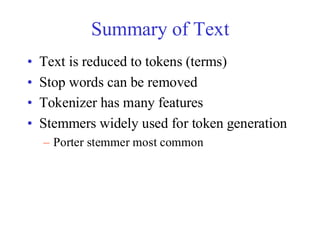
68.
Summary of Text
•Text is reduced to tokens (terms)
• Stop words can be removed
• Tokenizer has many features
• Stemmers widely used for token generation
– Porter stemmer most common
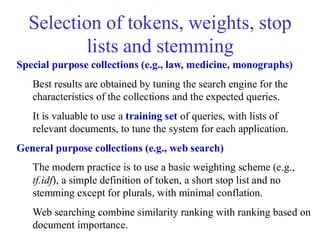
69.
Selection of tokens,weights, stop
lists and stemming
Special purpose collections (e.g., law, medicine, monographs)
Best results are obtained by tuning the search engine for the
characteristics of the collections and the expected queries.
It is valuable to use a training set of queries, with lists of
relevant documents, to tune the system for each application.
General purpose collections (e.g., web search)
The modern practice is to use a basic weighting scheme (e.g.,
tf.idf), a simple definition of token, a short stop list and no
stemming except for plurals, with minimal conflation.
Web searching combine similarity ranking with ranking based on
document importance.
70.
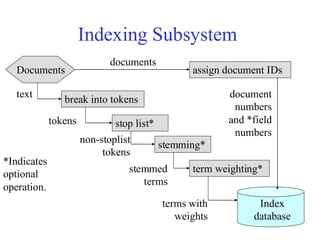
Indexing Subsystem
Documents
break intotokens
stop list*
stemming*
term weighting*
Index
database
text
non-stoplist
tokens
tokens
stemmed
terms
terms with
weights
*Indicates
optional
operation.
assign document IDs
documents
document
numbers
and *field
numbers
71.
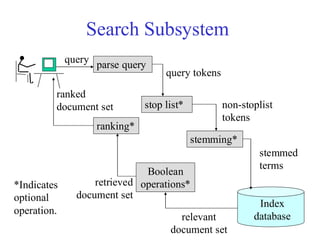
Search Subsystem
Index
database
query parsequery
stemming*
stemmed
terms
stop list* non-stoplist
tokens
query tokens
Boolean
operations*
ranking*
relevant
document set
ranked
document set
retrieved
document set
*Indicates
optional
operation.
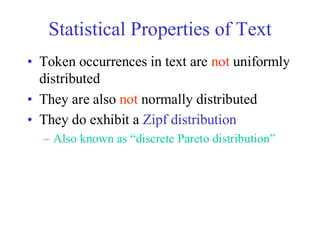
Statistical Properties ofText
• Token occurrences in text are not uniformly
distributed
• They are also not normally distributed
• They do exhibit a Zipf distribution
– Also known as “discrete Pareto distribution”
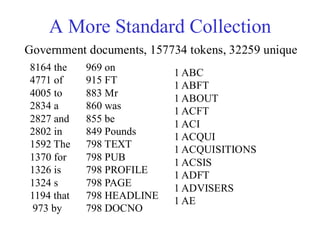
A More StandardCollection
8164 the
4771 of
4005 to
2834 a
2827 and
2802 in
1592 The
1370 for
1326 is
1324 s
1194 that
973 by
969 on
915 FT
883 Mr
860 was
855 be
849 Pounds
798 TEXT
798 PUB
798 PROFILE
798 PAGE
798 HEADLINE
798 DOCNO
1 ABC
1 ABFT
1 ABOUT
1 ACFT
1 ACI
1 ACQUI
1 ACQUISITIONS
1 ACSIS
1 ADFT
1 ADVISERS
1 AE
Government documents, 157734 tokens, 32259 unique
78.
Plotting Word Frequencyby Rank
• Main idea: count
– How many times tokens occur in the text
• Over all texts in the collection
• Now rank these according to how often they
occur. This is called the rank.
79.
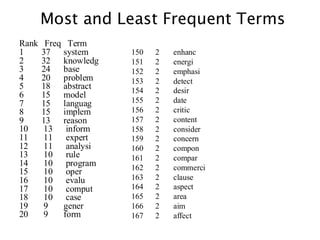
Rank Freq Term
137 system
2 32 knowledg
3 24 base
4 20 problem
5 18 abstract
6 15 model
7 15 languag
8 15 implem
9 13 reason
10 13 inform
11 11 expert
12 11 analysi
13 10 rule
14 10 program
15 10 oper
16 10 evalu
17 10 comput
18 10 case
19 9 gener
20 9 form
150 2 enhanc
151 2 energi
152 2 emphasi
153 2 detect
154 2 desir
155 2 date
156 2 critic
157 2 content
158 2 consider
159 2 concern
160 2 compon
161 2 compar
162 2 commerci
163 2 clause
164 2 aspect
165 2 area
166 2 aim
167 2 affect
Most and Least Frequent Terms
80.
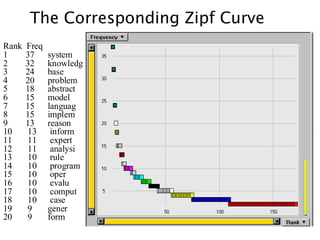
Rank Freq
1 37system
2 32 knowledg
3 24 base
4 20 problem
5 18 abstract
6 15 model
7 15 languag
8 15 implem
9 13 reason
10 13 inform
11 11 expert
12 11 analysi
13 10 rule
14 10 program
15 10 oper
16 10 evalu
17 10 comput
18 10 case
19 9 gener
20 9 form
The Corresponding Zipf Curve
81.
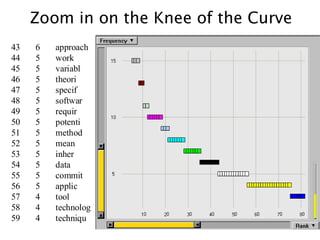
Zoom in onthe Knee of the Curve
43 6 approach
44 5 work
45 5 variabl
46 5 theori
47 5 specif
48 5 softwar
49 5 requir
50 5 potenti
51 5 method
52 5 mean
53 5 inher
54 5 data
55 5 commit
56 5 applic
57 4 tool
58 4 technolog
59 4 techniqu
82.
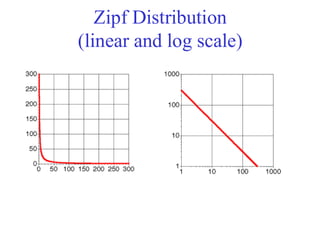
Zipf Distribution
• TheImportant Points:
– a few elements occur very frequently
– a medium number of elements have medium
frequency
– many elements occur very infrequently
– Self similarity
• Same shape for large and small frequency
words
– Long tail
– Not necessarily obeys central limit theorem
83.
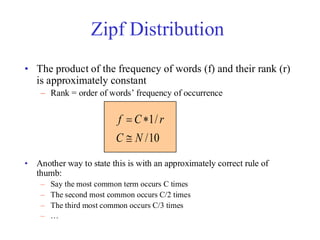
Zipf Distribution
• Theproduct of the frequency of words (f) and their rank (r)
is approximately constant
– Rank = order of words’ frequency of occurrence
• Another way to state this is with an approximately correct rule of
thumb:
– Say the most common term occurs C times
– The second most common occurs C/2 times
– The third most common occurs C/3 times
– …
10
/
/
1
N
C
r
C
f
@
*
=
What Kinds ofData Exhibit a Zipf
Distribution?
• Words in a text collection
– Virtually any language usage
• Library book checkout patterns
• Incoming Web Page Requests (Nielsen)
• Outgoing Web Page Requests (Cunha &
Crovella)
• Document Size on Web (Cunha & Crovella)
• Many sales with certain retailers
86.
Prevalence of ZipfianLaws
• Many items exhibit a Zipfian distribution.
– Population of cities
– Wealth of individuals
•Discovered by sociologist/economist Pareto in 1909
– Popularity of books, movies, music, web-pages,
etc.
– Popularity of consumer products
•Chris Anderson’s “long tail”
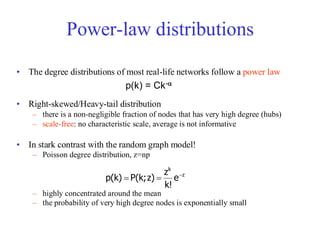
Power-law distributions
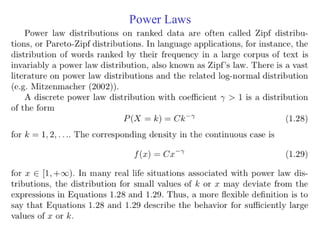
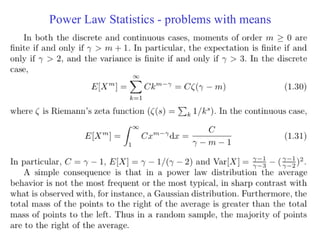
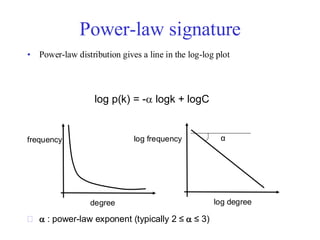
• Thedegree distributions of most real-life networks follow a power law
• Right-skewed/Heavy-tail distribution
– there is a non-negligible fraction of nodes that has very high degree (hubs)
– scale-free: no characteristic scale, average is not informative
• In stark contrast with the random graph model!
– Poisson degree distribution, z=np
– highly concentrated around the mean
– the probability of very high degree nodes is exponentially small
p(k) = Ck-
z
k
e
k!
z
z)
P(k;
p(k) -
=
=
90.
Power-law signature
• Power-lawdistribution gives a line in the log-log plot
: power-law exponent (typically 2 ≤ ≤ 3)
degree
frequency
log degree
log frequency α
log p(k) = - logk + logC
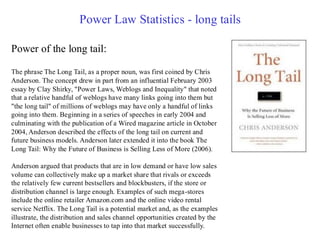
Power Law Statistics- long tails
Power of the long tail:
The phrase The Long Tail, as a proper noun, was first coined by Chris
Anderson. The concept drew in part from an influential February 2003
essay by Clay Shirky, "Power Laws, Weblogs and Inequality" that noted
that a relative handful of weblogs have many links going into them but
"the long tail" of millions of weblogs may have only a handful of links
going into them. Beginning in a series of speeches in early 2004 and
culminating with the publication of a Wired magazine article in October
2004, Anderson described the effects of the long tail on current and
future business models. Anderson later extended it into the book The
Long Tail: Why the Future of Business is Selling Less of More (2006).
Anderson argued that products that are in low demand or have low sales
volume can collectively make up a market share that rivals or exceeds
the relatively few current bestsellers and blockbusters, if the store or
distribution channel is large enough. Examples of such mega-stores
include the online retailer Amazon.com and the online video rental
service Netflix. The Long Tail is a potential market and, as the examples
illustrate, the distribution and sales channel opportunities created by the
Internet often enable businesses to tap into that market successfully.
93.
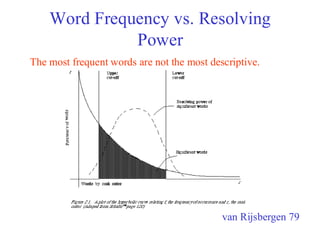
Word Frequency vs.Resolving
Power
The most frequent words are not the most descriptive.
van Rijsbergen 79
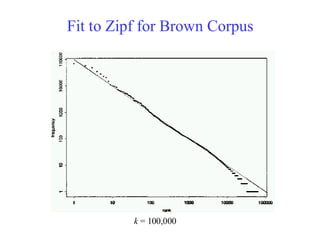
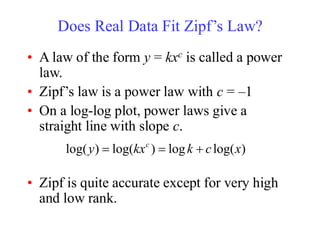
Does Real DataFit Zipf’s Law?
• A law of the form y = kxc is called a power
law.
• Zipf’s law is a power law with c = –1
• On a log-log plot, power laws give a
straight line with slope c.
• Zipf is quite accurate except for very high
and low rank.
)
log(
log
)
log(
)
log( x
c
k
kx
y c
+
=
=
96.
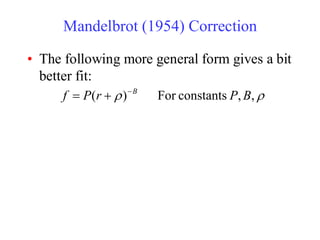
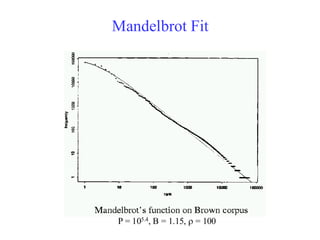
Mandelbrot (1954) Correction
•The following more general form gives a bit
better fit:
,
,
constants
For
)
( B
P
r
P
f B
−
+
=
Explanations for Zipf’sLaw
• Zipf’s explanation was his “principle of least
effort.” Balance between speaker’s desire for a
small vocabulary and hearer’s desire for a large
one.
• Debate (1955-61) between Mandelbrot and H.
Simon over explanation.
• Simon explanation is “rich get richer.”
• Li (1992) shows that just random typing of letters
including a space will generate “words” with a
Zipfian distribution.
– http://linkage.rockefeller.edu/wli/zipf/
99.
Zipf’s Law Impacton IR
• Good News:
– Stopwords will account for a large fraction of text so
eliminating them greatly reduces inverted-index storage
costs.
– Postings list for most remaining words in the inverted
index will be short since they are rare, making retrieval
fast.
• Bad News:
– For most words, gathering sufficient data for
meaningful statistical analysis (e.g. for correlation
analysis for query expansion) is difficult since they are
extremely rare.
100.
Vocabulary Growth
• Howdoes the size of the overall vocabulary
(number of unique words) grow with the
size of the corpus?
• This determines how the size of the inverted
index will scale with the size of the corpus.
• Vocabulary not really upper-bounded due to
proper names, typos, etc.
101.
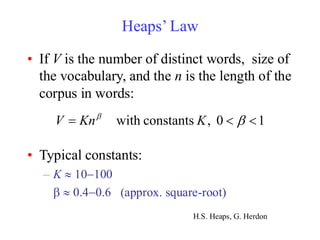
Heaps’ Law
• IfV is the number of distinct words, size of
the vocabulary, and the n is the length of the
corpus in words:
• Typical constants:
– K 10−100
0.4−0.6 (approx. square-root)
1
0
,
constants
with
=
K
Kn
V
H.S. Heaps, G. Herdon
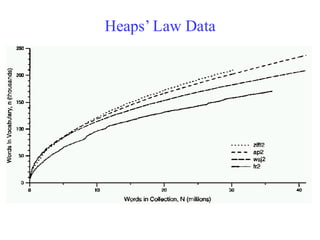
Explanation for Heaps’Law
• Can be derived from Zipf’s law by
assuming documents are generated by
randomly sampling words from a Zipfian
distribution.
104.
Consequences for Heaps’Law
• Heaps' law means that as more instance text is gathered, there
will be diminishing returns in terms of discovery of the full
vocabulary from which the distinct terms are drawn.
• Heaps' law also applies to situations in which the "vocabulary"
is just some set of distinct types which are attributes of some
collection of objects. For example, the objects could be people,
and the types could be country of origin of the person. If
persons are selected randomly (that is, we are not selecting
based on country of origin), then Heaps' law says we will
quickly have representatives from most countries (in proportion
to their population) but it will become increasingly difficult to
cover the entire set of countries by continuing this method of
sampling. Heaps' law has been observed also in single-cell
transcriptomes[4] considering genes as the distinct objects in
the "vocabulary".
105.
Consequences of Zipffor IR
• There are always a few very frequent tokens
that are not good discriminators.
– Called “stop words” in IR
– Usually correspond to linguistic notion of
“closed-class” words
• English examples: to, from, on, and, the, ...
• Grammatical classes that don’t take on new members.
• There are always a large number of tokens
that occur once and can mess up algorithms.
• Medium frequency words most descriptive
106.
Text Metadata
• Informationabout a document that may not be a
part of the document itself (data about data).
• Descriptive metadata is external to the meaning of
the document:
– Author
– Title
– Source (book, magazine, newspaper, journal)
– Date
– ISBN
– Publisher
– Length
107.
Metadata (cont)
• Semanticmetadata concerns the content:
– Abstract
– Keywords
– Subject Codes
•Library of Congress
•Dewey Decimal
•UMLS (Unified Medical Language System)
• Subject terms may come from specific
ontologies (hierarchical taxonomies of
standardized semantic terms).
108.
Web Metadata
• METAtag in HTML
– <META NAME=“keywords”
CONTENT=“pets, cats, dogs”>
• META “HTTP-EQUIV” attribute allows
server or browser to access information:
– <META HTTP-EQUIV=“expires”
CONTENT=“Tue, 01 Jan 02”>
– <META HTTP-EQUIV=“creation-date”
CONTENT=“23-Sep-01”>
109.
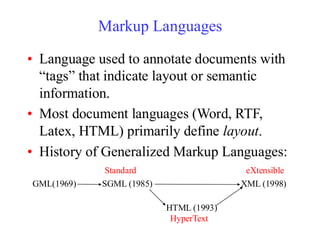
Markup Languages
• Languageused to annotate documents with
“tags” that indicate layout or semantic
information.
• Most document languages (Word, RTF,
Latex, HTML) primarily define layout.
• History of Generalized Markup Languages:
GML(1969) SGML (1985)
HTML (1993)
XML (1998)
Standard
HyperText
eXtensible
Text as queries
•Text is a natural query model.
• Discuss this next.
112.
Lemmatization vs stemming
•In general, lemmatization offers better precision than
stemming, but at the expense of recall.
• Stemming and lemmatization are effective techniques to
expand recall
• lemmatization gives up some recall to increase precision.
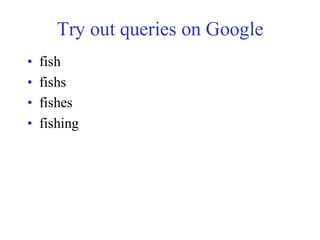
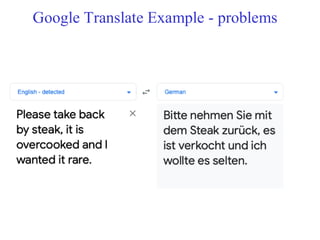
• But both techniques can feel like crude instruments, but
Google uses them
• Lemmatization and stemming are special cases of
normalization. They identify a canonical representative for a
set of related word forms. The entire process is often called
normalization
• Some use lemmatization to refer to both
113.
Text - Summary
•Perform lexical analysis - processing text into tokens or terms
– Many issues: normalization, lemmatization
– Most language dependent
– Languages on the internet
• Stemming reduces the number of tokens
– Porter stemmer most common
• Lemmatization reduces the number of tokes
– Can operate on stimms
– can include stemming
• Stop words removed to improve performance
– Can be omitted
• Lucene Analyzers perform tokenization
– Many tokenizers available (Python)
• What remains are terms to be indexed
• Text has power law distribution (Zipf)
– Words with resolving power in the middle and tail of the distribution
– Heap/s law shows how vocab growth tapers off
• Text as metadata and queries

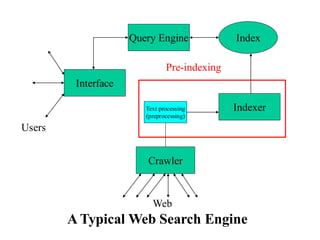
![Text Processing – Lexical Analysis
• Standard Steps:
– Recognize language class [english] (very easy)
– Recognize document structure
• titles, sections, paragraphs, etc.
– Break into tokens – type of markup
• Tokens are delimited text
– Hello, how are you.
– _hello_,_how_are_you_._
• usually space and punctuation delineated
• special issues with Asian languages
– Lemmatization, stemming/morphological analysis
– What is left are terms
– Store in inverted index
• Lexical analysis is the process of converting a sequence of
characters into a sequence of tokens.
– A program or function which performs lexical analysis is called a
lexical analyzer, lexer or scanner.](https://image.slidesharecdn.com/textpreprocessing-250818185945-961fd7a6/85/text-_preprocessing-_in-_NLP-AI-llms-pdf-13-320.jpg)
![Analysis example
• “The quick brown fox jumped over the lazy
dog”
• WhitespaceAnalyzer
– [The] [quick] [brown] [fox] [jumped] [over] [the]
[lazy] [dog]
• SimpleAnalyzer
– [the] [quick] [brown] [fox] [jumped] [over] [the]
[lazy] [dog]
• StopAnalyzer
– [quick] [brown] [fox] [jumped] [over] [lazy] [dog]
• StandardAnalyzer
– [quick] [brown] [fox] [jumped] [over] [lazy] [dog]](https://image.slidesharecdn.com/textpreprocessing-250818185945-961fd7a6/85/text-_preprocessing-_in-_NLP-AI-llms-pdf-60-320.jpg)
![Another analysis example
• “XY&Z Corporation – xyz@example.com”
• WhitespaceAnalyzer
– [XY&Z] [Corporation] [-] [xyz@example.com]
• SimpleAnalyzer
– [xy] [z] [corporation] [xyz] [example] [com]
• StopAnalyzer
– [xy] [z] [corporation] [xyz] [example] [com]
• StandardAnalyzer
– [xy&z] [corporation] [xyz@example.com]](https://image.slidesharecdn.com/textpreprocessing-250818185945-961fd7a6/85/text-_preprocessing-_in-_NLP-AI-llms-pdf-61-320.jpg)
![Examples of degree distribution for power
laws
Taken from [Newman 2003]](https://image.slidesharecdn.com/textpreprocessing-250818185945-961fd7a6/85/text-_preprocessing-_in-_NLP-AI-llms-pdf-91-320.jpg)
![Consequences for Heaps’ Law
• Heaps' law means that as more instance text is gathered, there
will be diminishing returns in terms of discovery of the full
vocabulary from which the distinct terms are drawn.
• Heaps' law also applies to situations in which the "vocabulary"
is just some set of distinct types which are attributes of some
collection of objects. For example, the objects could be people,
and the types could be country of origin of the person. If
persons are selected randomly (that is, we are not selecting
based on country of origin), then Heaps' law says we will
quickly have representatives from most countries (in proportion
to their population) but it will become increasingly difficult to
cover the entire set of countries by continuing this method of
sampling. Heaps' law has been observed also in single-cell
transcriptomes[4] considering genes as the distinct objects in
the "vocabulary".](https://image.slidesharecdn.com/textpreprocessing-250818185945-961fd7a6/85/text-_preprocessing-_in-_NLP-AI-llms-pdf-104-320.jpg)