NLTK Natural Language Processing made easy Elvis Joel D’Souza Gopikrishnan Nambiar Ashutosh Pandey
WHAT: Session Objective To introduce Natural Language Toolkit(NLTK), an open source library which simplifies the implementation of Natural Language Processing(NLP) in Python.
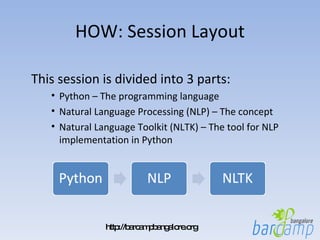
HOW: Session Layout This session is divided into 3 parts: Python – The programming language Natural Language Processing (NLP) – The concept Natural Language Toolkit (NLTK) – The tool for NLP implementation in Python
 
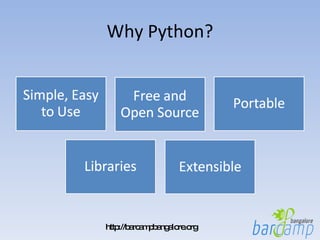
Why Python?
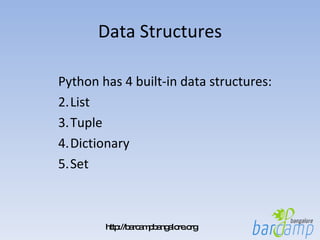
Data Structures Python has 4 built-in data structures: List Tuple Dictionary Set
List A list in Python is an  ordered   group  of items (or  elements ).  It is a very general structure, and list elements don't have to be of the same type.  listOfWords = [‘this’,’is’,’a’,’list’,’of’,’words’]  listOfRandomStuff = [1,’pen’,’costs’,’Rs.’,6.50]
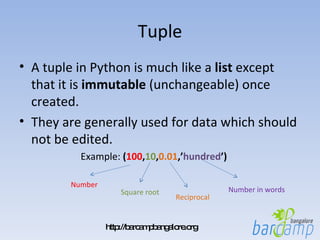
Tuple A tuple in Python is much like a  list  except that it is  immutable  (unchangeable) once created.  They are generally used for data which should not be edited. Example:  ( 100 , 10 , 0.01 ,’ hundred ’) Number Square root Reciprocal Number in words
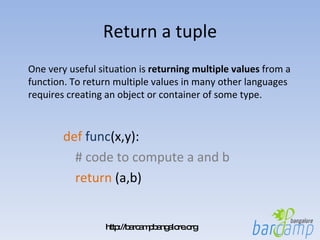
Return a tuple def   func (x,y):  # code to compute a and b return  (a,b) One very useful situation is  returning multiple values  from a function. To return multiple values in many other languages requires creating an object or container of some type.
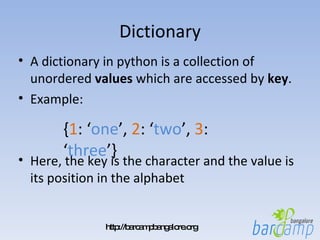
Dictionary A dictionary in python is a collection of unordered  values  which are accessed by  key . Example: Here, the key is the character and the value is its position in the alphabet { 1 : ‘ one ’,  2 : ‘ two ’,  3 : ‘ three ’}
Sets Python also has an implementation of the mathematical set.  Unlike sequence objects such as lists and tuples, in which each element is indexed, a set is an  unordered  collection of objects.  Sets also  cannot  have  duplicate  members - a given object appears in a set 0 or 1 times. SetOfBrowsers=set([‘IE’,’Firefox’,’Opera’,’Chrome’])
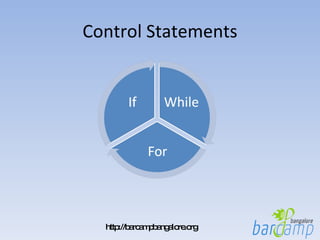
Control Statements
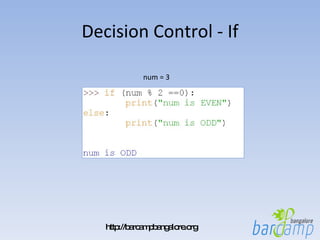
Decision Control - If num = 3
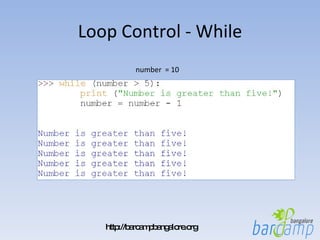
Loop Control - While number  = 10
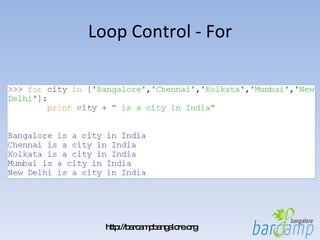
Loop Control - For
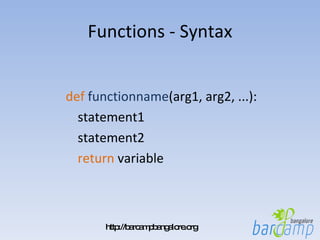
Functions - Syntax def   functionname (arg1, arg2, ...): statement1  statement2  return  variable
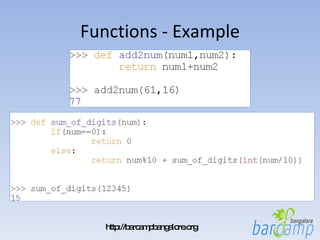
Functions - Example
Modules A module is a file containing Python definitions and statements.  The file name is the module name with the suffix .py appended. A module can be  imported by another program to make use of its functionality.
Import import   math The import keyword is used to tell Python, that we need the ‘math’ module. This statement makes all the functions in this module accessible in the program.
Using Modules – An Example print  math. sqrt( 100 )   sqrt is a function math is a module math.sqrt(100) returns 10 This is being printed to the standard output
Natural Language Processing (NLP)
Natural Language Processing The term  natural language processing  encompasses a broad set of techniques for automated generation, manipulation, and analysis of natural or human languages
Why NLP Applications for processing large amounts of texts require NLP expertise Index and search large texts Speech understanding Information extraction Automatic summarization
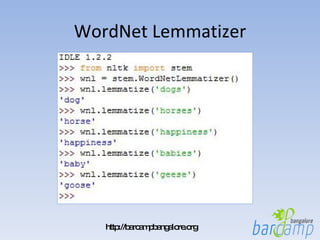
Stemming Stemming is the process for reducing inflected (or sometimes derived) words to their stem, base or root form – generally a written word form.  The stem need not be identical to the morphological root of the word; it is usually sufficient that related words map to the same stem, even if this stem is not in itself a valid root.  When you apply stemming on 'cats', the result is 'cat'
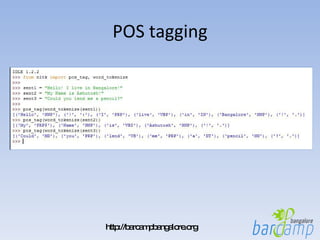
Part of speech tagging(POS Tagging) Part-of-speech (POS) tag: A word can be classified into one or more lexical or part-of-speech categories  such as nouns, verbs, adjectives, and articles, to name a few. A POS tag is a symbol representing such a lexical category, e.g., NN (noun), VB (verb), JJ (adjective), AT (article).
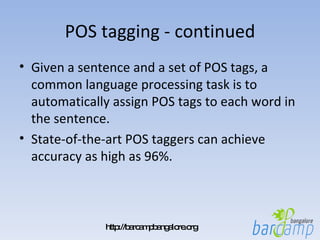
POS tagging - continued Given a sentence and a set of POS tags, a common language processing task is to automatically assign POS tags to each word in the sentence.  State-of-the-art POS taggers can achieve accuracy as high as 96%.
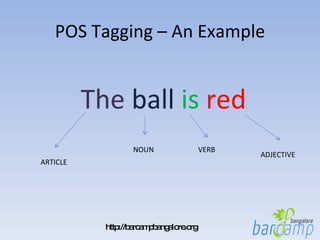
POS Tagging – An Example The   ball   is   red NOUN VERB ADJECTIVE ARTICLE
Parsing Parsing a sentence involves the use of linguistic knowledge of a language to discover the way in which a sentence is structured
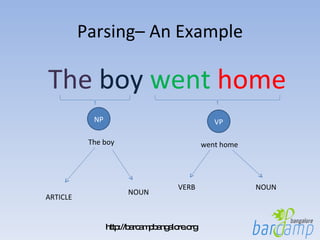
Parsing– An Example The   boy   went   home NOUN VERB NOUN ARTICLE NP VP The boy went home
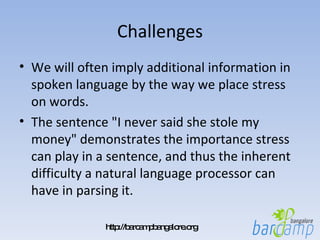
Challenges We will often imply additional information in spoken language by the way we place stress on words.  The sentence "I never said she stole my money" demonstrates the importance stress can play in a sentence, and thus the inherent difficulty a natural language processor can have in parsing it.
Depending on which word the speaker places the stress, sentences could have several distinct meanings Here goes an example…
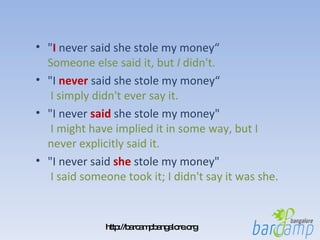
" I  never said she stole my money“  Someone else said it, but  I  didn't.  "I  never  said she stole my money“    I simply didn't ever say it.  "I never  said  she stole my money"   I might have implied it in some way, but I never explicitly said it.  "I never said  she  stole my money"    I said someone took it; I didn't say it was she.
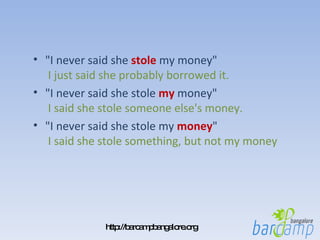
"I never said she  stole  my money"    I just said she probably borrowed it.  "I never said she stole  my  money"   I said she stole someone else's money.  "I never said she stole my  money "   I said she stole something, but not my money
NLTK Natural Language Toolkit
Design Goals
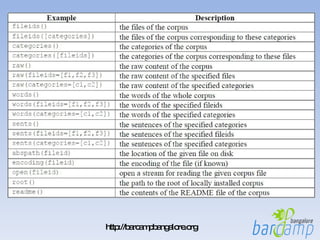
Exploring Corpora Corpus is a large collection of text which is used to either train an NLP program or is used as input by an NLP program In NLTK , a corpus can be loaded using the PlainTextCorpusReader Class
 
Loading your own corpus >>> from nltk.corpus import PlaintextCorpusReader corpus_root = ‘C:\text\’ >>> wordlists = PlaintextCorpusReader(corpus_root, '.*‘) >>> wordlists.fileids() ['README', 'connectives', 'propernames', 'web2', 'web2a', 'words'] >>> wordlists.words('connectives') ['the', 'of', 'and', 'to', 'a', 'in', 'that', 'is', ...]
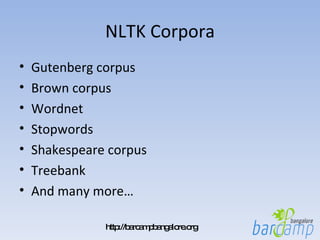
NLTK Corpora Gutenberg corpus Brown corpus Wordnet Stopwords Shakespeare corpus Treebank And many more…
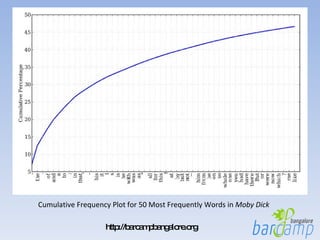
Computing with Language: Simple Statistics Frequency Distributions >>> fdist1 = FreqDist(text1) >>> fdist1 [2] <FreqDist with 260819 outcomes> >>> vocabulary1 = fdist1.keys() >>> vocabulary1[:50] [',', 'the', '.', 'of', 'and', 'a', 'to', ';', 'in', 'that', &quot;'&quot;, '-', 'his', 'it', 'I', 's', 'is', 'he', 'with', 'was', 'as', '&quot;', 'all', 'for', 'this', '!', 'at', 'by', 'but', 'not', '--', 'him', 'from', 'be', 'on', 'so', 'whale', 'one', 'you', 'had', 'have', 'there', 'But', 'or', 'were', 'now', 'which', '?', 'me', 'like'] >>> fdist1['whale'] 906
Cumulative Frequency Plot for 50 Most Frequently Words in  Moby Dick
POS tagging
WordNet Lemmatizer
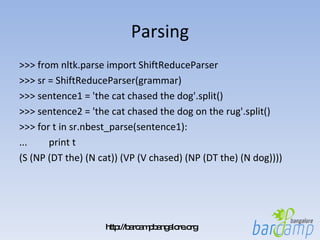
Parsing >>> from nltk.parse import ShiftReduceParser >>> sr = ShiftReduceParser(grammar) >>> sentence1 = 'the cat chased the dog'.split() >>> sentence2 = 'the cat chased the dog on the rug'.split() >>> for t in sr.nbest_parse(sentence1): ...  print t (S (NP (DT the) (N cat)) (VP (V chased) (NP (DT the) (N dog))))
Authorship Attribution An Example
Find nltk @  <python-installation>\Lib\site-packages\nltk
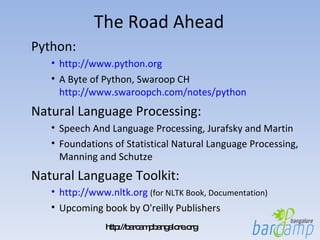
The Road Ahead Python:  http://www.python.org A Byte of Python, Swaroop CH  http://www.swaroopch.com/notes/python Natural Language Processing: Speech And Language Processing, Jurafsky and Martin Foundations of Statistical Natural Language Processing, Manning and Schutze Natural Language Toolkit: http://www.nltk.org   (for NLTK Book, Documentation) Upcoming book by O'reilly Publishers

NLTK: Natural Language Processing made easy

  • 1.
    NLTK Natural LanguageProcessing made easy Elvis Joel D’Souza Gopikrishnan Nambiar Ashutosh Pandey
  • 2.
    WHAT: Session ObjectiveTo introduce Natural Language Toolkit(NLTK), an open source library which simplifies the implementation of Natural Language Processing(NLP) in Python.
  • 3.
    HOW: Session LayoutThis session is divided into 3 parts: Python – The programming language Natural Language Processing (NLP) – The concept Natural Language Toolkit (NLTK) – The tool for NLP implementation in Python
  • 4.
  • 5.
  • 6.
    Data Structures Pythonhas 4 built-in data structures: List Tuple Dictionary Set
  • 7.
    List A listin Python is an ordered group of items (or elements ). It is a very general structure, and list elements don't have to be of the same type. listOfWords = [‘this’,’is’,’a’,’list’,’of’,’words’] listOfRandomStuff = [1,’pen’,’costs’,’Rs.’,6.50]
  • 8.
    Tuple A tuplein Python is much like a list except that it is immutable (unchangeable) once created. They are generally used for data which should not be edited. Example: ( 100 , 10 , 0.01 ,’ hundred ’) Number Square root Reciprocal Number in words
  • 9.
    Return a tupledef func (x,y): # code to compute a and b return (a,b) One very useful situation is returning multiple values from a function. To return multiple values in many other languages requires creating an object or container of some type.
  • 10.
    Dictionary A dictionaryin python is a collection of unordered values which are accessed by key . Example: Here, the key is the character and the value is its position in the alphabet { 1 : ‘ one ’, 2 : ‘ two ’, 3 : ‘ three ’}
  • 11.
    Sets Python alsohas an implementation of the mathematical set. Unlike sequence objects such as lists and tuples, in which each element is indexed, a set is an unordered collection of objects. Sets also cannot have duplicate members - a given object appears in a set 0 or 1 times. SetOfBrowsers=set([‘IE’,’Firefox’,’Opera’,’Chrome’])
  • 12.
  • 13.
  • 14.
    Loop Control -While number = 10
  • 15.
  • 16.
    Functions - Syntaxdef functionname (arg1, arg2, ...): statement1 statement2 return variable
  • 17.
  • 18.
    Modules A moduleis a file containing Python definitions and statements. The file name is the module name with the suffix .py appended. A module can be imported by another program to make use of its functionality.
  • 19.
    Import import math The import keyword is used to tell Python, that we need the ‘math’ module. This statement makes all the functions in this module accessible in the program.
  • 20.
    Using Modules –An Example print math. sqrt( 100 ) sqrt is a function math is a module math.sqrt(100) returns 10 This is being printed to the standard output
  • 21.
  • 22.
    Natural Language ProcessingThe term natural language processing encompasses a broad set of techniques for automated generation, manipulation, and analysis of natural or human languages
  • 23.
    Why NLP Applicationsfor processing large amounts of texts require NLP expertise Index and search large texts Speech understanding Information extraction Automatic summarization
  • 24.
    Stemming Stemming isthe process for reducing inflected (or sometimes derived) words to their stem, base or root form – generally a written word form. The stem need not be identical to the morphological root of the word; it is usually sufficient that related words map to the same stem, even if this stem is not in itself a valid root. When you apply stemming on 'cats', the result is 'cat'
  • 25.
    Part of speechtagging(POS Tagging) Part-of-speech (POS) tag: A word can be classified into one or more lexical or part-of-speech categories such as nouns, verbs, adjectives, and articles, to name a few. A POS tag is a symbol representing such a lexical category, e.g., NN (noun), VB (verb), JJ (adjective), AT (article).
  • 26.
    POS tagging -continued Given a sentence and a set of POS tags, a common language processing task is to automatically assign POS tags to each word in the sentence. State-of-the-art POS taggers can achieve accuracy as high as 96%.
  • 27.
    POS Tagging –An Example The ball is red NOUN VERB ADJECTIVE ARTICLE
  • 28.
    Parsing Parsing asentence involves the use of linguistic knowledge of a language to discover the way in which a sentence is structured
  • 29.
    Parsing– An ExampleThe boy went home NOUN VERB NOUN ARTICLE NP VP The boy went home
  • 30.
    Challenges We willoften imply additional information in spoken language by the way we place stress on words. The sentence &quot;I never said she stole my money&quot; demonstrates the importance stress can play in a sentence, and thus the inherent difficulty a natural language processor can have in parsing it.
  • 31.
    Depending on whichword the speaker places the stress, sentences could have several distinct meanings Here goes an example…
  • 32.
    &quot; I never said she stole my money“ Someone else said it, but I didn't. &quot;I never said she stole my money“ I simply didn't ever say it. &quot;I never said she stole my money&quot; I might have implied it in some way, but I never explicitly said it. &quot;I never said she stole my money&quot; I said someone took it; I didn't say it was she.
  • 33.
    &quot;I never saidshe stole my money&quot; I just said she probably borrowed it. &quot;I never said she stole my money&quot; I said she stole someone else's money. &quot;I never said she stole my money &quot; I said she stole something, but not my money
  • 34.
  • 35.
  • 36.
    Exploring Corpora Corpusis a large collection of text which is used to either train an NLP program or is used as input by an NLP program In NLTK , a corpus can be loaded using the PlainTextCorpusReader Class
  • 37.
  • 38.
    Loading your owncorpus >>> from nltk.corpus import PlaintextCorpusReader corpus_root = ‘C:\text\’ >>> wordlists = PlaintextCorpusReader(corpus_root, '.*‘) >>> wordlists.fileids() ['README', 'connectives', 'propernames', 'web2', 'web2a', 'words'] >>> wordlists.words('connectives') ['the', 'of', 'and', 'to', 'a', 'in', 'that', 'is', ...]
  • 39.
    NLTK Corpora Gutenbergcorpus Brown corpus Wordnet Stopwords Shakespeare corpus Treebank And many more…
  • 40.
    Computing with Language:Simple Statistics Frequency Distributions >>> fdist1 = FreqDist(text1) >>> fdist1 [2] <FreqDist with 260819 outcomes> >>> vocabulary1 = fdist1.keys() >>> vocabulary1[:50] [',', 'the', '.', 'of', 'and', 'a', 'to', ';', 'in', 'that', &quot;'&quot;, '-', 'his', 'it', 'I', 's', 'is', 'he', 'with', 'was', 'as', '&quot;', 'all', 'for', 'this', '!', 'at', 'by', 'but', 'not', '--', 'him', 'from', 'be', 'on', 'so', 'whale', 'one', 'you', 'had', 'have', 'there', 'But', 'or', 'were', 'now', 'which', '?', 'me', 'like'] >>> fdist1['whale'] 906
  • 41.
    Cumulative Frequency Plotfor 50 Most Frequently Words in Moby Dick
  • 42.
  • 43.
  • 44.
    Parsing >>> fromnltk.parse import ShiftReduceParser >>> sr = ShiftReduceParser(grammar) >>> sentence1 = 'the cat chased the dog'.split() >>> sentence2 = 'the cat chased the dog on the rug'.split() >>> for t in sr.nbest_parse(sentence1): ... print t (S (NP (DT the) (N cat)) (VP (V chased) (NP (DT the) (N dog))))
  • 45.
  • 46.
    Find nltk @ <python-installation>\Lib\site-packages\nltk
  • 47.
    The Road AheadPython: http://www.python.org A Byte of Python, Swaroop CH http://www.swaroopch.com/notes/python Natural Language Processing: Speech And Language Processing, Jurafsky and Martin Foundations of Statistical Natural Language Processing, Manning and Schutze Natural Language Toolkit: http://www.nltk.org (for NLTK Book, Documentation) Upcoming book by O'reilly Publishers