Bio-IT World Asia Meeting, 7th June 2012              Scott Edmunds


Data dissemination in the era of “big data”
William Gibson: "Information is the currency of the future world”

Sir Tim Berners-Lee: "Data is a precious thing and will last longer than the systems
themselves”


                    www.gigasciencejournal.com
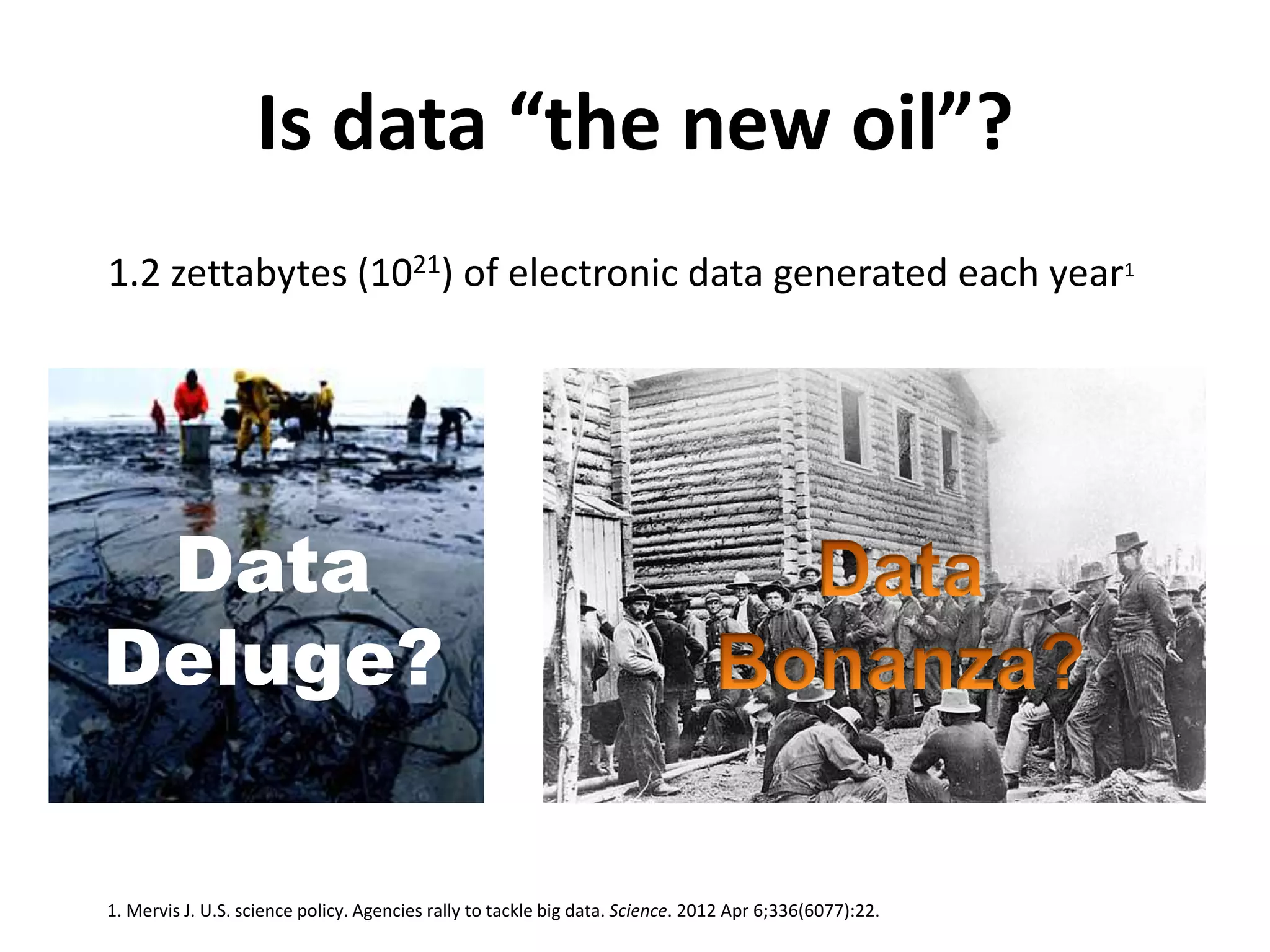
Is data “the new oil”?
1.2 zettabytes (1021) of electronic data generated each year1


 Data
Deluge?

1. Mervis J. U.S. science policy. Agencies rally to tackle big data. Science. 2012 Apr 6;336(6077):22.
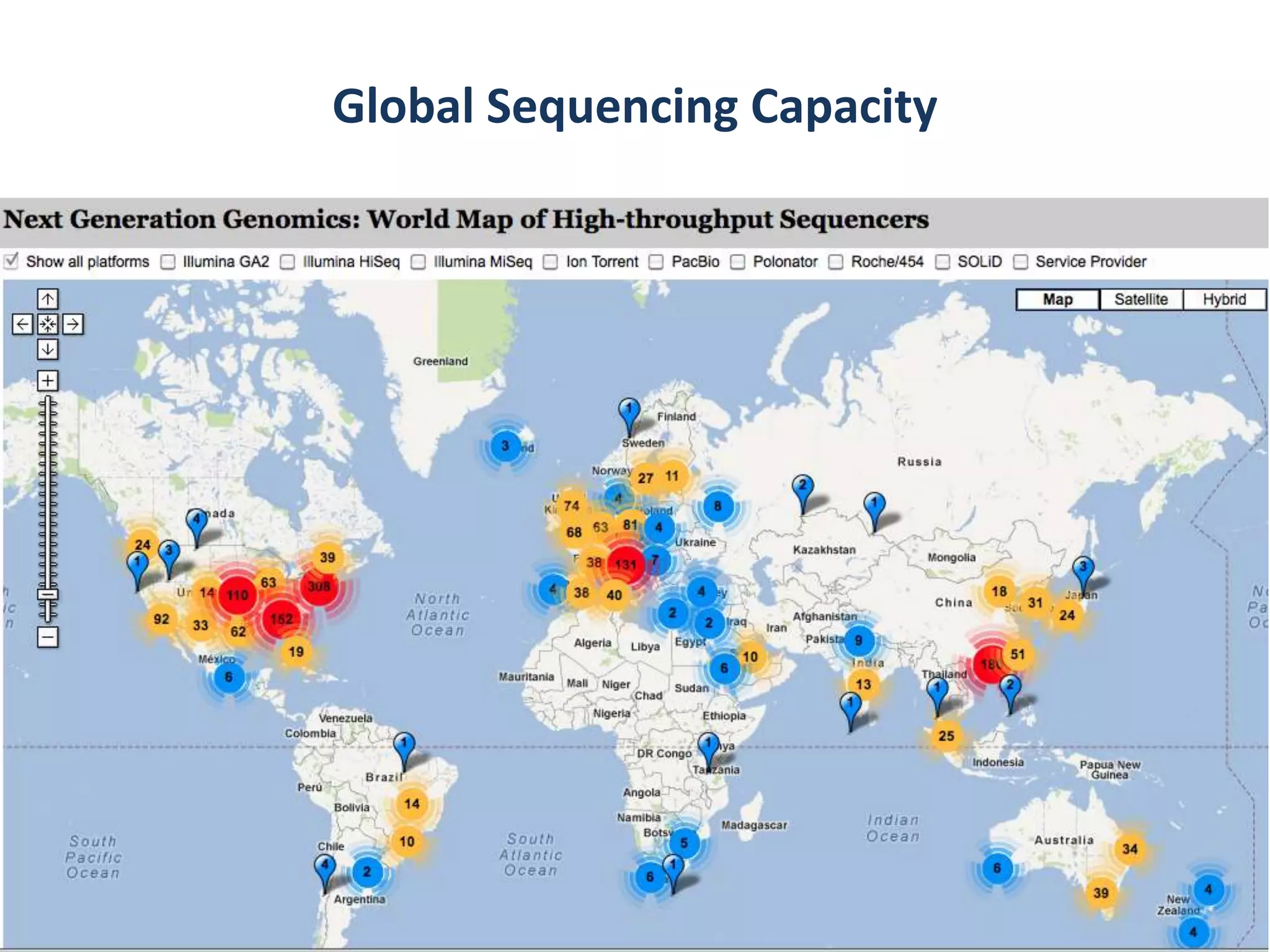
Global Sequencing Capacity


                        Data Production
                          5.6 Tb / day
                > 1500X of human genome / day

                Multiple Supercomputing Centers
                       157 TB   Flops
                       20 TB Memory
                       14.7 PB Storage
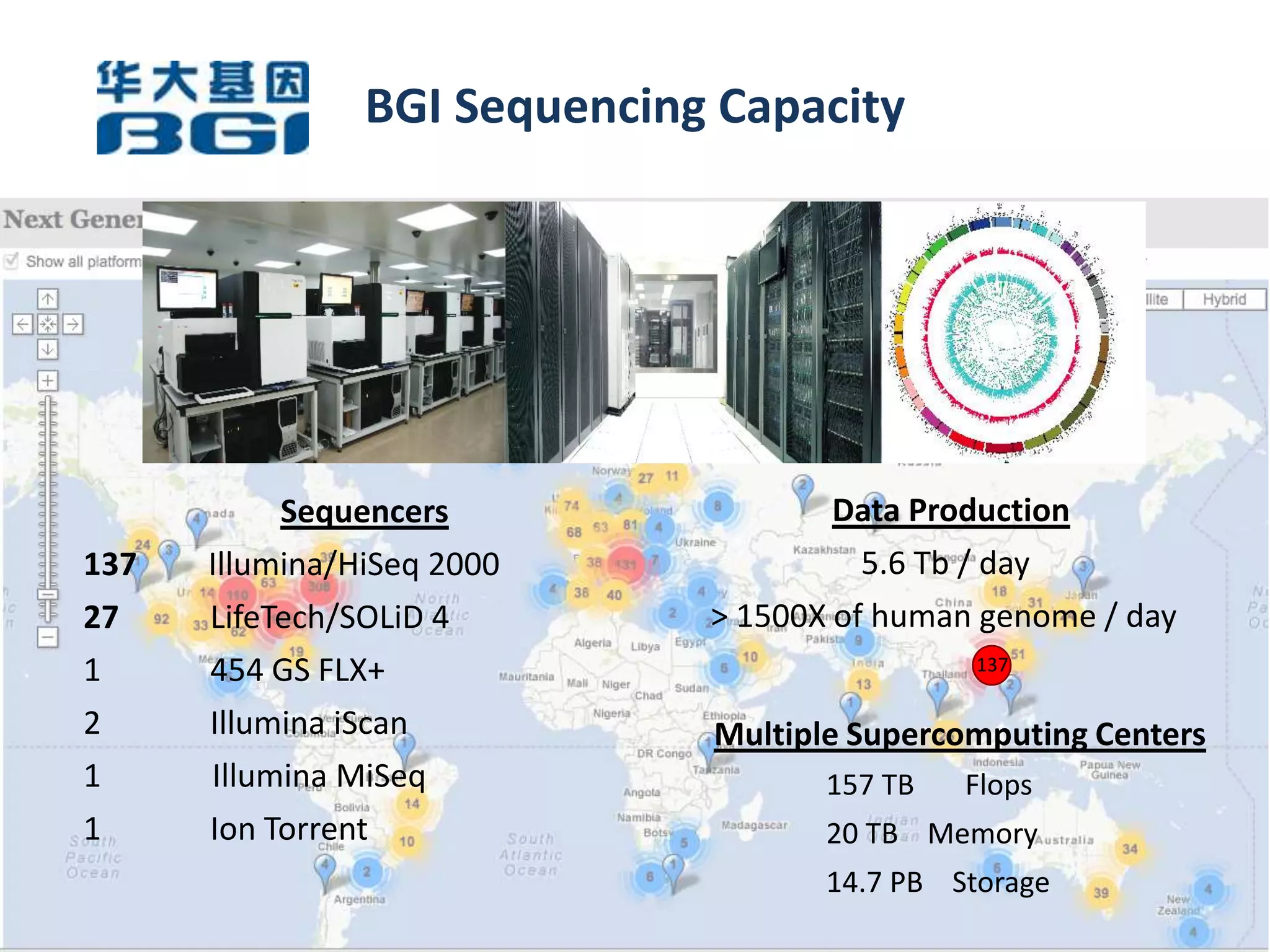
BGI Sequencing Capacity


           Sequencers                 Data Production
137   Illumina/HiSeq 2000               5.6 Tb / day
27    LifeTech/SOLiD 4        > 1500X of human genome / day
1     454 GS FLX+                              137

2     Illumina iScan          Multiple Supercomputing Centers
1     Illumina MiSeq                 157 TB   Flops
1     Ion Torrent                    20 TB Memory
                                     14.7 PB Storage
Now taking submissions…


    Large-Scale Data:
Journal/Database/Platform
      In conjunction with:

Editor-in-Chief: Laurie Goodman, PhD
Editor: Scott Edmunds, PhD
Assistant Editor: Alexandra Basford, PhD
Lead BioCurator: Tam Sneddon, Dphil
Data Platform: Peter Li, PhD
    www.gigasciencejournal.com
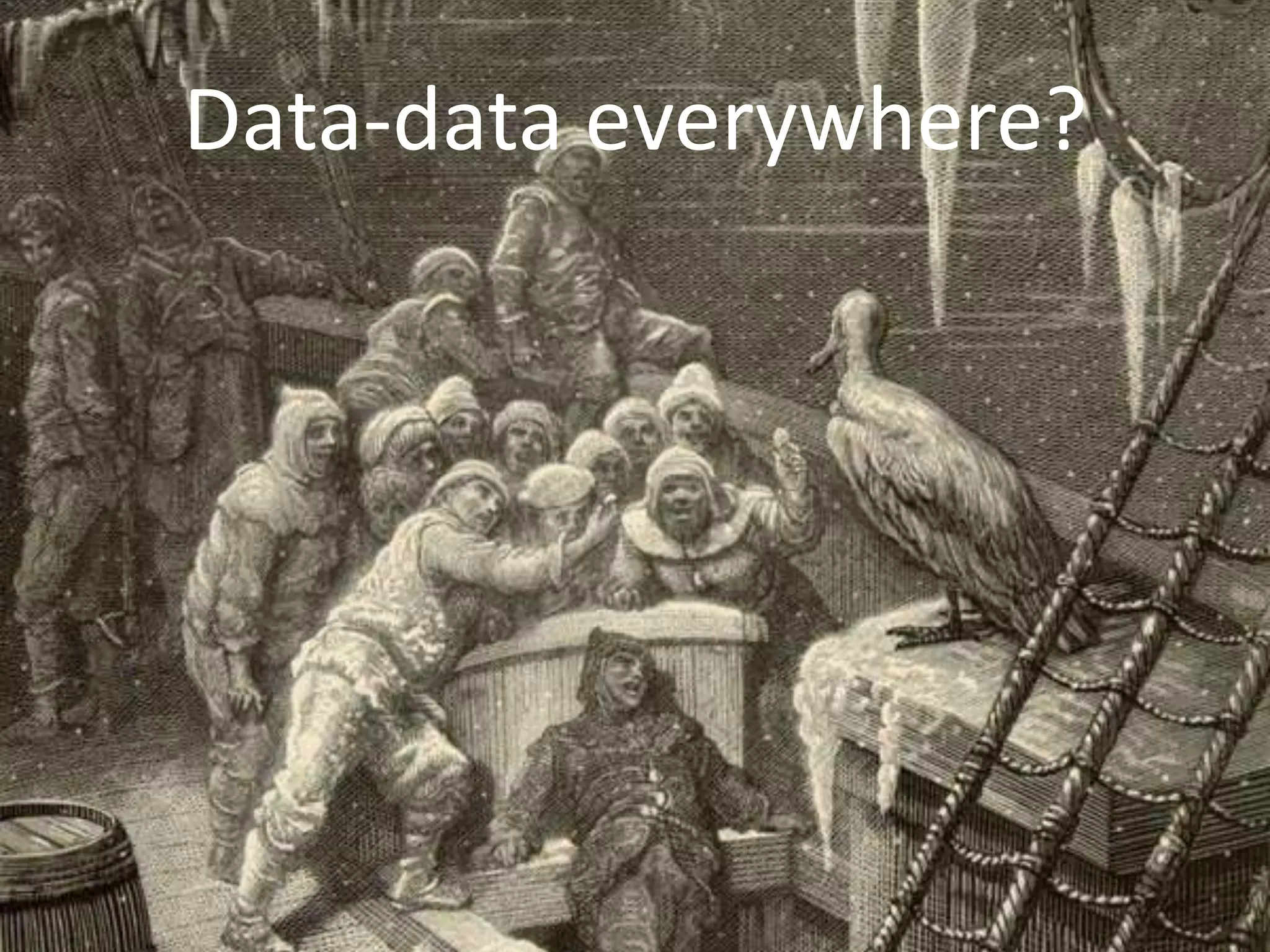
Data-data everywhere?
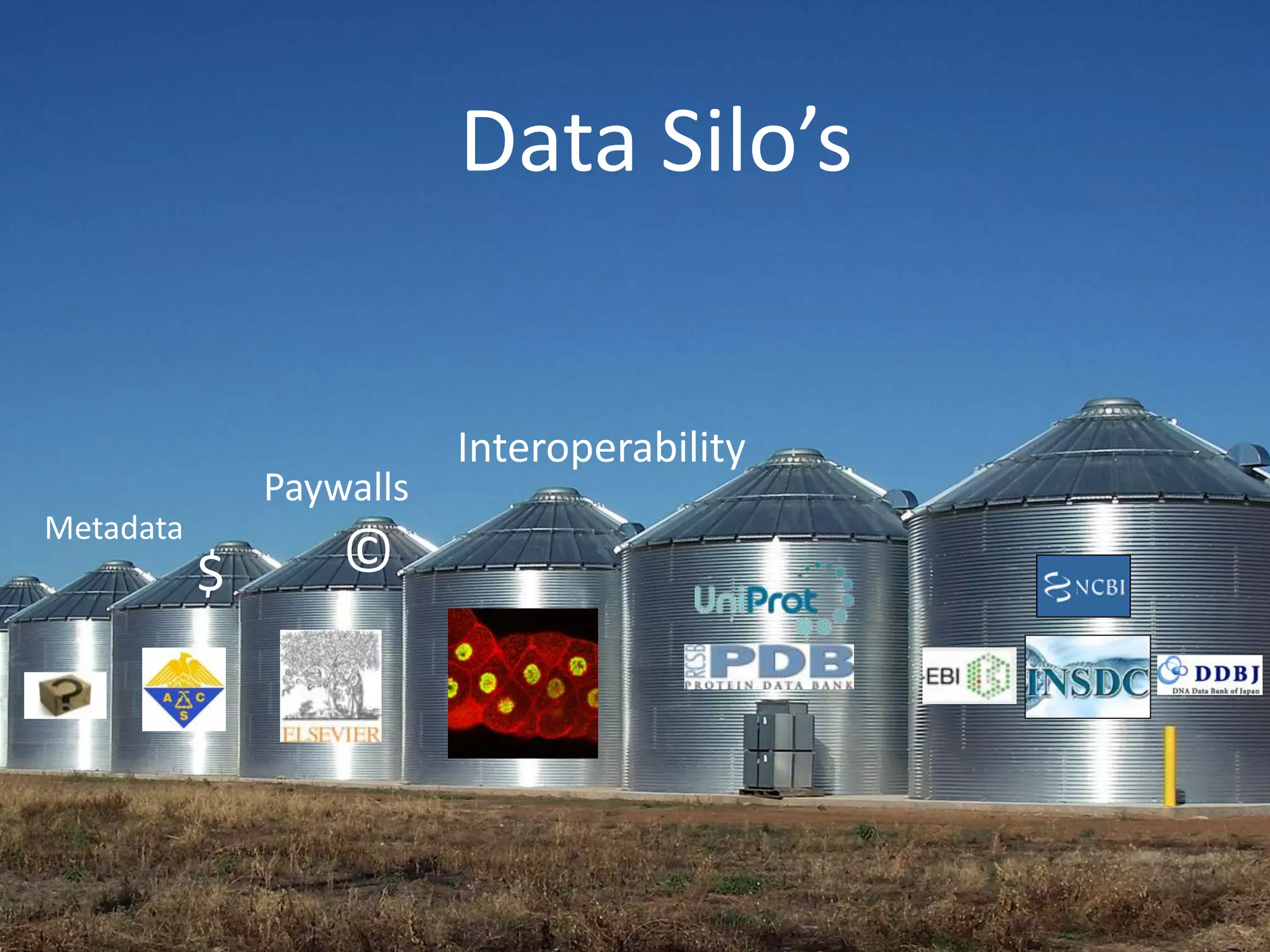
Data Silo’s


                          Interoperability
               Paywalls
Metadata
           $       ©
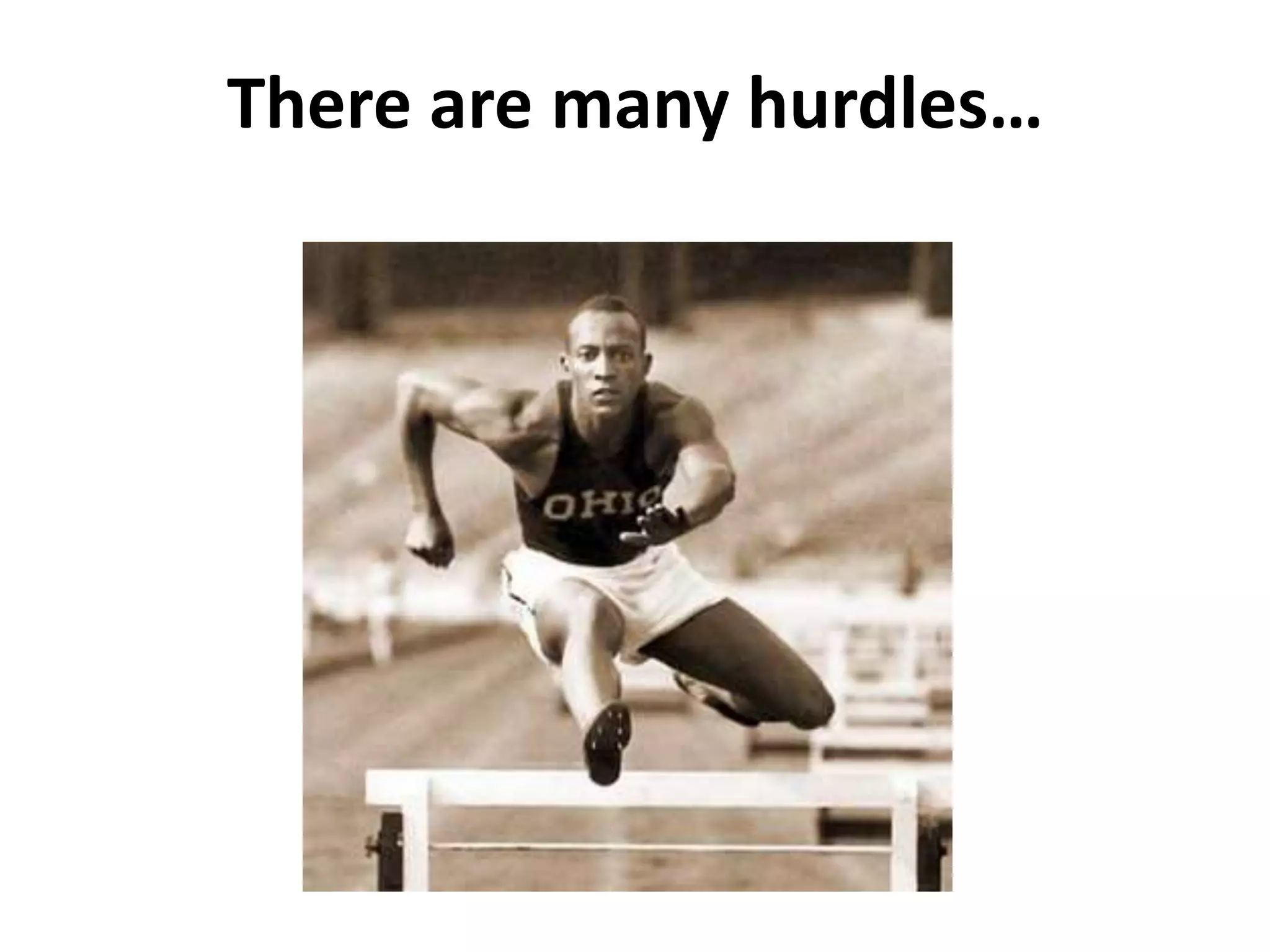
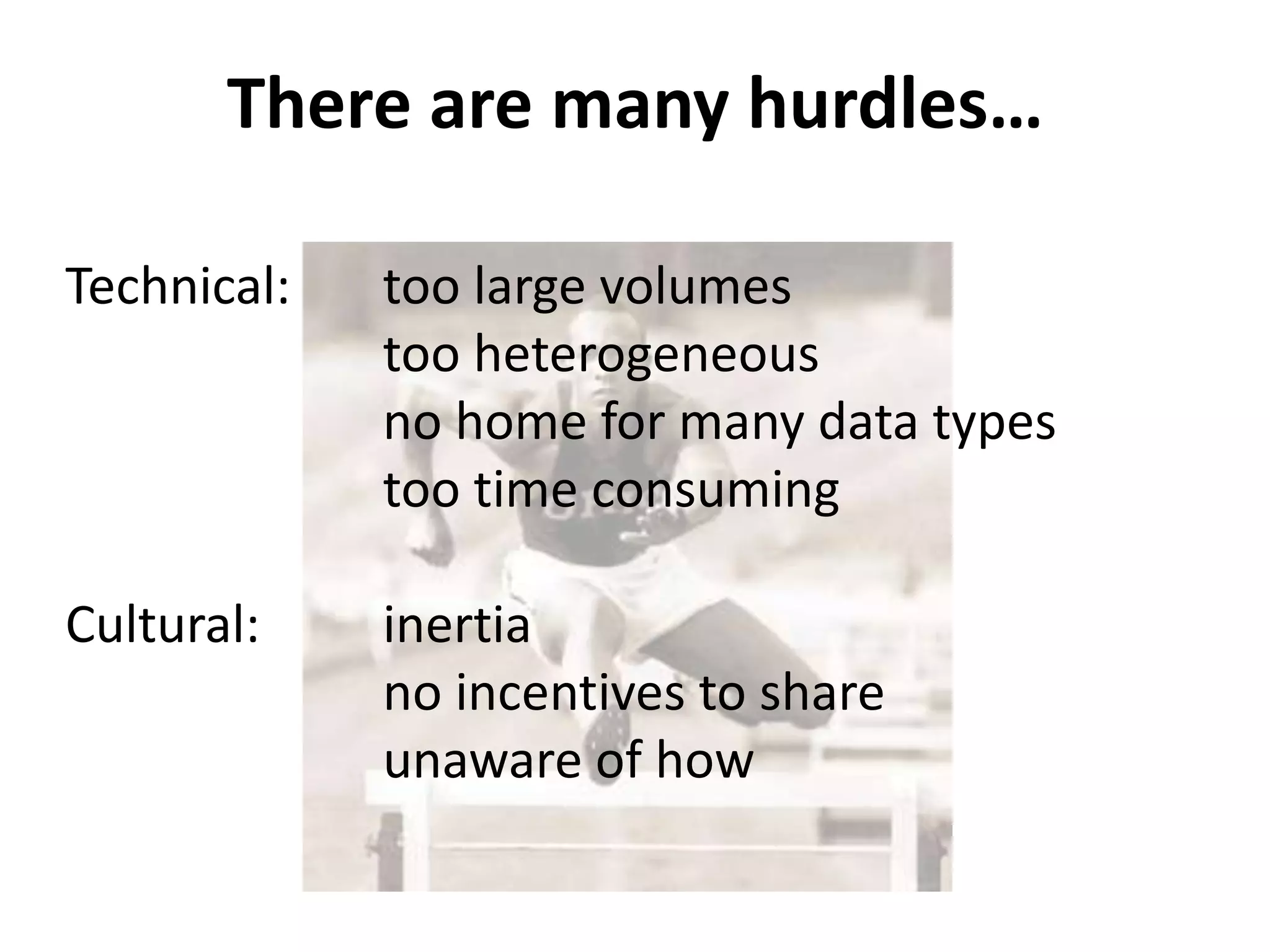
There are many hurdles…


          ?
There are many hurdles…

Technical:   too large volumes
             too heterogeneous
             no home for many data types
             too time consuming

Cultural:    inertia
             no incentives to share
             unaware of how
                      ?
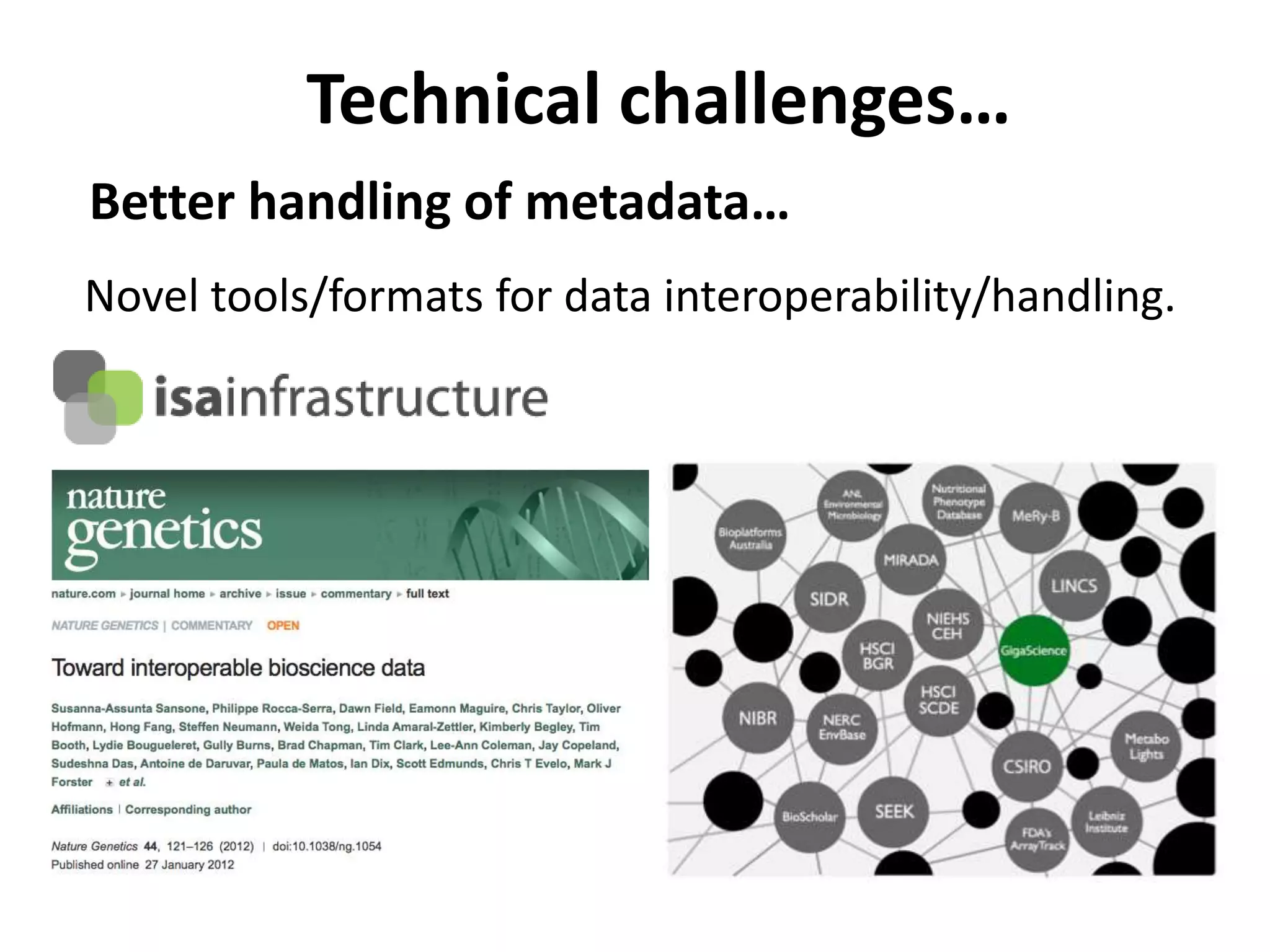
Technical challenges…
Better handling of metadata…
Novel tools/formats for data interoperability/handling.
       Cloud
     solutions?
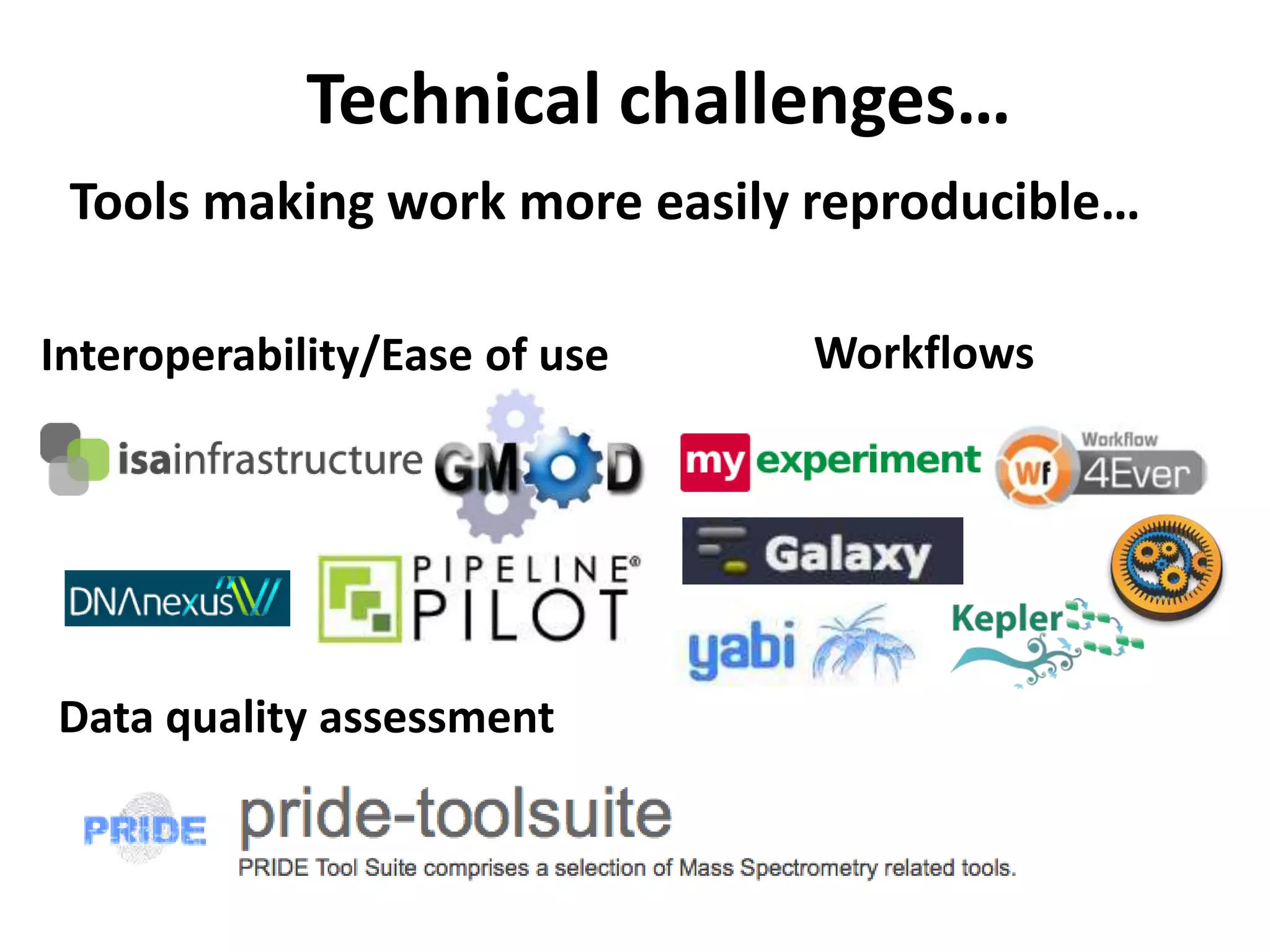
Technical challenges…
 Tools making work more easily reproducible…

Interoperability/Ease of use   Workflows


Data quality assessment
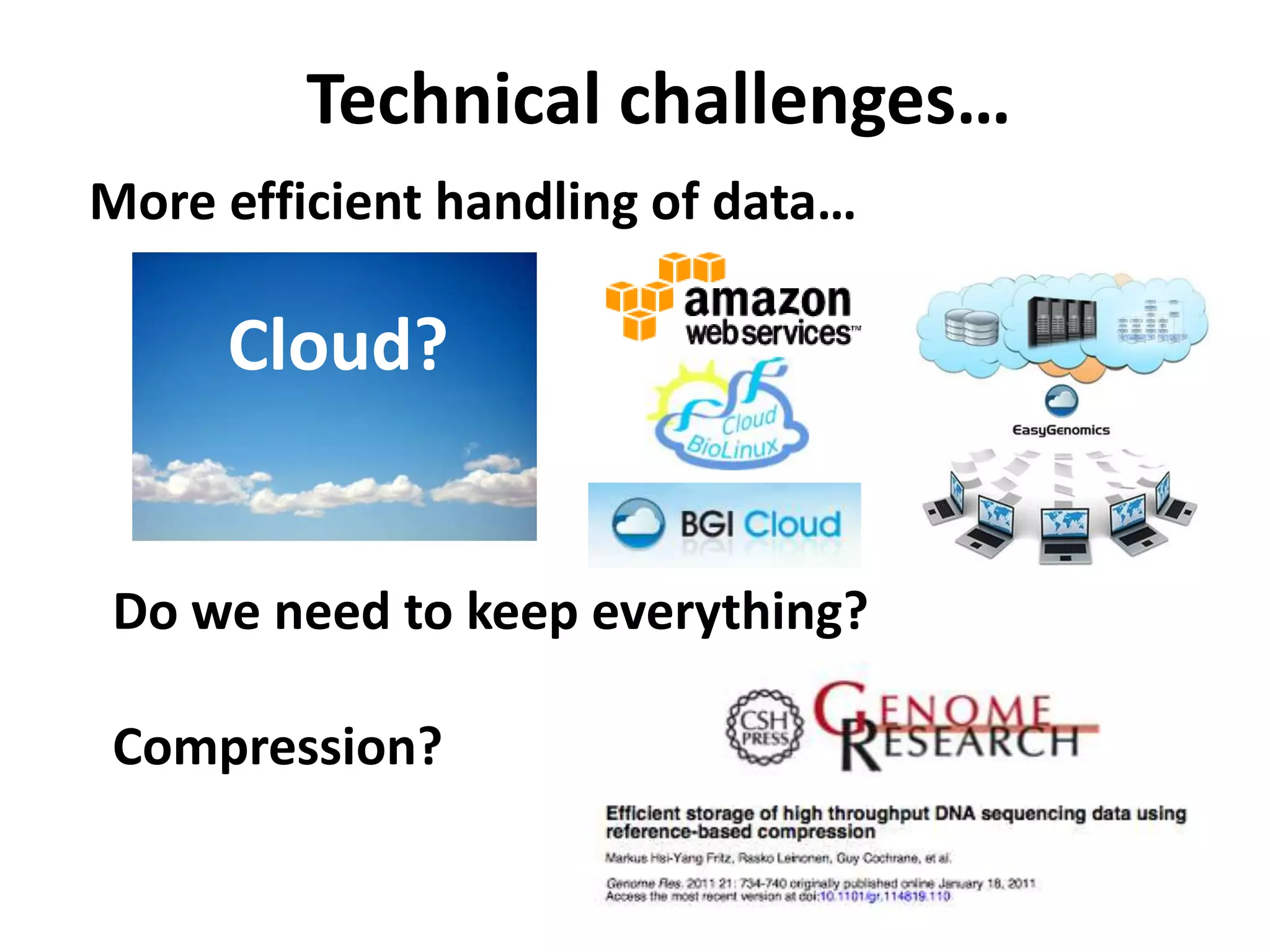
Technical challenges…
More efficient handling of data…

     Cloud?


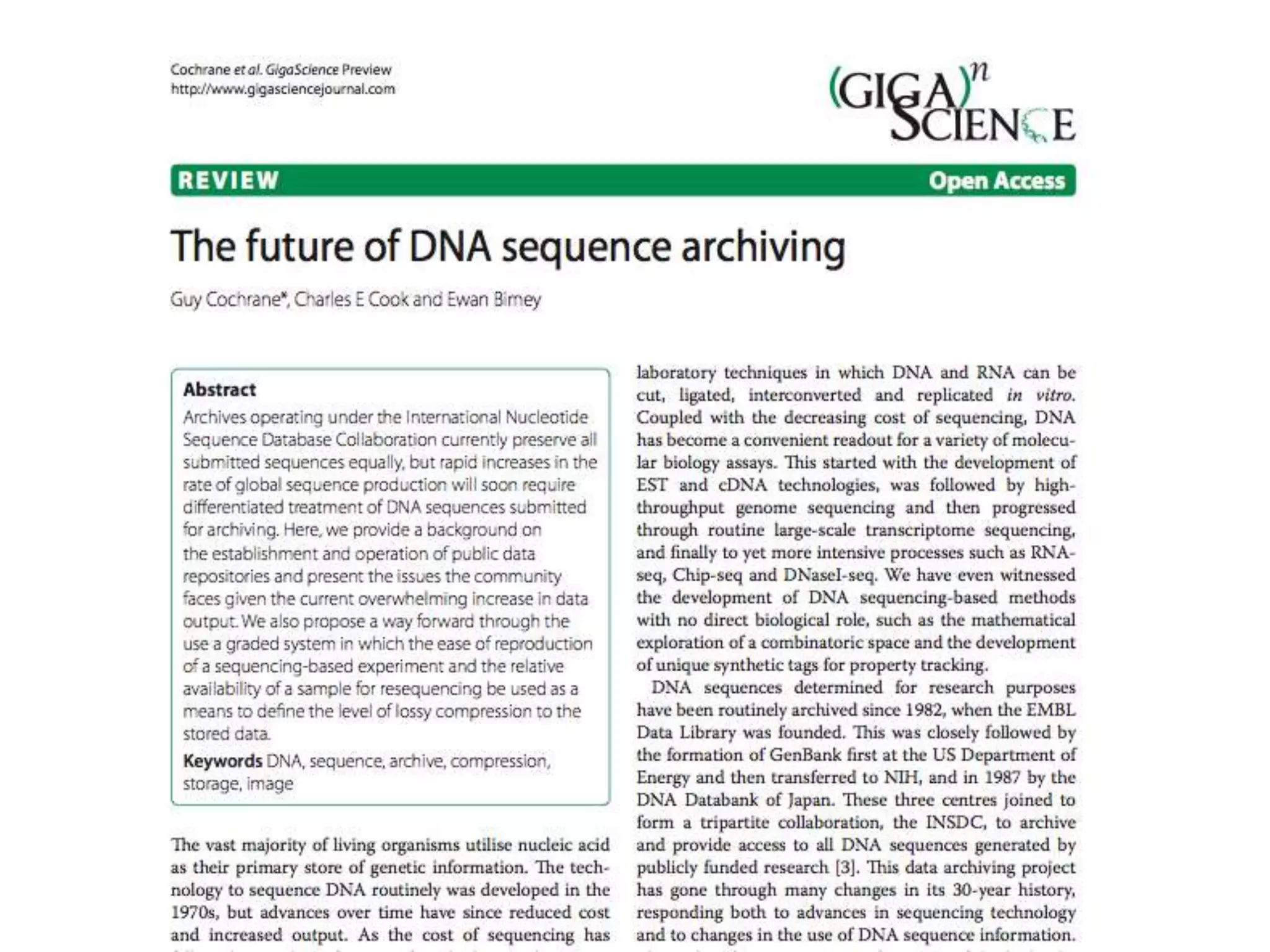
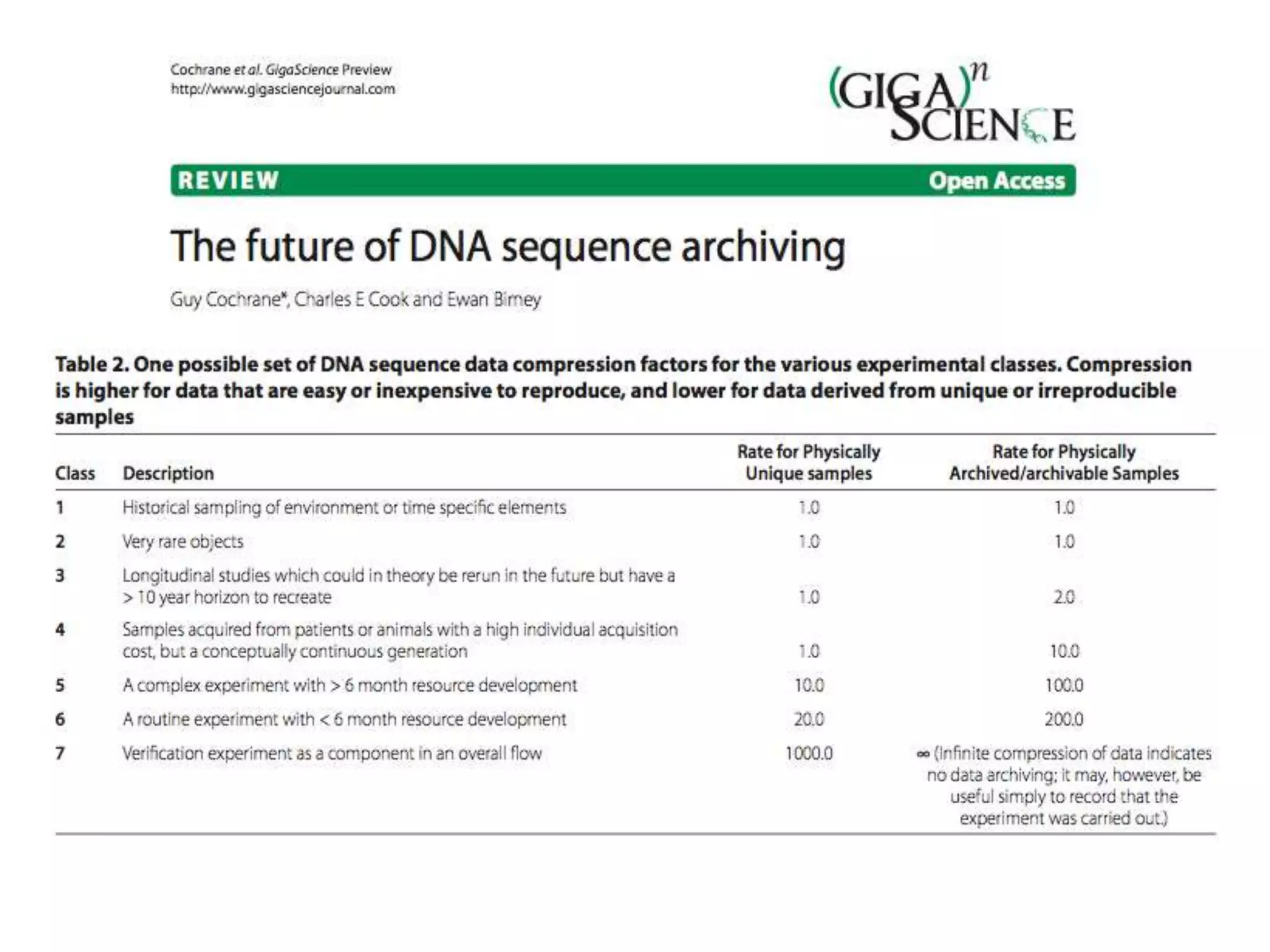
Do we need to keep everything?

Compression?
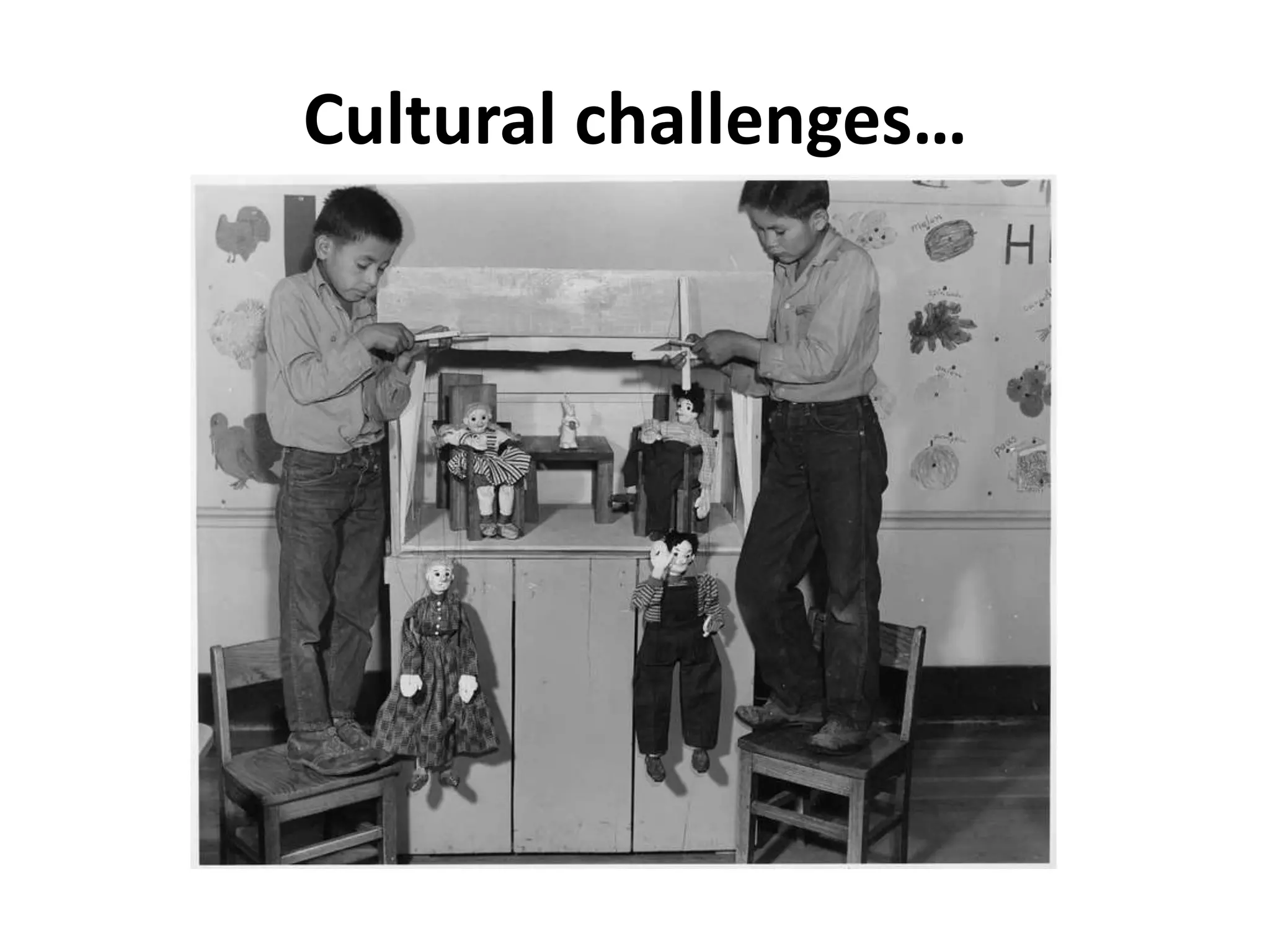
Cultural challenges…
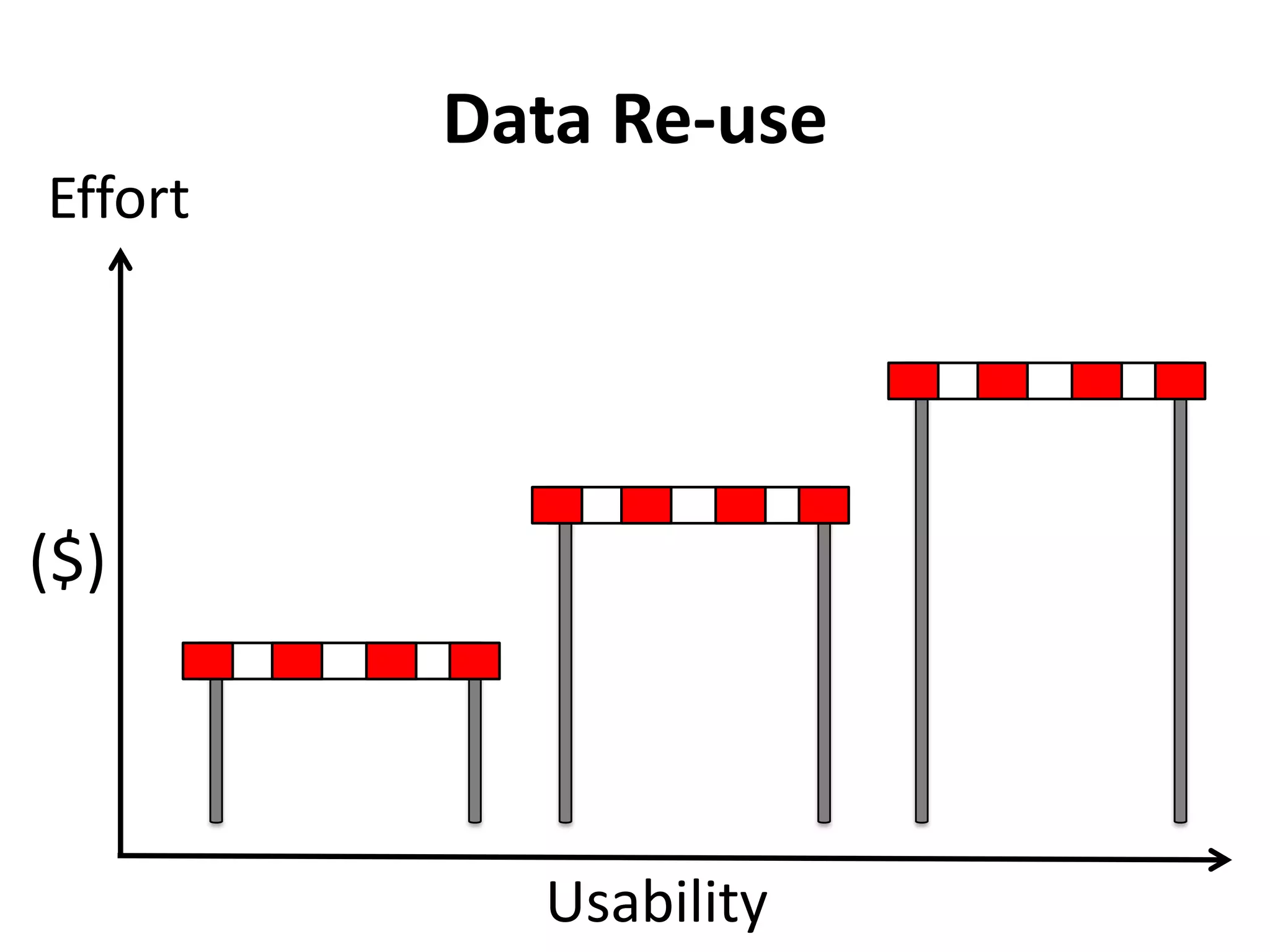
Data Re-use
Effort


($)


           Usability
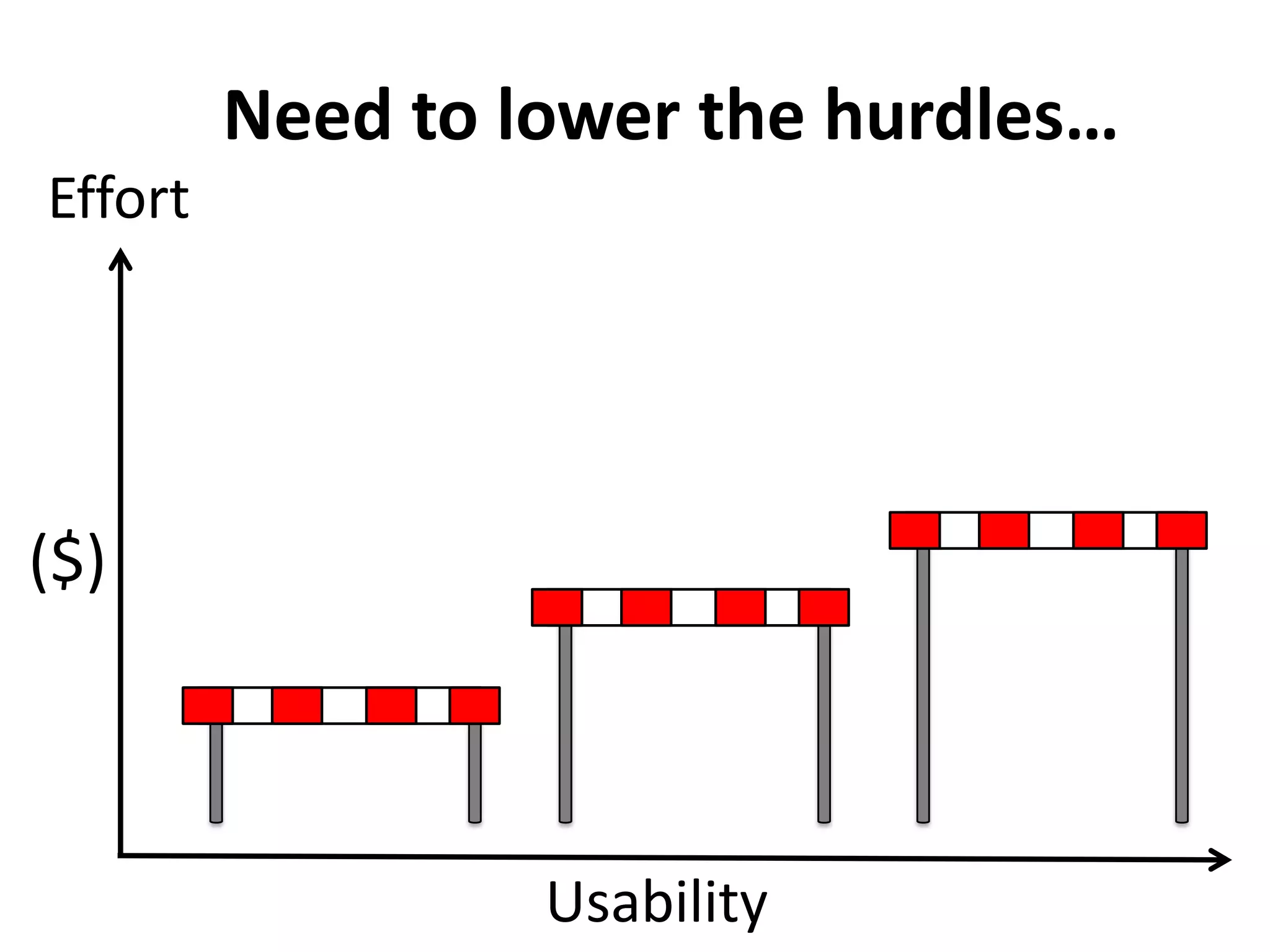
Need to lower the hurdles…
Effort


($)


                  Usability
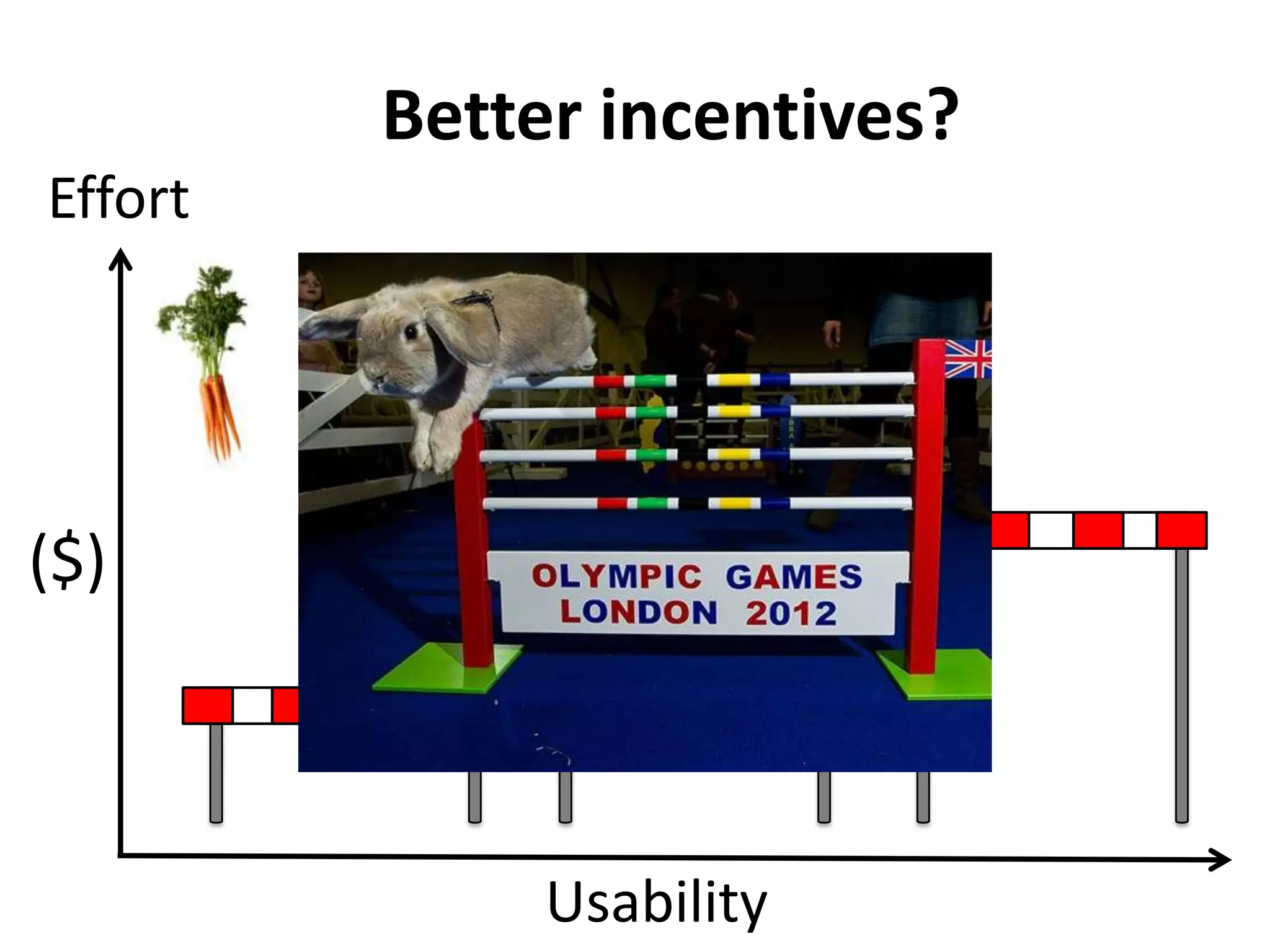
Better incentives?
Effort


($)


              Usability
Incentives/credit
Credit where credit is overdue:
“One option would be to provide researchers who release data to
public repositories with a means of accreditation.”
“An ability to search the literature for all online papers that used a
particular data set would enable appropriate attribution for those
who share. “
Nature Biotechnology 27, 579 (2009)


Prepublication data sharing
(Toronto International Data Release Workshop)
“Data producers benefit from creating a citable reference, as it can
later be used to reflect impact of the data sets.”
Nature 461, 168-170 (2009)
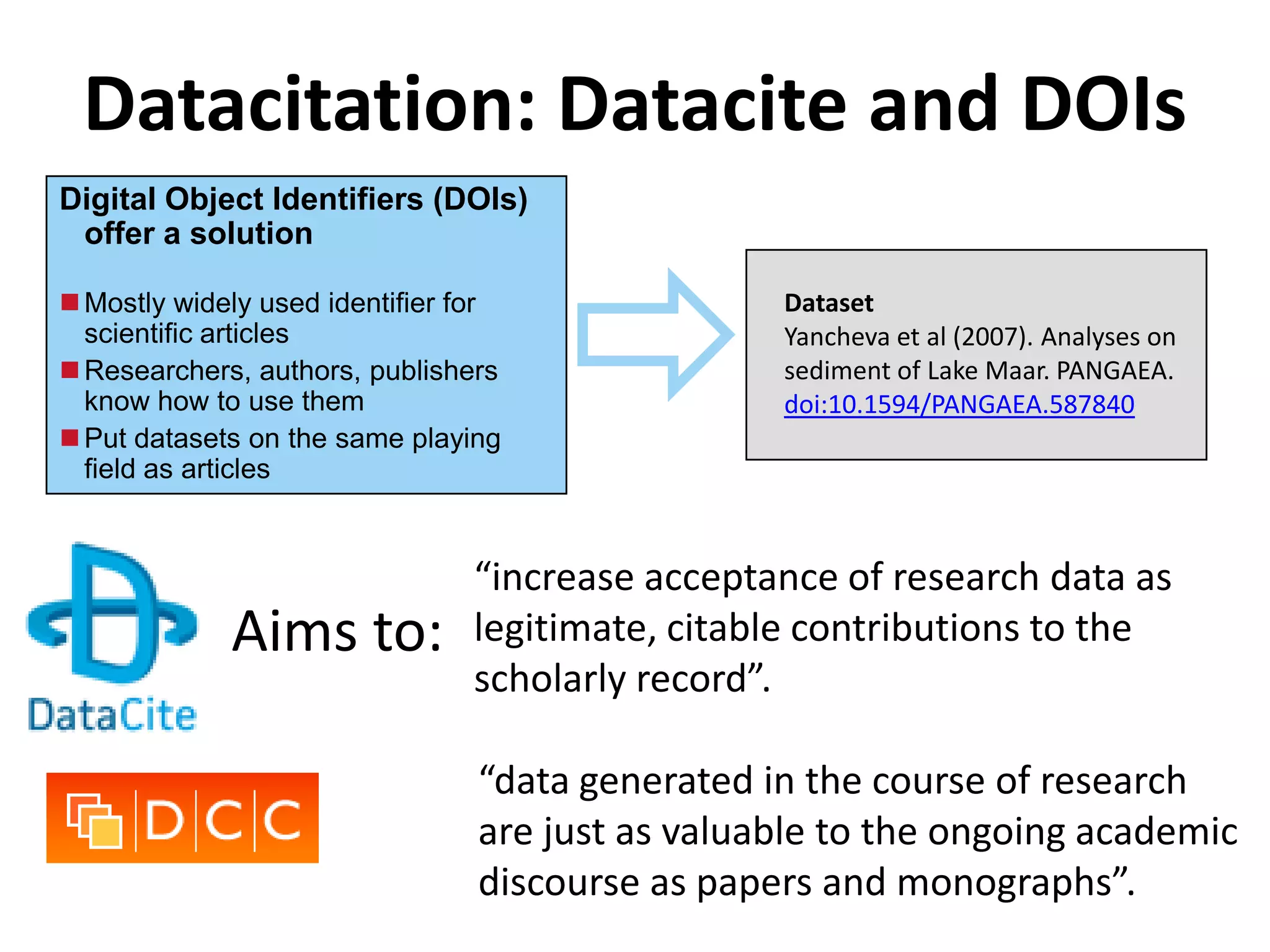
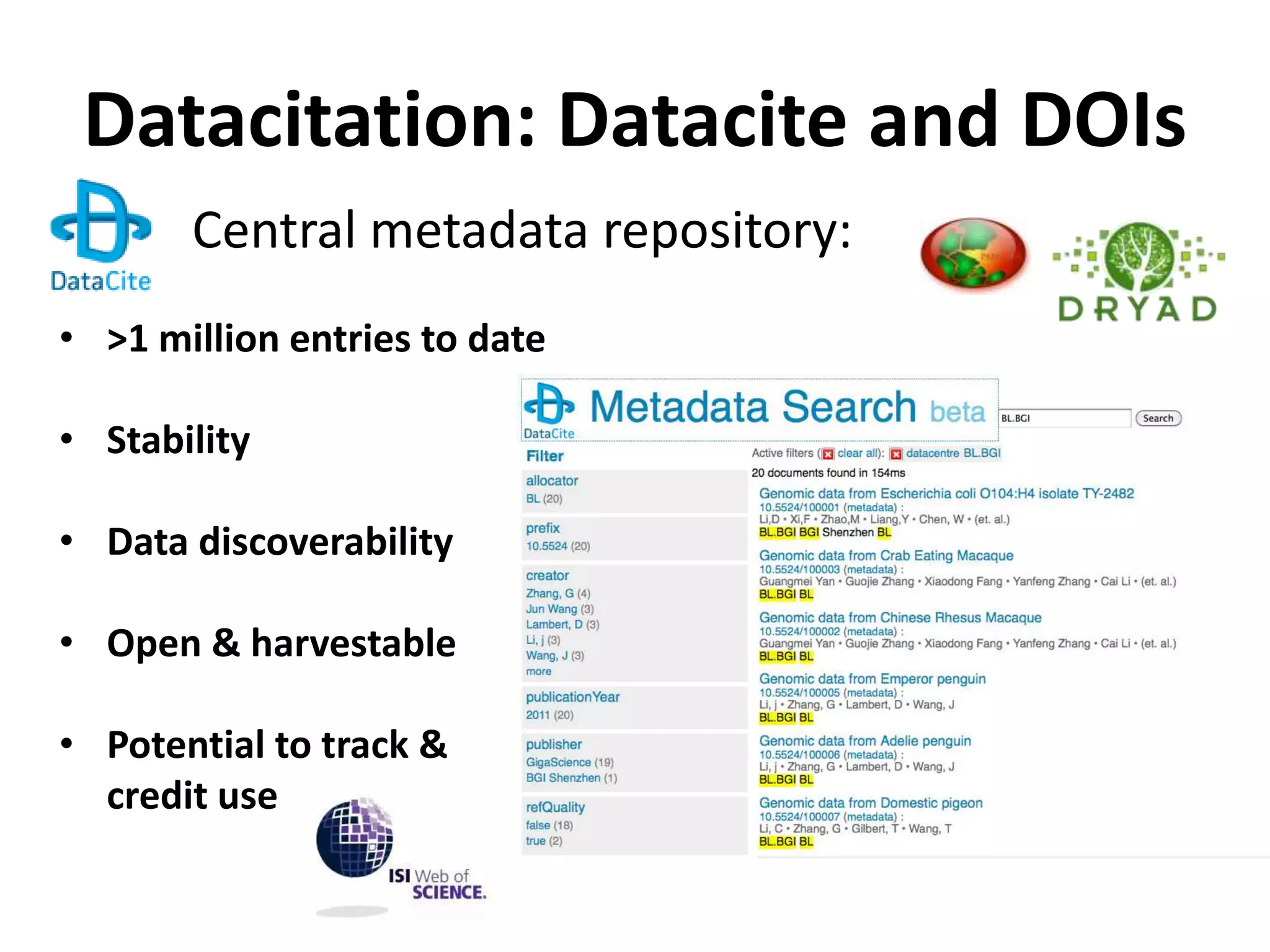
Datacitation: Datacite and DOIs
Digital Object Identifiers (DOIs)


                                      
 offer a solution

 Mostly widely used identifier for               Dataset
  scientific articles                             Yancheva et al (2007). Analyses on
 Researchers, authors, publishers                sediment of Lake Maar. PANGAEA.
  know how to use them                            doi:10.1594/PANGAEA.587840
 Put datasets on the same playing
  field as articles


                                “increase acceptance of research data as
             Aims to:           legitimate, citable contributions to the
                                scholarly record”.

                                 “data generated in the course of research
                                 are just as valuable to the ongoing academic
                                 discourse as papers and monographs”.
Datacitation: Datacite and DOIs
       Central metadata repository:
• >1 million entries to date

• Stability

• Data discoverability

• Open & harvestable

• Potential to track &
  credit use
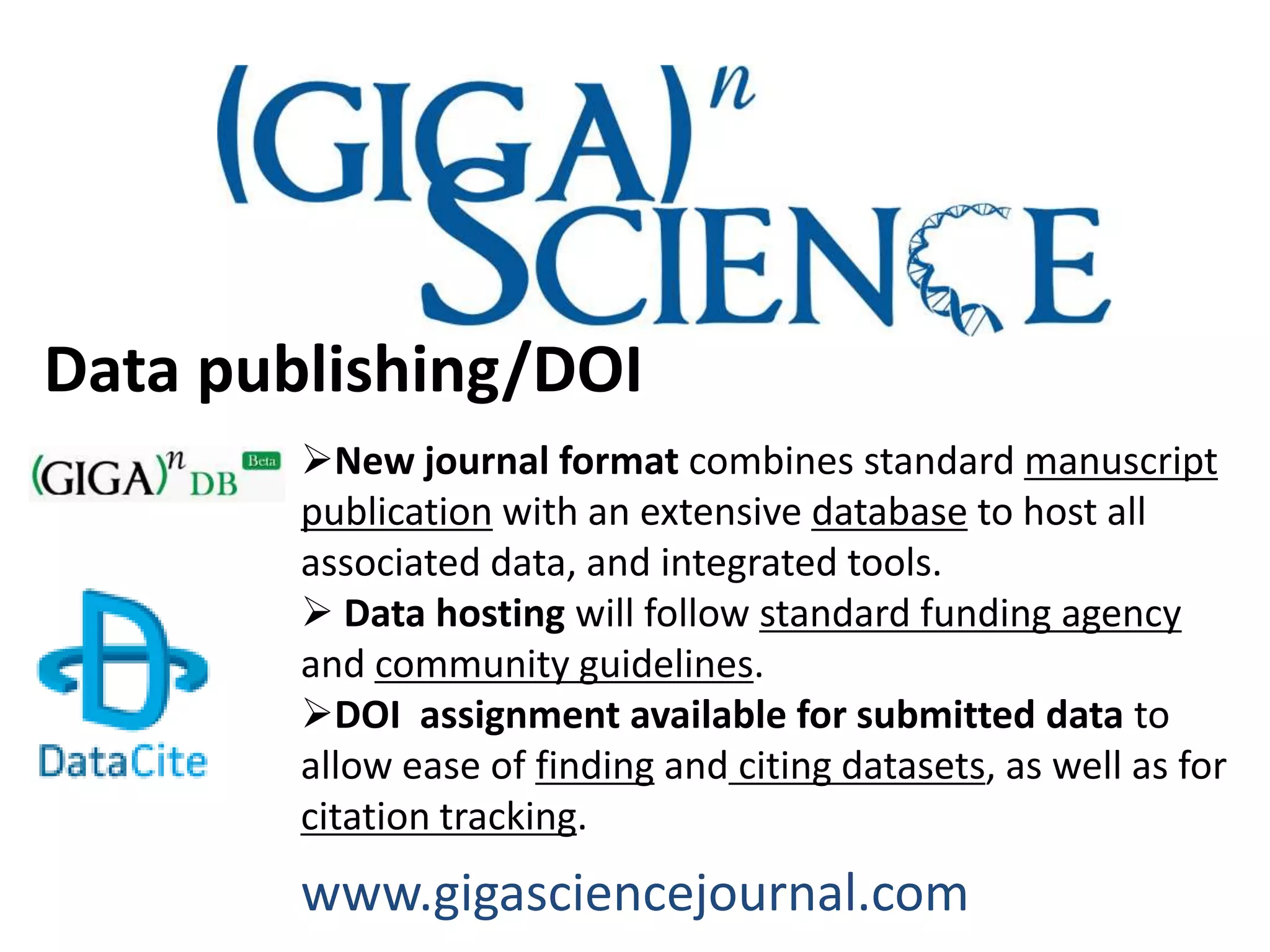
Data publishing/DOI
        New journal format combines standard manuscript
        publication with an extensive database to host all
        associated data, and integrated tools.
         Data hosting will follow standard funding agency
        and community guidelines.
        DOI assignment available for submitted data to
        allow ease of finding and citing datasets, as well as for
        citation tracking.
        www.gigasciencejournal.com
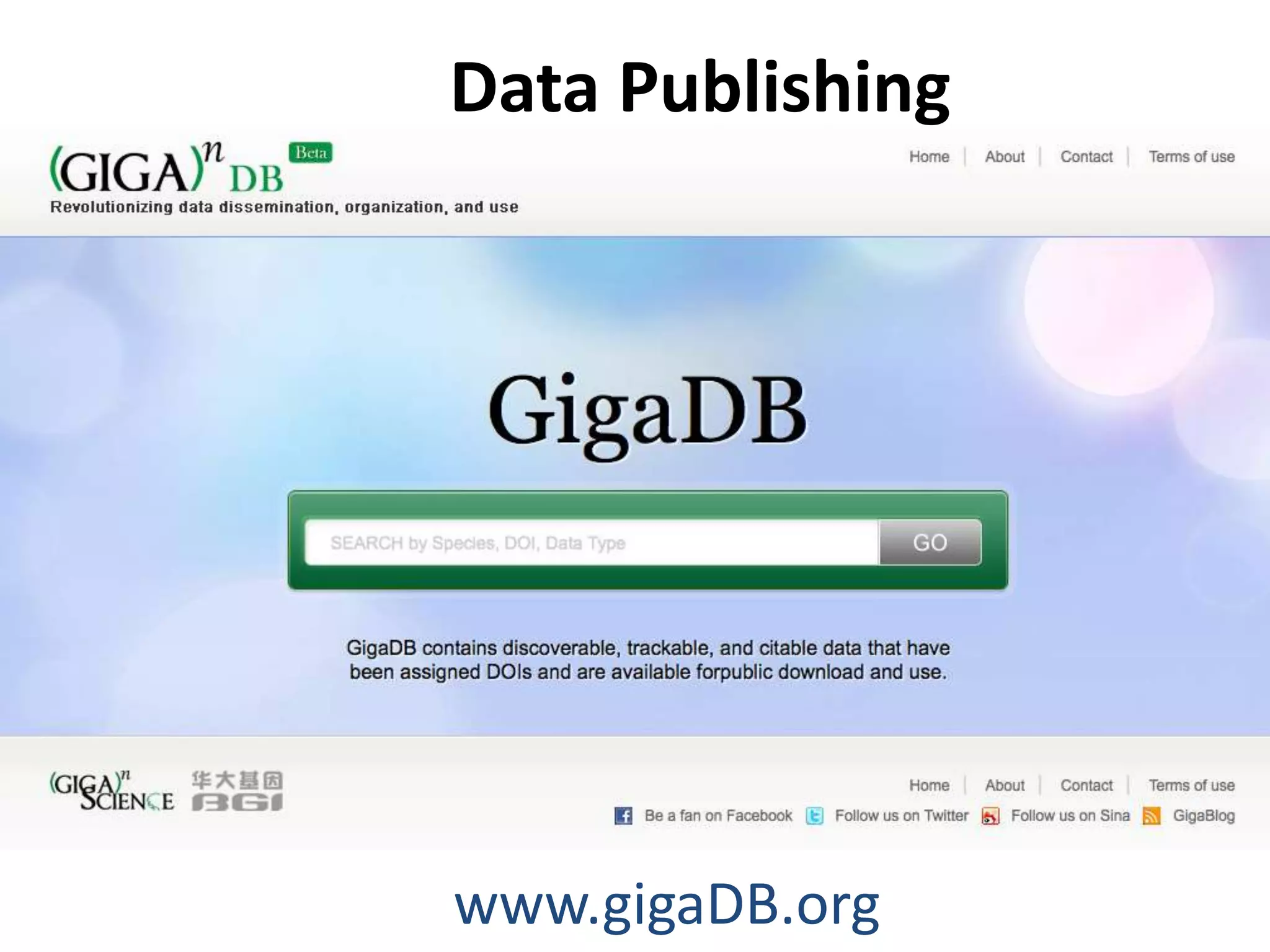
Data Publishing


www.gigaDB.org
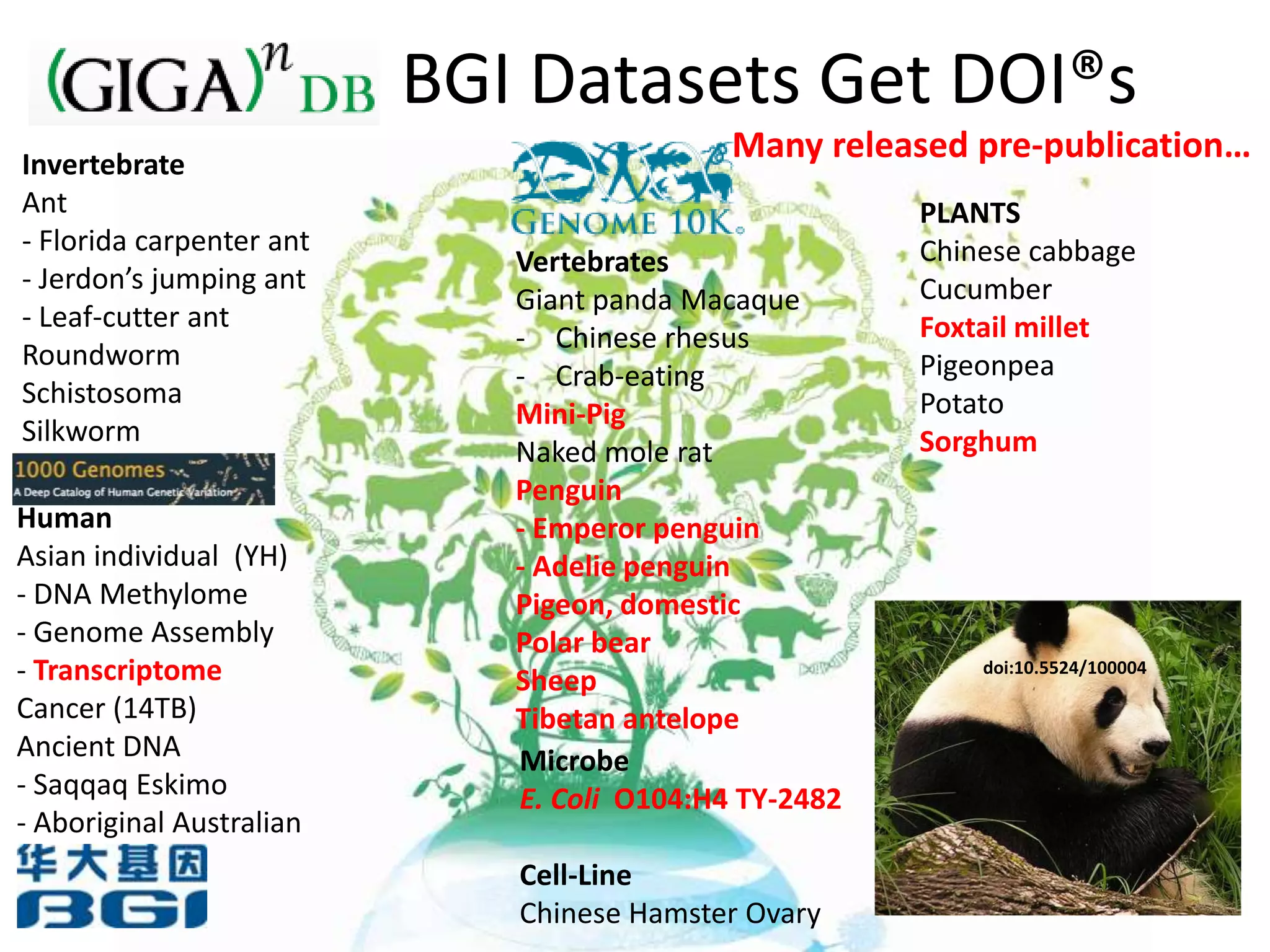
BGI Datasets Get DOI®s
Invertebrate
                                            Many released pre-publication…
Ant                                                    PLANTS
- Florida carpenter ant                                Chinese cabbage
                             Vertebrates
- Jerdon’s jumping ant                                 Cucumber
                             Giant panda Macaque
- Leaf-cutter ant                                      Foxtail millet
                             - Chinese rhesus
Roundworm                                              Pigeonpea
                             - Crab-eating
Schistosoma                                            Potato
                             Mini-Pig
Silkworm                                               Sorghum
                             Naked mole rat
                             Penguin
Human                        - Emperor penguin
Asian individual (YH)        - Adelie penguin
- DNA Methylome              Pigeon, domestic
- Genome Assembly            Polar bear
- Transcriptome              Sheep
                                                           doi:10.5524/100004

Cancer (14TB)                Tibetan antelope
Ancient DNA                  Microbe
- Saqqaq Eskimo              E. Coli O104:H4 TY-2482
- Aboriginal Australian
                             Cell-Line
                             Chinese Hamster Ovary
For data citation to work, needs:

• Proven utility/potential user base.

• Acceptance/inclusion by journals.

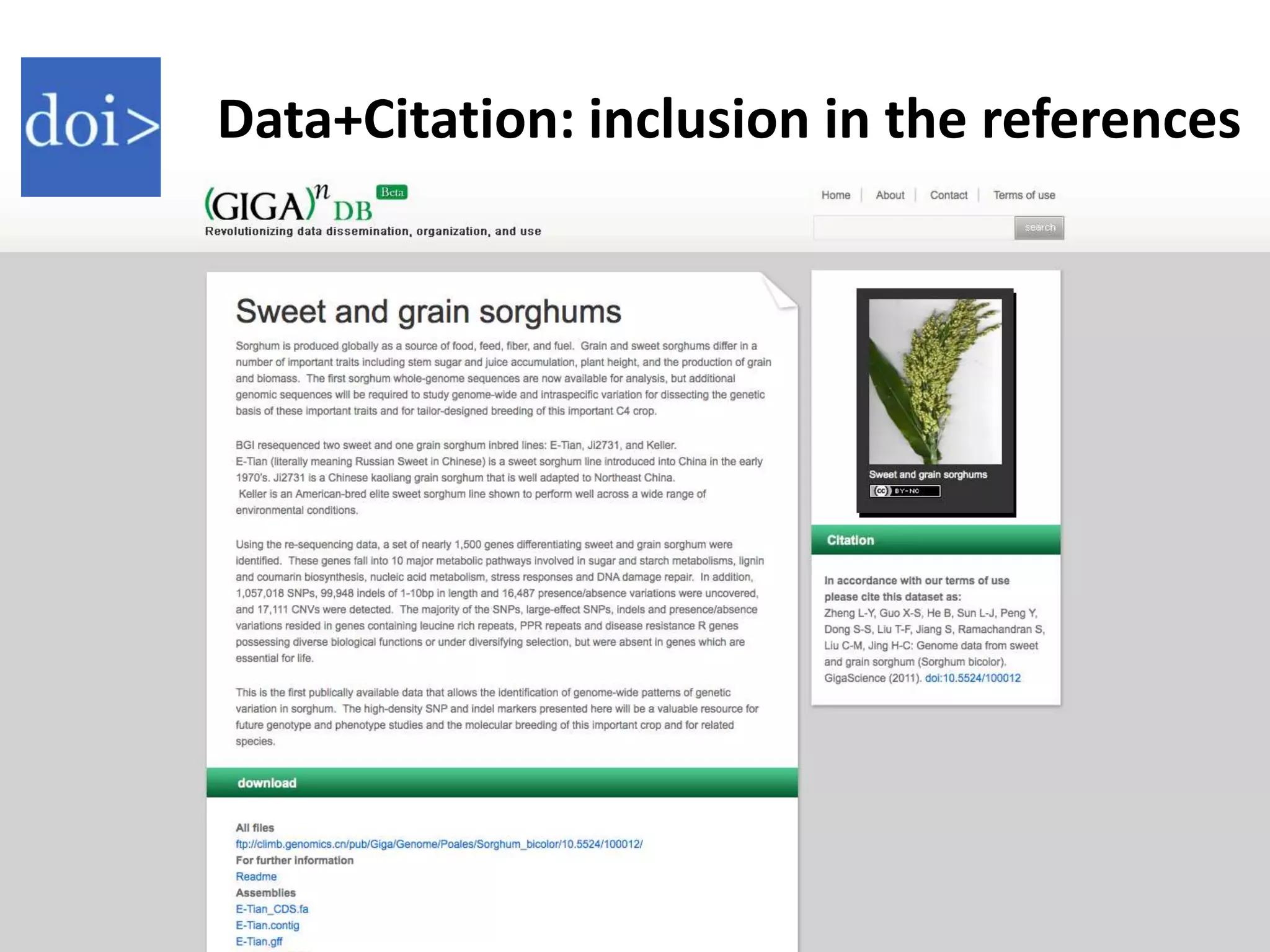
• Data+Citation: inclusion in the references.

• Tracking by citation indexes.

• Usage of the metrics by the community…
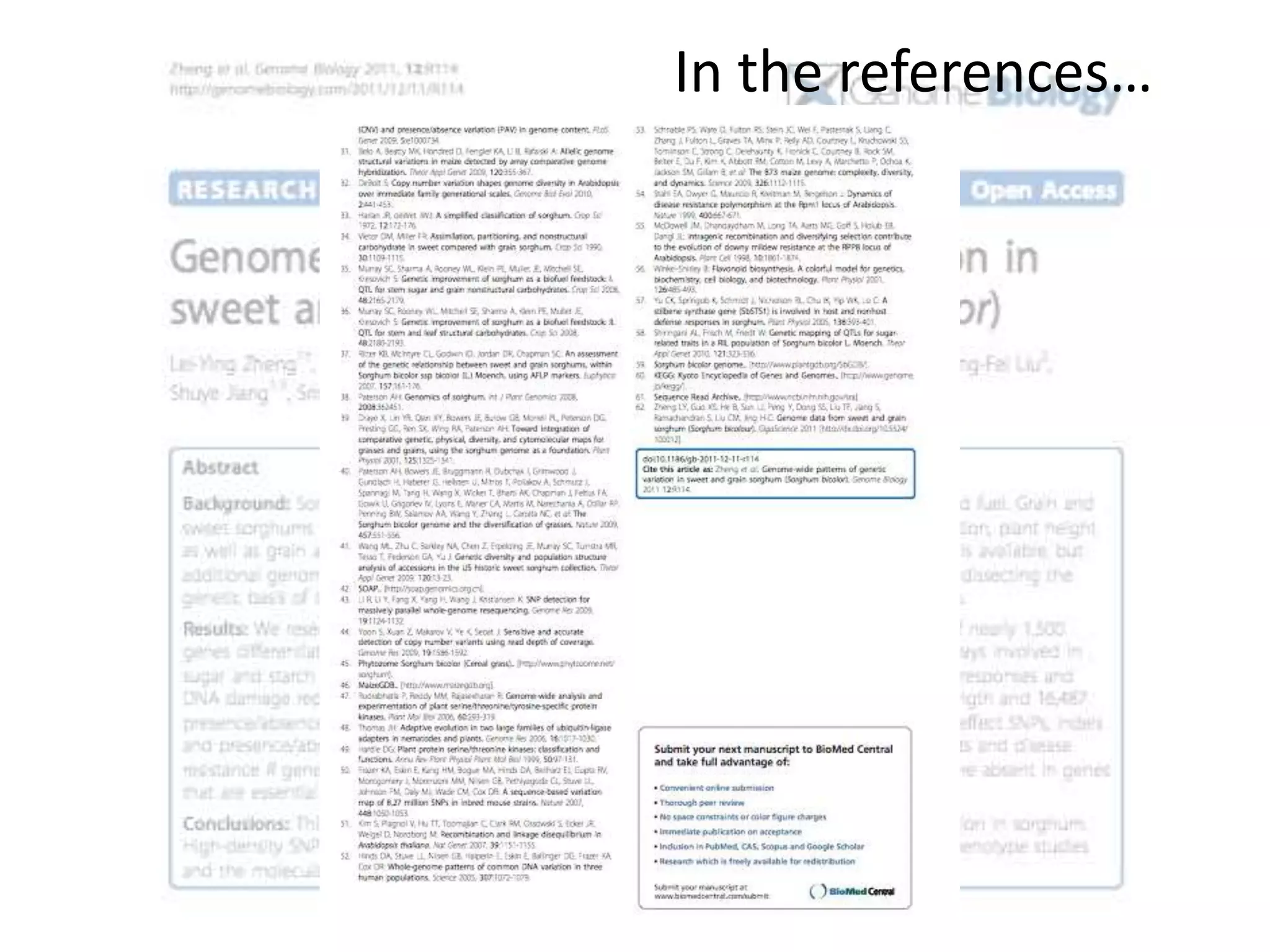
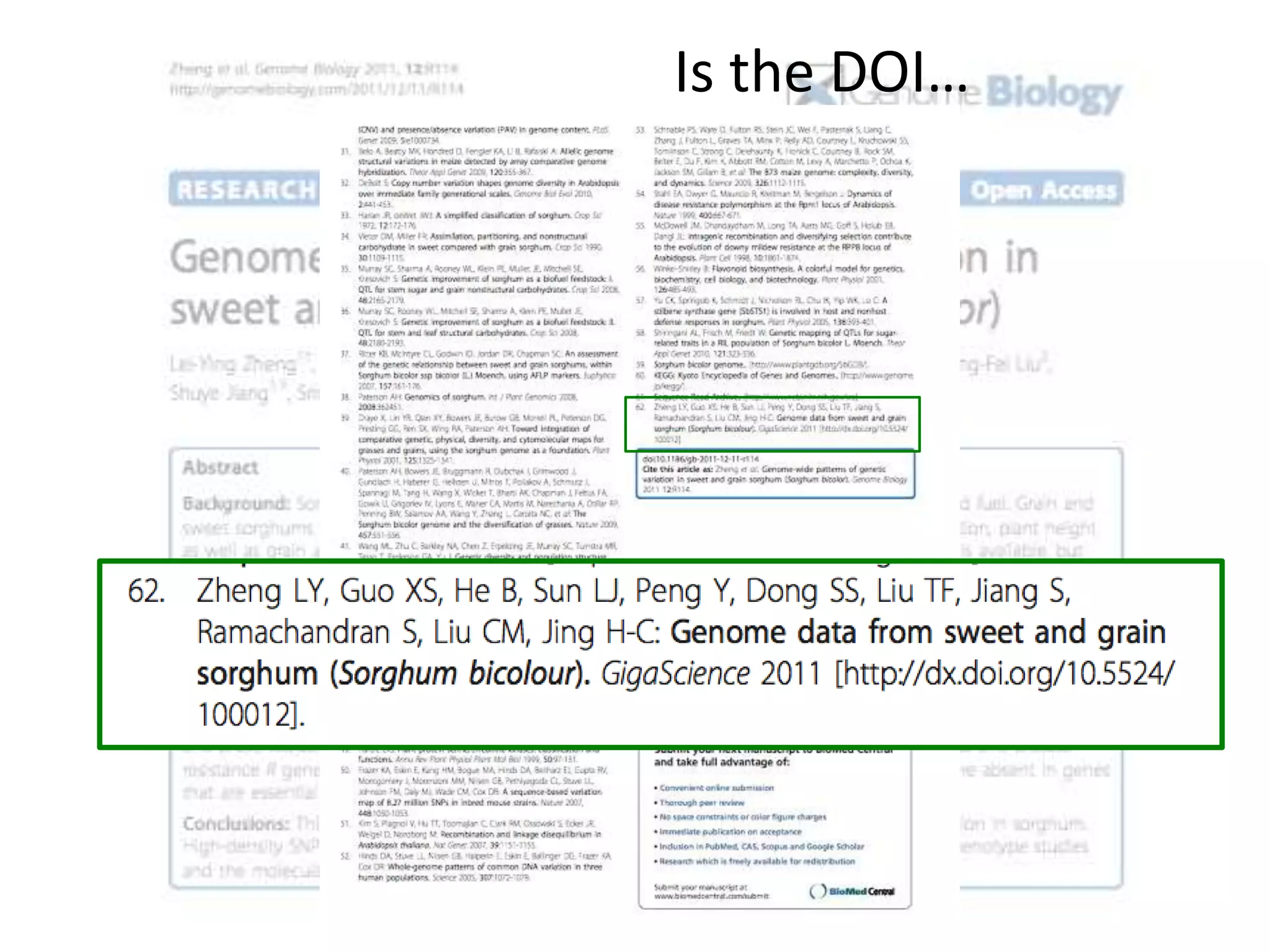
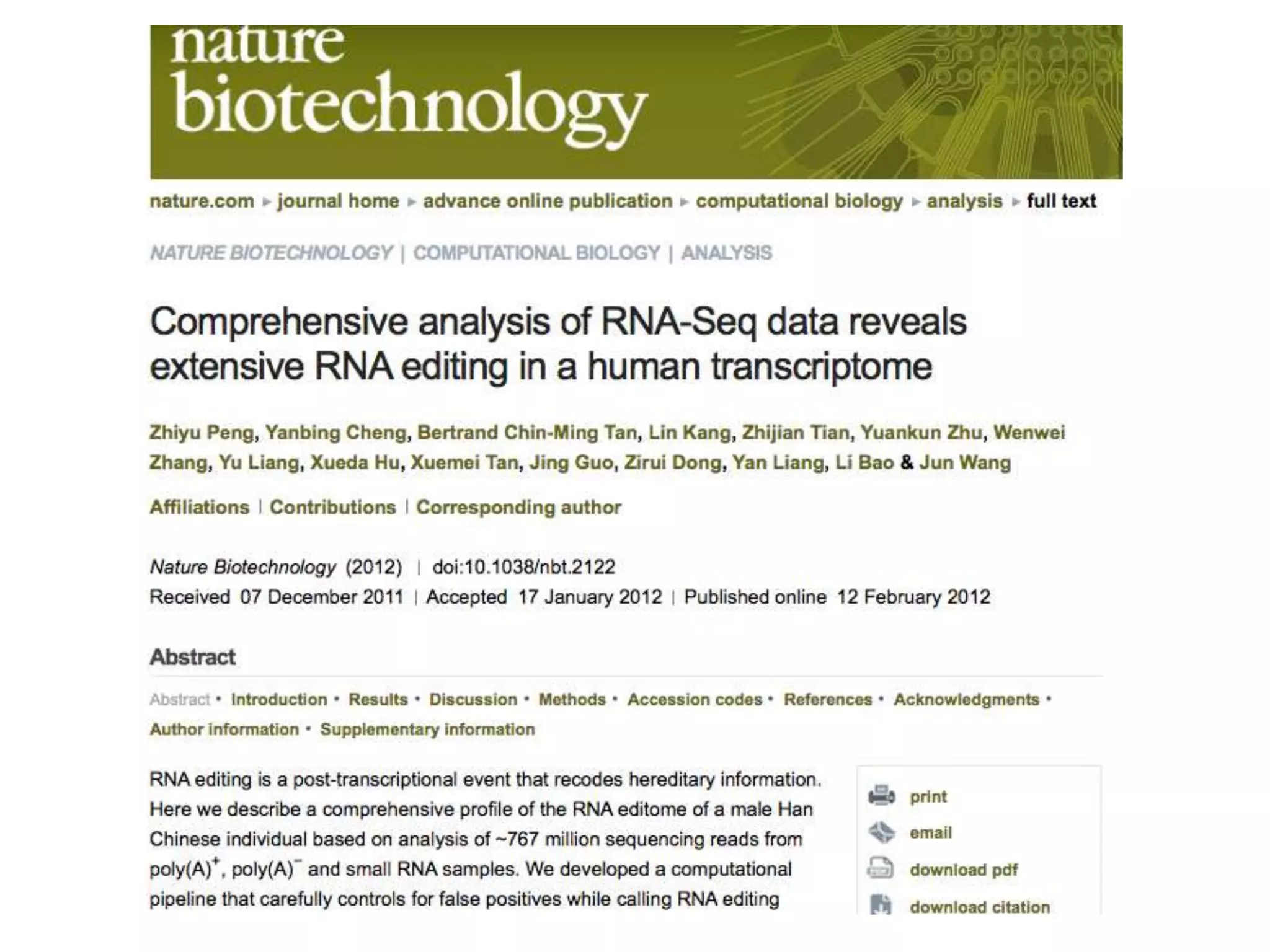
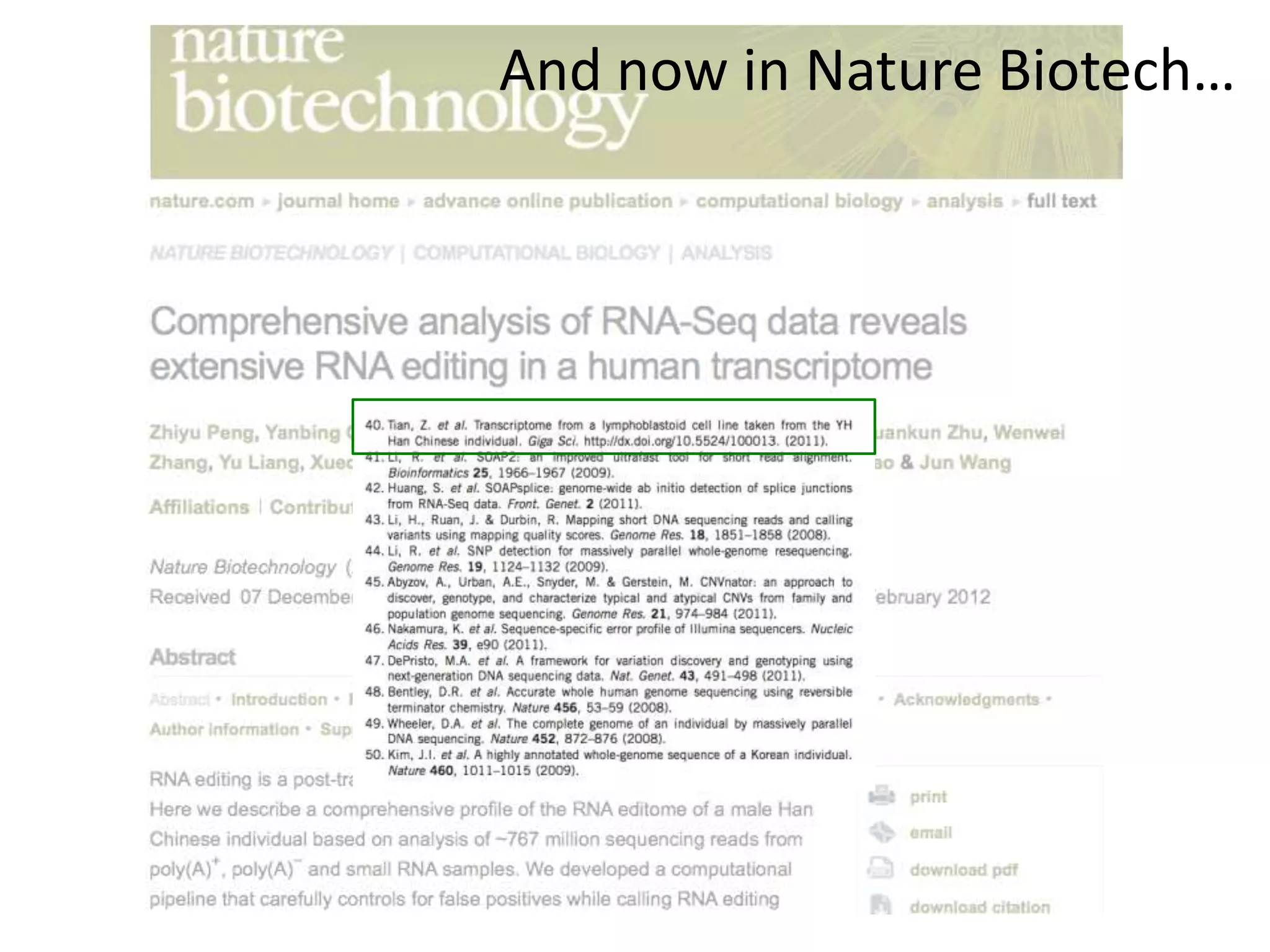
Data+Citation: inclusion in the references
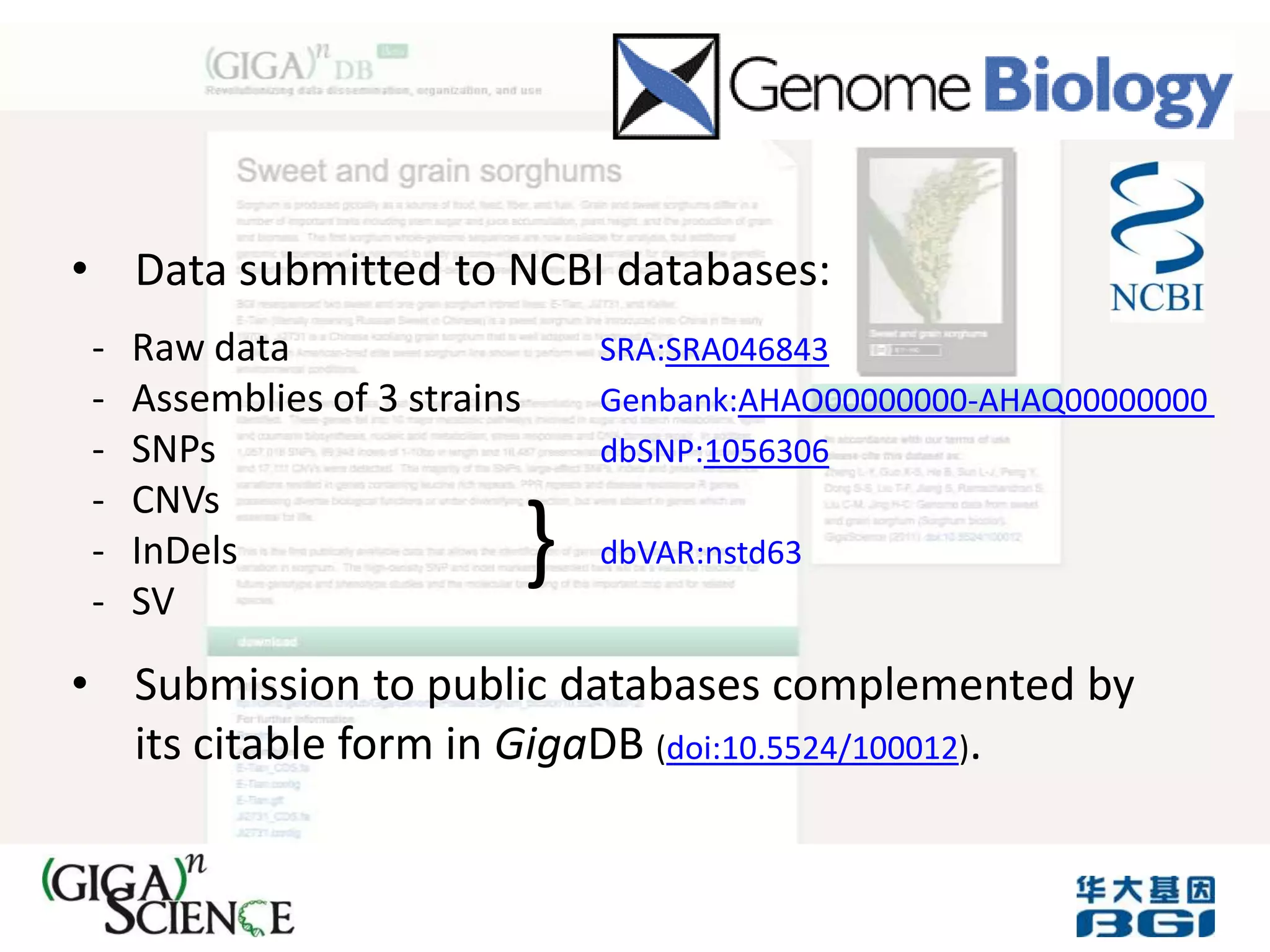
• Data submitted to NCBI databases:
-   Raw data                      SRA:SRA046843
-   Assemblies of 3 strains       Genbank:AHAO00000000-AHAQ00000000
-   SNPs                          dbSNP:1056306
-   CNVs
-
-
    InDels
    SV
                              }   dbVAR:nstd63


• Submission to public databases complemented by
  its citable form in GigaDB (doi:10.5524/100012).
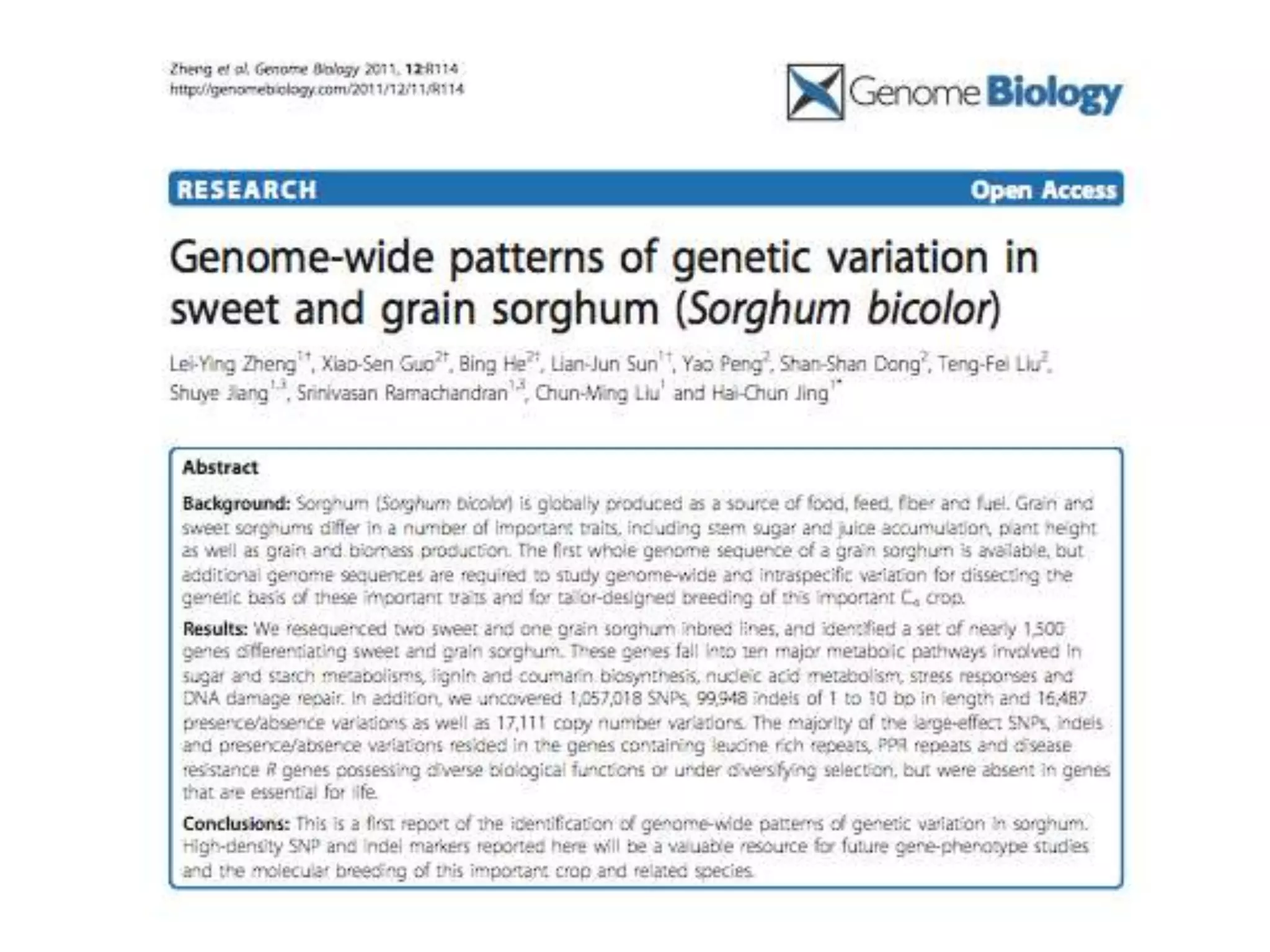
In the references…
Is the DOI…
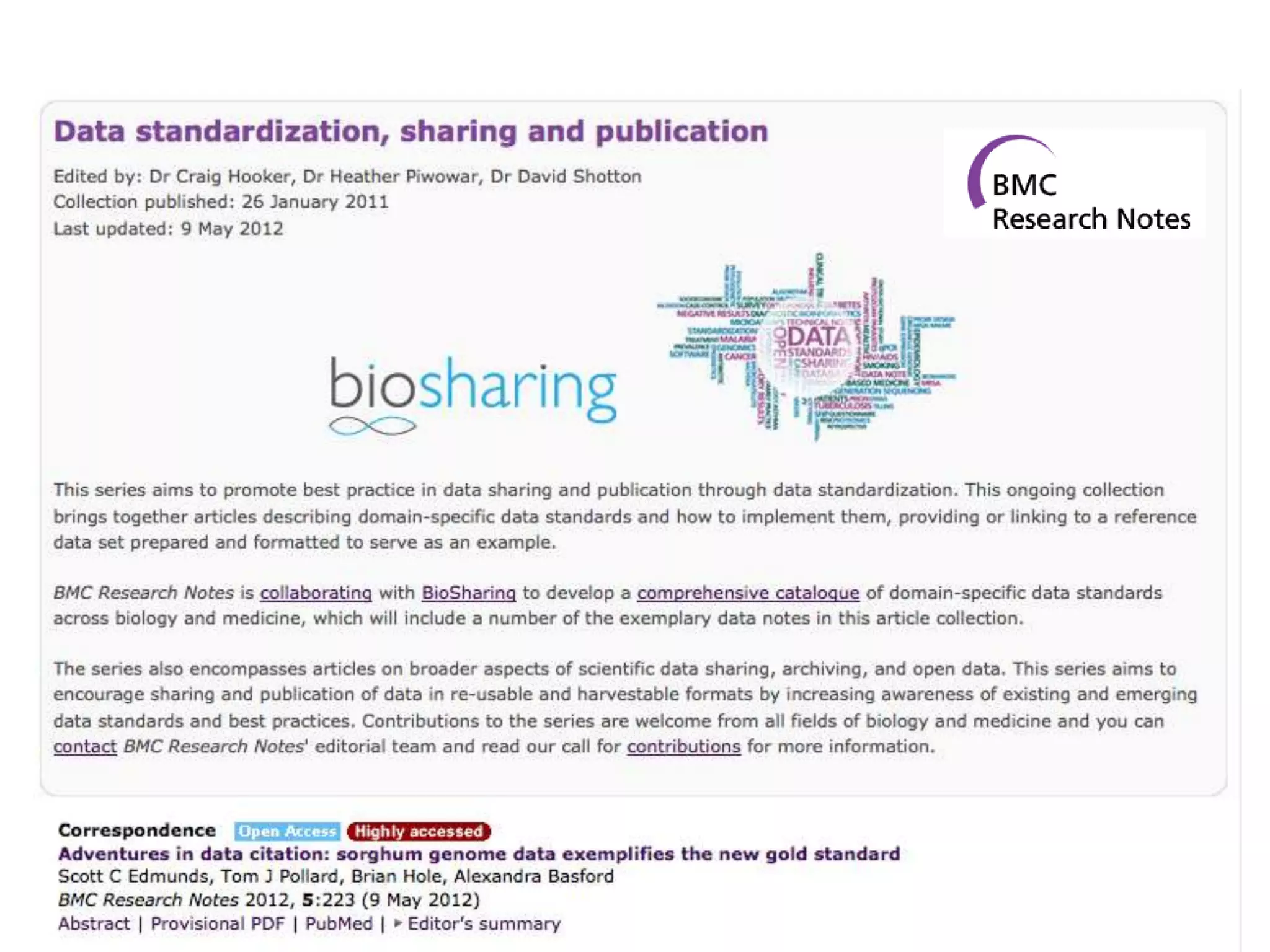
And now in Nature Biotech…
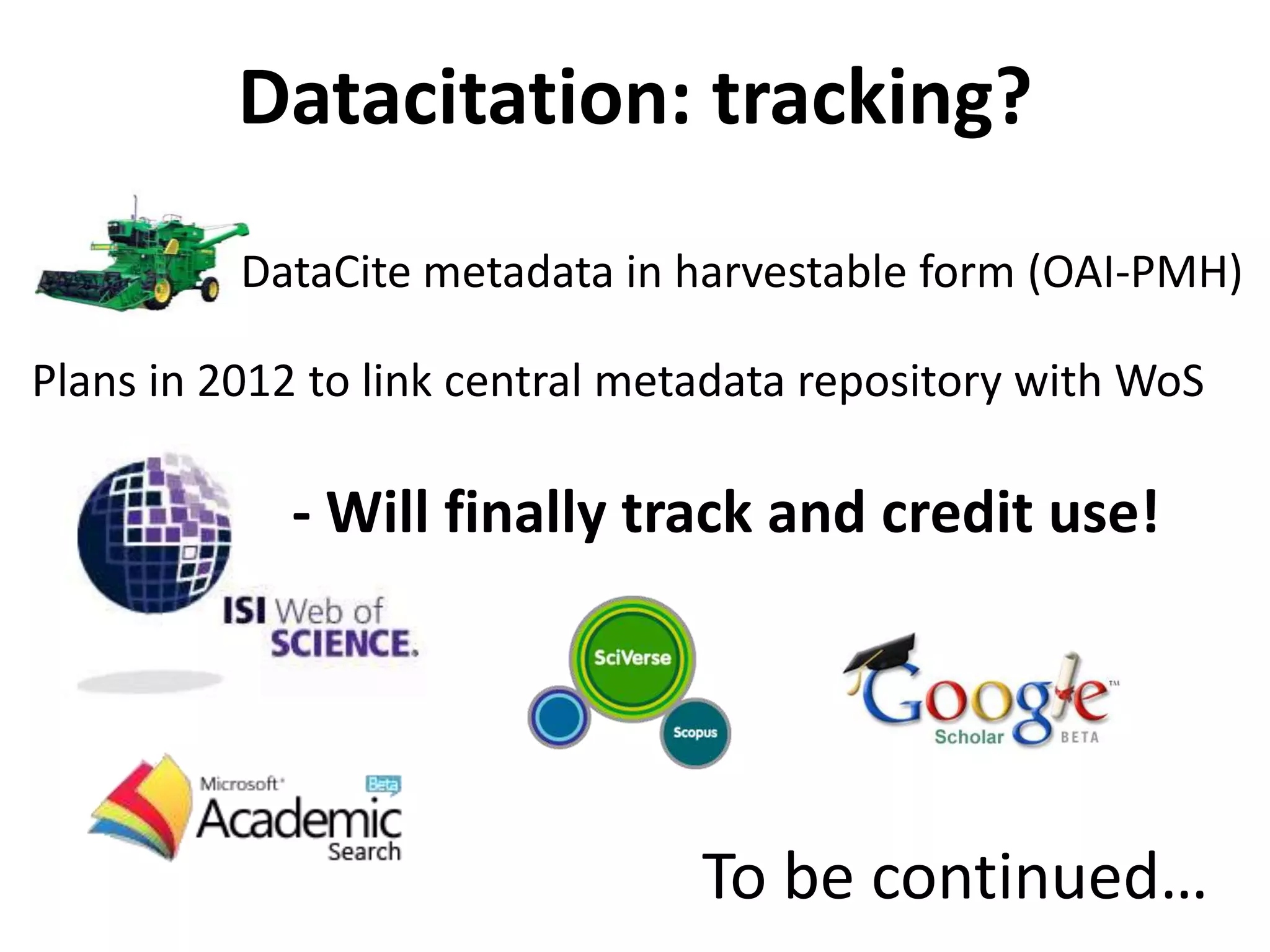
Datacitation: tracking?
          DataCite metadata in harvestable form (OAI-PMH)

Plans in 2012 to link central metadata repository with WoS

            - Will finally track and credit use!


                                 To be continued…
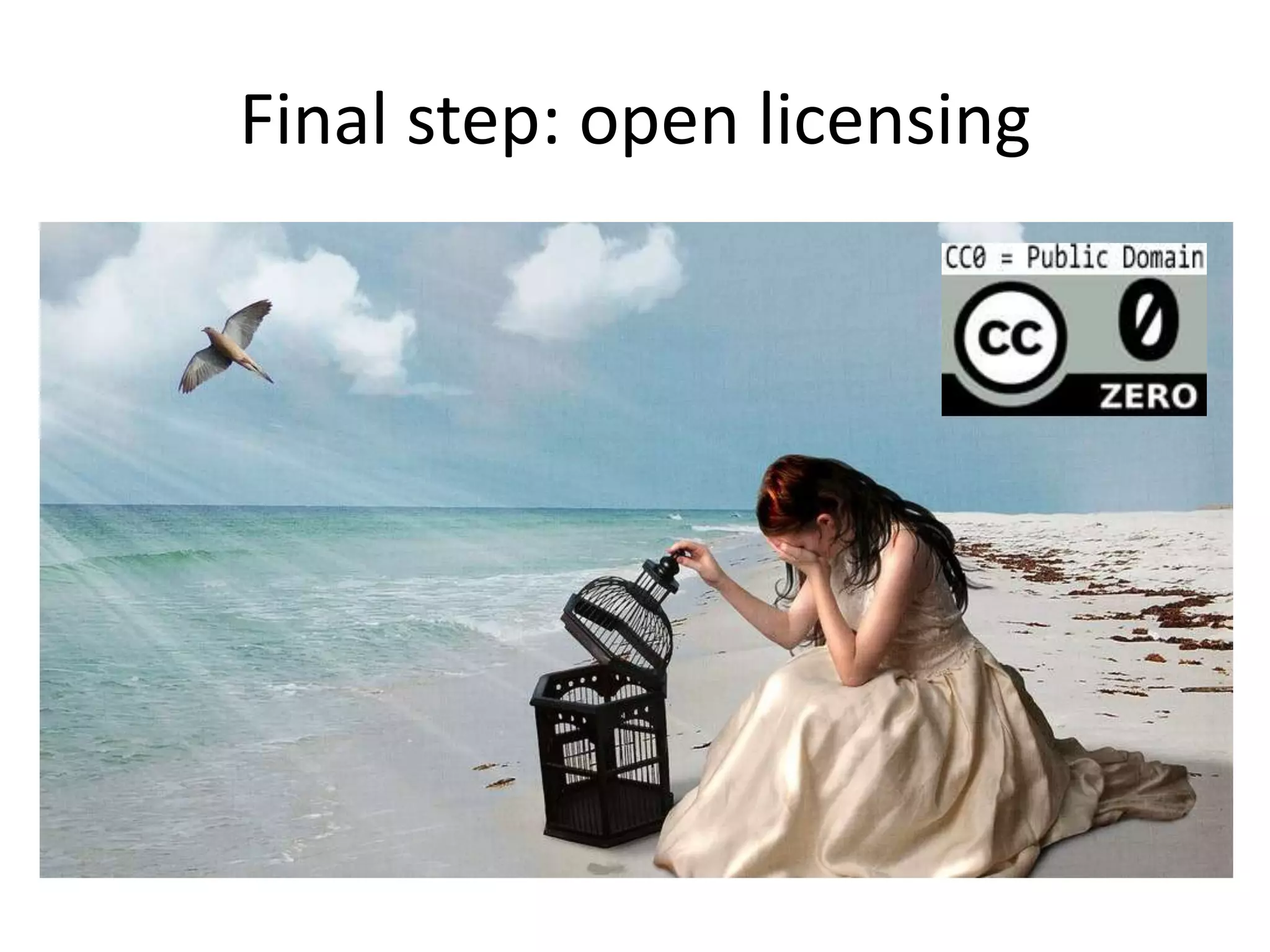
Final step: open licensing
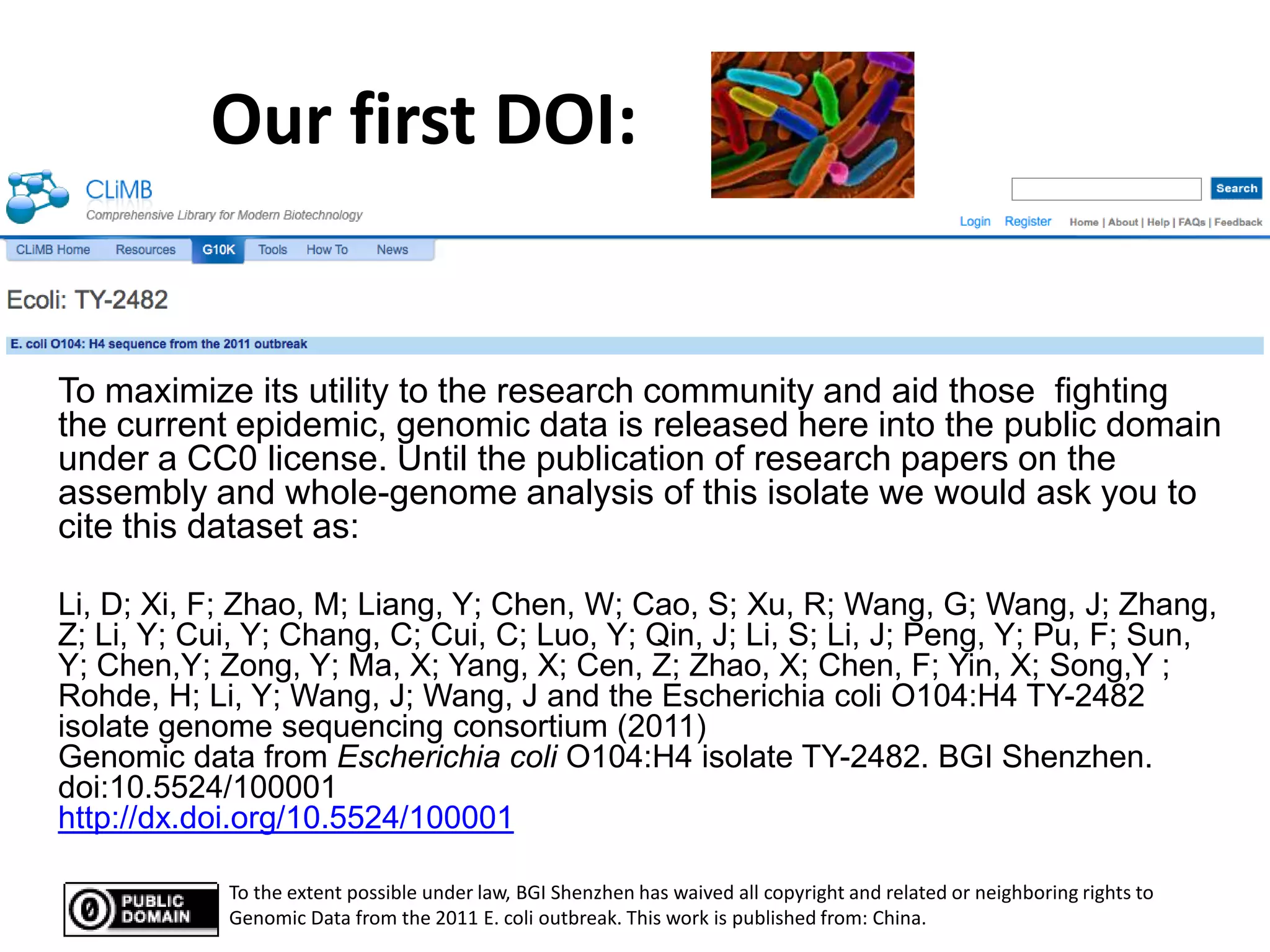
Our first DOI:


To maximize its utility to the research community and aid those fighting
the current epidemic, genomic data is released here into the public domain
under a CC0 license. Until the publication of research papers on the
assembly and whole-genome analysis of this isolate we would ask you to
cite this dataset as:

Li, D; Xi, F; Zhao, M; Liang, Y; Chen, W; Cao, S; Xu, R; Wang, G; Wang, J; Zhang,
Z; Li, Y; Cui, Y; Chang, C; Cui, C; Luo, Y; Qin, J; Li, S; Li, J; Peng, Y; Pu, F; Sun,
Y; Chen,Y; Zong, Y; Ma, X; Yang, X; Cen, Z; Zhao, X; Chen, F; Yin, X; Song,Y ;
Rohde, H; Li, Y; Wang, J; Wang, J and the Escherichia coli O104:H4 TY-2482
isolate genome sequencing consortium (2011)
Genomic data from Escherichia coli O104:H4 isolate TY-2482. BGI Shenzhen.
doi:10.5524/100001
http://dx.doi.org/10.5524/100001

            To the extent possible under law, BGI Shenzhen has waived all copyright and related or neighboring rights to
            Genomic Data from the 2011 E. coli outbreak. This work is published from: China.
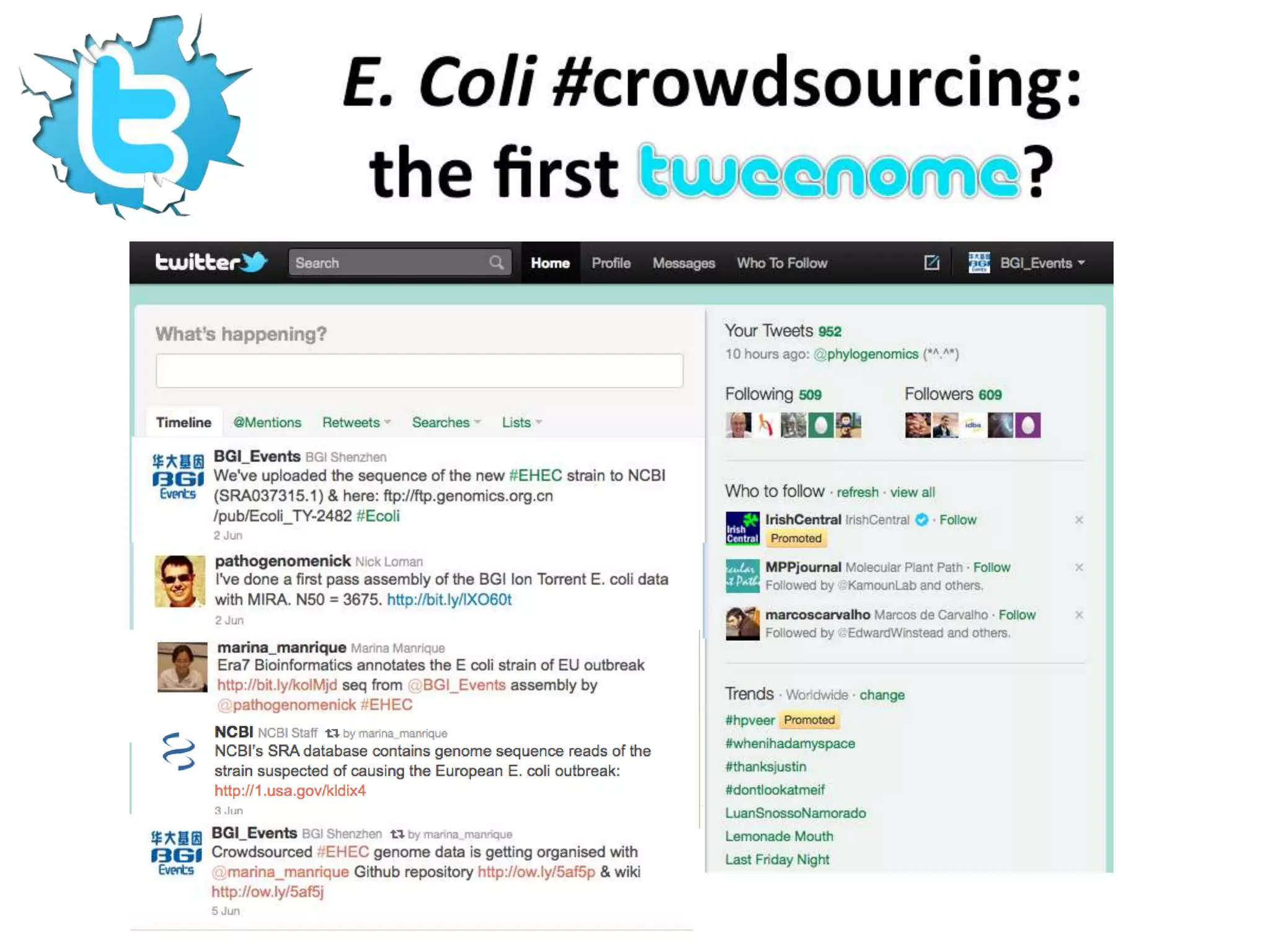
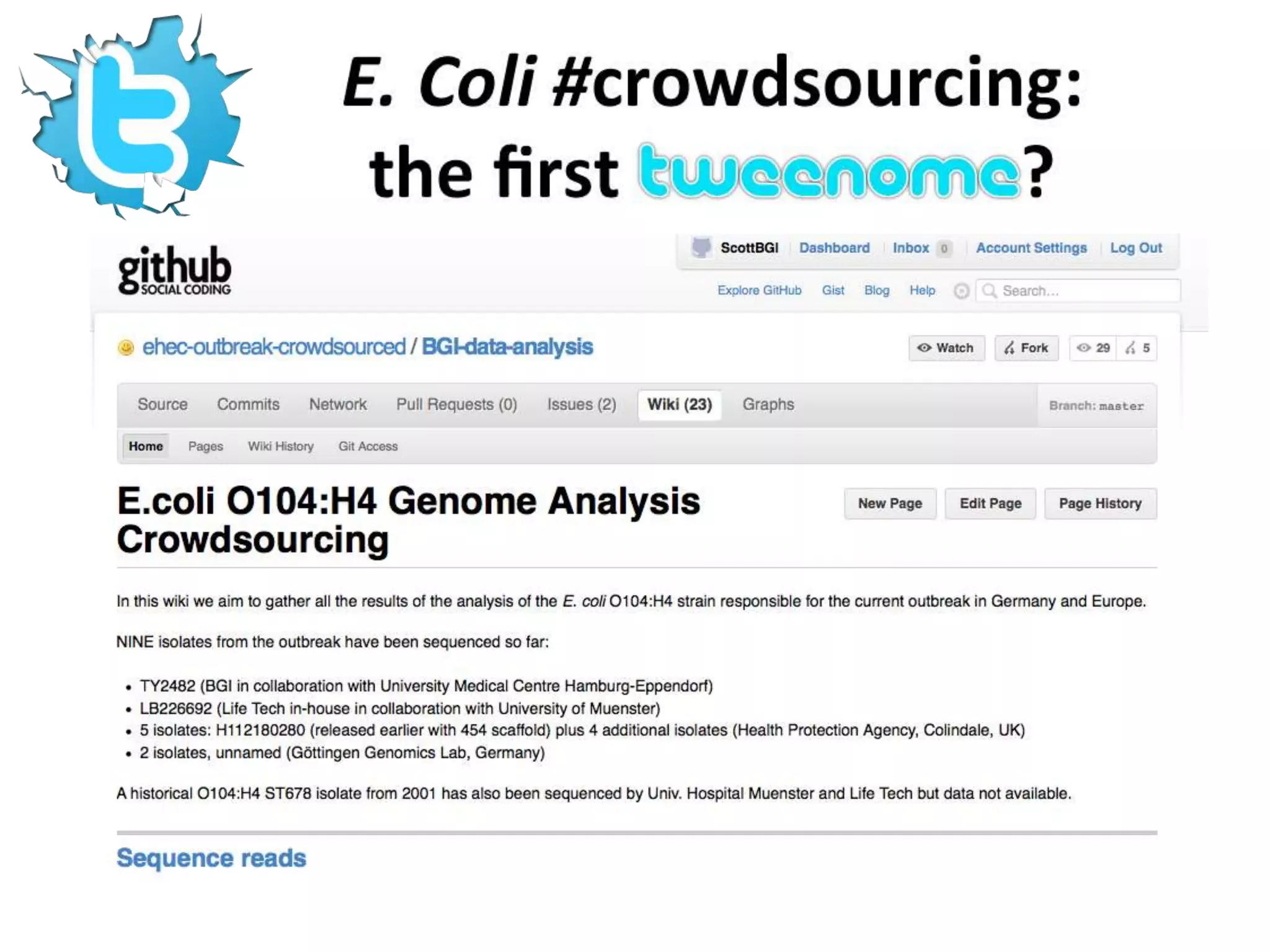
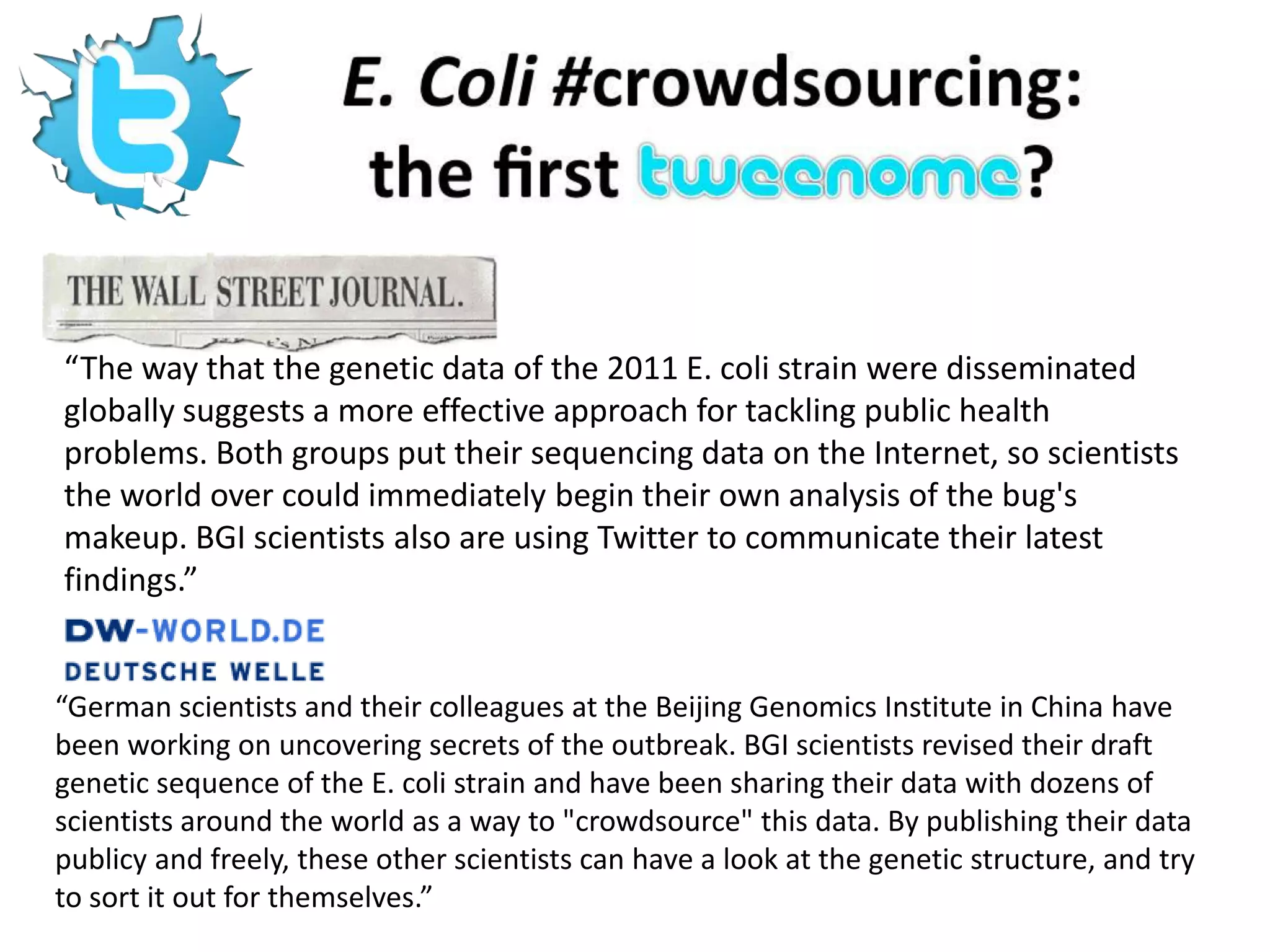
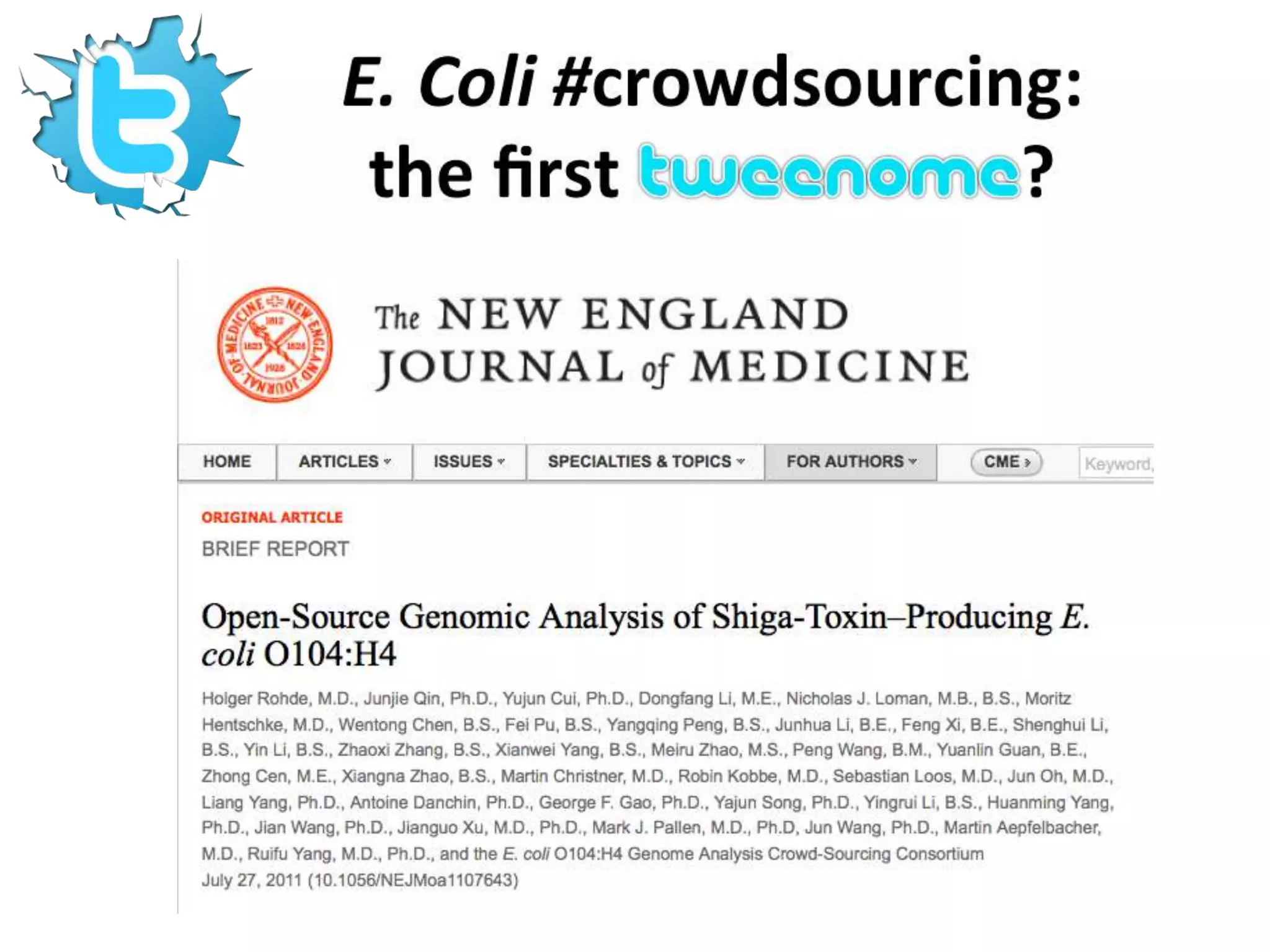
“The way that the genetic data of the 2011 E. coli strain were disseminated
globally suggests a more effective approach for tackling public health
problems. Both groups put their sequencing data on the Internet, so scientists
the world over could immediately begin their own analysis of the bug's
makeup. BGI scientists also are using Twitter to communicate their latest
findings.”


“German scientists and their colleagues at the Beijing Genomics Institute in China have
been working on uncovering secrets of the outbreak. BGI scientists revised their draft
genetic sequence of the E. coli strain and have been sharing their data with dozens of
scientists around the world as a way to "crowdsource" this data. By publishing their data
publicy and freely, these other scientists can have a look at the genetic structure, and try
to sort it out for themselves.”
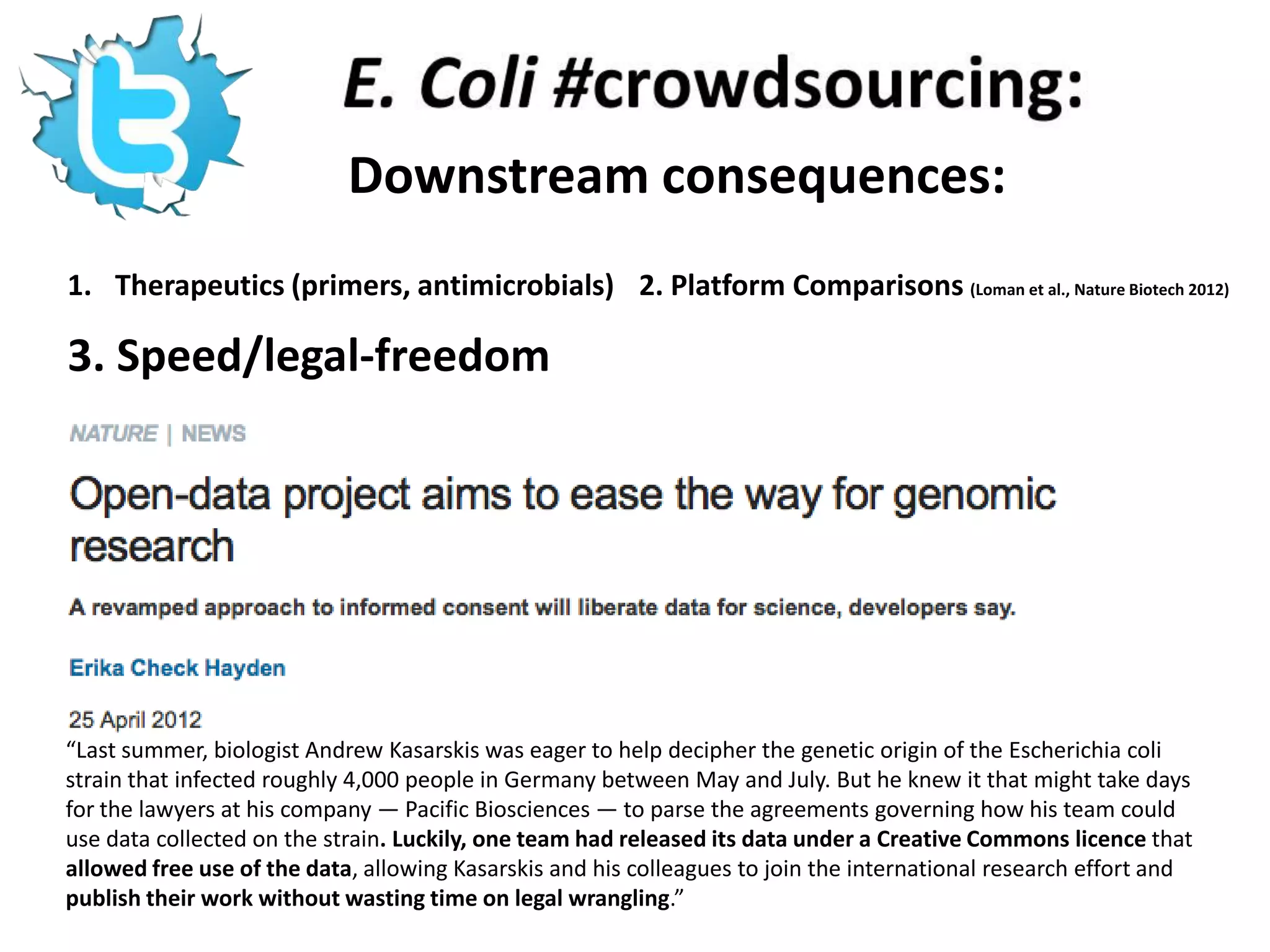
Downstream consequences:
1. Therapeutics (primers, antimicrobials) 2. Platform Comparisons (Loman et al., Nature Biotech 2012)

3. Speed/legal-freedom


“Last summer, biologist Andrew Kasarskis was eager to help decipher the genetic origin of the Escherichia coli
strain that infected roughly 4,000 people in Germany between May and July. But he knew it that might take days
for the lawyers at his company — Pacific Biosciences — to parse the agreements governing how his team could
use data collected on the strain. Luckily, one team had released its data under a Creative Commons licence that
allowed free use of the data, allowing Kasarskis and his colleagues to join the international research effort and
publish their work without wasting time on legal wrangling.”
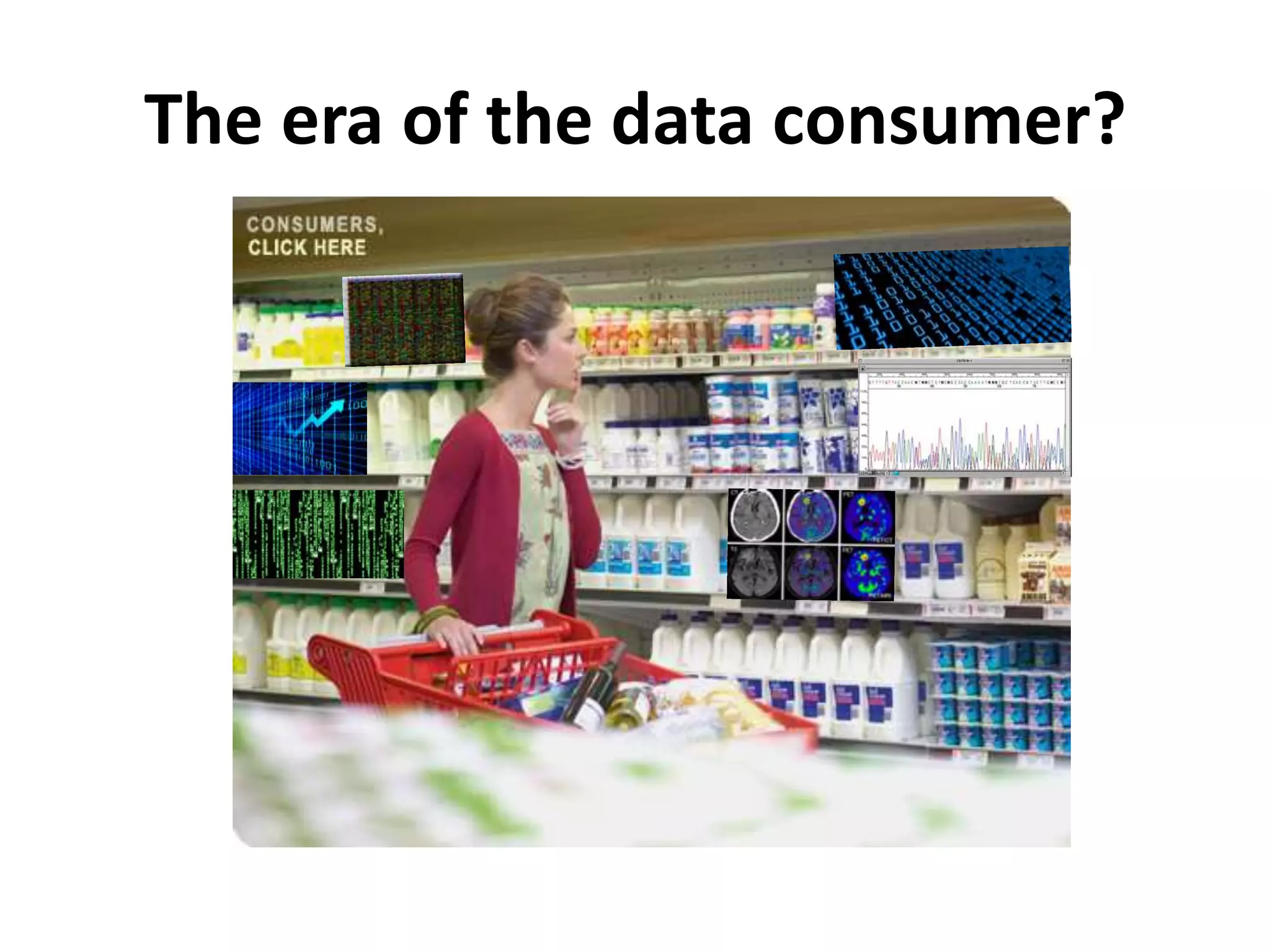
The era of the data consumer?


?
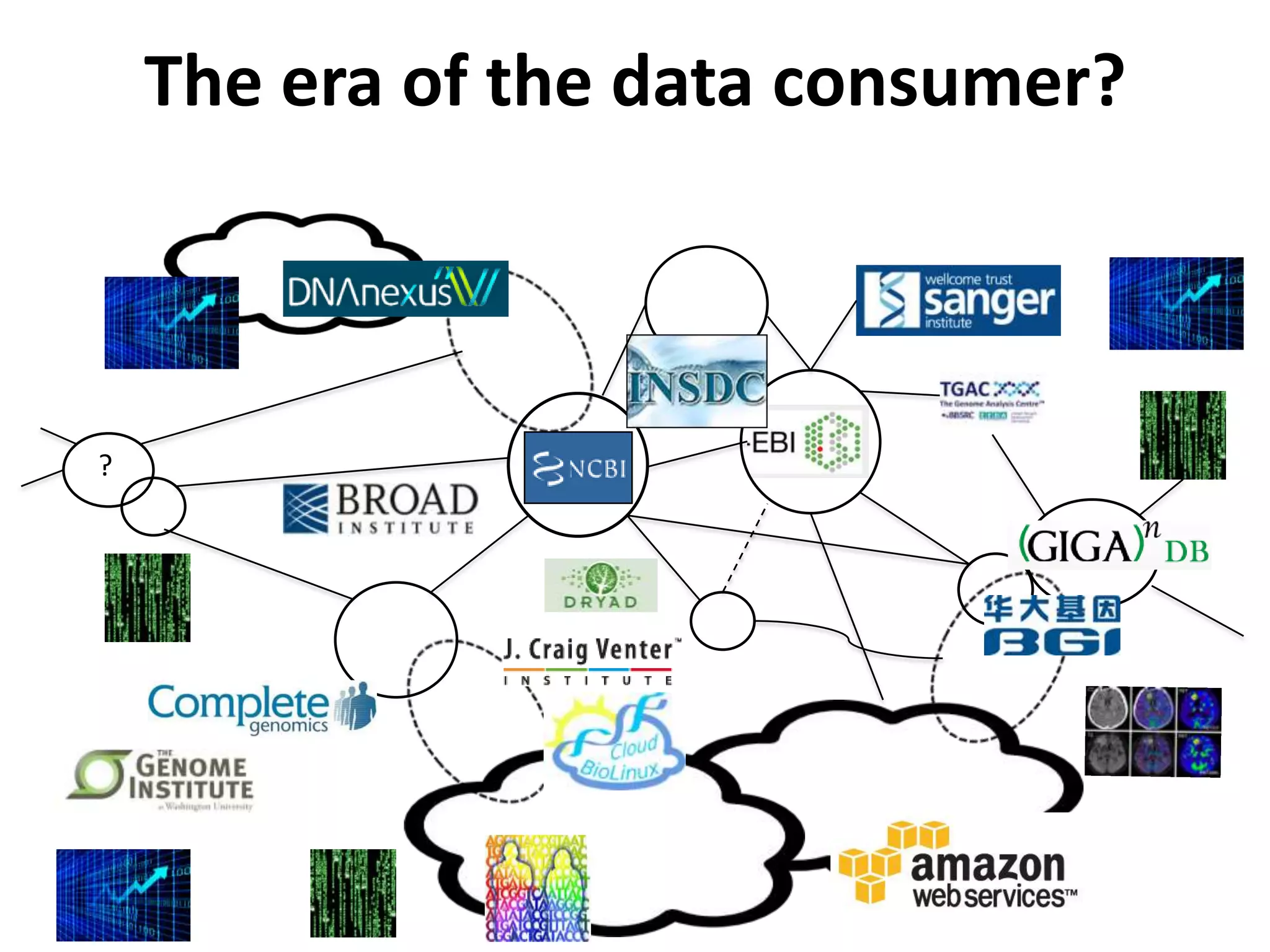
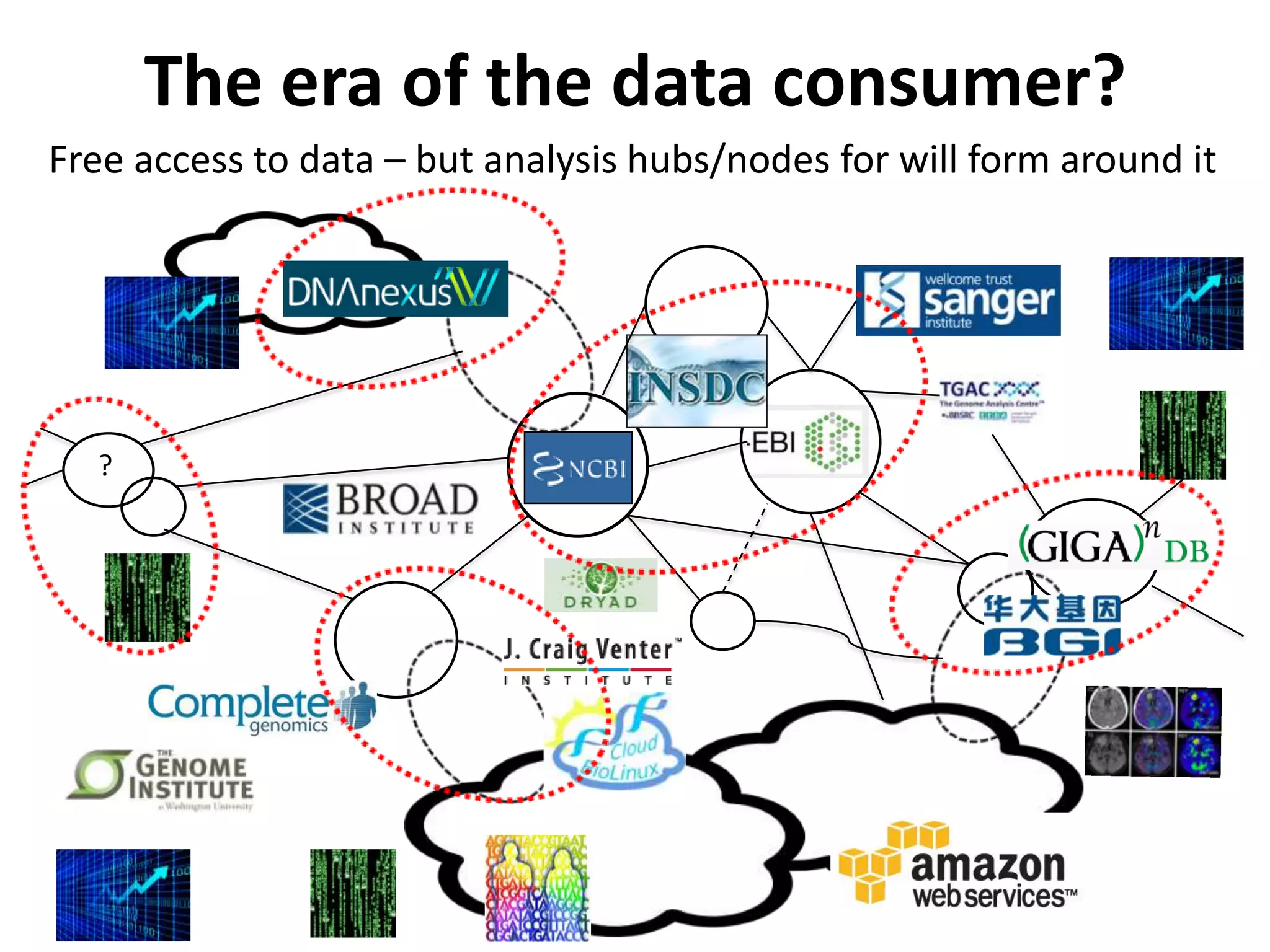
The era of the data consumer?
Free access to data – but analysis hubs/nodes for will form around it


  ?
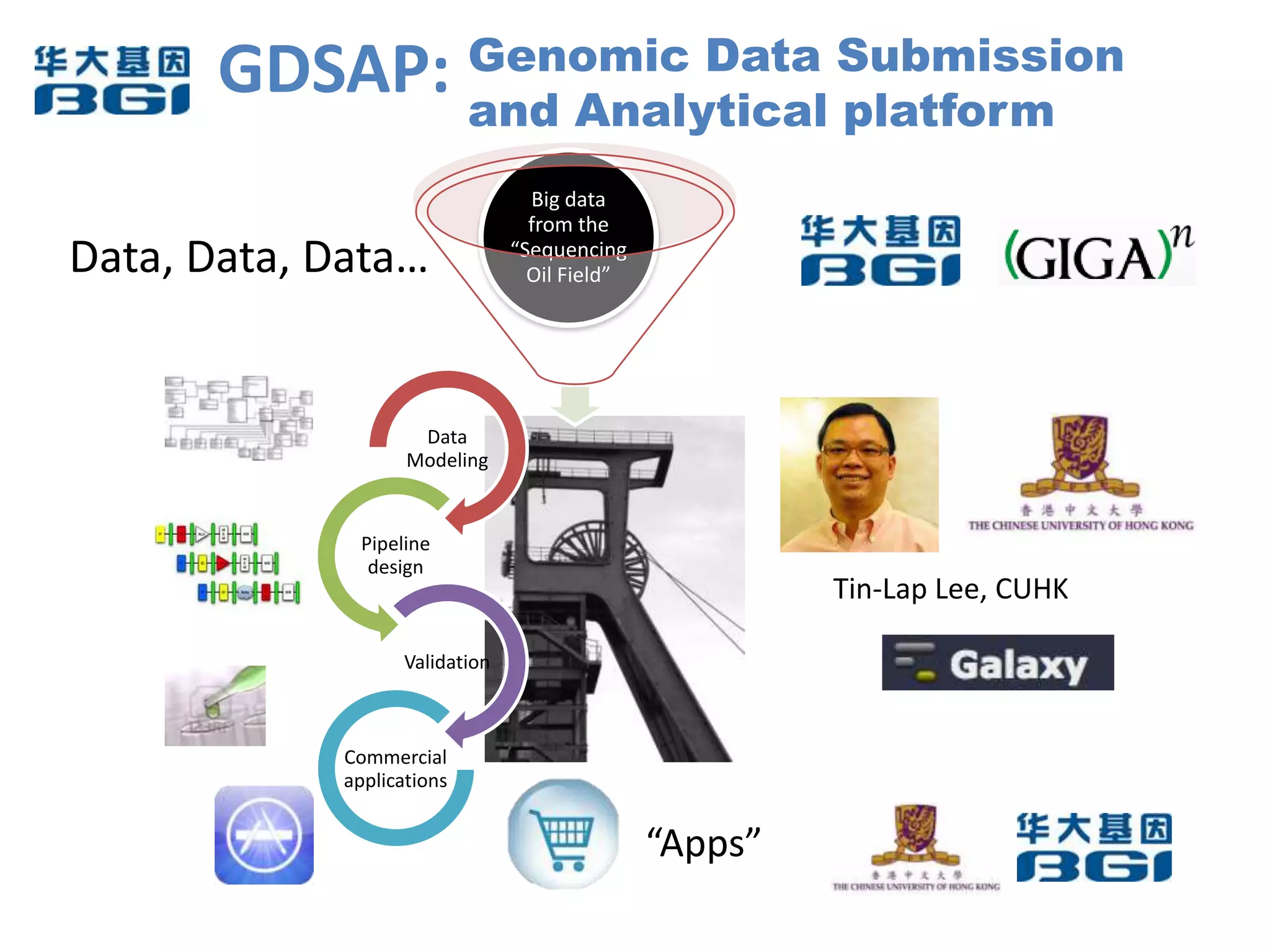
GDSAP: Genomic Data Submission
              and Analytical platform
                                 Big data
                                 from the
Data, Data, Data…              “Sequencing
                                 Oil Field”


                    Data
                   Modeling


              Pipeline
               design
                                                       Tin-Lap Lee, CUHK

                  Validation


            Commercial
            applications


                                              “Apps”
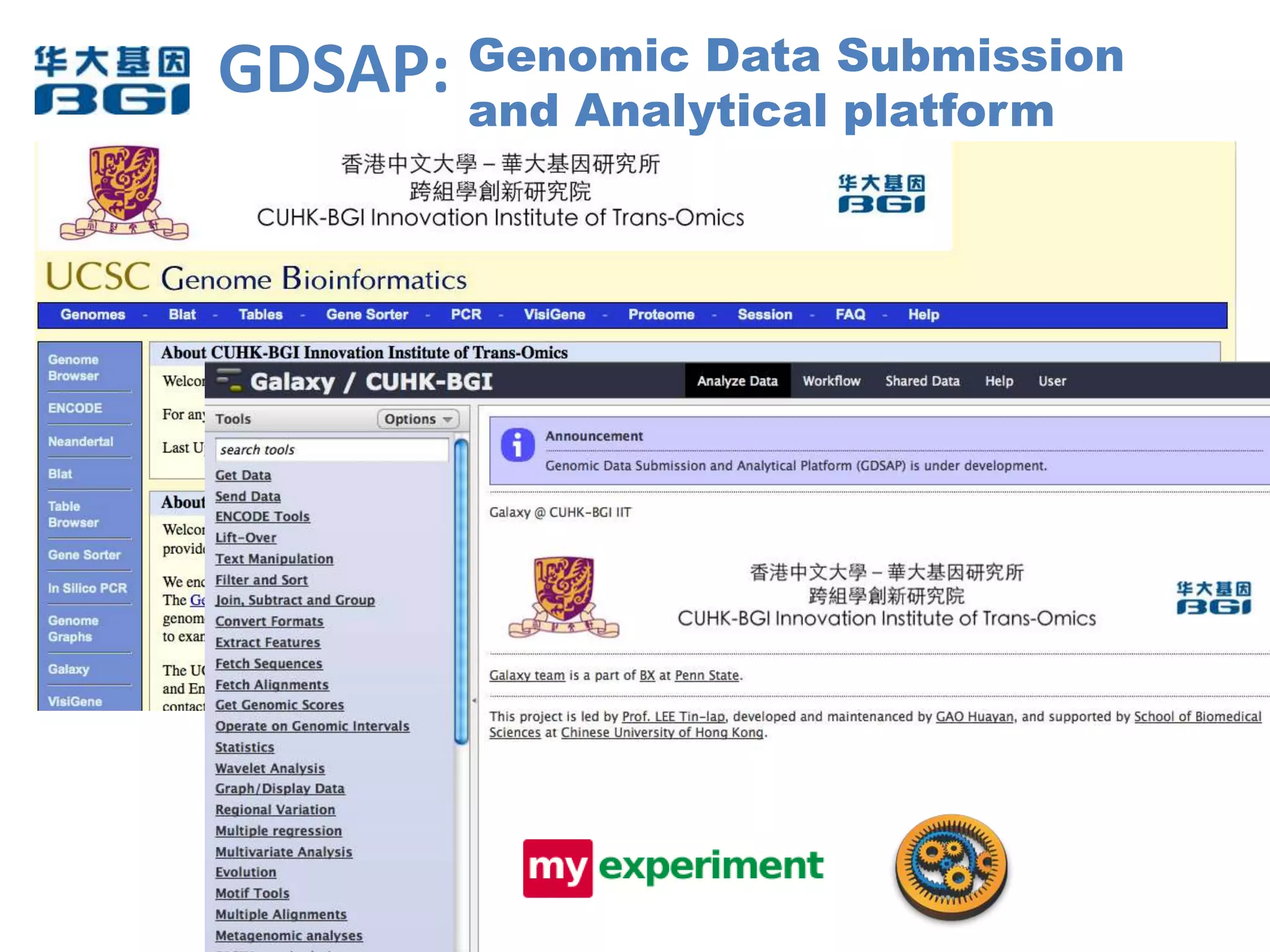
GDSAP: Genomic Data Submission
       and Analytical platform
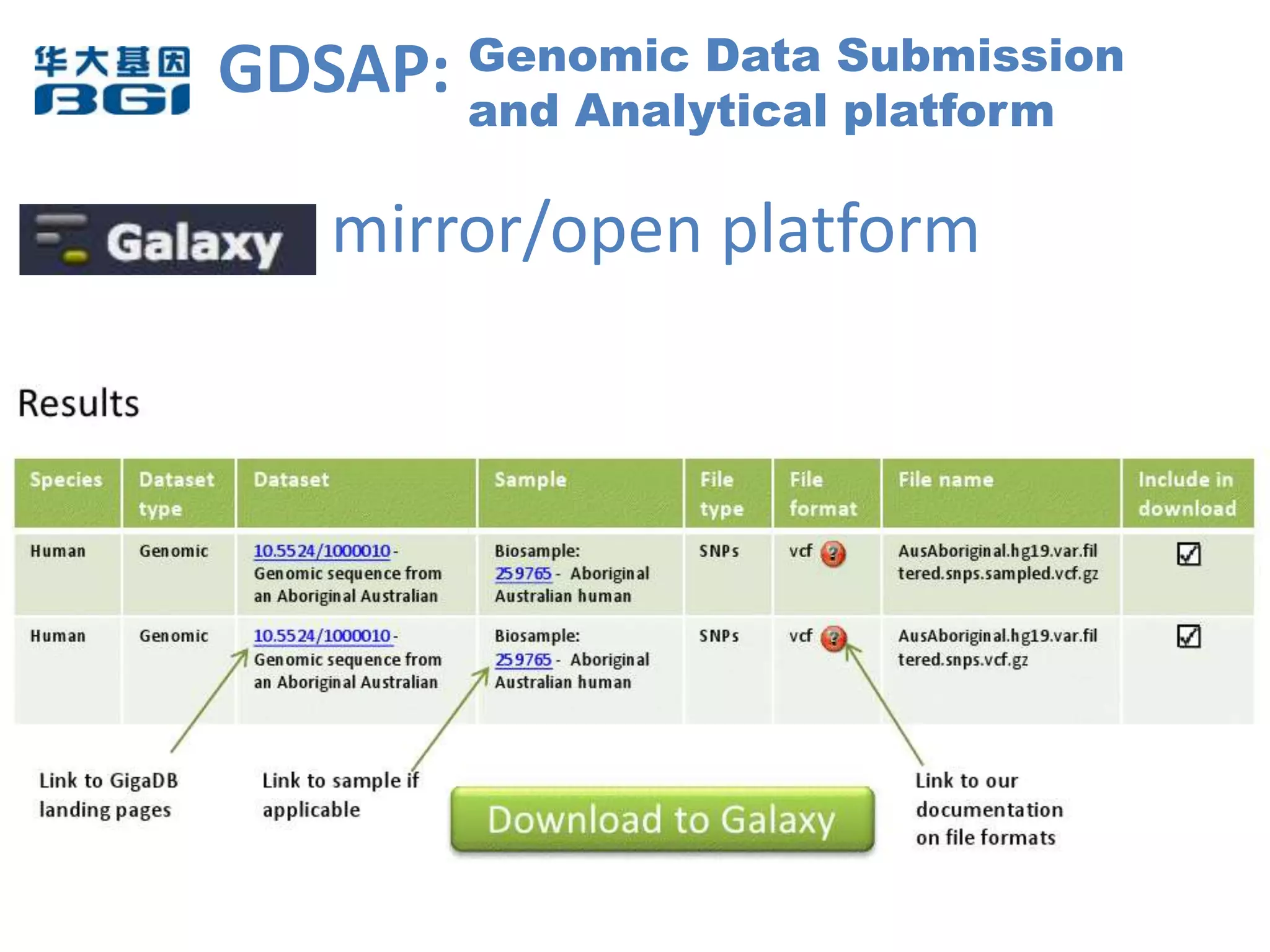
GDSAP: Genomic Data Submission
       and Analytical platform

   mirror/open platform
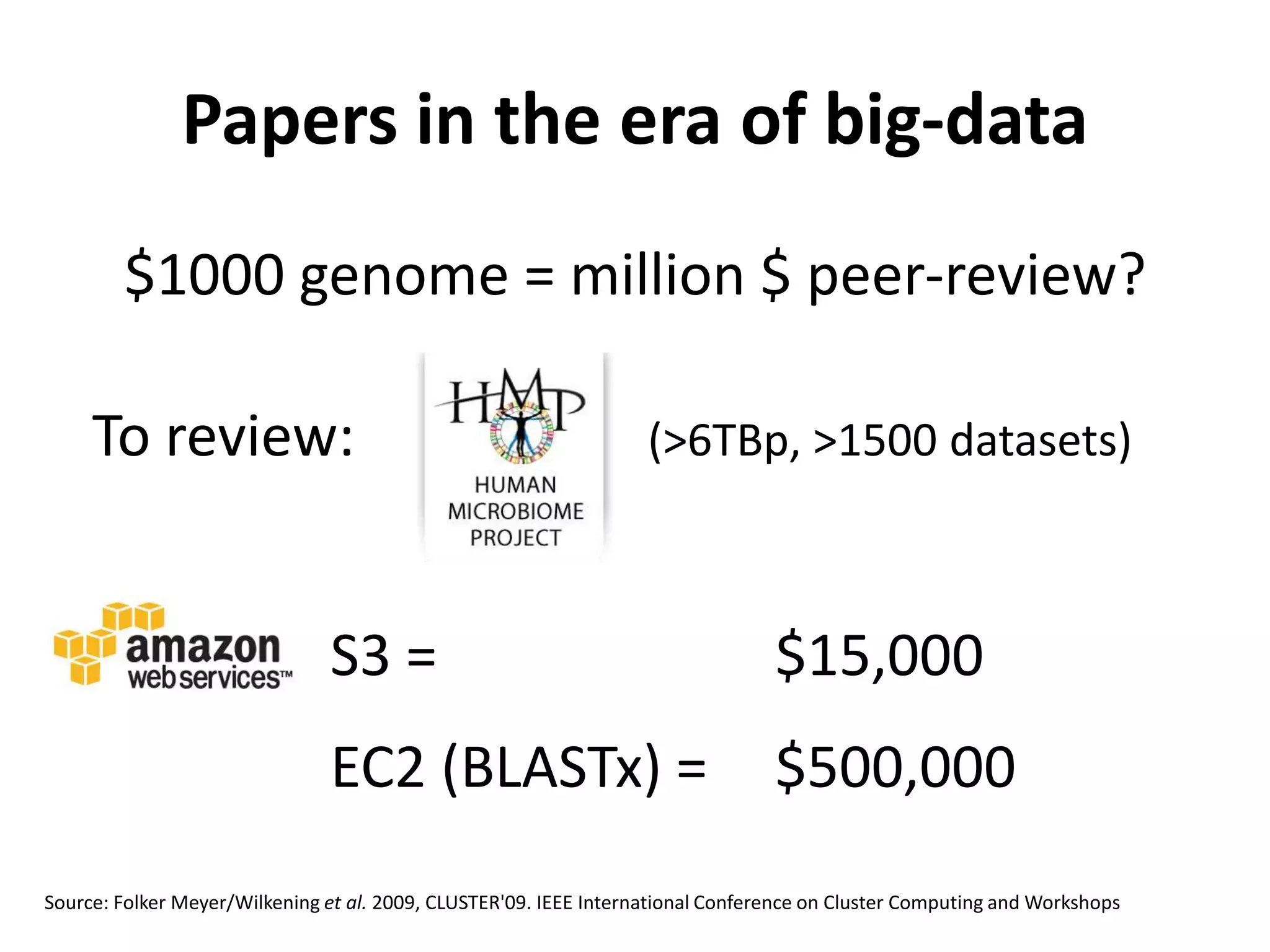
Papers in the era of big-data
        $1000 genome = million $ peer-review?

     To review:                                                    (>6TBp, >1500 datasets)


                               S3 =                                              $15,000
                               EC2 (BLASTx) =                                    $500,000
Source: Folker Meyer/Wilkening et al. 2009, CLUSTER'09. IEEE International Conference on Cluster Computing and Workshops
Papers in the era of big-data
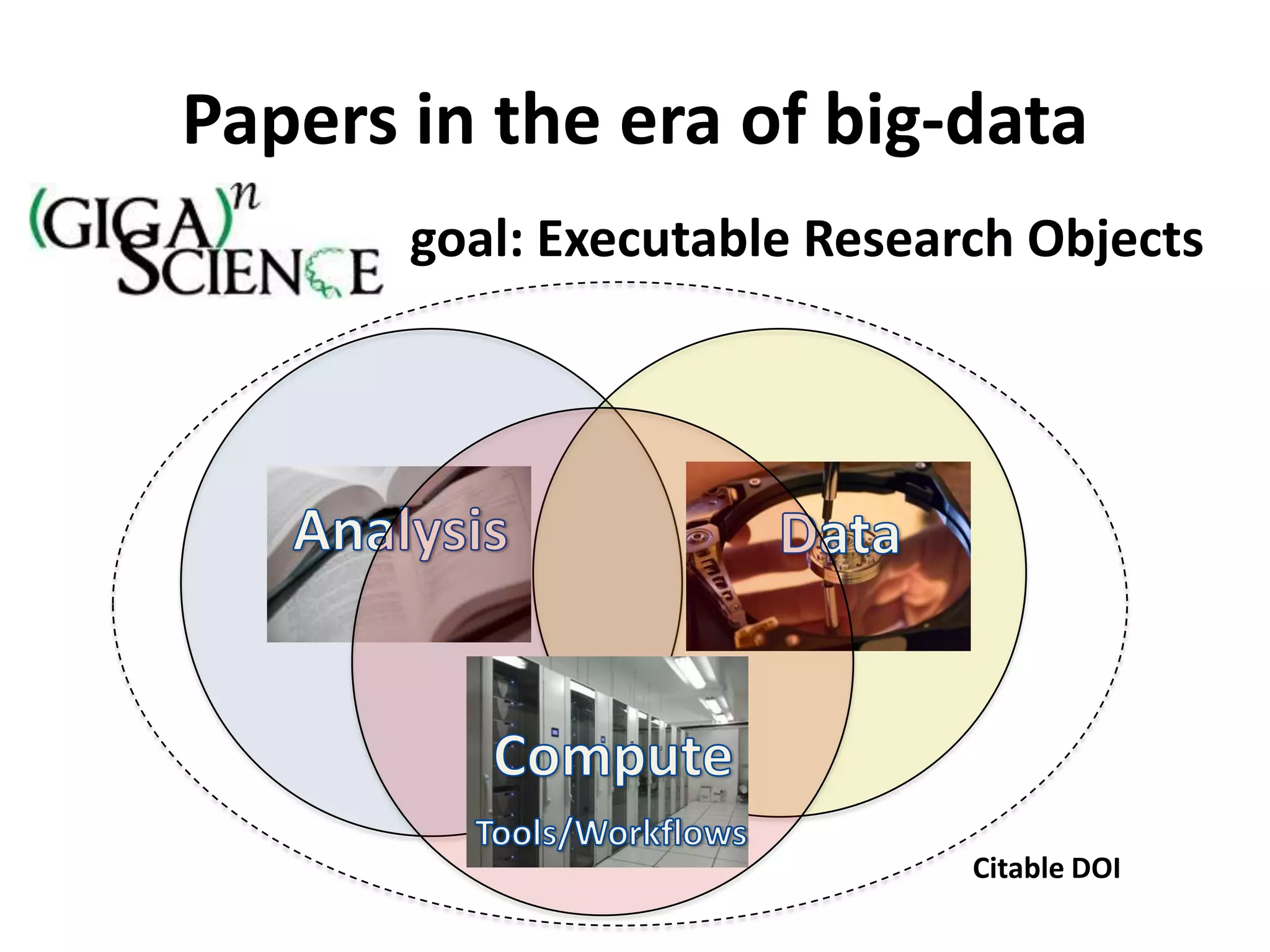
       goal: Executable Research Objects


                              Citable DOI
Papers in the era of big-data
                           goal: Executable Research Objects

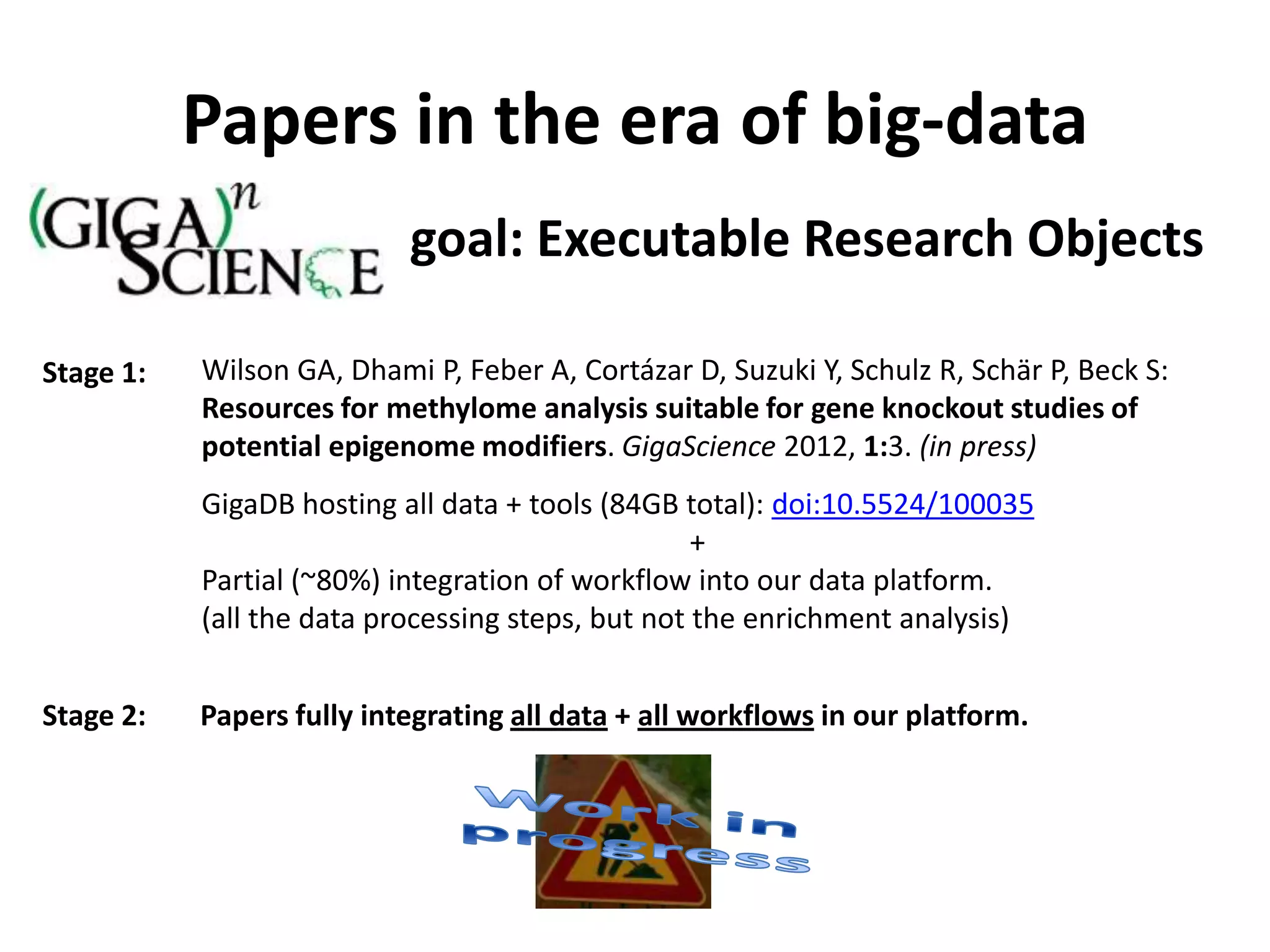
Stage 1:   Wilson GA, Dhami P, Feber A, Cortázar D, Suzuki Y, Schulz R, Schär P, Beck S:
           Resources for methylome analysis suitable for gene knockout studies of
           potential epigenome modifiers. GigaScience 2012, 1:3. (in press)
           GigaDB hosting all data + tools (84GB total): doi:10.5524/100035
                                                   +
           Partial (~80%) integration of workflow into our data platform.
           (all the data processing steps, but not the enrichment analysis)


Stage 2:   Papers fully integrating all data + all workflows in our platform.
Papers in the era of big-data
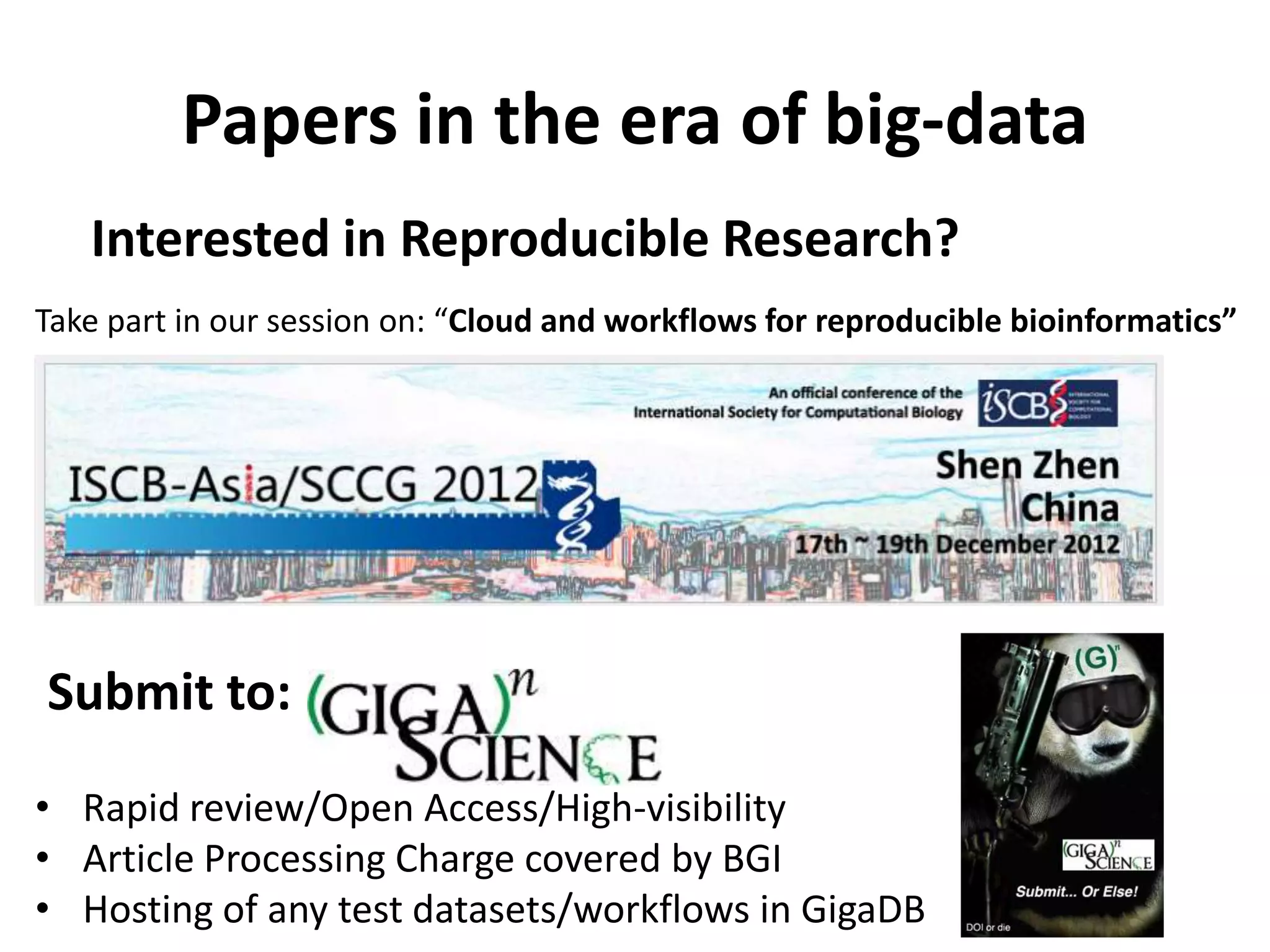
   Interested in Reproducible Research?
Take part in our session on: “Cloud and workflows for reproducible bioinformatics”


Submit to:
• Rapid review/Open Access/High-visibility
• Article Processing Charge covered by BGI
• Hosting of any test datasets/workflows in GigaDB
Thanks to:
Laurie Goodman       Alexandra Basford
Tam Sneddon          Peter Li
Tin-Lap Lee (CUHK)   Qiong Luo (HKUST)
                        scott@gigasciencejournal.com
Contact us:
                        editorial@gigasciencejournal.com


                          @gigascience

 Follow us:               facebook.com/GigaScience

                          blogs.openaccesscentral.com/blogs/gigablog/


            www.gigasciencejournal.com

Scott Edmunds: Data Dissemination in the era of "Big-Data"

  • 1.
    Bio-IT World AsiaMeeting, 7th June 2012 Scott Edmunds Data dissemination in the era of “big data” William Gibson: "Information is the currency of the future world” Sir Tim Berners-Lee: "Data is a precious thing and will last longer than the systems themselves” www.gigasciencejournal.com
  • 2.
    Is data “thenew oil”? 1.2 zettabytes (1021) of electronic data generated each year1 Data Deluge? 1. Mervis J. U.S. science policy. Agencies rally to tackle big data. Science. 2012 Apr 6;336(6077):22.
  • 3.
    Global Sequencing Capacity Data Production 5.6 Tb / day > 1500X of human genome / day Multiple Supercomputing Centers 157 TB Flops 20 TB Memory 14.7 PB Storage
  • 4.
    BGI Sequencing Capacity Sequencers Data Production 137 Illumina/HiSeq 2000 5.6 Tb / day 27 LifeTech/SOLiD 4 > 1500X of human genome / day 1 454 GS FLX+ 137 2 Illumina iScan Multiple Supercomputing Centers 1 Illumina MiSeq 157 TB Flops 1 Ion Torrent 20 TB Memory 14.7 PB Storage
  • 5.
    Now taking submissions… Large-Scale Data: Journal/Database/Platform In conjunction with: Editor-in-Chief: Laurie Goodman, PhD Editor: Scott Edmunds, PhD Assistant Editor: Alexandra Basford, PhD Lead BioCurator: Tam Sneddon, Dphil Data Platform: Peter Li, PhD www.gigasciencejournal.com
  • 6.
  • 7.
    Data Silo’s Interoperability Paywalls Metadata $ ©
  • 8.
    There are manyhurdles… ?
  • 9.
    There are manyhurdles… Technical: too large volumes too heterogeneous no home for many data types too time consuming Cultural: inertia no incentives to share unaware of how ?
  • 10.
    Technical challenges… Better handlingof metadata… Novel tools/formats for data interoperability/handling. Cloud solutions?
  • 11.
    Technical challenges… Toolsmaking work more easily reproducible… Interoperability/Ease of use Workflows Data quality assessment
  • 12.
    Technical challenges… More efficienthandling of data… Cloud? Do we need to keep everything? Compression?
  • 15.
  • 16.
  • 17.
    Need to lowerthe hurdles… Effort ($) Usability
  • 18.
  • 19.
    Incentives/credit Credit where creditis overdue: “One option would be to provide researchers who release data to public repositories with a means of accreditation.” “An ability to search the literature for all online papers that used a particular data set would enable appropriate attribution for those who share. “ Nature Biotechnology 27, 579 (2009) Prepublication data sharing (Toronto International Data Release Workshop) “Data producers benefit from creating a citable reference, as it can later be used to reflect impact of the data sets.” Nature 461, 168-170 (2009)
  • 20.
    Datacitation: Datacite andDOIs Digital Object Identifiers (DOIs)  offer a solution  Mostly widely used identifier for Dataset scientific articles Yancheva et al (2007). Analyses on  Researchers, authors, publishers sediment of Lake Maar. PANGAEA. know how to use them doi:10.1594/PANGAEA.587840  Put datasets on the same playing field as articles “increase acceptance of research data as Aims to: legitimate, citable contributions to the scholarly record”. “data generated in the course of research are just as valuable to the ongoing academic discourse as papers and monographs”.
  • 21.
    Datacitation: Datacite andDOIs Central metadata repository: • >1 million entries to date • Stability • Data discoverability • Open & harvestable • Potential to track & credit use
  • 22.
    Data publishing/DOI New journal format combines standard manuscript publication with an extensive database to host all associated data, and integrated tools.  Data hosting will follow standard funding agency and community guidelines. DOI assignment available for submitted data to allow ease of finding and citing datasets, as well as for citation tracking. www.gigasciencejournal.com
  • 23.
  • 24.
    BGI Datasets GetDOI®s Invertebrate Many released pre-publication… Ant PLANTS - Florida carpenter ant Chinese cabbage Vertebrates - Jerdon’s jumping ant Cucumber Giant panda Macaque - Leaf-cutter ant Foxtail millet - Chinese rhesus Roundworm Pigeonpea - Crab-eating Schistosoma Potato Mini-Pig Silkworm Sorghum Naked mole rat Penguin Human - Emperor penguin Asian individual (YH) - Adelie penguin - DNA Methylome Pigeon, domestic - Genome Assembly Polar bear - Transcriptome Sheep doi:10.5524/100004 Cancer (14TB) Tibetan antelope Ancient DNA Microbe - Saqqaq Eskimo E. Coli O104:H4 TY-2482 - Aboriginal Australian Cell-Line Chinese Hamster Ovary
  • 25.
    For data citationto work, needs: • Proven utility/potential user base. • Acceptance/inclusion by journals. • Data+Citation: inclusion in the references. • Tracking by citation indexes. • Usage of the metrics by the community…
  • 26.
  • 27.
    • Data submittedto NCBI databases: - Raw data SRA:SRA046843 - Assemblies of 3 strains Genbank:AHAO00000000-AHAQ00000000 - SNPs dbSNP:1056306 - CNVs - - InDels SV } dbVAR:nstd63 • Submission to public databases complemented by its citable form in GigaDB (doi:10.5524/100012).
  • 29.
  • 30.
  • 32.
    And now inNature Biotech…
  • 33.
    Datacitation: tracking? DataCite metadata in harvestable form (OAI-PMH) Plans in 2012 to link central metadata repository with WoS - Will finally track and credit use! To be continued…
  • 35.
  • 36.
    Our first DOI: Tomaximize its utility to the research community and aid those fighting the current epidemic, genomic data is released here into the public domain under a CC0 license. Until the publication of research papers on the assembly and whole-genome analysis of this isolate we would ask you to cite this dataset as: Li, D; Xi, F; Zhao, M; Liang, Y; Chen, W; Cao, S; Xu, R; Wang, G; Wang, J; Zhang, Z; Li, Y; Cui, Y; Chang, C; Cui, C; Luo, Y; Qin, J; Li, S; Li, J; Peng, Y; Pu, F; Sun, Y; Chen,Y; Zong, Y; Ma, X; Yang, X; Cen, Z; Zhao, X; Chen, F; Yin, X; Song,Y ; Rohde, H; Li, Y; Wang, J; Wang, J and the Escherichia coli O104:H4 TY-2482 isolate genome sequencing consortium (2011) Genomic data from Escherichia coli O104:H4 isolate TY-2482. BGI Shenzhen. doi:10.5524/100001 http://dx.doi.org/10.5524/100001 To the extent possible under law, BGI Shenzhen has waived all copyright and related or neighboring rights to Genomic Data from the 2011 E. coli outbreak. This work is published from: China.
  • 39.
    “The way thatthe genetic data of the 2011 E. coli strain were disseminated globally suggests a more effective approach for tackling public health problems. Both groups put their sequencing data on the Internet, so scientists the world over could immediately begin their own analysis of the bug's makeup. BGI scientists also are using Twitter to communicate their latest findings.” “German scientists and their colleagues at the Beijing Genomics Institute in China have been working on uncovering secrets of the outbreak. BGI scientists revised their draft genetic sequence of the E. coli strain and have been sharing their data with dozens of scientists around the world as a way to "crowdsource" this data. By publishing their data publicy and freely, these other scientists can have a look at the genetic structure, and try to sort it out for themselves.”
  • 41.
    Downstream consequences: 1. Therapeutics(primers, antimicrobials) 2. Platform Comparisons (Loman et al., Nature Biotech 2012) 3. Speed/legal-freedom “Last summer, biologist Andrew Kasarskis was eager to help decipher the genetic origin of the Escherichia coli strain that infected roughly 4,000 people in Germany between May and July. But he knew it that might take days for the lawyers at his company — Pacific Biosciences — to parse the agreements governing how his team could use data collected on the strain. Luckily, one team had released its data under a Creative Commons licence that allowed free use of the data, allowing Kasarskis and his colleagues to join the international research effort and publish their work without wasting time on legal wrangling.”
  • 42.
    The era ofthe data consumer?
  • 43.
    The era ofthe data consumer? ?
  • 44.
    The era ofthe data consumer? Free access to data – but analysis hubs/nodes for will form around it ?
  • 45.
    GDSAP: Genomic DataSubmission and Analytical platform Big data from the Data, Data, Data… “Sequencing Oil Field” Data Modeling Pipeline design Tin-Lap Lee, CUHK Validation Commercial applications “Apps”
  • 46.
    GDSAP: Genomic DataSubmission and Analytical platform
  • 47.
    GDSAP: Genomic DataSubmission and Analytical platform mirror/open platform
  • 48.
    Papers in theera of big-data $1000 genome = million $ peer-review? To review: (>6TBp, >1500 datasets) S3 = $15,000 EC2 (BLASTx) = $500,000 Source: Folker Meyer/Wilkening et al. 2009, CLUSTER'09. IEEE International Conference on Cluster Computing and Workshops
  • 49.
    Papers in theera of big-data goal: Executable Research Objects Citable DOI
  • 50.
    Papers in theera of big-data goal: Executable Research Objects Stage 1: Wilson GA, Dhami P, Feber A, Cortázar D, Suzuki Y, Schulz R, Schär P, Beck S: Resources for methylome analysis suitable for gene knockout studies of potential epigenome modifiers. GigaScience 2012, 1:3. (in press) GigaDB hosting all data + tools (84GB total): doi:10.5524/100035 + Partial (~80%) integration of workflow into our data platform. (all the data processing steps, but not the enrichment analysis) Stage 2: Papers fully integrating all data + all workflows in our platform.
  • 51.
    Papers in theera of big-data Interested in Reproducible Research? Take part in our session on: “Cloud and workflows for reproducible bioinformatics” Submit to: • Rapid review/Open Access/High-visibility • Article Processing Charge covered by BGI • Hosting of any test datasets/workflows in GigaDB
  • 52.
    Thanks to: Laurie Goodman Alexandra Basford Tam Sneddon Peter Li Tin-Lap Lee (CUHK) Qiong Luo (HKUST) scott@gigasciencejournal.com Contact us: editorial@gigasciencejournal.com @gigascience Follow us: facebook.com/GigaScience blogs.openaccesscentral.com/blogs/gigablog/ www.gigasciencejournal.com

Editor's Notes

  • #4 Our facilities feature Sanger and next-generation sequencing technologies, providing the highest throughput sequencing capacity in the world. Powered by 137 IlluminaHiSeq 2000 instruments and 27 Applied BiosystemsSOLiD™ 4 Systems, we provide, high-quality sequencing results with industry-leading turnaround time. As of December 2010, our sequencing capacity is 5 Tb raw data per day, supported by several supercomputing centers with a total peak performance up to 102 Tflops, 20 TB of memory, and 10 PB storage. We provide stable and efficient resources to store and analyze massive amounts of data generated by next generation sequencing.
  • #5 Our facilities feature Sanger and next-generation sequencing technologies, providing the highest throughput sequencing capacity in the world. Powered by 137 IlluminaHiSeq 2000 instruments and 27 Applied BiosystemsSOLiD™ 4 Systems, we provide, high-quality sequencing results with industry-leading turnaround time. As of December 2010, our sequencing capacity is 5 Tb raw data per day, supported by several supercomputing centers with a total peak performance up to 102 Tflops, 20 TB of memory, and 10 PB storage. We provide stable and efficient resources to store and analyze massive amounts of data generated by next generation sequencing.
  • #13 Helps reproducibility, but some debate over whether it can help that much regarding scaling.
  • #28 Raw data has been submitted to the SRA, the assembly submitted to GenBank (no number), SV data todbVar (it’s the first plant data they’ve received). Complements the traditional public databases by having all these “extra” data types, it’s all in one place, and it’s citable.
  • #29 Raw data has been submitted to the SRA, the assembly submitted to GenBank (no number), SV data todbVar (it’s the first plant data they’ve received). Complements the traditional public databases by having all these “extra” data types, it’s all in one place, and it’s citable.
  • #30 Raw data has been submitted to the SRA, the assembly submitted to GenBank (no number), SV data todbVar (it’s the first plant data they’ve received). Complements the traditional public databases by having all these “extra” data types, it’s all in one place, and it’s citable.
  • #31 Raw data has been submitted to the SRA, the assembly submitted to GenBank (no number), SV data todbVar (it’s the first plant data they’ve received). Complements the traditional public databases by having all these “extra” data types, it’s all in one place, and it’s citable.