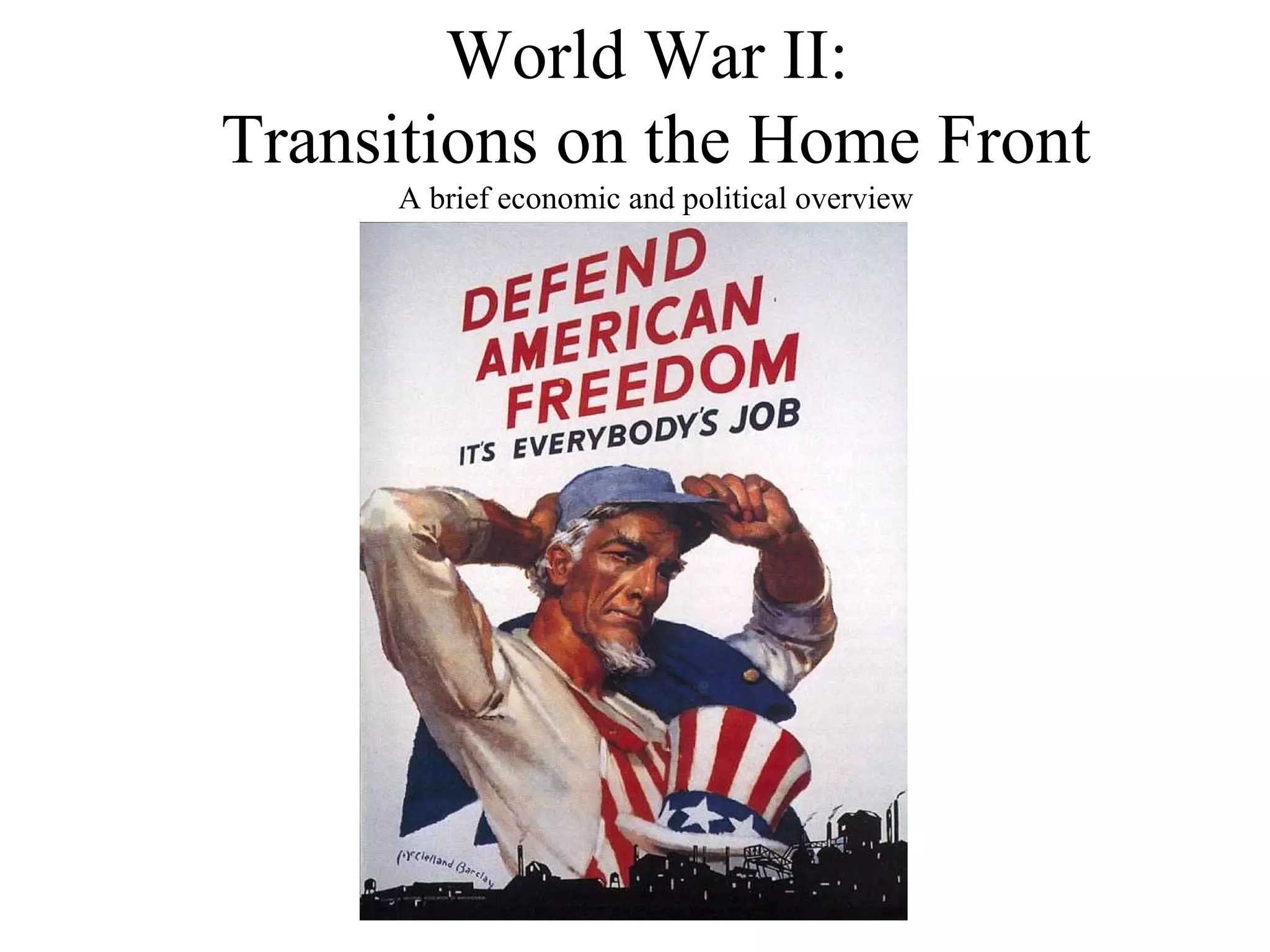
World War II:
Transitions on the Home Front
A brief economic and political overview
Transition to War
• While America declared neutrality until after the Japanese
bombed Pearl Harbor, steps were taken by President Franklin
D. Roosevelt to get the American economy and people ready
for a potential war.
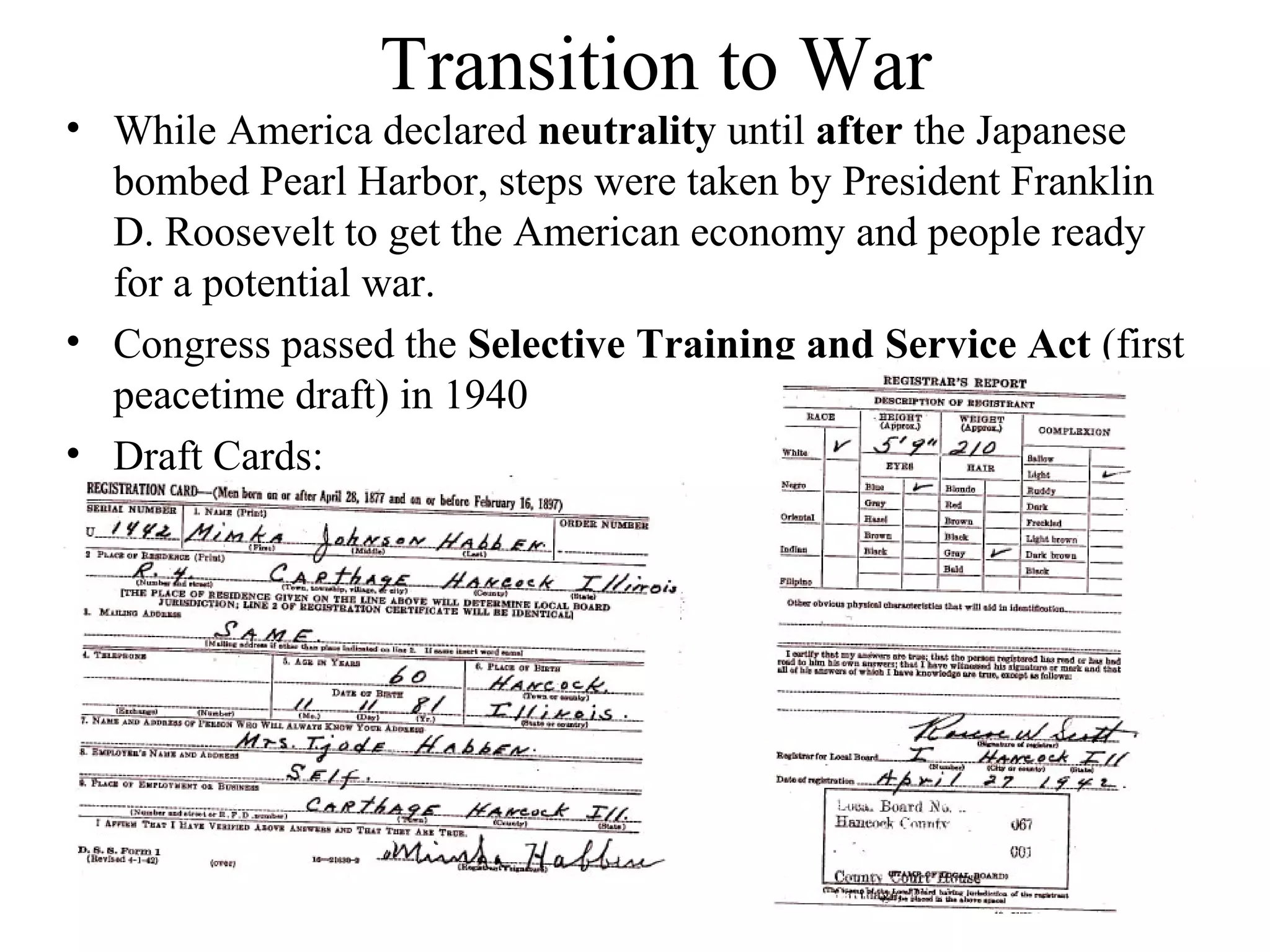
• Congress passed the Selective Training and Service Act (first
peacetime draft) in 1940
• Draft Cards:
Transition to War
1. American had a policy of Isolationism
before Pearl Harbor. What is Isolationism?
2. Why did American change the
Isolationism policy?
3. What was the Draft?
Transition to War: Economic
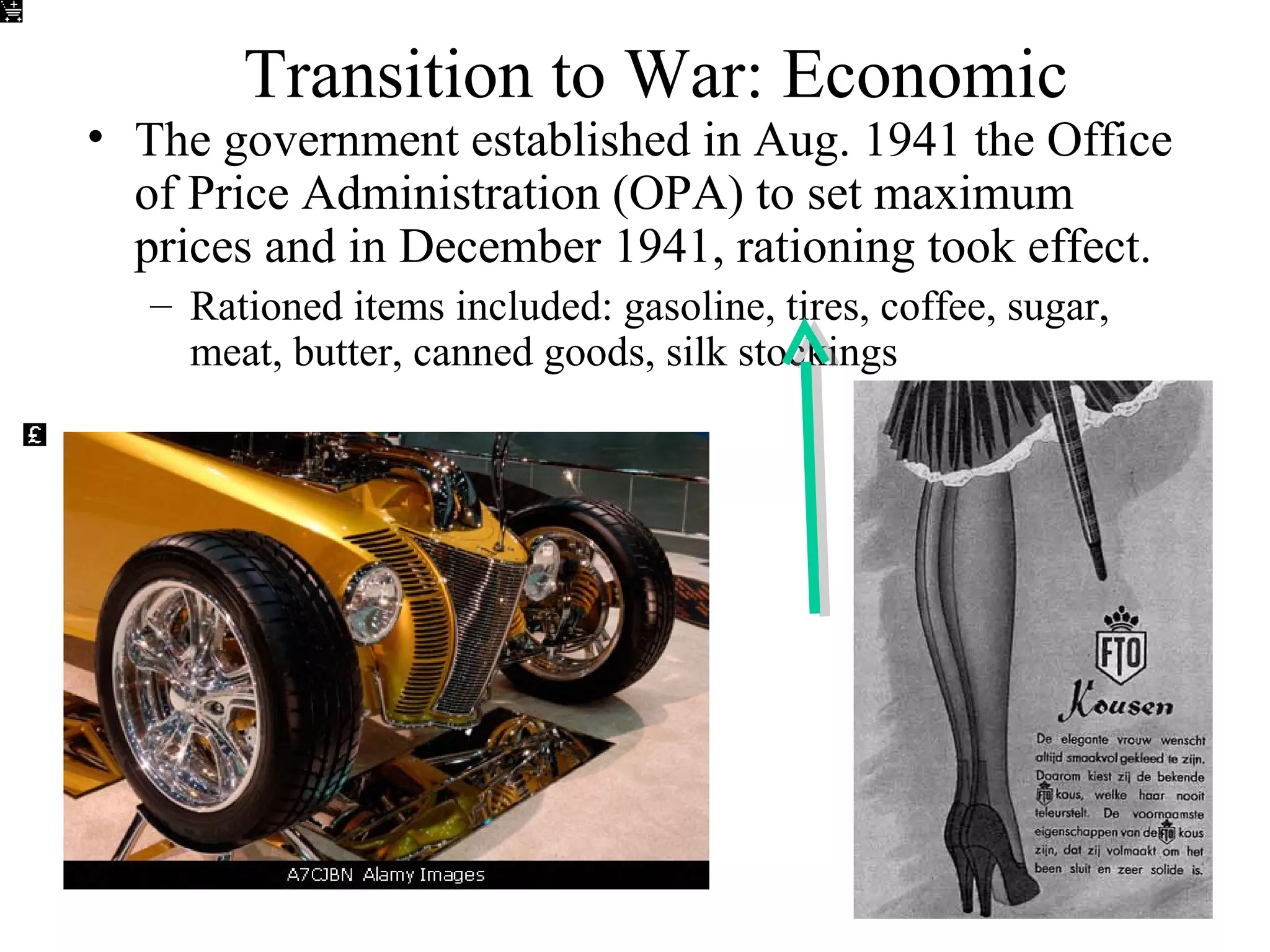
• The government established in Aug. 1941 the Office
of Price Administration (OPA) to set maximum
prices and in December 1941, rationing took effect.
– Rationed items included: gasoline, tires, coffee, sugar,
meat, butter, canned goods, silk stockings
Economics
1. What was Rationing?
1. Why was there Rationing?
1. Name some Rationed items
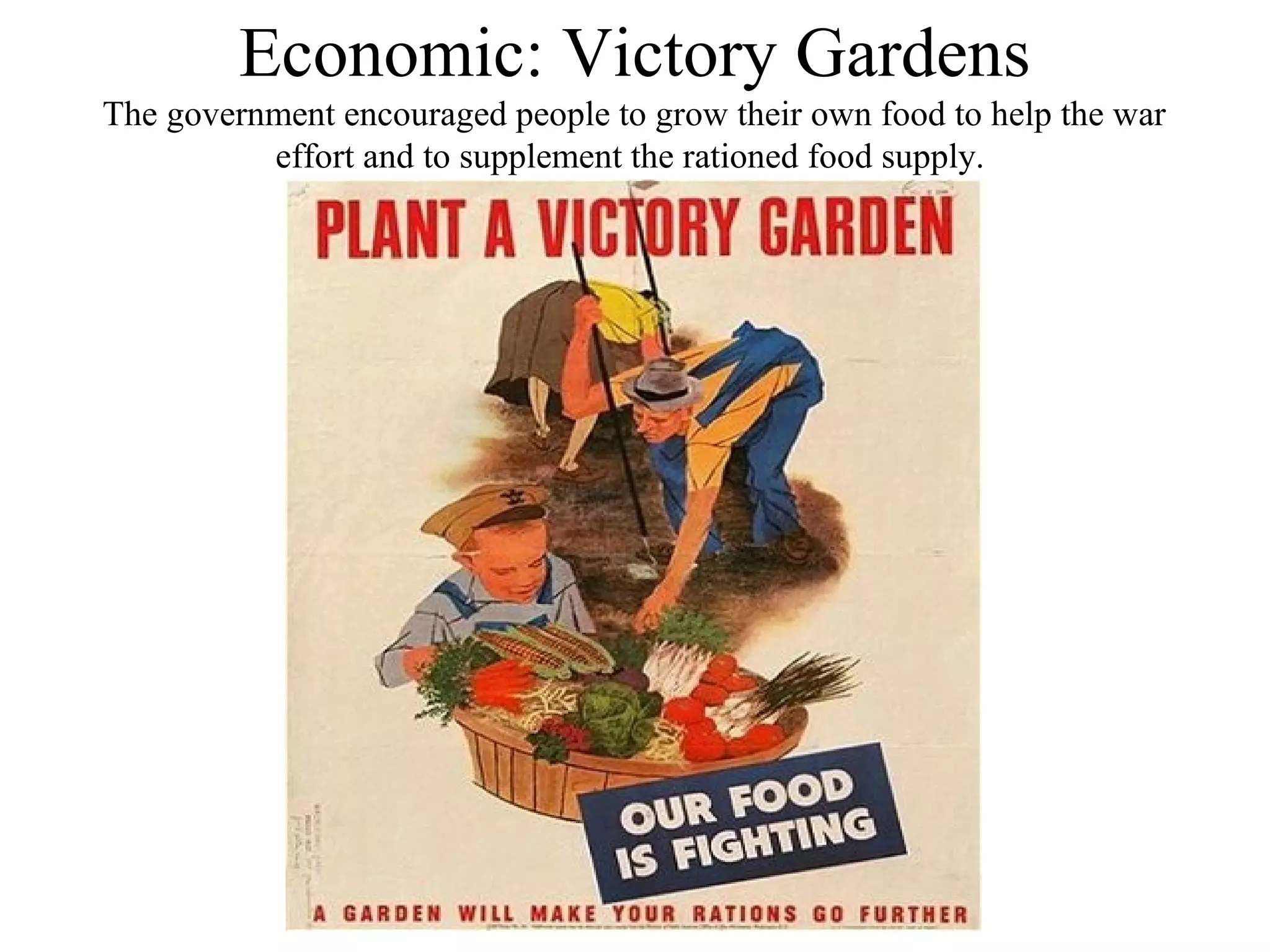
Economic: Victory Gardens
The government encouraged people to grow their own food to help the war
effort and to supplement the rationed food supply.
Victory Garden Poster
Victory Gardens
• What was a Victory Gardens?
• Why did people have Victory Gardens?
• How did it help the War Effort?
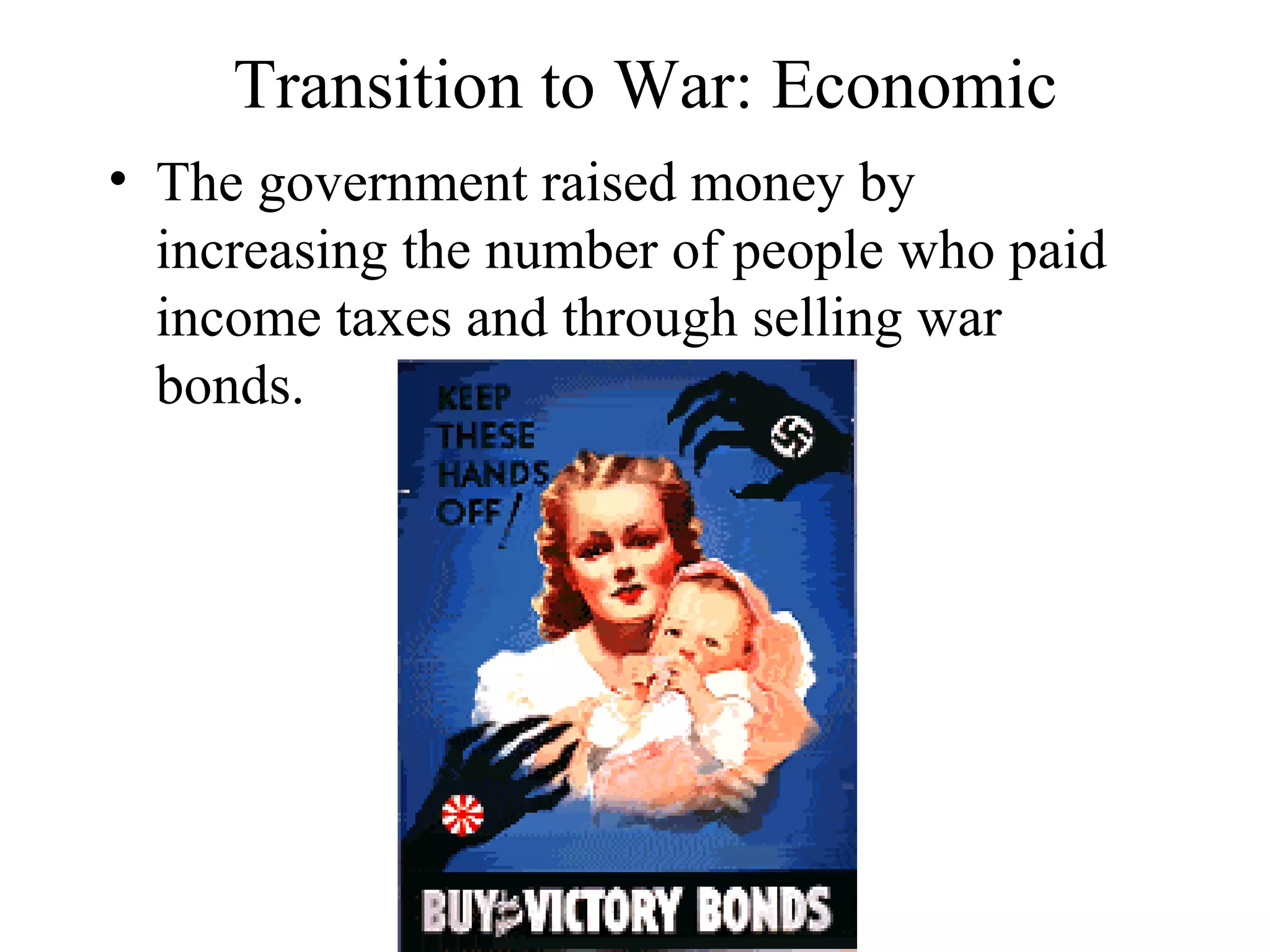
Transition to War: Economic
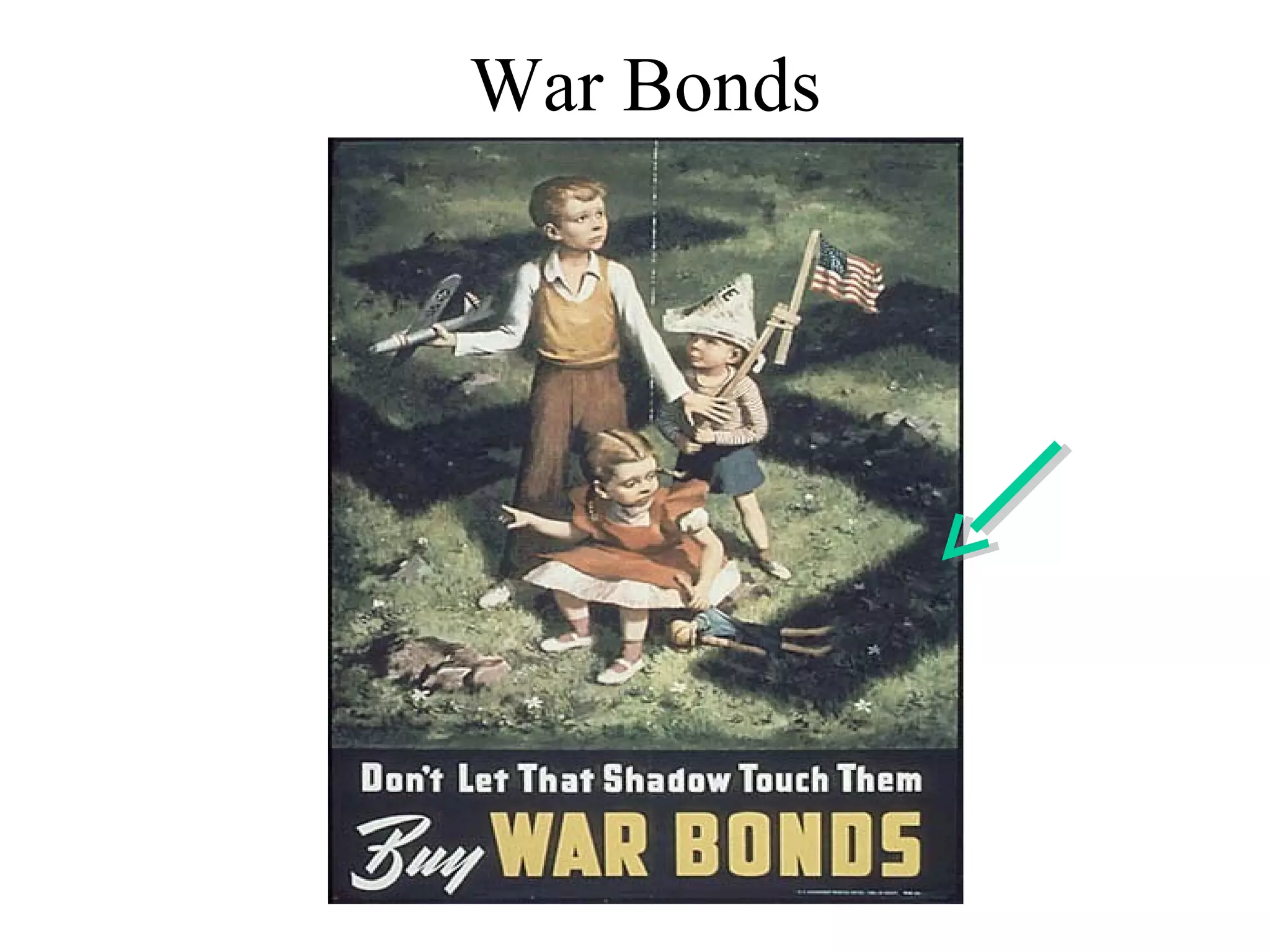
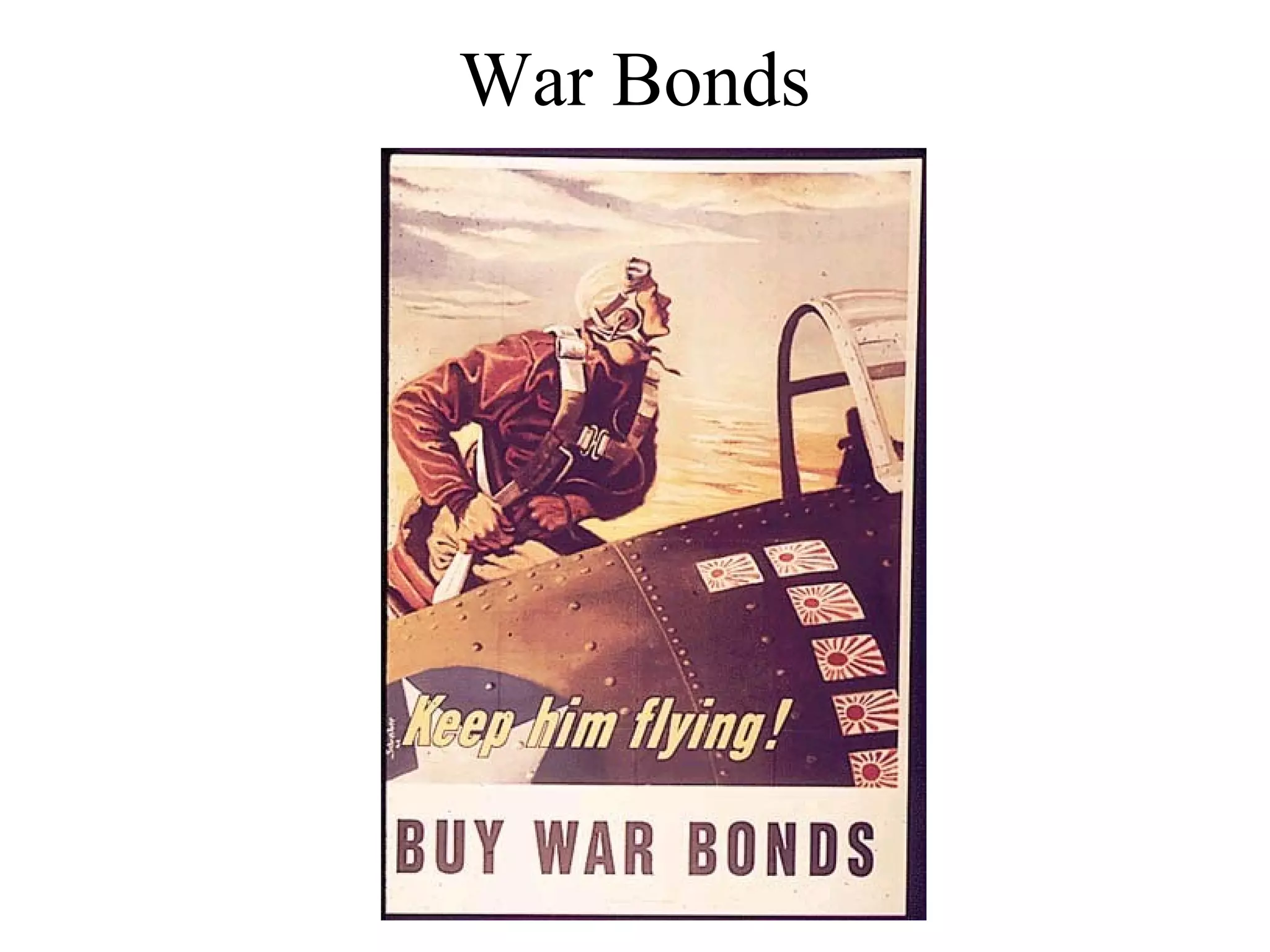
• The government raised money by
increasing the number of people who paid
income taxes and through selling war
bonds.
War Bonds
War Bonds
Raising Money
• Name 2 ways the government raised money
for the war.
Transition to War: Political
• In his State of the Union Address on Jan. 6, 1941,
President Franklin D. Roosevelt outlined the natural rights
of mankind, which were obviously being abolished under
the Axis Powers. These natural rights were distilled into
four freedoms that he believed all people were entitled to.
(This is 11 months before Pearl Harbor is bombed by the Japanese.)
• Four Freedoms
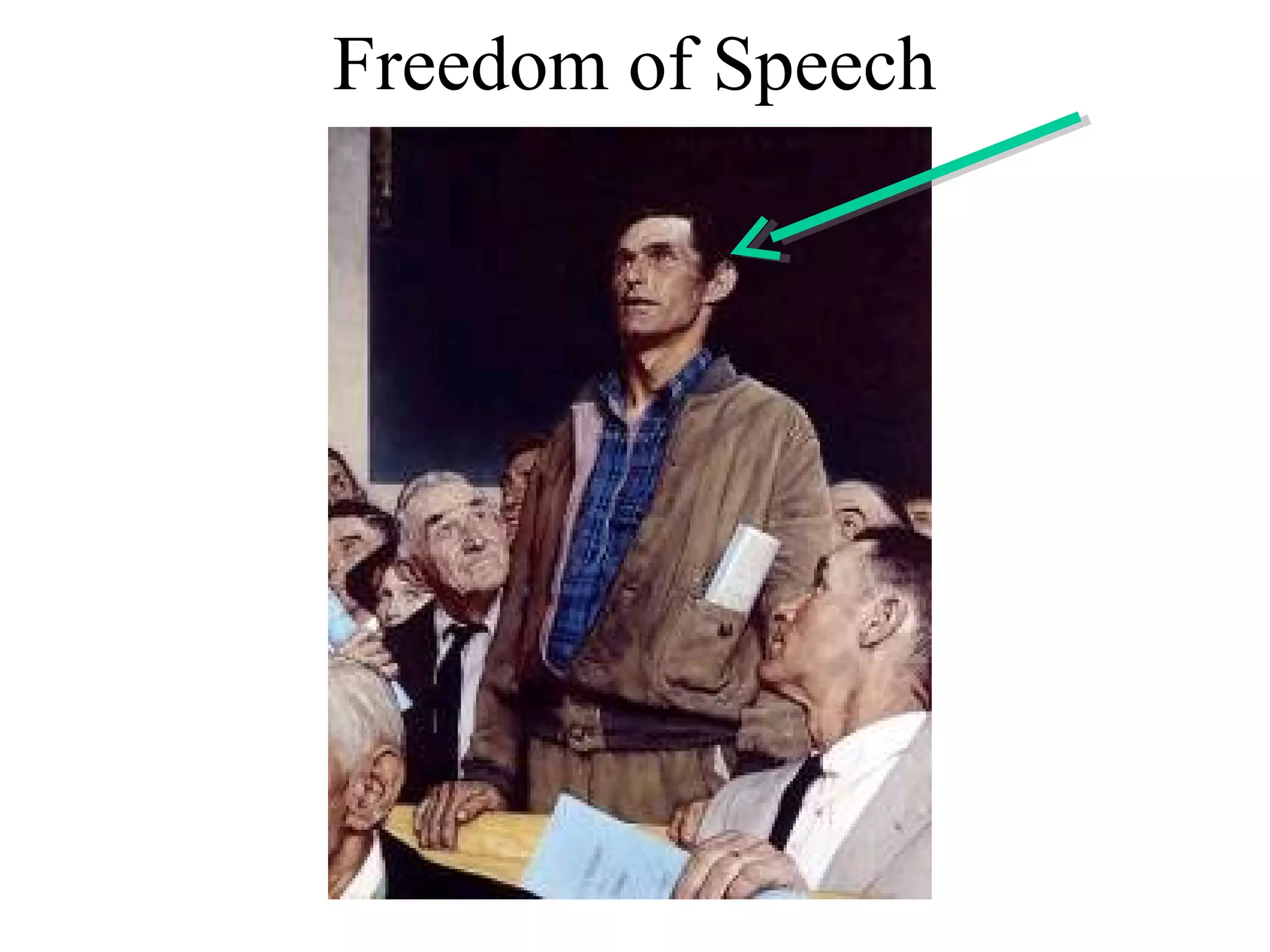
– Freedom of Speech
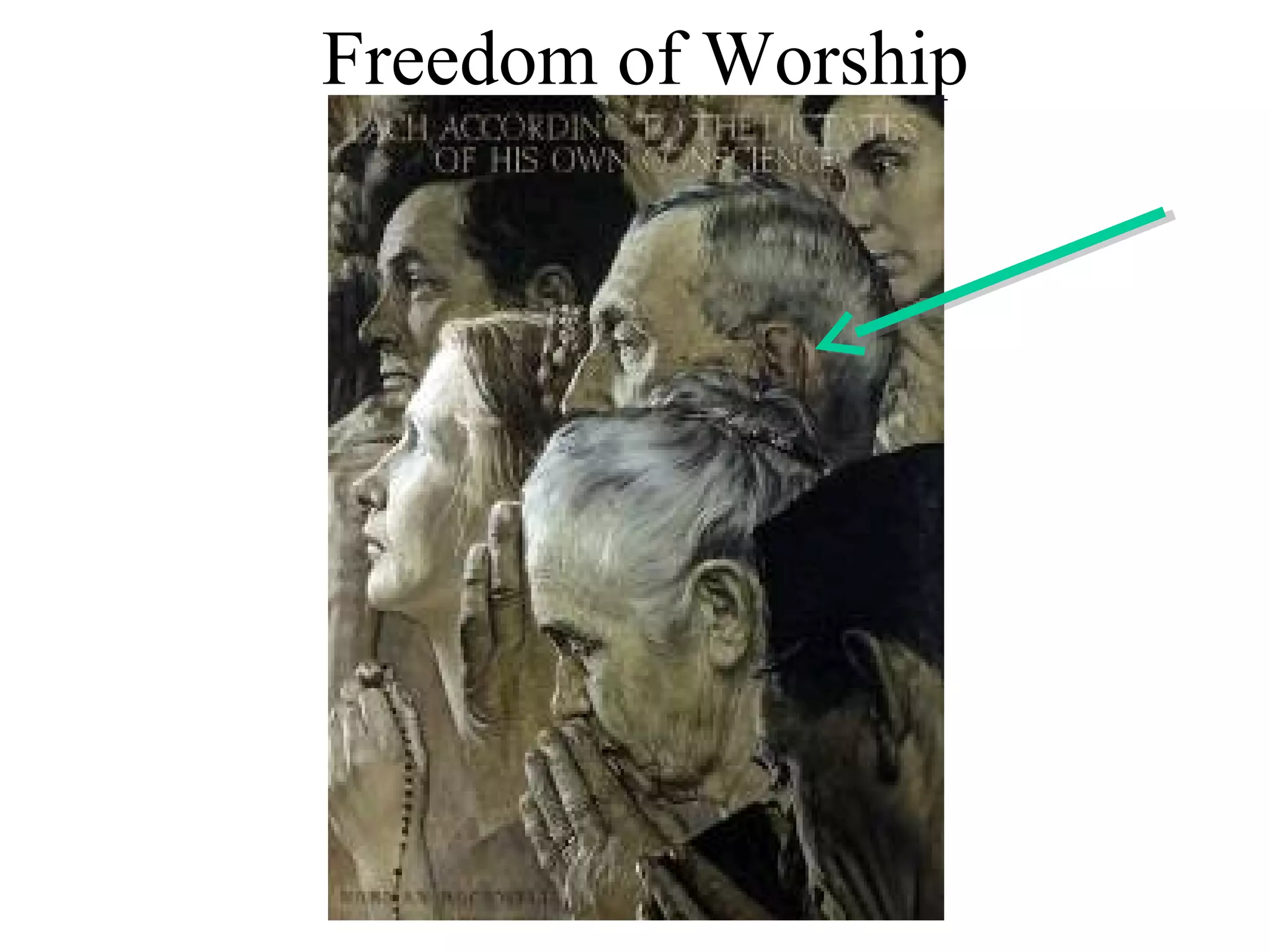
– Freedom of Worship
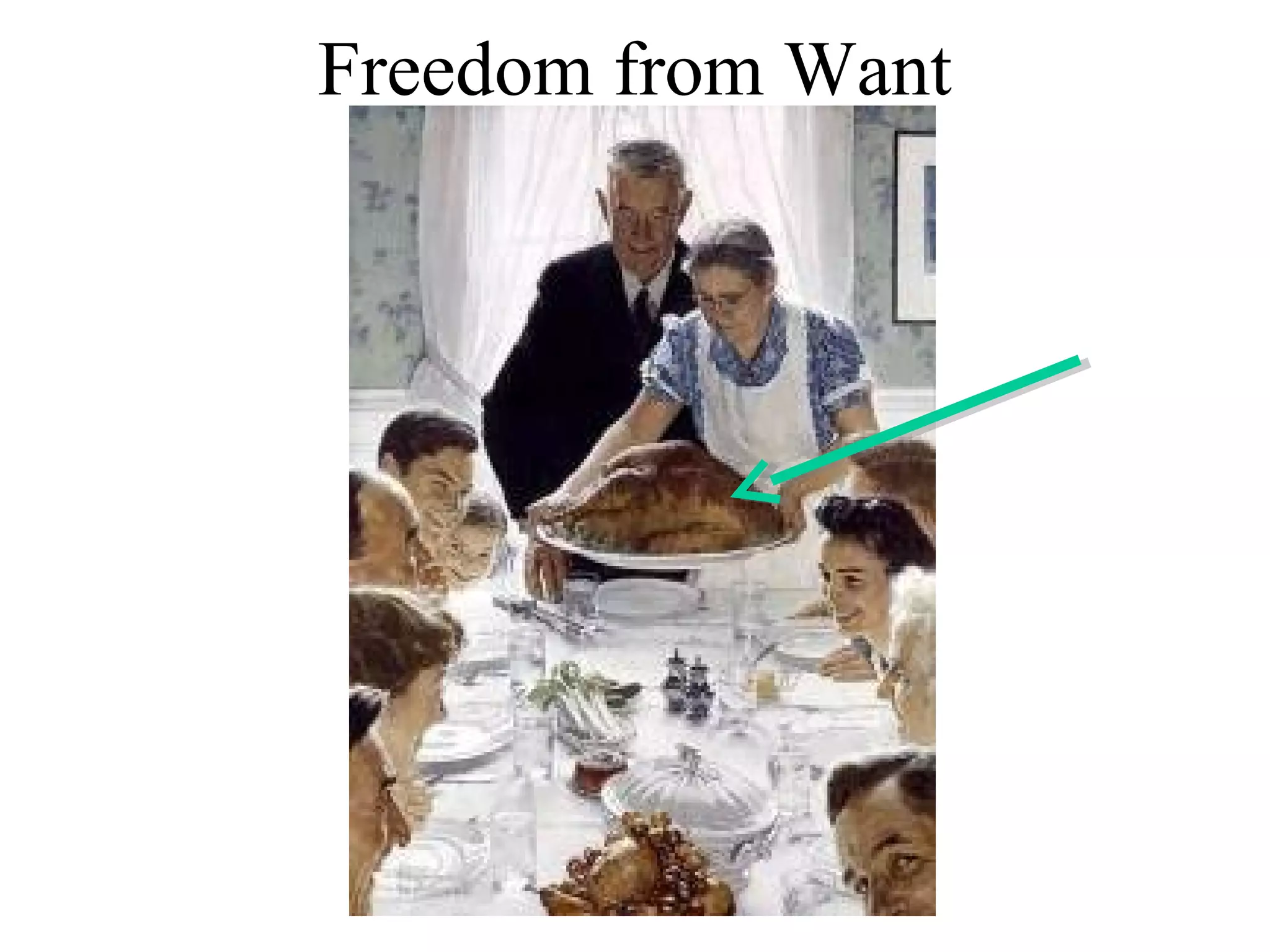
– Freedom from Want
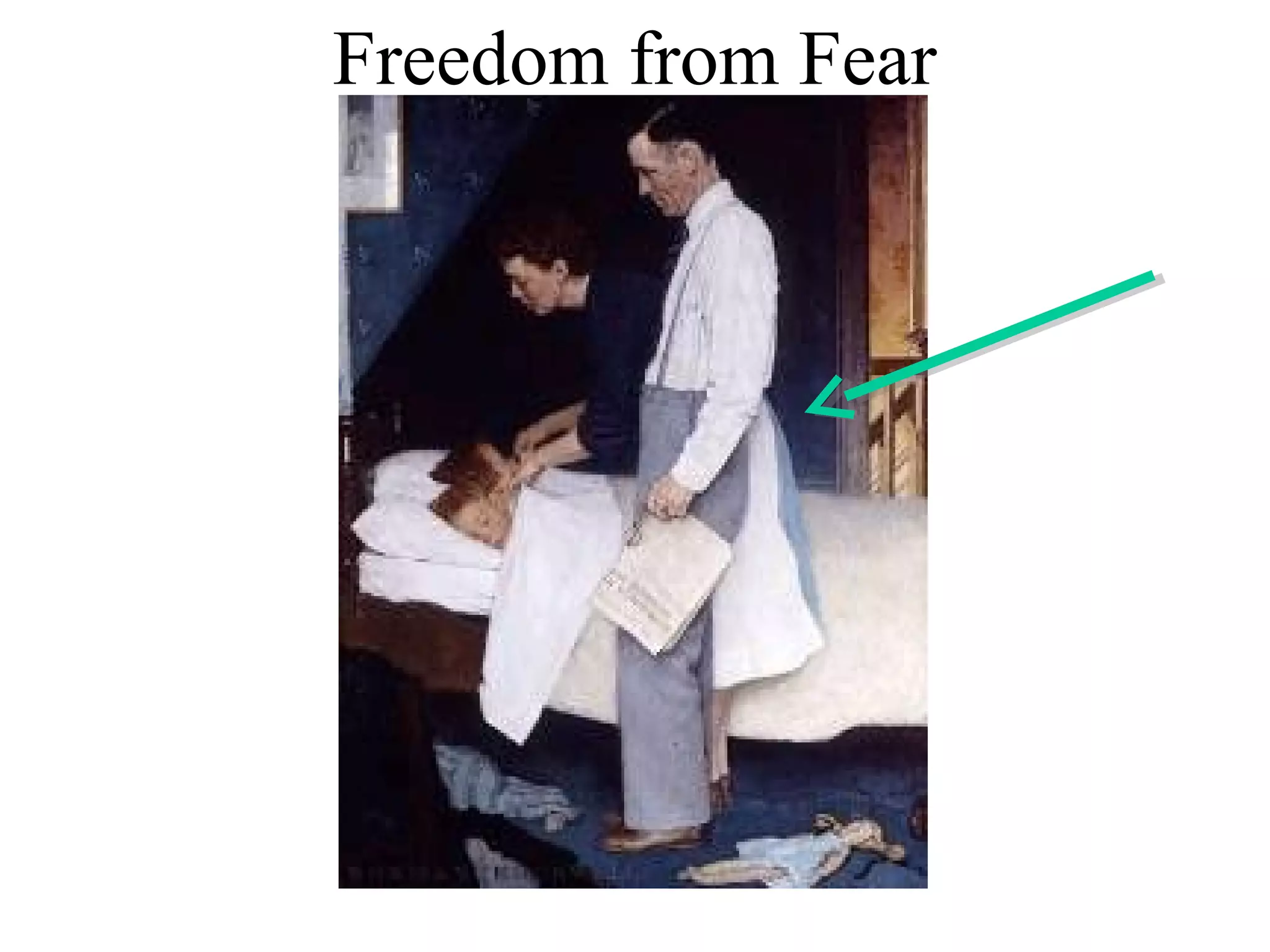
– Freedom from Fear
• Norman Rockwell interpreted these four freedoms in
pictures to help support the war effort.
Freedom of Speech
Freedom of Worship
Freedom from Want
Freedom from Fear
Beginning of War
• When these freedoms are infringed upon by the
Japanese attack on Pearl Harbor on December 7,
1941, Americans are mentally prepared to go to war.
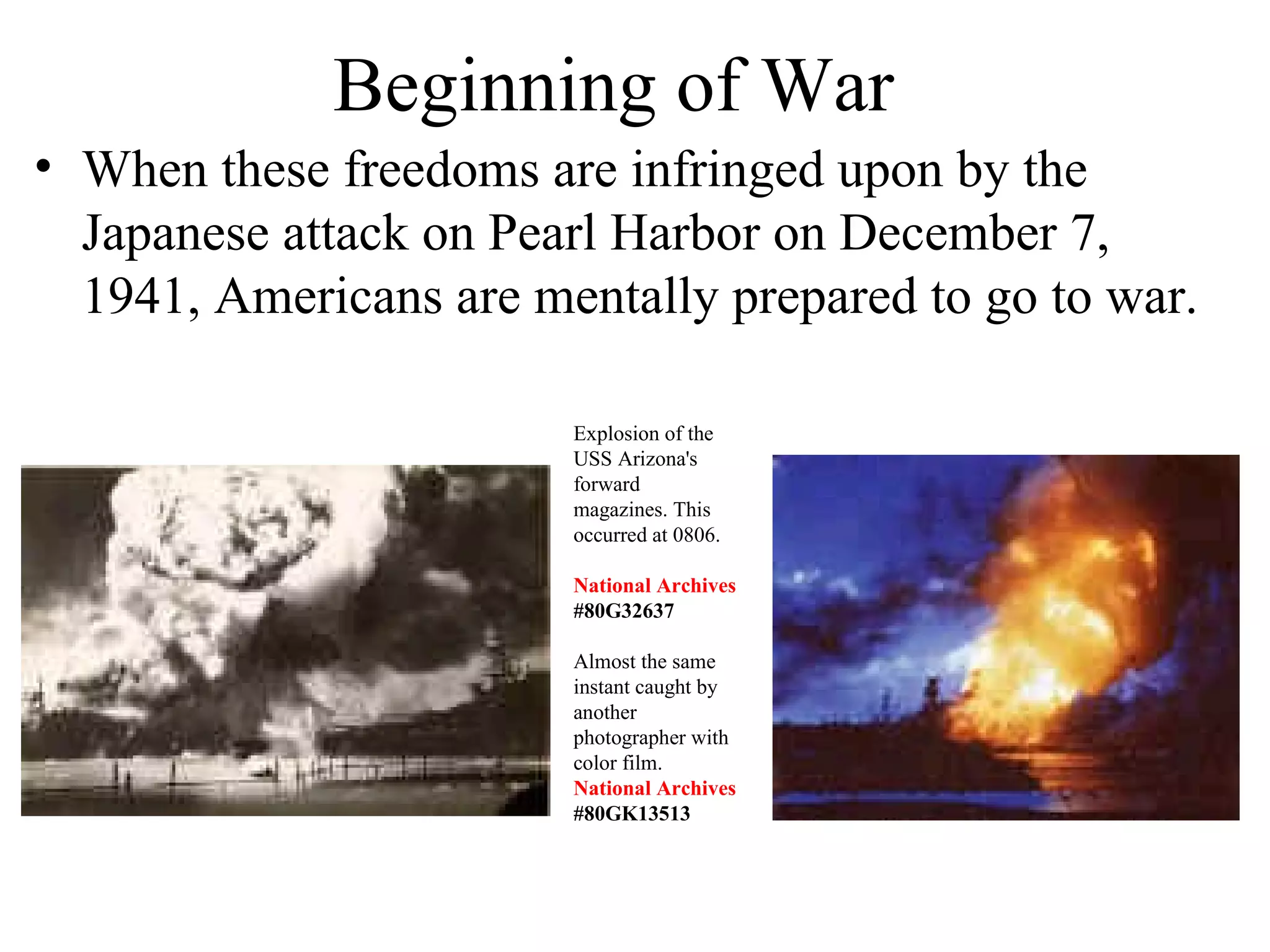
Explosion of the
USS Arizona's
forward
magazines. This
occurred at 0806.
National Archives
#80G32637
Almost the same
instant caught by
another
photographer with
color film.
National Archives
#80GK13513
Pearl Harbor
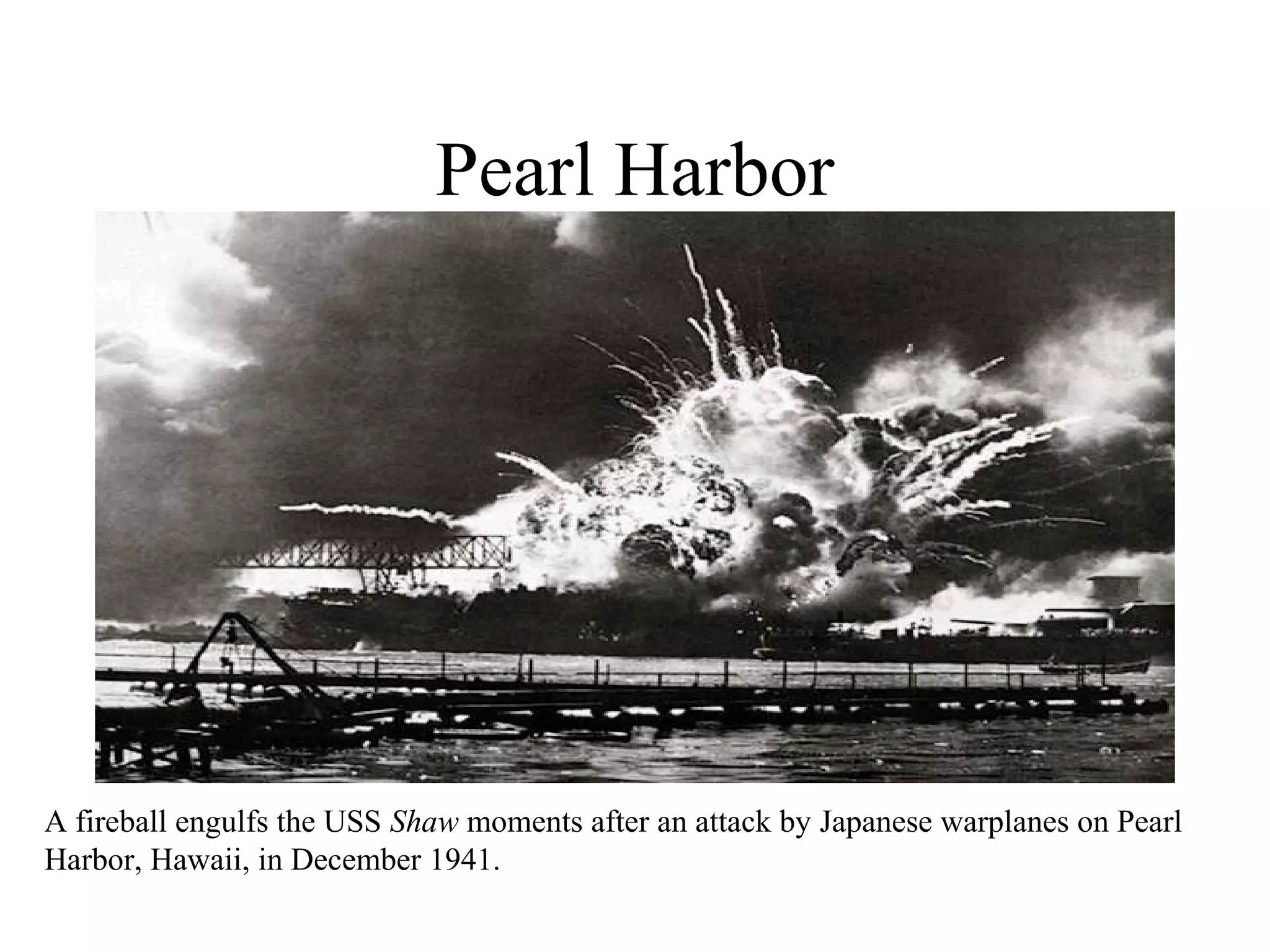
A fireball engulfs the USS Shaw moments after an attack by Japanese warplanes on Pearl
Harbor, Hawaii, in December 1941.
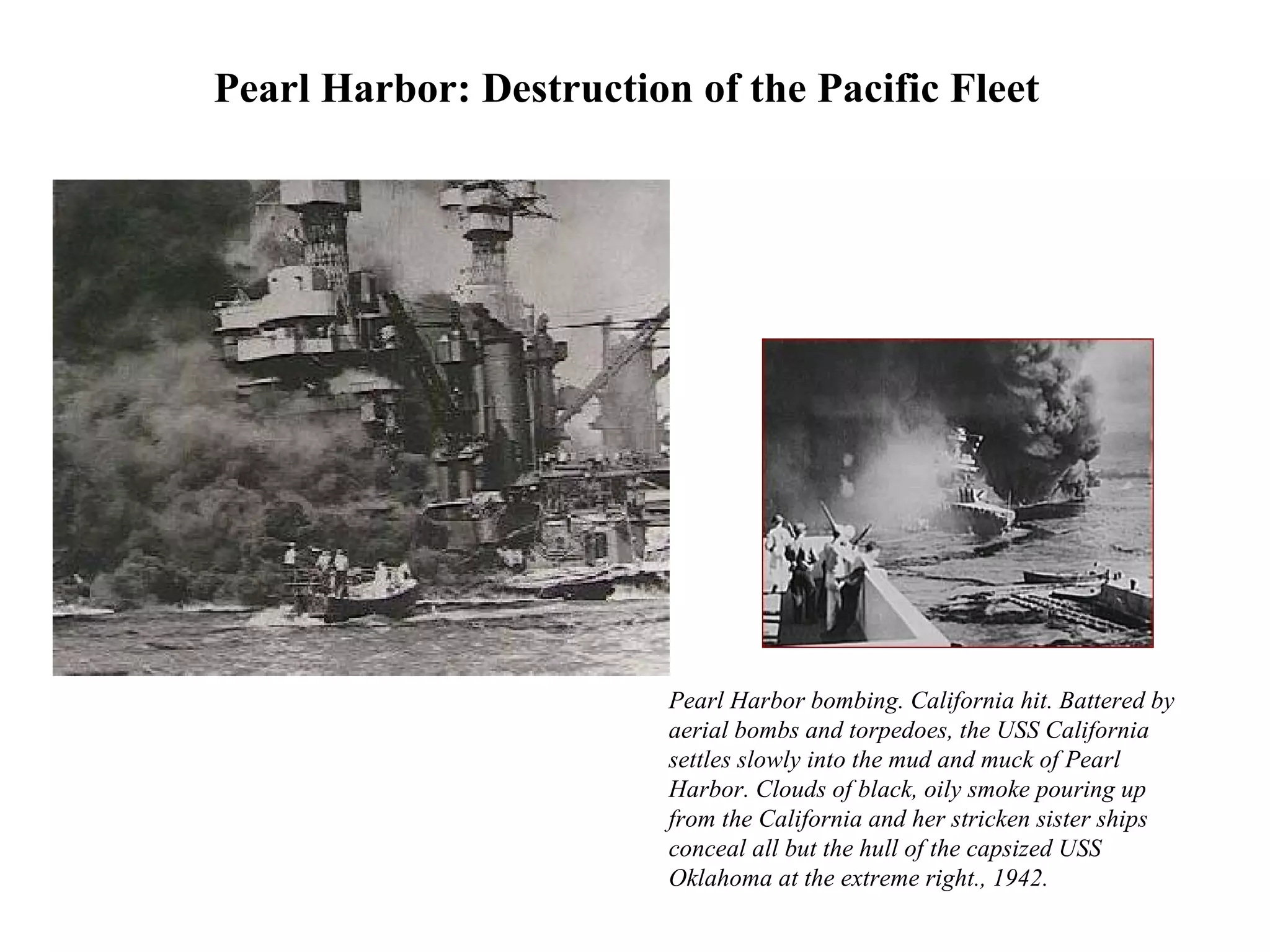
Pearl Harbor bombing. California hit. Battered by
aerial bombs and torpedoes, the USS California
settles slowly into the mud and muck of Pearl
Harbor. Clouds of black, oily smoke pouring up
from the California and her stricken sister ships
conceal all but the hull of the capsized USS
Oklahoma at the extreme right., 1942.
Pearl Harbor: Destruction of the Pacific Fleet
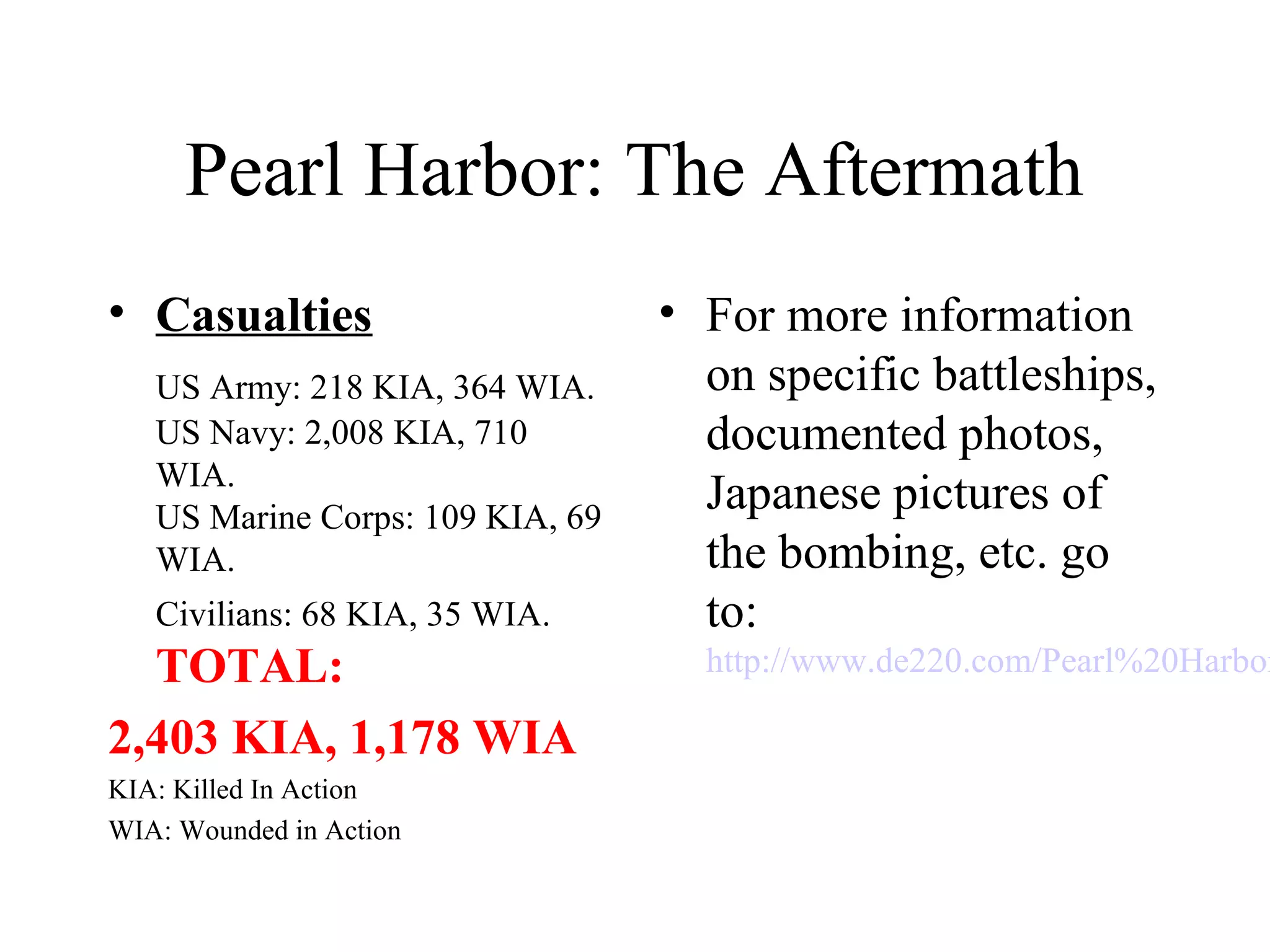
Pearl Harbor: The Aftermath
• Casualties
US Army: 218 KIA, 364 WIA.
US Navy: 2,008 KIA, 710
WIA.
US Marine Corps: 109 KIA, 69
WIA.
Civilians: 68 KIA, 35 WIA.
TOTAL:
2,403 KIA, 1,178 WIA
KIA: Killed In Action
WIA: Wounded in Action
• For more information
on specific battleships,
documented photos,
Japanese pictures of
the bombing, etc. go
to:
http://www.de220.com/Pearl%20Harbor
War Declared
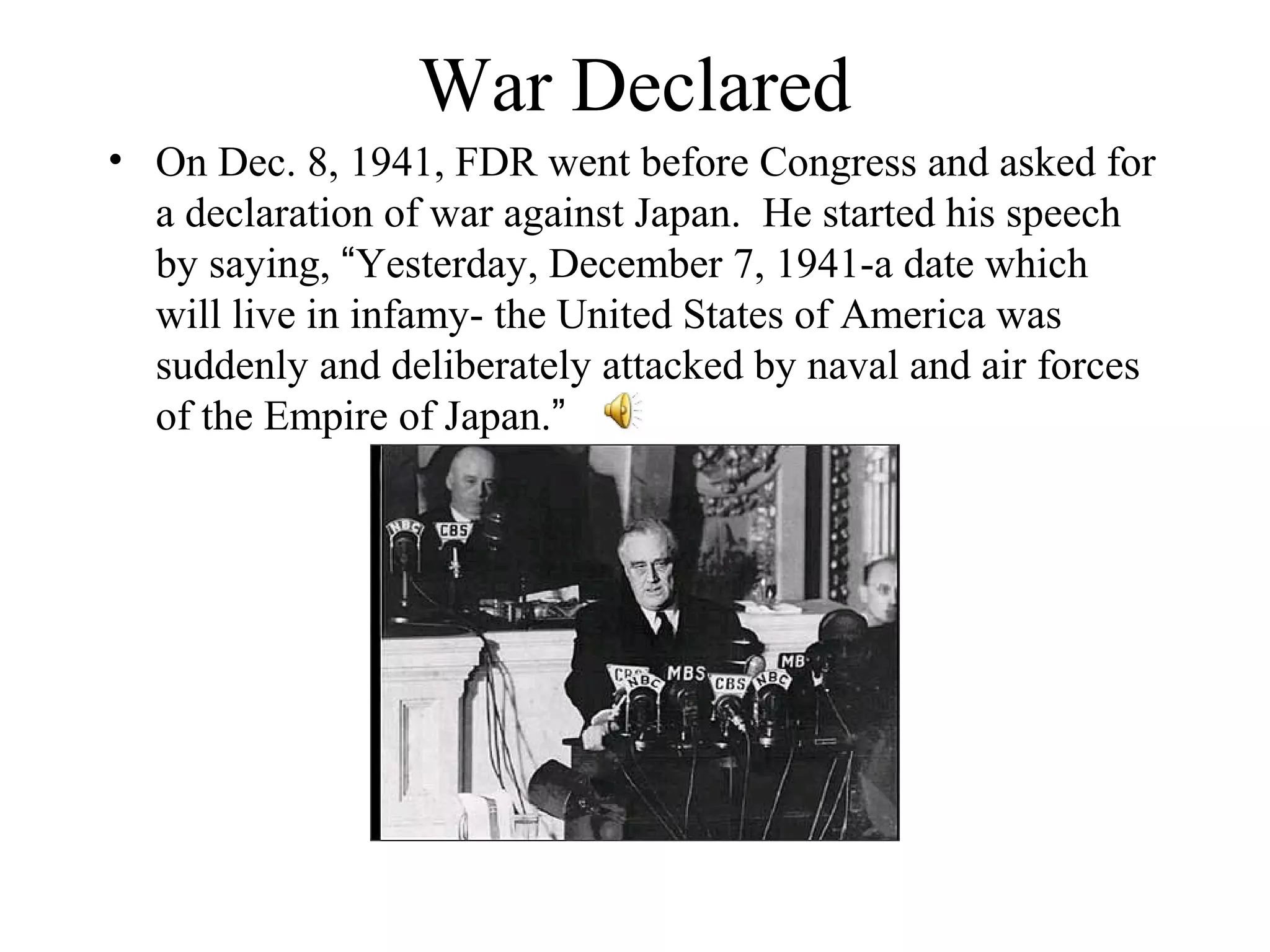
• On Dec. 8, 1941, FDR went before Congress and asked for
a declaration of war against Japan. He started his speech
by saying, “Yesterday, December 7, 1941-a date which
will live in infamy- the United States of America was
suddenly and deliberately attacked by naval and air forces
of the Empire of Japan.”
War’s Upon Us
• With the declaration of war, American production has got to get
moving!
• In 1942 the War Production Board (WPB) is created to increase
military production.
– Converted existing factories to wartime production
– Built new factories
– Recycled raw materials into different industries
• In 1943 the Office of War Mobilization (OWM) is created to
coordinate government agencies involved in the war effort.
– Determined amount of raw materials that could be diverted
to civilians.
• Ex. Nylon used for parachutes, not pantyhose. Fashion
styles changed, as fabric couldn’t be sacrificed to make
pleats or cuffs.
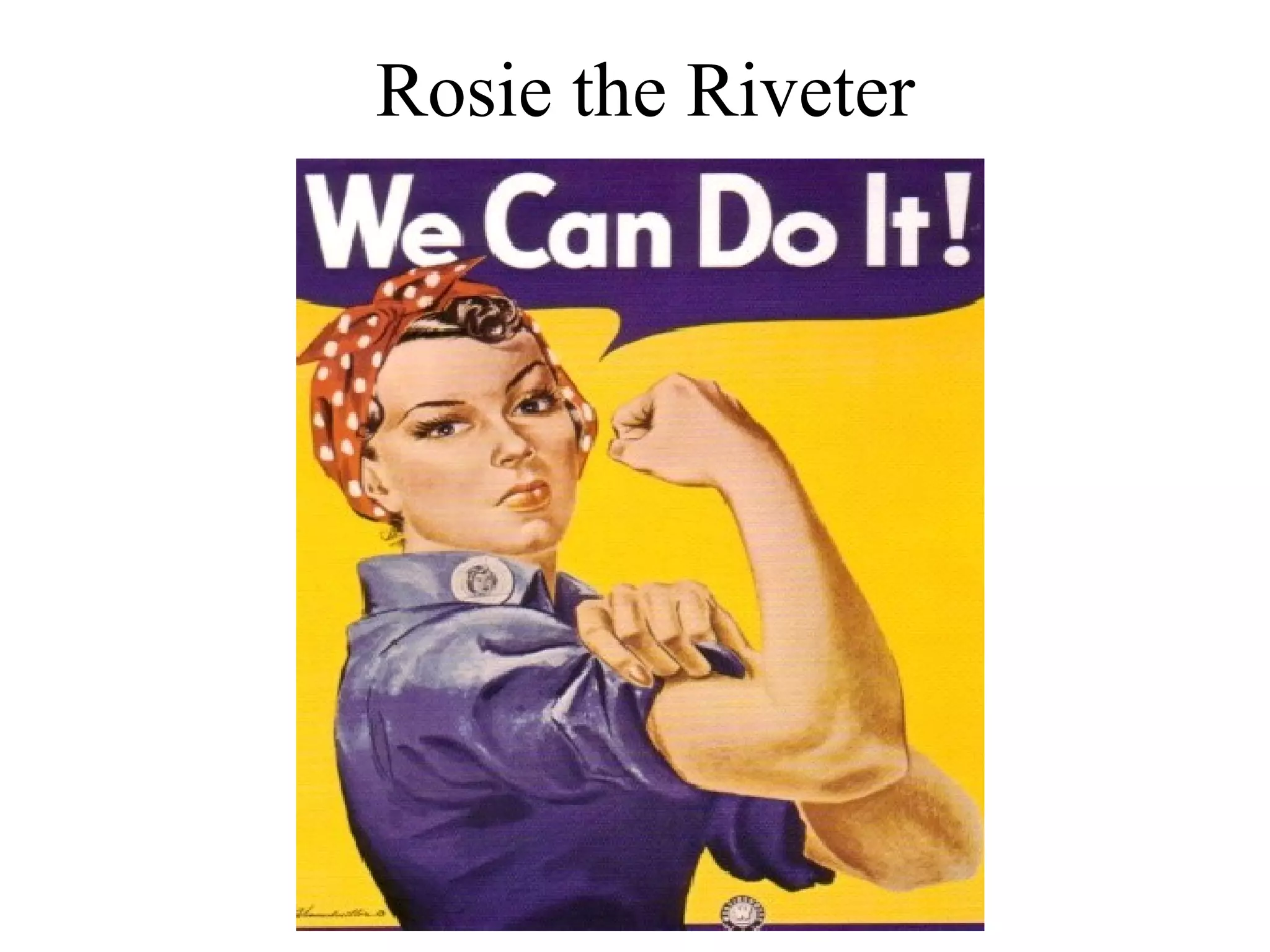
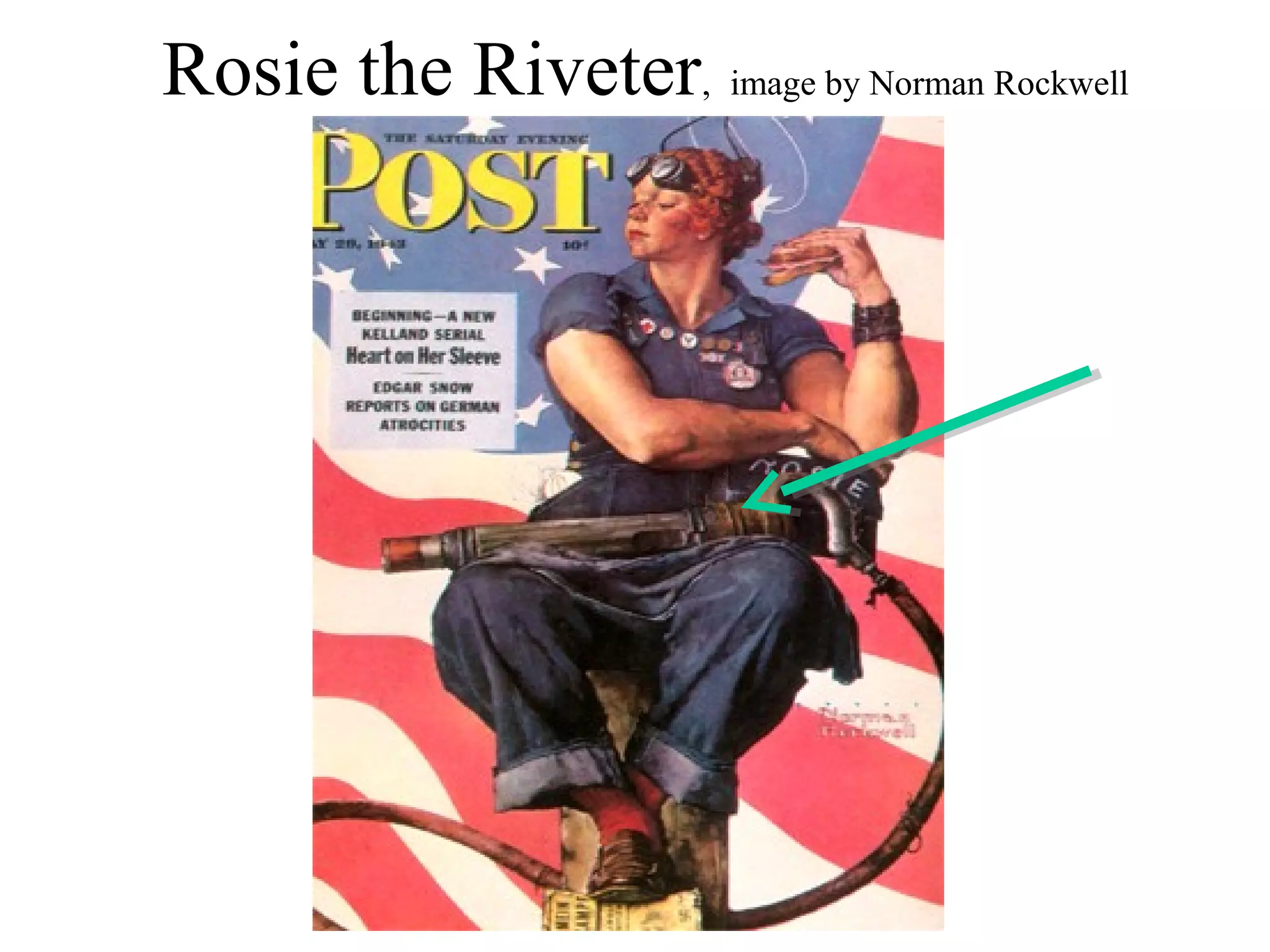
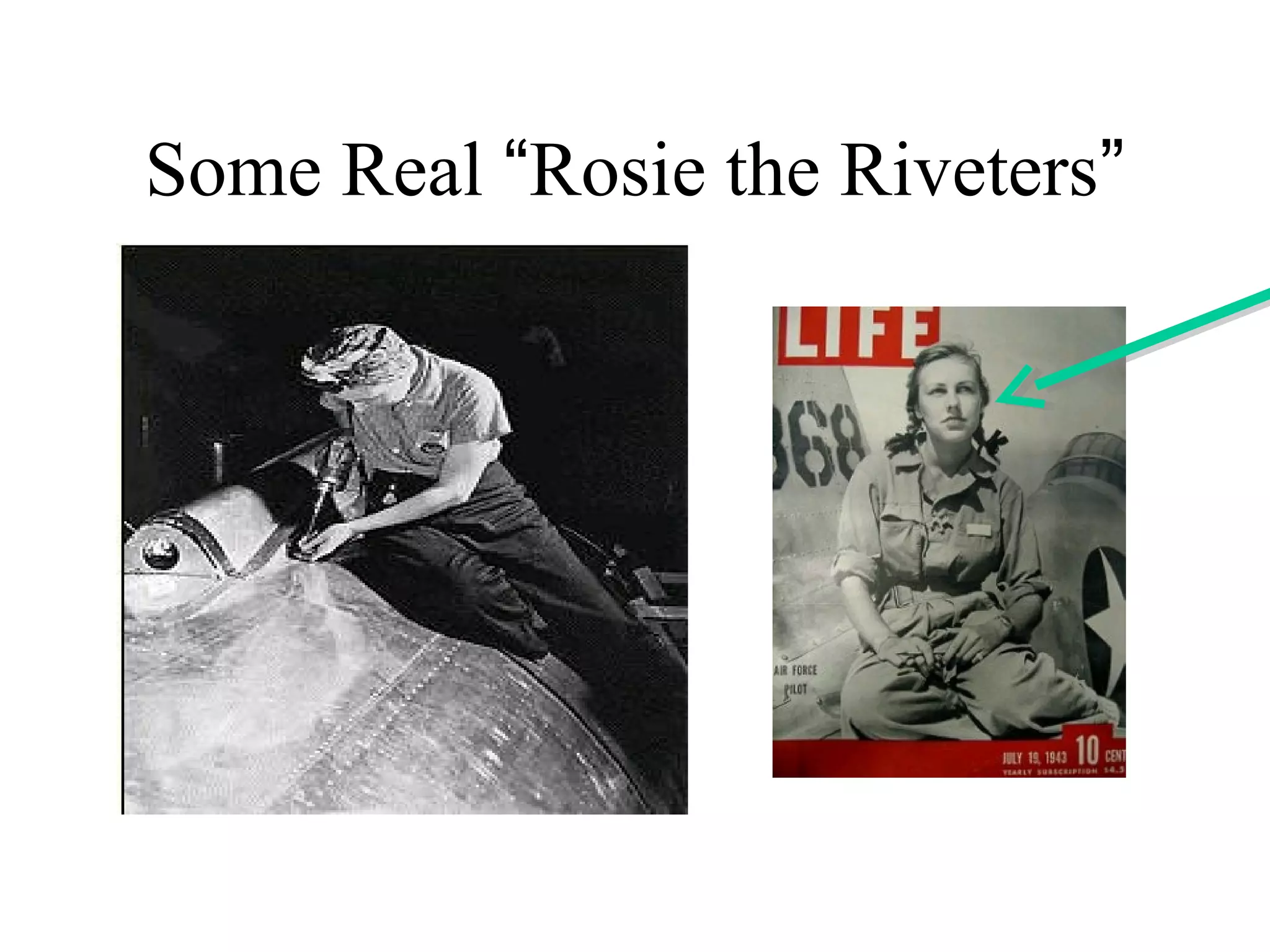
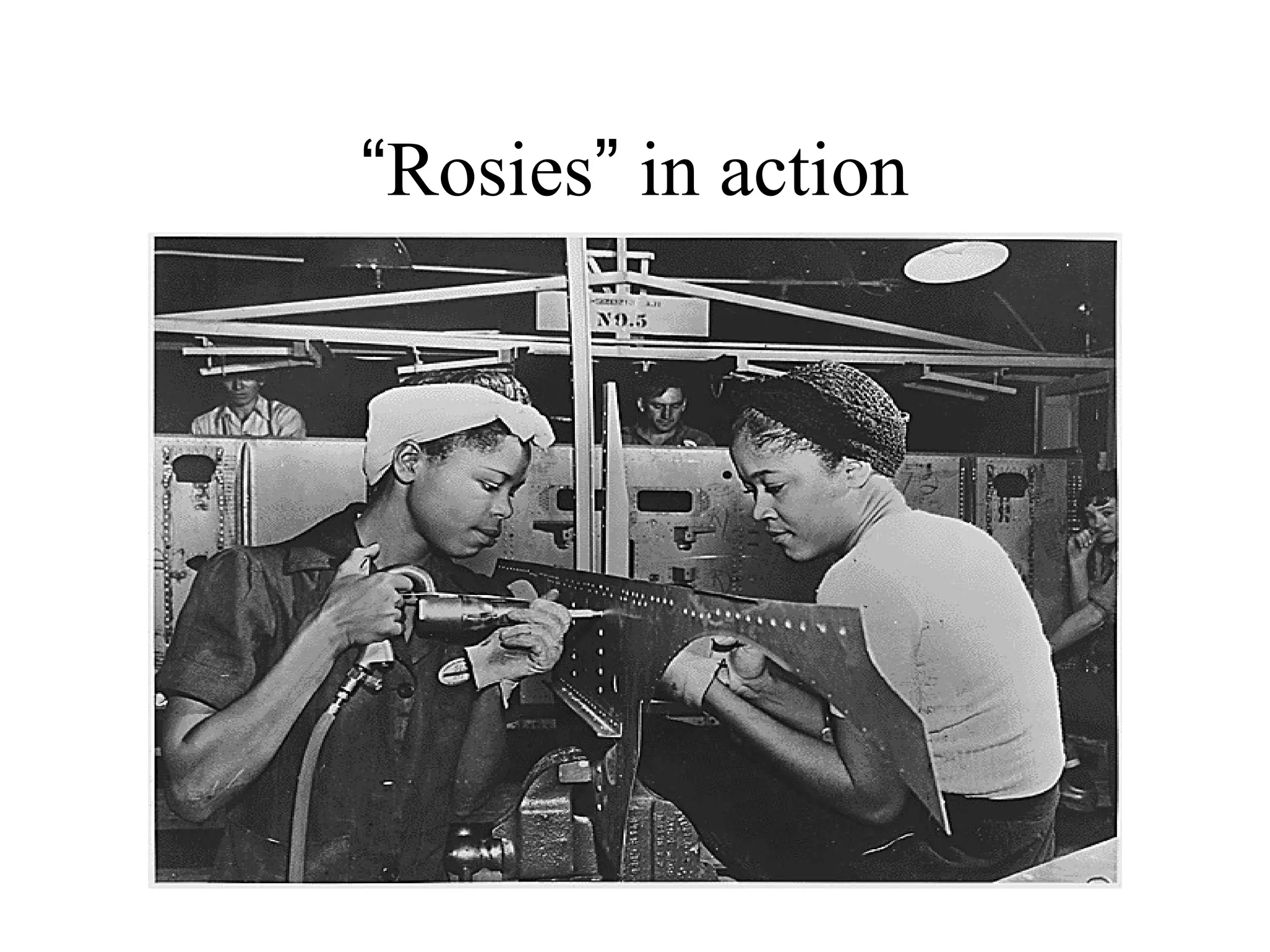
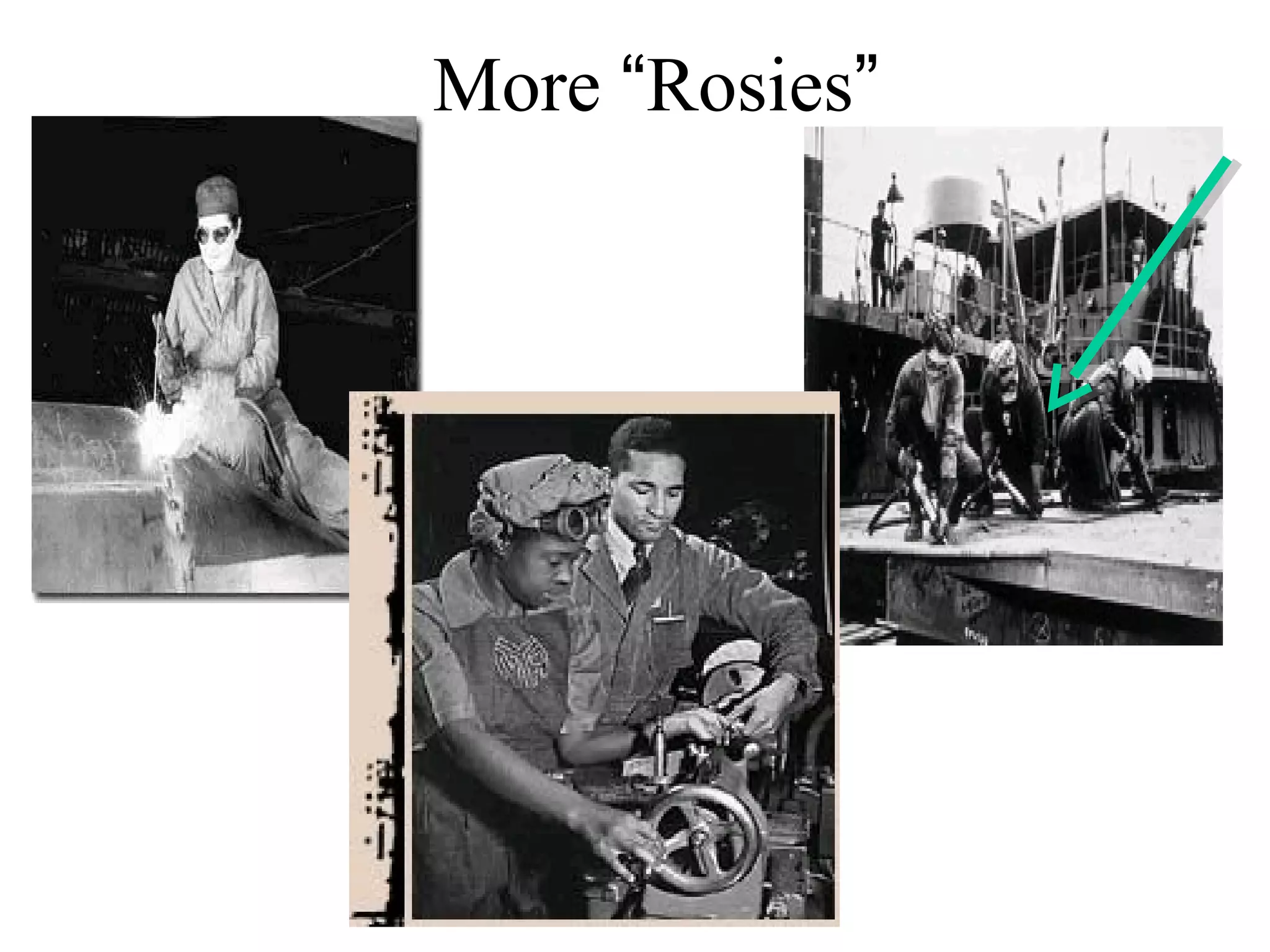
• Women are recruited to fill the positions men are leaving as
they go to war. The most iconic image is of Rosie the Riveter.
Rosie the Riveter
Rosie the Riveter, image by Norman Rockwell
Some Real “Rosie the Riveters”
“Rosies” in action
More “Rosies”
Women and Overall War Production
• From 1940 to 1944, 6 million new women joined the
workforce, most in clerical and service jobs.
• Women were paid less than men for the same work.
• African American women and women over 40 yrs old had a
harder time finding employers.
• Unemployment dropped from 14.6% in 1940 to 1.2% in 1944.
• Average weekly wages rose 65 percent, and manufacturing
workers saw their real income jump 27 percent.
• Earnings nearly doubled between 1939 and 1945.
• In 1940, government arsenals employed 22,000 workers and
by 1943, they employed 486,000.
• From 1940 to 1945 America built 300,000 aircraft; 88,000
landing craft; 215 submarines, 147 aircraft carriers, 952 other
warships, 5,200 merchant ships, 88,410 tanks, 6.5 million
rifles, and 40 billion bullets.
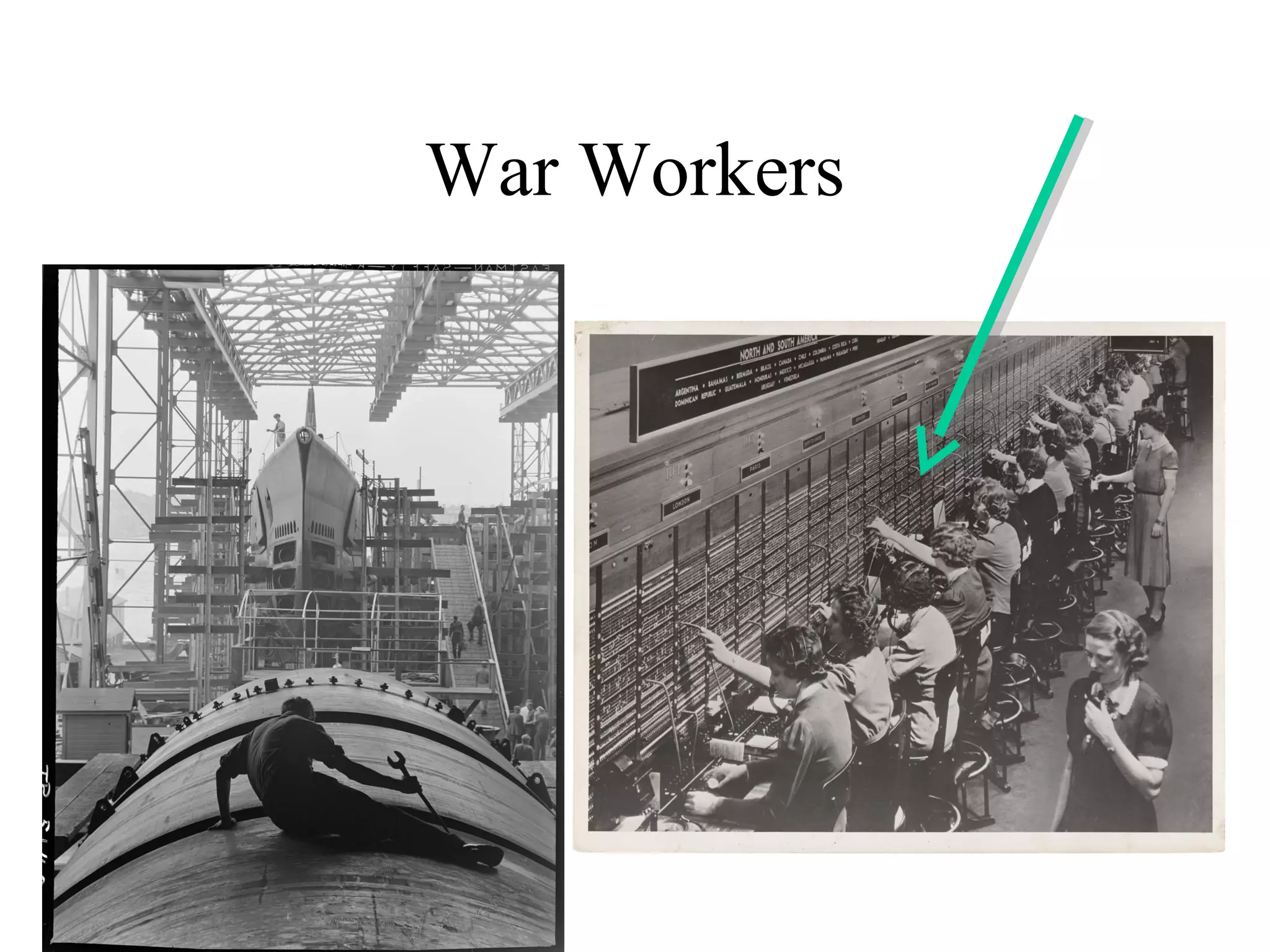
War Workers
WWII:
Transitions on the Home Front
• Due to pre-war/early war
economic and political
preparations by the US
government, Americans
were better able to deal
with the onset of war.
• These preparations
allowed civilians to more
effectively contribute to
the war effort, which in
turn helped soldiers. We
will look at the military
impact next.

April26 homefront

  • 1.
    World War II: Transitionson the Home Front A brief economic and political overview
  • 2.
    Transition to War •While America declared neutrality until after the Japanese bombed Pearl Harbor, steps were taken by President Franklin D. Roosevelt to get the American economy and people ready for a potential war. • Congress passed the Selective Training and Service Act (first peacetime draft) in 1940 • Draft Cards:
  • 3.
    Transition to War 1.American had a policy of Isolationism before Pearl Harbor. What is Isolationism? 2. Why did American change the Isolationism policy? 3. What was the Draft?
  • 4.
    Transition to War:Economic • The government established in Aug. 1941 the Office of Price Administration (OPA) to set maximum prices and in December 1941, rationing took effect. – Rationed items included: gasoline, tires, coffee, sugar, meat, butter, canned goods, silk stockings
  • 5.
    Economics 1. What wasRationing? 1. Why was there Rationing? 1. Name some Rationed items
  • 6.
    Economic: Victory Gardens Thegovernment encouraged people to grow their own food to help the war effort and to supplement the rationed food supply.
  • 7.
  • 8.
    Victory Gardens • Whatwas a Victory Gardens? • Why did people have Victory Gardens? • How did it help the War Effort?
  • 9.
    Transition to War:Economic • The government raised money by increasing the number of people who paid income taxes and through selling war bonds.
  • 10.
  • 11.
  • 12.
    Raising Money • Name2 ways the government raised money for the war.
  • 13.
    Transition to War:Political • In his State of the Union Address on Jan. 6, 1941, President Franklin D. Roosevelt outlined the natural rights of mankind, which were obviously being abolished under the Axis Powers. These natural rights were distilled into four freedoms that he believed all people were entitled to. (This is 11 months before Pearl Harbor is bombed by the Japanese.) • Four Freedoms – Freedom of Speech – Freedom of Worship – Freedom from Want – Freedom from Fear • Norman Rockwell interpreted these four freedoms in pictures to help support the war effort.
  • 14.
  • 15.
  • 16.
  • 17.
  • 18.
    Beginning of War •When these freedoms are infringed upon by the Japanese attack on Pearl Harbor on December 7, 1941, Americans are mentally prepared to go to war. Explosion of the USS Arizona's forward magazines. This occurred at 0806. National Archives #80G32637 Almost the same instant caught by another photographer with color film. National Archives #80GK13513
  • 19.
    Pearl Harbor A fireballengulfs the USS Shaw moments after an attack by Japanese warplanes on Pearl Harbor, Hawaii, in December 1941.
  • 20.
    Pearl Harbor bombing.California hit. Battered by aerial bombs and torpedoes, the USS California settles slowly into the mud and muck of Pearl Harbor. Clouds of black, oily smoke pouring up from the California and her stricken sister ships conceal all but the hull of the capsized USS Oklahoma at the extreme right., 1942. Pearl Harbor: Destruction of the Pacific Fleet
  • 22.
    Pearl Harbor: TheAftermath • Casualties US Army: 218 KIA, 364 WIA. US Navy: 2,008 KIA, 710 WIA. US Marine Corps: 109 KIA, 69 WIA. Civilians: 68 KIA, 35 WIA. TOTAL: 2,403 KIA, 1,178 WIA KIA: Killed In Action WIA: Wounded in Action • For more information on specific battleships, documented photos, Japanese pictures of the bombing, etc. go to: http://www.de220.com/Pearl%20Harbor
  • 23.
    War Declared • OnDec. 8, 1941, FDR went before Congress and asked for a declaration of war against Japan. He started his speech by saying, “Yesterday, December 7, 1941-a date which will live in infamy- the United States of America was suddenly and deliberately attacked by naval and air forces of the Empire of Japan.”
  • 24.
    War’s Upon Us •With the declaration of war, American production has got to get moving! • In 1942 the War Production Board (WPB) is created to increase military production. – Converted existing factories to wartime production – Built new factories – Recycled raw materials into different industries • In 1943 the Office of War Mobilization (OWM) is created to coordinate government agencies involved in the war effort. – Determined amount of raw materials that could be diverted to civilians. • Ex. Nylon used for parachutes, not pantyhose. Fashion styles changed, as fabric couldn’t be sacrificed to make pleats or cuffs. • Women are recruited to fill the positions men are leaving as they go to war. The most iconic image is of Rosie the Riveter.
  • 25.
  • 26.
    Rosie the Riveter,image by Norman Rockwell
  • 27.
    Some Real “Rosiethe Riveters”
  • 28.
  • 29.
  • 30.
    Women and OverallWar Production • From 1940 to 1944, 6 million new women joined the workforce, most in clerical and service jobs. • Women were paid less than men for the same work. • African American women and women over 40 yrs old had a harder time finding employers. • Unemployment dropped from 14.6% in 1940 to 1.2% in 1944. • Average weekly wages rose 65 percent, and manufacturing workers saw their real income jump 27 percent. • Earnings nearly doubled between 1939 and 1945. • In 1940, government arsenals employed 22,000 workers and by 1943, they employed 486,000. • From 1940 to 1945 America built 300,000 aircraft; 88,000 landing craft; 215 submarines, 147 aircraft carriers, 952 other warships, 5,200 merchant ships, 88,410 tanks, 6.5 million rifles, and 40 billion bullets.
  • 31.
  • 32.
    WWII: Transitions on theHome Front • Due to pre-war/early war economic and political preparations by the US government, Americans were better able to deal with the onset of war. • These preparations allowed civilians to more effectively contribute to the war effort, which in turn helped soldiers. We will look at the military impact next.

Editor's Notes

  • #3 Draft card (front and back) found at: http://www.rootdig.com/draft/worldwartwo.html
  • #5 Picture of a 1940 Ford roadster at the 2007 Detroit Autorama . Found at: http://www.alamy.com/stock_photography/7/1/Mark+Scheuern/A7CJBN.html Picture of silk stockings from: http://www.joeri.net/retro/fashion/ladiesshoes.htm OPA: http://www.archives.gov/research/guide-fed-records/groups/188.html#188.1
  • #10 War bond image from: http://www.teacheroz.com/WWIIHomefront.htm
  • #15 n four indelible images, Norman Rockwell painted a portrait of a country united. Rockwell wanted to express the freedoms in the simple everyday manner for which he was known. To achieve this goal he turned to his Arlington, Vermont, neighbors for inspiration. The artist recalled how Arlington resident Jim Edgerton had stood up during a town meeting to voice a decidedly unpopular opinion. Instead of objecting to his remarks, however, the townspeople honored the man's right to have his say. Rockwell felt this act of respect perfectly illustrated the idea of Freedom of Speech . His finished painting features strong contrasts; a central figure, dressed in working clothes, stands determined amidst a group of quizzical figures clad in business attire. http://www.nrm.org/exhibits/current/four-freedoms.html
  • #16 Rockwell's next entry in the series, Freedom to Worship , was his attempt to illustrate the right of individuals to worship as they choose without governmental persecution for their beliefs. The painting's muted palette softens the contrasting skin tones in the multi-ethnic figures appearing on the canvas. Above the profiled faces, Rockwell further stressed the painting's theme with the simple text, "Each According to the Dictates of His Own Conscience." http://www.nrm.org/exhibits/current/four-freedoms.html
  • #17 Third in the series, Freedom from Want , is one of Rockwell's best-known illustrations. The often-copied composition, depicting a Thanksgiving family gathering, includes a friendly face at the painting's bottom right that appears to welcome the viewer to join those seated at the dinner table. Light shining from the window offers viewers a warm welcome. As beloved as the painting has become, however, Rockwell had concerns at the time that the image depicted overabundance, rather than freedom from want. http://www.nrm.org/exhibits/current/four-freedoms.html
  • #18 Rockwell had similar doubts concerning Freedom from Fear , the final entry of The Four Freedoms . The painting depicts a mother and father tucking their children into bed at night. While the father holds a newspaper with headlines announcing wartime bombings, the light shining in the corners of the room works to dispel the foreboding aura of this somber scene. As he did with his previous work, Rockwell also fretted about this painting, concerned that it came across too smugly in its notion of American children sleeping safely while destruction and uncertainty were a reality overseas. http://www.nrm.org/exhibits/current/four-freedoms.html
  • #24 Franklin Roosevelt, US President, addresses Congress to declare war on Japan after Pearl Harbor bombing, House Speaker Sam Rayburn sits at left, B&W photo (AP) Full war declaration can be found at: http://www.quotes2u.com/histdocs/declarationwar.htm
  • #31 Content from American Nation , Holt Publishing, 2005 and The National Archives: The Way We Worked at http://www.archives.gov/exhibits/twww/
  • #32 Picture at left is of a “ man working on hull of U.S. Submarine at Electric Boat Co., Groton, Conn. ” By Charles Fenno Jacobs, August 1943, National Archives, General Records of the U.S. Navy, 1789–1947 (80-G-468517). Found at: http://www.archives.gov/exhibits/twww/ Picture at right is of “ a Bell System switchboard where overseas calls are handled. Not all of the services shown here are available under wartime conditions. ” By an unknown photographer, unknown location, December 22, 1943. Found at: http://www.archives.gov/exhibits/twww/
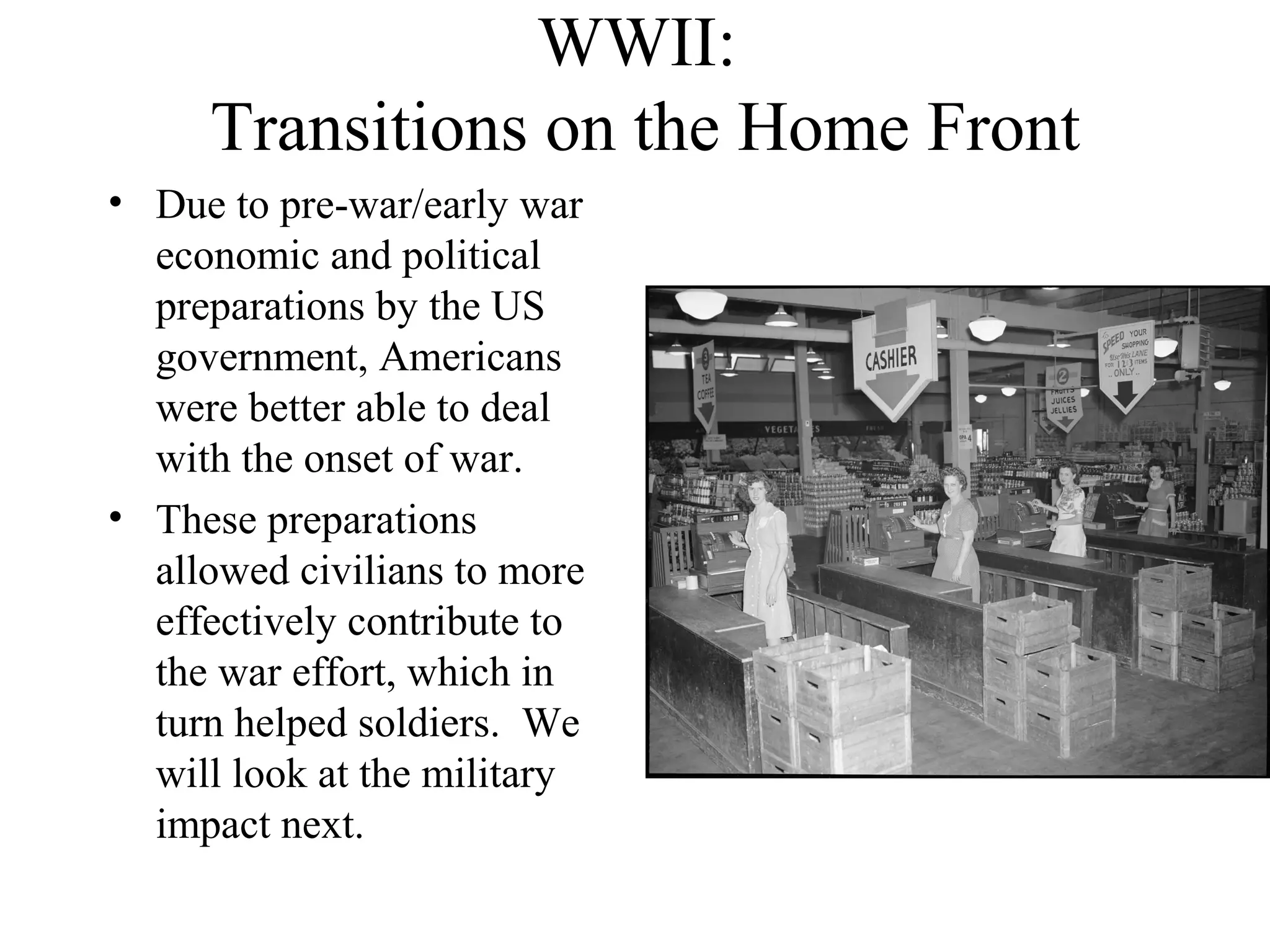
  • #33 Picture: “ Tulip Town Market, Grove Center. ” By James Earl Westcott, Oak Ridge, Tennessee, July 4, 1945. World War II created numerous “ boomtowns ” associated with the expanding shipbuilding, armaments, and aircraft industries. There were also “ secret cities ” built for workers involved in the development of the atomic bomb. These grocery clerks worked in Oak Ridge, Tennessee, site of several uranium-235 extraction facilities. National Archives, General Records of the Department of Energy (433-ORN-PRO-802-6). Found at: http://www.archives.gov/exhibits/twww/