Benefits of Gymnema
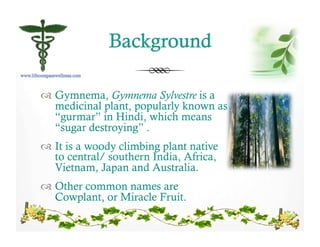
! Gymnema, Gymnema Sylvestre is a
medicinal plant, popularly known as
“gurmar” in Hindi, which means
“sugar destroying” .
! It is a woody climbing plant native
to central/ southern India, Africa,
Vietnam, Japan and Australia.
! Other common names are
Cowplant, or Miracle Fruit.
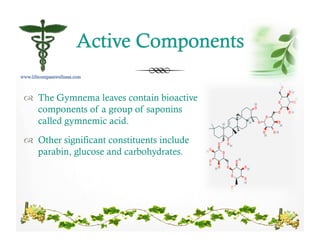
!  The Gymnema leaves contain bioactive
components of a group of saponins
called gymnemic acid.
!  Other significant constituents include
parabin, glucose and carbohydrates.
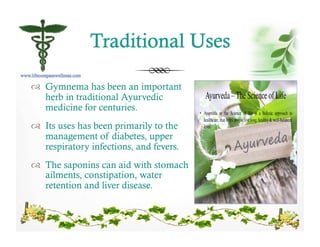
!  Gymnema has been an important
herb in traditional Ayurvedic
medicine for centuries.
!  Its uses has been primarily to the
management of diabetes, upper
respiratory infections, and fevers.
!  The saponins can aid with stomach
ailments, constipation, water
retention and liver disease.
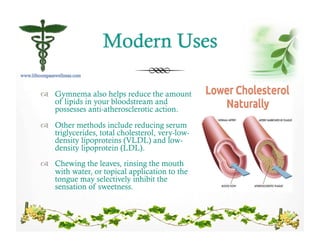
!  Gymnema also helps reduce the amount
of lipids in your bloodstream and
possesses anti-atherosclerotic action.
!  Other methods include reducing serum
triglycerides, total cholesterol, very-low-
density lipoproteins (VLDL) and low-
density lipoprotein (LDL).
!  Chewing the leaves, rinsing the mouth
with water, or topical application to the
tongue may selectively inhibit the
sensation of sweetness.
!  As early as 1980s, researchers have started to study the anti-
diabetic effects of Gymnema sylvestre leaf extracts.
!  Studies have shown Gymnema powder to effective in
lowering blood sugar when given 10g/day for seven days.
!  Other studies shows that administration of 200 mg/d of G.
Sylvestre extract decreased the required insulin dose by 50%
and lowered A1C in both type 1 and type 2 Diabetes by 18 to
20 months.
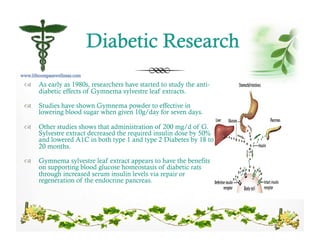
!  Gymnema sylvestre leaf extract appears to have the benefits
on supporting blood glucose homeostasis of diabetic rats
through increased serum insulin levels via repair or
regeneration of the endocrine pancreas.
!  There is little indication of toxicity and contraindications
for the use of Gymnema.
!  This herb has been deemed very safe for adults when taken
in recommended doses.
!  It has also been suggested that this herb may reduce the
amount of triglycerides and LDLs, “bad cholesterol”, in
the bloodstream.
!  Chewing the leaves, or even taking capsule form, can alter
the taste of sugar when ingested and reduce the sweetness.
!  The most common dosage for blood sugar control is 400 to
600 mg when taken with food.
!  Bone, K. (2003). A clinical guide to blending liquid herbs: Herbal formulations for the
Individual patient. St. Louis, MO: Churchill Livingstone.
!  Gymnema Uses, Benefits & Side Effects - Drugs.com Herbal Database. (n.d.). Retrieved
November 12, 2016, from https://www.drugs.com/npc/gymnema.html
!  Gymnema. (2016.). Retrieved November 12, 2016, from
https://naturalmedicines.therapeuticresearch.com/databases/food,-herbs-
supplements/professional.aspx?productid=841
!  Hyman, M. (2012). The Blood Sugar Solution. New York, NY Hachette.
!  Martínez-Abundis, E., Villar, M. M., Pérez-Rubio, K. G., Zuñiga, L. Y., Cortez-
Navarrete, M., Ramírez-Rodriguez, A., & González-Ortiz, M. (2016). Novel
nutraceutic therapies for the treatment of metabolic syndrome. World Journal of
Diabetes WJD, 7(7), 142. doi:10.4239/wjd.v7.i7.142
!  Petersen, D. (2016) Dynamic Phytotherapy Homeobotanical Materia Medica: Module
Portland OR: American College of Healthcare Sciences.
THANK YOU !

Gymnema lc

  • 1.
  • 2.
    ! Gymnema, Gymnema Sylvestre is a medicinalplant, popularly known as “gurmar” in Hindi, which means “sugar destroying” . ! It is a woody climbing plant native to central/ southern India, Africa, Vietnam, Japan and Australia. ! Other common names are Cowplant, or Miracle Fruit.
  • 3.
    !  The Gymnemaleaves contain bioactive components of a group of saponins called gymnemic acid. !  Other significant constituents include parabin, glucose and carbohydrates.
  • 4.
    !  Gymnema hasbeen an important herb in traditional Ayurvedic medicine for centuries. !  Its uses has been primarily to the management of diabetes, upper respiratory infections, and fevers. !  The saponins can aid with stomach ailments, constipation, water retention and liver disease.
  • 5.
    !  Gymnema alsohelps reduce the amount of lipids in your bloodstream and possesses anti-atherosclerotic action. !  Other methods include reducing serum triglycerides, total cholesterol, very-low- density lipoproteins (VLDL) and low- density lipoprotein (LDL). !  Chewing the leaves, rinsing the mouth with water, or topical application to the tongue may selectively inhibit the sensation of sweetness.
  • 6.
    !  As earlyas 1980s, researchers have started to study the anti- diabetic effects of Gymnema sylvestre leaf extracts. !  Studies have shown Gymnema powder to effective in lowering blood sugar when given 10g/day for seven days. !  Other studies shows that administration of 200 mg/d of G. Sylvestre extract decreased the required insulin dose by 50% and lowered A1C in both type 1 and type 2 Diabetes by 18 to 20 months. !  Gymnema sylvestre leaf extract appears to have the benefits on supporting blood glucose homeostasis of diabetic rats through increased serum insulin levels via repair or regeneration of the endocrine pancreas.
  • 7.
    !  There islittle indication of toxicity and contraindications for the use of Gymnema. !  This herb has been deemed very safe for adults when taken in recommended doses. !  It has also been suggested that this herb may reduce the amount of triglycerides and LDLs, “bad cholesterol”, in the bloodstream. !  Chewing the leaves, or even taking capsule form, can alter the taste of sugar when ingested and reduce the sweetness. !  The most common dosage for blood sugar control is 400 to 600 mg when taken with food.
  • 8.
    !  Bone, K.(2003). A clinical guide to blending liquid herbs: Herbal formulations for the Individual patient. St. Louis, MO: Churchill Livingstone. !  Gymnema Uses, Benefits & Side Effects - Drugs.com Herbal Database. (n.d.). Retrieved November 12, 2016, from https://www.drugs.com/npc/gymnema.html !  Gymnema. (2016.). Retrieved November 12, 2016, from https://naturalmedicines.therapeuticresearch.com/databases/food,-herbs- supplements/professional.aspx?productid=841 !  Hyman, M. (2012). The Blood Sugar Solution. New York, NY Hachette. !  Martínez-Abundis, E., Villar, M. M., Pérez-Rubio, K. G., Zuñiga, L. Y., Cortez- Navarrete, M., Ramírez-Rodriguez, A., & González-Ortiz, M. (2016). Novel nutraceutic therapies for the treatment of metabolic syndrome. World Journal of Diabetes WJD, 7(7), 142. doi:10.4239/wjd.v7.i7.142 !  Petersen, D. (2016) Dynamic Phytotherapy Homeobotanical Materia Medica: Module Portland OR: American College of Healthcare Sciences.
  • 9.