N. Merna Torres
Lifecompass Wellness
September 27, 2015
Introduction
! In our modern society we are constantly on the go and eating a healthy diet can be
challenging.
! The type of food we consume has a direct impact on our health.
! Several studies have shown a correlation between diet and increase in
degenerative diseases, cardiovascular diseases, diabetes, obesity and some types of
cancers (Satyanarayana, 2012).
! It is important to understand the components or nutrients the body requires to
function properly.
! Our bodies require both macronutrients (carbohydrates, fats and proteins) and also
micronutrients (vitamins and minerals) for energy.
Foods
! Important factors to consider when obtaining nutrients are the sources and
bioavailability.
! In our modern society we have many processed foods which are filled with
empty calories and are not nutrient dense.
! Processed foods are refined foods in which the nutrients are removed to
prevent them from spoiling and are easier to store and transport.
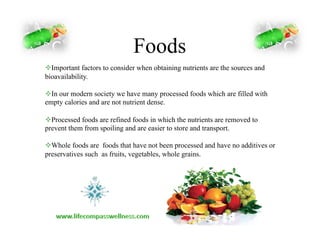
! Whole foods are foods that have not been processed and have no additives or
preservatives such as fruits, vegetables, whole grains.
Macronutrients
! Macronutrients are substances that provide energy such as carbohydrates,
proteins, lipids, fiber and water.
! Carbohydrates are the main source of energy and is chemically broken down
into to glucose, which is fuel for cells.
! Proteins are made up of amino acids and are necessary for growth and tissue
repair.
! Lipids are fats required to help with maintaining the cell membranes, helps
with insulating the body and absorption of some vitamins.
! Fiber are indigestible forms of carbohydrates that help remove waste from the
body.
Micronutrients
! Micronutrients are nutrients that are required in small amounts in order to
maintain homeostasis.
! Vitamins and minerals are considered micronutrients.
! Vitamins are organic substances made from plants.
! Minerals are inorganic elements which come from the soil and water.
! These elements are absorbed by the plants.
! Vitamins and minerals are responsible for many different functions throughout
the body.
! They help with the production and release of energy.
! They help with build proteins and support functions of the cells.
! They also help may collagen, which helps with healing.
Dietary Supplements
! Dietary supplements are a mixture of vitamins , minerals , herbs and other
products.
! Dietary supplements can help alleviate certain deficiencies that may be lacking in
our normal diet.
! Some studies have shown that taking dietary supplements may reduce certain risks
or delay progression of chronic disease such as HIV (Woodside, 2005).
! A good example is vitamin B12 which is not produced by plants and is only
available from animal sources.	
  
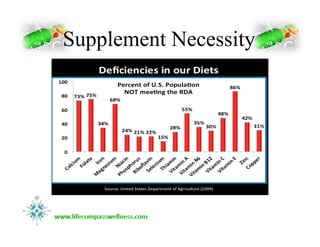
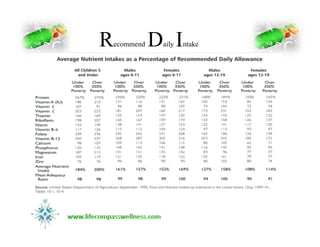
! A vast majority of the US population are not getting adequate amounts of nutrients.
Supplement Necessity
Vitamins & Minerals
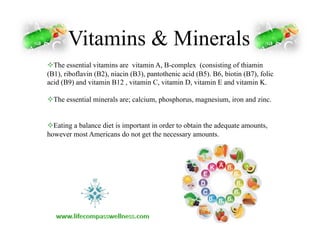
! The essential vitamins are vitamin A, B-complex (consisting of thiamin
(B1), riboflavin (B2), niacin (B3), pantothenic acid (B5). B6, biotin (B7), folic
acid (B9) and vitamin B12 , vitamin C, vitamin D, vitamin E and vitamin K.
! The essential minerals are; calcium, phosphorus, magnesium, iron and zinc.
! Eating a balance diet is important in order to obtain the adequate amounts,
however most Americans do not get the necessary amounts.
Recommend Daily Intake
Conclusion
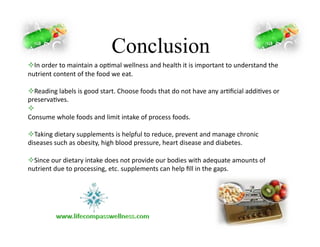
! In	
  order	
  to	
  maintain	
  a	
  op-mal	
  wellness	
  and	
  health	
  it	
  is	
  important	
  to	
  understand	
  the	
  
nutrient	
  content	
  of	
  the	
  food	
  we	
  eat.	
  
! Reading	
  labels	
  is	
  good	
  start.	
  Choose	
  foods	
  that	
  do	
  not	
  have	
  any	
  ar-ficial	
  addi-ves	
  or	
  
preserva-ves.	
  
! 	
  
Consume	
  whole	
  foods	
  and	
  limit	
  intake	
  of	
  process	
  foods.	
  
! Taking	
  dietary	
  supplements	
  is	
  helpful	
  to	
  reduce,	
  prevent	
  and	
  manage	
  chronic	
  
diseases	
  such	
  as	
  obesity,	
  high	
  blood	
  pressure,	
  heart	
  disease	
  and	
  diabetes.	
  
! Since	
  our	
  dietary	
  intake	
  does	
  not	
  provide	
  our	
  bodies	
  with	
  adequate	
  amounts	
  of	
  
nutrient	
  due	
  to	
  processing,	
  etc.	
  supplements	
  can	
  help	
  fill	
  in	
  the	
  gaps.	
  
References
Insel, P., Ross, D., McMahon, K. I., & Bernstein, M. (2014). Nutrition (Fifth Edition).
Burlington, MA: Jones & Bartlett Learning.
Lichtenstein, A., & Russell, R. (2005). Essential nutrients: food or supplements. The
Journal of American Medical Association, 294(3), 351-358.
O’Leary, F., & Samman, S. (2010). Vitamin B12 in Health and Disease. Nutrients, 2,
299-316. doi:10.3390/nu2030299
Satyanarayana, S., Kumar Pindi, P., Singh, A., A, D., & G, A. (2012). Potential
Impacts of Food and it’s Processing on Global Sustainable Health. Journal of Food
Processing & Technology, 3(2), 1-7. doi: 10.4172/2157-7110.1000143
Woodside, J., McCall, D., McGartland, C., & Young, I. (2005). Micronutrients: dietary
intake v. supplement use. Proceedings of the Nutrition Society, 64, 543-553. doi:
10.1079/PNS2005464

Food balance

  • 1.
    N. Merna Torres LifecompassWellness September 27, 2015
  • 2.
    Introduction ! In our modernsociety we are constantly on the go and eating a healthy diet can be challenging. ! The type of food we consume has a direct impact on our health. ! Several studies have shown a correlation between diet and increase in degenerative diseases, cardiovascular diseases, diabetes, obesity and some types of cancers (Satyanarayana, 2012). ! It is important to understand the components or nutrients the body requires to function properly. ! Our bodies require both macronutrients (carbohydrates, fats and proteins) and also micronutrients (vitamins and minerals) for energy.
  • 3.
    Foods ! Important factors toconsider when obtaining nutrients are the sources and bioavailability. ! In our modern society we have many processed foods which are filled with empty calories and are not nutrient dense. ! Processed foods are refined foods in which the nutrients are removed to prevent them from spoiling and are easier to store and transport. ! Whole foods are foods that have not been processed and have no additives or preservatives such as fruits, vegetables, whole grains.
  • 4.
    Macronutrients ! Macronutrients are substancesthat provide energy such as carbohydrates, proteins, lipids, fiber and water. ! Carbohydrates are the main source of energy and is chemically broken down into to glucose, which is fuel for cells. ! Proteins are made up of amino acids and are necessary for growth and tissue repair. ! Lipids are fats required to help with maintaining the cell membranes, helps with insulating the body and absorption of some vitamins. ! Fiber are indigestible forms of carbohydrates that help remove waste from the body.
  • 5.
    Micronutrients ! Micronutrients are nutrientsthat are required in small amounts in order to maintain homeostasis. ! Vitamins and minerals are considered micronutrients. ! Vitamins are organic substances made from plants. ! Minerals are inorganic elements which come from the soil and water. ! These elements are absorbed by the plants. ! Vitamins and minerals are responsible for many different functions throughout the body. ! They help with the production and release of energy. ! They help with build proteins and support functions of the cells. ! They also help may collagen, which helps with healing.
  • 6.
    Dietary Supplements ! Dietary supplementsare a mixture of vitamins , minerals , herbs and other products. ! Dietary supplements can help alleviate certain deficiencies that may be lacking in our normal diet. ! Some studies have shown that taking dietary supplements may reduce certain risks or delay progression of chronic disease such as HIV (Woodside, 2005). ! A good example is vitamin B12 which is not produced by plants and is only available from animal sources.   ! A vast majority of the US population are not getting adequate amounts of nutrients.
  • 7.
  • 8.
    Vitamins & Minerals ! Theessential vitamins are vitamin A, B-complex (consisting of thiamin (B1), riboflavin (B2), niacin (B3), pantothenic acid (B5). B6, biotin (B7), folic acid (B9) and vitamin B12 , vitamin C, vitamin D, vitamin E and vitamin K. ! The essential minerals are; calcium, phosphorus, magnesium, iron and zinc. ! Eating a balance diet is important in order to obtain the adequate amounts, however most Americans do not get the necessary amounts.
  • 9.
  • 10.
    Conclusion ! In  order  to  maintain  a  op-mal  wellness  and  health  it  is  important  to  understand  the   nutrient  content  of  the  food  we  eat.   ! Reading  labels  is  good  start.  Choose  foods  that  do  not  have  any  ar-ficial  addi-ves  or   preserva-ves.   !    Consume  whole  foods  and  limit  intake  of  process  foods.   ! Taking  dietary  supplements  is  helpful  to  reduce,  prevent  and  manage  chronic   diseases  such  as  obesity,  high  blood  pressure,  heart  disease  and  diabetes.   ! Since  our  dietary  intake  does  not  provide  our  bodies  with  adequate  amounts  of   nutrient  due  to  processing,  etc.  supplements  can  help  fill  in  the  gaps.  
  • 11.
    References Insel, P., Ross,D., McMahon, K. I., & Bernstein, M. (2014). Nutrition (Fifth Edition). Burlington, MA: Jones & Bartlett Learning. Lichtenstein, A., & Russell, R. (2005). Essential nutrients: food or supplements. The Journal of American Medical Association, 294(3), 351-358. O’Leary, F., & Samman, S. (2010). Vitamin B12 in Health and Disease. Nutrients, 2, 299-316. doi:10.3390/nu2030299 Satyanarayana, S., Kumar Pindi, P., Singh, A., A, D., & G, A. (2012). Potential Impacts of Food and it’s Processing on Global Sustainable Health. Journal of Food Processing & Technology, 3(2), 1-7. doi: 10.4172/2157-7110.1000143 Woodside, J., McCall, D., McGartland, C., & Young, I. (2005). Micronutrients: dietary intake v. supplement use. Proceedings of the Nutrition Society, 64, 543-553. doi: 10.1079/PNS2005464