DEPARTMENT
OF
PHYSICALEDUCATION - TEL&R,
PGGC-11 CHANDIGARH
HAMMER THROW
JAGPREET SINGH
M.P.ED. 2ND
17107/19
introduction
• For safety purposes, the event takes place in a cage with moveable
doors to accommodate left and right-handed throwers.
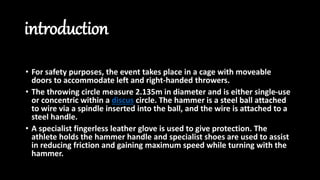
• The throwing circle measure 2.135m in diameter and is either single-use
or concentric within a discus circle. The hammer is a steel ball attached
to wire via a spindle inserted into the ball, and the wire is attached to a
steel handle.
• A specialist fingerless leather glove is used to give protection. The
athlete holds the hammer handle and specialist shoes are used to assist
in reducing friction and gaining maximum speed while turning with the
hammer.
History
• With roots dating back to the 15th century, the contemporary version of
the hammer throw is one of the oldest of Olympic Games competitions,
first included at the 1900 games in Paris, France (the second Olympiad of
the modern era).
• The hammer evolved from its early informal origins to become part of
the Scottish Highland games in the late 18th century, where the original
version of the event is still contested today.
• While the men's hammer throw has been part of the Olympics since
1900, the International Association of Athletics Federations did not start
ratifying women's marks until 1995.
• Women's hammer throw was first included in the Olympics at the 2000
summer games in Sydney, Australia after having been included in
the World Championships a year earlier.
The components of the throw
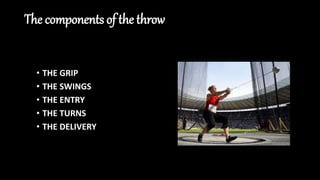
• THE GRIP
• THE SWINGS
• THE ENTRY
• THE TURNS
• THE DELIVERY
The grip
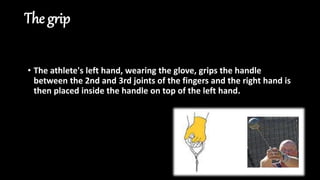
• The athlete's left hand, wearing the glove, grips the handle
between the 2nd and 3rd joints of the fingers and the right hand is
then placed inside the handle on top of the left hand.
The swings
• The athlete stands at the rear of the circle [12
o'clock] feet parallel, with back towards the
throwing sector [6 o'clock]. The preliminary
swings are used to commence the momentum of
the throw.
• The athlete, in general, uses two swings, but
more or less can be used. The swing starts from
behind the right side of the body, taking the
hammer forward away from the body and over
the head. This will achieve a low point of the
hammer ball in front of the body [12 o'clock] and
a high point behind [6 o'clock].
The entry
• At the end of the swings, the athlete is
about to enter the turning phase. With
the hammer directly in front of the
thrower, the low point, the turns
commence. The shoulders are relaxed,
head passive, trunk engaged, knees and
hips flexed, feet remaining in contact
with the circle.
• The hammer is pushed to the left and
the turns are started.
The turns
• The number of turns performed is
a personal choice, but in general 3
or 4 are used. These are a series of
movements performed to increase
the speed of the hammer using
balance through the feet, and
power from the legs and hips. The
feet are working together
throughout the throw.
The delivery
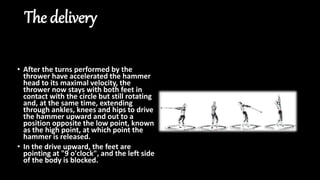
• After the turns performed by the
thrower have accelerated the hammer
head to its maximal velocity, the
thrower now stays with both feet in
contact with the circle but still rotating
and, at the same time, extending
through ankles, knees and hips to drive
the hammer upward and out to a
position opposite the low point, known
as the high point, at which point the
hammer is released.
• In the drive upward, the feet are
pointing at "9 o'clock", and the left side
of the body is blocked.
Thank
you

HAMMER THROW (ATHLETICS)

  • 1.
    DEPARTMENT OF PHYSICALEDUCATION - TEL&R, PGGC-11CHANDIGARH HAMMER THROW JAGPREET SINGH M.P.ED. 2ND 17107/19
  • 2.
    introduction • For safetypurposes, the event takes place in a cage with moveable doors to accommodate left and right-handed throwers. • The throwing circle measure 2.135m in diameter and is either single-use or concentric within a discus circle. The hammer is a steel ball attached to wire via a spindle inserted into the ball, and the wire is attached to a steel handle. • A specialist fingerless leather glove is used to give protection. The athlete holds the hammer handle and specialist shoes are used to assist in reducing friction and gaining maximum speed while turning with the hammer.
  • 3.
    History • With rootsdating back to the 15th century, the contemporary version of the hammer throw is one of the oldest of Olympic Games competitions, first included at the 1900 games in Paris, France (the second Olympiad of the modern era). • The hammer evolved from its early informal origins to become part of the Scottish Highland games in the late 18th century, where the original version of the event is still contested today. • While the men's hammer throw has been part of the Olympics since 1900, the International Association of Athletics Federations did not start ratifying women's marks until 1995. • Women's hammer throw was first included in the Olympics at the 2000 summer games in Sydney, Australia after having been included in the World Championships a year earlier.
  • 4.
    The components ofthe throw • THE GRIP • THE SWINGS • THE ENTRY • THE TURNS • THE DELIVERY
  • 5.
    The grip • Theathlete's left hand, wearing the glove, grips the handle between the 2nd and 3rd joints of the fingers and the right hand is then placed inside the handle on top of the left hand.
  • 6.
    The swings • Theathlete stands at the rear of the circle [12 o'clock] feet parallel, with back towards the throwing sector [6 o'clock]. The preliminary swings are used to commence the momentum of the throw. • The athlete, in general, uses two swings, but more or less can be used. The swing starts from behind the right side of the body, taking the hammer forward away from the body and over the head. This will achieve a low point of the hammer ball in front of the body [12 o'clock] and a high point behind [6 o'clock].
  • 7.
    The entry • Atthe end of the swings, the athlete is about to enter the turning phase. With the hammer directly in front of the thrower, the low point, the turns commence. The shoulders are relaxed, head passive, trunk engaged, knees and hips flexed, feet remaining in contact with the circle. • The hammer is pushed to the left and the turns are started.
  • 8.
    The turns • Thenumber of turns performed is a personal choice, but in general 3 or 4 are used. These are a series of movements performed to increase the speed of the hammer using balance through the feet, and power from the legs and hips. The feet are working together throughout the throw.
  • 9.
    The delivery • Afterthe turns performed by the thrower have accelerated the hammer head to its maximal velocity, the thrower now stays with both feet in contact with the circle but still rotating and, at the same time, extending through ankles, knees and hips to drive the hammer upward and out to a position opposite the low point, known as the high point, at which point the hammer is released. • In the drive upward, the feet are pointing at "9 o'clock", and the left side of the body is blocked.
  • 10.