Overview of the Climate Change Adaptation in Africa Program and North African Research  Guy Jobbins, Senior Program Officer Climate Change Adaptation in Africa International Development Research  Centre Cairo
Content Introduction to CCAA Program  Projects in North Africa Findings & Conclusions
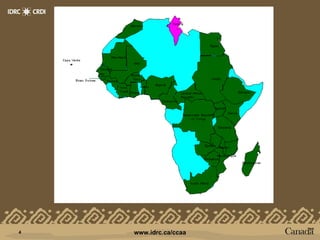
The CCAA Program Collaboration between DFID (UK) and IDRC (Canada) for research and capacity development on adaptation to climate change in Africa. Program launched in 2006, to end in March 2012 65 million CAD programming funds, including 24 million sterling from DfID 45 research and capacity projects in 28 countries Agriculture & rural livelihoods, human health, coastal adaptation, water as main themes
 
Goal of CCAA To strengthen the capacity of African countries to adapt to climate change in ways that benefit the most vulnerable members of society
CCAA Objectives Researchers able to identify vulnerabilities and develop adaptation options Policy makers, vulnerable people and researchers share knowledge on overcoming climate vulnerability and poverty Policy makers, vulnerable people and researchers join their knowledge to implement effective adaptation strategies Policy is informed by good quality science-based work on vulnerability and adaptation, and the experiences of vulnerable people
CCAA Activities Education and Training Formal training and capacity strengthening for researchers, policy makers, and at risk groups Knowledge Sharing Facilitating communication between different perspectives, disseminating information, and supporting a community of practise Participatory Action Research Collaborative experiments testing adaptation strategies developed through research processes that include local and/or indigenous knowledge
CCAA in North Africa - PAR 7 Participatory Action Research projects in North Africa: Adaptation in mountains and plains communities, INRA-Settat, Maroc Adaptation to sea level rise, ENFI, Maroc Optimisation of small dams using EcoHealth approaches, INRA-Agadir, Maroc  Water demand management in adapting to water scarcity, AUI, Maroc Management of Leishmaniasis outbreaks, NONED, Tunisia  Settler communities west of Lake Nasser, CDS, Egypt Adaptation to sea level rise, NWRC, Egypt
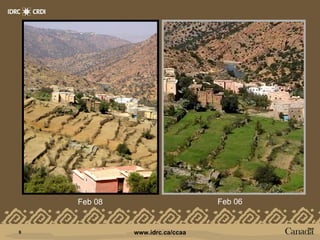
Feb 06 Feb 08
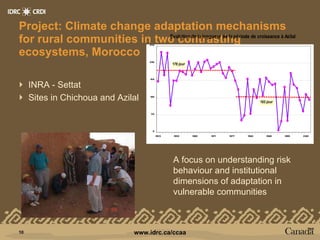
Project: Climate change adaptation mechanisms for rural communities in two contrasting ecosystems, Morocco INRA - Settat Sites in Chichoua and Azilal A focus on understanding risk behaviour and institutional dimensions of adaptation in vulnerable communities
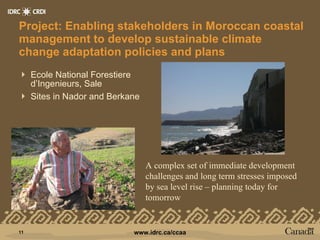
Project: Enabling stakeholders in Moroccan coastal management to develop sustainable climate change adaptation policies and plans Ecole National Forestiere d’Ingenieurs, Sale Sites in Nador and Berkane A complex set of immediate development challenges and long term stresses imposed by sea level rise – planning today for tomorrow
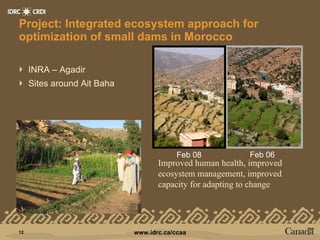
Project: Integrated ecosystem approach for optimization of small dams in Morocco INRA – Agadir Sites around Ait Baha Improved human health, improved ecosystem management, improved capacity for adapting to change Feb 06 Feb 08
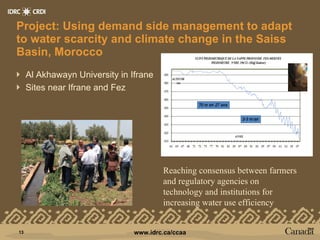
Project: Using demand side management to adapt to water scarcity and climate change in the Saiss Basin, Morocco Al Akhawayn University in Ifrane Sites near Ifrane and Fez Reaching consensus between farmers and regulatory agencies on technology and institutions for increasing water use efficiency
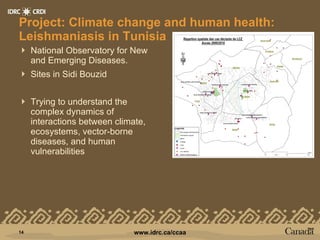
Project: Climate change and human health: Leishmaniasis in Tunisia National Observatory for New and Emerging Diseases. Sites in Sidi Bouzid Trying to understand the complex dynamics of interactions between climate, ecosystems, vector-borne diseases, and human vulnerabilities
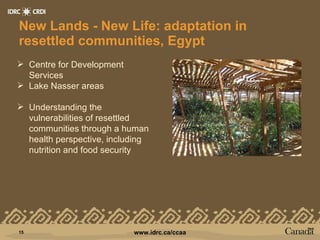
New Lands - New Life: adaptation in resettled communities, Egypt Centre for Development Services Lake Nasser areas Understanding the vulnerabilities of resettled communities through a human health perspective, including nutrition and food security
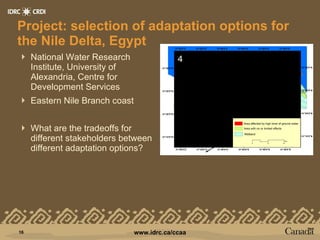
Project: selection of adaptation options for the Nile Delta, Egypt National Water Research Institute, University of Alexandria, Centre for Development Services Eastern Nile Branch coast What are the tradeoffs for different stakeholders between different adaptation options?
Resilience So far, climate change mainly experienced as increased variability Droughts, floods, heat-waves, storms Can synergise with other global system shocks, such as food prices  Resilience related to socio-economic development Health Income & access to markets Livelihood diversity Access to public services etc
Adaptations – Water as a key entry point  Water scarcity & agriculture water use  Better use of climate information in irrigation regimes Reduce quantities and costs of pumped water Water excess Flood risk management  Improve aquifer recharge Soil erosion
Adaptations– Water as a key entry point  Small dams Health impacts  Inequalities of access to water Coastal change Soil salinisation  Agri- to aquaculture
Adaptive capacity Importance of socio-political processes Enabling and empowerment of community level institutions Learning institutions needed at all levels  Use and sharing of information Innovation means being prepared to be wrong
Conclusions Adaptation is local Depends on exchange of capacities held by a range of different actors Implies institutional development Anticipation of future vulnerabilities Key areas of research: Economics of adaptation – ‘return on investment options’ Management of uncertainty in decision making
http://www.idrc.ca/ccaa http://www.africa-adapt.org

Guy jobbins ccaa presentation 26 may 2011

  • 1.
    Overview of theClimate Change Adaptation in Africa Program and North African Research Guy Jobbins, Senior Program Officer Climate Change Adaptation in Africa International Development Research Centre Cairo
  • 2.
    Content Introduction toCCAA Program Projects in North Africa Findings & Conclusions
  • 3.
    The CCAA ProgramCollaboration between DFID (UK) and IDRC (Canada) for research and capacity development on adaptation to climate change in Africa. Program launched in 2006, to end in March 2012 65 million CAD programming funds, including 24 million sterling from DfID 45 research and capacity projects in 28 countries Agriculture & rural livelihoods, human health, coastal adaptation, water as main themes
  • 4.
  • 5.
    Goal of CCAATo strengthen the capacity of African countries to adapt to climate change in ways that benefit the most vulnerable members of society
  • 6.
    CCAA Objectives Researchersable to identify vulnerabilities and develop adaptation options Policy makers, vulnerable people and researchers share knowledge on overcoming climate vulnerability and poverty Policy makers, vulnerable people and researchers join their knowledge to implement effective adaptation strategies Policy is informed by good quality science-based work on vulnerability and adaptation, and the experiences of vulnerable people
  • 7.
    CCAA Activities Educationand Training Formal training and capacity strengthening for researchers, policy makers, and at risk groups Knowledge Sharing Facilitating communication between different perspectives, disseminating information, and supporting a community of practise Participatory Action Research Collaborative experiments testing adaptation strategies developed through research processes that include local and/or indigenous knowledge
  • 8.
    CCAA in NorthAfrica - PAR 7 Participatory Action Research projects in North Africa: Adaptation in mountains and plains communities, INRA-Settat, Maroc Adaptation to sea level rise, ENFI, Maroc Optimisation of small dams using EcoHealth approaches, INRA-Agadir, Maroc Water demand management in adapting to water scarcity, AUI, Maroc Management of Leishmaniasis outbreaks, NONED, Tunisia Settler communities west of Lake Nasser, CDS, Egypt Adaptation to sea level rise, NWRC, Egypt
  • 9.
  • 10.
    Project: Climate changeadaptation mechanisms for rural communities in two contrasting ecosystems, Morocco INRA - Settat Sites in Chichoua and Azilal A focus on understanding risk behaviour and institutional dimensions of adaptation in vulnerable communities
  • 11.
    Project: Enabling stakeholdersin Moroccan coastal management to develop sustainable climate change adaptation policies and plans Ecole National Forestiere d’Ingenieurs, Sale Sites in Nador and Berkane A complex set of immediate development challenges and long term stresses imposed by sea level rise – planning today for tomorrow
  • 12.
    Project: Integrated ecosystemapproach for optimization of small dams in Morocco INRA – Agadir Sites around Ait Baha Improved human health, improved ecosystem management, improved capacity for adapting to change Feb 06 Feb 08
  • 13.
    Project: Using demandside management to adapt to water scarcity and climate change in the Saiss Basin, Morocco Al Akhawayn University in Ifrane Sites near Ifrane and Fez Reaching consensus between farmers and regulatory agencies on technology and institutions for increasing water use efficiency
  • 14.
    Project: Climate changeand human health: Leishmaniasis in Tunisia National Observatory for New and Emerging Diseases. Sites in Sidi Bouzid Trying to understand the complex dynamics of interactions between climate, ecosystems, vector-borne diseases, and human vulnerabilities
  • 15.
    New Lands -New Life: adaptation in resettled communities, Egypt Centre for Development Services Lake Nasser areas Understanding the vulnerabilities of resettled communities through a human health perspective, including nutrition and food security
  • 16.
    Project: selection ofadaptation options for the Nile Delta, Egypt National Water Research Institute, University of Alexandria, Centre for Development Services Eastern Nile Branch coast What are the tradeoffs for different stakeholders between different adaptation options?
  • 17.
    Resilience So far,climate change mainly experienced as increased variability Droughts, floods, heat-waves, storms Can synergise with other global system shocks, such as food prices Resilience related to socio-economic development Health Income & access to markets Livelihood diversity Access to public services etc
  • 18.
    Adaptations – Wateras a key entry point Water scarcity & agriculture water use Better use of climate information in irrigation regimes Reduce quantities and costs of pumped water Water excess Flood risk management Improve aquifer recharge Soil erosion
  • 19.
    Adaptations– Water asa key entry point Small dams Health impacts Inequalities of access to water Coastal change Soil salinisation Agri- to aquaculture
  • 20.
    Adaptive capacity Importanceof socio-political processes Enabling and empowerment of community level institutions Learning institutions needed at all levels Use and sharing of information Innovation means being prepared to be wrong
  • 21.
    Conclusions Adaptation islocal Depends on exchange of capacities held by a range of different actors Implies institutional development Anticipation of future vulnerabilities Key areas of research: Economics of adaptation – ‘return on investment options’ Management of uncertainty in decision making
  • 22.