Win-win approaches Low Emission &
Climate Resilient Development

EU DG Climate Action Initiative
Social, Ecological and Agricultural Resilience in the Face of Climate
Change SEARCH

COP19-Side Event, Warsaw, 14th November 2013
Muffleh Al Abbadi - IUCN
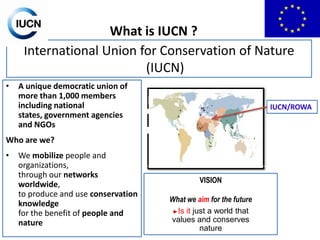
What is IUCN ?
International Union for Conservation of Nature
(IUCN)
•

A unique democratic union of
more than 1,000 members
including national
states, government agencies
and NGOs

IUCN/ROWA

Who are we?
•

We mobilize people and
organizations,
through our networks
worldwide,
to produce and use conservation
knowledge
for the benefit of people and
nature
2

VISION
What we aim for the future
►Is it just a world that
values and conserves
nature
SEARCH Project
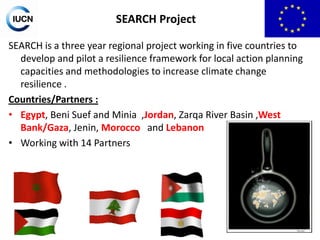
SEARCH is a three year regional project working in five countries to
develop and pilot a resilience framework for local action planning
capacities and methodologies to increase climate change
resilience .
Countries/Partners :
• Egypt, Beni Suef and Minia ,Jordan, Zarqa River Basin ,West
Bank/Gaza, Jenin, Morocco and Lebanon
• Working with 14 Partners
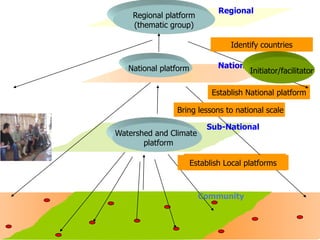
Regional platform
(thematic group)

Regional

Identify countries
National platform

National
Initiator/facilitator
Establish National platform

Bring lessonsin watershedscale
Identify up tocountry
Scale Pilot national
Watershed and Climate
platform

Sub-National

Establish in communities
ConsolidateDistrict platform
Scale pilot Watershed
Establish Local platforms
Learn together
Identify up lessons and. …

Community

4

11/22/2013
Case Study
Morocco and Jordan
Morocco

Jordan
•

•

•
•

•
•

Jordan is characterized by its semi-arid
climate, high dependence on rainfall and
scarcity of water resources
Jordan is ranked among the poorest countries
in the world in water availability 149 Cubic
meters/year
reduction in rainfall from 5-20% (previous
decades )
Predicted increase in temperature and
decease in precipitation will increase water
scarcity in Jordan.
Environmental degradation costs Jordan
more than 2 per cent of GDP a year.
Jordan’s reliance on energy imports, coupled
with its low energy efficiency.

•
•

•
•
•
•
•

Morocco is among the countries
that are more likely threatened by
climatic change.
Precipitation, in Morocco, is low
and highly variable from one season
to another and within the cropping
year.
Increased of drought frequency
Reduction of the length of the
growth period of crops
Energy consumption 17.7 Million
toe ,Import 95.5 %.
National energy bill 10.1 billion $m
subsides 4.8 billion $, annual
increase rate 5.3% .
RE: 42% contribution to the
electricity installed capacity by
2020: 14% Hydro – 14% Wind –
14% Solar
Energy Profile / Jordan
Constrains/Problems :
• Lack of knowledge by energy users of the benefits of energy efficiency,
•
Lack of expertise to develop energy efficiency projects,
• High initial implementation cost,
• Lack of suitable financing mechanisms.(SNC,2009)
Actions :
• Master Strategy for the Energy Sector 2007 – 2020
– Renewable energy to account for 10 per cent of total energy supply (1,800 MW) compared to 3.5
per cent at present
– Energy savings of 20 per cent
– The provision of solar water heating systems to 30 per cent of households
• These targets are supported by:
– The Renewable Energy and Energy Efficiency Law no. 13, which creates framework for renewable
energy investment and the Jordan Renewable Energy and Energy Efficiency Fund
– Tax incentives for renewable energy and energy efficiency
– A range of energy efficiency initiatives such as replace incandescent bulbs in government buildings
and energy audits for certain firms .
• Jordan maintains the Summertime all-year-around this saved around 7 Million/Yr $ from the energy
cost .
Pilot project in ZRB/Jordan and Wadi Kabeer
Basin/Morocco
A Community-Based Climate Change Assessment and
Adaptation Development
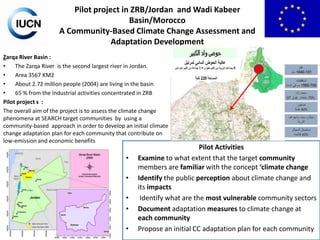
Zarqa River Basin :
•
The Zarqa River is the second largest river in Jordan.
•
Area 3567 KM2
•
About 2.72 million people (2004) are living in the basin
•
65 % from the Industrial activities concentrated in ZRB
Pilot project s :
The overall aim of the project is to assess the climate change
phenomena at SEARCH target communities by using a
community-based approach in order to develop an initial climate
change adaptation plan for each community that contribute on
low-emission and economic benefits

•
•
•
•
•

Pilot Activities
Examine to what extent that the target community
members are familiar with the concept ‘climate change
Identify the public perception about climate change and
its impacts
Identify what are the most vulnerable community sectors
Document adaptation measures to climate change at
each community
Propose an initial CC adaptation plan for each community
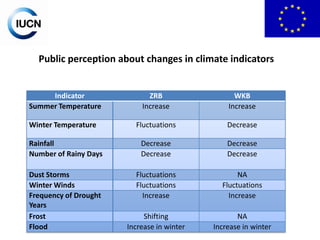
Public perception about changes in climate indicators

Indicator
Summer Temperature

ZRB
Increase

WKB
Increase

Fluctuations

Decrease

Rainfall
Number of Rainy Days

Decrease
Decrease

Decrease
Decrease

Dust Storms
Winter Winds
Frequency of Drought
Years
Frost
Flood

Fluctuations
Fluctuations
Increase

NA
Fluctuations
Increase

Shifting
Increase in winter

NA
Increase in winter

Winter Temperature
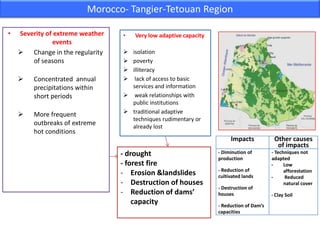
Morocco- Tangier-Tetouan Region
•

Severity of extreme weather
events
 Change in the regularity
of seasons


Concentrated annual
precipitations within
short periods



More frequent
outbreaks of extreme
hot conditions

•

Very low adaptive capacity

 isolation
 poverty
 illiteracy
 lack of access to basic
services and information
 weak relationships with
public institutions
 traditional adaptive
techniques rudimentary or
already lost

Impacts

- drought
- forest fire
- Erosion &landslides
- Destruction of houses
- Reduction of dams’
capacity

- Diminution of
production
- Reduction of
cultivated lands

- Destruction of
houses
- Reduction of Dam’s
capacities

Other causes
of impacts
- Techniques not
adapted
Low
afforestation
Reduced
natural cover
- Clay Soil
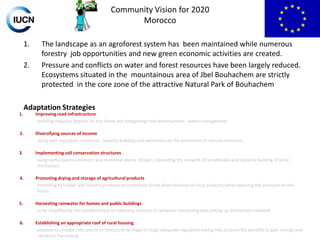
Community Vision for 2020
Morocco
1.
2.

The landscape as an agroforest system has been maintained while numerous
forestry job opportunities and new green economic activities are created.
Pressure and conflicts on water and forest resources have been largely reduced.
Ecosystems situated in the mountainous area of Jbel Bouhachem are strictly
protected in the core zone of the attractive Natural Park of Bouhachem

Adaptation Strategies
1.

Improving road infrastructure
avoiding negative impacts on the forest and integrating road development - water management

2.

Diversifying sources of income
along with regulatory measures, capacity building and awareness on the protection of natural resources

3.

Implementing soil conservation structures
using useful plants (aromatic and medicinal plants, forage), expanding the network of windbreaks and capacity building of local
institutions

4.

Promoting drying and storage of agricultural products
extending to fodder and forestry products to contribute to the diversification of local products while reducing the pressure on the
forest

5.

Harvesting rainwater for homes and public buildings
to be amplified by the establishment of collective systems of rainwater harvesting and setting up distribution network

6.

Establishing an appropriate roof of rural housing
adapted to climate risks and to architectural heritage through adequate regulation taking into account the benefits to gain energy and
rainwater harvesting
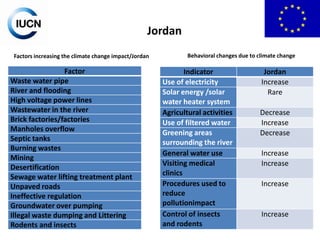
Jordan
Factors increasing the climate change impact/Jordan

Factor
Waste water pipe
River and flooding
High voltage power lines
Wastewater in the river
Brick factories/factories
Manholes overflow
Septic tanks
Burning wastes
Mining
Desertification
Sewage water lifting treatment plant
Unpaved roads
Ineffective regulation
Groundwater over pumping
Illegal waste dumping and Littering
Rodents and insects

Behavioral changes due to climate change

Indicator
Use of electricity
Solar energy /solar
water heater system
Agricultural activities
Use of filtered water
Greening areas
surrounding the river
General water use
Visiting medical
clinics
Procedures used to
reduce
pollutionimpact
Control of insects
and rodents

Jordan
Increase
Rare
Decrease
Increase
Decrease
Increase
Increase
Increase

Increase
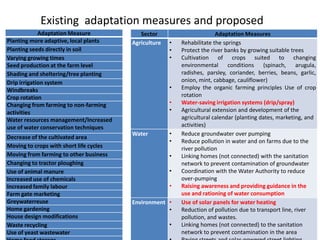
Existing adaptation measures and proposed
Adaptation Measure
Planting more adaptive, local plants
Planting seeds directly in soil
Varying growing times
Seed production at the farm level
Shading and sheltering/tree planting
Drip irrigation system
Windbreaks
Crop rotation
Changing from farming to non-farming
activities
Water resources management/Increased
use of water conservation techniques
Decrease of the cultivated area
Moving to crops with short life cycles
Moving from farming to other business
Changing to tractor ploughing
Use of animal manure
Increased use of chemicals
Increased family labour
Farm gate marketing
Greywaterreuse
Home gardening
House design modifications
Waste recycling
Use of yeast wastewater

Sector
Agriculture

•
•
•

•
•
•

Water

•
•
•
•

•
Environment •
•
•

Adaptation Measures
Rehabilitate the springs
Protect the river banks by growing suitable trees
Cultivation of crops suited to changing
environmental conditions (spinach, arugula,
radishes, parsley, coriander, berries, beans, garlic,
onion, mint, cabbage, cauliflower)
Employ the organic farming principles Use of crop
rotation
Water-saving irrigation systems (drip/spray)
Agricultural extension and development of the
agricultural calendar (planting dates, marketing, and
activities)
Reduce groundwater over pumping
Reduce pollution in water and on farms due to the
river pollution
Linking homes (not connected) with the sanitation
network to prevent contamination of groundwater
Coordination with the Water Authority to reduce
over-pumping
Raising awareness and providing guidance in the
use and rationing of water consumption
Use of solar panels for water heating
Reduction of pollution due to transport line, river
pollution, and wastes.
Linking homes (not connected) to the sanitation
network to prevent contamination in the area
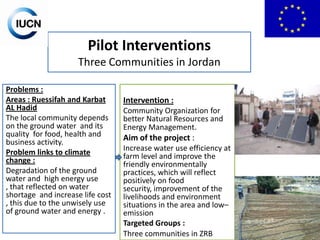
Pilot Interventions
Three Communities in Jordan
Problems :
Areas : Ruessifah and Karbat
AL Hadid
The local community depends
on the ground water and its
quality for food, health and
business activity.
Problem links to climate
change :
Degradation of the ground
water and high energy use
, that reflected on water
shortage and increase life cost
, this due to the unwisely use
of ground water and energy .

Intervention :
Community Organization for
better Natural Resources and
Energy Management.

Aim of the project :
Increase water use efficiency at
farm level and improve the
friendly environmentally
practices, which will reflect
positively on food
security, improvement of the
livelihoods and environment
situations in the area and low–
emission
Targeted Groups :
Three communities in ZRB
Result of the Interventions

Low –emission level (mitigation)
•

•

•

Increase the energy efficient use, and
decrease the burden of energy
capacity at house level .
The direct contribution on CO2
emission is 63.65 tons reduction of
Carbon Dioxide (CO2) emissions in the
atmosphere annually.
In direct contribution on CO 2
emission is 127.3 Tons reduction (
100 systems were installed by the
communities themselves after they
saw the results ).
Total is 190.95 Tons of CO2

Water Irrigation System
•
•
•
•
•
•
•

All surface irrigation systems were
converted to drip irrigation systems.
50 % reduced in labor costs
Saved 40% in water pumping cost
Pumping water with less time (lowemission , pressure on energy ,cost )
Energy cost decreased by 60 $
Agricultural areas increased by 30
%
More agricultural productivity
increased by 20 %.
Conclusions
• Participatory Approach is Crucial for CBA
- The most sustainable adaptation measures are the once that
reflect positively on the improvement of the livelihoods situation.
- Involvement of the local community in climate V&A and adaptation
development is very crucial for the identification of priority
adaptations at local level and Provides information flow and simplify
the climate change assessment .

• Mobilize Financial Resources and National & Sub-national
Authorities
- Involvement of national and sub-national authorities along with
local level is very important for capacity building ,trust building
, improve the coordination between the ministries at national level
as well as improve the development plans and policy influencing
and framing
- Involvement of the private sectors can help in providing new
investment opportunities such as HSBC Bank.
The way towards a closer dialogue
• Seeking Always for Synergy in Climate Action
- The win-win situation between low CO2 emission
and energy low cost is very effective factor for the
sustainability of any adaptation measure.
- Low carbon emission is not the priority of the local
community but when it links with life cost saving
and national planning it becomes a priority .
• EU DG Climate Action Committed to Support the Move
towards a closer dialogue
31/10/13
Thank You
Still there is a need to develop Participatory Climate
Change Planning Approach with
Specific Tools to ensure real participation of all
relevant Stakeholders including local community
combining Adaptation ,Mitigation and Development
!!!!!!
Awareness –Planning –Projects

EU DG Climate Action Initiative

  • 1.
    Win-win approaches LowEmission & Climate Resilient Development EU DG Climate Action Initiative Social, Ecological and Agricultural Resilience in the Face of Climate Change SEARCH COP19-Side Event, Warsaw, 14th November 2013 Muffleh Al Abbadi - IUCN
  • 2.
    What is IUCN? International Union for Conservation of Nature (IUCN) • A unique democratic union of more than 1,000 members including national states, government agencies and NGOs IUCN/ROWA Who are we? • We mobilize people and organizations, through our networks worldwide, to produce and use conservation knowledge for the benefit of people and nature 2 VISION What we aim for the future ►Is it just a world that values and conserves nature
  • 3.
    SEARCH Project SEARCH isa three year regional project working in five countries to develop and pilot a resilience framework for local action planning capacities and methodologies to increase climate change resilience . Countries/Partners : • Egypt, Beni Suef and Minia ,Jordan, Zarqa River Basin ,West Bank/Gaza, Jenin, Morocco and Lebanon • Working with 14 Partners
  • 4.
    Regional platform (thematic group) Regional Identifycountries National platform National Initiator/facilitator Establish National platform Bring lessonsin watershedscale Identify up tocountry Scale Pilot national Watershed and Climate platform Sub-National Establish in communities ConsolidateDistrict platform Scale pilot Watershed Establish Local platforms Learn together Identify up lessons and. … Community 4 11/22/2013
  • 5.
    Case Study Morocco andJordan Morocco Jordan • • • • • • Jordan is characterized by its semi-arid climate, high dependence on rainfall and scarcity of water resources Jordan is ranked among the poorest countries in the world in water availability 149 Cubic meters/year reduction in rainfall from 5-20% (previous decades ) Predicted increase in temperature and decease in precipitation will increase water scarcity in Jordan. Environmental degradation costs Jordan more than 2 per cent of GDP a year. Jordan’s reliance on energy imports, coupled with its low energy efficiency. • • • • • • • Morocco is among the countries that are more likely threatened by climatic change. Precipitation, in Morocco, is low and highly variable from one season to another and within the cropping year. Increased of drought frequency Reduction of the length of the growth period of crops Energy consumption 17.7 Million toe ,Import 95.5 %. National energy bill 10.1 billion $m subsides 4.8 billion $, annual increase rate 5.3% . RE: 42% contribution to the electricity installed capacity by 2020: 14% Hydro – 14% Wind – 14% Solar
  • 6.
    Energy Profile /Jordan Constrains/Problems : • Lack of knowledge by energy users of the benefits of energy efficiency, • Lack of expertise to develop energy efficiency projects, • High initial implementation cost, • Lack of suitable financing mechanisms.(SNC,2009) Actions : • Master Strategy for the Energy Sector 2007 – 2020 – Renewable energy to account for 10 per cent of total energy supply (1,800 MW) compared to 3.5 per cent at present – Energy savings of 20 per cent – The provision of solar water heating systems to 30 per cent of households • These targets are supported by: – The Renewable Energy and Energy Efficiency Law no. 13, which creates framework for renewable energy investment and the Jordan Renewable Energy and Energy Efficiency Fund – Tax incentives for renewable energy and energy efficiency – A range of energy efficiency initiatives such as replace incandescent bulbs in government buildings and energy audits for certain firms . • Jordan maintains the Summertime all-year-around this saved around 7 Million/Yr $ from the energy cost .
  • 7.
    Pilot project inZRB/Jordan and Wadi Kabeer Basin/Morocco A Community-Based Climate Change Assessment and Adaptation Development Zarqa River Basin : • The Zarqa River is the second largest river in Jordan. • Area 3567 KM2 • About 2.72 million people (2004) are living in the basin • 65 % from the Industrial activities concentrated in ZRB Pilot project s : The overall aim of the project is to assess the climate change phenomena at SEARCH target communities by using a community-based approach in order to develop an initial climate change adaptation plan for each community that contribute on low-emission and economic benefits • • • • • Pilot Activities Examine to what extent that the target community members are familiar with the concept ‘climate change Identify the public perception about climate change and its impacts Identify what are the most vulnerable community sectors Document adaptation measures to climate change at each community Propose an initial CC adaptation plan for each community
  • 8.
    Public perception aboutchanges in climate indicators Indicator Summer Temperature ZRB Increase WKB Increase Fluctuations Decrease Rainfall Number of Rainy Days Decrease Decrease Decrease Decrease Dust Storms Winter Winds Frequency of Drought Years Frost Flood Fluctuations Fluctuations Increase NA Fluctuations Increase Shifting Increase in winter NA Increase in winter Winter Temperature
  • 9.
    Morocco- Tangier-Tetouan Region • Severityof extreme weather events  Change in the regularity of seasons  Concentrated annual precipitations within short periods  More frequent outbreaks of extreme hot conditions • Very low adaptive capacity  isolation  poverty  illiteracy  lack of access to basic services and information  weak relationships with public institutions  traditional adaptive techniques rudimentary or already lost Impacts - drought - forest fire - Erosion &landslides - Destruction of houses - Reduction of dams’ capacity - Diminution of production - Reduction of cultivated lands - Destruction of houses - Reduction of Dam’s capacities Other causes of impacts - Techniques not adapted Low afforestation Reduced natural cover - Clay Soil
  • 10.
    Community Vision for2020 Morocco 1. 2. The landscape as an agroforest system has been maintained while numerous forestry job opportunities and new green economic activities are created. Pressure and conflicts on water and forest resources have been largely reduced. Ecosystems situated in the mountainous area of Jbel Bouhachem are strictly protected in the core zone of the attractive Natural Park of Bouhachem Adaptation Strategies 1. Improving road infrastructure avoiding negative impacts on the forest and integrating road development - water management 2. Diversifying sources of income along with regulatory measures, capacity building and awareness on the protection of natural resources 3. Implementing soil conservation structures using useful plants (aromatic and medicinal plants, forage), expanding the network of windbreaks and capacity building of local institutions 4. Promoting drying and storage of agricultural products extending to fodder and forestry products to contribute to the diversification of local products while reducing the pressure on the forest 5. Harvesting rainwater for homes and public buildings to be amplified by the establishment of collective systems of rainwater harvesting and setting up distribution network 6. Establishing an appropriate roof of rural housing adapted to climate risks and to architectural heritage through adequate regulation taking into account the benefits to gain energy and rainwater harvesting
  • 11.
    Jordan Factors increasing theclimate change impact/Jordan Factor Waste water pipe River and flooding High voltage power lines Wastewater in the river Brick factories/factories Manholes overflow Septic tanks Burning wastes Mining Desertification Sewage water lifting treatment plant Unpaved roads Ineffective regulation Groundwater over pumping Illegal waste dumping and Littering Rodents and insects Behavioral changes due to climate change Indicator Use of electricity Solar energy /solar water heater system Agricultural activities Use of filtered water Greening areas surrounding the river General water use Visiting medical clinics Procedures used to reduce pollutionimpact Control of insects and rodents Jordan Increase Rare Decrease Increase Decrease Increase Increase Increase Increase
  • 12.
    Existing adaptation measuresand proposed Adaptation Measure Planting more adaptive, local plants Planting seeds directly in soil Varying growing times Seed production at the farm level Shading and sheltering/tree planting Drip irrigation system Windbreaks Crop rotation Changing from farming to non-farming activities Water resources management/Increased use of water conservation techniques Decrease of the cultivated area Moving to crops with short life cycles Moving from farming to other business Changing to tractor ploughing Use of animal manure Increased use of chemicals Increased family labour Farm gate marketing Greywaterreuse Home gardening House design modifications Waste recycling Use of yeast wastewater Sector Agriculture • • • • • • Water • • • • • Environment • • • Adaptation Measures Rehabilitate the springs Protect the river banks by growing suitable trees Cultivation of crops suited to changing environmental conditions (spinach, arugula, radishes, parsley, coriander, berries, beans, garlic, onion, mint, cabbage, cauliflower) Employ the organic farming principles Use of crop rotation Water-saving irrigation systems (drip/spray) Agricultural extension and development of the agricultural calendar (planting dates, marketing, and activities) Reduce groundwater over pumping Reduce pollution in water and on farms due to the river pollution Linking homes (not connected) with the sanitation network to prevent contamination of groundwater Coordination with the Water Authority to reduce over-pumping Raising awareness and providing guidance in the use and rationing of water consumption Use of solar panels for water heating Reduction of pollution due to transport line, river pollution, and wastes. Linking homes (not connected) to the sanitation network to prevent contamination in the area
  • 13.
    Pilot Interventions Three Communitiesin Jordan Problems : Areas : Ruessifah and Karbat AL Hadid The local community depends on the ground water and its quality for food, health and business activity. Problem links to climate change : Degradation of the ground water and high energy use , that reflected on water shortage and increase life cost , this due to the unwisely use of ground water and energy . Intervention : Community Organization for better Natural Resources and Energy Management. Aim of the project : Increase water use efficiency at farm level and improve the friendly environmentally practices, which will reflect positively on food security, improvement of the livelihoods and environment situations in the area and low– emission Targeted Groups : Three communities in ZRB
  • 15.
    Result of theInterventions Low –emission level (mitigation) • • • Increase the energy efficient use, and decrease the burden of energy capacity at house level . The direct contribution on CO2 emission is 63.65 tons reduction of Carbon Dioxide (CO2) emissions in the atmosphere annually. In direct contribution on CO 2 emission is 127.3 Tons reduction ( 100 systems were installed by the communities themselves after they saw the results ). Total is 190.95 Tons of CO2 Water Irrigation System • • • • • • • All surface irrigation systems were converted to drip irrigation systems. 50 % reduced in labor costs Saved 40% in water pumping cost Pumping water with less time (lowemission , pressure on energy ,cost ) Energy cost decreased by 60 $ Agricultural areas increased by 30 % More agricultural productivity increased by 20 %.
  • 16.
    Conclusions • Participatory Approachis Crucial for CBA - The most sustainable adaptation measures are the once that reflect positively on the improvement of the livelihoods situation. - Involvement of the local community in climate V&A and adaptation development is very crucial for the identification of priority adaptations at local level and Provides information flow and simplify the climate change assessment . • Mobilize Financial Resources and National & Sub-national Authorities - Involvement of national and sub-national authorities along with local level is very important for capacity building ,trust building , improve the coordination between the ministries at national level as well as improve the development plans and policy influencing and framing - Involvement of the private sectors can help in providing new investment opportunities such as HSBC Bank.
  • 17.
    The way towardsa closer dialogue • Seeking Always for Synergy in Climate Action - The win-win situation between low CO2 emission and energy low cost is very effective factor for the sustainability of any adaptation measure. - Low carbon emission is not the priority of the local community but when it links with life cost saving and national planning it becomes a priority . • EU DG Climate Action Committed to Support the Move towards a closer dialogue 31/10/13
  • 18.
    Thank You Still thereis a need to develop Participatory Climate Change Planning Approach with Specific Tools to ensure real participation of all relevant Stakeholders including local community combining Adaptation ,Mitigation and Development !!!!!! Awareness –Planning –Projects