Dr. Ram Mani Bhandari
What is life??
BODY + MIND + SENSES + SOUL
Body is run by mind
and mind is run by body.
Mind=Body
 WHAT IS MIND?
 WHERE IS MIND ?
 WHAT IS THE FUNCTION OF MIND?
 PLEASE DON’T MIND
 Functional unit to judge, think, memory etc.
 Not visible.
 Physiology of consciousness.
 Living creatures have only mind.
 MANN is
"MANNYATE AVABUDDHATE GYAYETE ITI MANNAH",
 means the MANN is that phenomenon, by which we can
imagine, consider, acquire knowledge and so on.
Symptoms of MANN are
 " LAXANAM MANNSO GYANASYABHAVOABHAV EVA CHA.SATIHI
ATMENINDRIYA ARTHANAM SANNIKARSHA NA VERTATE"
 The maan are presence or non appearance of the
knowledge.
 If the mann does not give attention to the vishaya (the
object of the sensory organ) of the related Indriya, the
atma cannot receive the sensations or knowledge or any
thing from the outer world.
According to Ayurveda
 Mann or mind is an organ of perception and
well as of action.
 The main work of the mind is perception,
thinking, understanding, taking rightful
decisions, etc.
 If due to improper diet and lifestyle the
natural state of mind is disturbed and
feelings like anger, jealousy, cruelty, laziness
etc happens.
Mind is only one but sometimes it appears as if
we are having multiple minds.
e.g. while watching movies we see and listen.
But this is not true. As mind is only one it is
able to perform one function at a time, but
it has tremendous speed so we feel that all
things are happening at a same time.
 Ayurveda doctor need not call themselves
psychologist.
 Psychology is part of their usual practice.
 Ayurveda is the holistic approach of healing.
 In Ayurveda the mind and heart are one and
the same.
 The mind is said to reside in the heart and
this means the physical heart as well as the
heart of our pure awareness.
 All 3 doshas also reside in the heart, along
with Prana, Tejas and Ojas, the subtle forms
of the doshas and the Gunas, Sattwa,
Rajas and Tamas.
 Mental health is a state of sensory, mental,
intellectual and spiritual well being.
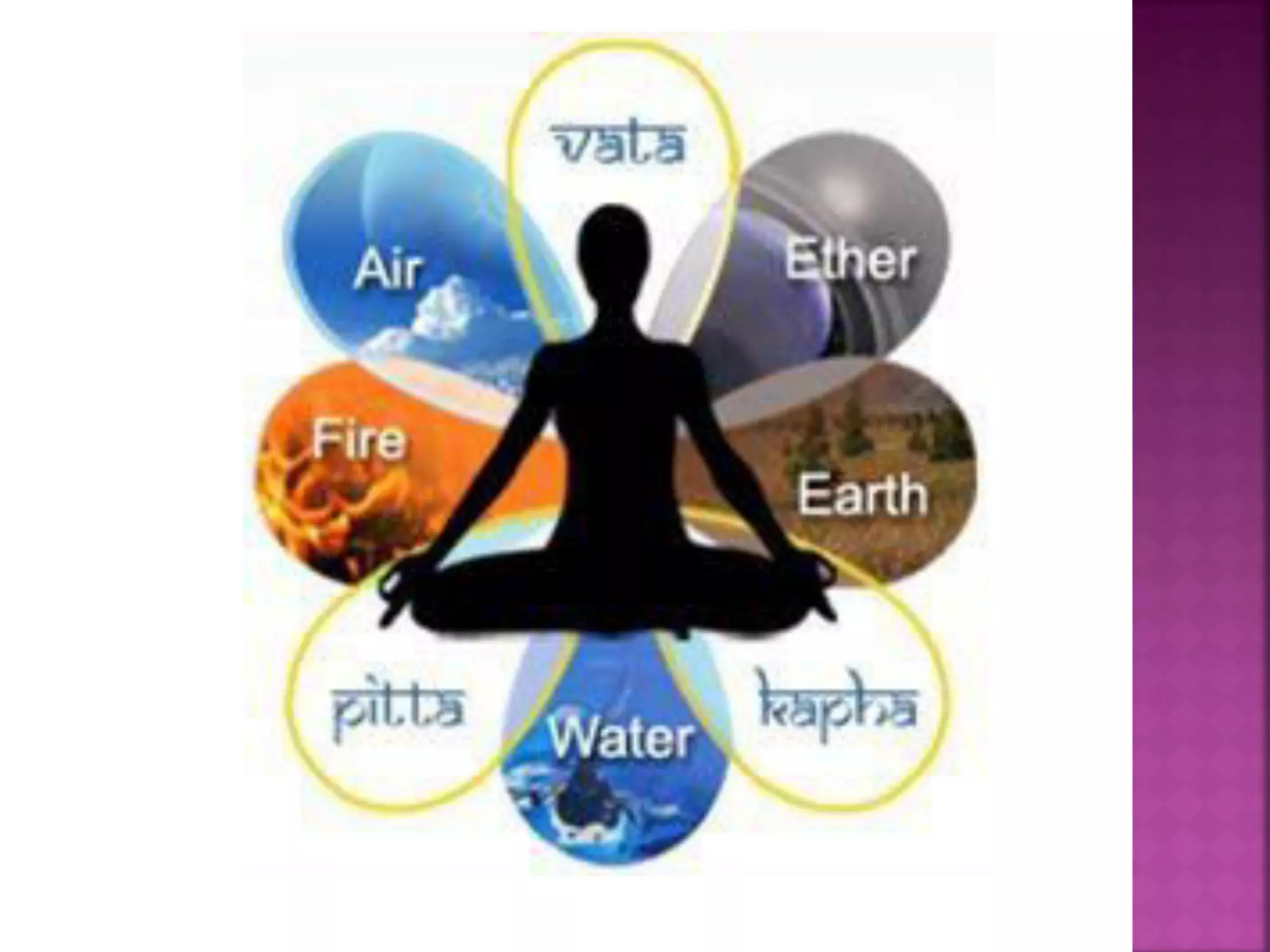
 Tridoshas (Vata, Pitta, Kapha)
Body Constitution
 Tri Gunas (Satwa, Rajas, Tamas)
Mind Constitution (Qualities of Mind)
Body + mind + Sense + Soul
Physical body + mind = Complete health
Gunas :
 Properties/Quality/Characters
 Meaning: Mental quality/Properties
 The three gunas preserve the mind (and
indirectly the body), maintaining it in a
healthy state.
 Any disturbance in this equilibrium results in
various types of mental disorders.
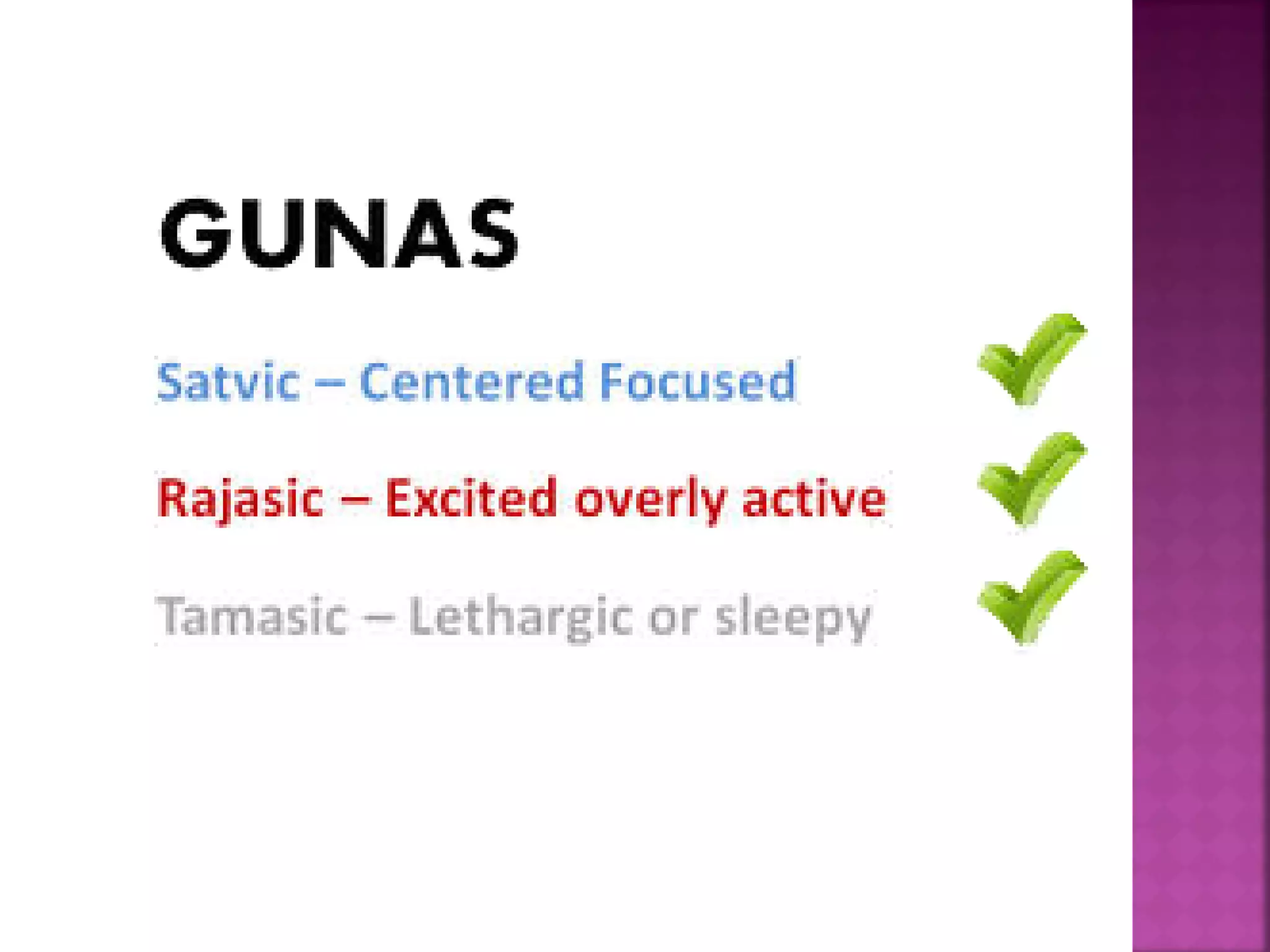
3 types of Gunas
 Satwa (Purity, peace, harmony)
 Rajas (Passion, ambition, spontaneity)
 Tamas (Inertia, ignorance, jealousy)
Creation (Sattva),
Preservation (Rajas),
Destruction/transformation
(Tamas)
Satwa has the characteristics of
lightness, consciousness, pleasure and
clarity. It is pure, free from disease and
cannot be disturbed in any way. It
activates the senses and is responsible
for the perception of knowledge.
 .
Rajas, the most active of the
Gunas, has motion and
stimulation as its
characteristics. All desires,
wishes, ambitions and fickle-
mindedness are a result of
Rajas.
Tamas is characterised by
heaviness and resistance. It
causes disturbances in
perception and other activities
of the mind. Delusion, false
knowledge, laziness, apathy,
sleep and drowsiness are a
result of Tamas
 In any human being though all these three
qualities will be present in varying
proportions, generally one of these qualities
will be more predominant than the other
two. For example,
 Saints and sages are predominantly sattwic.
 A politician or a sports star will be
predominantly rajasic.
 People who easily get hooked to drinking or
drugs will be predominantly tamasic.
Satwa Rajas Tamas
Kapha Pitta Vata
Tamsik person does not work. He has no interest in life. he is
totally ignorant.
Rajsik is desire ridden ,passionate and is stressed.
Satvik is at goodness stage, superior and attains glory. He is always
calm and peaceful "
 Rajas and Tamas, as with the doshas, can be
unbalanced by stress and negative desires as
 kama (lust),
 irshya (malice),
 moha (delusion and halucination),
 lobha (greed),
 chinta (anxiety),
 bhaya (fear) and
 krodha (anger).
 Karma is the Sanskrit word for "action" or
"deed".
 Any physical or mental action is considered
as Karma.
 According to Hinduism, life is an infinite
chain of results of actions (Karma) in the
past. In simple words this works as "Law of
Cause and Effect" or "As you sow, so you
reap". The way the results of Karma are
delivered in the life is the “Law of Karma”.
 Tri-Gunas (Sattwa, Raja, Tama) are the driver
behind the thought, thought is the driver
behind the action (Karma). Karma is the
driver behind the life (of cause and effect)
that we live.
 Tri-Gunas is the seed – Karma is the tree –
Consequence of the Karma is the fruit that
we are living today.
1) Satwik Gun = Satwik Karma = Satwik fruit =
Person is more close to the God
2) Tamo Gun = Tamasik Karma = Tamasik fruit =
Person is far away from the God
 Prakriti (Body type) is permanent.
 Gunas (Mental constitution) is Changeable.
Importance of Gunas:
 To balance doshas.
 To build immunity.
 To achieve sprituality.
 Health, happiness, Suceess
 To achieve goal of life
Satwa Purity &
Knowledge
Lives in service
of society of
recognition or
reward or any
ulter
Rajas Action and
Passion
Lives more for
personal
achievement
Tamas Ignorance and
inertia
Has no problem
about stepping
other’s toes to
get ahead or
harming society
 Pain of mind is worse than pain of body.
~Latin Proverb
 Body and mind, like man and wife, do not
always agree to die together. ~Charles Caleb
Colton
Thank you

Gunas (Psychological constitution)

  • 1.
    Dr. Ram ManiBhandari
  • 2.
    What is life?? BODY+ MIND + SENSES + SOUL Body is run by mind and mind is run by body. Mind=Body
  • 3.
     WHAT ISMIND?  WHERE IS MIND ?  WHAT IS THE FUNCTION OF MIND?  PLEASE DON’T MIND
  • 4.
     Functional unitto judge, think, memory etc.  Not visible.  Physiology of consciousness.  Living creatures have only mind.
  • 5.
     MANN is "MANNYATEAVABUDDHATE GYAYETE ITI MANNAH",  means the MANN is that phenomenon, by which we can imagine, consider, acquire knowledge and so on. Symptoms of MANN are  " LAXANAM MANNSO GYANASYABHAVOABHAV EVA CHA.SATIHI ATMENINDRIYA ARTHANAM SANNIKARSHA NA VERTATE"  The maan are presence or non appearance of the knowledge.  If the mann does not give attention to the vishaya (the object of the sensory organ) of the related Indriya, the atma cannot receive the sensations or knowledge or any thing from the outer world.
  • 6.
    According to Ayurveda Mann or mind is an organ of perception and well as of action.  The main work of the mind is perception, thinking, understanding, taking rightful decisions, etc.  If due to improper diet and lifestyle the natural state of mind is disturbed and feelings like anger, jealousy, cruelty, laziness etc happens.
  • 7.
    Mind is onlyone but sometimes it appears as if we are having multiple minds. e.g. while watching movies we see and listen. But this is not true. As mind is only one it is able to perform one function at a time, but it has tremendous speed so we feel that all things are happening at a same time.
  • 8.
     Ayurveda doctorneed not call themselves psychologist.  Psychology is part of their usual practice.  Ayurveda is the holistic approach of healing.
  • 10.
     In Ayurvedathe mind and heart are one and the same.  The mind is said to reside in the heart and this means the physical heart as well as the heart of our pure awareness.  All 3 doshas also reside in the heart, along with Prana, Tejas and Ojas, the subtle forms of the doshas and the Gunas, Sattwa, Rajas and Tamas.  Mental health is a state of sensory, mental, intellectual and spiritual well being.
  • 12.
     Tridoshas (Vata,Pitta, Kapha) Body Constitution  Tri Gunas (Satwa, Rajas, Tamas) Mind Constitution (Qualities of Mind) Body + mind + Sense + Soul Physical body + mind = Complete health
  • 13.
    Gunas :  Properties/Quality/Characters Meaning: Mental quality/Properties
  • 14.
     The threegunas preserve the mind (and indirectly the body), maintaining it in a healthy state.  Any disturbance in this equilibrium results in various types of mental disorders.
  • 15.
    3 types ofGunas  Satwa (Purity, peace, harmony)  Rajas (Passion, ambition, spontaneity)  Tamas (Inertia, ignorance, jealousy)
  • 16.
  • 17.
    Satwa has thecharacteristics of lightness, consciousness, pleasure and clarity. It is pure, free from disease and cannot be disturbed in any way. It activates the senses and is responsible for the perception of knowledge.  .
  • 18.
    Rajas, the mostactive of the Gunas, has motion and stimulation as its characteristics. All desires, wishes, ambitions and fickle- mindedness are a result of Rajas.
  • 19.
    Tamas is characterisedby heaviness and resistance. It causes disturbances in perception and other activities of the mind. Delusion, false knowledge, laziness, apathy, sleep and drowsiness are a result of Tamas
  • 20.
     In anyhuman being though all these three qualities will be present in varying proportions, generally one of these qualities will be more predominant than the other two. For example,  Saints and sages are predominantly sattwic.  A politician or a sports star will be predominantly rajasic.  People who easily get hooked to drinking or drugs will be predominantly tamasic.
  • 21.
    Satwa Rajas Tamas KaphaPitta Vata Tamsik person does not work. He has no interest in life. he is totally ignorant. Rajsik is desire ridden ,passionate and is stressed. Satvik is at goodness stage, superior and attains glory. He is always calm and peaceful "
  • 22.
     Rajas andTamas, as with the doshas, can be unbalanced by stress and negative desires as  kama (lust),  irshya (malice),  moha (delusion and halucination),  lobha (greed),  chinta (anxiety),  bhaya (fear) and  krodha (anger).
  • 23.
     Karma isthe Sanskrit word for "action" or "deed".  Any physical or mental action is considered as Karma.  According to Hinduism, life is an infinite chain of results of actions (Karma) in the past. In simple words this works as "Law of Cause and Effect" or "As you sow, so you reap". The way the results of Karma are delivered in the life is the “Law of Karma”.
  • 24.
     Tri-Gunas (Sattwa,Raja, Tama) are the driver behind the thought, thought is the driver behind the action (Karma). Karma is the driver behind the life (of cause and effect) that we live.  Tri-Gunas is the seed – Karma is the tree – Consequence of the Karma is the fruit that we are living today. 1) Satwik Gun = Satwik Karma = Satwik fruit = Person is more close to the God 2) Tamo Gun = Tamasik Karma = Tamasik fruit = Person is far away from the God
  • 26.
     Prakriti (Bodytype) is permanent.  Gunas (Mental constitution) is Changeable.
  • 27.
    Importance of Gunas: To balance doshas.  To build immunity.  To achieve sprituality.  Health, happiness, Suceess  To achieve goal of life
  • 28.
    Satwa Purity & Knowledge Livesin service of society of recognition or reward or any ulter Rajas Action and Passion Lives more for personal achievement Tamas Ignorance and inertia Has no problem about stepping other’s toes to get ahead or harming society
  • 33.
     Pain ofmind is worse than pain of body. ~Latin Proverb  Body and mind, like man and wife, do not always agree to die together. ~Charles Caleb Colton
  • 34.