Can Pushing help our ED
PET?
Ideas for Today and improvements for
Tomorrow
Eugene Farrell – Succession Management Programme 14th & 15th October 2014
Vision Statement
 The 2014 HSE Service plan states;
“The core purpose of the HSE is to provide effective, safe and high
quality health care that is patient centered.”
 Future Health – A strategic framework for reform in
the Health Service 2012 – 2015 also clearly
enumerates the ethos of patient centric care;
“The current system is unfair to patients, it often fails to meet their needs
fast enough; and it does not deliver value for money.”
Introduction
 Overview of the current ED PET performance
 Proposed performance improvement initiatives
 Change management
 Implementation requirements
 Conclusion
Goal and Objectives
 The Goal of ED performance is;
 To improve patient experience time when presenting at
the Emergence Department (ED)
 The Objectives to improve ED performance are;
 To decrease the waiting time for admission or
discharge for patients within ED (PET)
 To meet the service plan key performance indicators
(KPI’s) for ED performance
Today’s Situation
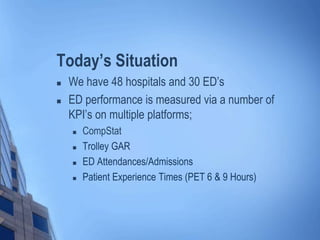
 We have 48 hospitals and 30 ED’s
 ED performance is measured via a number of
KPI’s on multiple platforms;
 CompStat
 Trolley GAR
 ED Attendances/Admissions
 Patient Experience Times (PET 6 & 9 Hours)
Today’s Situation
 International literature suggests the reasons for
delay within ED;
 Medical personnel
 Bed capacity
 Radiology results
 Laboratory results
Today’s Situation
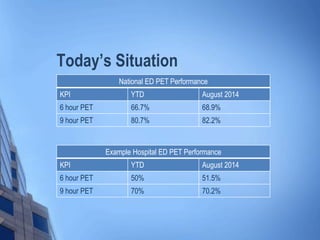
National ED PET Performance
KPI YTD August 2014
6 hour PET 66.7% 68.9%
9 hour PET 80.7% 82.2%
Example Hospital ED PET Performance
KPI YTD August 2014
6 hour PET 50% 51.5%
9 hour PET 70% 70.2%
How Did We Get Here?
 Independent General Practice services
 Poor referral patterns and pathways
 Poor ICT solutions
 Lack of resources
 Responsibility for individuals health
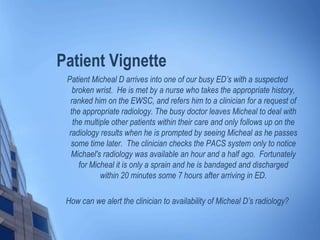
Patient Vignette
Patient Micheal D arrives into one of our busy ED’s with a suspected
broken wrist. He is met by a nurse who takes the appropriate history,
ranked him on the EWSC, and refers him to a clinician for a request of
the appropriate radiology. The busy doctor leaves Micheal to deal with
the multiple other patients within their care and only follows up on the
radiology results when he is prompted by seeing Micheal as he passes
some time later. The clinician checks the PACS system only to notice
Michael's radiology was available an hour and a half ago. Fortunately
for Micheal it is only a sprain and he is bandaged and discharged
within 20 minutes some 7 hours after arriving in ED.
How can we alert the clinician to availability of Micheal D’s radiology?
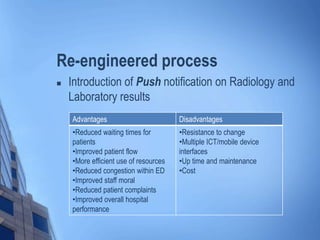
Re-engineered process
 Introduction of Push notification on Radiology and
Laboratory results
Advantages Disadvantages
•Reduced waiting times for
patients
•Improved patient flow
•More efficient use of resources
•Reduced congestion within ED
•Improved staff moral
•Reduced patient complaints
•Improved overall hospital
performance
•Resistance to change
•Multiple ICT/mobile device
interfaces
•Up time and maintenance
•Cost
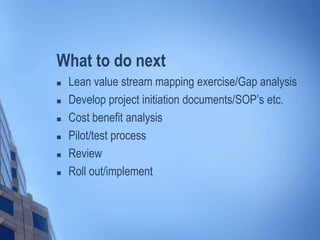
What to do next
 Lean value stream mapping exercise/Gap analysis
 Develop project initiation documents/SOP’s etc.
 Cost benefit analysis
 Pilot/test process
 Review
 Roll out/implement
Change Management
 Resistance to change by stakeholders
 Infrastructural capabilities
Conclusions
 Clear understanding of the existing processes
 Identify the natural waste that can removed from
the system
 Develop an improvement plan
 Implement and test the improvement plan against
expected outcomes
 Move on to the next constraint
Questions

Can Pushing help our ED PET

  • 1.
    Can Pushing helpour ED PET? Ideas for Today and improvements for Tomorrow Eugene Farrell – Succession Management Programme 14th & 15th October 2014
  • 2.
    Vision Statement  The2014 HSE Service plan states; “The core purpose of the HSE is to provide effective, safe and high quality health care that is patient centered.”  Future Health – A strategic framework for reform in the Health Service 2012 – 2015 also clearly enumerates the ethos of patient centric care; “The current system is unfair to patients, it often fails to meet their needs fast enough; and it does not deliver value for money.”
  • 3.
    Introduction  Overview ofthe current ED PET performance  Proposed performance improvement initiatives  Change management  Implementation requirements  Conclusion
  • 4.
    Goal and Objectives The Goal of ED performance is;  To improve patient experience time when presenting at the Emergence Department (ED)  The Objectives to improve ED performance are;  To decrease the waiting time for admission or discharge for patients within ED (PET)  To meet the service plan key performance indicators (KPI’s) for ED performance
  • 5.
    Today’s Situation  Wehave 48 hospitals and 30 ED’s  ED performance is measured via a number of KPI’s on multiple platforms;  CompStat  Trolley GAR  ED Attendances/Admissions  Patient Experience Times (PET 6 & 9 Hours)
  • 6.
    Today’s Situation  Internationalliterature suggests the reasons for delay within ED;  Medical personnel  Bed capacity  Radiology results  Laboratory results
  • 7.
    Today’s Situation National EDPET Performance KPI YTD August 2014 6 hour PET 66.7% 68.9% 9 hour PET 80.7% 82.2% Example Hospital ED PET Performance KPI YTD August 2014 6 hour PET 50% 51.5% 9 hour PET 70% 70.2%
  • 8.
    How Did WeGet Here?  Independent General Practice services  Poor referral patterns and pathways  Poor ICT solutions  Lack of resources  Responsibility for individuals health
  • 9.
    Patient Vignette Patient MichealD arrives into one of our busy ED’s with a suspected broken wrist. He is met by a nurse who takes the appropriate history, ranked him on the EWSC, and refers him to a clinician for a request of the appropriate radiology. The busy doctor leaves Micheal to deal with the multiple other patients within their care and only follows up on the radiology results when he is prompted by seeing Micheal as he passes some time later. The clinician checks the PACS system only to notice Michael's radiology was available an hour and a half ago. Fortunately for Micheal it is only a sprain and he is bandaged and discharged within 20 minutes some 7 hours after arriving in ED. How can we alert the clinician to availability of Micheal D’s radiology?
  • 10.
    Re-engineered process  Introductionof Push notification on Radiology and Laboratory results Advantages Disadvantages •Reduced waiting times for patients •Improved patient flow •More efficient use of resources •Reduced congestion within ED •Improved staff moral •Reduced patient complaints •Improved overall hospital performance •Resistance to change •Multiple ICT/mobile device interfaces •Up time and maintenance •Cost
  • 11.
    What to donext  Lean value stream mapping exercise/Gap analysis  Develop project initiation documents/SOP’s etc.  Cost benefit analysis  Pilot/test process  Review  Roll out/implement
  • 12.
    Change Management  Resistanceto change by stakeholders  Infrastructural capabilities
  • 13.
    Conclusions  Clear understandingof the existing processes  Identify the natural waste that can removed from the system  Develop an improvement plan  Implement and test the improvement plan against expected outcomes  Move on to the next constraint Questions