GUIDELINES for INDUCTION  MODIFIED BISHOP SCORE  INDUCTION ETIQUETTE WHAT ARE THE REVISED GUIDELINES CYTOTEC PHARMACOKINETICS ACTIVE MANAGEMENT  INPATIENT vs OUTPATIENT HOW TO USE A FOLEY BULB CERVIDIL NOT RECOMMENDED
MODIFIED BISHOP SCORE ONLY 3 VARIABLES Positive Predictive Value for Delivery Equals or Exceeds  Original 5 variable Bishop Score  CERVICAL DILATION IS THE STRONGEST PREDICTOR AND CARRIES DOUBLE WEIGHT Obstet Gynecol 1982;60:137
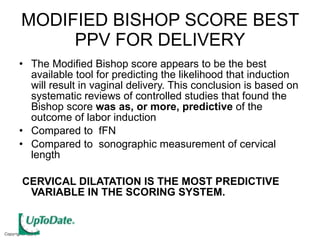
MODIFIED BISHOP SCORE BEST PPV FOR DELIVERY The Modified Bishop score appears to be the best available tool for predicting the likelihood that induction will result in vaginal delivery. This conclusion is based on systematic reviews of controlled studies that found the Bishop score  was as, or more, predictive  of the outcome of labor induction  Compared to  fFN   Compared to  sonographic measurement of cervical length CERVICAL DILATATION IS THE MOST PREDICTIVE VARIABLE IN THE SCORING SYSTEM.
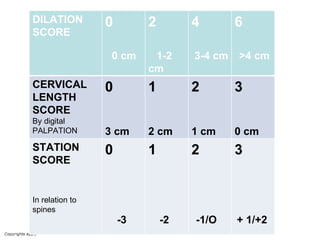
DILATION  SCORE 0   0 cm 2 1-2 cm 4 3-4 cm 6 >4 cm CERVICAL LENGTH SCORE By digital  PALPATION 0 3 cm 1 2 cm 2 1 cm 3 0 cm STATION SCORE In relation to spines 0 -3 1 -2 2 -1/O 3 + 1/+2
Favorable Cervix is score of 6 For Nulliparous cervix should also be 3-4 cm for Pitocin Induction   Bishop Score of < 5  is associated with an increased risk for a 2 day induction and  ~ Doubles the Risk of Cesarean Section  -  Most dependent on whether the  cervix is dilated Am J Obstet Gynecol 2003 Jun;188(6):1565-9
“ POP & PIT “ Amniotomy as Soon As Possible  A Cochrane review of randomized trials found the combination of  amniotomy plus intravenous   oxytocin  administration was more effective than either alone. With the combined regimen, fewer women were undelivered at 24 hours than with amniotomy alone RR 0.13 and C/S rate was reduced with both RR 0.88 IMMEDIATE   Oxytocin  with  Amniotomy  compared to DELAYE of either results in  FASTER  establishment of labor SHORTER  time to delivery LOWER C/S RATE MORE maternal satisfaction Arch Gynecol Obstet. 2009 Jun;279(6):813-20  Cochrane Database Syst Rev. 2009
DO NOT USE CYTOTEC WITH A FAVORABLE CERVIX In women with favorable cervices undergoing labor induction, Cytotec did not result in better outcomes than intravenous  oxytocin .  Cytotec was associated with a higher frequency of tachysystole and failure to deliver vaginally within 24 hours.                     Am J Obstet Gynecol 2004 Jun;190(6):1689-94
INDUCTION ETIQUETTE It is not preferred to attempt scheduling an induction on an E xact day  OR  Arbitrary deadline  unless you are on L&D in an attempt to be present for Delivery. Most medically indicated inductions are associated with @ least a week or more in which the patient should be delivered. Ie 39 th  week up to 40w 6d VS 39w 0d Remember to be considerate of your partners / CNM associates and try to  schedule inductions when you are on, especially if it is an inpatient induction . If you are not on L&D call your partner / CNM associate  who is on and request the favor of caring for your patient.  L&D has more Anesthesiology providers available Monday through Friday vs Weekends. If you are attempting to schedule an induction on the  weekend  because  you are on  make sure that  Anesthesiology / L&D Staff  are aware.
INPATIENT INDUCTION Etiquette & Wisdom A note describing the  Risk / Benefit / Indications for Medical Induction  Should be placed under the  Clinician Notes  on the Patients Chart. Physicians who you discussed the case with and whether or not consultation with MFM was obtained should be included.  Patients who want  amniotomy  first without Pitocin and / or request to  walk  first without Pitocin in the hopes that the normal contractions that are invariably present @ term will result in &quot; natural labor &quot;  without immediate Pitocin start  require further counseling & Documentation re IUFD / C/S risk NOT CANDIDATES FOR  A 41 WEEK POSTTERM INDUCTION. Schedule @ 42w0d +/- 1 day IF MEDICAL INDUCTION IS INDICATED THIS IS NOT ACCEPTABLE
What are the Changes ARRIVE EARLIER Out Patient and In Patient  CYTOTEC INDUCTIONS  all scheduled to  ARRIVE @ 7:30 PM   This will facilitate a decision re Admission/Discharge prior to 8:30 AM the following morning  This will provide the  opportunity  for an  In Patient Induction admitted the night before for Cytotec the opportunity for  additional Cytotec dosing if appropriate  AND more time for cervical ripening During board rounds @ 5:30 PM  a  discussion between the OB 1 & 2  regarding the  status of L&D  and whether or not the inductions  ( 2 max of 3) can arrive @ 7:30 PM  OR  if the Patient is to call back later  @ a time To Be Determined  by the  OB 1 & 2  for arrival as early as it appears reasonable. The decision made by the OB 1 & 2 will then be  discussed with the charge nurse  prior to the patient calling @ 6 PM to have their scheduled 7:30 PM arrival time approved. 2)   In Patient Pitocin only induction ARRIVES @ 0600  in an effort to start Pitocin Induction  prior to 7 AM .
What are the Changes   ACTIVELY MANAGE ACTIVE MANAGEMENT  OF INDUCTION   - Consider 3rd dose of Cytotec   Intravaginal 3 (25 mcg doses Q 4 hours) Most EFFECTIVE  ie less failed inductions vs PO dosing   Intravaginal 3 (25 mcg doses Q 4 hours) More EFFICIENT  vs PO dosing   regarding a goal of starting Pitocin ASAP.   -  Consider Foley Bulb  as an alternative to Cytotec, which has been validated to be as effective as Cytotec regarding successful induction; May be associated with less hyperstimulation & meconium passage ?safer?. Definitely a better alternative than Cervidil in a patient that you may be concerned has “ marginal placental / fetal reserve”. ACTIVE MANAGEMENT OF LABOR  ( “POP & Pit”) Validated to Lower the C/S rate and shorten duration of labor Cochrane Database Syst Rev. 2009 Cochrane Database Syst Rev 2001;(2): Am J Obstet Gynecol 2003 Oct;189(4):1031-5
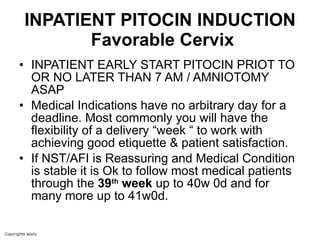
INPATIENT PITOCIN INDUCTION  Favorable Cervix Patient is to arrive early enough so that she can be admitted , IV started, and  Pitocin induction started no later than 0700.  The best way to ensure this  will be to have the  P atient arrive no later than 06000 AM and clearly communicate with the Nursing staff that you desire the Pitocin Started as early as possible.  ACTIVELY MANAGE   Perform early   amniotomy  in patients with a  favorable cervix  either simultaneously with  starting the Pitocin  or ASAP 2)  This  will increase the likelihood that the  Doctor or CNM who is scheduling  the inpatient induction may be  present   for the delivery.  If the cervix is favorable ( Modified Bishop Score 6 including cervical dilation of 3-4 cm for Nulliparous) vaginal delivery will occur within 12 hours in the majority of patients.
INPATIENT PITOCIN INDUCTION  Favorable Cervix INPATIENT EARLY START PITOCIN PRIOT TO OR NO LATER THAN 7 AM / AMNIOTOMY ASAP Medical Indications have no arbitrary day for a deadline. Most commonly you will have the flexibility of a delivery “week “ to work with achieving good etiquette & patient satisfaction. If NST/AFI is Reassuring and Medical Condition is stable it is Ok to follow most medical patients  through the  39 th  week  up to 40w 0d and for many more up to 41w0d.
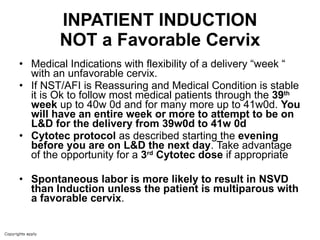
INPATIENT INDUCTION NOT a Favorable Cervix Medical Indications with flexibility of a delivery “week “ with an unfavorable cervix. If NST/AFI is Reassuring and Medical Condition is stable it is Ok to follow most medical patients through the  39 th  week  up to 40w 0d and for many more up to 41w0d.  You will have an entire week or more to attempt to be on L&D for the delivery from 39w0d to 41w 0d Cytotec protocol  as described starting the  evening before you are on L&D the next day . Take advantage of the opportunity for a  3 rd  Cytotec dose  if appropriate Spontaneous labor is more likely to result in NSVD than Induction unless the patient is multiparous with a favorable cervix .
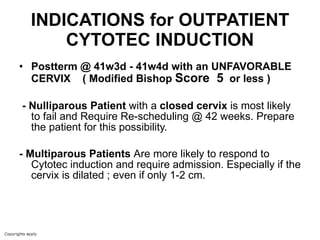
INDICATIONS for OUTPATIENT CYTOTEC INDUCTION Postterm @ 41w3d - 41w4d with an UNFAVORABLE CERVIX  ( Modified Bishop  Score  5   or less ) - Nulliparous Patient  with a  closed cervix  is most likely to fail and Require Re-scheduling @ 42 weeks. Prepare the patient for this possibility. - Multiparous Patients  Are   more likely to respond to Cytotec induction and require admission. Especially if the cervix is dilated ; even if only 1-2 cm.
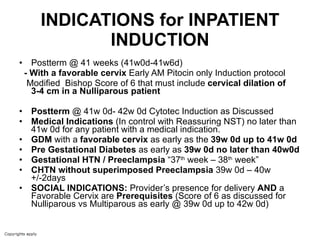
INDICATIONS for INPATIENT INDUCTION Postterm @ 41 weeks (41w0d-41w6d) - With a favorable cervix  Early AM Pitocin only Induction protocol Modified  Bishop Score of 6 that must include  cervical dilation of 3-4 cm in a Nulliparous patient Postterm  @ 41w 0d- 42w 0d Cytotec Induction as Discussed  Medical Indications  (In control with Reassuring NST) no later than 41w 0d for any patient with a medical indication. GDM  with a  favorable cervix  as early as the  39w 0d up to 41w 0d   Pre Gestational Diabetes  as early as  39w 0d no later than 40w0d Gestational HTN / Preeclampsia  “37 th  week – 38 th  week” CHTN without superimposed Preeclampsia  39w 0d – 40w +/-2days SOCIAL INDICATIONS:  Provider’s presence for delivery  AND  a Favorable Cervix are  Prerequisites  (Score of 6 as discussed for Nulliparous vs Multiparous as early @ 39w 0d up to 42w 0d)
Indications for a CST  Prior to Induction CONSIDER PROLONGED CST(60 minutes contractions q 2-3 ) Including but not limited to Patients with Unstable Maternal Medical Condition OR IUGR  OR  ? AFI < 5 ? May be a Candidate for Cytotec Induction if CST Negative Reactive May be a Candidate for Foley Bulb OR Pitocin Only Induction if CST Equivocal Reactive dependent on Modified Bishop Score Cervidil NOT RECOMMENDED Low threshold to obtain an EFW by ultrasound prior to induction if no EFW in the last 2-3 weeks especially if Fundal Height is suspicious IUGR with an EFW </= 10 % tile may be a relative contraindication for induction dependent on the clinical situation ie consider:  Modified Bishop Score, Parity, Estimated time to Delivery, Maternal Medical condition, Degree of IUGR )  AFI < / = 5 cm is not a contraindication for Induction; However may be associated with an increased risk for C/S for fetal Indications.
RIVERSIDE OUTPATIENT CYTOTEC GUIDELINES OUTPATIENT INDUCTION  Our goal is to ensure delivery of a healthy baby without increasing the Cesarean Section Rate. Key to successful implementation will be to start outpatient inductions in a timely fashion and follow our protocol with as little modification as possible.  The revised protocol is an attempt to achieve two goals. A   safer and more successful induction  for the mother & baby 2)  Facilitate a  final decision regarding admission or discharge prior to 8:30 AM  the following morning by the  same provider who initially managed the patient.   (Warm hand-off / decision including the oncoming OB 1 &/Or Board rounds may be appropriate for some)  Patients who are discharged home are to return @ 42 0/7 +/- 1 day for an inpatient induction.
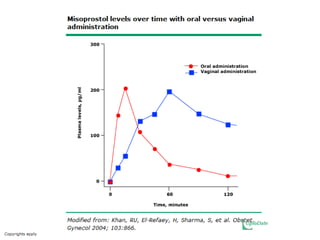
RIVERSIDE CYTOTEC GUIDELINES Patients arrive @ 7:30 PM . Initial Cytotec dose is  25  micrograms placed  Intravaginal  followed by Either: 50   micrograms   PO  with a  6  hour interval  OR  25 microgram intravaginal  dose within a  4-6  hour interval AND IF APPROPRIATTE An  Opportunity  for 3 rd  dose by either route. Most important for an IP Cytotec induction. If you are planning to attempt a 3 rd  dose based on the Modified Bishop Score on arrival strongly consider and plan for 3 Intravaginal doses allowing Pitocin start ASAP ( no closer than 4 hours ) from a previous intravaginal dose. The pharmacokinetics of a PO dose have a higher peak concentration within a shorter time frame and a shorter duration of action than the intravaginal dose. The tail end of a previous intravaginal dose may act synergistically with an early onset peak of a subsequent PO dose increasing the probability of uterine hyperstimulation.  See Pharmacokinetics graph
 
RIVERSIDE OP CYTOTEC GUIDELINES   2nd dose of Cytotec If During the 5 th   hour of the 6 hour trial period after the intravaginal 25 microgram Cytotec:  Nurse may administer a 50 microgram PO dose of Cytotec without notifying the provider if the following criteria are met 1)  Contractions occurring every 5 minutes or further apart  2)  Contraction Strength mild-moderate intensity  (not requiring pain meds)  3)  Category 1 fetal heart tones present throughout the trial   OR   The provider may choose a 4 hour interval with a second intravaginal dose
RIVERSIDE OP CYTOTEC GUIDELINES   2nd dose of Cytotec If   at any time after the first dose of the intravaginal 25 microgram Cytotec  Contractions are painful ( requiring pain medication ) OR category 2 fetal heart rate pattern is present OR SROM occurs the provider is to be notified @ that time.  IN THIS SITUATION ONE OF  3 CHOICES  MUST BE MADE NOW 1)  Admission is mandatory for category 2 FHT or SROM SROM mandates 2 nd  4hr interval dose of vaginal Cytotec OR Pitocin start @ 4 hours from last Cytotec dose 2)  Pitocin induction/augmentation with amniotomy ASAP OR placement of intrauterine Foley bulb. Either requires MANDATORY ADMISSION  3)  Additional dose of Intravaginal or PO Cytotec as an outpatient no later than 6 hours from the first dose of Cytotec 4)Continued monitoring for spontaneous labor is NOT AN OPTION
“ POP & PIT “ Amniotomy as Soon As Possible  A Cochrane review of randomized trials found the combination of  amniotomy plus intravenous   oxytocin  administration was more effective than either alone. With the combined regimen, fewer women were undelivered at 24 hours than with amniotomy alone RR 0.13 and C/S rate was reduced with both RR 0.88 IMMEDIATE   Oxytocin  with  Amniotomy  compared to DELAYE of either results in  FASTER  establishment of labor SHORTER  time to delivery LOWER C/S RATE MORE maternal satisfaction Arch Gynecol Obstet. 2009 Jun;279(6):813-20  Cochrane Database Syst Rev. 2009
RIVERSIDE OP CYTOTEC GUIDELINES Patients who are discharged home are to return @ 42 0/7 +/- 1 day for an inpatient induction and also be within 3-4 days of the outpatient failed induction N0 interval NST is indicated if a &quot; reassuring FHT tracing &quot; is present after failed attempt at outpatient induction.   If you are concerned regarding any clinical information that became apparent during the outpatient induction ; ADMIT THE PATIENT and continue with 2 day induction or C/S.  A history of Previous postpartum hemorrhage , current EFW =/>4000 grams,  Grand Multiparity ( 5 previous deliveries), and history of previous difficult delivery may all increase the risk associated with induction.
Why a Foley Bulb Induction As Effective as Cytotec and Probably safer   Uterine contractile abnormalities and meconium passage are more common with misoprostol. Intravaginal misoprostol and transcervical Foley catheter are equivalent for cervical ripening. Obstet Gynecol 2001 Apr;97(4):603-7.  The shortest mean induction-to-delivery interval was obtained with the Foley vs prostaglandins  ( 12.9 hours versus ~ 17 hours ). Induction of labor with a transcervical balloon catheter is effective and safe and can be recommended as the first choice. BJOG. 2008 Oct;115(11):1443-50.  Intravaginal misoprostol and intracervical Foley catheter are comparable for preinduction cervical ripening. Am J Obstet Gynecol 2003 Oct;189(4):1031-5  In conclusion, the maternal and perinatal outcomes in this study have shown no difference confirming the efficacy and safety of either Foley catheter induction or misoprostol. J Obstet Gynaecol. 2005 Aug;25(6):565
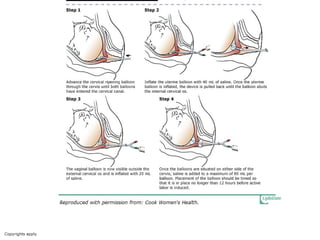
HOW TO PLACE a FOLEY BULB   Foley catheter (#16-#18 tip removal optional) and @ least a 30 mL balloon). The catheter may be inserted under direct visualization into the extra amniotic  space using a sterile speculum after cleaning the cervix with antiseptic solution. If dilated or favorable enough may consider digital insertion. Ring forceps may be used to facilitate passage of the Foley through the internal os. If necessary ultrasound can ensure the Foley is in the extra amniotic space. The balloon should be distended with saline  (@ least   60 ml  and  up to   80 ml )  with subsequent gentle traction applied so that the distended bulb is applied to the internal os. Either attach one liter of fluid to the end of the catheter and suspend it from the end of the bed OR apply moderate traction and secure the Foley with tape to the patients thigh. Foley placement is possible  even if the cervix is not dilated.  If it is difficult to pass the Foley, a uterine sound can be used to facilitate placement; OR a urologic sound can be placed inside the Foley catheter and used as a “guide wire” to direct placement.  The Foley is left in place until it is extruded (typically within 12 hours). Consideration for removal should be made if spontaneous rupture of membranes occurs while the Foley is in place. I am recommending  removal @ 12 hours  if spontaneous expulsion has not occurred @ that time. There is no consistent increase risk of infection following the above protocol Contraindications  :  SROM prior to or with placement of Foley bulb, Placental edge with 2 cm of the internal os, Intraamniotic infection, Active labor ( painful & persistent contractions every 3 minutes or less ) Cochrane Database Syst Rev 2001 Am J Obstet Gynecol 2004 Nov;191(5):1632 Obstet Gynecol 2010;115:1239
 
Foley Bulb Placement  Commits the patient to Delivery Do NOT discharge a patient to home after placement of a Foley Bulb in the extra amniotic Space. The safety of this practice has not been studied. Prior to placement of a Foley Bulb discuss with the patient the possibility of a 2 day induction dependent on Modified Bishop Score
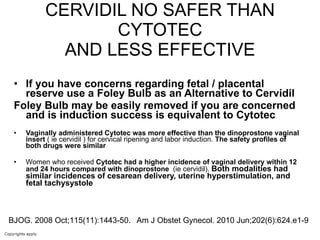
CERVIDIL NO SAFER THAN CYTOTEC AND LESS EFFECTIVE If you have concerns regarding fetal / placental reserve use a Foley Bulb as an Alternative to Cervidil Foley Bulb may be easily removed if you are concerned and is induction success is equivalent to Cytotec Vaginally administered Cytotec was more effective than the dinoprostone vaginal insert  ( ie cervidil ) for cervical ripening and labor induction.  The safety profiles of both drugs were similar Women who received  Cytotec had a higher incidence of vaginal delivery within 12 and 24 hours compared with dinoprostone   (ie cervidil).  Both modalities had similar incidences of cesarean delivery, uterine hyperstimulation, and fetal tachysystole Am J Obstet Gynecol. 2010 Jun;202(6):624.e1-9 BJOG. 2008 Oct;115(11):1443-50.
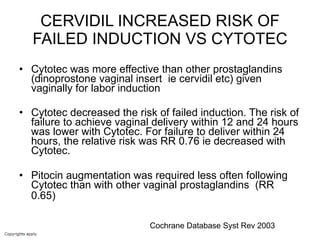
CERVIDIL INCREASED RISK OF FAILED INDUCTION VS CYTOTEC Cytotec was more effective than other prostaglandins  (dinoprostone vaginal insert  ie cervidil etc) given vaginally for labor induction Cytotec decreased the risk of failed induction. The risk of failure to achieve vaginal delivery within 12 and 24 hours was lower with Cytotec. For failure to deliver within 24 hours, the relative risk was RR 0.76 ie decreased with Cytotec.  Pitocin augmentation was required less often following Cytotec than with other vaginal prostaglandins  (RR 0.65)   Cochrane Database Syst Rev 2003
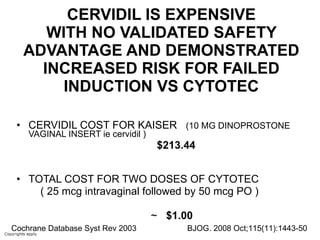
CERVIDIL IS EXPENSIVE WITH NO VALIDATED SAFETY ADVANTAGE AND DEMONSTRATED INCREASED RISK FOR FAILED INDUCTION VS CYTOTEC CERVIDIL COST FOR KAISER  (10 MG DINOPROSTONE VAGINAL INSERT ie cervidil ) $213.44   TOTAL COST FOR TWO DOSES OF CYTOTEC  ( 25 mcg intravaginal followed by 50 mcg PO ) ~  $1.00 Cochrane Database Syst Rev 2003 BJOG. 2008 Oct;115(11):1443-50
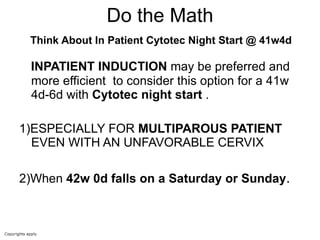
Do the Math   Think About In Patient Cytotec Night Start @ 41w4d   INPATIENT   INDUCTION  may be preferred and more efficient  to consider this option for a 41w 4d-6d with  Cytotec night start  .  1)ESPECIALLY FOR  MULTIPAROUS PATIENT  EVEN WITH AN UNFAVORABLE CERVIX 2)When  42w 0d falls on a Saturday or Sunday .
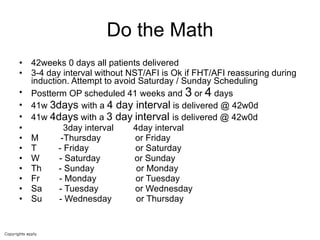
Do the Math 42weeks 0 days all patients delivered  3-4 day interval without NST/AFI is Ok if FHT/AFI reassuring during induction. Attempt to avoid Saturday / Sunday Scheduling  Postterm OP scheduled 41 weeks and  3  or  4  days  41w  3days  with a  4 day interval  is delivered @ 42w0d  41w  4days  with a  3 day   interval  is delivered @ 42w0d 3day interval  4day interval  M  -Thursday  or Friday T  - Friday  or Saturday  W  - Saturday  or Sunday Th  - Sunday  or Monday Fr  - Monday  or Tuesday Sa  - Tuesday  or Wednesday Su  - Wednesday  or Thursday

Guidelines for induction

  • 1.
    GUIDELINES for INDUCTION MODIFIED BISHOP SCORE INDUCTION ETIQUETTE WHAT ARE THE REVISED GUIDELINES CYTOTEC PHARMACOKINETICS ACTIVE MANAGEMENT INPATIENT vs OUTPATIENT HOW TO USE A FOLEY BULB CERVIDIL NOT RECOMMENDED
  • 2.
    MODIFIED BISHOP SCOREONLY 3 VARIABLES Positive Predictive Value for Delivery Equals or Exceeds Original 5 variable Bishop Score CERVICAL DILATION IS THE STRONGEST PREDICTOR AND CARRIES DOUBLE WEIGHT Obstet Gynecol 1982;60:137
  • 3.
    MODIFIED BISHOP SCOREBEST PPV FOR DELIVERY The Modified Bishop score appears to be the best available tool for predicting the likelihood that induction will result in vaginal delivery. This conclusion is based on systematic reviews of controlled studies that found the Bishop score was as, or more, predictive of the outcome of labor induction Compared to fFN   Compared to sonographic measurement of cervical length CERVICAL DILATATION IS THE MOST PREDICTIVE VARIABLE IN THE SCORING SYSTEM.
  • 4.
    DILATION SCORE0 0 cm 2 1-2 cm 4 3-4 cm 6 >4 cm CERVICAL LENGTH SCORE By digital PALPATION 0 3 cm 1 2 cm 2 1 cm 3 0 cm STATION SCORE In relation to spines 0 -3 1 -2 2 -1/O 3 + 1/+2
  • 5.
    Favorable Cervix isscore of 6 For Nulliparous cervix should also be 3-4 cm for Pitocin Induction Bishop Score of < 5 is associated with an increased risk for a 2 day induction and ~ Doubles the Risk of Cesarean Section - Most dependent on whether the cervix is dilated Am J Obstet Gynecol 2003 Jun;188(6):1565-9
  • 6.
    “ POP &PIT “ Amniotomy as Soon As Possible A Cochrane review of randomized trials found the combination of amniotomy plus intravenous oxytocin  administration was more effective than either alone. With the combined regimen, fewer women were undelivered at 24 hours than with amniotomy alone RR 0.13 and C/S rate was reduced with both RR 0.88 IMMEDIATE Oxytocin  with Amniotomy compared to DELAYE of either results in FASTER establishment of labor SHORTER time to delivery LOWER C/S RATE MORE maternal satisfaction Arch Gynecol Obstet. 2009 Jun;279(6):813-20 Cochrane Database Syst Rev. 2009
  • 7.
    DO NOT USECYTOTEC WITH A FAVORABLE CERVIX In women with favorable cervices undergoing labor induction, Cytotec did not result in better outcomes than intravenous oxytocin . Cytotec was associated with a higher frequency of tachysystole and failure to deliver vaginally within 24 hours.                 Am J Obstet Gynecol 2004 Jun;190(6):1689-94
  • 8.
    INDUCTION ETIQUETTE Itis not preferred to attempt scheduling an induction on an E xact day OR Arbitrary deadline unless you are on L&D in an attempt to be present for Delivery. Most medically indicated inductions are associated with @ least a week or more in which the patient should be delivered. Ie 39 th week up to 40w 6d VS 39w 0d Remember to be considerate of your partners / CNM associates and try to schedule inductions when you are on, especially if it is an inpatient induction . If you are not on L&D call your partner / CNM associate who is on and request the favor of caring for your patient. L&D has more Anesthesiology providers available Monday through Friday vs Weekends. If you are attempting to schedule an induction on the weekend because you are on make sure that Anesthesiology / L&D Staff are aware.
  • 9.
    INPATIENT INDUCTION Etiquette& Wisdom A note describing the Risk / Benefit / Indications for Medical Induction Should be placed under the Clinician Notes on the Patients Chart. Physicians who you discussed the case with and whether or not consultation with MFM was obtained should be included. Patients who want amniotomy first without Pitocin and / or request to walk first without Pitocin in the hopes that the normal contractions that are invariably present @ term will result in &quot; natural labor &quot; without immediate Pitocin start require further counseling & Documentation re IUFD / C/S risk NOT CANDIDATES FOR A 41 WEEK POSTTERM INDUCTION. Schedule @ 42w0d +/- 1 day IF MEDICAL INDUCTION IS INDICATED THIS IS NOT ACCEPTABLE
  • 10.
    What are theChanges ARRIVE EARLIER Out Patient and In Patient CYTOTEC INDUCTIONS all scheduled to ARRIVE @ 7:30 PM This will facilitate a decision re Admission/Discharge prior to 8:30 AM the following morning This will provide the opportunity for an In Patient Induction admitted the night before for Cytotec the opportunity for additional Cytotec dosing if appropriate AND more time for cervical ripening During board rounds @ 5:30 PM a discussion between the OB 1 & 2 regarding the status of L&D and whether or not the inductions ( 2 max of 3) can arrive @ 7:30 PM OR if the Patient is to call back later @ a time To Be Determined by the OB 1 & 2 for arrival as early as it appears reasonable. The decision made by the OB 1 & 2 will then be discussed with the charge nurse prior to the patient calling @ 6 PM to have their scheduled 7:30 PM arrival time approved. 2) In Patient Pitocin only induction ARRIVES @ 0600 in an effort to start Pitocin Induction prior to 7 AM .
  • 11.
    What are theChanges ACTIVELY MANAGE ACTIVE MANAGEMENT OF INDUCTION - Consider 3rd dose of Cytotec Intravaginal 3 (25 mcg doses Q 4 hours) Most EFFECTIVE ie less failed inductions vs PO dosing Intravaginal 3 (25 mcg doses Q 4 hours) More EFFICIENT vs PO dosing regarding a goal of starting Pitocin ASAP. - Consider Foley Bulb as an alternative to Cytotec, which has been validated to be as effective as Cytotec regarding successful induction; May be associated with less hyperstimulation & meconium passage ?safer?. Definitely a better alternative than Cervidil in a patient that you may be concerned has “ marginal placental / fetal reserve”. ACTIVE MANAGEMENT OF LABOR ( “POP & Pit”) Validated to Lower the C/S rate and shorten duration of labor Cochrane Database Syst Rev. 2009 Cochrane Database Syst Rev 2001;(2): Am J Obstet Gynecol 2003 Oct;189(4):1031-5
  • 12.
    INPATIENT PITOCIN INDUCTION Favorable Cervix Patient is to arrive early enough so that she can be admitted , IV started, and Pitocin induction started no later than 0700. The best way to ensure this will be to have the P atient arrive no later than 06000 AM and clearly communicate with the Nursing staff that you desire the Pitocin Started as early as possible. ACTIVELY MANAGE Perform early amniotomy in patients with a favorable cervix either simultaneously with starting the Pitocin or ASAP 2) This will increase the likelihood that the Doctor or CNM who is scheduling the inpatient induction may be present for the delivery. If the cervix is favorable ( Modified Bishop Score 6 including cervical dilation of 3-4 cm for Nulliparous) vaginal delivery will occur within 12 hours in the majority of patients.
  • 13.
    INPATIENT PITOCIN INDUCTION Favorable Cervix INPATIENT EARLY START PITOCIN PRIOT TO OR NO LATER THAN 7 AM / AMNIOTOMY ASAP Medical Indications have no arbitrary day for a deadline. Most commonly you will have the flexibility of a delivery “week “ to work with achieving good etiquette & patient satisfaction. If NST/AFI is Reassuring and Medical Condition is stable it is Ok to follow most medical patients through the 39 th week up to 40w 0d and for many more up to 41w0d.
  • 14.
    INPATIENT INDUCTION NOTa Favorable Cervix Medical Indications with flexibility of a delivery “week “ with an unfavorable cervix. If NST/AFI is Reassuring and Medical Condition is stable it is Ok to follow most medical patients through the 39 th week up to 40w 0d and for many more up to 41w0d. You will have an entire week or more to attempt to be on L&D for the delivery from 39w0d to 41w 0d Cytotec protocol as described starting the evening before you are on L&D the next day . Take advantage of the opportunity for a 3 rd Cytotec dose if appropriate Spontaneous labor is more likely to result in NSVD than Induction unless the patient is multiparous with a favorable cervix .
  • 15.
    INDICATIONS for OUTPATIENTCYTOTEC INDUCTION Postterm @ 41w3d - 41w4d with an UNFAVORABLE CERVIX ( Modified Bishop Score 5 or less ) - Nulliparous Patient with a closed cervix is most likely to fail and Require Re-scheduling @ 42 weeks. Prepare the patient for this possibility. - Multiparous Patients Are more likely to respond to Cytotec induction and require admission. Especially if the cervix is dilated ; even if only 1-2 cm.
  • 16.
    INDICATIONS for INPATIENTINDUCTION Postterm @ 41 weeks (41w0d-41w6d) - With a favorable cervix Early AM Pitocin only Induction protocol Modified Bishop Score of 6 that must include cervical dilation of 3-4 cm in a Nulliparous patient Postterm @ 41w 0d- 42w 0d Cytotec Induction as Discussed Medical Indications (In control with Reassuring NST) no later than 41w 0d for any patient with a medical indication. GDM with a favorable cervix as early as the 39w 0d up to 41w 0d Pre Gestational Diabetes as early as 39w 0d no later than 40w0d Gestational HTN / Preeclampsia “37 th week – 38 th week” CHTN without superimposed Preeclampsia 39w 0d – 40w +/-2days SOCIAL INDICATIONS: Provider’s presence for delivery AND a Favorable Cervix are Prerequisites (Score of 6 as discussed for Nulliparous vs Multiparous as early @ 39w 0d up to 42w 0d)
  • 17.
    Indications for aCST Prior to Induction CONSIDER PROLONGED CST(60 minutes contractions q 2-3 ) Including but not limited to Patients with Unstable Maternal Medical Condition OR IUGR OR ? AFI < 5 ? May be a Candidate for Cytotec Induction if CST Negative Reactive May be a Candidate for Foley Bulb OR Pitocin Only Induction if CST Equivocal Reactive dependent on Modified Bishop Score Cervidil NOT RECOMMENDED Low threshold to obtain an EFW by ultrasound prior to induction if no EFW in the last 2-3 weeks especially if Fundal Height is suspicious IUGR with an EFW </= 10 % tile may be a relative contraindication for induction dependent on the clinical situation ie consider: Modified Bishop Score, Parity, Estimated time to Delivery, Maternal Medical condition, Degree of IUGR ) AFI < / = 5 cm is not a contraindication for Induction; However may be associated with an increased risk for C/S for fetal Indications.
  • 18.
    RIVERSIDE OUTPATIENT CYTOTECGUIDELINES OUTPATIENT INDUCTION Our goal is to ensure delivery of a healthy baby without increasing the Cesarean Section Rate. Key to successful implementation will be to start outpatient inductions in a timely fashion and follow our protocol with as little modification as possible. The revised protocol is an attempt to achieve two goals. A safer and more successful induction for the mother & baby 2) Facilitate a final decision regarding admission or discharge prior to 8:30 AM the following morning by the same provider who initially managed the patient. (Warm hand-off / decision including the oncoming OB 1 &/Or Board rounds may be appropriate for some) Patients who are discharged home are to return @ 42 0/7 +/- 1 day for an inpatient induction.
  • 19.
    RIVERSIDE CYTOTEC GUIDELINESPatients arrive @ 7:30 PM . Initial Cytotec dose is 25 micrograms placed Intravaginal followed by Either: 50 micrograms PO with a 6 hour interval OR 25 microgram intravaginal dose within a 4-6 hour interval AND IF APPROPRIATTE An Opportunity for 3 rd dose by either route. Most important for an IP Cytotec induction. If you are planning to attempt a 3 rd dose based on the Modified Bishop Score on arrival strongly consider and plan for 3 Intravaginal doses allowing Pitocin start ASAP ( no closer than 4 hours ) from a previous intravaginal dose. The pharmacokinetics of a PO dose have a higher peak concentration within a shorter time frame and a shorter duration of action than the intravaginal dose. The tail end of a previous intravaginal dose may act synergistically with an early onset peak of a subsequent PO dose increasing the probability of uterine hyperstimulation. See Pharmacokinetics graph
  • 20.
  • 21.
    RIVERSIDE OP CYTOTECGUIDELINES 2nd dose of Cytotec If During the 5 th hour of the 6 hour trial period after the intravaginal 25 microgram Cytotec: Nurse may administer a 50 microgram PO dose of Cytotec without notifying the provider if the following criteria are met 1) Contractions occurring every 5 minutes or further apart 2) Contraction Strength mild-moderate intensity (not requiring pain meds) 3) Category 1 fetal heart tones present throughout the trial OR The provider may choose a 4 hour interval with a second intravaginal dose
  • 22.
    RIVERSIDE OP CYTOTECGUIDELINES 2nd dose of Cytotec If at any time after the first dose of the intravaginal 25 microgram Cytotec Contractions are painful ( requiring pain medication ) OR category 2 fetal heart rate pattern is present OR SROM occurs the provider is to be notified @ that time. IN THIS SITUATION ONE OF 3 CHOICES MUST BE MADE NOW 1) Admission is mandatory for category 2 FHT or SROM SROM mandates 2 nd 4hr interval dose of vaginal Cytotec OR Pitocin start @ 4 hours from last Cytotec dose 2) Pitocin induction/augmentation with amniotomy ASAP OR placement of intrauterine Foley bulb. Either requires MANDATORY ADMISSION 3) Additional dose of Intravaginal or PO Cytotec as an outpatient no later than 6 hours from the first dose of Cytotec 4)Continued monitoring for spontaneous labor is NOT AN OPTION
  • 23.
    “ POP &PIT “ Amniotomy as Soon As Possible A Cochrane review of randomized trials found the combination of amniotomy plus intravenous oxytocin  administration was more effective than either alone. With the combined regimen, fewer women were undelivered at 24 hours than with amniotomy alone RR 0.13 and C/S rate was reduced with both RR 0.88 IMMEDIATE Oxytocin  with Amniotomy compared to DELAYE of either results in FASTER establishment of labor SHORTER time to delivery LOWER C/S RATE MORE maternal satisfaction Arch Gynecol Obstet. 2009 Jun;279(6):813-20 Cochrane Database Syst Rev. 2009
  • 24.
    RIVERSIDE OP CYTOTECGUIDELINES Patients who are discharged home are to return @ 42 0/7 +/- 1 day for an inpatient induction and also be within 3-4 days of the outpatient failed induction N0 interval NST is indicated if a &quot; reassuring FHT tracing &quot; is present after failed attempt at outpatient induction. If you are concerned regarding any clinical information that became apparent during the outpatient induction ; ADMIT THE PATIENT and continue with 2 day induction or C/S. A history of Previous postpartum hemorrhage , current EFW =/>4000 grams, Grand Multiparity ( 5 previous deliveries), and history of previous difficult delivery may all increase the risk associated with induction.
  • 25.
    Why a FoleyBulb Induction As Effective as Cytotec and Probably safer Uterine contractile abnormalities and meconium passage are more common with misoprostol. Intravaginal misoprostol and transcervical Foley catheter are equivalent for cervical ripening. Obstet Gynecol 2001 Apr;97(4):603-7. The shortest mean induction-to-delivery interval was obtained with the Foley vs prostaglandins ( 12.9 hours versus ~ 17 hours ). Induction of labor with a transcervical balloon catheter is effective and safe and can be recommended as the first choice. BJOG. 2008 Oct;115(11):1443-50. Intravaginal misoprostol and intracervical Foley catheter are comparable for preinduction cervical ripening. Am J Obstet Gynecol 2003 Oct;189(4):1031-5 In conclusion, the maternal and perinatal outcomes in this study have shown no difference confirming the efficacy and safety of either Foley catheter induction or misoprostol. J Obstet Gynaecol. 2005 Aug;25(6):565
  • 26.
    HOW TO PLACEa FOLEY BULB Foley catheter (#16-#18 tip removal optional) and @ least a 30 mL balloon). The catheter may be inserted under direct visualization into the extra amniotic space using a sterile speculum after cleaning the cervix with antiseptic solution. If dilated or favorable enough may consider digital insertion. Ring forceps may be used to facilitate passage of the Foley through the internal os. If necessary ultrasound can ensure the Foley is in the extra amniotic space. The balloon should be distended with saline (@ least 60 ml and up to 80 ml ) with subsequent gentle traction applied so that the distended bulb is applied to the internal os. Either attach one liter of fluid to the end of the catheter and suspend it from the end of the bed OR apply moderate traction and secure the Foley with tape to the patients thigh. Foley placement is possible even if the cervix is not dilated. If it is difficult to pass the Foley, a uterine sound can be used to facilitate placement; OR a urologic sound can be placed inside the Foley catheter and used as a “guide wire” to direct placement. The Foley is left in place until it is extruded (typically within 12 hours). Consideration for removal should be made if spontaneous rupture of membranes occurs while the Foley is in place. I am recommending removal @ 12 hours if spontaneous expulsion has not occurred @ that time. There is no consistent increase risk of infection following the above protocol Contraindications : SROM prior to or with placement of Foley bulb, Placental edge with 2 cm of the internal os, Intraamniotic infection, Active labor ( painful & persistent contractions every 3 minutes or less ) Cochrane Database Syst Rev 2001 Am J Obstet Gynecol 2004 Nov;191(5):1632 Obstet Gynecol 2010;115:1239
  • 27.
  • 28.
    Foley Bulb Placement Commits the patient to Delivery Do NOT discharge a patient to home after placement of a Foley Bulb in the extra amniotic Space. The safety of this practice has not been studied. Prior to placement of a Foley Bulb discuss with the patient the possibility of a 2 day induction dependent on Modified Bishop Score
  • 29.
    CERVIDIL NO SAFERTHAN CYTOTEC AND LESS EFFECTIVE If you have concerns regarding fetal / placental reserve use a Foley Bulb as an Alternative to Cervidil Foley Bulb may be easily removed if you are concerned and is induction success is equivalent to Cytotec Vaginally administered Cytotec was more effective than the dinoprostone vaginal insert ( ie cervidil ) for cervical ripening and labor induction. The safety profiles of both drugs were similar Women who received Cytotec had a higher incidence of vaginal delivery within 12 and 24 hours compared with dinoprostone (ie cervidil). Both modalities had similar incidences of cesarean delivery, uterine hyperstimulation, and fetal tachysystole Am J Obstet Gynecol. 2010 Jun;202(6):624.e1-9 BJOG. 2008 Oct;115(11):1443-50.
  • 30.
    CERVIDIL INCREASED RISKOF FAILED INDUCTION VS CYTOTEC Cytotec was more effective than other prostaglandins (dinoprostone vaginal insert ie cervidil etc) given vaginally for labor induction Cytotec decreased the risk of failed induction. The risk of failure to achieve vaginal delivery within 12 and 24 hours was lower with Cytotec. For failure to deliver within 24 hours, the relative risk was RR 0.76 ie decreased with Cytotec. Pitocin augmentation was required less often following Cytotec than with other vaginal prostaglandins (RR 0.65) Cochrane Database Syst Rev 2003
  • 31.
    CERVIDIL IS EXPENSIVEWITH NO VALIDATED SAFETY ADVANTAGE AND DEMONSTRATED INCREASED RISK FOR FAILED INDUCTION VS CYTOTEC CERVIDIL COST FOR KAISER (10 MG DINOPROSTONE VAGINAL INSERT ie cervidil ) $213.44 TOTAL COST FOR TWO DOSES OF CYTOTEC ( 25 mcg intravaginal followed by 50 mcg PO ) ~ $1.00 Cochrane Database Syst Rev 2003 BJOG. 2008 Oct;115(11):1443-50
  • 32.
    Do the Math Think About In Patient Cytotec Night Start @ 41w4d INPATIENT INDUCTION may be preferred and more efficient to consider this option for a 41w 4d-6d with Cytotec night start . 1)ESPECIALLY FOR MULTIPAROUS PATIENT EVEN WITH AN UNFAVORABLE CERVIX 2)When 42w 0d falls on a Saturday or Sunday .
  • 33.
    Do the Math42weeks 0 days all patients delivered 3-4 day interval without NST/AFI is Ok if FHT/AFI reassuring during induction. Attempt to avoid Saturday / Sunday Scheduling Postterm OP scheduled 41 weeks and 3 or 4 days 41w 3days with a 4 day interval is delivered @ 42w0d 41w 4days with a 3 day interval is delivered @ 42w0d 3day interval 4day interval M -Thursday or Friday T - Friday or Saturday W - Saturday or Sunday Th - Sunday or Monday Fr - Monday or Tuesday Sa - Tuesday or Wednesday Su - Wednesday or Thursday