INDUCTION OF LABOUR
Dr. Ei Shwe Syn
JC
CWH
Learning Objectives
1) List common indications and contraindications for
induction of labor
2) Describe methods available for labor induction
3) Understand appropriate use of each method of
induction
4) Discuss challenges faced with labor induction
What is IOL?
Definition
Artificial stimulation of uterine
contractions before spontaneous onset of
labour with the purpose of accomplishing
successful vaginal delivery
Augmentation
Augmentation is the process of stimulation of the uterine
contraction that are already present but found to be
inadequate.
Indication
 IOL is indicated when:
 The benefits of delivery to the mother or fetus outweighs
those of continuing the pregnancy.
MATERNAL
 Post-term pregnancy
 PROM
 Preeclampsia, eclampsia
 Abruptio placenta
 Chorioamnionitis
 Medical conditions-
DM,Heart ds, Renal
ds,Chr. HT etc
FETAL
 IUFD
 Fetal anomaly
incompatible with life
 Severe IUGR without Fetal
compromise
 Rh isoimmunisation
 Macrosomia
Indications
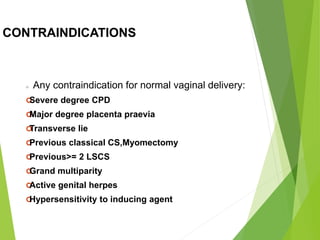
CONTRAINDICATIONS
Any contraindication for normal vaginal delivery:

Severe degree CPD

Major degree placenta praevia

Transverse lie

Previous classical CS,Myomectomy

Previous>= 2 LSCS

Grand multiparity

Active genital herpes

Hypersensitivity to inducing agent

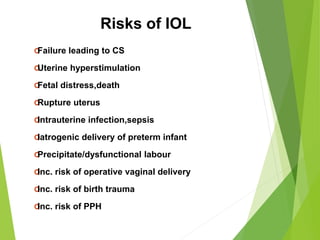
Failure leading to CS

Uterine hyperstimulation

Fetal distress,death

Rupture uterus

Intrauterine infection,sepsis

Iatrogenic delivery of preterm infant

Precipitate/dysfunctional labour

Inc. risk of operative vaginal delivery

Inc. risk of birth trauma

Inc. risk of PPH
Risks of IOL
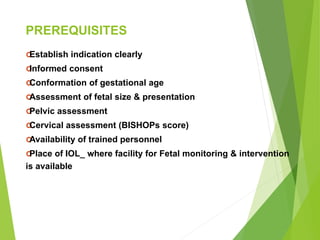
PREREQUISITES

Establish indication clearly

Informed consent

Conformation of gestational age

Assessment of fetal size & presentation

Pelvic assessment

Cervical assessment (BISHOPs score)

Availability of trained personnel

Place of IOL_ where facility for Fetal monitoring & intervention
is available
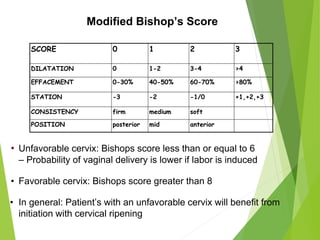
SCORE 0 1 2 3
DILATATION 0 1-2 3-4 >4
EFFACEMENT 0-30% 40-50% 60-70% >80%
STATION -3 -2 -1/0 +1,+2,+3
CONSISTENCY firm medium soft
POSITION posterior mid anterior
Modified Bishop’s Score
• Unfavorable cervix: Bishops score less than or equal to 6
– Probability of vaginal delivery is lower if labor is induced
• Favorable cervix: Bishops score greater than 8
• In general: Patient’s with an unfavorable cervix will benefit from
initiation with cervical ripening
NATURAL
Breast/nipple stimulation
Sexual intercourse
Membrane stripping
Amniotomy
Acupuncture
MECHANICAL
Balloon catheters
Lamineria tents
Synthetic osmotic dilators
CHEMICAL
NONHORMONAL
Herbs,evening primrose oil
Homeopathic prep
Enemas
Castor oil
HORMONAL
Oxytocin
Prostaglandins –
PGE2,Misoprostol
Relaxin
Nitric oxide donors
mifepristone
Methods for Induction
Stripping of the Membranes
Stripping of the membranes causes an increase in the
activity of phospholipase and prostaglandin as well as causing
mechanical dilation of the cervix, which releases
prostaglandins.
The membranes are stripped by inserting the examining
finger through the internal cervical os and moving it in a
circular direction to detach the inferior pole of the
membranes from the lower uterine segment.
Risks of this technique include:
infection,
bleeding,
accidental rupture of the membranes,
 patient discomfort
Increased likelihood of spontaneous labor in 48
hours or delivery within 1 week
Compared to no intervention, reduced frequency of
pregnancy continuing beyond 41 weeks 42 weeks
Reduced frequency for formal induction compared to
no intervention
Amniotomy
• Deliberate rupture of the amniotic sac to
induce or expedite labor
• Ensure head is well applied to reduce risk of
prolapse of cord or fetal part
Risks associated with this procedure include:
umbilical cord prolapse or compression,
 maternal or neonatal infection,
FHR deceleration,
bleeding from placenta previa or low-lying placenta, and
possible fetal injury.
In one RCT, routine early amniotomy in nulliparous labor
induction shortened the time to delivery by > 2 hours and
increased the proportion of deliveries within 24 hours
• May place during digital
exam or with speculum
using a ring forceps or
urologic sound
• May leave in place until
extruded or for up to 12
hours
• Goal is to have
intrauterine balloon
distended with saline
and retracted so it rests
against the internal os
Balloon Catheters
Misoprostol
• Prostaglandin E1
• Brand name: Cytotec
• FDA approved for treatment and prevention of
gastric ulcers
• Off label use for labor induction in women
without history of cesarean section
• Available in 100 mcg and 200 mcg tablets
• Route: oral, sublingual, buccal or vaginal
• Typical use:25mcg vaginally every 3-6 hours
Outcomes using vaginal misoprostol
• Compared to no treatment/placebo
– Improved rates of vaginal delivery within 24 hours
• Compared to other prostaglandins
– Decreased risk of failure to achieve vaginal delivery within 24
hours
– Decreased need for oxytocin augmentation
• Compared to balloon catheters
– No statistically significant difference in likelihood of vaginal
delivery within 24 hours
– No statistically significant difference in cesarean delivery rates
• Compared to oxytocin
– Reduced risk of failure to achieve vaginal delivery in 24 hours
– Reduced cesarean delivery rate
Dinoprostone
• ProstaglandinE2
• Brand Names:
– Prepidil: Gel, contains 0.5 mg dinoprostone in 2.5
mL of gel
– Cervidil: Vaginal insert, contains 10 mg dinoprostone
in time release formulation (0.3 mg/h)
_ Prostin : Vaginal Tab (3mg)
Outcomes using dinoprostone
• Compared to placebo/no treatment
– Reduced likelihood of vaginal delivery not achieved in 24 hours
Reduced rate of continuation of unfavorable cervix after 12-24 hours
– Reduced need for oxytocin augmentation
• Compared to balloon catheters
– Proportion of women who did not achieve vaginal delivery within 24 hours
was not significantly different
Risks of Prostaglandins
 Nausea, vomiting, diarrhoea
 Bronchospasm
 Tachysystole
 Hyperstimulation of Ut
 Fetal distress
 Ruptured uterus
Oxytocin
• Synthetic analog of oxytocin
• Mechanism of action
– Stimulates uterine contractions by activating G- protein coupled
receptors that trigger increases in intracellular calcium levels in
uterine myofibrils
– Increased local prostaglandin production, further stimulating uterine
contractions
• In general, less successful when used in women with a low Bishop
score, and as such, a ripening process should be used prior to
administering oxytocin to women with unfavorable cervixes
• For IOL, typically given IV
• Low dose and high dose protocols
given through infusion pumps
• Goal to have strong contractions
every 2-3 minutes
• No benefit in increasing dose
when one of these endpoints is
achieved
Failed IOL
Failed induction is defined as labour not starting after
one cycle of treatment
 If induction fails, decisions about further management
should be made in accordance with the woman's wishes,
and should take into account the clinical circumstances.
 If induction fails, the subsequent management options
include:
_a further attempt to induce labour (the timing should
depend on the clinical situation and the woman's wishes)
_caesarean section
Questions?

IOL (97-2003).pptx

  • 1.
    INDUCTION OF LABOUR Dr.Ei Shwe Syn JC CWH
  • 2.
    Learning Objectives 1) Listcommon indications and contraindications for induction of labor 2) Describe methods available for labor induction 3) Understand appropriate use of each method of induction 4) Discuss challenges faced with labor induction
  • 3.
    What is IOL? Definition Artificialstimulation of uterine contractions before spontaneous onset of labour with the purpose of accomplishing successful vaginal delivery
  • 4.
    Augmentation Augmentation is theprocess of stimulation of the uterine contraction that are already present but found to be inadequate.
  • 5.
    Indication  IOL isindicated when:  The benefits of delivery to the mother or fetus outweighs those of continuing the pregnancy.
  • 6.
    MATERNAL  Post-term pregnancy PROM  Preeclampsia, eclampsia  Abruptio placenta  Chorioamnionitis  Medical conditions- DM,Heart ds, Renal ds,Chr. HT etc FETAL  IUFD  Fetal anomaly incompatible with life  Severe IUGR without Fetal compromise  Rh isoimmunisation  Macrosomia Indications
  • 7.
    CONTRAINDICATIONS Any contraindication fornormal vaginal delivery:  Severe degree CPD  Major degree placenta praevia  Transverse lie  Previous classical CS,Myomectomy  Previous>= 2 LSCS  Grand multiparity  Active genital herpes  Hypersensitivity to inducing agent
  • 8.
     Failure leading toCS  Uterine hyperstimulation  Fetal distress,death  Rupture uterus  Intrauterine infection,sepsis  Iatrogenic delivery of preterm infant  Precipitate/dysfunctional labour  Inc. risk of operative vaginal delivery  Inc. risk of birth trauma  Inc. risk of PPH Risks of IOL
  • 9.
    PREREQUISITES  Establish indication clearly  Informedconsent  Conformation of gestational age  Assessment of fetal size & presentation  Pelvic assessment  Cervical assessment (BISHOPs score)  Availability of trained personnel  Place of IOL_ where facility for Fetal monitoring & intervention is available
  • 10.
    SCORE 0 12 3 DILATATION 0 1-2 3-4 >4 EFFACEMENT 0-30% 40-50% 60-70% >80% STATION -3 -2 -1/0 +1,+2,+3 CONSISTENCY firm medium soft POSITION posterior mid anterior Modified Bishop’s Score • Unfavorable cervix: Bishops score less than or equal to 6 – Probability of vaginal delivery is lower if labor is induced • Favorable cervix: Bishops score greater than 8 • In general: Patient’s with an unfavorable cervix will benefit from initiation with cervical ripening
  • 11.
    NATURAL Breast/nipple stimulation Sexual intercourse Membranestripping Amniotomy Acupuncture MECHANICAL Balloon catheters Lamineria tents Synthetic osmotic dilators CHEMICAL NONHORMONAL Herbs,evening primrose oil Homeopathic prep Enemas Castor oil HORMONAL Oxytocin Prostaglandins – PGE2,Misoprostol Relaxin Nitric oxide donors mifepristone Methods for Induction
  • 12.
    Stripping of theMembranes Stripping of the membranes causes an increase in the activity of phospholipase and prostaglandin as well as causing mechanical dilation of the cervix, which releases prostaglandins. The membranes are stripped by inserting the examining finger through the internal cervical os and moving it in a circular direction to detach the inferior pole of the membranes from the lower uterine segment.
  • 14.
    Risks of thistechnique include: infection, bleeding, accidental rupture of the membranes,  patient discomfort
  • 15.
    Increased likelihood ofspontaneous labor in 48 hours or delivery within 1 week Compared to no intervention, reduced frequency of pregnancy continuing beyond 41 weeks 42 weeks Reduced frequency for formal induction compared to no intervention
  • 16.
    Amniotomy • Deliberate ruptureof the amniotic sac to induce or expedite labor • Ensure head is well applied to reduce risk of prolapse of cord or fetal part
  • 18.
    Risks associated withthis procedure include: umbilical cord prolapse or compression,  maternal or neonatal infection, FHR deceleration, bleeding from placenta previa or low-lying placenta, and possible fetal injury.
  • 19.
    In one RCT,routine early amniotomy in nulliparous labor induction shortened the time to delivery by > 2 hours and increased the proportion of deliveries within 24 hours
  • 20.
    • May placeduring digital exam or with speculum using a ring forceps or urologic sound • May leave in place until extruded or for up to 12 hours • Goal is to have intrauterine balloon distended with saline and retracted so it rests against the internal os Balloon Catheters
  • 22.
    Misoprostol • Prostaglandin E1 •Brand name: Cytotec • FDA approved for treatment and prevention of gastric ulcers • Off label use for labor induction in women without history of cesarean section
  • 24.
    • Available in100 mcg and 200 mcg tablets • Route: oral, sublingual, buccal or vaginal • Typical use:25mcg vaginally every 3-6 hours
  • 25.
    Outcomes using vaginalmisoprostol • Compared to no treatment/placebo – Improved rates of vaginal delivery within 24 hours • Compared to other prostaglandins – Decreased risk of failure to achieve vaginal delivery within 24 hours – Decreased need for oxytocin augmentation • Compared to balloon catheters – No statistically significant difference in likelihood of vaginal delivery within 24 hours – No statistically significant difference in cesarean delivery rates • Compared to oxytocin – Reduced risk of failure to achieve vaginal delivery in 24 hours – Reduced cesarean delivery rate
  • 26.
    Dinoprostone • ProstaglandinE2 • BrandNames: – Prepidil: Gel, contains 0.5 mg dinoprostone in 2.5 mL of gel – Cervidil: Vaginal insert, contains 10 mg dinoprostone in time release formulation (0.3 mg/h) _ Prostin : Vaginal Tab (3mg)
  • 28.
    Outcomes using dinoprostone •Compared to placebo/no treatment – Reduced likelihood of vaginal delivery not achieved in 24 hours Reduced rate of continuation of unfavorable cervix after 12-24 hours – Reduced need for oxytocin augmentation • Compared to balloon catheters – Proportion of women who did not achieve vaginal delivery within 24 hours was not significantly different
  • 29.
    Risks of Prostaglandins Nausea, vomiting, diarrhoea  Bronchospasm  Tachysystole  Hyperstimulation of Ut  Fetal distress  Ruptured uterus
  • 30.
    Oxytocin • Synthetic analogof oxytocin • Mechanism of action – Stimulates uterine contractions by activating G- protein coupled receptors that trigger increases in intracellular calcium levels in uterine myofibrils – Increased local prostaglandin production, further stimulating uterine contractions • In general, less successful when used in women with a low Bishop score, and as such, a ripening process should be used prior to administering oxytocin to women with unfavorable cervixes
  • 31.
    • For IOL,typically given IV • Low dose and high dose protocols given through infusion pumps • Goal to have strong contractions every 2-3 minutes • No benefit in increasing dose when one of these endpoints is achieved
  • 32.
    Failed IOL Failed inductionis defined as labour not starting after one cycle of treatment
  • 33.
     If inductionfails, decisions about further management should be made in accordance with the woman's wishes, and should take into account the clinical circumstances.  If induction fails, the subsequent management options include: _a further attempt to induce labour (the timing should depend on the clinical situation and the woman's wishes) _caesarean section
  • 34.