GUIDELINES FOR
PROJECT & SEMINAR WRITING
(For Final Year B.E. Student)
By
Prof. S. P. Bhonge
(E&TC Dept.)SPB
SPB
Contents
oIntroduction
oGeneral Issues
oBasic Requirements
oElements of Technical Writing (Project Report)
Selecting a Project – Composing the Title - Writing the Introduction – Body
of the Report – Problem – Methodology and Tools – Collecting the Results
–Presentation of the Results – Conclusions and Recommendations –
Abstract – Appendix
SPB
Scope
Presentation of broad guidelines on writing a project report.
Purpose
‘Writing a Project Report’.
Plan
General Issues – Elements of Technical Writing – Technical
Report Writing.
Introduction
SPB
General Issues
Why a Lecture About Writing Technical Report?
Surely, any literate can write. Why talk about „Writing‟?
„Writing‟ is a SKILL.
Good writing is an ART. More so „Technical Writing‟.
There may be those who are born or gifted writers.
Others have to LEARN and PRACTICE.
SPB
"Practice is the best of all instructors.“
-- Publilius Syrus,
Syrian-born Roman author, c. 100 BC
SPB
Good Vs Bad writing: This is subjective. No one is perfect.
But „writing‟ should meet Minimum Acceptable Standard
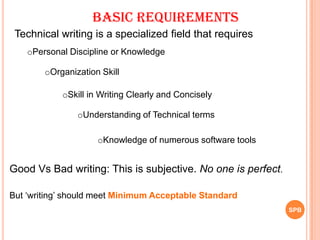
Technical writing is a specialized field that requires
Basic Requirements
oPersonal Discipline or Knowledge
oSkill in Writing Clearly and Concisely
oUnderstanding of Technical terms
oOrganization Skill
oKnowledge of numerous software tools
SPB
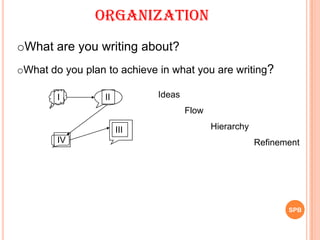
Organization
oWhat are you writing about?
oWhat do you plan to achieve in what you are writing?
I II
III
IV
Ideas
Flow
Hierarchy
Refinement
SPB
Reader Point of View
oWho is going to read the report?
oWhat is the level of their current knowledge?
oWhat background information to include?
oWhy is the reader reading the report?
oIs the document supposed to inform or convince?
oHow much information is needed?
oHow much time does the reader have to read it?
SPB
Give Attention
.
o Avoid grammatical & spelling errors
oMaintain a good flow of language
(like a good song) – This comes by practice.
o Write and re-write
Change the sequence of sentences. Write in several ways.
o Avoid phrases like
Coming to the point…
It is important to note…
All in all…
To reiterate…
It can‟t be overemphasized that …
We have to note especially that …
Can I ask you a question? – This itself is a question
oUse appropriate words.
oEach sentence must have a main verb (action).
oUse simple declarative sentences.
oLet the sentences be inter-connected.
oEach paragraph contains one main idea.
oParagraphs must be inter-connected.
Some Guidelines regarding Flow
SPB
SPB
If language is not correct, then what is said is not
what is meant. If what is said is not what is meant,
then what ought to be done remains undone.
--Kong Fu Zi/Confucius
ELEMENTS OF TECHNICAL WRITING
 Abstract
 Introduction
 Literature Review
 Methodology (Theory Based Chapter ex. Algorithms)
 Project Implementation
 Results and Discussion
 Conclusions and Scope For Future Work
 References
SPB
o Don‟t be too ambitious -
selecting a big project that can‟t be handled within the
available time reflects badly
o Don‟t select a trivial project either – Discuss with various
persons
o What Evaluators look for in a project? Important Points to
remember:
DEPTH – QUALITY – COMPLETENESS – KNOWLEDGE ACQUIRED
– SKILLS ACQUIRED – PRESENTATION SKILLS (Oral and Written)
-
SELECTING A PROJECT
SPB
o Depth: Thoroughly familiar with all the terms / concepts /formulae
used.
o Quality: Work must show the ability to solve a problem – know the
difference between reality and model: Resistor Vs Resistance?
o Completeness: Making a big claim in the Title of the project, but
within the report stating that due to lack of time only a part could be
done - not a good practice.
o Knowledge/Skills Acquired: Evaluators are going to test the
knowledge relating to the problem area – You must become an
expert in the chosen problem area (sub-area) – be able to teach
/guide / lecture
SPB
Wrong Titles for a Project
Data Acquisition System
Image Processing
Digital Communication System
Network Control System
Analysis of an IC Engine
More appropriate Title
A high speed analog-to-digital converter based on …
Human Face Verification for Security Clearance based on …
An adaptive delta modulation system for speech
Software for delay reduction in Network traffic
Calculation of Stress induced in the casing of a four stroke engine based
on simulation studies SPB
Composing the Title
Abstract
SPB
ABSTRACT
oMEAN
oA written summary of the key points especially of a scientific paper
oMini Version of the paper or project report
oSummary of a body of information in a paragraph
oCondensed version of a longer piece of writing that highlights the
major points covered
GIVE
Quickly and accurately identify basic contents of the paper
 To attract the interest and curiosity of the non-specialist reader
Quickly acquaint the reader of current research
To be remembered long after the paper has been read
SPB
Introduction
SPB
Introduction has Three principal parts
A Problem Overview
B Scope of the work
C Organization of Report
DON‟T: Start with a long history, very general discussion about the subject
matter.
DO: Let the reader to know the subject matter of the report immediately.
Writing the Introduction
SPB
Writing the Introduction
Wrong styles of Introduction
“VLSI is an exciting and important area in electronics. Over the past decade it
has emerged as …”
“Security is a vital issue of national importance. Today‟s technology has
advanced …”
Instead, use direct approach:
“Researchers are actively involved in VLSI design and is applications from last
decade. It is exciting and important area in electronics.”
“A digital image processing algorithm is presented that verifies the image of the
human face recorded using a web camera against images stored in an
existing database. The algorithm is based on …”
SPB
Literature Review
SPB
Literature Review
oLiterature Survey
How similar problems have been solved? Put your work in the
contemporary context
oBased on Previous Technologies use for same outcome
oWork of researcher belongs to same fields
oDifferent methods used for same results
SPB
Methodology
SPB
o Algorithms used to solve the problem or design the
system (Theory Based Chapter)
o Implementation of required algorithms to meet required
outcome ( Chapter Based on Actual Implementation of
Project)
o Available software tool
Based on the problem proper software tool has to be used. Proper
input has to be specified. The tool also generates graphs.
Methodology
SPB
Ex. Problem
Electronics > Digital Signal Processing > Image Processing > Face
Recognition
Face Recognition: Is it identification or Verification?
Technique: What Features are used? What is the Classification strategy?
Situation: Input Image: Passport photographs, web camera, movie
clippings etc.
Setting-up performance criteria is a part of the problem statement – Is it to
improve the speed or accuracy? – Is it hardware implementation or
simulation study etc? What is the size of database?
Relevance: Application. Why have you selected this problem? What are
the engineering challenges that are addressed in the problem?
.
SPB
Results and Discussion
SPB
How are you going to test the results?
o Validate using simplified models.
o Estimate the expected results and compare them with those
generated by the tools.
o Run the Experiment for Repeatability, Consistency.
o One Single Run is no experiment, No conclusion can be drawn.
o Collect the Results in a systematic manner.
o Some of the experiments may be time consuming. Proper planning is
required.
o Present one experiment at a time with a clear objective for the
experiment. Present the results and discuss the main findings. Use
Tables, Graphs etc for proper illustration. Use proper scale and
legend for the Graphs.
o Show the link between one experiment and another.
Results and Discussion
SPB
Conclusions and Scope For
Future Work
SPB
o Conclusions are convictions based on (experimental)
evidence.
o Results are measurements. What you infer from the
results are the conclusions.
Conclusions
SCOPE FOR FUTURE
o Due to some lack of timing we are unable to provide
results using ALL POSSIBLE measure parameter,
Mention them for future use by other researcher
SPB
References
SPB
How can you bring-in an innovation into his/her project
work?
o In the selection of the problem.
o In the methodology used to solve the problem.
o In the presentation of results and ability to
draw interesting conclusions.
o In visualizing new applications.
o In the presentation of the report.
Where is the innovation?
SPB
Honesty is the best policy.
You cannot write a good report / paper unless you have something to say.
First decide what is that you want to say. Then say it boldly, clearly and briefly.
Technical writing is a boring job. Doing an experiment or computation or
observing the sky is more exciting. (They involve new tasks!) But technical
reporting is an equally important job. Hence it has to be done properly. It does
not necessarily mean we have to spend more time.
Philosophy
Poor technical writing makes one suspect about the care taken in your
technical work itself.
SPB
THANK YOU…
SPB

Guideline for project writing

  • 1.
    GUIDELINES FOR PROJECT &SEMINAR WRITING (For Final Year B.E. Student) By Prof. S. P. Bhonge (E&TC Dept.)SPB
  • 2.
    SPB Contents oIntroduction oGeneral Issues oBasic Requirements oElementsof Technical Writing (Project Report) Selecting a Project – Composing the Title - Writing the Introduction – Body of the Report – Problem – Methodology and Tools – Collecting the Results –Presentation of the Results – Conclusions and Recommendations – Abstract – Appendix
  • 3.
    SPB Scope Presentation of broadguidelines on writing a project report. Purpose ‘Writing a Project Report’. Plan General Issues – Elements of Technical Writing – Technical Report Writing. Introduction
  • 4.
    SPB General Issues Why aLecture About Writing Technical Report? Surely, any literate can write. Why talk about „Writing‟? „Writing‟ is a SKILL. Good writing is an ART. More so „Technical Writing‟. There may be those who are born or gifted writers. Others have to LEARN and PRACTICE.
  • 5.
    SPB "Practice is thebest of all instructors.“ -- Publilius Syrus, Syrian-born Roman author, c. 100 BC
  • 6.
    SPB Good Vs Badwriting: This is subjective. No one is perfect. But „writing‟ should meet Minimum Acceptable Standard Technical writing is a specialized field that requires Basic Requirements oPersonal Discipline or Knowledge oSkill in Writing Clearly and Concisely oUnderstanding of Technical terms oOrganization Skill oKnowledge of numerous software tools
  • 7.
    SPB Organization oWhat are youwriting about? oWhat do you plan to achieve in what you are writing? I II III IV Ideas Flow Hierarchy Refinement
  • 8.
    SPB Reader Point ofView oWho is going to read the report? oWhat is the level of their current knowledge? oWhat background information to include? oWhy is the reader reading the report? oIs the document supposed to inform or convince? oHow much information is needed? oHow much time does the reader have to read it?
  • 9.
    SPB Give Attention . o Avoidgrammatical & spelling errors oMaintain a good flow of language (like a good song) – This comes by practice. o Write and re-write Change the sequence of sentences. Write in several ways. o Avoid phrases like Coming to the point… It is important to note… All in all… To reiterate… It can‟t be overemphasized that … We have to note especially that … Can I ask you a question? – This itself is a question
  • 10.
    oUse appropriate words. oEachsentence must have a main verb (action). oUse simple declarative sentences. oLet the sentences be inter-connected. oEach paragraph contains one main idea. oParagraphs must be inter-connected. Some Guidelines regarding Flow SPB
  • 11.
    SPB If language isnot correct, then what is said is not what is meant. If what is said is not what is meant, then what ought to be done remains undone. --Kong Fu Zi/Confucius
  • 12.
    ELEMENTS OF TECHNICALWRITING  Abstract  Introduction  Literature Review  Methodology (Theory Based Chapter ex. Algorithms)  Project Implementation  Results and Discussion  Conclusions and Scope For Future Work  References SPB
  • 13.
    o Don‟t betoo ambitious - selecting a big project that can‟t be handled within the available time reflects badly o Don‟t select a trivial project either – Discuss with various persons o What Evaluators look for in a project? Important Points to remember: DEPTH – QUALITY – COMPLETENESS – KNOWLEDGE ACQUIRED – SKILLS ACQUIRED – PRESENTATION SKILLS (Oral and Written) - SELECTING A PROJECT SPB
  • 14.
    o Depth: Thoroughlyfamiliar with all the terms / concepts /formulae used. o Quality: Work must show the ability to solve a problem – know the difference between reality and model: Resistor Vs Resistance? o Completeness: Making a big claim in the Title of the project, but within the report stating that due to lack of time only a part could be done - not a good practice. o Knowledge/Skills Acquired: Evaluators are going to test the knowledge relating to the problem area – You must become an expert in the chosen problem area (sub-area) – be able to teach /guide / lecture SPB
  • 15.
    Wrong Titles fora Project Data Acquisition System Image Processing Digital Communication System Network Control System Analysis of an IC Engine More appropriate Title A high speed analog-to-digital converter based on … Human Face Verification for Security Clearance based on … An adaptive delta modulation system for speech Software for delay reduction in Network traffic Calculation of Stress induced in the casing of a four stroke engine based on simulation studies SPB Composing the Title
  • 16.
  • 17.
    ABSTRACT oMEAN oA written summaryof the key points especially of a scientific paper oMini Version of the paper or project report oSummary of a body of information in a paragraph oCondensed version of a longer piece of writing that highlights the major points covered GIVE Quickly and accurately identify basic contents of the paper  To attract the interest and curiosity of the non-specialist reader Quickly acquaint the reader of current research To be remembered long after the paper has been read SPB
  • 18.
  • 19.
    Introduction has Threeprincipal parts A Problem Overview B Scope of the work C Organization of Report DON‟T: Start with a long history, very general discussion about the subject matter. DO: Let the reader to know the subject matter of the report immediately. Writing the Introduction SPB
  • 20.
    Writing the Introduction Wrongstyles of Introduction “VLSI is an exciting and important area in electronics. Over the past decade it has emerged as …” “Security is a vital issue of national importance. Today‟s technology has advanced …” Instead, use direct approach: “Researchers are actively involved in VLSI design and is applications from last decade. It is exciting and important area in electronics.” “A digital image processing algorithm is presented that verifies the image of the human face recorded using a web camera against images stored in an existing database. The algorithm is based on …” SPB
  • 21.
  • 22.
    Literature Review oLiterature Survey Howsimilar problems have been solved? Put your work in the contemporary context oBased on Previous Technologies use for same outcome oWork of researcher belongs to same fields oDifferent methods used for same results SPB
  • 23.
  • 24.
    o Algorithms usedto solve the problem or design the system (Theory Based Chapter) o Implementation of required algorithms to meet required outcome ( Chapter Based on Actual Implementation of Project) o Available software tool Based on the problem proper software tool has to be used. Proper input has to be specified. The tool also generates graphs. Methodology SPB
  • 25.
    Ex. Problem Electronics >Digital Signal Processing > Image Processing > Face Recognition Face Recognition: Is it identification or Verification? Technique: What Features are used? What is the Classification strategy? Situation: Input Image: Passport photographs, web camera, movie clippings etc. Setting-up performance criteria is a part of the problem statement – Is it to improve the speed or accuracy? – Is it hardware implementation or simulation study etc? What is the size of database? Relevance: Application. Why have you selected this problem? What are the engineering challenges that are addressed in the problem? . SPB
  • 26.
  • 27.
    How are yougoing to test the results? o Validate using simplified models. o Estimate the expected results and compare them with those generated by the tools. o Run the Experiment for Repeatability, Consistency. o One Single Run is no experiment, No conclusion can be drawn. o Collect the Results in a systematic manner. o Some of the experiments may be time consuming. Proper planning is required. o Present one experiment at a time with a clear objective for the experiment. Present the results and discuss the main findings. Use Tables, Graphs etc for proper illustration. Use proper scale and legend for the Graphs. o Show the link between one experiment and another. Results and Discussion SPB
  • 28.
    Conclusions and ScopeFor Future Work SPB
  • 29.
    o Conclusions areconvictions based on (experimental) evidence. o Results are measurements. What you infer from the results are the conclusions. Conclusions SCOPE FOR FUTURE o Due to some lack of timing we are unable to provide results using ALL POSSIBLE measure parameter, Mention them for future use by other researcher SPB
  • 30.
  • 31.
    How can youbring-in an innovation into his/her project work? o In the selection of the problem. o In the methodology used to solve the problem. o In the presentation of results and ability to draw interesting conclusions. o In visualizing new applications. o In the presentation of the report. Where is the innovation? SPB
  • 32.
    Honesty is thebest policy. You cannot write a good report / paper unless you have something to say. First decide what is that you want to say. Then say it boldly, clearly and briefly. Technical writing is a boring job. Doing an experiment or computation or observing the sky is more exciting. (They involve new tasks!) But technical reporting is an equally important job. Hence it has to be done properly. It does not necessarily mean we have to spend more time. Philosophy Poor technical writing makes one suspect about the care taken in your technical work itself. SPB
  • 33.