Technical Report Writing
.
Originally created by J. Ayers
Edited by R. Magnusson and J. Chandy, Spring 2011
Edited by M. van Dijk, Fall 2013
ECE 4901
Technical writing
• Journal paper
• Thesis
• Dissertation
• Report
• Project statement
• Project specifications
• Design memo, proposal, report
Elements of a Technical Report
•Title
•Abstract (Executive Summary)
•Introduction
•Theory and Analysis
•Experimental Procedures
•Results and Discussion
•Conclusion(s)
•Acknowledgments
•References
•Appendix
Writing Mechanics
• Check Spelling
• Check Grammar
• Minimize the use of Acronyms
• If Acronyms are necessary, always define them at the first
use
• Number all equations, tables, and figures
• All tables and figures must have captions.
• All figures must have labeled axes
• All quantities must have units
• Try to avoid footnotes
Writing Style
•Depends on the audience
•More Lively Writing (usually preferred)
– First Person, Active Voice, Past/Present Tense
•More Formal Writing
– Third Person, Passive Voice, Past/Present Tense
•Never use slang
Writing Style
•Use First-Person, Active Voice, Past Tense or
Third-Person, Passive Voice, Past Tense
• Not Recommended: Clean the gallium arsenide
substrates by boiling them in trichloroethylene.
• Not Recommended: I clean the gallium arsenide
substrates by boiling them in trichloroethylene.
• Acceptable: The gallium arsenide substrates were
cleaned by boiling in trichloroethylene.
• Recommended: We cleaned the gallium arsenide
substrates by boiling them in trichloroethylene.
Writing Center
http://www.writingcenter.uconn.edu/index.php
•Improve your grammar and style
– Read “The Science of Scientific Writing”
– Quote: “If the reader is to grasp what the writer means,
the writer must understand what the reader needs.”
•Organize your paper
– Read “Critical Reading Towards Critical Writing”
– Quote: “… ask "How does this text work? How is it
argued? … How does the text reach its conclusions?”
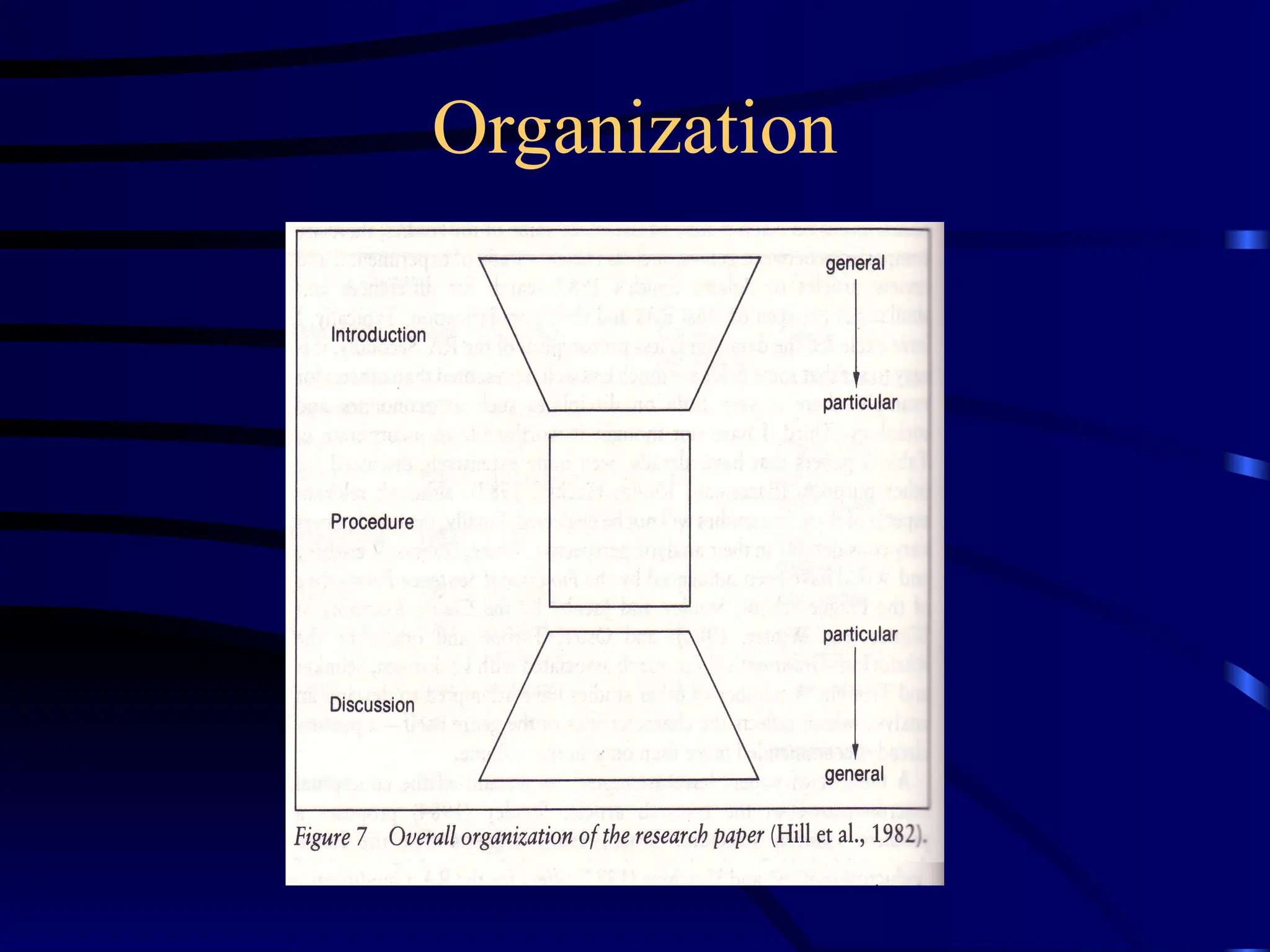
Organization
Writing the Report: An Approach
• Results come first
– Your results are the heart of your paper
– Begin by analyzing and understanding your data
– The results section includes:
• Figures/diagrams/plots (labeled, captioned and titled)
• Data you didn’t expect
• Your description of your figures
• No interpretation or conclusions
Material from J. Stickgold-Sarah
Writing the Report: An Approach
• Results section:
– Use tables and graphs
– Consider moving large quantities of raw data,
detailed derivations, or code to an appendix
– Methods of plotting which produce well
delineated lines should be considered
– Results should be critically compared to theory
– Consider limitations in the theory and engineering
tolerances
Writing the Report: An Approach
• What happens in the discussion?
– The Discussion ties back to the Introduction
– Talk about how and why you did or didn’t
confirm your hypothesis
– Unexpected results
– Speculate here!
– Claims are grounded in results and background
material in Introduction
Material from J. Stickgold-Sarah
Writing the Report: An Approach
• Now you are ready for the introduction
– Brief background, enough to understand your hypothesis
– State your hypothesis and your conclusion
– Intro is not a substitute for the report, and so does not
echo the abstract
– Here is the place for context, relation to prior work,
general objective, and approach
• Next: title, abstract, conclusions and other sections
Some material borrowed from J. Stickgold-Sarah
Title and Abstract
• Title gives understandable label for area of inquiry
• Abstract or Executive Summary:
– Abstract is a mini-paper (often around 200 words)
– Think of it as a substitute for the report for a busy reader:
what if your reader has only access to the abstract?
– Purpose, Findings, Impact
• Sentence One: expand on the title
• Sentence Two: why the work was done
• Remainder: key results, with numbers as appropriate,
conclusions, recommendations
Some material borrowed from J. Stickgold-Sarah
Sentences that serve the key
purposes of an introduction
Example: Savage, S. Eraser: A Dynamic Data Race Detector for Multithreaded Programs. ACM Transactions on Computer
Systems, 15 (4) 391-411
Describe your field:
Multithreading has become a common programming technique.
Explain why your problem matters
Unfortunately, debugging a multithreaded program can be difficult.
Summarize prior research:
The difficulties with using threads are well summarized by John Ousterhout.
Propose your solution:
In this article we describe a tool, called Eraser, that dynamically detects data races in multithreaded programs
Conclusion
• Similar to abstract or executive summary
• Must be concise
• Reinforces key ideas formed in discussion
• Includes recommendations for future work,
such as implementation of a design
Theory and Analysis
• Briefly describe the theory relevant to the work
• Provide design equations
• Include calculations and computer simulation results
• Provide values for all key parameters
Experimental Procedures
• Describe Apparatus and Materials
– Diagram of apparatus goes here (add a photo)
– Open with an overview of the experimental design
• Show test setups
• This section should allow any electrical or computer
engineer to duplicate your results:
– Repeat experiment
– Validate experimental design
Some material borrowed from J. Stickgold-Sarah
Figures and Tables
• Every figure must have a caption
• All tables must have a title
• Figure/tables are placed after they are mentioned in the text
– All must be mentioned/discussed
– Summarize their data in the text
• Make figures/tables first, and then insert into the text
• Put the figure/table number beside its title, and put this in a
standard location
• Don’t start a sentence with an abbreviation: Figure vs. Fig.
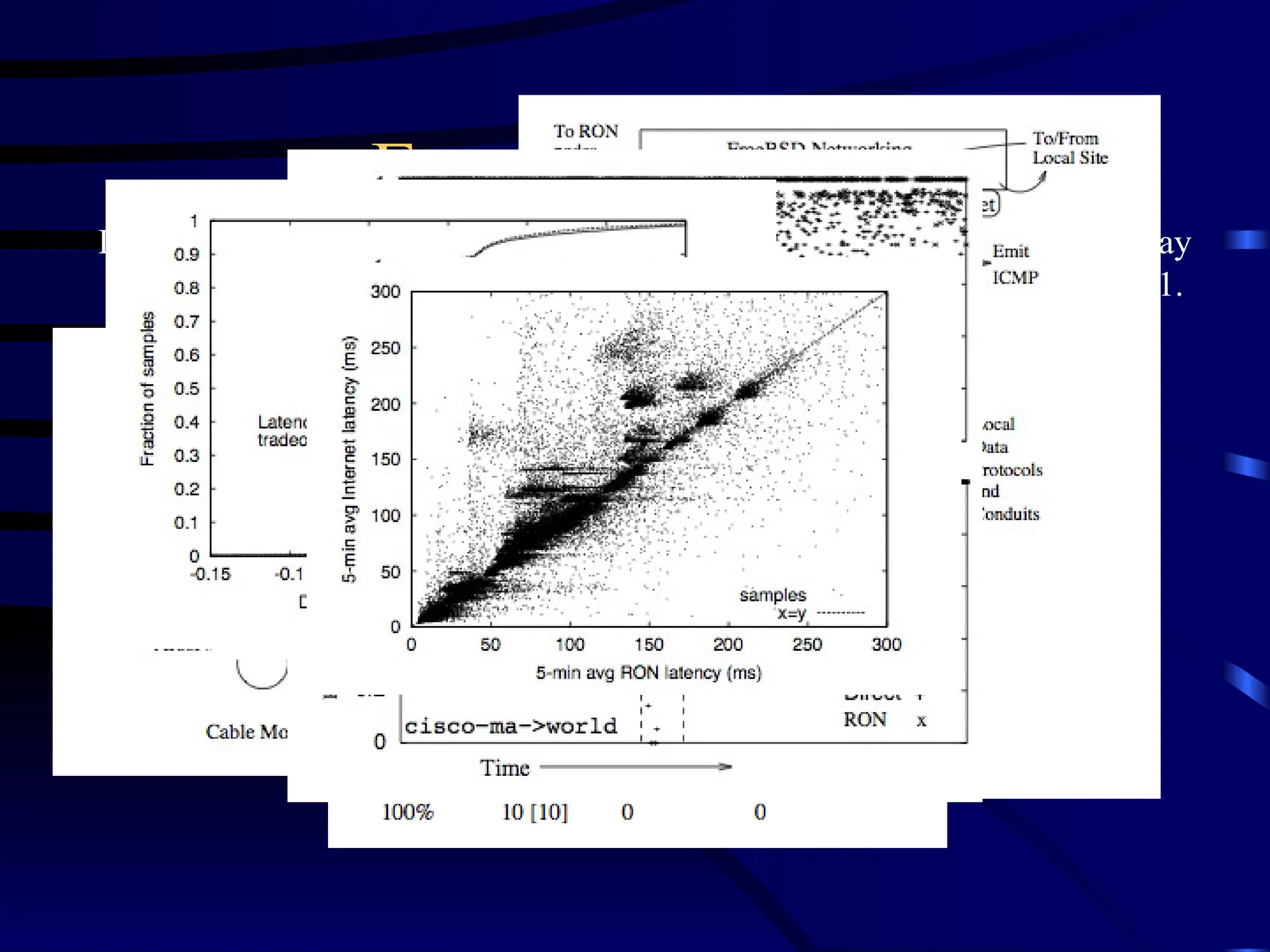
Example Figures
D. Andersen, H. Balakrishnan, F. Kaashoek and R. Morris. Resilient Overlay
Networks. 18th
ACM Symp. On Operating System Principles (SOSP), 2001.
Acknowledgements
• Keep track of those to be acknowledged-keep a
diary so that you don’t forget anyone
• Include: your sponsor, outside sources
(companies or agencies), other departments on
campus, individuals outside of your team who
have helped
• Be brief
References
• Various formats have been developed. Pick
one you like such as the IEEE Transactions
format
• Decide on a sequence, such as the order
they appear in the text
• Always give full references such that others
may find the item
References (examples)
• [1] A. Student and B. Professor, “Very
Important Project,” in Journal of
Irreproducable Research, vol. 13, no. 9, pp.
25-31, Nov. 2004.
• [2] C. Dean, The Book of Earth-Shattering
Research, Husky Press, Storrs, CT, 2005.
Plagiarism
• Never take the work of others without giving proper
credit
• Never take verbatim sentences/paragraphs from the
literature
• If you feel that you must use verbatim material, use
quotation marks and a reference. Do this sparingly!
• There are search engines that can find if verbatim
material has been stolen. Professors fail students who
do this. Additional disciplinary action may follow.
#5. “We connected the citrus
machine...” Jane Doe, Spring 1999
The names have been changed to protect the innocent.
Top Five Quotes from ECE Engineering
Reports.
#4 “The other wildly used configuration
of the dc commutator machine is the
series field motor.” David Doe, Fall
1999
The names have been changed to protect the innocent.
Top Five Quotes from ECE Engineering
Reports.
#3 “…the power rating was doubled by
about a factor of 2.5…” Joe Doe,
Spring 2000
The names have been changed to protect the innocent.
Top Five Quotes from ECE Engineering
Reports.
#2 “From the result section we see that
the transformer was rated at
approximately 20 kHz from 10 kHz to 2
MHz and the results were consistent.”
John Doe, Spring 1999
The names have been changed to protect the innocent.
Top Five Quotes from ECE Engineering
Reports.
#1 “A sketch of the setup for both tests
depicting relative positions and
connections is featured in showing the
relative posit featuring the relative
setup of the tests is featured in the
following section.” Mr. Doe, Spring
2000
The names have been changed to protect the innocent.
Top Five Quotes from ECE Engineering
Reports.
References
– William Strunk and E. B. White, The Elements of Style
(New York: Macmillian, 2000).
– H. R. Fowler, The Little, Brown Handbook (Boston: Little,
Brown and Company, 1980).
– G. L. Tuve and L. C. Domholdt, Engineering
Experimentation (New York: McGraw-Hill Book Co.,
1966).
– Craig Waddell, Basic Prose Style and Mechanics (Troy,
NY: Rensselaer Press, 1990).
– Joseph Williams, Style: Ten Lessons in Clarity and Grace
(Glenview, IL: Scott, Foresman, 1981).
– ECE Dept, “Engineering Report Writing,” September 2003.

technical Writing for research methodology

  • 1.
    Technical Report Writing . Originallycreated by J. Ayers Edited by R. Magnusson and J. Chandy, Spring 2011 Edited by M. van Dijk, Fall 2013 ECE 4901
  • 2.
    Technical writing • Journalpaper • Thesis • Dissertation • Report • Project statement • Project specifications • Design memo, proposal, report
  • 3.
    Elements of aTechnical Report •Title •Abstract (Executive Summary) •Introduction •Theory and Analysis •Experimental Procedures •Results and Discussion •Conclusion(s) •Acknowledgments •References •Appendix
  • 4.
    Writing Mechanics • CheckSpelling • Check Grammar • Minimize the use of Acronyms • If Acronyms are necessary, always define them at the first use • Number all equations, tables, and figures • All tables and figures must have captions. • All figures must have labeled axes • All quantities must have units • Try to avoid footnotes
  • 5.
    Writing Style •Depends onthe audience •More Lively Writing (usually preferred) – First Person, Active Voice, Past/Present Tense •More Formal Writing – Third Person, Passive Voice, Past/Present Tense •Never use slang
  • 6.
    Writing Style •Use First-Person,Active Voice, Past Tense or Third-Person, Passive Voice, Past Tense • Not Recommended: Clean the gallium arsenide substrates by boiling them in trichloroethylene. • Not Recommended: I clean the gallium arsenide substrates by boiling them in trichloroethylene. • Acceptable: The gallium arsenide substrates were cleaned by boiling in trichloroethylene. • Recommended: We cleaned the gallium arsenide substrates by boiling them in trichloroethylene.
  • 7.
    Writing Center http://www.writingcenter.uconn.edu/index.php •Improve yourgrammar and style – Read “The Science of Scientific Writing” – Quote: “If the reader is to grasp what the writer means, the writer must understand what the reader needs.” •Organize your paper – Read “Critical Reading Towards Critical Writing” – Quote: “… ask "How does this text work? How is it argued? … How does the text reach its conclusions?”
  • 8.
  • 9.
    Writing the Report:An Approach • Results come first – Your results are the heart of your paper – Begin by analyzing and understanding your data – The results section includes: • Figures/diagrams/plots (labeled, captioned and titled) • Data you didn’t expect • Your description of your figures • No interpretation or conclusions Material from J. Stickgold-Sarah
  • 10.
    Writing the Report:An Approach • Results section: – Use tables and graphs – Consider moving large quantities of raw data, detailed derivations, or code to an appendix – Methods of plotting which produce well delineated lines should be considered – Results should be critically compared to theory – Consider limitations in the theory and engineering tolerances
  • 11.
    Writing the Report:An Approach • What happens in the discussion? – The Discussion ties back to the Introduction – Talk about how and why you did or didn’t confirm your hypothesis – Unexpected results – Speculate here! – Claims are grounded in results and background material in Introduction Material from J. Stickgold-Sarah
  • 12.
    Writing the Report:An Approach • Now you are ready for the introduction – Brief background, enough to understand your hypothesis – State your hypothesis and your conclusion – Intro is not a substitute for the report, and so does not echo the abstract – Here is the place for context, relation to prior work, general objective, and approach • Next: title, abstract, conclusions and other sections Some material borrowed from J. Stickgold-Sarah
  • 13.
    Title and Abstract •Title gives understandable label for area of inquiry • Abstract or Executive Summary: – Abstract is a mini-paper (often around 200 words) – Think of it as a substitute for the report for a busy reader: what if your reader has only access to the abstract? – Purpose, Findings, Impact • Sentence One: expand on the title • Sentence Two: why the work was done • Remainder: key results, with numbers as appropriate, conclusions, recommendations Some material borrowed from J. Stickgold-Sarah
  • 14.
    Sentences that servethe key purposes of an introduction Example: Savage, S. Eraser: A Dynamic Data Race Detector for Multithreaded Programs. ACM Transactions on Computer Systems, 15 (4) 391-411 Describe your field: Multithreading has become a common programming technique. Explain why your problem matters Unfortunately, debugging a multithreaded program can be difficult. Summarize prior research: The difficulties with using threads are well summarized by John Ousterhout. Propose your solution: In this article we describe a tool, called Eraser, that dynamically detects data races in multithreaded programs
  • 15.
    Conclusion • Similar toabstract or executive summary • Must be concise • Reinforces key ideas formed in discussion • Includes recommendations for future work, such as implementation of a design
  • 16.
    Theory and Analysis •Briefly describe the theory relevant to the work • Provide design equations • Include calculations and computer simulation results • Provide values for all key parameters
  • 17.
    Experimental Procedures • DescribeApparatus and Materials – Diagram of apparatus goes here (add a photo) – Open with an overview of the experimental design • Show test setups • This section should allow any electrical or computer engineer to duplicate your results: – Repeat experiment – Validate experimental design Some material borrowed from J. Stickgold-Sarah
  • 18.
    Figures and Tables •Every figure must have a caption • All tables must have a title • Figure/tables are placed after they are mentioned in the text – All must be mentioned/discussed – Summarize their data in the text • Make figures/tables first, and then insert into the text • Put the figure/table number beside its title, and put this in a standard location • Don’t start a sentence with an abbreviation: Figure vs. Fig.
  • 19.
    Example Figures D. Andersen,H. Balakrishnan, F. Kaashoek and R. Morris. Resilient Overlay Networks. 18th ACM Symp. On Operating System Principles (SOSP), 2001.
  • 20.
    Acknowledgements • Keep trackof those to be acknowledged-keep a diary so that you don’t forget anyone • Include: your sponsor, outside sources (companies or agencies), other departments on campus, individuals outside of your team who have helped • Be brief
  • 21.
    References • Various formatshave been developed. Pick one you like such as the IEEE Transactions format • Decide on a sequence, such as the order they appear in the text • Always give full references such that others may find the item
  • 22.
    References (examples) • [1]A. Student and B. Professor, “Very Important Project,” in Journal of Irreproducable Research, vol. 13, no. 9, pp. 25-31, Nov. 2004. • [2] C. Dean, The Book of Earth-Shattering Research, Husky Press, Storrs, CT, 2005.
  • 23.
    Plagiarism • Never takethe work of others without giving proper credit • Never take verbatim sentences/paragraphs from the literature • If you feel that you must use verbatim material, use quotation marks and a reference. Do this sparingly! • There are search engines that can find if verbatim material has been stolen. Professors fail students who do this. Additional disciplinary action may follow.
  • 24.
    #5. “We connectedthe citrus machine...” Jane Doe, Spring 1999 The names have been changed to protect the innocent. Top Five Quotes from ECE Engineering Reports.
  • 25.
    #4 “The otherwildly used configuration of the dc commutator machine is the series field motor.” David Doe, Fall 1999 The names have been changed to protect the innocent. Top Five Quotes from ECE Engineering Reports.
  • 26.
    #3 “…the powerrating was doubled by about a factor of 2.5…” Joe Doe, Spring 2000 The names have been changed to protect the innocent. Top Five Quotes from ECE Engineering Reports.
  • 27.
    #2 “From theresult section we see that the transformer was rated at approximately 20 kHz from 10 kHz to 2 MHz and the results were consistent.” John Doe, Spring 1999 The names have been changed to protect the innocent. Top Five Quotes from ECE Engineering Reports.
  • 28.
    #1 “A sketchof the setup for both tests depicting relative positions and connections is featured in showing the relative posit featuring the relative setup of the tests is featured in the following section.” Mr. Doe, Spring 2000 The names have been changed to protect the innocent. Top Five Quotes from ECE Engineering Reports.
  • 29.
    References – William Strunkand E. B. White, The Elements of Style (New York: Macmillian, 2000). – H. R. Fowler, The Little, Brown Handbook (Boston: Little, Brown and Company, 1980). – G. L. Tuve and L. C. Domholdt, Engineering Experimentation (New York: McGraw-Hill Book Co., 1966). – Craig Waddell, Basic Prose Style and Mechanics (Troy, NY: Rensselaer Press, 1990). – Joseph Williams, Style: Ten Lessons in Clarity and Grace (Glenview, IL: Scott, Foresman, 1981). – ECE Dept, “Engineering Report Writing,” September 2003.

Editor's Notes

  • #2 We will focus on how to write a technical report. A) Project statement & Project specifications: Describe the problem, describe the product (solution), why people want to use it, propose a timeline including designing the system, writing the proposal, and writing the report. Include a paragraph justifying that timeline (why are the tasks in that order, which are major and which are minor). In real-life system designs are under-specified, and it is your job to complete the specification in a sensible way given the overall requirements of the project. In practice, the specifications often need some adjustment as the design is fleshed out. B) The design proposal should be a concise summary of your overall system design. A design proposal is typically used to propose a particular solution to a problem. It explains how the author’s design works, demonstrates that the design meets all the requirements, and if necessary shows how the author’s design is superior to others. As in a professional environment we ask you to clearly lay out the problem, then match your solution to that problem description. You should be able to characterize your proposed system at a high level and describe your proposed implementation and how it will meet requirements. Use technical language as appropriate, but write for an audience outside your specific area. Title Overview presents the problem and your solution. Explain the problem to be solved by your design. Summarize your proposed solution, including your overall design approach. Specify how your design solves the problem and meets requirements. Design description gives a fuller presentation of your design, demonstrating to your reader that your design will work and will solve the problem. Uses some hierarchy (subsections, logical groupings of material) and briefly introduces each subsection. Organizes and introduces implementation by task or function, not by I/O. Describes the design’s interface. Specifies your plan for implementation. Explains how the interface will be used by applications. Includes one titled, labeled, captioned figure which illustrates a challenging concept. If bullet lists are used they are always introduced with a few sentences! Conclusion briefly summarizes how your design will meet the requirements, and notes problems which remain to be resolved. May be a separate section or may be the final paragraph. Some writing considerations for the proposal: Does the proposal summarize the proposed system as a whole? Does the proposal make an argument in favor of the system (as opposed to a different design)? Do figures clarify or illustrate an essential concept presented in the text? Are figure properly formatted, labeled, and referenced? Does the document meet basic standards of professional grammar, syntax, spelling, etc? Here are a few tips: Before you explain the solution to any given problem, say what the problem is. Before presenting the details of any given design component, ensure that the purpose and requirements of that component are well described. It's often valuable to illustrate an idea using an example, but an example is no substitute for a full explanation of the idea. Explain all figures, tables, and pseudo-code; explain what is being presented, and what conclusions the reader should draw. The above material is taken from MIT course 6.033 ”Computer System Design”
  • #3 No table of contents
  • #5 Make it lively!
  • #6 Some acceptable exceptions like “Notice that …”, although preferred is “We notice that …” or “We remark that …”
  • #7 If it doesn’t feel quite right  do something. Ask friends (who have no idea about your project) to read your report .
  • #10 Producing figures, diagrams, tables and graphs is an art. Experiment with different layouts, what work best for conveying your message? Put large quantities of raw data in a separate file accessible using a public url.
  • #20 Did you get a scolarship?
  • #21 Recommended: alphabetical Decide with your team what format you will use: Word, LaTex etc.