Types of Paragraphs 
Sebastian Lopez Ramos 
Universidad EAN 
Noviembre de 2014
Introduction 
When writing texts, is important to know what will be the 
intentionality of the message that we want to share with the readers, 
depending of that, this message can be(or cannot be) understood by 
them the way we want. So, it becomes crucial to know about the 
different kinds of structures that we can write in order to use the 
best one in the development of our texts. There are four types of 
these structures, they can be used in paragraphs as we will see, or in 
a whole text, depending of our needs. These types are descriptive, 
expositive, narrative and persuasive(as well-known as 
argumentative).
Descriptive Paragraph 
This kind of paragraph is used to describe 
objects and persons. It appeals to the 
reader’s five senses. Depending of the type 
of description, they can be divided on: 
-Prosopography 
-Cartoon 
-Portrait 
-Self-portrait 
-Cartoon 
-Cronography 
-Topography
❏ Prosopography: description based on physical features of people 
❏ Cartoon: deformed description based on highlights features(mostly defects) 
❏ Portrait: this one includes physic and moral features 
❏ Self-portrait: this is a author’s self description 
❏ Cronography: A certain epoch or period of time is described 
❏ Topography: Description of landscapes and geography
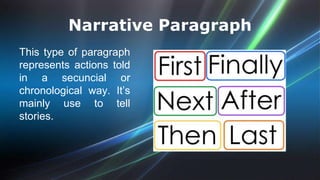
Narrative Paragraph 
This type of paragraph 
represents actions told 
in a secuncial or 
chronological way. It’s 
mainly use to tell 
stories.
Every narrative paragraph at least 1 of 5 main 
points: 
❏ Initial equilibrium state 
❏ Complication: some element breaks the 
equilibrium 
❏ Development 
❏ Solution: another breaking element that restores 
the things again. 
❏ A new equilibrium
Expository Paragraph 
The expositive 
paragraph is used to 
give the reader some 
sort of information 
about a special or 
specific topic.
This kind of paragraph can be divided by the 
organization of information, in these: 
❏ Analysis/Sintesis 
❏ Problem/solution 
❏ Descriptive enumeration 
❏ Cause/effect 
❏ Temporal secuence 
❏ Comparison by contrast
Persuasive Paragraph 
We use this type of 
paragraph when we 
want to convince the 
reader with an idea or 
an argument 
(affirmative, neutral or 
negative)
This kind of paragraph is used when: 
❏ We use a thesis in our texts 
❏ We use arguments in our texts 
❏ We came with conclusions in our texts
Conclusion 
As we could see with these types of paragraphs, 
there are different forms to express ourselves 
through texts, depending our intention, we can give 
a message to our reader. We have the freedom to 
choose the meaning of the words that we will use, 
but with this freedom comes a responsibility of 
using the right structure if we want to share 
something new with our reader(s).

Guide 4 types of paragraphs

  • 1.
    Types of Paragraphs Sebastian Lopez Ramos Universidad EAN Noviembre de 2014
  • 2.
    Introduction When writingtexts, is important to know what will be the intentionality of the message that we want to share with the readers, depending of that, this message can be(or cannot be) understood by them the way we want. So, it becomes crucial to know about the different kinds of structures that we can write in order to use the best one in the development of our texts. There are four types of these structures, they can be used in paragraphs as we will see, or in a whole text, depending of our needs. These types are descriptive, expositive, narrative and persuasive(as well-known as argumentative).
  • 3.
    Descriptive Paragraph Thiskind of paragraph is used to describe objects and persons. It appeals to the reader’s five senses. Depending of the type of description, they can be divided on: -Prosopography -Cartoon -Portrait -Self-portrait -Cartoon -Cronography -Topography
  • 4.
    ❏ Prosopography: descriptionbased on physical features of people ❏ Cartoon: deformed description based on highlights features(mostly defects) ❏ Portrait: this one includes physic and moral features ❏ Self-portrait: this is a author’s self description ❏ Cronography: A certain epoch or period of time is described ❏ Topography: Description of landscapes and geography
  • 5.
    Narrative Paragraph Thistype of paragraph represents actions told in a secuncial or chronological way. It’s mainly use to tell stories.
  • 6.
    Every narrative paragraphat least 1 of 5 main points: ❏ Initial equilibrium state ❏ Complication: some element breaks the equilibrium ❏ Development ❏ Solution: another breaking element that restores the things again. ❏ A new equilibrium
  • 7.
    Expository Paragraph Theexpositive paragraph is used to give the reader some sort of information about a special or specific topic.
  • 8.
    This kind ofparagraph can be divided by the organization of information, in these: ❏ Analysis/Sintesis ❏ Problem/solution ❏ Descriptive enumeration ❏ Cause/effect ❏ Temporal secuence ❏ Comparison by contrast
  • 9.
    Persuasive Paragraph Weuse this type of paragraph when we want to convince the reader with an idea or an argument (affirmative, neutral or negative)
  • 10.
    This kind ofparagraph is used when: ❏ We use a thesis in our texts ❏ We use arguments in our texts ❏ We came with conclusions in our texts
  • 11.
    Conclusion As wecould see with these types of paragraphs, there are different forms to express ourselves through texts, depending our intention, we can give a message to our reader. We have the freedom to choose the meaning of the words that we will use, but with this freedom comes a responsibility of using the right structure if we want to share something new with our reader(s).