PARAGRAPH STRUCTURE
AND TYPES
TATIANA ARDILA
WHAT IS A PARAGRAPH?
• The purpose of a
paragraph is to express a
speaker’s thoughts on a
particular point in a clear
way that is unique and
specific to that paragraph.
BASIC PARAGRAPH STRUCTURE:
• Topic Sentence + Supporting Sentences + Concluding Sentence
Topic sentence: A topic sentence is the first sentence of the body paragraph. Simply put, the
topic sentence introduces the topic of the paragraph. A good topic sentence will be broad
enough to allow for explication but narrow enough that it does not require a paragraph that is
too long.
Supporting sentences: The supporting sentences of a paragraph are the sentences between
the topic sentence and the concluding sentence. The supporting sentences “support” the topic
sentence. That is, they explain and elaborate the point of the paragraph.
Concluding sentence: The concluding sentence is the last sentence in the paragraph. It should
succinctly end the paragraph and transition to the next paragraph, if appropriate.
TYPES OF PARAGRAPHS
There are four types of
paragraphs that you need
to know
about: descriptive,
narrative, expository,
and persuasive.
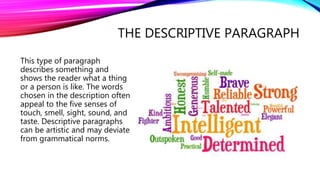
THE DESCRIPTIVE PARAGRAPH
This type of paragraph
describes something and
shows the reader what a thing
or a person is like. The words
chosen in the description often
appeal to the five senses of
touch, smell, sight, sound, and
taste. Descriptive paragraphs
can be artistic and may deviate
from grammatical norms.
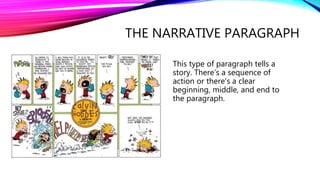
THE NARRATIVE PARAGRAPH
This type of paragraph tells a
story. There's a sequence of
action or there's a clear
beginning, middle, and end to
the paragraph.
THE EXPOSITORY PARAGRAPH
This type of paragraph explains
something or provides instruction.
It could also describe a process and
move the reader step by step
through a method. This type of
paragraph often requires research,
but it's possible that the writer is
able to rely on his or her own
knowledge and expertise.
THE PERSUASIVE PARAGRAPH
This type of paragraph tries to
get the reader to accept a
particular point of view or
understand the writer's position.
This is the type of paragraph that
many teachers focus on because
it's useful when building an
argument. It often requires the
collection of facts and research.
REFERENCES
• http://www.wordreference.com/
• https://writingexplained.org/grammar-dictionary/paragraph
• https://www.learnamericanenglishonline.com/Write_in_English/WL
10_types_of_paragraphs.html
• https://www.time4writing.com/writing-paragraphs/unity-
coherence/

Paragraph structure and types

  • 1.
  • 2.
    WHAT IS APARAGRAPH? • The purpose of a paragraph is to express a speaker’s thoughts on a particular point in a clear way that is unique and specific to that paragraph.
  • 3.
    BASIC PARAGRAPH STRUCTURE: •Topic Sentence + Supporting Sentences + Concluding Sentence Topic sentence: A topic sentence is the first sentence of the body paragraph. Simply put, the topic sentence introduces the topic of the paragraph. A good topic sentence will be broad enough to allow for explication but narrow enough that it does not require a paragraph that is too long. Supporting sentences: The supporting sentences of a paragraph are the sentences between the topic sentence and the concluding sentence. The supporting sentences “support” the topic sentence. That is, they explain and elaborate the point of the paragraph. Concluding sentence: The concluding sentence is the last sentence in the paragraph. It should succinctly end the paragraph and transition to the next paragraph, if appropriate.
  • 4.
    TYPES OF PARAGRAPHS Thereare four types of paragraphs that you need to know about: descriptive, narrative, expository, and persuasive.
  • 5.
    THE DESCRIPTIVE PARAGRAPH Thistype of paragraph describes something and shows the reader what a thing or a person is like. The words chosen in the description often appeal to the five senses of touch, smell, sight, sound, and taste. Descriptive paragraphs can be artistic and may deviate from grammatical norms.
  • 6.
    THE NARRATIVE PARAGRAPH Thistype of paragraph tells a story. There's a sequence of action or there's a clear beginning, middle, and end to the paragraph.
  • 7.
    THE EXPOSITORY PARAGRAPH Thistype of paragraph explains something or provides instruction. It could also describe a process and move the reader step by step through a method. This type of paragraph often requires research, but it's possible that the writer is able to rely on his or her own knowledge and expertise.
  • 8.
    THE PERSUASIVE PARAGRAPH Thistype of paragraph tries to get the reader to accept a particular point of view or understand the writer's position. This is the type of paragraph that many teachers focus on because it's useful when building an argument. It often requires the collection of facts and research.
  • 9.
    REFERENCES • http://www.wordreference.com/ • https://writingexplained.org/grammar-dictionary/paragraph •https://www.learnamericanenglishonline.com/Write_in_English/WL 10_types_of_paragraphs.html • https://www.time4writing.com/writing-paragraphs/unity- coherence/