PARAGRAPH WRITING
Lecture part 3
(Types of Paragraphs)
Paragraph Types
There are four types of paragraphs that you need to know about: descriptive, narrative,
expository, and persuasive. A quick search around the internet will yield other types, but to
keep this simple, it's a good idea to consider just these four.
⮚ Chronological Paragraph
⮚ Enumeration Paragraph
⮚ Descriptive Paragraph
⮚ Explanatory Paragraph
⮚ Expository Paragraph
⮚ Argumentative Paragraph
⮚ Narrative Paragraph
⮚ Comparative Paragraph
⮚ Cause and effect Paragraph
⮚ Deductive Paragraph
⮚ Inductive Paragraph
Chronological Paragraph
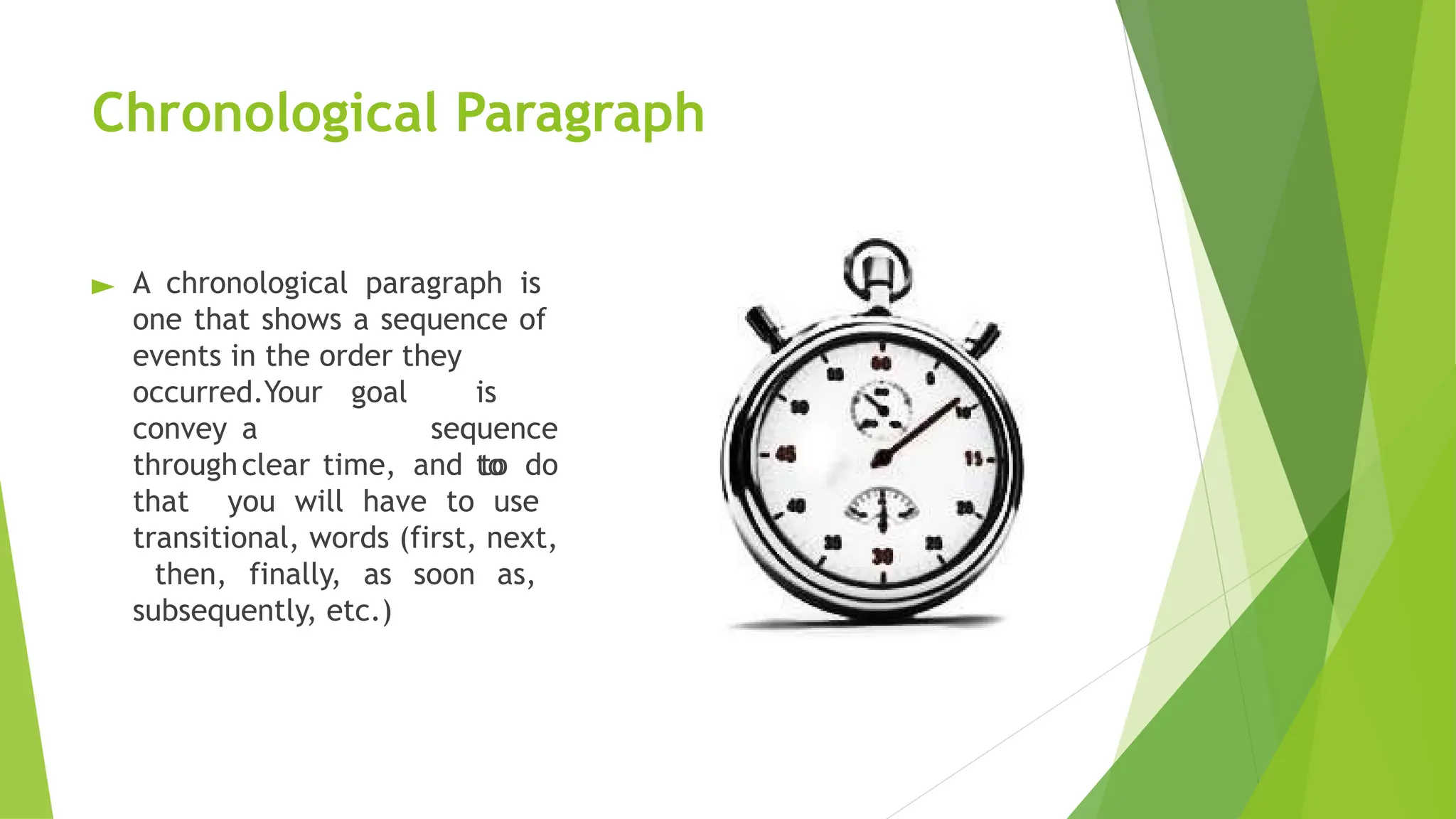
► A chronological paragraph is
one that shows a sequence of
events in the order they
is
to
occurred.Your goal
convey a
clear
sequence
through time, and to do
that you will have to use
transitional, words (first, next,
then, finally, as soon as,
subsequently, etc.)
Enumeration Paragraph
Paragraph enumeration means to develop a paragraph by breaking a general
topic down into its categories or classes.
<<The following are topics that would indicate enumerative organization: * What
are the characteristics of a good teacher? * Describe some common
learning styles. * What kinds of reading material can be found in a library? *
Describe different types of parents. * What are
the basic elements of paragraph organization? * Describe
some unique aspects of American government. * What are the phases of cultural
shock? Other terms such as the following might also be used: classes, parts,
factors, divisions, subdivisions, categories, methods, and specializations.
Descriptive Paragraph
Descriptive paragraphs include details that appeal to the five senses:
sight, taste, touch, smell, and hearing. In a descriptive paragraph, the
writer must convey information that appeals to all the senses, in order to
give the best possible description to the reader. Descriptive paragraphs
are commonly used in fiction and non-fiction writing, to help immerse
readers into the world of the author. Though there are no hard and fast
rules for how exactly these paragraphs should be structured, there are
several suggestions that can help you write an effective and appealing
descriptive paragraph
Explanatory Paragraph
Explanatory paragraphs, also known as expository paragraphs, give an
overall description of something that may be difficult to understand.
These paragraphs are comprised of information that concisely and clearly
explain a process or present other people's opinions or views in detail
without being overly analytical or critical, according to Word-Mart.com,
an
online
paragraphs
grammar
are written smoothly and have
and writing resource. Effective
explanatory
fluidity.
Expository Paragraph
Expository paragraphs are non-fiction writing. Their purpose
it to give information to readers in an organized format.
Writers give reasons, facts, or details to support a main
idea. Writers use a stoplight to organize an expository
paragraph. Students often used green, yellow and red strips
as one way to plan their writing.
Argumentative Paragraph
An argument is an opinion supported by facts. Writers refer
to opinions as claims and facts as evidence. The claim
clearly states a stance on a topic or issue. Evidence to prove
this claim can include reasons, personal experience,
statistics, confirmed facts, and expert research.
Narrative Paragraph
A narrative paragraph ‘tells a story’, that is, it tells about a
series of events that happened to the narrator. It is usually
told in time sequence with a definite beginning, middle and
end.
Any student writing a narrative paragraph for the first time
must use transitions. These special words help the writer
develop a logical, unified paragraph. The most common kind
of transition used in narrative writing is the time
relationship transition.
Comparative Paragraph
Comparative Paragraph disclosed the similarities and
differences between two ideas, characters, or situations, to
name a few.
It serves to point out the similarities and differences
between two objects, facts or ideas.
Such paragraphs usually has the following structure:
introduction in which the elements are to be compared and
their development, the comparison is presented.
Development or comparison usually occurs in two ways,
either by conflicting descriptions, along with separate
descriptions.
Cause and effect Paragraph
You can organize a cause/effect paragraph in one of three ways.
First, discuss both the causes and effects of a problem or issue
simultaneously or consecutively; second, state an effect first and
then discuss its causes; third, state a cause first and then discuss
its effects.
Paragraphs cause and effect are those with a fact which followed
the reasons that have caused, or the consequences thereof.
Example:
Many people moved to Canada from Europe in the nineteenth
century because living conditions were terrible in Europe.
Deductive Paragraph
Inductive reasoning refers to making specific or particular
observations/arguments which, together, build towards a more
broad general conclusion.
Deductive reasoning refers to beginning with a general conclusion
or statement and then finding specific or particular
observations/arguments to support your initial thesis.
Inductive Paragraph
Inductive Paragraph main idea at the end. It starts with sentences
expressing secondary ideas to reach a generalization, or
thematic ideas as a conclusion of what has been said.
GOOD LUCK

LECTURE 3 Paragraph writing.pptx group presentation

  • 1.
    PARAGRAPH WRITING Lecture part3 (Types of Paragraphs)
  • 2.
    Paragraph Types There arefour types of paragraphs that you need to know about: descriptive, narrative, expository, and persuasive. A quick search around the internet will yield other types, but to keep this simple, it's a good idea to consider just these four. ⮚ Chronological Paragraph ⮚ Enumeration Paragraph ⮚ Descriptive Paragraph ⮚ Explanatory Paragraph ⮚ Expository Paragraph ⮚ Argumentative Paragraph ⮚ Narrative Paragraph ⮚ Comparative Paragraph ⮚ Cause and effect Paragraph ⮚ Deductive Paragraph ⮚ Inductive Paragraph
  • 3.
    Chronological Paragraph ► Achronological paragraph is one that shows a sequence of events in the order they is to occurred.Your goal convey a clear sequence through time, and to do that you will have to use transitional, words (first, next, then, finally, as soon as, subsequently, etc.)
  • 4.
    Enumeration Paragraph Paragraph enumerationmeans to develop a paragraph by breaking a general topic down into its categories or classes. <<The following are topics that would indicate enumerative organization: * What are the characteristics of a good teacher? * Describe some common learning styles. * What kinds of reading material can be found in a library? * Describe different types of parents. * What are the basic elements of paragraph organization? * Describe some unique aspects of American government. * What are the phases of cultural shock? Other terms such as the following might also be used: classes, parts, factors, divisions, subdivisions, categories, methods, and specializations.
  • 5.
    Descriptive Paragraph Descriptive paragraphsinclude details that appeal to the five senses: sight, taste, touch, smell, and hearing. In a descriptive paragraph, the writer must convey information that appeals to all the senses, in order to give the best possible description to the reader. Descriptive paragraphs are commonly used in fiction and non-fiction writing, to help immerse readers into the world of the author. Though there are no hard and fast rules for how exactly these paragraphs should be structured, there are several suggestions that can help you write an effective and appealing descriptive paragraph
  • 6.
    Explanatory Paragraph Explanatory paragraphs,also known as expository paragraphs, give an overall description of something that may be difficult to understand. These paragraphs are comprised of information that concisely and clearly explain a process or present other people's opinions or views in detail without being overly analytical or critical, according to Word-Mart.com, an online paragraphs grammar are written smoothly and have and writing resource. Effective explanatory fluidity.
  • 7.
    Expository Paragraph Expository paragraphsare non-fiction writing. Their purpose it to give information to readers in an organized format. Writers give reasons, facts, or details to support a main idea. Writers use a stoplight to organize an expository paragraph. Students often used green, yellow and red strips as one way to plan their writing.
  • 8.
    Argumentative Paragraph An argumentis an opinion supported by facts. Writers refer to opinions as claims and facts as evidence. The claim clearly states a stance on a topic or issue. Evidence to prove this claim can include reasons, personal experience, statistics, confirmed facts, and expert research.
  • 9.
    Narrative Paragraph A narrativeparagraph ‘tells a story’, that is, it tells about a series of events that happened to the narrator. It is usually told in time sequence with a definite beginning, middle and end. Any student writing a narrative paragraph for the first time must use transitions. These special words help the writer develop a logical, unified paragraph. The most common kind of transition used in narrative writing is the time relationship transition.
  • 10.
    Comparative Paragraph Comparative Paragraphdisclosed the similarities and differences between two ideas, characters, or situations, to name a few. It serves to point out the similarities and differences between two objects, facts or ideas. Such paragraphs usually has the following structure: introduction in which the elements are to be compared and their development, the comparison is presented. Development or comparison usually occurs in two ways, either by conflicting descriptions, along with separate descriptions.
  • 11.
    Cause and effectParagraph You can organize a cause/effect paragraph in one of three ways. First, discuss both the causes and effects of a problem or issue simultaneously or consecutively; second, state an effect first and then discuss its causes; third, state a cause first and then discuss its effects. Paragraphs cause and effect are those with a fact which followed the reasons that have caused, or the consequences thereof. Example: Many people moved to Canada from Europe in the nineteenth century because living conditions were terrible in Europe.
  • 12.
    Deductive Paragraph Inductive reasoningrefers to making specific or particular observations/arguments which, together, build towards a more broad general conclusion. Deductive reasoning refers to beginning with a general conclusion or statement and then finding specific or particular observations/arguments to support your initial thesis.
  • 13.
    Inductive Paragraph Inductive Paragraphmain idea at the end. It starts with sentences expressing secondary ideas to reach a generalization, or thematic ideas as a conclusion of what has been said.
  • 14.