GUAYULE:
SMALL SHRUB, BIG DREAMS
Bridgestone Internship
Summer 2017
PLS 492
Dr. Tanya Quist
Kelly McDowell
GUAYULE INTRODUCTION
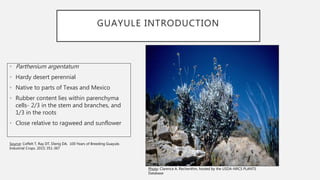
• Parthenium argentatum
• Hardy desert perennial
• Native to parts of Texas and Mexico
• Rubber content lies within parenchyma
cells- 2/3 in the stem and branches, and
1/3 in the roots
• Close relative to ragweed and sunflower
Photo: Clarence A. Rechenthin, hosted by the USDA-NRCS PLANTS
Database
Source: Coffelt T, Ray DT, Dierig DA. 100 Years of Breeding Guayule.
Industrial Crops. 2015; 351-367
EARLY HISTORY
• First documented use of guayule by Spanish in 1500’s
• Natives observed chewing large wads to make balls for games
Photo: “The Ball Game”, Museo
Amparo,
http://cookjmex.blogspot.com.au/2011
/10/puebla-part-5-gods-men-and-
animals-as.html
Source: Coffelt T, Ray DT, Dierig DA. 100 Years of Breeding Guayule. Industrial Crops. 2015; 351-
367
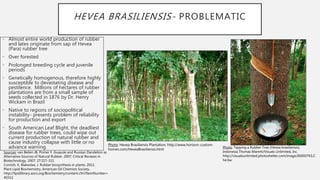
HEVEA BRASILIENSIS- PROBLEMATIC
• Almost entire world production of rubber
and latex originate from sap of Hevea
(Para) rubber tree
• Over forested
• Prolonged breeding cycle and juvenile
periods
• Genetically homogenous, therefore highly
susceptible to devastating disease and
pestilence. Millions of hectares of rubber
plantations are from a small sample of
seeds collected in 1876 by Dr. Henry
Wickam in Brazil
• Native to regions of sociopolitical
instability- presents problem of reliability
for production and export
• South American Leaf Blight, the deadliest
disease for rubber trees, could wipe out
current production of natural rubber and
cause industry collapse with little or no
advance warning.
Photo: Hevea Brasiliensis Plantation, http://www.horizon-custom-
homes.com/HeveaBrasiliensis.html
Photo: Tapping a Rubber Tree (Hevea brasiliensis),
Indonesia.Thomas Marent/Visuals Unlimited, Inc.
http://visualsunlimited.photoshelter.com/image/I0000iTKS.C
he.6w
Sources: van Beilen JB, Poirier Y. Guayule and Russian Dandelion as
Alternative Sources of Natural Rubber. 2007; Critical Reviews in
Biotechnology. 2007; 27:217-321
Cornish, K, Blakeslee, J. Rubber biosynthesis in plants. 2011;
Plant Lipid Biochemistry, American Oil Chemists Society.
http://lipidlibrary.aocs.org/Biochemistry/content.cfm?ItemNumber=
40312
RUBBER RUNDOWN
• Annual worldwide natural rubber production is
almost 8.8 million tons
• 10% of latex harvested from Hevea trees is
manufactured into latex products
• Natural rubber is the end product of
isoprenoid/terpenoid synthesis pathway
• cis-1,4-polyisoprene polymer composed from
isopentyl pyrophosphate monomers
• Molecular weight is the prime determining
factor of rubber quality- higher weight
correlates to higher quality
Sources: Cornish, K, Blakeslee, J. Rubber biosynthesis in plants. 2011;
Plant Lipid Biochemistry, American Oil Chemists Society.
http://lipidlibrary.aocs.org/Biochemistry/content.cfm?ItemNumber=40312
International Rubber Study Group. (n.d.). Retrieved June 20, 2017, from
http://www.rubberstudy.com/
Diagram: Natural rubber chemical formula,
http://byjus.com/chemistry/natural-rubber-and-properties/
A block of guayule rubber without carbon black additive.
Photo: Cooper Tire and Rubber,
http://www.toledoblade.com/Automotive/2016/09/16/Cooper-tests-
promising-for-rubber-made-in-U-S.html
NEED AND DEMAND FOR ALTERNATIVE
RUBBER SOURCES
• 2006 rubber production deficit was almost 250,000 tons
• >90% of international rubber supply comes from Malaysia, Indonesia and Thailand- sociopolitical and economic
instability
• 50% increase in rubber consumption from 2007 to 2020 forecasted by International Rubber Study Group
• 1.5 to 3 million metric ton shortfall in natural rubber production by 2021
Sources: van Beilen JB, Poirier Y. Guayule and Russian Dandelion as Alternative Sources of Natural
Rubber. 2007; Critical Reviews in Biotechnology. 2007; 27:217-321
International Rubber Study Group. (n.d.). Retrieved June 20, 2017, from http://www.rubberstudy.com/
Photo: Rubber (Official Movie Site),
Magnolia Pictures,
http://www.magnetreleasing.com/rubber/
FIRST COMMERCIALIZATION EFFORT
• High price of Amazonian rubber
initiated first effort in early 1900’s
Mexico
• Robust production accounted for 24%
of total rubber imported by US in 1910
• Mexican Revolution ceased production
in 1912
• Concerted effort to relocate operations
across the border to US
• Great Depression halted relocation
efforts in 1929
Photos: Lloyd, Francis Ernest. “The Guayule- A Desert Rubber
Plant.” Popular Science Monthly, vol. 81, Oct. 1912,
en.wikisource.org/wiki/Popular_Science_Monthly/Volume_81/Octo
ber_1912/The_Guayule:_A_Desert_Rubber_Plant.Source: Coffelt T, Ray DT, Dierig DA. 100 Years of
Breeding Guayule. Industrial Crops. 2015; 351-367
SECOND COMMERCIALIZATION EFFORT
• Emergency Rubber Project of World War II enacted after Southeast Asian sources of Hevea were cutoff at the beginning
of the war
• Scientists, agronomists, and farmers imprisoned in Japanese internment camps were crucial to research operations and
owed credit for many guayule discoveries
• Effort ceased at the end of the war when natural rubber trade routes were restored and synthetic rubber was developed
Photo: Dorothea
Lange, 1942.
https://phys.org/new
s/2017-03-variety-
guayule-natural-
source-rubber.html
Photo: Dorothea Lange,
1942,
War Relocation
Authority Photographs
of Japanese-American
Evacuation &
Resettlement Collection.
UC Berkeley, Bancroft
Library
https://calisphere.org/ite
m/ark:/13030/ft1c6003c
x/
Source: Finlay, Mark R. "Behind the Barbed Wire of Manzanar: Guayule and the Search for Natural Rubber." Chemical
Heritage Foundation. N.p., 04 Apr. 2017. Web. 26 June 2017. https://www.chemheritage.org/distillations/magazine/behind-
the-barbed-wire-of-manzanar-guayule-and-the-search-for-natural-rubber
THIRD COMMERCIALIZATION EFFORT
• Crude oil prices
quadrupled in the late
1970’s
• US fear of oil supply
manipulation or
disruption led to Native
Latex commercialization
and Economic
Development Act (1978)
and the Critical
Agricultural Materials Act
(1984)
• Significant yield increases
and modification to fit
modern mechanized
agriculture
• Interest and effort waned
after political climate
shifted
Source: (1861-1944 WTI,
1945-1983 Arabian Light,
1984-2011 Brent)
Source: Coffelt T, Ray DT, Dierig DA. 100 Years
of Breeding Guayule. Industrial Crops. 2015;
351-367
FOURTH COMMERCIALIZATION EFFORT:
PRESENT DAY
• Renewed interest with an estimated 1-6% general
population development of Hevea latex allergy
• Companies foresee sustainability and sociopolitical
issues with Hevea- search for a domestic
alternative for latex and rubber sources
• Unlike previous efforts, current commercialization
is driven by corporations and not government
support
Source: Coffelt T, Ray DT, Dierig DA. 100 Years of Breeding Guayule.
Industrial Crops. 2015; 351-367
Photo: Jesse Chahuk, 2015,
https://www.wired.com/2015/07/superplant-may-finally-topple-
rubber-monopoly/
BIOCHEMICAL AND PHYSIOLOGICAL
BACKGROUND OF GUAYULE
• Rubber synthesis pathway still undiscovered
• 2012 study concluded either gene expression
does not control enzymatic activity of rubber
transferase complex and posttranslational
modifications are actual point of control, or
proteins that encode the genes analyzed are
not those regulating rubber biosynthesis
• Guayule rubber synthesis is temperature
dependent, with highest production in cold
months
Source: Veatch-Blohm, M. E., D. T. Ray, and A. Gehrels. "Night Temperature,
Rubber Production, and Carbon Exchange in Guayule." Industrial Crops and
Products 25.1 (n.d.): 34-43. ScienceDirect. Web. 8 June 2017.
RUBBER BIOSYNTHESIS
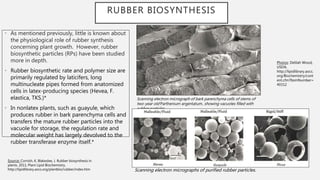
• As mentioned previously, little is known about
the physiological role of rubber synthesis
concerning plant growth. However, rubber
biosynthetic particles (RPs) have been studied
more in depth.
• Rubber biosynthetic rate and polymer size are
primarily regulated by laticifers, long
multinucleate pipes formed from anatomized
cells in latex-producing species (Hevea, F.
elastica, TKS.)*
• In nonlatex plants, such as guayule, which
produces rubber in bark parenchyma cells and
transfers the mature rubber particles into the
vacuole for storage, the regulation rate and
molecular weight has largely devolved to the
rubber transferase enzyme itself.*
Scanning electron micrograph of bark parenchyma cells of stems of
two-year old Parthenium argentatum, showing vacuoles filled with
rubber particles.
Scanning electron micrographs of purified rubber particles.
Photos: Delilah Wood,
USDA,
http://lipidlibrary.aocs.
org/Biochemistry/cont
ent.cfm?ItemNumber=
40312
Source: Cornish, K, Blakeslee, J. Rubber biosynthesis in
plants. 2011; Plant Lipid Biochemistry,
http://lipidlibrary.aocs.org/plantbio/rubber/index.htm
DESIRABLE GENETICS
• Heterozygous genetic makeup of
plants in guayule germplasm
collection
• Facultative apomixis in polyploid
guayule continuously releases
new variability with every seed
harvest
Diagram: Quick Reference Apomixis, Amber Lynch for
Bridgestone Agro Operations Guayule Research Farm
Source: Coffelt T, Ray DT, Dierig DA. 100 Years of
Breeding Guayule. Industrial Crops. 2015; 351-367
FACULTATIVE APOMIXIS
• Clonal propagation by seed
• Facultative- does not happen all the time
• Sporophytic, self-compatible polyploids
• Frequency of apomictic reproduction can
vary among plants, and even flowers on a
single plant
Source/Diagram: Ray, D.T., D.A. Dierig, and A.E. Thompson. 1990. Facultative apomixis in guayule
as a source of genetic diversity. p. 245-247. In: J. Janick and J.E. Simon (eds.), Advances in new
crops. Timber Press, Portland, OR.
GUAYULE:
A COMPARISON
PROS CONS
• High tolerance for drought and
extreme temperatures (-18 to 49.5ºC)
• High genetic variability and diversity
• Early success with breeding high
yielding cultivars- new lines yield up to
250% more rubber than older
midcentury lines
• High resistance to disease and
pestilence
• Domestic plant (native to Texas and
Mexico); removes trade and economic
dependence on unstable foreign
countries
• Other parts of guayule can be used for
a variety of uses (Bagasse, resin, etc.)
• Does not contain the same proteins as
H. brasiliensis that cause allergic
reactions
• Produces high molecular weight
• Extreme
variability
within and
between
lines
• Partially
domesticate
d
• Apomictic
• Perennial that requires relatively large
amounts of land for breeding programs
• Physiologically immature for 2 years
• Asexual reproduction
• Small seeds (1,000-1,500 seeds per
gram)
• Unreliable germination
• Seed dormancy must be broken by
special treatments
• Progenies often fail to repeat high
rubber content of parents
• Transplantation from greenhouse
preferred- direct seeding yields
unreliable results
• Longer transport distances and
increased storage times cause rubber
degradation
Photo: Yulex Corporation,
http://yulex.com/products/guayule/
Sources: Coffelt T, Ray DT, Dierig DA. 100 Years of
Breeding Guayule. Industrial Crops. 2015; 351-367
van Beilen JB, Poirier Y. Guayule and Russian
Dandelion as Alternative Sources of Natural Rubber.
2007; Critical Reviews in Biotechnology. 2007; 27:217-
321
Cornish, K, Blakeslee, J. Rubber biosynthesis in plants.
2011; Plant Lipid Biochemistry, American Oil Chemists
Society.
http://lipidlibrary.aocs.org/Biochemistry/content.cfm?I
temNumber=40312
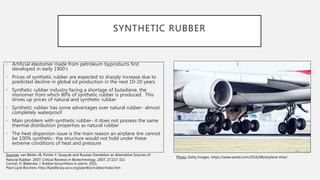
SYNTHETIC RUBBER
• Artificial elastomer made from petroleum byproducts first
developed in early 1900’s
• Prices of synthetic rubber are expected to sharply increase due to
predicted decline in global oil production in the next 10-20 years
• Synthetic rubber industry facing a shortage of butadiene, the
monomer from which 80% of synthetic rubber is produced. This
drives up prices of natural and synthetic rubber
• Synthetic rubber has some advantages over natural rubber- almost
completely waterproof
• Main problem with synthetic rubber- it does not possess the same
thermal distribution properties as natural rubber
• The heat dispersion issue is the main reason an airplane tire cannot
be 100% synthetic- the structure would not hold under these
extreme conditions of heat and pressure
Sources: van Beilen JB, Poirier Y. Guayule and Russian Dandelion as Alternative Sources of
Natural Rubber. 2007; Critical Reviews in Biotechnology. 2007; 27:217-321
Cornish, K, Blakeslee, J. Rubber biosynthesis in plants. 2011;
Plant Lipid Biochem, http://lipidlibrary.aocs.org/plantbio/rubber/index.htm
Photo: Getty Images, https://www.wired.com/2016/08/airplane-tires/
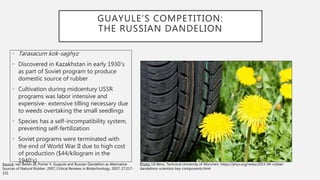
GUAYULE’S COMPETITION:
THE RUSSIAN DANDELION
• Taraxacum kok-saghyz
• Discovered in Kazakhstan in early 1930’s
as part of Soviet program to produce
domestic source of rubber
• Cultivation during midcentury USSR
programs was labor intensive and
expensive- extensive tilling necessary due
to weeds overtaking the small seedlings
• Species has a self-incompatibility system,
preventing self-fertilization
• Soviet programs were terminated with
the end of World War II due to high cost
of production ($44/kilogram in the
1940’s)Source: van Beilen JB, Poirier Y. Guayule and Russian Dandelion as Alternative
Sources of Natural Rubber. 2007; Critical Reviews in Biotechnology. 2007; 27:217-
321
Photo: Uli Benz, Technical University of München, https://phys.org/news/2015-04-rubber-
dandelions-scientists-key-components.html
TARAXACUM KOK-SAGHYZ
• Short life cycle (annual, 6-8 months)
• Modern-day resurgence as an
alternative to Hevea rubber
• DuPont, Bridgestone, Cooper and
Continental Tire are involved in various
TKS projects
• Full-scale development and
commercialization would require
building up molecular tools such as
BAC libraries, RNAi silencing,
microarrays, etc.
• Laticifers (distinct cell linkages
containing latex and rubber particles)
still need further research
Source: van Beilen JB, Poirier Y. Guayule and Russian Dandelion as Alternative
Sources of Natural Rubber. 2007; Critical Reviews in Biotechnology. 2007; 27:217-
321
Photo: Dandelion field, http://landscapermagazine.com/wp-
content/uploads/2015/08/dandelions-field.jpeg
PARTHENIUM ARGENTATUM
VERSUS
TARAXACUM KOK-SAGHYZ
Source: JB van Beilen and Y Poirier (2007) Guayule and Russian Dandelion as
Alternative Sources of Natural Rubber, Critical Reviews in Biotechnology, 27:4,
217-231.
THE SACATON PROJECT
• Department of Defense issued $20 million research grant to Gila
River Indian Community in Sacaton, Arizona
• 206 acres of guayule planted by 1986
• Low rubber yield and worries about paying back the loan led to
USDA takeover of Sacaton project
• In 1986, USDA contracted Firestone Tire and Rubber to produce 54
tons of guayule rubber in conjunction with Sacaton project
• Firestone’s pilot guayule processing plant completed in 1988
• Bridgestone acquired Firestone in 1988 for $2.6 billion
• Solvent leaks, contaminated latex, and other problems arose; both
the Sacaton project and the Firestone plant closed in 1991
Sources: EU-PEARLS 2010 W.W. Schloman, Jr.
https://www.researchgate.net/profile/W_Schloman/publication/312040009_Guayule
_Rubber_Production_at_Sacaton_Arizona_1987-
1990/links/586bca3e08ae329d621213d7.pdf?origin=publication_detail
Moore, Miles. “Guayule, Russian Dandelion through the Years.” Rubber & Plastics
News, 12 June 2013, www.rubbernews.com/article/20130607/NEWS/130609960.
BRIDGESTONE:
A RENEWED COMMITMENT
Source: Bridgestone Biorubber Process Research Center Grand
Opening. Bridgestone Corporation, 22 Sept. 2014,
www.youtube.com/watch?v=KkTopAcOqJI.
BRIDGESTONE AGRO OPERATIONS
GUAYULE RESEARCH FARM
• Eloy, Arizona
• Established in
2013
• 281 acres
• Two greenhouses
• Onsite laboratory
• 17 employees
Source: “From Seed to Tread: Bridgestone Reveals First Tires Made Entirely of Natural Rubber
Components from Company’s Guayule Research Operations.” Bridgestone Global Website,
Bridgestone Corporation, 1 Oct. 2015,
www.bridgestone.com/corporate/news/2015100101.html.
BRIDGESTONE BIORUBBER PROCESS RESEARCH CENTER
• Mesa, Arizona
• Established in 2014
• 8,300 ft² office and
laboratory
• Four platform, 3,500 ft²
shrub prep building
• 5,500 ft², two-level
process building for
rubber extraction, co-
product and solvent
recycling
• 3,100 ft² mechanical and
electrical building
Source/Photos: “Bridgestone Begins Producing Natural Rubber in Mesa,
Arizona.” Bridgestone Americas, Inc., 22 Sept. 2014,
www.bridgestoneamericas.com/en/newsroom/press-releases/2014/bridgestone-begins-
RUBBER EXTRACTION PROCESSES
Flotation/Saltillo Extraction
•Ground shrubs are placed in a large
vat of dilute sodium hydroxide until
the woody tissue takes up water and
sinks to the bottom and the resinous
rubber floats to the top in what are
called “worms” . These worms are
skimmed from the top and the rubber
is deresinated with acetone.*
•Used in Mexican guayule processing
facilities until 1990.
Sequential Extraction
•Resin is first extracted with acetone or
another polar organic solvent, and
then the rubber is extracted with
hexane. *
•Does not appear to be an
economically viable method.
•Does not assure the selective recovery
of the high-molecular weight fraction
of the rubber polymer*
Simultaneous Extraction
•A mixture of solvents, usually acetone
and hexane/pentane are used. After
the initial extraction, more acetone is
added to coagulate the high
molecular weight rubber. *
•Current method of extraction for
Bridgestone.
•Option to fractionate the rubber is
provided, unlike Sequential Extraction
Sources:
Schloman, W. W. “Processing
Guayule for Latex and Bulk
Rubber.” Industrial Crops and
Products, no. 22, 21 Apr. 2004,
pp. 41–47. Science Direct.
Ray, D.T. Guayule: A Source of
Natural Rubber. New Crops.
1993; 338-343
Photo: Bridgestone Americas, courtesy of Green Chemicals Blog.
https://greenchemicalsblog.com/2013/05/22/bio-rubber-
developments/
FLOTATION/SALTILLO PROCESS
Diagram: The Firestone Tire and Rubber Company (1987).
Process for extracting rubber and by-products from guayule
and guayule-like shrubs. EP0039910 B1.
Photo: Ansel Adams, 1943,
Library of Congress Prints and
Photographs Division, LC-DIG-ppprs-
00301
SIMULTANEOUS EXTRACTION
Diagram: The Firestone Tire and Rubber Company (1987). Use of rubber solvent-
resin solvent and miscella mixtures for extraction-expression of rubber and
resins from guayule shrub. US4681929 A.
Guayule bale on display at the Biorubber Process Research Center in
Mesa, AZ.
Photo: Jim Motavalli, 2014. https://www.mnn.com/green-
tech/transportation/blogs/bridgestone-is-growing-tires-in-the-
SIMULTANEOUS EXTRACTION PROCESS:
IN DEPTH
1. Shrub is sliced into 3-4cm pieces
2. Small pieces are sent through a flaker to flatten and shear shrub tissue which ruptures cells containing
rubber
3. Flaked shrub combines with extraction solvent¹ at 50°C to form slurry. Bagasse separates from the
miscella by a continuous screen bowl centrifuge. A percentage of the miscella is recycled and returns to
the extraction system to function as the rubber solvent.
4. Rubber fractionation is a multi-stage operation involving a series of five mixer-settler units. *
1. Miscella is mixed with acetone to thicken rubber, which is precipitated out and settles to the bottom of the mixer-settler.
2. The lighter liquid phase containing most of the resin is pumped continuously from the top of the unit.
3. The coagulated rubber is then pumped through the down-stream mixer-settler units, where a mixture of pentane or
hexane and acetone capable of dissolving both resin and low-molecular weight rubber is pumped counter-current to the
rubber-containing phase.
4. This strips the rubber phase of its resin and low-molecular weight rubber components.
5. The solvent-swollen, high molecular weight rubber phase was pumped from the bottom of the fifth-stage mixer-settler
unit. The stream containing the extracted resin and low-molecular weight rubber is decanted from the top of the second
stage mixer-settler.
5. The swollen rubber phase passes through a twin-screw extruder-devolatizer that uses a combination of
heat and reduced pressure to strip off the solvent. The extruded rubber product is compressed into
solid rectangular bales weighing 30-35 kg.*
Source/Diagram: W.W. Schloman, Processing guayule for latex
and bulk rubber, Industrial Crops and Products, Volume 22,
Issue 1, 2005, Pages 41-47, ISSN 0926-6690,
http://dx.doi.org/10.1016/j.indcrop.2004.04.031.
NOTE: While Bridgestone’s
current rubber extraction process is
highly confidential, the
Firestone/Sacaton Project’s general
extraction methods and diagrams
were published in a paper by W.W.
Schloman in 2004.
¹Acetone-pentane azeotrope or acetone-hexane mixture. Primary extraction medium was recycled
rubber-resin miscella.
GUAYULE
• Bagasse- fibrous, leftover plant material
for feedstock
• Resin- fatty acid triglycerides and
terpenoids for rubber additives, wood
preservative
• Inulin- storage carbohydrate (fructan)
for non-food applications or
fermentation into bioethanol
• Glucose- simple sugar for biogas
production
• Dandelion greens- plant material for
human consumption
TKS
INDUSTRIAL CROP BYPRODUCTS
(EXCLUDING RUBBER)
Photo: Dandelion in traffic,
http://www.ourherbgarden.com/her
b-history/dandelion-history.html
GUAYULE GROWING AREAS
Suitable U.S. Growing Areas
• California: 2,435,000 acres
• Arizona: 682,000 acres
• New Mexico: 895,000
acres
• Texas: 17,556,000 acres
Suitable Eastern Hemisphere
Growing Areas
• Spain
• France
• Italy
• Greece
• Turkey
• Israel
• Morocco
Sources: Bridgestone Agro
Operations Guayule
Research Farm
“European Natural Rubber
Substitute from
Guayule.” European
Commission, 1 Feb. 2015,
ec.europa.eu/growth/tools-
databases/eip-raw-
materials/en/content/europ
ean-natural-rubber-
substitute-guayule.
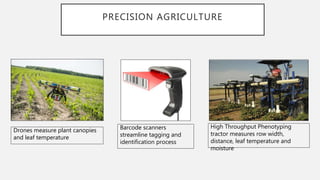
PRECISION AGRICULTURE
Drones measure plant canopies
and leaf temperature
Barcode scanners
streamline tagging and
identification process
High Throughput Phenotyping
tractor measures row width,
distance, leaf temperature and
moisture
Diagram: Mark Cruz for Bridgestone Agro Operations Guayule Research Farm
BRIDGESTONE AND UNIVERSITY OF ARIZONA:
COLLABORATIVE USDA GRANT PROJECT
Bridgestone and University of Arizona
are studying rubber content of USDA and
Bridgestone guayule lines. Plants were
pollinated, labelled and bagged biweekly. Seed
was collected from pollinated flowers 4-6 weeks
after crossing. Heavy monsoon rains did impede
pollination and collection for the majority of July.
Photo: Mark Cruz for Bridgestone Agro
Operations Guayule Research Farm, June
2017.
BRIDGESTONE RESEARCH:
LEAF AREA PAPER
Dr. David Dierig (Section Manager) and Dr.
Von Mark Von Cruz (Plant Breeder) began working on
a paper this summer analyzing leaf area differences on
the guayule USDA lines.
Five old leaves and five new leaves were
collected from five plants of each line (41USDA lines
planted at Bridgestone, 52 lines total in USDA seed
vault). Selections were made to ensure no
biotic/abiotic damage to samples for proper analysis.
All guayule leaves were pressed for 24 hours to ensure
accurate serration and area measurements.
Leaves were scanned into PDF format, then
individually cropped to be analyzed by MorphoLeaf
software.To ensure area data accuracy, leaves were
also individually analyzed on a Licor Leaf Area Meter.
Photos: Kelly McDowell for Bridgestone Agro Operations Guayule Research
Farm
LineN396,Plant#302,oldLineAZ2,Plant#01,
old
LineCFS24,Plant#264,
old
MORPHOLEAF SOFTWARE
MorphoLeaf is a free software
allows users to extract the outline of leaf
images and identify biologically-relevant
points of interest. The software
quantifies morphological parameters of
leaves and then reconstructs average
leaf forms.
Source/Photo: MorphoLeaf Software,
http://morpholeaf.versailles.inra.fr/#features
Arabadopsis analysis example- extraction of leaf tip and
teeth sinuses
Preliminary results from
average area analysis
Source: Bridgestone Agro
Operations Guayule
Research Farm
Possible results from analysis for future use:
 Rubber/latex yields
 Drought tolerance
 Photosynthesis, Photosynthetic Active Radiation, Daily Light Integral and Specific Leaf Area
 Biomass productivity (direct correlation)
 Leaf shape characteristics: variations, benefits, i.e. leaf wax, trichomes

Guayule presentation

  • 1.
    GUAYULE: SMALL SHRUB, BIGDREAMS Bridgestone Internship Summer 2017 PLS 492 Dr. Tanya Quist Kelly McDowell
  • 2.
    GUAYULE INTRODUCTION • Partheniumargentatum • Hardy desert perennial • Native to parts of Texas and Mexico • Rubber content lies within parenchyma cells- 2/3 in the stem and branches, and 1/3 in the roots • Close relative to ragweed and sunflower Photo: Clarence A. Rechenthin, hosted by the USDA-NRCS PLANTS Database Source: Coffelt T, Ray DT, Dierig DA. 100 Years of Breeding Guayule. Industrial Crops. 2015; 351-367
  • 3.
    EARLY HISTORY • Firstdocumented use of guayule by Spanish in 1500’s • Natives observed chewing large wads to make balls for games Photo: “The Ball Game”, Museo Amparo, http://cookjmex.blogspot.com.au/2011 /10/puebla-part-5-gods-men-and- animals-as.html Source: Coffelt T, Ray DT, Dierig DA. 100 Years of Breeding Guayule. Industrial Crops. 2015; 351- 367
  • 4.
    HEVEA BRASILIENSIS- PROBLEMATIC •Almost entire world production of rubber and latex originate from sap of Hevea (Para) rubber tree • Over forested • Prolonged breeding cycle and juvenile periods • Genetically homogenous, therefore highly susceptible to devastating disease and pestilence. Millions of hectares of rubber plantations are from a small sample of seeds collected in 1876 by Dr. Henry Wickam in Brazil • Native to regions of sociopolitical instability- presents problem of reliability for production and export • South American Leaf Blight, the deadliest disease for rubber trees, could wipe out current production of natural rubber and cause industry collapse with little or no advance warning. Photo: Hevea Brasiliensis Plantation, http://www.horizon-custom- homes.com/HeveaBrasiliensis.html Photo: Tapping a Rubber Tree (Hevea brasiliensis), Indonesia.Thomas Marent/Visuals Unlimited, Inc. http://visualsunlimited.photoshelter.com/image/I0000iTKS.C he.6w Sources: van Beilen JB, Poirier Y. Guayule and Russian Dandelion as Alternative Sources of Natural Rubber. 2007; Critical Reviews in Biotechnology. 2007; 27:217-321 Cornish, K, Blakeslee, J. Rubber biosynthesis in plants. 2011; Plant Lipid Biochemistry, American Oil Chemists Society. http://lipidlibrary.aocs.org/Biochemistry/content.cfm?ItemNumber= 40312
  • 5.
    RUBBER RUNDOWN • Annualworldwide natural rubber production is almost 8.8 million tons • 10% of latex harvested from Hevea trees is manufactured into latex products • Natural rubber is the end product of isoprenoid/terpenoid synthesis pathway • cis-1,4-polyisoprene polymer composed from isopentyl pyrophosphate monomers • Molecular weight is the prime determining factor of rubber quality- higher weight correlates to higher quality Sources: Cornish, K, Blakeslee, J. Rubber biosynthesis in plants. 2011; Plant Lipid Biochemistry, American Oil Chemists Society. http://lipidlibrary.aocs.org/Biochemistry/content.cfm?ItemNumber=40312 International Rubber Study Group. (n.d.). Retrieved June 20, 2017, from http://www.rubberstudy.com/ Diagram: Natural rubber chemical formula, http://byjus.com/chemistry/natural-rubber-and-properties/ A block of guayule rubber without carbon black additive. Photo: Cooper Tire and Rubber, http://www.toledoblade.com/Automotive/2016/09/16/Cooper-tests- promising-for-rubber-made-in-U-S.html
  • 6.
    NEED AND DEMANDFOR ALTERNATIVE RUBBER SOURCES • 2006 rubber production deficit was almost 250,000 tons • >90% of international rubber supply comes from Malaysia, Indonesia and Thailand- sociopolitical and economic instability • 50% increase in rubber consumption from 2007 to 2020 forecasted by International Rubber Study Group • 1.5 to 3 million metric ton shortfall in natural rubber production by 2021 Sources: van Beilen JB, Poirier Y. Guayule and Russian Dandelion as Alternative Sources of Natural Rubber. 2007; Critical Reviews in Biotechnology. 2007; 27:217-321 International Rubber Study Group. (n.d.). Retrieved June 20, 2017, from http://www.rubberstudy.com/ Photo: Rubber (Official Movie Site), Magnolia Pictures, http://www.magnetreleasing.com/rubber/
  • 7.
    FIRST COMMERCIALIZATION EFFORT •High price of Amazonian rubber initiated first effort in early 1900’s Mexico • Robust production accounted for 24% of total rubber imported by US in 1910 • Mexican Revolution ceased production in 1912 • Concerted effort to relocate operations across the border to US • Great Depression halted relocation efforts in 1929 Photos: Lloyd, Francis Ernest. “The Guayule- A Desert Rubber Plant.” Popular Science Monthly, vol. 81, Oct. 1912, en.wikisource.org/wiki/Popular_Science_Monthly/Volume_81/Octo ber_1912/The_Guayule:_A_Desert_Rubber_Plant.Source: Coffelt T, Ray DT, Dierig DA. 100 Years of Breeding Guayule. Industrial Crops. 2015; 351-367
  • 8.
    SECOND COMMERCIALIZATION EFFORT •Emergency Rubber Project of World War II enacted after Southeast Asian sources of Hevea were cutoff at the beginning of the war • Scientists, agronomists, and farmers imprisoned in Japanese internment camps were crucial to research operations and owed credit for many guayule discoveries • Effort ceased at the end of the war when natural rubber trade routes were restored and synthetic rubber was developed Photo: Dorothea Lange, 1942. https://phys.org/new s/2017-03-variety- guayule-natural- source-rubber.html Photo: Dorothea Lange, 1942, War Relocation Authority Photographs of Japanese-American Evacuation & Resettlement Collection. UC Berkeley, Bancroft Library https://calisphere.org/ite m/ark:/13030/ft1c6003c x/ Source: Finlay, Mark R. "Behind the Barbed Wire of Manzanar: Guayule and the Search for Natural Rubber." Chemical Heritage Foundation. N.p., 04 Apr. 2017. Web. 26 June 2017. https://www.chemheritage.org/distillations/magazine/behind- the-barbed-wire-of-manzanar-guayule-and-the-search-for-natural-rubber
  • 9.
    THIRD COMMERCIALIZATION EFFORT •Crude oil prices quadrupled in the late 1970’s • US fear of oil supply manipulation or disruption led to Native Latex commercialization and Economic Development Act (1978) and the Critical Agricultural Materials Act (1984) • Significant yield increases and modification to fit modern mechanized agriculture • Interest and effort waned after political climate shifted Source: (1861-1944 WTI, 1945-1983 Arabian Light, 1984-2011 Brent) Source: Coffelt T, Ray DT, Dierig DA. 100 Years of Breeding Guayule. Industrial Crops. 2015; 351-367
  • 10.
    FOURTH COMMERCIALIZATION EFFORT: PRESENTDAY • Renewed interest with an estimated 1-6% general population development of Hevea latex allergy • Companies foresee sustainability and sociopolitical issues with Hevea- search for a domestic alternative for latex and rubber sources • Unlike previous efforts, current commercialization is driven by corporations and not government support Source: Coffelt T, Ray DT, Dierig DA. 100 Years of Breeding Guayule. Industrial Crops. 2015; 351-367 Photo: Jesse Chahuk, 2015, https://www.wired.com/2015/07/superplant-may-finally-topple- rubber-monopoly/
  • 11.
    BIOCHEMICAL AND PHYSIOLOGICAL BACKGROUNDOF GUAYULE • Rubber synthesis pathway still undiscovered • 2012 study concluded either gene expression does not control enzymatic activity of rubber transferase complex and posttranslational modifications are actual point of control, or proteins that encode the genes analyzed are not those regulating rubber biosynthesis • Guayule rubber synthesis is temperature dependent, with highest production in cold months Source: Veatch-Blohm, M. E., D. T. Ray, and A. Gehrels. "Night Temperature, Rubber Production, and Carbon Exchange in Guayule." Industrial Crops and Products 25.1 (n.d.): 34-43. ScienceDirect. Web. 8 June 2017.
  • 12.
    RUBBER BIOSYNTHESIS • Asmentioned previously, little is known about the physiological role of rubber synthesis concerning plant growth. However, rubber biosynthetic particles (RPs) have been studied more in depth. • Rubber biosynthetic rate and polymer size are primarily regulated by laticifers, long multinucleate pipes formed from anatomized cells in latex-producing species (Hevea, F. elastica, TKS.)* • In nonlatex plants, such as guayule, which produces rubber in bark parenchyma cells and transfers the mature rubber particles into the vacuole for storage, the regulation rate and molecular weight has largely devolved to the rubber transferase enzyme itself.* Scanning electron micrograph of bark parenchyma cells of stems of two-year old Parthenium argentatum, showing vacuoles filled with rubber particles. Scanning electron micrographs of purified rubber particles. Photos: Delilah Wood, USDA, http://lipidlibrary.aocs. org/Biochemistry/cont ent.cfm?ItemNumber= 40312 Source: Cornish, K, Blakeslee, J. Rubber biosynthesis in plants. 2011; Plant Lipid Biochemistry, http://lipidlibrary.aocs.org/plantbio/rubber/index.htm
  • 13.
    DESIRABLE GENETICS • Heterozygousgenetic makeup of plants in guayule germplasm collection • Facultative apomixis in polyploid guayule continuously releases new variability with every seed harvest Diagram: Quick Reference Apomixis, Amber Lynch for Bridgestone Agro Operations Guayule Research Farm Source: Coffelt T, Ray DT, Dierig DA. 100 Years of Breeding Guayule. Industrial Crops. 2015; 351-367
  • 14.
    FACULTATIVE APOMIXIS • Clonalpropagation by seed • Facultative- does not happen all the time • Sporophytic, self-compatible polyploids • Frequency of apomictic reproduction can vary among plants, and even flowers on a single plant Source/Diagram: Ray, D.T., D.A. Dierig, and A.E. Thompson. 1990. Facultative apomixis in guayule as a source of genetic diversity. p. 245-247. In: J. Janick and J.E. Simon (eds.), Advances in new crops. Timber Press, Portland, OR.
  • 15.
    GUAYULE: A COMPARISON PROS CONS •High tolerance for drought and extreme temperatures (-18 to 49.5ºC) • High genetic variability and diversity • Early success with breeding high yielding cultivars- new lines yield up to 250% more rubber than older midcentury lines • High resistance to disease and pestilence • Domestic plant (native to Texas and Mexico); removes trade and economic dependence on unstable foreign countries • Other parts of guayule can be used for a variety of uses (Bagasse, resin, etc.) • Does not contain the same proteins as H. brasiliensis that cause allergic reactions • Produces high molecular weight • Extreme variability within and between lines • Partially domesticate d • Apomictic • Perennial that requires relatively large amounts of land for breeding programs • Physiologically immature for 2 years • Asexual reproduction • Small seeds (1,000-1,500 seeds per gram) • Unreliable germination • Seed dormancy must be broken by special treatments • Progenies often fail to repeat high rubber content of parents • Transplantation from greenhouse preferred- direct seeding yields unreliable results • Longer transport distances and increased storage times cause rubber degradation Photo: Yulex Corporation, http://yulex.com/products/guayule/ Sources: Coffelt T, Ray DT, Dierig DA. 100 Years of Breeding Guayule. Industrial Crops. 2015; 351-367 van Beilen JB, Poirier Y. Guayule and Russian Dandelion as Alternative Sources of Natural Rubber. 2007; Critical Reviews in Biotechnology. 2007; 27:217- 321 Cornish, K, Blakeslee, J. Rubber biosynthesis in plants. 2011; Plant Lipid Biochemistry, American Oil Chemists Society. http://lipidlibrary.aocs.org/Biochemistry/content.cfm?I temNumber=40312
  • 16.
    SYNTHETIC RUBBER • Artificialelastomer made from petroleum byproducts first developed in early 1900’s • Prices of synthetic rubber are expected to sharply increase due to predicted decline in global oil production in the next 10-20 years • Synthetic rubber industry facing a shortage of butadiene, the monomer from which 80% of synthetic rubber is produced. This drives up prices of natural and synthetic rubber • Synthetic rubber has some advantages over natural rubber- almost completely waterproof • Main problem with synthetic rubber- it does not possess the same thermal distribution properties as natural rubber • The heat dispersion issue is the main reason an airplane tire cannot be 100% synthetic- the structure would not hold under these extreme conditions of heat and pressure Sources: van Beilen JB, Poirier Y. Guayule and Russian Dandelion as Alternative Sources of Natural Rubber. 2007; Critical Reviews in Biotechnology. 2007; 27:217-321 Cornish, K, Blakeslee, J. Rubber biosynthesis in plants. 2011; Plant Lipid Biochem, http://lipidlibrary.aocs.org/plantbio/rubber/index.htm Photo: Getty Images, https://www.wired.com/2016/08/airplane-tires/
  • 17.
    GUAYULE’S COMPETITION: THE RUSSIANDANDELION • Taraxacum kok-saghyz • Discovered in Kazakhstan in early 1930’s as part of Soviet program to produce domestic source of rubber • Cultivation during midcentury USSR programs was labor intensive and expensive- extensive tilling necessary due to weeds overtaking the small seedlings • Species has a self-incompatibility system, preventing self-fertilization • Soviet programs were terminated with the end of World War II due to high cost of production ($44/kilogram in the 1940’s)Source: van Beilen JB, Poirier Y. Guayule and Russian Dandelion as Alternative Sources of Natural Rubber. 2007; Critical Reviews in Biotechnology. 2007; 27:217- 321 Photo: Uli Benz, Technical University of München, https://phys.org/news/2015-04-rubber- dandelions-scientists-key-components.html
  • 18.
    TARAXACUM KOK-SAGHYZ • Shortlife cycle (annual, 6-8 months) • Modern-day resurgence as an alternative to Hevea rubber • DuPont, Bridgestone, Cooper and Continental Tire are involved in various TKS projects • Full-scale development and commercialization would require building up molecular tools such as BAC libraries, RNAi silencing, microarrays, etc. • Laticifers (distinct cell linkages containing latex and rubber particles) still need further research Source: van Beilen JB, Poirier Y. Guayule and Russian Dandelion as Alternative Sources of Natural Rubber. 2007; Critical Reviews in Biotechnology. 2007; 27:217- 321 Photo: Dandelion field, http://landscapermagazine.com/wp- content/uploads/2015/08/dandelions-field.jpeg
  • 19.
    PARTHENIUM ARGENTATUM VERSUS TARAXACUM KOK-SAGHYZ Source:JB van Beilen and Y Poirier (2007) Guayule and Russian Dandelion as Alternative Sources of Natural Rubber, Critical Reviews in Biotechnology, 27:4, 217-231.
  • 20.
    THE SACATON PROJECT •Department of Defense issued $20 million research grant to Gila River Indian Community in Sacaton, Arizona • 206 acres of guayule planted by 1986 • Low rubber yield and worries about paying back the loan led to USDA takeover of Sacaton project • In 1986, USDA contracted Firestone Tire and Rubber to produce 54 tons of guayule rubber in conjunction with Sacaton project • Firestone’s pilot guayule processing plant completed in 1988 • Bridgestone acquired Firestone in 1988 for $2.6 billion • Solvent leaks, contaminated latex, and other problems arose; both the Sacaton project and the Firestone plant closed in 1991 Sources: EU-PEARLS 2010 W.W. Schloman, Jr. https://www.researchgate.net/profile/W_Schloman/publication/312040009_Guayule _Rubber_Production_at_Sacaton_Arizona_1987- 1990/links/586bca3e08ae329d621213d7.pdf?origin=publication_detail Moore, Miles. “Guayule, Russian Dandelion through the Years.” Rubber & Plastics News, 12 June 2013, www.rubbernews.com/article/20130607/NEWS/130609960.
  • 21.
    BRIDGESTONE: A RENEWED COMMITMENT Source:Bridgestone Biorubber Process Research Center Grand Opening. Bridgestone Corporation, 22 Sept. 2014, www.youtube.com/watch?v=KkTopAcOqJI.
  • 22.
    BRIDGESTONE AGRO OPERATIONS GUAYULERESEARCH FARM • Eloy, Arizona • Established in 2013 • 281 acres • Two greenhouses • Onsite laboratory • 17 employees Source: “From Seed to Tread: Bridgestone Reveals First Tires Made Entirely of Natural Rubber Components from Company’s Guayule Research Operations.” Bridgestone Global Website, Bridgestone Corporation, 1 Oct. 2015, www.bridgestone.com/corporate/news/2015100101.html.
  • 23.
    BRIDGESTONE BIORUBBER PROCESSRESEARCH CENTER • Mesa, Arizona • Established in 2014 • 8,300 ft² office and laboratory • Four platform, 3,500 ft² shrub prep building • 5,500 ft², two-level process building for rubber extraction, co- product and solvent recycling • 3,100 ft² mechanical and electrical building Source/Photos: “Bridgestone Begins Producing Natural Rubber in Mesa, Arizona.” Bridgestone Americas, Inc., 22 Sept. 2014, www.bridgestoneamericas.com/en/newsroom/press-releases/2014/bridgestone-begins-
  • 24.
    RUBBER EXTRACTION PROCESSES Flotation/SaltilloExtraction •Ground shrubs are placed in a large vat of dilute sodium hydroxide until the woody tissue takes up water and sinks to the bottom and the resinous rubber floats to the top in what are called “worms” . These worms are skimmed from the top and the rubber is deresinated with acetone.* •Used in Mexican guayule processing facilities until 1990. Sequential Extraction •Resin is first extracted with acetone or another polar organic solvent, and then the rubber is extracted with hexane. * •Does not appear to be an economically viable method. •Does not assure the selective recovery of the high-molecular weight fraction of the rubber polymer* Simultaneous Extraction •A mixture of solvents, usually acetone and hexane/pentane are used. After the initial extraction, more acetone is added to coagulate the high molecular weight rubber. * •Current method of extraction for Bridgestone. •Option to fractionate the rubber is provided, unlike Sequential Extraction Sources: Schloman, W. W. “Processing Guayule for Latex and Bulk Rubber.” Industrial Crops and Products, no. 22, 21 Apr. 2004, pp. 41–47. Science Direct. Ray, D.T. Guayule: A Source of Natural Rubber. New Crops. 1993; 338-343 Photo: Bridgestone Americas, courtesy of Green Chemicals Blog. https://greenchemicalsblog.com/2013/05/22/bio-rubber- developments/
  • 25.
    FLOTATION/SALTILLO PROCESS Diagram: TheFirestone Tire and Rubber Company (1987). Process for extracting rubber and by-products from guayule and guayule-like shrubs. EP0039910 B1. Photo: Ansel Adams, 1943, Library of Congress Prints and Photographs Division, LC-DIG-ppprs- 00301
  • 26.
    SIMULTANEOUS EXTRACTION Diagram: TheFirestone Tire and Rubber Company (1987). Use of rubber solvent- resin solvent and miscella mixtures for extraction-expression of rubber and resins from guayule shrub. US4681929 A. Guayule bale on display at the Biorubber Process Research Center in Mesa, AZ. Photo: Jim Motavalli, 2014. https://www.mnn.com/green- tech/transportation/blogs/bridgestone-is-growing-tires-in-the-
  • 27.
    SIMULTANEOUS EXTRACTION PROCESS: INDEPTH 1. Shrub is sliced into 3-4cm pieces 2. Small pieces are sent through a flaker to flatten and shear shrub tissue which ruptures cells containing rubber 3. Flaked shrub combines with extraction solvent¹ at 50°C to form slurry. Bagasse separates from the miscella by a continuous screen bowl centrifuge. A percentage of the miscella is recycled and returns to the extraction system to function as the rubber solvent. 4. Rubber fractionation is a multi-stage operation involving a series of five mixer-settler units. * 1. Miscella is mixed with acetone to thicken rubber, which is precipitated out and settles to the bottom of the mixer-settler. 2. The lighter liquid phase containing most of the resin is pumped continuously from the top of the unit. 3. The coagulated rubber is then pumped through the down-stream mixer-settler units, where a mixture of pentane or hexane and acetone capable of dissolving both resin and low-molecular weight rubber is pumped counter-current to the rubber-containing phase. 4. This strips the rubber phase of its resin and low-molecular weight rubber components. 5. The solvent-swollen, high molecular weight rubber phase was pumped from the bottom of the fifth-stage mixer-settler unit. The stream containing the extracted resin and low-molecular weight rubber is decanted from the top of the second stage mixer-settler. 5. The swollen rubber phase passes through a twin-screw extruder-devolatizer that uses a combination of heat and reduced pressure to strip off the solvent. The extruded rubber product is compressed into solid rectangular bales weighing 30-35 kg.* Source/Diagram: W.W. Schloman, Processing guayule for latex and bulk rubber, Industrial Crops and Products, Volume 22, Issue 1, 2005, Pages 41-47, ISSN 0926-6690, http://dx.doi.org/10.1016/j.indcrop.2004.04.031. NOTE: While Bridgestone’s current rubber extraction process is highly confidential, the Firestone/Sacaton Project’s general extraction methods and diagrams were published in a paper by W.W. Schloman in 2004. ¹Acetone-pentane azeotrope or acetone-hexane mixture. Primary extraction medium was recycled rubber-resin miscella.
  • 28.
    GUAYULE • Bagasse- fibrous,leftover plant material for feedstock • Resin- fatty acid triglycerides and terpenoids for rubber additives, wood preservative • Inulin- storage carbohydrate (fructan) for non-food applications or fermentation into bioethanol • Glucose- simple sugar for biogas production • Dandelion greens- plant material for human consumption TKS INDUSTRIAL CROP BYPRODUCTS (EXCLUDING RUBBER) Photo: Dandelion in traffic, http://www.ourherbgarden.com/her b-history/dandelion-history.html
  • 29.
    GUAYULE GROWING AREAS SuitableU.S. Growing Areas • California: 2,435,000 acres • Arizona: 682,000 acres • New Mexico: 895,000 acres • Texas: 17,556,000 acres Suitable Eastern Hemisphere Growing Areas • Spain • France • Italy • Greece • Turkey • Israel • Morocco Sources: Bridgestone Agro Operations Guayule Research Farm “European Natural Rubber Substitute from Guayule.” European Commission, 1 Feb. 2015, ec.europa.eu/growth/tools- databases/eip-raw- materials/en/content/europ ean-natural-rubber- substitute-guayule.
  • 30.
    PRECISION AGRICULTURE Drones measureplant canopies and leaf temperature Barcode scanners streamline tagging and identification process High Throughput Phenotyping tractor measures row width, distance, leaf temperature and moisture
  • 31.
    Diagram: Mark Cruzfor Bridgestone Agro Operations Guayule Research Farm
  • 32.
    BRIDGESTONE AND UNIVERSITYOF ARIZONA: COLLABORATIVE USDA GRANT PROJECT Bridgestone and University of Arizona are studying rubber content of USDA and Bridgestone guayule lines. Plants were pollinated, labelled and bagged biweekly. Seed was collected from pollinated flowers 4-6 weeks after crossing. Heavy monsoon rains did impede pollination and collection for the majority of July. Photo: Mark Cruz for Bridgestone Agro Operations Guayule Research Farm, June 2017.
  • 33.
    BRIDGESTONE RESEARCH: LEAF AREAPAPER Dr. David Dierig (Section Manager) and Dr. Von Mark Von Cruz (Plant Breeder) began working on a paper this summer analyzing leaf area differences on the guayule USDA lines. Five old leaves and five new leaves were collected from five plants of each line (41USDA lines planted at Bridgestone, 52 lines total in USDA seed vault). Selections were made to ensure no biotic/abiotic damage to samples for proper analysis. All guayule leaves were pressed for 24 hours to ensure accurate serration and area measurements. Leaves were scanned into PDF format, then individually cropped to be analyzed by MorphoLeaf software.To ensure area data accuracy, leaves were also individually analyzed on a Licor Leaf Area Meter. Photos: Kelly McDowell for Bridgestone Agro Operations Guayule Research Farm LineN396,Plant#302,oldLineAZ2,Plant#01, old LineCFS24,Plant#264, old
  • 34.
    MORPHOLEAF SOFTWARE MorphoLeaf isa free software allows users to extract the outline of leaf images and identify biologically-relevant points of interest. The software quantifies morphological parameters of leaves and then reconstructs average leaf forms. Source/Photo: MorphoLeaf Software, http://morpholeaf.versailles.inra.fr/#features Arabadopsis analysis example- extraction of leaf tip and teeth sinuses
  • 35.
    Preliminary results from averagearea analysis Source: Bridgestone Agro Operations Guayule Research Farm Possible results from analysis for future use:  Rubber/latex yields  Drought tolerance  Photosynthesis, Photosynthetic Active Radiation, Daily Light Integral and Specific Leaf Area  Biomass productivity (direct correlation)  Leaf shape characteristics: variations, benefits, i.e. leaf wax, trichomes