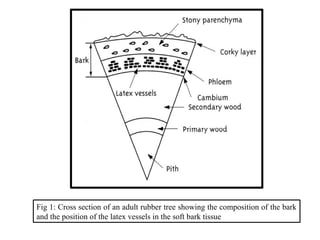
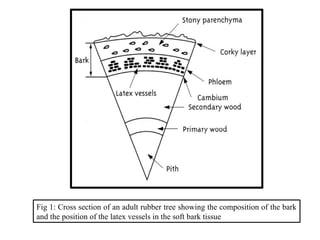
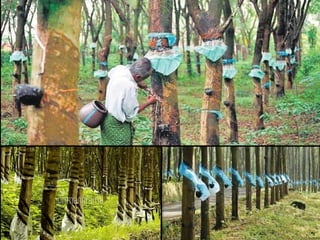
Fig 1: Crosssection of an adult rubber tree showing the composition of the bark
and the position of the latex vessels in the soft bark tissue
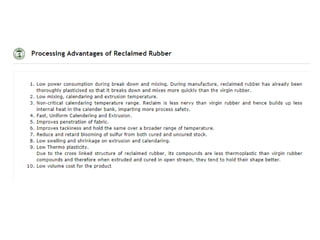
4.
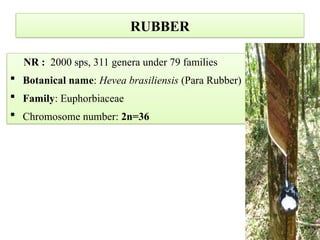
NR : 2000sps, 311 genera under 79 families
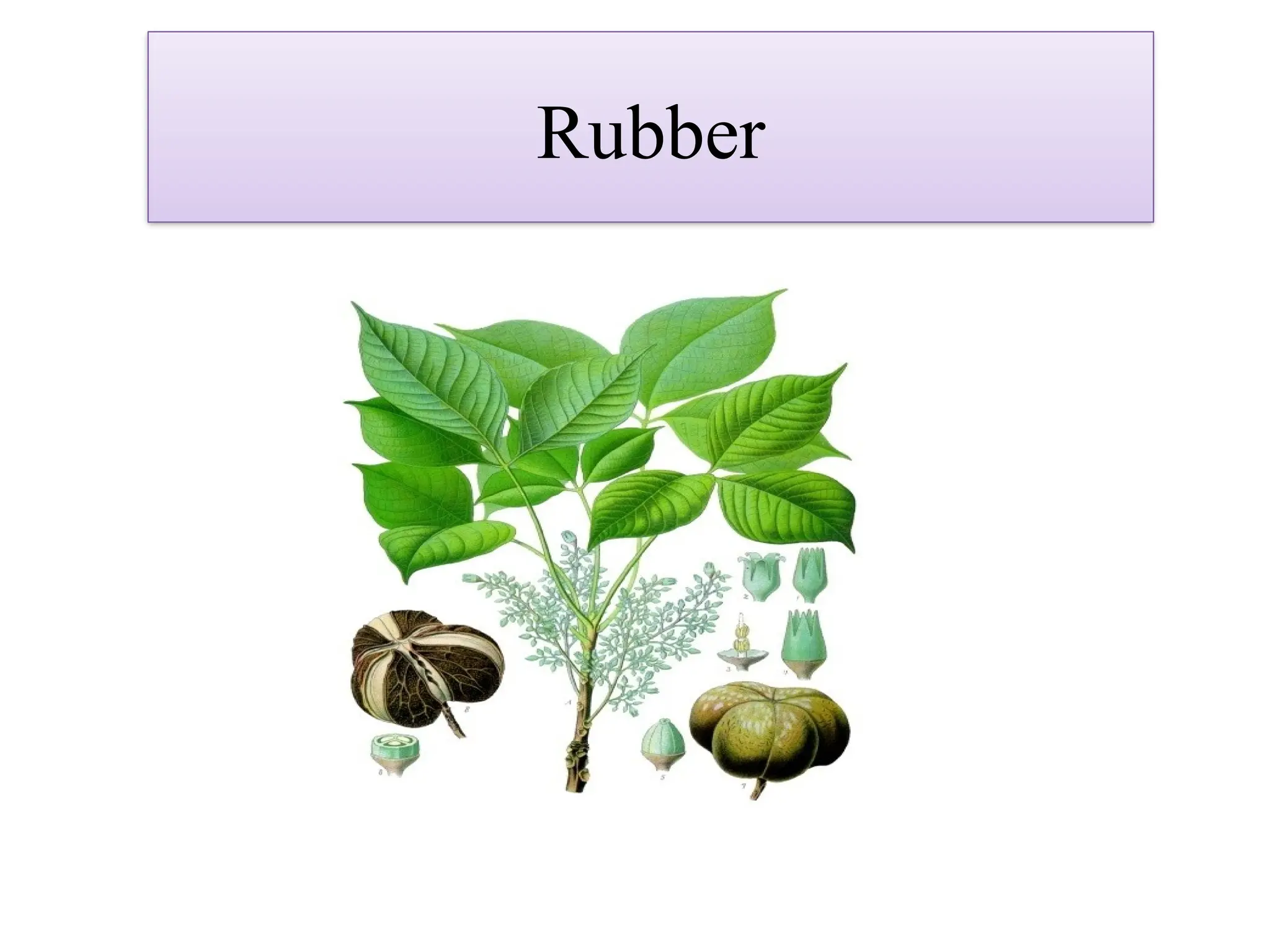
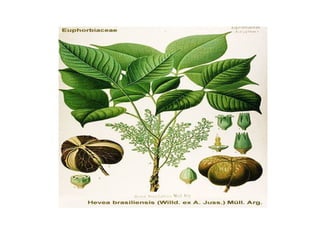
Botanical name: Hevea brasiliensis (Para Rubber)
Family: Euphorbiaceae
Chromosome number: 2n=36
RUBBER
5.
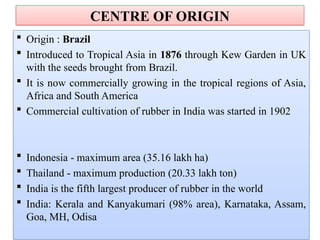
Origin :Brazil
Introduced to Tropical Asia in 1876 through Kew Garden in UK
with the seeds brought from Brazil.
It is now commercially growing in the tropical regions of Asia,
Africa and South America
Commercial cultivation of rubber in India was started in 1902
Indonesia - maximum area (35.16 lakh ha)
Thailand - maximum production (20.33 lakh ton)
India is the fifth largest producer of rubber in the world
India: Kerala and Kanyakumari (98% area), Karnataka, Assam,
Goa, MH, Odisa
CENTRE OF ORIGIN
7.
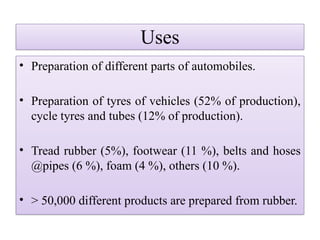
Uses
• Preparation ofdifferent parts of automobiles.
• Preparation of tyres of vehicles (52% of production),
cycle tyres and tubes (12% of production).
• Tread rubber (5%), footwear (11 %), belts and hoses
@pipes (6 %), foam (4 %), others (10 %).
• > 50,000 different products are prepared from rubber.
8.
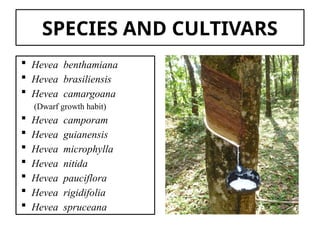
Genus Heveacomprises of 10 species
RUBBER- SPECIES DIVERSITY
Other rubber yieldingplants
• Manihot glaziovii : Cera rubber
• Ficus elastica : Indian rubber
• Castiolla elastica : Panama rubber
• Parthenium argentatum :Guayul rubber
• Taraxacum koksaghyz and Hevea brassiliensis : Para rubber
• Hevea brassiliensis supplies more than 99% of world rubber, commercially
cultivated
• Guayul rubber is considered as an alternative for Para rubber
11.
Hevea brasiliensis- quick growing tree
Rarely exceeds 25 m height in plantations
But wild trees grows over 40 m
The trunk of the tree tapers from the base and is conical or
cylindrical in shape. The young plants shows characteristic growth
pattern of Rapid elongation and consolidated development.
BOTANY
12.
The treehas a well-developed tap root, 2-5 m long after 3 years, with
several long laterals roots.
The lateral roots emerge from the tap-root below the collar. They can
reach up to 10 m and can make a dense network of feeder roots and root
hairs in the upper soil layers.
Root
13.
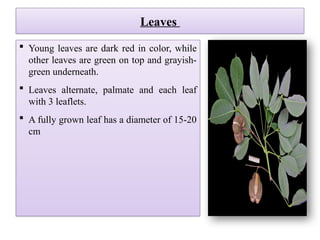
Leaves
Young leavesare dark red in color, while
other leaves are green on top and grayish-
green underneath.
Leaves alternate, palmate and each leaf
with 3 leaflets.
A fully grown leaf has a diameter of 15-20
cm
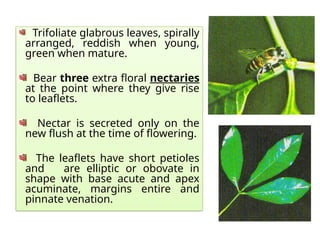
14.
Trifoliate glabrous leaves,spirally
arranged, reddish when young,
green when mature.
Bear three extra floral nectaries
at the point where they give rise
to leaflets.
Nectar is secreted only on the
new flush at the time of flowering.
The leaflets have short petioles
and are elliptic or obovate in
shape with base acute and apex
acuminate, margins entire and
pinnate venation.
16.
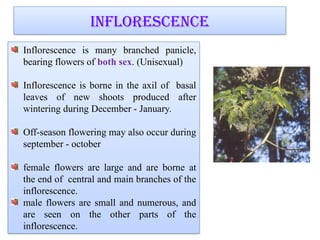
Inflorescence
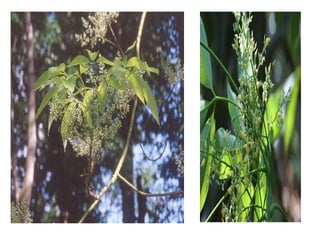
Inflorescence is manybranched panicle,
bearing flowers of both sex. (Unisexual)
Inflorescence is borne in the axil of basal
leaves of new shoots produced after
wintering during December - January.
Off-season flowering may also occur during
september - october
female flowers are large and are borne at
the end of central and main branches of the
inflorescence.
male flowers are small and numerous, and
are seen on the other parts of the
inflorescence.
17.
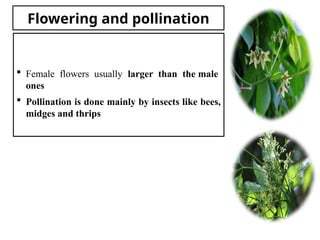
Female flowersusually larger than the male
ones
Pollination is done mainly by insects like bees,
midges and thrips
Flowering and pollination
18.
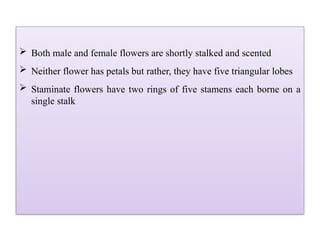
Both maleand female flowers are shortly stalked and scented
Neither flower has petals but rather, they have five triangular lobes
Staminate flowers have two rings of five stamens each borne on a
single stalk
20.
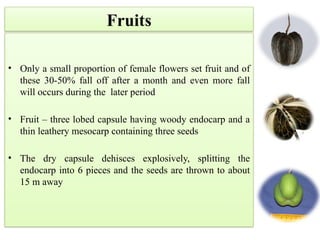
Fruits
• Only asmall proportion of female flowers set fruit and of
these 30-50% fall off after a month and even more fall
will occurs during the later period
• Fruit – three lobed capsule having woody endocarp and a
thin leathery mesocarp containing three seeds
• The dry capsule dehisces explosively, splitting the
endocarp into 6 pieces and the seeds are thrown to about
15 m away
21.
Fig 1: Crosssection of an adult rubber tree showing the composition of the bark
and the position of the latex vessels in the soft bark tissue
22.
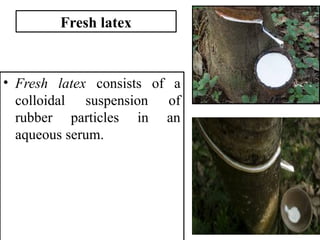
Fresh latex
• Freshlatex consists of a
colloidal suspension of
rubber particles in an
aqueous serum.
24.
Rubber board ofIndia
• The Rubber Board is a statutory body constituted by
the Government of India, under the Rubber Act 1947,
for the overall development of the rubber industry in
the country
25.
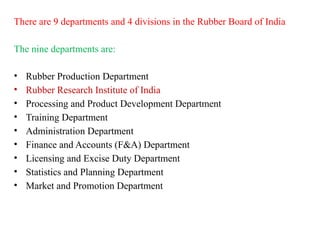
There are 9departments and 4 divisions in the Rubber Board of India
The nine departments are:
• Rubber Production Department
• Rubber Research Institute of India
• Processing and Product Development Department
• Training Department
• Administration Department
• Finance and Accounts (F&A) Department
• Licensing and Excise Duty Department
• Statistics and Planning Department
• Market and Promotion Department
26.
The four divisionsare :
• Publicity and Public Relations Division
• Planning Division
• Vigilance Division
• Internal Audit
27.
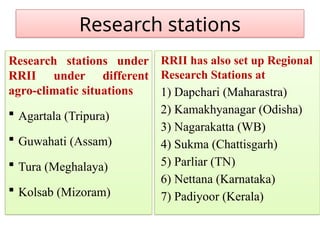
Research stations
Research stationsunder
RRII under different
agro-climatic situations
Agartala (Tripura)
Guwahati (Assam)
Tura (Meghalaya)
Kolsab (Mizoram)
RRII has also set up Regional
Research Stations at
1) Dapchari (Maharastra)
2) Kamakhyanagar (Odisha)
3) Nagarakatta (WB)
4) Sukma (Chattisgarh)
5) Parliar (TN)
6) Nettana (Karnataka)
7) Padiyoor (Kerala)
28.
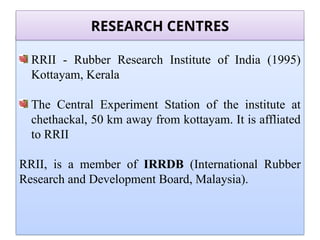
RRII - RubberResearch Institute of India (1995)
Kottayam, Kerala
The Central Experiment Station of the institute at
chethackal, 50 km away from kottayam. It is affliated
to RRII
RRII, is a member of IRRDB (International Rubber
Research and Development Board, Malaysia).
RESEARCH CENTRES
29.
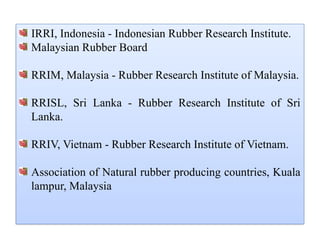
IRRI, Indonesia -Indonesian Rubber Research Institute.
Malaysian Rubber Board
RRIM, Malaysia - Rubber Research Institute of Malaysia.
RRISL, Sri Lanka - Rubber Research Institute of Sri
Lanka.
RRIV, Vietnam - Rubber Research Institute of Vietnam.
Association of Natural rubber producing countries, Kuala
lampur, Malaysia
31.
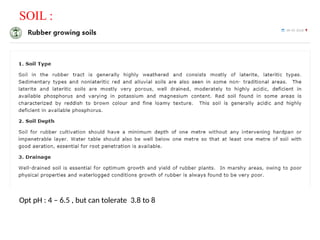
Opt pH :4 – 6.5 , but can tolerate 3.8 to 8
SOIL :
32.
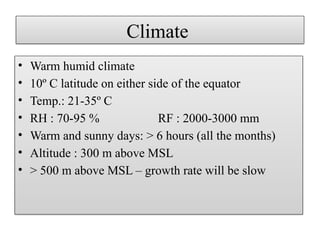
Climate
• Warm humidclimate
• 10º C latitude on either side of the equator
• Temp.: 21-35º C
• RH : 70-95 % RF : 2000-3000 mm
• Warm and sunny days: > 6 hours (all the months)
• Altitude : 300 m above MSL
• > 500 m above MSL – growth rate will be slow
33.
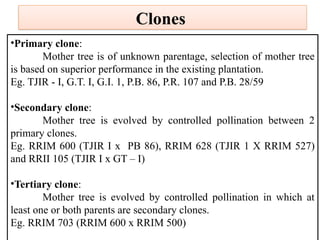
•Primary clone:
Mother treeis of unknown parentage, selection of mother tree
is based on superior performance in the existing plantation.
Eg. TJIR - I, G.T. I, G.I. 1, P.B. 86, P.R. 107 and P.B. 28/59
•Secondary clone:
Mother tree is evolved by controlled pollination between 2
primary clones.
Eg. RRIM 600 (TJIR I x PB 86), RRIM 628 (TJIR 1 X RRIM 527)
and RRII 105 (TJIR I x GT – I)
•Tertiary clone:
Mother tree is evolved by controlled pollination in which at
least one or both parents are secondary clones.
Eg. RRIM 703 (RRIM 600 x RRIM 500)
Clones
34.
• In orderto avoid potential risks involved in monoclone culture, a
multiclone culture with the clones grouped into three categories as
given below is followed
35.
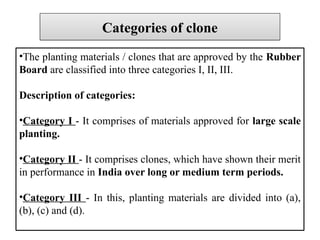
•The planting materials/ clones that are approved by the Rubber
Board are classified into three categories I, II, III.
Description of categories:
•Category I - It comprises of materials approved for large scale
planting.
•Category II - It comprises clones, which have shown their merit
in performance in India over long or medium term periods.
•Category III - In this, planting materials are divided into (a),
(b), (c) and (d).
Categories of clone
36.
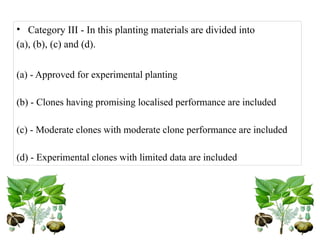
• Category III- In this planting materials are divided into
(a), (b), (c) and (d).
(a) - Approved for experimental planting
(b) - Clones having promising localised performance are included
(c) - Moderate clones with moderate clone performance are included
(d) - Experimental clones with limited data are included
37.
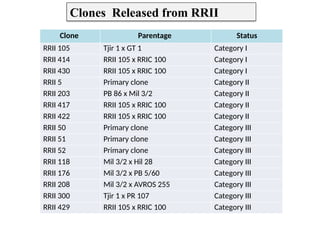
Clone Parentage Status
RRII105 Tjir 1 x GT 1 Category I
RRII 414 RRII 105 x RRIC 100 Category I
RRII 430 RRII 105 x RRIC 100 Category I
RRII 5 Primary clone Category II
RRII 203 PB 86 x Mil 3/2 Category II
RRII 417 RRII 105 x RRIC 100 Category II
RRII 422 RRII 105 x RRIC 100 Category II
RRII 50 Primary clone Category III
RRII 51 Primary clone Category III
RRII 52 Primary clone Category III
RRII 118 Mil 3/2 x Hil 28 Category III
RRII 176 Mil 3/2 x PB 5/60 Category III
RRII 208 Mil 3/2 x AVROS 255 Category III
RRII 300 Tjir 1 x PR 107 Category III
RRII 429 RRII 105 x RRIC 100 Category III
Clones Released from RRII
38.
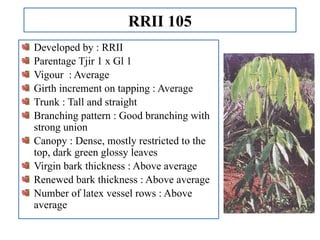
RRII 105
Developed by: RRII
Parentage Tjir 1 x Gl 1
Vigour : Average
Girth increment on tapping : Average
Trunk : Tall and straight
Branching pattern : Good branching with
strong union
Canopy : Dense, mostly restricted to the
top, dark green glossy leaves
Virgin bark thickness : Above average
Renewed bark thickness : Above average
Number of latex vessel rows : Above
average
39.
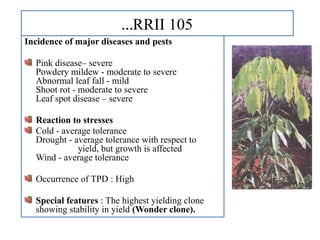
…RRII 105
Incidence ofmajor diseases and pests
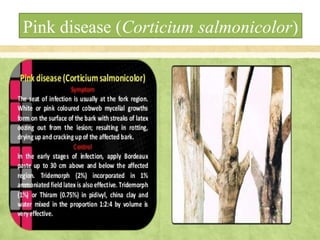
Pink disease– severe
Powdery mildew - moderate to severe
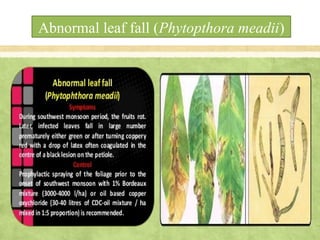
Abnormal leaf fall - mild
Shoot rot - moderate to severe
Leaf spot disease – severe
Reaction to stresses
Cold - average tolerance
Drought - average tolerance with respect to
yield, but growth is affected
Wind - average tolerance
Occurrence of TPD : High
Special features : The highest yielding clone
showing stability in yield (Wonder clone).
40.
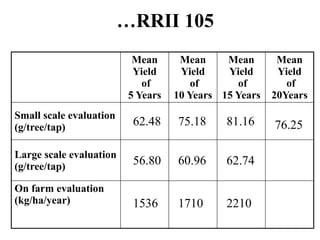
…RRII 105
Mean
Yield
of
5 Years
Mean
Yield
of
10Years
Mean
Yield
of
15 Years
Mean
Yield
of
20Years
Small scale evaluation
(g/tree/tap) 62.48 75.18 81.16 76.25
Large scale evaluation
(g/tree/tap) 56.80 60.96 62.74
On farm evaluation
(kg/ha/year) 1536 1710 2210
41.
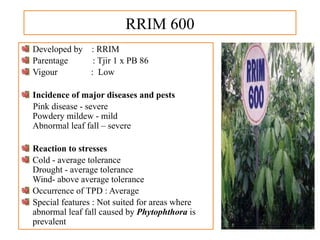
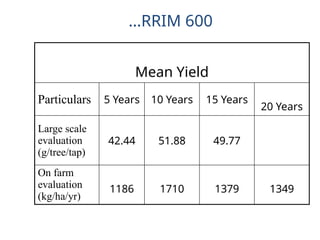
RRIM 600
Developed by: RRIM
Parentage : Tjir 1 x PB 86
Vigour : Low
Incidence of major diseases and pests
Pink disease - severe
Powdery mildew - mild
Abnormal leaf fall – severe
Reaction to stresses
Cold - average tolerance
Drought - average tolerance
Wind- above average tolerance
Occurrence of TPD : Average
Special features : Not suited for areas where
abnormal leaf fall caused by Phytophthora is
prevalent
42.
Mean Yield
Particulars 5Years 10 Years 15 Years
20 Years
Large scale
evaluation
(g/tree/tap)
42.44 51.88 49.77
On farm
evaluation
(kg/ha/yr)
1186 1710 1379 1349
…RRIM 600
43.
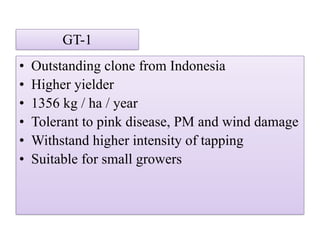
GT-1
• Outstanding clonefrom Indonesia
• Higher yielder
• 1356 kg / ha / year
• Tolerant to pink disease, PM and wind damage
• Withstand higher intensity of tapping
• Suitable for small growers
44.
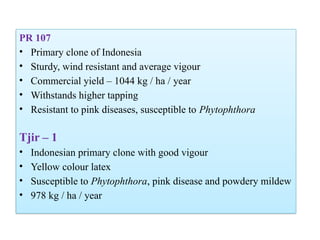
PR 107
• Primaryclone of Indonesia
• Sturdy, wind resistant and average vigour
• Commercial yield – 1044 kg / ha / year
• Withstands higher tapping
• Resistant to pink diseases, susceptible to Phytophthora
Tjir – 1
• Indonesian primary clone with good vigour
• Yellow colour latex
• Susceptible to Phytophthora, pink disease and powdery mildew
• 978 kg / ha / year
45.
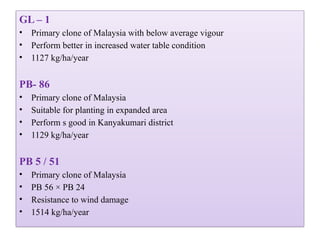
GL – 1
•Primary clone of Malaysia with below average vigour
• Perform better in increased water table condition
• 1127 kg/ha/year
PB- 86
• Primary clone of Malaysia
• Suitable for planting in expanded area
• Perform s good in Kanyakumari district
• 1129 kg/ha/year
PB 5 / 51
• Primary clone of Malaysia
• PB 56 × PB 24
• Resistance to wind damage
• 1514 kg/ha/year
46.
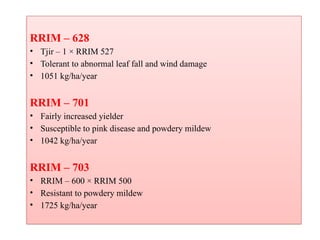
RRIM – 628
•Tjir – 1 × RRIM 527
• Tolerant to abnormal leaf fall and wind damage
• 1051 kg/ha/year
RRIM – 701
• Fairly increased yielder
• Susceptible to pink disease and powdery mildew
• 1042 kg/ha/year
RRIM – 703
• RRIM – 600 × RRIM 500
• Resistant to powdery mildew
• 1725 kg/ha/year
47.
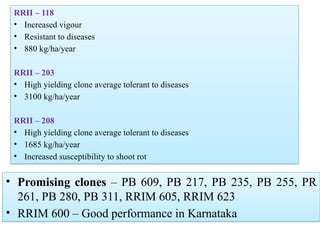
RRII – 118
•Increased vigour
• Resistant to diseases
• 880 kg/ha/year
RRII – 203
• High yielding clone average tolerant to diseases
• 3100 kg/ha/year
RRII – 208
• High yielding clone average tolerant to diseases
• 1685 kg/ha/year
• Increased susceptibility to shoot rot
• Promising clones – PB 609, PB 217, PB 235, PB 255, PR
261, PB 280, PB 311, RRIM 605, RRIM 623
• RRIM 600 – Good performance in Karnataka
48.
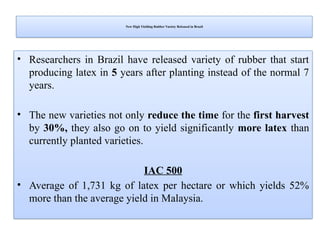
New High YieldingRubber Variety Released in Brazil
• Researchers in Brazil have released variety of rubber that start
producing latex in 5 years after planting instead of the normal 7
years.
• The new varieties not only reduce the time for the first harvest
by 30%, they also go on to yield significantly more latex than
currently planted varieties.
IAC 500
• Average of 1,731 kg of latex per hectare or which yields 52%
more than the average yield in Malaysia.
49.
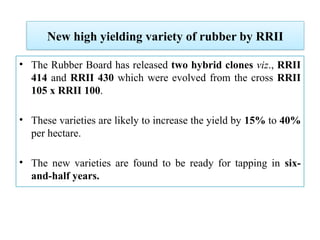
New high yieldingvariety of rubber by RRII
• The Rubber Board has released two hybrid clones viz., RRII
414 and RRII 430 which were evolved from the cross RRII
105 x RRII 100.
• These varieties are likely to increase the yield by 15% to 40%
per hectare.
• The new varieties are found to be ready for tapping in six-
and-half years.
50.
Table 1 :SECONDARY CHARACTERS OF NEWLY RELEASED CLONES BY RUBBER
BOARD
Parameters RRII-414 RRII-430 RRII-105
Grith at opening High (>55cm) Above average (>50) Average
Trunk Tall, Straight and
Cylindrical with prominent
leaf scar, slightly leaning
Tall, Straight and
Cylindrical stem with
smooth bark
Tall and Straight
Number of latex
vessel rows
Above avg. in both virgin
and renewed bark (>11)
Above avg. in both
virgin and renewed bark
(>11)
Above Average
Occorane to wind
damage
Average Low Medium
Occorane to T P D
(Tapping Pannel
Dryness)
Low (based on observation
on 12 trees over 11 year of
Tapping)
Low (based on
observation on 12 trees
over 11 year of Tapping)
High
Remarks Yield better than RRII-105
in the first years of tapping
in the farm Trial and
Comparable to that of RRII-
105 in the multi location
51.
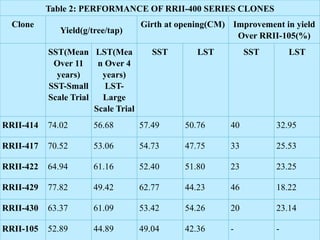
Table 2: PERFORMANCEOF RRII-400 SERIES CLONES
Clone
Yield(g/tree/tap)
Girth at opening(CM) Improvement in yield
Over RRII-105(%)
SST(Mean
Over 11
years)
SST-Small
Scale Trial
LST(Mea
n Over 4
years)
LST-
Large
Scale Trial
SST LST SST LST
RRII-414 74.02 56.68 57.49 50.76 40 32.95
RRII-417 70.52 53.06 54.73 47.75 33 25.53
RRII-422 64.94 61.16 52.40 51.80 23 23.25
RRII-429 77.82 49.42 62.77 44.23 46 18.22
RRII-430 63.37 61.09 53.42 54.26 20 23.14
RRII-105 52.89 44.89 49.04 42.36 - -
52.
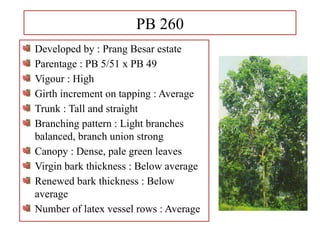
PB 260
Developed by: Prang Besar estate
Parentage : PB 5/51 x PB 49
Vigour : High
Girth increment on tapping : Average
Trunk : Tall and straight
Branching pattern : Light branches
balanced, branch union strong
Canopy : Dense, pale green leaves
Virgin bark thickness : Below average
Renewed bark thickness : Below
average
Number of latex vessel rows : Average
53.
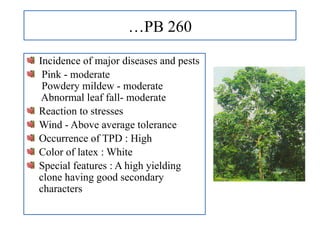
…PB 260
Incidence ofmajor diseases and pests
Pink - moderate
Powdery mildew - moderate
Abnormal leaf fall- moderate
Reaction to stresses
Wind - Above average tolerance
Occurrence of TPD : High
Color of latex : White
Special features : A high yielding
clone having good secondary
characters
54.
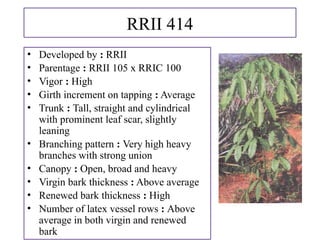
RRII 414
• Developedby : RRII
• Parentage : RRII 105 x RRIC 100
• Vigor : High
• Girth increment on tapping : Average
• Trunk : Tall, straight and cylindrical
with prominent leaf scar, slightly
leaning
• Branching pattern : Very high heavy
branches with strong union
• Canopy : Open, broad and heavy
• Virgin bark thickness : Above average
• Renewed bark thickness : High
• Number of latex vessel rows : Above
average in both virgin and renewed
bark
55.
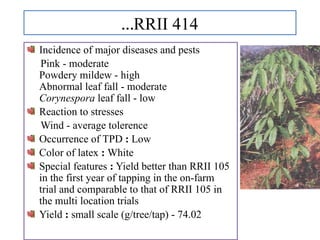
…RRII 414
Incidence ofmajor diseases and pests
Pink - moderate
Powdery mildew - high
Abnormal leaf fall - moderate
Corynespora leaf fall - low
Reaction to stresses
Wind - average tolerence
Occurrence of TPD : Low
Color of latex : White
Special features : Yield better than RRII 105
in the first year of tapping in the on-farm
trial and comparable to that of RRII 105 in
the multi location trials
Yield : small scale (g/tree/tap) - 74.02
56.
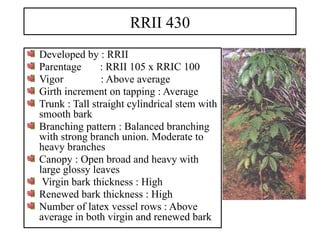
RRII 430
Developed by: RRII
Parentage : RRII 105 x RRIC 100
Vigor : Above average
Girth increment on tapping : Average
Trunk : Tall straight cylindrical stem with
smooth bark
Branching pattern : Balanced branching
with strong branch union. Moderate to
heavy branches
Canopy : Open broad and heavy with
large glossy leaves
Virgin bark thickness : High
Renewed bark thickness : High
Number of latex vessel rows : Above
average in both virgin and renewed bark
57.
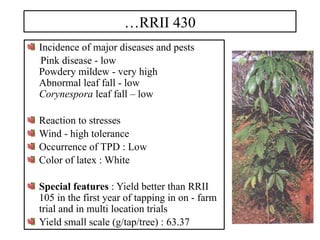
…RRII 430
Incidence ofmajor diseases and pests
Pink disease - low
Powdery mildew - very high
Abnormal leaf fall - low
Corynespora leaf fall – low
Reaction to stresses
Wind - high tolerance
Occurrence of TPD : Low
Color of latex : White
Special features : Yield better than RRII
105 in the first year of tapping in on - farm
trial and in multi location trials
Yield small scale (g/tap/tree) : 63.37
58.
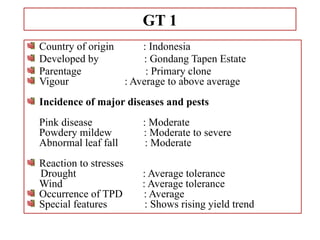
GT 1
Country oforigin : Indonesia
Developed by : Gondang Tapen Estate
Parentage : Primary clone
Vigour : Average to above average
Incidence of major diseases and pests
Pink disease : Moderate
Powdery mildew : Moderate to severe
Abnormal leaf fall : Moderate
Reaction to stresses
Drought : Average tolerance
Wind : Average tolerance
Occurrence of TPD : Average
Special features : Shows rising yield trend
59.
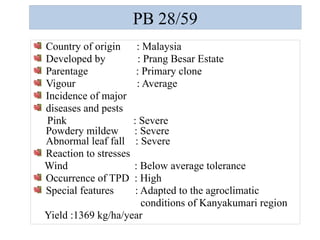
PB 28/59
Country oforigin : Malaysia
Developed by : Prang Besar Estate
Parentage : Primary clone
Vigour : Average
Incidence of major
diseases and pests
Pink : Severe
Powdery mildew : Severe
Abnormal leaf fall : Severe
Reaction to stresses
Wind : Below average tolerance
Occurrence of TPD : High
Special features : Adapted to the agroclimatic
conditions of Kanyakumari region
Yield :1369 kg/ha/year
60.
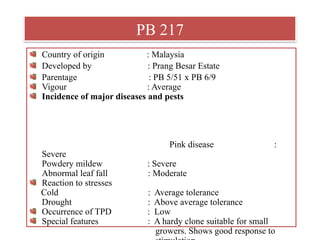
PB 217
Country oforigin : Malaysia
Developed by : Prang Besar Estate
Parentage : PB 5/51 x PB 6/9
Vigour : Average
Incidence of major diseases and pests
Pink disease :
Severe
Powdery mildew : Severe
Abnormal leaf fall : Moderate
Reaction to stresses
Cold : Average tolerance
Drought : Above average tolerance
Occurrence of TPD : Low
Special features : A hardy clone suitable for small
growers. Shows good response to
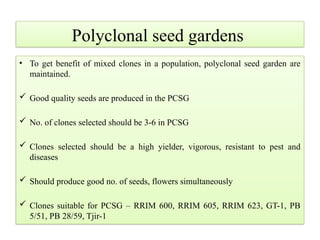
Polyclonal seed gardens
•To get benefit of mixed clones in a population, polyclonal seed garden are
maintained.
Good quality seeds are produced in the PCSG
No. of clones selected should be 3-6 in PCSG
Clones selected should be a high yielder, vigorous, resistant to pest and
diseases
Should produce good no. of seeds, flowers simultaneously
Clones suitable for PCSG – RRIM 600, RRIM 605, RRIM 623, GT-1, PB
5/51, PB 28/59, Tjir-1
63.
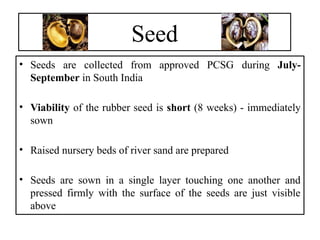
Seed
• Seeds arecollected from approved PCSG during July-
September in South India
• Viability of the rubber seed is short (8 weeks) - immediately
sown
• Raised nursery beds of river sand are prepared
• Seeds are sown in a single layer touching one another and
pressed firmly with the surface of the seeds are just visible
above
64.
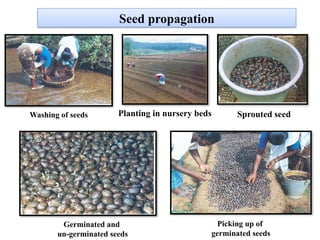
Seed propagation
Washing ofseeds
Germinated and
un-germinated seeds
Picking up of
germinated seeds
Sprouted seed
Planting in nursery beds
65.
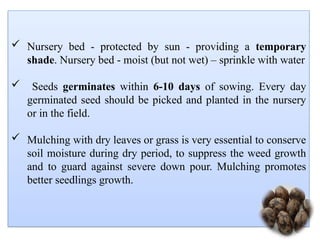
Nursery bed- protected by sun - providing a temporary
shade. Nursery bed - moist (but not wet) – sprinkle with water
Seeds germinates within 6-10 days of sowing. Every day
germinated seed should be picked and planted in the nursery
or in the field.
Mulching with dry leaves or grass is very essential to conserve
soil moisture during dry period, to suppress the weed growth
and to guard against severe down pour. Mulching promotes
better seedlings growth.
66.
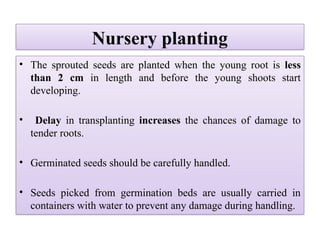
Nursery planting
• Thesprouted seeds are planted when the young root is less
than 2 cm in length and before the young shoots start
developing.
• Delay in transplanting increases the chances of damage to
tender roots.
• Germinated seeds should be carefully handled.
• Seeds picked from germination beds are usually carried in
containers with water to prevent any damage during handling.
67.
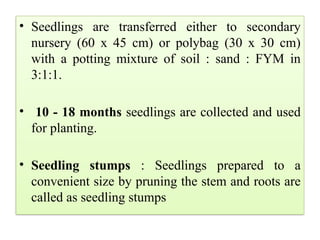
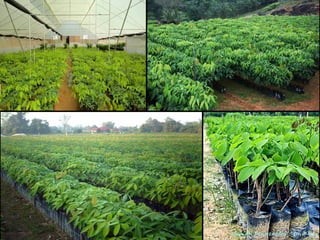
• Seedlings aretransferred either to secondary
nursery (60 x 45 cm) or polybag (30 x 30 cm)
with a potting mixture of soil : sand : FYM in
3:1:1.
• 10 - 18 months seedlings are collected and used
for planting.
• Seedling stumps : Seedlings prepared to a
convenient size by pruning the stem and roots are
called as seedling stumps
69.
Budwood nursery
• Budsrequired for bud grafting are collected
from budwood obtained from the plants which
are raised specially for this purpose
• 2 types :
Brown budwood nursery
Green budwood nursery
70.
• Planting canbe done with polybag plants /
budded stumps / seed at stake followed by
budding
• During first year : only one shoot is allowed to
grow and about one meter brown budwood can
be obtained from this
• From the second year onwards two / three shoots
are allowed
• Now, the budwood can be harvested by leaving
about 15 cm from the base. From this portions
shoots develop again in the subsequent seasons.
71.
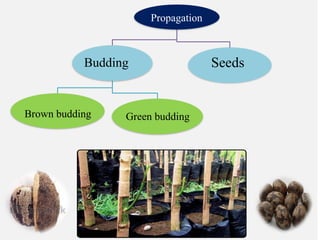
Budding
• Principle :replacement of the shoot system of a plant with
that of another more desirable plant
72.
BUDDING
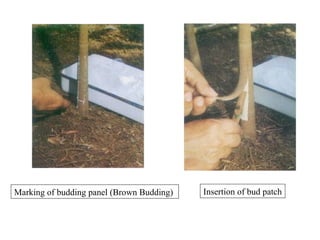
Brown budding -Brown colored buds taken from bud wood of about
1 years growth budded onto stock plants of 10 months or more
growth with 7.5 cm thickness at the base.
Vigorously growing healthy stalks are best
Buds found in axils of fallen leaves are used
In S-India : Best season : April – May, Budding from 1 m budwood
of 1 year growth with 20 buds (1.5 to 2 months).
Maintained upto 6-8 months
73.
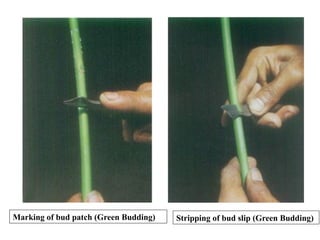
Green budding -Both stock and bud wood for green
budding are young.
Seedlings which are 2 – 8 months old are used as a stock
Buds are collected from 6-8 weeks old budwood
Buds that are found above the scale leaves of the shoot are
for budding
Too dry or too wet condition are not preferred.
Marking of budpatch (Green Budding) Stripping of bud slip (Green Budding)
76.
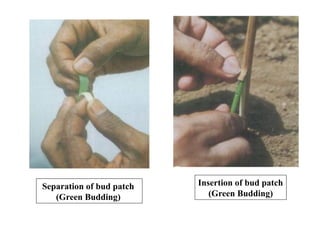
Separation of budpatch
(Green Budding)
Insertion of bud patch
(Green Budding)
77.
Planting
• Found insloppy and undulated hill lands.
• Remove green shrubs, clear the land and open pits of 1 m3
with 12 kg
FYM, top soil, 125 g rock phosphate.
• June- July is the best season.
• Square or triangular system of planting.
• Pits 1m3
are dug out and filled with soil and compost.
78.
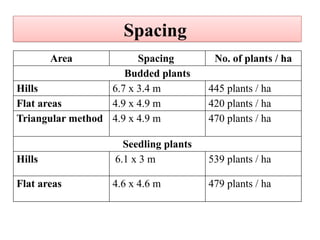
Spacing
Area Spacing No.of plants / ha
Budded plants
Hills 6.7 x 3.4 m 445 plants / ha
Flat areas 4.9 x 4.9 m 420 plants / ha
Triangular method 4.9 x 4.9 m 470 plants / ha
Seedling plants
Hills 6.1 x 3 m 539 plants / ha
Flat areas 4.6 x 4.6 m 479 plants / ha
79.
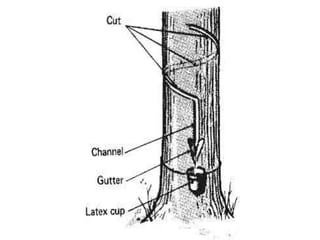
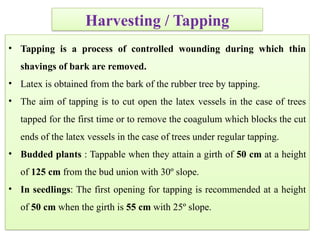
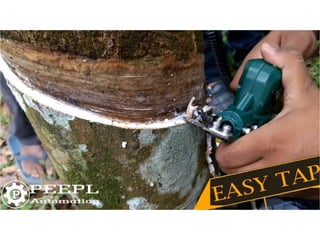
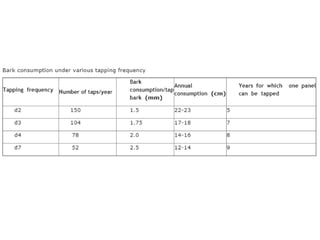
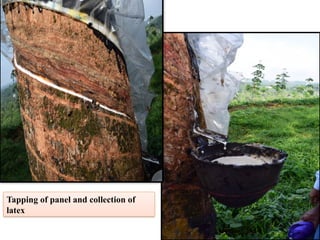
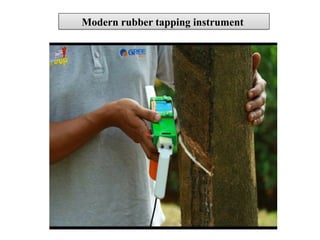
• Tapping isa process of controlled wounding during which thin
shavings of bark are removed.
• Latex is obtained from the bark of the rubber tree by tapping.
• The aim of tapping is to cut open the latex vessels in the case of trees
tapped for the first time or to remove the coagulum which blocks the cut
ends of the latex vessels in the case of trees under regular tapping.
• Budded plants : Tappable when they attain a girth of 50 cm at a height
of 125 cm from the bud union with 30º slope.
• In seedlings: The first opening for tapping is recommended at a height
of 50 cm when the girth is 55 cm with 25º slope.
Harvesting / Tapping
80.
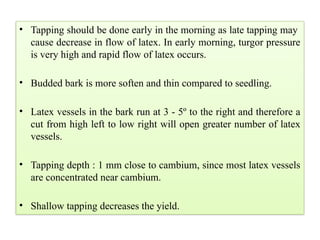
• Tapping shouldbe done early in the morning as late tapping may
cause decrease in flow of latex. In early morning, turgor pressure
is very high and rapid flow of latex occurs.
• Budded bark is more soften and thin compared to seedling.
• Latex vessels in the bark run at 3 - 5º to the right and therefore a
cut from high left to low right will open greater number of latex
vessels.
• Tapping depth : 1 mm close to cambium, since most latex vessels
are concentrated near cambium.
• Shallow tapping decreases the yield.
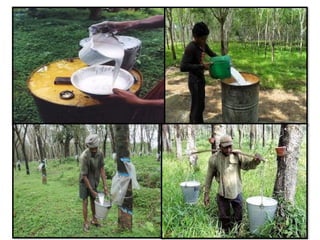
Processing of rubber
Thelatex that flows from the rubber trees on
tapping is channeled in to a container, generally
coconut shell cups, attached to them.
Latex collected in coconut shell cups is transferred
to clean buckets, two to three hours after tapping.
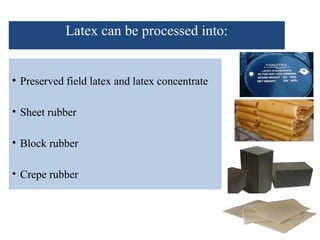
85.
Latex can beprocessed into:
• Preserved field latex and latex concentrate
• Sheet rubber
• Block rubber
• Crepe rubber
86.
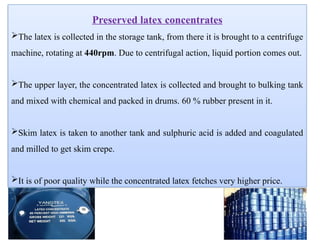
Preserved latex concentrates
Thelatex is collected in the storage tank, from there it is brought to a centrifuge
machine, rotating at 440rpm. Due to centrifugal action, liquid portion comes out.
The upper layer, the concentrated latex is collected and brought to bulking tank
and mixed with chemical and packed in drums. 60 % rubber present in it.
Skim latex is taken to another tank and sulphuric acid is added and coagulated
and milled to get skim crepe.
It is of poor quality while the concentrated latex fetches very higher price.
87.
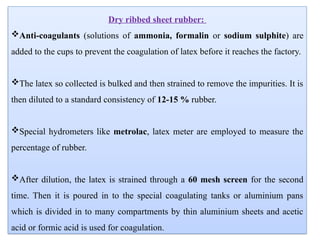
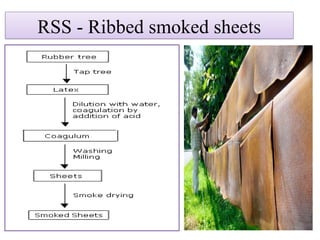
Dry ribbed sheetrubber:
Anti-coagulants (solutions of ammonia, formalin or sodium sulphite) are
added to the cups to prevent the coagulation of latex before it reaches the factory.
The latex so collected is bulked and then strained to remove the impurities. It is
then diluted to a standard consistency of 12-15 % rubber.
Special hydrometers like metrolac, latex meter are employed to measure the
percentage of rubber.
After dilution, the latex is strained through a 60 mesh screen for the second
time. Then it is poured in to the special coagulating tanks or aluminium pans
which is divided in to many compartments by thin aluminium sheets and acetic
acid or formic acid is used for coagulation.
88.
Slow coagulation producesa soft rubber which is easy to work on the rollers. The acid
is to be added quickly and mixed thoroughly with the latex
Froth formed is removed to avoid formation of bubbles on the surface of rubber sheets
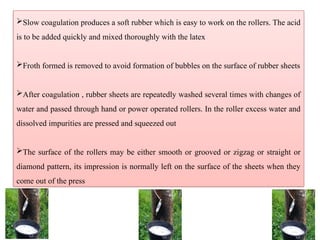
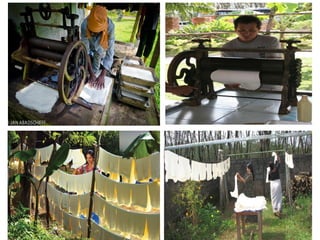
After coagulation , rubber sheets are repeatedly washed several times with changes of
water and passed through hand or power operated rollers. In the roller excess water and
dissolved impurities are pressed and squeezed out
The surface of the rollers may be either smooth or grooved or zigzag or straight or
diamond pattern, its impression is normally left on the surface of the sheets when they
come out of the press
89.
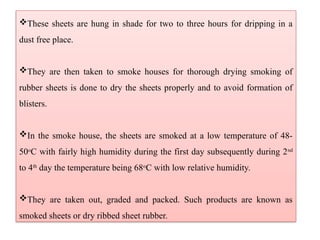
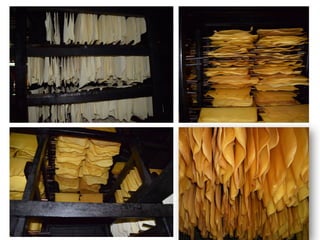
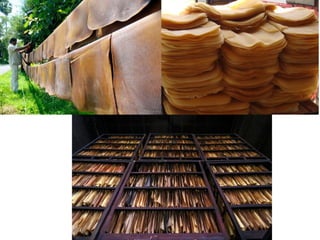
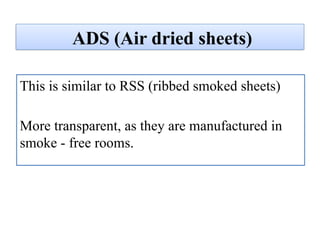
These sheets arehung in shade for two to three hours for dripping in a
dust free place.
They are then taken to smoke houses for thorough drying smoking of
rubber sheets is done to dry the sheets properly and to avoid formation of
blisters.
In the smoke house, the sheets are smoked at a low temperature of 48-
50o
C with fairly high humidity during the first day subsequently during 2nd
to 4th
day the temperature being 68o
C with low relative humidity.
They are taken out, graded and packed. Such products are known as
smoked sheets or dry ribbed sheet rubber.
93.
Various grade ofrubber sheets are
RMA IX
RMA-1
RMA-2
RMA-3
RMA-4
RMA-5
High grade rubber sheets are clear, free from blisters, translucent and of a
golden brown colour and fetch a better price.
SHEET RUBBER
• Rubbersheets are folded to form bales (e.g. 60
cm x 60 cm and 100 - 113 kg per bale)
compressed and wrapped in protective sheets
• A protective coating and talcum are applied to
the surface to protect against oxidation
• To prevent the sheets from sticking to each other
98.
MARKETING
• Rubber Boardto promote and facilitate
production, processing and marketing of
natural rubber undertakes stringent measures
to ensure that the products marketed under the
brand confirm to the specified quality
standards.
99.
STORAGE
• Recommended storageduration for natural rubber
5-7 years
• Recommended storage temperature for natural
rubber 15 - 30 °C
• Storage of latex concentrates : 6 - 12 months
Temperature range : 5 - 35°C
106.
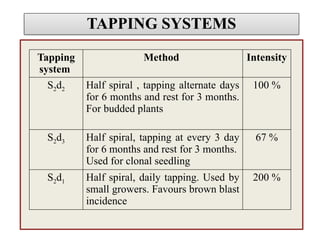
TAPPING SYSTEMS
Tapping
system
Method Intensity
S2d2Half spiral , tapping alternate days
for 6 months and rest for 3 months.
For budded plants
100 %
S2d3 Half spiral, tapping at every 3 day
for 6 months and rest for 3 months.
Used for clonal seedling
67 %
S2d1 Half spiral, daily tapping. Used by
small growers. Favours brown blast
incidence
200 %
108.
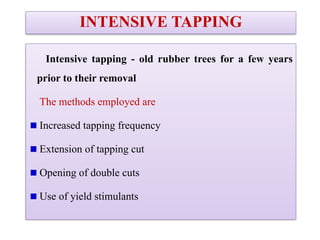
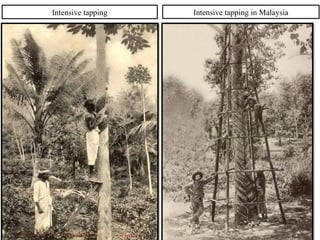
INTENSIVE TAPPING
Intensive tapping- old rubber trees for a few years
prior to their removal
The methods employed are
Increased tapping frequency
Extension of tapping cut
Opening of double cuts
Use of yield stimulants
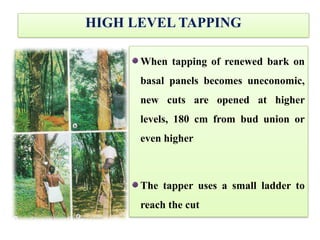
HIGH LEVEL TAPPING
Whentapping of renewed bark on
basal panels becomes uneconomic,
new cuts are opened at higher
levels, 180 cm from bud union or
even higher
The tapper uses a small ladder to
reach the cut
111.
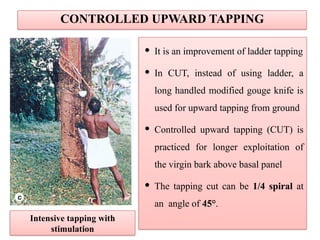
CONTROLLED UPWARD TAPPING
It is an improvement of ladder tapping
In CUT, instead of using ladder, a
long handled modified gouge knife is
used for upward tapping from ground
Controlled upward tapping (CUT) is
practiced for longer exploitation of
the virgin bark above basal panel
The tapping cut can be 1/4 spiral at
an angle of 45°.
Intensive tapping with
stimulation
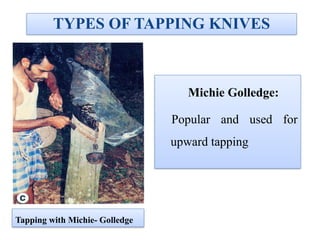
TYPES OF TAPPINGKNIVES
Michie Golledge:
Popular and used for
upward tapping
Tapping with Michie- Golledge
114.
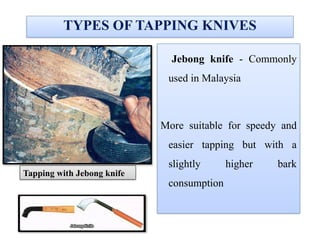
TYPES OF TAPPINGKNIVES
Jebong knife - Commonly
used in Malaysia
More suitable for speedy and
easier tapping but with a
slightly higher bark
consumption
Tapping with Jebong knife
115.
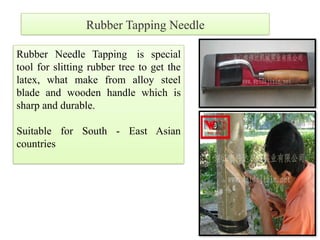
Rubber Needle Tappingis special
tool for slitting rubber tree to get the
latex, what make from alloy steel
blade and wooden handle which is
sharp and durable.
Suitable for South - East Asian
countries
Rubber Tapping Needle
117.
YIELD STIMULATION
• Certainchemicals induce ethylene formation in the plant tissue while
others generate ethylene directly by decomposition. eg., Ethephon
• Under low frequency tapping systems, trees are stimulated from first
year of tapping using ethephon (2.5%) by panel application.
118.
Concentration :
Market availableethephon usually contain 10% active
ingredient
It is diluted with palm oil, petroleum jelly, coconut oil or
even with water to 5 or 10 %
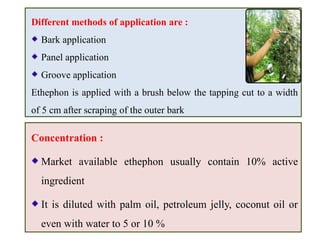
Different methods of application are :
Bark application
Panel application
Groove application
Ethephon is applied with a brush below the tapping cut to a width
of 5 cm after scraping of the outer bark
119.
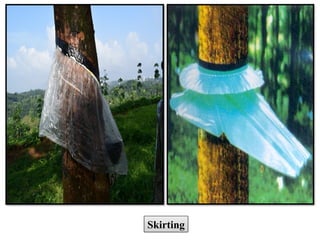
RAIN GUARDING
• Anysuitable device fixed above the tapping panel to
keep the panel, tapping cut and collection cup dry
during rainy season is termed as rain guard.
Three types of rain guards
• Polythene skirt
• Tapping shade
• Guardian rain guard
Collection of latex
•The latex that flows from the rubber trees on tapping is channeled in to a
container, generally coconut shell cups attached to them.
• Latex transferred to clean buckets – 2 to 3 hours after tapping
• The latex which gets dried up on the tapping panel (tree lace) and the
collection cups (shell scrap) also form a part of the crop and are collected by
the tappers in baskets just prior to tapping.
• The latex split including overflown on the ground (earth scrap), when gets
dried up, is also collected once in a month.
• Normally 10-20 percent of the total crop constitutes the tree lace, shell scrap
and earth scrap.
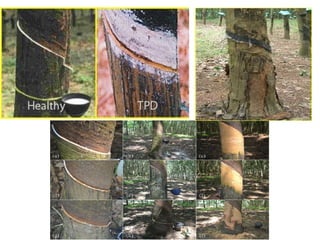
Tapping Panel Dryness
•Generally high yielding clones of natural
rubber are susceptible to the physiological
disorder commonly termed Tapping Panel
Dryness (TPD) earlier referred to as Brown
Blast.
• It occurs when the harvesting of latex from the
trees exceeds the physiological capacity of its
regeneration. It is estimated that TPD leads to
approximately 15-20% decrease in yield.
127.
Symptoms
• Excessive latedripping of latex simultaneous
with a drop in the dry rubber content of the
latex in the initial phase
• In the later phase, total inhibition of rubber
biosynthesis occurs and no latex is produced
towards the final phase.
129.
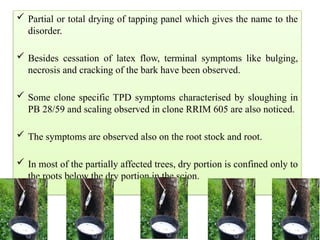
Partial ortotal drying of tapping panel which gives the name to the
disorder.
Besides cessation of latex flow, terminal symptoms like bulging,
necrosis and cracking of the bark have been observed.
Some clone specific TPD symptoms characterised by sloughing in
PB 28/59 and scaling observed in clone RRIM 605 are also noticed.
The symptoms are observed also on the root stock and root.
In most of the partially affected trees, dry portion is confined only to
the roots below the dry portion in the scion.
130.
Management practice toTPD
• Giving tapping rest and changing the
tapping panel.
• Tapping rest has shown some result in
reducing the TPD situation at least for a while
and when the trees are reopened on a new
panel, the trees may make full recovery.
131.
• It isadvantageous to follow 1/2 S d/3 tapping
system to reduce the intensity of exploitation
stress thereby reducing the TPD incidence.
• Tapping can be resumed changing the tapping
panel and following a low intensity tapping
system.
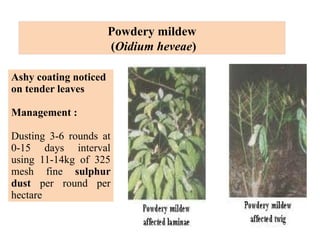
Ashy coating noticed
ontender leaves
Management :
Dusting 3-6 rounds at
0-15 days interval
using 11-14kg of 325
mesh fine sulphur
dust per round per
hectare
Powdery mildew
(Oidium heveae)