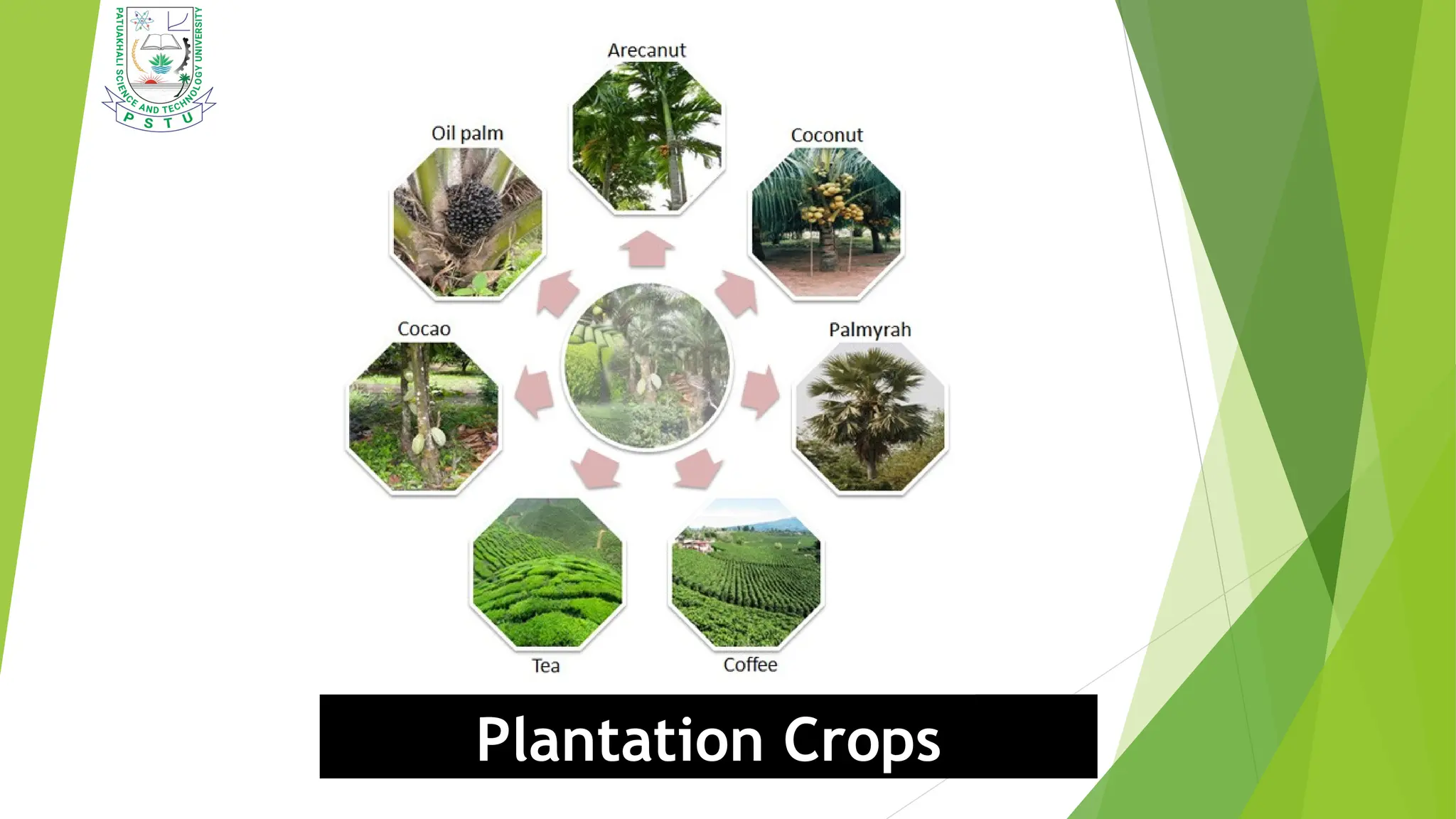
Plantation Crops
Outline of the Lecture
 Memorizing previous class
 Plantation Crops Concept;
 Importance;
 Classification;
 Production Technology of Rubber;
 Postharvest processing of Rubber;
 Recap
 Questions/Comments
The crops which are perennial in nature, cultivated in a vast area
for continuously and commercially, large scaly, managed by
individually or a company and long time yielded are termed as
plantation crops.
Bamboo, betel leaf, betel nut, rubber, tea, coffee, cocoa, coconut,
palmyra, oil palm etc.
Plantation Crops
 Perennial in nature
 Vast area/large scale cultivation in continuously
 Commercial value
 Managed by individually or company
 Long time yielded
 Export oriented
 Intensive management
 Specific agro-climate etc.
Criteria of PCs
 Major source of foreign income
 Decrease import cost
 Raw materials for industry
 Employment opportunities
 Promote regional development
 Fallow land utilization
 Creation of new industry
 Eco-friendly effect
Importance of PCs
 Leaf: Tea, Betel leaf
 Fruit: Oil palm, coconut, palmyra
 Seed: Coffee, Betel nut
 Stem: Bamboo
 Latex: Rubber
Classification of PCs
 Theaceae: Tea
 Euphorbiaceae: Rubber
 Rubiaceae: Coffee
 Gramineae: Bamboo
 Piperaceae: Betel leaf
 Palmaceae: Betel nut, Coconut
 Sterculiaceae: Cocoa
 Latex: Rubber
Family
Usable plant parts
Beverage crops: Tea, Coffee, Cocoa
Industrial crops: Rubber, Oil palm
Plant type
Rubber
Scientific name: Hevea brasiliensis
Family: Euphorbiaceae
Origin: Brazil
Rubber
South American tropical tree
Southeast Asia and western Africa
Sturdy, quick-growing, erect tree with a straight trunk
In the wild, the trees may grow to over 40 m with a life span of
more than 100 years. However, cultivated plants rarely grow
beyond 25-30 m in height because of the growth reduction due to
harvesting of latex by tapping.
Natural rubber is obtained from the latex or milky fluid which is
formed in laticiferous cell.
These laticiferous cells remain in between cambium and phloem
of the plants.
Rubber
Composition of latex
Rubber 30.45%
Protein 2-2.5%
Ash 0.7-0.9%
Resin 1.16%
Sugar 1.15%
water 60%
Origin
• A latex yielding plant native to South
America
(Amazon region).
Distributio
n
History
• 1770—Joseph Priestly discovered that the material
would rub out paper marks, hence the name India
rubber,
• 1823—Mackintosh manufactureswaterproof
raincoats
by coating fabric with rubber dissolved in naphtha.
• 1839—Goodyear discovered vulcanization, when rubber
was heated with sulfur, rubber retained physical
properties from 0 to 100°C. This led to rubber boom.
• 1898—Dunlop rediscovers pneumatic tires (Motor cars
invented in 1885).
• primary component in tires and tubes
• automotive parts like belts, hoses, and gaskets
• ability to form tight seals preventing leaks and ensuring
proper functionality.
• production of medical gloves, catheters, blood pressure cuffs,
and other medical devices
• wide range of footwear, from boots
• make tight-fitting and elastic clothing
• making toys, including balls, dolls, and chew toys for pets
• flooring for various applications
• industrial settings, cushioning, slip resistance, and durability
• glue or gum, sports goods like football, volleyball etc
• marine applications like boat fenders and dock bumpers
Importance/uses of rubber
Use of rubber
• 70% of total rubber consumption is in the
manufacture of tyres and tubes.
• About 6% of worlds rubber is used for
manufacture of foot wear, soles and heels and 4%
for wire and cable insulation.
• Other uses such as rubberized fabrics, shock
absorbers, washers and gaskets, conveyor belting ,
sports goods, vulcanized a hard high sulphurized
rubber is used in electrical and radio engineering.
Rubber powder with bitumen is used for road
surfacing.
fruit
Inflorescence
leaf
Near about 2000 rubber producing species are available in the
world. Most important rubber producing species are as follows:
1. Hevea brasiliensis: Para rubber, 95% of total rubber
2. Parthenium argentatum: Guayule rubber
3. Manihot glaziovii: Ceara rubber
4. Ficus elastica: Indian rubber
5. Castilla elastica: Panama rubber
Source of rubber
 warm, humid climates with consistent rainfall
 temperatures between 20°C and 30°C are ideal
 relative humidity, ideally between 75% and 85%
 abundant rainfall, typically between 200 – 300 cm annually
 well-drained, deep, and fertile sandy loam soil is best
 pH between 4.0 and 6.0.
Climate and soil
Propagation
Time of planting
Pit size
both sexually and asexually through seeds,
cutting, air layering and budding
Spring to early summer
1m×1m, 75cm deep, this pit should be filled
up with soil and compost
Selection of bud
Budded plant
Flow chart of budding
 12 kg of compost or FYM and 120 g of rock phosphate in each pit before
planting should be incorporated.
 A ratio of 10:10:4:1.5 NPK and Mg should be applied.
 Once in April/May and another in September/October
 For mature plant, NPK 12:6:6 mixture should be applied at the rate of
400 kg/ha every year in two split doses.
 10 kg commercial Magnesium sulphate should be added for every 100
kg of the above mixture if there is magnesium deficiency.
Nutrient management
Weed management
Irrigation in during dry seasons
Mulching 1.5-2m radius; thickness 8-10 cm
Pruning for removing diseased or damaged branches, facilitating
easier tapping, and maintaining optimal tree height for
management efficiency.
Pests and diseases like aphids, scale insects, mealy bugs, mites,
leaf blight, root rot, wilting should be effectively controlled.
After cares
Tapping is the process of harvesting latex, the milky white fluid
found in rubber trees, by making controlled incisions in the
bark.
Trees must be approximately six years old and six inches (150
mm) in diameter in order to be tapped for latex.
A person who taps rubber is a rubber tapper.
To tap rubber, a rubber tapper must remove a thin layer of bark
on the tree trunk. If done carefully and with skill, this tapping
panel will yield latex for up to five hours.
The cut allows the latex to run down to a collecting cup. The
work is done at night or in the early morning before the day's
temperature rises so that the latex will drip longer before
coagulating and sealing the cut.
Tapping
I. Herringbone method: In this method oblique cuts are made on the
bark which opposite with each other. All cuts are converging to a
vertical line. The latex runs down the cut into the central one which
conducts to the cup at the bottom.
II. Spiral method:
(a) Half spiral: The half spiral may have the spiral curves on one side of
the vertical
line.
(b) Full spiral: Spiral may have the curve completely around the
circumference of the trunk.
III. V-curved method: Two slanting cuts are made like the two curves of a
“V“ which meet at the lower end where the latex receiving cup is
fitted.
Methods of Tapping
around 500 kg of rubber per hectare annually
Yield
• Preparation of fresh flower bouquet or flower
arrangement is not only a beautiful and creative
hobby but also a mean of earning good money.
• It is a mode of value addition to flowers and also
holds the key to the ultimate fate of the commercial
flower industry.
 Cut flowers alone or with fillers can be used for making
various flower arrangements.
 These flower bouquets can be given on certain
occasions like birthdays, New Year Celebrations,
Christmas, Marriage Anniversaries, and weddings etc.
 These bouquets can be easily adapted to make table
center pieces.
Styles of flower arrangements:
 Basically 2 styles of flower arrangements:
 Western style or English style: Employing a ‘mass’
concept of arranging flowers in an even symmetry.
 The Eastern or Japanese or Ikebana styles: Which are
based on specific rules and angles, using less material.
Emphasis is given on spiritual and religious background and
only few flowers are used.
Western style arrangement
 Western style is characterized by the mass of flowers and foliage arranged in various
format.
 It is balanced formal style which may be for front viewing or to be viewed from all sides.
Types of arrangements:
 Circular
 Triangular
 Radiating
 Crescent
 Hogarthian or S curve
 Horizontal design
TYPES OF FLOWER ARRANGEMENT
 Circular shape:
Arranging flower in circular design adds a
pleasing element. It is satisfying to the
viewer's eye. The circular or round shape is
loved by nature since majority of flowers lies
in this shape. In fact, its also easier to
arrange flowers in circular fashion. These
designs are constructed in low round
containers or in basket that holds water.
 Triangular shape :
It is a most common arrangement
of flowers used in personal and
professional functions. Firstly,
height and width is fixed with
flowers and then focal point is
established. It is made in the
triangle shape and looks very
attractive. The focal point flower
will be positioned immediately
above and in front of the rim of
container.
Fan shape or Radiating :
General outline of the
radiating is like fan. It is a low
arrangement and it does not
interfere with conversation across
the table. It is a fan or a horizontal
in shape generally placed in the
restaurant either in buffet or on
dining table.
 Crescent Design: The
crescent design has a
naturally free flowering
outline which has a
formal appeal. The
crescent design is
constructed in half
moon shape having a
height at the left side
being two-third the
length of the entire line
of arrangement.
Hogarth or 'S'
shape:
This is very graceful style of
arrangement. It is easier to make
when curved branches are used.
Once 'S' shape is made, flowers are
filled at the center.
Different types of Ikebana
 Moribana
 Nageire
 Jiyubana
 Zeneika
 Zneibana
 Morimono
Moribana
‘Moribana’ means piled flowers, in which
arrangements are made in shallow containers.
The flowers and branches are supported with the help
of pin holders, which are known as ‘Kensan’ in
Japanese language.
This arrangement looks very natural and is often called
as natural ‘Ikebana’
Moribana
Nageire
‘Nageire’ means thrown in and flowers are arranged in
upright containers.
Flowers must have sufficient stem length and these are
supported with the help of cross bar fixture, which
may be single or split types.
Nageire
Juyubana
‘Juyubana’ means free flowers, which can be arranged
both in ‘Moribana’ or ‘Nageire’ styles of ‘Ikebana’.
Wood, metal or any other material may be used in
addition to flowers.
Juyubana
Zeneika
‘Zeneika’ means abstract and this style does not
simulate nature.
Straight material with uneven height is used.
Zeneika
Zeneibana
In this style a beautiful sculpture is created using
wood, stone, rocks, metal depicting any natural
scenery.
Zeneibana
Morimono
In this style fruits, vegetables and flowers are arranged
and this style looks like ‘English flower Arrangement’.
Major forms used in floral design
Hogarthian/ S curve
Crescent curve
Cornucopia
Wreath
Mass Arrangement
Ikebana
55
Circular Arrangement
Conical design:
 Often used at Christmas.
 The design can be used to create
table arrangement.
 A low, round container is used for
this design for table arrangement.
 Pedestaled containers give a more
dramatic look
• Foliage was arranged in container
to resemble cone shaped trees.
• Low, round container is used
• Used to create table center piece
• Used in church altar, banquet
arrangements and basket designs.
57
o Tall vase is used for arrangement.
Oval Arrangement
Triangular Arrangement
They may be used in formal, informal, or contemporary settings.
It is a design style suitable for any occasion because of its
many variation.
many variation.
They may be symmetrical or asymmetrical
Symmetrical
Symmetrical Asymmetrical
Asymmetrical Right
Right Angle
Angle
Line Arrangement
S/ Hogarth curve
S/ Hogarth curve
Crescent curve
Crescent curve
Contemporary Free style
 Bouquets: A flower bouquet is a collection of flowers in a creative arrangement.
 Flower bouquets can be arranged for the decor of homes or public buildings or may be
handheld.
 Handheld bouquets are classified by several different popular shapes and styles, including
nosegay, crescent, and cascading bouquets.
The art of organizing the
DESIGN ELEMENTS
inherent in plant materials, containers and
accessories according to the
PRINCIPLES OF DESIGN
to attain a composition with certain
OBJECTIVES
Line
Shape and
Form
Pattern and
Texture
Colour
Space
Size
Proportion
Balance
Dominance
Rhythm
Radiation
Repetition
Transition Beauty
Simplicity
Harmony
Suitability
Expression
Flower Bouquet
Elegant Vases Foam
Floral Tape Wooden Picks Wires Ribbon
Floral Florist Shear Ribbon Cutter Pin Holder
The items used to keep the flowers, foliage and stem in place within the container.
These are not visible.
Floral foam (Oasis)
Floral foam (Oasis)
Wire (wire mesh)
Wire (wire mesh)
Pin Holders (Kenzan)
Adhesive tape
Adhesive tape
Setting Clay
Setting Clay
Pebbles & marbles
Pebbles & marbles
Tools to ensure that a good arrangement is made.
Florist Scissors
Florist Scissors
Mister
Mister
Floral Tape
Floral Tape
Wire
Wire
Knife
Knife
o Vase & Jugs
o Basket
o Bowls & Trays
o Wreath Frames
o Candle Cups
Objects kept underneath the container to add beauty to
the display or protect the surface.
 Wood base
Wood base
 Stone base
Stone base
 Tree section
Tree section
 Table mats
Table mats
 Cut/Loose Flowers
 Cut Foliages
 Bold/Shiny Leaves
 Plant branches
 Dried plant material
 Fruit/pod/seeds
Common Flowers
Common Flowers
o Roses
o Gerberas
o Carnations
o Lilies
o Tulips
o Gladioli
o Anthurium
o Tuberoses
o Chrysanthemums
o Orchids
o Bird of Paradise
o Dahlias
FOLIAGE
FOLIAGE
Asparagus
Dracaenas
Ferns
Thuja
Silver Oak
Daisy
Golden Rod
Palm Leaves
Oleander
Cycas Leaves
1. Make a definite plan for any flower arrangement,
based on the purpose, room area and location.
2. Select containers, flowers and foliage that express
the mood of the area.
3. Use flowers with stems of different sizes.
4. Arrange the tallest stem first and then others.
5. Large flowers with bright, bold colours can be used in
small
6. Avoid mixing fresh and artificial flowers.
7. Avoid regular spacing.
8. Distinctive flowers should usually be placed alone.
Simple bouquet making steps
Principles of floral designs
Balance:
 Should have both mechanical and visual balance.
 Mechanical balance is achieved when the container is the
proper size of flowers used with it.
Two kinds of balance
 Symmetrical balance or formal arrangement
 Asymmetrical or informal arrangement
Symmetrical
Asymmetrical
Visual Balance
 Proportion: It is the interrelationship of all parts of an
arrangement – flowers, foliage, accessories, and container.
 Scale: Proportions of different components of the floral
arrangement.
 Focal point: the focal point of a design is the area that
attracts and holds the interest of the viewer.
.
1
11/2
1
11/2
Focal point
proportion
Design Elements
Line:
Line is the frame work. It is created by using
linear material such as stem, branches, or line flowers
Form:
Form is defined as the shape of an arrangement.
Texture:
Refers to the surface appearance of the flowers,
foliage, container, and accessories, such as ribbon and
balloons.
Colour:
Colour wheel is a tool that may help to
understand the use of colors
Fine Texture Medium Texture Coarse Texture
Rose
Lily
Orchids
Carnation
gerbera
Zinnia
Dahlia
Chrysanthemum
Summary
Questions/Comments/Suggestions
Plantation Crops criteria importance.ppt

Plantation Crops criteria importance.ppt

  • 1.
  • 2.
    Outline of theLecture  Memorizing previous class  Plantation Crops Concept;  Importance;  Classification;  Production Technology of Rubber;  Postharvest processing of Rubber;  Recap  Questions/Comments
  • 3.
    The crops whichare perennial in nature, cultivated in a vast area for continuously and commercially, large scaly, managed by individually or a company and long time yielded are termed as plantation crops. Bamboo, betel leaf, betel nut, rubber, tea, coffee, cocoa, coconut, palmyra, oil palm etc. Plantation Crops
  • 4.
     Perennial innature  Vast area/large scale cultivation in continuously  Commercial value  Managed by individually or company  Long time yielded  Export oriented  Intensive management  Specific agro-climate etc. Criteria of PCs
  • 5.
     Major sourceof foreign income  Decrease import cost  Raw materials for industry  Employment opportunities  Promote regional development  Fallow land utilization  Creation of new industry  Eco-friendly effect Importance of PCs
  • 6.
     Leaf: Tea,Betel leaf  Fruit: Oil palm, coconut, palmyra  Seed: Coffee, Betel nut  Stem: Bamboo  Latex: Rubber Classification of PCs  Theaceae: Tea  Euphorbiaceae: Rubber  Rubiaceae: Coffee  Gramineae: Bamboo  Piperaceae: Betel leaf  Palmaceae: Betel nut, Coconut  Sterculiaceae: Cocoa  Latex: Rubber Family Usable plant parts Beverage crops: Tea, Coffee, Cocoa Industrial crops: Rubber, Oil palm Plant type
  • 7.
    Rubber Scientific name: Heveabrasiliensis Family: Euphorbiaceae Origin: Brazil
  • 8.
    Rubber South American tropicaltree Southeast Asia and western Africa Sturdy, quick-growing, erect tree with a straight trunk In the wild, the trees may grow to over 40 m with a life span of more than 100 years. However, cultivated plants rarely grow beyond 25-30 m in height because of the growth reduction due to harvesting of latex by tapping. Natural rubber is obtained from the latex or milky fluid which is formed in laticiferous cell. These laticiferous cells remain in between cambium and phloem of the plants.
  • 9.
  • 10.
    Composition of latex Rubber30.45% Protein 2-2.5% Ash 0.7-0.9% Resin 1.16% Sugar 1.15% water 60%
  • 11.
    Origin • A latexyielding plant native to South America (Amazon region). Distributio n
  • 12.
    History • 1770—Joseph Priestlydiscovered that the material would rub out paper marks, hence the name India rubber, • 1823—Mackintosh manufactureswaterproof raincoats by coating fabric with rubber dissolved in naphtha. • 1839—Goodyear discovered vulcanization, when rubber was heated with sulfur, rubber retained physical properties from 0 to 100°C. This led to rubber boom. • 1898—Dunlop rediscovers pneumatic tires (Motor cars invented in 1885).
  • 13.
    • primary componentin tires and tubes • automotive parts like belts, hoses, and gaskets • ability to form tight seals preventing leaks and ensuring proper functionality. • production of medical gloves, catheters, blood pressure cuffs, and other medical devices • wide range of footwear, from boots • make tight-fitting and elastic clothing • making toys, including balls, dolls, and chew toys for pets • flooring for various applications • industrial settings, cushioning, slip resistance, and durability • glue or gum, sports goods like football, volleyball etc • marine applications like boat fenders and dock bumpers Importance/uses of rubber
  • 14.
    Use of rubber •70% of total rubber consumption is in the manufacture of tyres and tubes. • About 6% of worlds rubber is used for manufacture of foot wear, soles and heels and 4% for wire and cable insulation. • Other uses such as rubberized fabrics, shock absorbers, washers and gaskets, conveyor belting , sports goods, vulcanized a hard high sulphurized rubber is used in electrical and radio engineering. Rubber powder with bitumen is used for road surfacing.
  • 17.
  • 18.
    Near about 2000rubber producing species are available in the world. Most important rubber producing species are as follows: 1. Hevea brasiliensis: Para rubber, 95% of total rubber 2. Parthenium argentatum: Guayule rubber 3. Manihot glaziovii: Ceara rubber 4. Ficus elastica: Indian rubber 5. Castilla elastica: Panama rubber Source of rubber
  • 19.
     warm, humidclimates with consistent rainfall  temperatures between 20°C and 30°C are ideal  relative humidity, ideally between 75% and 85%  abundant rainfall, typically between 200 – 300 cm annually  well-drained, deep, and fertile sandy loam soil is best  pH between 4.0 and 6.0. Climate and soil Propagation Time of planting Pit size both sexually and asexually through seeds, cutting, air layering and budding Spring to early summer 1m×1m, 75cm deep, this pit should be filled up with soil and compost
  • 20.
    Selection of bud Buddedplant Flow chart of budding
  • 22.
     12 kgof compost or FYM and 120 g of rock phosphate in each pit before planting should be incorporated.  A ratio of 10:10:4:1.5 NPK and Mg should be applied.  Once in April/May and another in September/October  For mature plant, NPK 12:6:6 mixture should be applied at the rate of 400 kg/ha every year in two split doses.  10 kg commercial Magnesium sulphate should be added for every 100 kg of the above mixture if there is magnesium deficiency. Nutrient management
  • 23.
    Weed management Irrigation induring dry seasons Mulching 1.5-2m radius; thickness 8-10 cm Pruning for removing diseased or damaged branches, facilitating easier tapping, and maintaining optimal tree height for management efficiency. Pests and diseases like aphids, scale insects, mealy bugs, mites, leaf blight, root rot, wilting should be effectively controlled. After cares
  • 24.
    Tapping is theprocess of harvesting latex, the milky white fluid found in rubber trees, by making controlled incisions in the bark. Trees must be approximately six years old and six inches (150 mm) in diameter in order to be tapped for latex. A person who taps rubber is a rubber tapper. To tap rubber, a rubber tapper must remove a thin layer of bark on the tree trunk. If done carefully and with skill, this tapping panel will yield latex for up to five hours. The cut allows the latex to run down to a collecting cup. The work is done at night or in the early morning before the day's temperature rises so that the latex will drip longer before coagulating and sealing the cut. Tapping
  • 25.
    I. Herringbone method:In this method oblique cuts are made on the bark which opposite with each other. All cuts are converging to a vertical line. The latex runs down the cut into the central one which conducts to the cup at the bottom. II. Spiral method: (a) Half spiral: The half spiral may have the spiral curves on one side of the vertical line. (b) Full spiral: Spiral may have the curve completely around the circumference of the trunk. III. V-curved method: Two slanting cuts are made like the two curves of a “V“ which meet at the lower end where the latex receiving cup is fitted. Methods of Tapping
  • 28.
    around 500 kgof rubber per hectare annually Yield
  • 29.
    • Preparation offresh flower bouquet or flower arrangement is not only a beautiful and creative hobby but also a mean of earning good money. • It is a mode of value addition to flowers and also holds the key to the ultimate fate of the commercial flower industry.
  • 30.
     Cut flowersalone or with fillers can be used for making various flower arrangements.  These flower bouquets can be given on certain occasions like birthdays, New Year Celebrations, Christmas, Marriage Anniversaries, and weddings etc.  These bouquets can be easily adapted to make table center pieces.
  • 31.
    Styles of flowerarrangements:  Basically 2 styles of flower arrangements:  Western style or English style: Employing a ‘mass’ concept of arranging flowers in an even symmetry.  The Eastern or Japanese or Ikebana styles: Which are based on specific rules and angles, using less material. Emphasis is given on spiritual and religious background and only few flowers are used.
  • 32.
    Western style arrangement Western style is characterized by the mass of flowers and foliage arranged in various format.  It is balanced formal style which may be for front viewing or to be viewed from all sides.
  • 33.
    Types of arrangements: Circular  Triangular  Radiating  Crescent  Hogarthian or S curve  Horizontal design
  • 34.
    TYPES OF FLOWERARRANGEMENT  Circular shape: Arranging flower in circular design adds a pleasing element. It is satisfying to the viewer's eye. The circular or round shape is loved by nature since majority of flowers lies in this shape. In fact, its also easier to arrange flowers in circular fashion. These designs are constructed in low round containers or in basket that holds water.
  • 35.
     Triangular shape: It is a most common arrangement of flowers used in personal and professional functions. Firstly, height and width is fixed with flowers and then focal point is established. It is made in the triangle shape and looks very attractive. The focal point flower will be positioned immediately above and in front of the rim of container.
  • 36.
    Fan shape orRadiating : General outline of the radiating is like fan. It is a low arrangement and it does not interfere with conversation across the table. It is a fan or a horizontal in shape generally placed in the restaurant either in buffet or on dining table.
  • 37.
     Crescent Design:The crescent design has a naturally free flowering outline which has a formal appeal. The crescent design is constructed in half moon shape having a height at the left side being two-third the length of the entire line of arrangement.
  • 38.
    Hogarth or 'S' shape: Thisis very graceful style of arrangement. It is easier to make when curved branches are used. Once 'S' shape is made, flowers are filled at the center.
  • 39.
    Different types ofIkebana  Moribana  Nageire  Jiyubana  Zeneika  Zneibana  Morimono
  • 40.
    Moribana ‘Moribana’ means piledflowers, in which arrangements are made in shallow containers. The flowers and branches are supported with the help of pin holders, which are known as ‘Kensan’ in Japanese language. This arrangement looks very natural and is often called as natural ‘Ikebana’
  • 41.
  • 42.
    Nageire ‘Nageire’ means thrownin and flowers are arranged in upright containers. Flowers must have sufficient stem length and these are supported with the help of cross bar fixture, which may be single or split types.
  • 43.
  • 44.
    Juyubana ‘Juyubana’ means freeflowers, which can be arranged both in ‘Moribana’ or ‘Nageire’ styles of ‘Ikebana’. Wood, metal or any other material may be used in addition to flowers.
  • 45.
  • 46.
    Zeneika ‘Zeneika’ means abstractand this style does not simulate nature. Straight material with uneven height is used.
  • 47.
  • 48.
    Zeneibana In this stylea beautiful sculpture is created using wood, stone, rocks, metal depicting any natural scenery.
  • 49.
  • 50.
    Morimono In this stylefruits, vegetables and flowers are arranged and this style looks like ‘English flower Arrangement’.
  • 51.
    Major forms usedin floral design
  • 53.
  • 54.
  • 55.
    55 Circular Arrangement Circular Arrangement Conicaldesign:  Often used at Christmas.  The design can be used to create table arrangement.  A low, round container is used for this design for table arrangement.  Pedestaled containers give a more dramatic look
  • 56.
    • Foliage wasarranged in container to resemble cone shaped trees. • Low, round container is used • Used to create table center piece • Used in church altar, banquet arrangements and basket designs.
  • 57.
    57 o Tall vaseis used for arrangement. Oval Arrangement
  • 58.
    Triangular Arrangement They maybe used in formal, informal, or contemporary settings. They may be used in formal, informal, or contemporary settings. It is a design style suitable for any occasion because of its It is a design style suitable for any occasion because of its many variation. many variation. They may be symmetrical or asymmetrical They may be symmetrical or asymmetrical Symmetrical Symmetrical Asymmetrical Asymmetrical Right Right Angle Angle
  • 59.
    Line Arrangement S/ Hogarthcurve S/ Hogarth curve Crescent curve Crescent curve Contemporary Free style Contemporary Free style
  • 60.
     Bouquets: Aflower bouquet is a collection of flowers in a creative arrangement.  Flower bouquets can be arranged for the decor of homes or public buildings or may be handheld.  Handheld bouquets are classified by several different popular shapes and styles, including nosegay, crescent, and cascading bouquets.
  • 61.
    The art oforganizing the DESIGN ELEMENTS inherent in plant materials, containers and accessories according to the PRINCIPLES OF DESIGN to attain a composition with certain OBJECTIVES Line Shape and Form Pattern and Texture Colour Space Size Proportion Balance Dominance Rhythm Radiation Repetition Transition Beauty Simplicity Harmony Suitability Expression Flower Bouquet
  • 64.
    Elegant Vases Foam FloralTape Wooden Picks Wires Ribbon Floral Florist Shear Ribbon Cutter Pin Holder
  • 65.
    The items usedto keep the flowers, foliage and stem in place within the container. These are not visible. Floral foam (Oasis) Floral foam (Oasis) Wire (wire mesh) Wire (wire mesh) Pin Holders (Kenzan) Pin Holders (Kenzan) Adhesive tape Adhesive tape Setting Clay Setting Clay Pebbles & marbles Pebbles & marbles
  • 66.
    Tools to ensurethat a good arrangement is made. Florist Scissors Florist Scissors Mister Mister Floral Tape Floral Tape Wire Wire Knife Knife
  • 67.
    o Vase &Jugs o Basket o Bowls & Trays o Wreath Frames o Candle Cups
  • 68.
    Objects kept underneaththe container to add beauty to the display or protect the surface.  Wood base Wood base  Stone base Stone base  Tree section Tree section  Table mats Table mats
  • 69.
     Cut/Loose Flowers Cut Foliages  Bold/Shiny Leaves  Plant branches  Dried plant material  Fruit/pod/seeds
  • 70.
    Common Flowers Common Flowers oRoses o Gerberas o Carnations o Lilies o Tulips o Gladioli o Anthurium o Tuberoses o Chrysanthemums o Orchids o Bird of Paradise o Dahlias
  • 72.
  • 74.
    1. Make adefinite plan for any flower arrangement, based on the purpose, room area and location. 2. Select containers, flowers and foliage that express the mood of the area.
  • 75.
    3. Use flowerswith stems of different sizes. 4. Arrange the tallest stem first and then others. 5. Large flowers with bright, bold colours can be used in small 6. Avoid mixing fresh and artificial flowers. 7. Avoid regular spacing. 8. Distinctive flowers should usually be placed alone.
  • 78.
  • 81.
    Principles of floraldesigns Balance:  Should have both mechanical and visual balance.  Mechanical balance is achieved when the container is the proper size of flowers used with it. Two kinds of balance  Symmetrical balance or formal arrangement  Asymmetrical or informal arrangement Symmetrical Asymmetrical
  • 82.
  • 83.
     Proportion: Itis the interrelationship of all parts of an arrangement – flowers, foliage, accessories, and container.  Scale: Proportions of different components of the floral arrangement.  Focal point: the focal point of a design is the area that attracts and holds the interest of the viewer. . 1 11/2 1 11/2 Focal point proportion
  • 86.
    Design Elements Line: Line isthe frame work. It is created by using linear material such as stem, branches, or line flowers Form: Form is defined as the shape of an arrangement. Texture: Refers to the surface appearance of the flowers, foliage, container, and accessories, such as ribbon and balloons. Colour: Colour wheel is a tool that may help to understand the use of colors
  • 87.
    Fine Texture MediumTexture Coarse Texture Rose Lily Orchids Carnation gerbera Zinnia Dahlia Chrysanthemum
  • 88.
  • 89.

Editor's Notes

  • #83 The height of an arrangement should be at least 1½ times the height of its container’s greatest dimension
  • #86 Form:The design might have circular or triangular form or might be composed of number of curved lines.