International Journal of Trend in Scientific Research and Development (IJTSRD)
Volume 3 Issue 5, August 2019 Available Online: www.ijtsrd.com e-ISSN: 2456 – 6470
@ IJTSRD | Unique Paper ID – IJTSRD26743 | Volume – 3 | Issue – 5 | July - August 2019 Page 1675
GSM Based Home Appliance Control System
Mrs Khin Ei Ei Khine, Mr Nay Soe Shwe, Mr Aung Myo Naing
Master of Engineering, Technological University, Hmawbi, Yangon, Myanmar
How to cite this paper: Mrs Khin Ei Ei
Khine | Mr Nay Soe Shwe | Mr Aung Myo
Naing "GSM Based Home Appliance
Control System"
Published in
International
Journal of Trend in
Scientific Research
and Development
(ijtsrd), ISSN: 2456-
6470, Volume-3 |
Issue-5, August 2019, pp.1675-1680,
https://doi.org/10.31142/ijtsrd26743
Copyright © 2019 by author(s) and
International Journalof Trendin Scientific
Research and Development Journal. This
is an Open Access article distributed
under the terms of
the Creative
CommonsAttribution
License (CC BY 4.0)
(http://creativecommons.org/licenses/by
/4.0)
ABSTRACT
In this paper, describes about how to control home appliances, auto door
sliding motor, fan and lighting using GSM technology by using android
application through android mobile phone. Performing of these tasks with a
single android device makes every faster because the android makes SMS
communication. This paper serve as a basic structure of the communication
control system. The programming is done door operating system,hedge light-
bulbs and fan and light-bulbs inside the home.ArduinoUno,Sensorsandserial
communicating devices are incorporated and synchronized with thepersonal
computer.
KEYWORDS: SMS communication, Control System, Sensor, GSM technology,
android mobile phone, Arduino Uno
1. INTRODUCTION
In recent years, the wireless communication is increasing day byday.Thereisa
huge advancement in the communication sector. Any new facilities home
appliances that promise to enhance the life style is grabbed by the consumers.
The more such facilities and appliances are improved, it becomes inevitable to
have easy and convenient methods and means to control and operate these
appliances. Almost all people nowadays have access to mobile phones and thus
the world has indeed become a global village. At any given moment, anyperson
across the world is contacted with the help of a mobile phone.
But mobile phones are not only used for the calling and
sending SMS purposes but also new ideas is generated and
techniques from it that further enhance it capabilities.
Having wireless control of almost all the things in a person’s
life is a growing interest and many systems are providing
such control. This idea has designed a control system which
is based on the GSM technology that effectively allows
control from a remote area to the desired location. Because
of this system, there is no need for a person to physically
present to switch on/off the electricalappliances. Thispaper
represent remotely controlled smart home automation
system, for monitoring and controlling of the home light,
hedge light, fan and sliding door by using GSM phone inside
and outside the home. [1]
The SMS received by the receiver is transmitted to the
Arduino Uno which reads the message and controls the
appropriate device. The SMS received by the receiver is
transmitted to the Arduino Uno which reads the message
and controls the appropriate device. The primary goal is to
discuss home automation technology, lifetime is getting
easier and simpler on all side in life. This technology
proposed to control the home GSM network. The user
commands are transferred to a server, processes the user
commands and sends them to the relevant units. The home
server is built upon a SMS mobile cell module. The system
makes use of Arduino Uno for home appliances control. It
makes use of GSM for control of the appliances in terms of
SMS based system.[2]
2. SYSTEM DESCRIPTION
The system has two parts, namely; hardware and software.
The hardware architecture consists of
1. Arduino Uno (ATmega328)
2. GSM Shield SIM900A Moderm
3. Limit Switch Sensor
4. 8-channel Relay Module
5. 7805 Voltage Regulator
6. L293 Motor Driver
7. Diode
8. Capacitor
9. Resistor
10. LED
11. Printed Circuit Board (PCB)
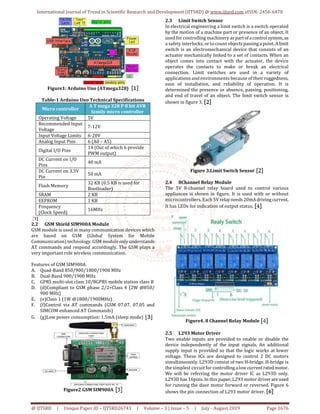
2.1 Arduino Uno (ATmega328)
The Arduino Uno is a microcontroller board based on the
(AT mega 328) as shown in figure-1. It has 14 digital
input/output pins (of which 6 can be used as PWM outputs),
6 analog inputs, a 16 MHz crystal oscillator, a USB
connection, a power jack, an ICSP header, and aresetbutton.
It contains everything needed to support the
microcontroller; simply connect it to a computer with a USB
cable or power it with an AC-to-DC adapter or battery to get
started. This board operates in 5V 40-50mA. This paper has
used an adapter with the Arduino Uno (ATmega328) while
provide the power supply to all the components.
IJTSRD26743
International Journal of Trend in Scientific Research and Development (IJTSRD) @ www.ijtsrd.com eISSN: 2456-6470
@ IJTSRD | Unique Paper ID – IJTSRD26743 | Volume – 3 | Issue – 5 | July - August 2019 Page 1676
Figure1: Arduino Uno (ATmega328)
Table-1 Arduino Uno Technical Specifications
Micro controller
A T mega 328 P 8 bit AVR
family micro controller
Operating Voltage 5V
Recommended Input
Voltage
7-12V
Input Voltage Limits 6-20V
Analog Input Pins 6 (A0 – A5)
Digital I/O Pins
14 (Out of which 6 provide
PWM output)
DC Current on I/O
Pins
40 mA
DC Current on 3.3V
Pin
50 mA
Flash Memory
32 KB (0.5 KB is used for
Bootloader)
SRAM 2 KB
EEPROM 1 KB
Frequency
(Clock Speed)
16MHz
2.2 GSM Shield SIM900A Module
GSM module is used in many communication devices which
are based on GSM (Global System for Mobile
Communication) technology. GSM module onlyunderstands
AT commands and respond accordingly. The GSM plays a
very important role wireless communication.
Features of GSM SIM900A
A. Quad-Band 850/900/1800/1900 MHz
B. Dual-Band 900/1900 MHz
C. GPRS multi-slot class 10/8GPRS mobile station class B
D. (d)Compliant to GSM phase 2/2+Class 4 (2W @850/
900 MHz)
E. (e)Class 1 (1W @1800/1900MHz)
F. (f)Control via AT commands (GSM 07.07, 07.05 and
SIMCOM enhanced AT Commands)
G. (g)Low power consumption: 1.5mA (sleep mode)
Figure2 GSM SIM900A
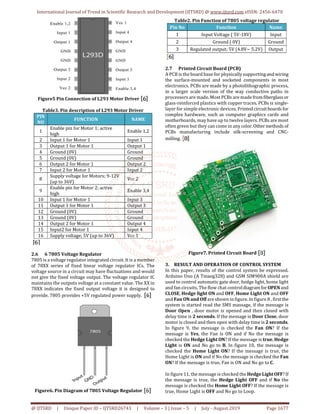
2.3 Limit Switch Sensor
In electrical engineering a limit switch is a switch operated
by the motion of a machine part or presence of an object. It
used for controlling machinery as partofacontrolsystem, as
a safety interlocks, or to count objectspassingapoint.Alimit
switch is an electromechanical device that consists of an
actuator mechanically linked to a set of contacts. When an
object comes into contact with the actuator, the device
operates the contacts to make or break an electrical
connection. Limit switches are used in a variety of
applications and environments because of their ruggedness,
ease of installation, and reliability of operation. It is
determined the presence or absence, passing, positioning,
and end of travel of an object. The limit switch sensor is
shown in figure 3.
Figure 3.Limit Switch Sensor
2.4 8Channel Relay Module
The 5V 8-channel relay board used to control various
appliances is shown in figure. It is used with or without
microcontrollers. Each 5V relayneeds20mAdriving current.
It has LEDs for indication of output status.
Figure4. 8 Channel Relay Module
2.5 L293 Motor Driver
Two enable inputs are provided to enable or disable the
device independently of the input signals. An additional
supply input is provided so that the logic works at lower
voltage. These ICs are designed to control 2 DC motors
simultaneously. L293D consist of two H-bridge. H-bridge is
the simplest circuit for controllingalowcurrentratedmotor.
We will be referring the motor driver IC as L293D only.
L293D has 16pins. In this paper, L293 motor driverareused
for running the door motor forward or reversed. Figure 6
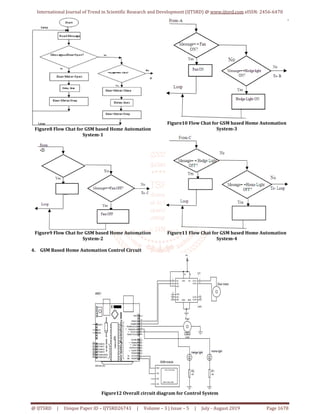
shows the pin connection of L293 motor driver.
International Journal of Trend in Scientific Research and Development (IJTSRD) @ www.ijtsrd.com eISSN: 2456-6470
@ IJTSRD | Unique Paper ID – IJTSRD26743 | Volume – 3 | Issue – 5 | July - August 2019 Page 1677
Figure5 Pin Connection of L293 Motor Driver
Table3. Pin description of L293 Motor Driver
PIN
NO
FUNCTION NAME
1
Enable pin for Motor 1; active
high
Enable 1,2
2 Input 1 for Motor 1 Input 1
3 Output 1 for Motor 1 Output 1
4 Ground (0V) Ground
5 Ground (0V) Ground
6 Output 2 for Motor 1 Output 2
7 Input 2 for Motor 1 Input 2
8
Supply voltage for Motors; 9-12V
(up to 36V)
Vcc 2
9
Enable pin for Motor 2; active
high
Enable 3,4
10 Input 1 for Motor 1 Input 3
11 Output 1 for Motor 1 Output 3
12 Ground (0V) Ground
13 Ground (0V) Ground
14 Output 2 for Motor 1 Output 4
15 Input2 for Motor 1 Input 4
16 Supply voltage; 5V (up to 36V) Vcc 1
2.6 6 7805 Voltage Regulator
7805 is a voltage regulator integrated circuit. It is a member
of 78XX series of fixed linear voltage regulator ICs. The
voltage source in a circuit may have fluctuations and would
not give the fixed voltage output. The voltage regulator IC
maintains the outputs voltage at a constant value. The XX in
78XX indicates the fixed output voltage it is designed to
provide. 7805 provides +5V regulated power supply.
Figure6. Pin Diagram of 7805 Voltage Regulator
Table2. Pin Function of 7805 voltage regulator
Pin No Function Name
1 Input Voltage ( 5V-18V) Input
2 Ground ( 0V) Ground
3 Regulated output; 5V (4.8V~ 5.2V) Output
2.7 Printed Circuit Board (PCB)
A PCB is the board base for physically supportingandwiring
the surface-mounted and socketed components in most
electronics. PCBs are made by a photolithographic process,
in a larger scale version of the way conductive paths in
processors are made. Most PCBs are made fromfiberglass or
glass-reinforced plastics with copper traces. PCBs is single-
layer for simple electronic devices. Printed circuitboards for
complex hardware, such as computer graphics cards and
motherboards, may have up to twelve layers. PCBs are most
often green but they can come in any color.Other methods of
PCBs manufacturing include silk-screening and CNC-
milling.
Figure7. Printed Circuit Board
3. RESULT AND OPERATION OF CONTROL SYSTEM
In this paper, results of the control system be expressed.
Arduino Uno (A Tmaeg328) and GSM SIM900A shield are
used to control automatic gate door, hedge light, home light
and fan circuits. The flow chat controldiagramfor OPENand
CLOSE, Hedge light ON and OFF, Home Light ON and OFF
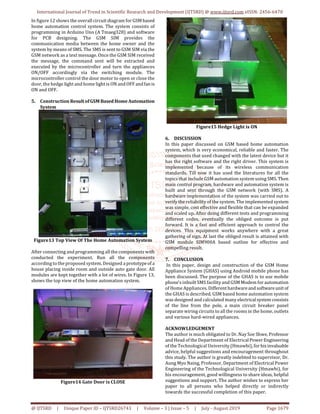
and Fan ON and Off are shown in figure. In figure 8 , firstthe
system is started read the SMS massage, if the message is
Door Open , door motor is opened and then closed with
delay time is 2 seconds. If the message is Door Close, door
motor is closed and then open with delay time is 2 seconds.
In figure 9, the message is checked the Fan ON? If the
message is Yes, the Fan is ON and if No the message is
checked the Hedge Light ON? If the message is true, Hedge
Light is ON and No go to B. In figure 10, the message is
checked the Home Light ON? If the message is true, the
Home Light is ON and if No the message is checked the Fan
ON? If the message is true, Fan is ON and No go to C.
In figure 11, the message is checked the HedgeLightOFF?If
the message is true, the Hedge Light OFF and if No the
message is checked the Home Light OFF? If the message is
true, Home Light is OFF and No go to Loop.
International Journal of Trend in Scientific Research and Development (IJTSRD) @ www.ijtsrd.com eISSN: 2456-6470
@ IJTSRD | Unique Paper ID – IJTSRD26743 | Volume – 3 | Issue – 5 | July - August 2019 Page 1678
Figure8 Flow Chat for GSM based Home Automation
System-1
Figure9 Flow Chat for GSM based Home Automation
System-2
Figure10 Flow Chat for GSM based Home Automation
System-3
Figure11 Flow Chat for GSM based Home Automation
System-4
4. GSM Based Home Automation Control Circuit
Figure12 Overall circuit diagram for Control System
International Journal of Trend in Scientific Research and Development (IJTSRD) @ www.ijtsrd.com eISSN: 2456-6470
@ IJTSRD | Unique Paper ID – IJTSRD26743 | Volume – 3 | Issue – 5 | July - August 2019 Page 1679
In figure 12 shows the overall circuit diagram for GSMbased
home automation control system. The system consists of
programming in Arduino Uno (A Tmaeg328) and software
for PCB designing. The GSM SIM provides the
communication media between the home owner and the
system by means of SMS. The SMS is sent to GSM SIM via the
GSM network as a text message. Once the GSM SIM received
the message, the command sent will be extracted and
executed by the microcontroller and turn the appliances
ON/OFF accordingly via the switching module. The
microcontroller control the door motor to open or close the
door, the hedge light and home light is ON and OFF andfanis
ON and OFF.
5. Construction ResultofGSM BasedHomeAutomation
System
Figure13 Top View Of The Home Automation System
After connecting and programming all the components with
conducted the experiment. Run all the components
according to the proposed system. Designed a prototypeof a
house placing inside room and outside auto gate door. All
modules are kept together with a lot of wires. In Figure 13,
shows the top view of the home automation system.
Figure14 Gate Door is CLOSE
Figure15 Hedge Light is ON
6. DISCUSSION
In this paper discussed on GSM based home automation
system, which is very economical, reliable and faster. The
components that used changed with the latest device but it
has the right software and the right driver. This system is
implemented because of its wireless communication
standards. Till now it has used the literatures for all the
topics that include GSM automation system using SMS.Then
main control program, hardware and automation system is
built and sent through the GSM network (with SMS). A
hardware implementation of the system was carried out to
verify the reliability of the system. The implemented system
was simple, cost effective and flexible that can be expanded
and scaled up. After doing different tests and programming
different codes, eventually the obliged outcome is put
forward. It is a fast and efficient approach to control the
devices. This equipment works anywhere with a great
gathering of sign. At last the obliged result is attained with
GSM module SIM900A based outline for effective and
compelling result.
7. CONCLUSION
In this paper, design and construction of the GSM Home
Appliance System (GHAS) using Android mobile phone has
been discussed. The purpose of the GHAS is to use mobile
phone’s inbuilt SMS facility and GSM Modem for automation
of Home Appliances. Differenthardwareand softwareunit of
the GHAS is described. GSM based home automation system
was designed and calculated many electricalsystem consists
of the line from the pole, a main circuit breaker panel
separate wiring circuits to all the rooms in the home, outlets
and various hard-wired appliances.
ACKNOWLEDGEMENT
The author is much obligated to Dr. Nay Soe Shwe, Professor
and Head of the Department of ElectricalPowerEngineering
of the Technological University (Hmawbi), forhisinvaluable
advice, helpful suggestions and encouragement throughout
this study. The author is greatly indebted to supervisor, Dr.
Aung Myo Naing, Professor, Department of Electrical Power
Engineering of the Technological University (Hmawbi), for
his encouragement, good willingness to share ideas, helpful
suggestions and support. The author wishes to express her
paper to all persons who helped directly or indirectly
towards the successful completion of this paper.
International Journal of Trend in Scientific Research and Development (IJTSRD) @ www.ijtsrd.com eISSN: 2456-6470
@ IJTSRD | Unique Paper ID – IJTSRD26743 | Volume – 3 | Issue – 5 | July - August 2019 Page 1680
REFERENCES
[1] Wikipedia No Date. , Arduino Uno, Received in August
2018 <https;//en.wikipedia.org/wiki/Arduino Uno>
[2] Wikipedia No Date., Limit Switch Sensor, Received in
August 2018 <https;//en.wikipedia.org/wiki/ Limit
Switch Sensor >
[3] Wikipedia No Date., GSM Shield Sim 900A, Received in
August 2018 <https;//en.wikipedia.org/wiki/ GSM
Shield Sim 900A >
[4] WikipediaNoDate, RelayModule(8-Channel),Received
in August 2018 <https;//en.wikipedia.org/wiki/Relay
Module(8-Channel)>
[5] Wikipedia No Date, Diode, Received in August 2018
<https;//en.wikipedia.org/wiki/ Diode>
[6] Wikipedia No Date. , Bridge Rectifier, Received in
August 2018 <https;//en.wikipedia.org/wiki/ Bridge
Rectifier >
[7] Wikipedia No Date, Light Emitting Diode(LED),
Received in August 2018
<https;//en.wikipedia.org/wiki/ Light Emitting
Diode(LED)>
[8] Wikipedia No Date, Printed Circuit Board(PCB),
Received in August 2018
<https;//en.wikipedia.org/wiki/ Printed Circuit
Board(PCB)>

GSM Based Home Appliance Control System

  • 1.
    International Journal ofTrend in Scientific Research and Development (IJTSRD) Volume 3 Issue 5, August 2019 Available Online: www.ijtsrd.com e-ISSN: 2456 – 6470 @ IJTSRD | Unique Paper ID – IJTSRD26743 | Volume – 3 | Issue – 5 | July - August 2019 Page 1675 GSM Based Home Appliance Control System Mrs Khin Ei Ei Khine, Mr Nay Soe Shwe, Mr Aung Myo Naing Master of Engineering, Technological University, Hmawbi, Yangon, Myanmar How to cite this paper: Mrs Khin Ei Ei Khine | Mr Nay Soe Shwe | Mr Aung Myo Naing "GSM Based Home Appliance Control System" Published in International Journal of Trend in Scientific Research and Development (ijtsrd), ISSN: 2456- 6470, Volume-3 | Issue-5, August 2019, pp.1675-1680, https://doi.org/10.31142/ijtsrd26743 Copyright © 2019 by author(s) and International Journalof Trendin Scientific Research and Development Journal. This is an Open Access article distributed under the terms of the Creative CommonsAttribution License (CC BY 4.0) (http://creativecommons.org/licenses/by /4.0) ABSTRACT In this paper, describes about how to control home appliances, auto door sliding motor, fan and lighting using GSM technology by using android application through android mobile phone. Performing of these tasks with a single android device makes every faster because the android makes SMS communication. This paper serve as a basic structure of the communication control system. The programming is done door operating system,hedge light- bulbs and fan and light-bulbs inside the home.ArduinoUno,Sensorsandserial communicating devices are incorporated and synchronized with thepersonal computer. KEYWORDS: SMS communication, Control System, Sensor, GSM technology, android mobile phone, Arduino Uno 1. INTRODUCTION In recent years, the wireless communication is increasing day byday.Thereisa huge advancement in the communication sector. Any new facilities home appliances that promise to enhance the life style is grabbed by the consumers. The more such facilities and appliances are improved, it becomes inevitable to have easy and convenient methods and means to control and operate these appliances. Almost all people nowadays have access to mobile phones and thus the world has indeed become a global village. At any given moment, anyperson across the world is contacted with the help of a mobile phone. But mobile phones are not only used for the calling and sending SMS purposes but also new ideas is generated and techniques from it that further enhance it capabilities. Having wireless control of almost all the things in a person’s life is a growing interest and many systems are providing such control. This idea has designed a control system which is based on the GSM technology that effectively allows control from a remote area to the desired location. Because of this system, there is no need for a person to physically present to switch on/off the electricalappliances. Thispaper represent remotely controlled smart home automation system, for monitoring and controlling of the home light, hedge light, fan and sliding door by using GSM phone inside and outside the home. [1] The SMS received by the receiver is transmitted to the Arduino Uno which reads the message and controls the appropriate device. The SMS received by the receiver is transmitted to the Arduino Uno which reads the message and controls the appropriate device. The primary goal is to discuss home automation technology, lifetime is getting easier and simpler on all side in life. This technology proposed to control the home GSM network. The user commands are transferred to a server, processes the user commands and sends them to the relevant units. The home server is built upon a SMS mobile cell module. The system makes use of Arduino Uno for home appliances control. It makes use of GSM for control of the appliances in terms of SMS based system.[2] 2. SYSTEM DESCRIPTION The system has two parts, namely; hardware and software. The hardware architecture consists of 1. Arduino Uno (ATmega328) 2. GSM Shield SIM900A Moderm 3. Limit Switch Sensor 4. 8-channel Relay Module 5. 7805 Voltage Regulator 6. L293 Motor Driver 7. Diode 8. Capacitor 9. Resistor 10. LED 11. Printed Circuit Board (PCB) 2.1 Arduino Uno (ATmega328) The Arduino Uno is a microcontroller board based on the (AT mega 328) as shown in figure-1. It has 14 digital input/output pins (of which 6 can be used as PWM outputs), 6 analog inputs, a 16 MHz crystal oscillator, a USB connection, a power jack, an ICSP header, and aresetbutton. It contains everything needed to support the microcontroller; simply connect it to a computer with a USB cable or power it with an AC-to-DC adapter or battery to get started. This board operates in 5V 40-50mA. This paper has used an adapter with the Arduino Uno (ATmega328) while provide the power supply to all the components. IJTSRD26743
  • 2.
    International Journal ofTrend in Scientific Research and Development (IJTSRD) @ www.ijtsrd.com eISSN: 2456-6470 @ IJTSRD | Unique Paper ID – IJTSRD26743 | Volume – 3 | Issue – 5 | July - August 2019 Page 1676 Figure1: Arduino Uno (ATmega328) Table-1 Arduino Uno Technical Specifications Micro controller A T mega 328 P 8 bit AVR family micro controller Operating Voltage 5V Recommended Input Voltage 7-12V Input Voltage Limits 6-20V Analog Input Pins 6 (A0 – A5) Digital I/O Pins 14 (Out of which 6 provide PWM output) DC Current on I/O Pins 40 mA DC Current on 3.3V Pin 50 mA Flash Memory 32 KB (0.5 KB is used for Bootloader) SRAM 2 KB EEPROM 1 KB Frequency (Clock Speed) 16MHz 2.2 GSM Shield SIM900A Module GSM module is used in many communication devices which are based on GSM (Global System for Mobile Communication) technology. GSM module onlyunderstands AT commands and respond accordingly. The GSM plays a very important role wireless communication. Features of GSM SIM900A A. Quad-Band 850/900/1800/1900 MHz B. Dual-Band 900/1900 MHz C. GPRS multi-slot class 10/8GPRS mobile station class B D. (d)Compliant to GSM phase 2/2+Class 4 (2W @850/ 900 MHz) E. (e)Class 1 (1W @1800/1900MHz) F. (f)Control via AT commands (GSM 07.07, 07.05 and SIMCOM enhanced AT Commands) G. (g)Low power consumption: 1.5mA (sleep mode) Figure2 GSM SIM900A 2.3 Limit Switch Sensor In electrical engineering a limit switch is a switch operated by the motion of a machine part or presence of an object. It used for controlling machinery as partofacontrolsystem, as a safety interlocks, or to count objectspassingapoint.Alimit switch is an electromechanical device that consists of an actuator mechanically linked to a set of contacts. When an object comes into contact with the actuator, the device operates the contacts to make or break an electrical connection. Limit switches are used in a variety of applications and environments because of their ruggedness, ease of installation, and reliability of operation. It is determined the presence or absence, passing, positioning, and end of travel of an object. The limit switch sensor is shown in figure 3. Figure 3.Limit Switch Sensor 2.4 8Channel Relay Module The 5V 8-channel relay board used to control various appliances is shown in figure. It is used with or without microcontrollers. Each 5V relayneeds20mAdriving current. It has LEDs for indication of output status. Figure4. 8 Channel Relay Module 2.5 L293 Motor Driver Two enable inputs are provided to enable or disable the device independently of the input signals. An additional supply input is provided so that the logic works at lower voltage. These ICs are designed to control 2 DC motors simultaneously. L293D consist of two H-bridge. H-bridge is the simplest circuit for controllingalowcurrentratedmotor. We will be referring the motor driver IC as L293D only. L293D has 16pins. In this paper, L293 motor driverareused for running the door motor forward or reversed. Figure 6 shows the pin connection of L293 motor driver.
  • 3.
    International Journal ofTrend in Scientific Research and Development (IJTSRD) @ www.ijtsrd.com eISSN: 2456-6470 @ IJTSRD | Unique Paper ID – IJTSRD26743 | Volume – 3 | Issue – 5 | July - August 2019 Page 1677 Figure5 Pin Connection of L293 Motor Driver Table3. Pin description of L293 Motor Driver PIN NO FUNCTION NAME 1 Enable pin for Motor 1; active high Enable 1,2 2 Input 1 for Motor 1 Input 1 3 Output 1 for Motor 1 Output 1 4 Ground (0V) Ground 5 Ground (0V) Ground 6 Output 2 for Motor 1 Output 2 7 Input 2 for Motor 1 Input 2 8 Supply voltage for Motors; 9-12V (up to 36V) Vcc 2 9 Enable pin for Motor 2; active high Enable 3,4 10 Input 1 for Motor 1 Input 3 11 Output 1 for Motor 1 Output 3 12 Ground (0V) Ground 13 Ground (0V) Ground 14 Output 2 for Motor 1 Output 4 15 Input2 for Motor 1 Input 4 16 Supply voltage; 5V (up to 36V) Vcc 1 2.6 6 7805 Voltage Regulator 7805 is a voltage regulator integrated circuit. It is a member of 78XX series of fixed linear voltage regulator ICs. The voltage source in a circuit may have fluctuations and would not give the fixed voltage output. The voltage regulator IC maintains the outputs voltage at a constant value. The XX in 78XX indicates the fixed output voltage it is designed to provide. 7805 provides +5V regulated power supply. Figure6. Pin Diagram of 7805 Voltage Regulator Table2. Pin Function of 7805 voltage regulator Pin No Function Name 1 Input Voltage ( 5V-18V) Input 2 Ground ( 0V) Ground 3 Regulated output; 5V (4.8V~ 5.2V) Output 2.7 Printed Circuit Board (PCB) A PCB is the board base for physically supportingandwiring the surface-mounted and socketed components in most electronics. PCBs are made by a photolithographic process, in a larger scale version of the way conductive paths in processors are made. Most PCBs are made fromfiberglass or glass-reinforced plastics with copper traces. PCBs is single- layer for simple electronic devices. Printed circuitboards for complex hardware, such as computer graphics cards and motherboards, may have up to twelve layers. PCBs are most often green but they can come in any color.Other methods of PCBs manufacturing include silk-screening and CNC- milling. Figure7. Printed Circuit Board 3. RESULT AND OPERATION OF CONTROL SYSTEM In this paper, results of the control system be expressed. Arduino Uno (A Tmaeg328) and GSM SIM900A shield are used to control automatic gate door, hedge light, home light and fan circuits. The flow chat controldiagramfor OPENand CLOSE, Hedge light ON and OFF, Home Light ON and OFF and Fan ON and Off are shown in figure. In figure 8 , firstthe system is started read the SMS massage, if the message is Door Open , door motor is opened and then closed with delay time is 2 seconds. If the message is Door Close, door motor is closed and then open with delay time is 2 seconds. In figure 9, the message is checked the Fan ON? If the message is Yes, the Fan is ON and if No the message is checked the Hedge Light ON? If the message is true, Hedge Light is ON and No go to B. In figure 10, the message is checked the Home Light ON? If the message is true, the Home Light is ON and if No the message is checked the Fan ON? If the message is true, Fan is ON and No go to C. In figure 11, the message is checked the HedgeLightOFF?If the message is true, the Hedge Light OFF and if No the message is checked the Home Light OFF? If the message is true, Home Light is OFF and No go to Loop.
  • 4.
    International Journal ofTrend in Scientific Research and Development (IJTSRD) @ www.ijtsrd.com eISSN: 2456-6470 @ IJTSRD | Unique Paper ID – IJTSRD26743 | Volume – 3 | Issue – 5 | July - August 2019 Page 1678 Figure8 Flow Chat for GSM based Home Automation System-1 Figure9 Flow Chat for GSM based Home Automation System-2 Figure10 Flow Chat for GSM based Home Automation System-3 Figure11 Flow Chat for GSM based Home Automation System-4 4. GSM Based Home Automation Control Circuit Figure12 Overall circuit diagram for Control System
  • 5.
    International Journal ofTrend in Scientific Research and Development (IJTSRD) @ www.ijtsrd.com eISSN: 2456-6470 @ IJTSRD | Unique Paper ID – IJTSRD26743 | Volume – 3 | Issue – 5 | July - August 2019 Page 1679 In figure 12 shows the overall circuit diagram for GSMbased home automation control system. The system consists of programming in Arduino Uno (A Tmaeg328) and software for PCB designing. The GSM SIM provides the communication media between the home owner and the system by means of SMS. The SMS is sent to GSM SIM via the GSM network as a text message. Once the GSM SIM received the message, the command sent will be extracted and executed by the microcontroller and turn the appliances ON/OFF accordingly via the switching module. The microcontroller control the door motor to open or close the door, the hedge light and home light is ON and OFF andfanis ON and OFF. 5. Construction ResultofGSM BasedHomeAutomation System Figure13 Top View Of The Home Automation System After connecting and programming all the components with conducted the experiment. Run all the components according to the proposed system. Designed a prototypeof a house placing inside room and outside auto gate door. All modules are kept together with a lot of wires. In Figure 13, shows the top view of the home automation system. Figure14 Gate Door is CLOSE Figure15 Hedge Light is ON 6. DISCUSSION In this paper discussed on GSM based home automation system, which is very economical, reliable and faster. The components that used changed with the latest device but it has the right software and the right driver. This system is implemented because of its wireless communication standards. Till now it has used the literatures for all the topics that include GSM automation system using SMS.Then main control program, hardware and automation system is built and sent through the GSM network (with SMS). A hardware implementation of the system was carried out to verify the reliability of the system. The implemented system was simple, cost effective and flexible that can be expanded and scaled up. After doing different tests and programming different codes, eventually the obliged outcome is put forward. It is a fast and efficient approach to control the devices. This equipment works anywhere with a great gathering of sign. At last the obliged result is attained with GSM module SIM900A based outline for effective and compelling result. 7. CONCLUSION In this paper, design and construction of the GSM Home Appliance System (GHAS) using Android mobile phone has been discussed. The purpose of the GHAS is to use mobile phone’s inbuilt SMS facility and GSM Modem for automation of Home Appliances. Differenthardwareand softwareunit of the GHAS is described. GSM based home automation system was designed and calculated many electricalsystem consists of the line from the pole, a main circuit breaker panel separate wiring circuits to all the rooms in the home, outlets and various hard-wired appliances. ACKNOWLEDGEMENT The author is much obligated to Dr. Nay Soe Shwe, Professor and Head of the Department of ElectricalPowerEngineering of the Technological University (Hmawbi), forhisinvaluable advice, helpful suggestions and encouragement throughout this study. The author is greatly indebted to supervisor, Dr. Aung Myo Naing, Professor, Department of Electrical Power Engineering of the Technological University (Hmawbi), for his encouragement, good willingness to share ideas, helpful suggestions and support. The author wishes to express her paper to all persons who helped directly or indirectly towards the successful completion of this paper.
  • 6.
    International Journal ofTrend in Scientific Research and Development (IJTSRD) @ www.ijtsrd.com eISSN: 2456-6470 @ IJTSRD | Unique Paper ID – IJTSRD26743 | Volume – 3 | Issue – 5 | July - August 2019 Page 1680 REFERENCES [1] Wikipedia No Date. , Arduino Uno, Received in August 2018 <https;//en.wikipedia.org/wiki/Arduino Uno> [2] Wikipedia No Date., Limit Switch Sensor, Received in August 2018 <https;//en.wikipedia.org/wiki/ Limit Switch Sensor > [3] Wikipedia No Date., GSM Shield Sim 900A, Received in August 2018 <https;//en.wikipedia.org/wiki/ GSM Shield Sim 900A > [4] WikipediaNoDate, RelayModule(8-Channel),Received in August 2018 <https;//en.wikipedia.org/wiki/Relay Module(8-Channel)> [5] Wikipedia No Date, Diode, Received in August 2018 <https;//en.wikipedia.org/wiki/ Diode> [6] Wikipedia No Date. , Bridge Rectifier, Received in August 2018 <https;//en.wikipedia.org/wiki/ Bridge Rectifier > [7] Wikipedia No Date, Light Emitting Diode(LED), Received in August 2018 <https;//en.wikipedia.org/wiki/ Light Emitting Diode(LED)> [8] Wikipedia No Date, Printed Circuit Board(PCB), Received in August 2018 <https;//en.wikipedia.org/wiki/ Printed Circuit Board(PCB)>