• Growth and development are an extremely
complex series of events that are best evaluated
by careful examination at different stages
Factors affecting growth and
development
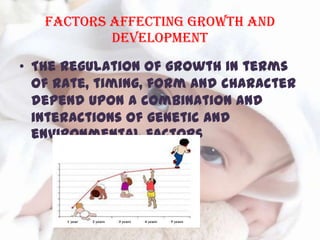
• The regulation of growth in terms
of rate, timing, form and character
depend upon a combination and
interactions of genetic and
environmental factors
Genetic factors
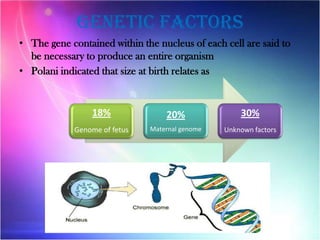
• The gene contained within the nucleus of each cell are said to
be necessary to produce an entire organism
• Polani indicated that size at birth relates as
18%
Genome of fetus
20%
Maternal genome
30%
Unknown factors
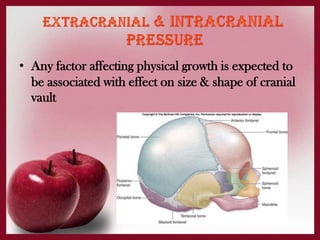
• Any factor affecting physical growth is expected to
be associated with effect on size & shape of cranial
vault
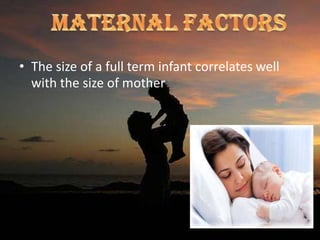
• The size of a full term infant correlates well
with the size of mother
• Lack of nutrition delays growth ,affects size of body part, body
properties , body chemistry ,quality & texture of some tissues
• Malnourished fetus wait for better time & with return of good
nutrition growth takes place unusually fast until genetically
determined curve is neared once mire it is called as catch up
growth
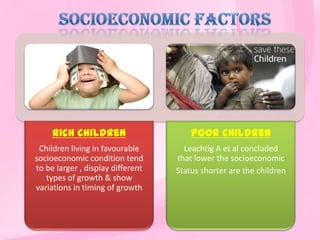
Rich children
Children living in favourable
socioeconomic condition tend
to be larger , display different
types of growth & show
variations in timing of growth
Poor children
Leachtig A et al concluded
that lower the socioeconomic
Status shorter are the children
•GROWTH HORMONE
•INSULIN
•THYROTROPIC HORMONE
Group I
[SKELETAL BONE GROWTH]
• PARATHORMONE
Group II
[OSSIFICATION OF BONE]
•ANDROGENS
•PROGESTRONE
•OESTROGEN
Group III
[PUBERTAL GROWTH SPURT]
• POLACTIN
Group IV
[MISCELLENOUS]
• The close relation between the muscle and the bone
growth is seen due to the fact that muscles influence
the growth both as tissue affecting vascular supply &as
a force element
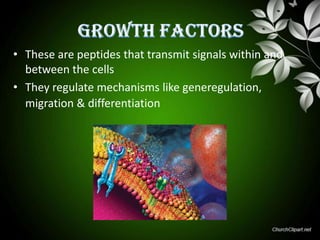
• These are peptides that transmit signals within and
between the cells
• They regulate mechanisms like generegulation,
migration & differentiation
• There are various factors like nutrition and
environment that may lead to difference in growth in
different races
• Any systemic disease or prolonged debilitating
disease has a profound affect on growth process of
child
 People living in cold climate tend to have more of adipose
tissue where as those living in hot climate are thinner
 Growth also varies according to the season like it is faster in
spring and summer; comparatively slower in winter
• There exists a definite relation between physique
and development according to somatotype
• It is useful for fitness and increase in muscles
mass but has no relation with linear growth
• In a family there will always exist a difference between the
various members of a family with respect to their individual
size,maturation level & intelligence
• Size and maturational changes in a large population
can be shown to occur with time
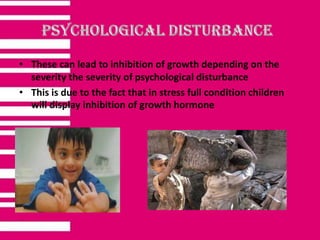
• These can lead to inhibition of growth depending on the
severity the severity of psychological disturbance
• This is due to the fact that in stress full condition children
will display inhibition of growth hormone
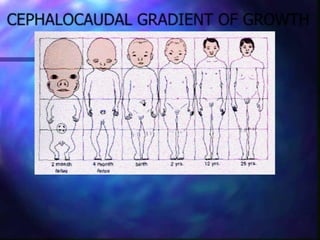
• The physical arrangement of the body at any one time is a
pattern of spatially proportioned parts
2 month fetus
•Head takes about 50% of total body length
•Limbs are rudimentary; trunks not developed
At birth
•30% of body is occupied by head
•Since trunk & head grows faster than head
adult
•12% of body is occupied by head
•Limb represents half of the body .lower limb > upper limb
Variability: since everybody is not alike it is very difficult but very
Important to decide whether an individual is merely at the extreme
of normal variation or falls outside the normal range . Thus it is
expressed quantitatively
Timing : variation from timing arises because the same event happens
for different individuals at different time
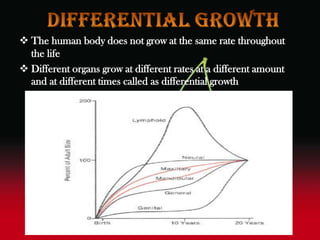
 The human body does not grow at the same rate throughout
the life
 Different organs grow at different rates at a different amount
and at different times called as differential growth
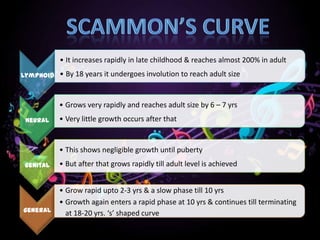
lymphoid
• It increases rapidly in late childhood & reaches almost 200% in adult
• By 18 years it undergoes involution to reach adult size
neural
• Grows very rapidly and reaches adult size by 6 – 7 yrs
• Very little growth occurs after that
genital
• This shows negligible growth until puberty
• But after that grows rapidly till adult level is achieved
general
• Grow rapid upto 2-3 yrs & a slow phase till 10 yrs
• Growth again enters a rapid phase at 10 yrs & continues till terminating
at 18-20 yrs. ‘s’ shaped curve
Growth assessment

Growth assessment

  • 3.
    • Growth anddevelopment are an extremely complex series of events that are best evaluated by careful examination at different stages
  • 4.
    Factors affecting growthand development • The regulation of growth in terms of rate, timing, form and character depend upon a combination and interactions of genetic and environmental factors
  • 5.
    Genetic factors • Thegene contained within the nucleus of each cell are said to be necessary to produce an entire organism • Polani indicated that size at birth relates as 18% Genome of fetus 20% Maternal genome 30% Unknown factors
  • 6.
    • Any factoraffecting physical growth is expected to be associated with effect on size & shape of cranial vault
  • 7.
    • The sizeof a full term infant correlates well with the size of mother
  • 8.
    • Lack ofnutrition delays growth ,affects size of body part, body properties , body chemistry ,quality & texture of some tissues • Malnourished fetus wait for better time & with return of good nutrition growth takes place unusually fast until genetically determined curve is neared once mire it is called as catch up growth
  • 9.
    Rich children Children livingin favourable socioeconomic condition tend to be larger , display different types of growth & show variations in timing of growth Poor children Leachtig A et al concluded that lower the socioeconomic Status shorter are the children
  • 10.
    •GROWTH HORMONE •INSULIN •THYROTROPIC HORMONE GroupI [SKELETAL BONE GROWTH] • PARATHORMONE Group II [OSSIFICATION OF BONE] •ANDROGENS •PROGESTRONE •OESTROGEN Group III [PUBERTAL GROWTH SPURT] • POLACTIN Group IV [MISCELLENOUS]
  • 11.
    • The closerelation between the muscle and the bone growth is seen due to the fact that muscles influence the growth both as tissue affecting vascular supply &as a force element
  • 12.
    • These arepeptides that transmit signals within and between the cells • They regulate mechanisms like generegulation, migration & differentiation
  • 13.
    • There arevarious factors like nutrition and environment that may lead to difference in growth in different races
  • 14.
    • Any systemicdisease or prolonged debilitating disease has a profound affect on growth process of child
  • 15.
     People livingin cold climate tend to have more of adipose tissue where as those living in hot climate are thinner  Growth also varies according to the season like it is faster in spring and summer; comparatively slower in winter
  • 16.
    • There existsa definite relation between physique and development according to somatotype
  • 17.
    • It isuseful for fitness and increase in muscles mass but has no relation with linear growth
  • 18.
    • In afamily there will always exist a difference between the various members of a family with respect to their individual size,maturation level & intelligence
  • 19.
    • Size andmaturational changes in a large population can be shown to occur with time
  • 20.
    • These canlead to inhibition of growth depending on the severity the severity of psychological disturbance • This is due to the fact that in stress full condition children will display inhibition of growth hormone
  • 21.
    • The physicalarrangement of the body at any one time is a pattern of spatially proportioned parts 2 month fetus •Head takes about 50% of total body length •Limbs are rudimentary; trunks not developed At birth •30% of body is occupied by head •Since trunk & head grows faster than head adult •12% of body is occupied by head •Limb represents half of the body .lower limb > upper limb
  • 23.
    Variability: since everybodyis not alike it is very difficult but very Important to decide whether an individual is merely at the extreme of normal variation or falls outside the normal range . Thus it is expressed quantitatively Timing : variation from timing arises because the same event happens for different individuals at different time
  • 24.
     The humanbody does not grow at the same rate throughout the life  Different organs grow at different rates at a different amount and at different times called as differential growth
  • 25.
    lymphoid • It increasesrapidly in late childhood & reaches almost 200% in adult • By 18 years it undergoes involution to reach adult size neural • Grows very rapidly and reaches adult size by 6 – 7 yrs • Very little growth occurs after that genital • This shows negligible growth until puberty • But after that grows rapidly till adult level is achieved general • Grow rapid upto 2-3 yrs & a slow phase till 10 yrs • Growth again enters a rapid phase at 10 yrs & continues till terminating at 18-20 yrs. ‘s’ shaped curve