School of Management
Topic : Groups, It’s Nature , It’s Types & Team
Building
Presented By
Rohit.K.Ravi
17MG401029
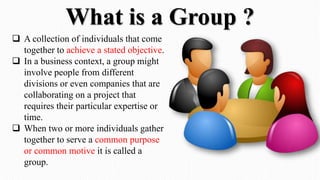
 A collection of individuals that come
together to achieve a stated objective.
 In a business context, a group might
involve people from different
divisions or even companies that are
collaborating on a project that
requires their particular expertise or
time.
 When two or more individuals gather
together to serve a common purpose
or common motive it is called a
group.
What is a Group ?
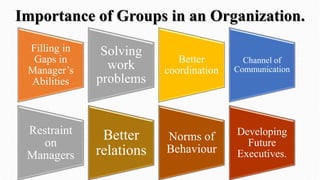
Importance of Groups in an Organization.
Filling in
Gaps in
Manager’s
Abilities
Solving
work
problems
Better
coordination
Channel of
Communication
Restraint
on
Managers
Better
relations
Norms of
Behaviour
Developing
Future
Executives.
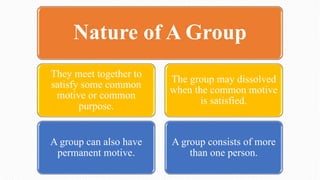
Nature of A Group
They meet together to
satisfy some common
motive or common
purpose.
A group can also have
permanent motive.
The group may dissolved
when the common motive
is satisfied.
A group consists of more
than one person.
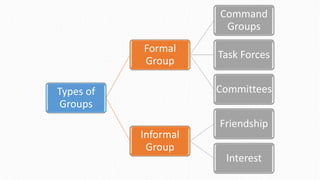
Types of
Groups
Formal
Group
Command
Groups
Task Forces
Committees
Informal
Group
Friendship
Interest
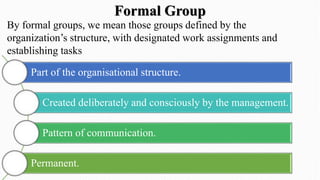
Part of the organisational structure.
Created deliberately and consciously by the management.
Pattern of communication.
Permanent.
By formal groups, we mean those groups defined by the
organization’s structure, with designated work assignments and
establishing tasks
Formal Group
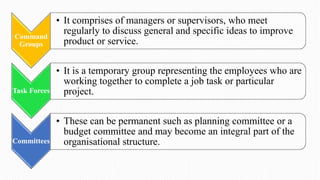
Command
Groups
• It comprises of managers or supervisors, who meet
regularly to discuss general and specific ideas to improve
product or service.
Task Forces
• It is a temporary group representing the employees who are
working together to complete a job task or particular
project.
Committees
• These can be permanent such as planning committee or a
budget committee and may become an integral part of the
organisational structure.
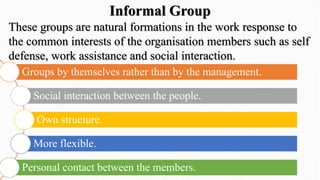
These groups are natural formations in the work response to
the common interests of the organisation members such as self
defense, work assistance and social interaction.
Groups by themselves rather than by the management.
Social interaction between the people.
Own structure.
More flexible.
Personal contact between the members.
Informal Group
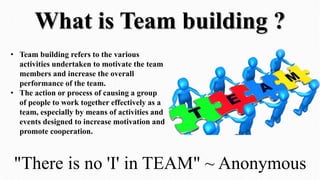
• Team building refers to the various
activities undertaken to motivate the team
members and increase the overall
performance of the team.
• The action or process of causing a group
of people to work together effectively as a
team, especially by means of activities and
events designed to increase motivation and
promote cooperation.
What is Team building ?
"There is no 'I' in TEAM" ~ Anonymous
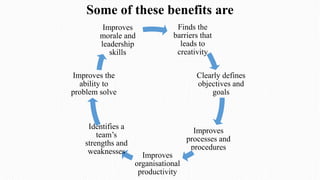
Some of these benefits are
Finds the
barriers that
leads to
creativity
Clearly defines
objectives and
goals
Improves
processes and
procedures
Improves
organisational
productivity
Identifies a
team’s
strengths and
weaknesses
Improves the
ability to
problem solve
Improves
morale and
leadership
skills
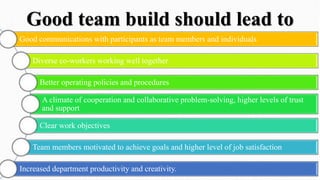
Good communications with participants as team members and individuals
Diverse co-workers working well together
Better operating policies and procedures
A climate of cooperation and collaborative problem-solving, higher levels of trust
and support
Clear work objectives
Team members motivated to achieve goals and higher level of job satisfaction
Increased department productivity and creativity.
Good team build should lead to
Thank You 

Groups, It’s Nature , It’s Types & Team Building

  • 1.
    School of Management Topic: Groups, It’s Nature , It’s Types & Team Building Presented By Rohit.K.Ravi 17MG401029
  • 2.
     A collectionof individuals that come together to achieve a stated objective.  In a business context, a group might involve people from different divisions or even companies that are collaborating on a project that requires their particular expertise or time.  When two or more individuals gather together to serve a common purpose or common motive it is called a group. What is a Group ?
  • 3.
    Importance of Groupsin an Organization. Filling in Gaps in Manager’s Abilities Solving work problems Better coordination Channel of Communication Restraint on Managers Better relations Norms of Behaviour Developing Future Executives.
  • 4.
    Nature of AGroup They meet together to satisfy some common motive or common purpose. A group can also have permanent motive. The group may dissolved when the common motive is satisfied. A group consists of more than one person.
  • 5.
  • 6.
    Part of theorganisational structure. Created deliberately and consciously by the management. Pattern of communication. Permanent. By formal groups, we mean those groups defined by the organization’s structure, with designated work assignments and establishing tasks Formal Group
  • 7.
    Command Groups • It comprisesof managers or supervisors, who meet regularly to discuss general and specific ideas to improve product or service. Task Forces • It is a temporary group representing the employees who are working together to complete a job task or particular project. Committees • These can be permanent such as planning committee or a budget committee and may become an integral part of the organisational structure.
  • 8.
    These groups arenatural formations in the work response to the common interests of the organisation members such as self defense, work assistance and social interaction. Groups by themselves rather than by the management. Social interaction between the people. Own structure. More flexible. Personal contact between the members. Informal Group
  • 9.
    • Team buildingrefers to the various activities undertaken to motivate the team members and increase the overall performance of the team. • The action or process of causing a group of people to work together effectively as a team, especially by means of activities and events designed to increase motivation and promote cooperation. What is Team building ? "There is no 'I' in TEAM" ~ Anonymous
  • 10.
    Some of thesebenefits are Finds the barriers that leads to creativity Clearly defines objectives and goals Improves processes and procedures Improves organisational productivity Identifies a team’s strengths and weaknesses Improves the ability to problem solve Improves morale and leadership skills
  • 11.
    Good communications withparticipants as team members and individuals Diverse co-workers working well together Better operating policies and procedures A climate of cooperation and collaborative problem-solving, higher levels of trust and support Clear work objectives Team members motivated to achieve goals and higher level of job satisfaction Increased department productivity and creativity. Good team build should lead to
  • 12.