Group and Group dynamics
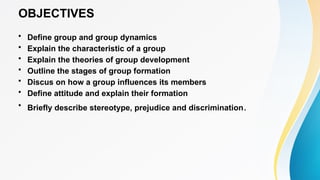
OBJECTIVES
• Define group and group dynamics
• Explain the characteristic of a group
• Explain the theories of group development
• Outline the stages of group formation
• Discus on how a group influences its members
• Define attitude and explain their formation
• Briefly describe stereotype, prejudice and discrimination.
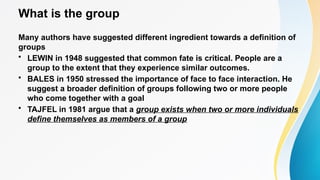
What is the group
Many authors have suggested different ingredient towards a definition of
groups
• LEWIN in 1948 suggested that common fate is critical. People are a
group to the extent that they experience similar outcomes.
• BALES in 1950 stressed the importance of face to face interaction. He
suggest a broader definition of groups following two or more people
who come together with a goal
• TAJFEL in 1981 argue that a group exists when two or more individuals
define themselves as members of a group
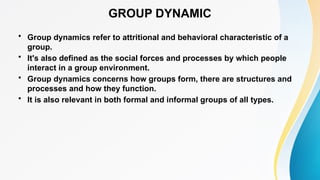
GROUP DYNAMIC
• Group dynamics refer to attritional and behavioral characteristic of a
group.
• It's also defined as the social forces and processes by which people
interact in a group environment.
• Group dynamics concerns how groups form, there are structures and
processes and how they function.
• It is also relevant in both formal and informal groups of all types.
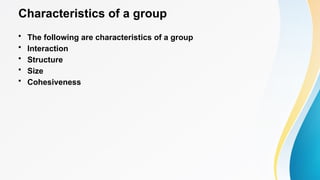
Characteristics of a group
• The following are characteristics of a group
• Interaction
• Structure
• Size
• Cohesiveness
Interaction
• Individuals are motivated to come closer physically and or virtually for
interaction thus it's the key feature of group life.
• The behavior of each member can affect the other members.
• Behavior is influenced by the atmosphere ego solidarity,
understanding, agreement in positive behavior, withdraw, antagonism
in negative behavior.
Structure
• Group structure is the layout of a group, it is a combination of group
roles, norms, status, conformity, work place behavior and attention
relation. For example the behavior expected by group members of roles
such as supporters defenders abstain ace critics, is defined by these
roles.
Size
Groups occur in different sizes and it was
classified by Simmel (1990) :
• Dyad (2) members
• Triad (3) members
• Small group (4) to (20) members.
• Society: (20) to (30) members.
• Large group which has more than 40 members
Cohesiveness
It relates to group strength, group bond and the power
of the network holding the group members together
and sustaining them.
Theories of group development
• As applied to group development, group dynamics is concern with why
and how groups develop
• Why do group develop. To answer such a question scholars came up
with different theories including
1. Classical theory
2. Social exchange theory
3. Social identity theory
1. Classical theory
• Developed by George Homans
• Suggested that groups develop based on activities, interaction and
sentiments
• The theory means that when individuals share common activities, they
will have more interaction and will develop attitude both positive and
negative
• The major element in this theory is the interaction of the individual
involved
2. Social Exchange Theory
• Individuals form relationships based on the implicit expectation of
mutually beneficial exchanges based on trust and felt obligation
3. Social identity theory
• This theory suggests that individuals get a sense of
identity and self esteem based upon their
membership in salient group
• Individual are motivated to belong to and contribute
to identity groups because of the sense of
belongingness and self worth membership in the
group imparts
Stages of group formation
• Forming stage
• Storming stage
• Norming stage
• Performing stage
• Termination stage
Forming stage
• This is initial stage whereby the group identifies the task and
boundaries regarding it, members observe others, various events and
issues and decide what type of behavior is acceptable, there is
guarding against self disclosure.
Storming stage
• There is alot of group influences which may affect
control, power and authority which is of prime
importance in this stage.
• There is competition for position in this stage.
• Then sub grouping is likely to occur.
• There is alot of investment in the leader and there is
no intiativie on the part of subordinates.
• It is a time of testing limits and exploring.
The norming stage, cont`
• In this group stage the group members have tested each other and the
leader.
• They have been able to contain any conflict and work through it.
• The group now agrees on the norms that will guide them through
collective behavior towards effective performance.
• Members begin to take responsibility or roles.
The performing stage
• Creative problem solving is done when solutions emerge from group
energy and there is alot of energy directed towards achieving group
goals.
• Responsibility is shared equally among group members regardless of
appointed leaders anxiety is decreased and tolarate to the working
level.
• The group becomes stable and realistic, matures and members
participate fully and freely.
Termination stage
The work of termination begins during the first stage of formation.
• It brings about fresh anxieties to group individuals.
• Termination has to be done gradually.
• It maybe painful in a successful group.
• There maybe regulation.
• Termination must be discussed fully in ample time and by all members.
• It is important for members to clear up any unfinished issues to be able
to celebrate before leaving.
Group influence on its members
• Group influence is a phenomenon that occurs when the majority of
people in a group influence the thought and behaviors of other people
within that group.
• Groups come in many forms, including family, friends, work, social and
so on.
• Groups use their shared beliefs and experiences to strengthen the
group which can be positive or negative.
• For example a therapy group in which members share their experiences
with trauma may bind the group together and give each member a
feeling that they are understood and supported.
• Groups influence individual decision making
processes in a variety of ways such as group think,
group shift and deindivituation.
Group think
• This is a psychological phenomenon that occurs within a group of
people, in which the desire for harmony or conformity in the group
results in an incorrect or deviant decision making outcome.
Group shift
• This is the phenomenon in which the initial position of individual
members of a group are exaggerated toward a more extreme position.
Deindivituation
This is the concept in social psychology that is generally thought of as
the loosing of self awareness in groups.
Theories of deindivituation propose that it is a psychological state of
decreased self evaluation and decreased evaluation that causes abnormal
collective behavior.
Attitude
• Attitude is the way one think and feel about something especially when
this shows in the way you behave.
• Attitudes are established ways of responding to situations and people
that we have learnt based on beliefs, values and assumptions we hold.
• Attitude is a general and lasting positive or negative opinion or feeling
about some person, object or issue.
Attitude formation
• Attitude formation occurs through either direct experience or the
persuasion of others or the media.
• Attitudes may develop out of psychological needs (motivational
foundations), social interactions ( social foundation), and genetics
( biological foundations).
Foundations of attitudes
• Affect or emotion,
• Behaviour and
• Cognitions
Motivational foundations of attitudes
• A key part of an attitude is the affect or the emotion associated with the
attitude. At a very basic level, we know whether we like it dislike
something or find an idea pleasant or unpleasant.
• For instance, we may say that we know something with " in our heart"
or have a " gut feeling".
• In such cases our attitudes have been formed though our emotions
rather than through logic or thinking.
• This can happen through sensory reactions, values, instrumental
conditioning, classical conditioning, semantic generalization evaluative
conditioning, or mere exposure.
THREE THEORIES OF ATTITUDE
Attitude are born out of what we know [cognitive] feel [emotions] and do
[behavior] about someone or something.
• The three foundational theories that describe the process of attitude
formation are
1. FUNCTIONALIST THEORY
2. LEARNING THEORY
3. EARLY LEARNING THEORY
1. FUNCTIONALIST THEORY
• DANIEL KATZ. A functional theorist suggested that
attitude are formed according to how a particular person
or thing meet our needs.
• To a functionalist, attitudes are shaped based on the
personal benefit they offer
• For example one might have a positive attitude about the
president because they find his political policies meet
their need
2. LEARNING THORY
• Attitude can be learned in a many ways consider how
advertisers use classical conditioning to influence your
attitude toward a particular product
• In a television commercial you see young beautiful people
having fun on a tropical beach while enjoying a sport drink
3 EARLY LEARNING THEORY
• This section might more accurately be called behavioral theories of
attitude change.
• These theories were also developed during the 1950s and 1960s. During
this time learning theories reflected behavioral physiology
Classical conditioning
• It happens when a new stimulus comes to elicit an emotional reaction
because of its association with the stimulus that already elicits the
emotional response.
Semantic generalization
• Not only can we become conditioned to a specific stimulus but this
initial condition can generally or spread to similar stimuli.
• For example a bell higher or lower in pitch to the original conditioned
sound may elicit the same reaction.
• In humans, the initial conditioning can spread even to words or
concepts similar to the original stimulus.
• As a result, we can form attitudes about an object or idea without
having direct contact with it.
• When this kind of generalization occurs, the process is called semantic
generalization.
Evaluative conditioning
• An object need not directly to cause us feel pleasant or unpleasant for
us to form an attitude.
• This conditioning occurs when we for attitudes towards an object or
person because our exposure to them considered with a positive or
negative emotion.
• For example, a couple may come to feel positive towards a particular
song that was playing on the radio during their first date.
Mere exposure
• Finally, when we see the same object or person over and over, we will
generally form a positive attitude towards that object or person.
• This is true for an object or person we feel neutral or positive about, so
long as we are not over exposed to it.
• For example many popular styles of clothing seem bizarre at first, but
as we see more of them we may come to accept or even like them.
Behavioural foundations of attitude
• Sometimes we form attitudes from our actions.
• This can happen if we do something before we have an attitude. For
example going to an art opening of an unknown artist, when we are
unsure of our attitude. E.g. going with a friend to a political rally.
• That is, there are times when just going through the motions can cause
us to form an attitude consistent with those actions.
• There are at least four lines of evidence that account for how attitudes
may form out of actions.
• These are self perception, cognitive dissonance, research evidence,
and role playing.
Self perception
• This theory suggests that we look to our behavior and figure out
attitude based on what we have done or are doing.
Cognitive dissonance
• Suggests that we strive for consistency between our attitudes and our
actions and when the two do not match we may form a new attitude to
confide with our past actions.
Research evidence
• This is evidence using the facial feedback hypothesis, which finds that
holding our facial muscles in the pose of an emotion will cause us to
experience that emotion, which may show the color of our opinions.
Role playing
• It involves improvising persuasive arguments, giving personal
testimony, taking on another person's perspective or even play acting,
are all additional ways that people may come to form attitudes based on
their behavior.
Cognitive foundations of attitudes
• Might as well be called beliefs, which come from direct experience with
the world or through thinking about the world.
• Thinking about the world includes any kind of active Information
processing such as deliberating, wondering, imagining and reflecting.
• For example if you believe that insects are dirty and disgusting, then
you will probably have the attitude that insects are not food.
• How ever, if you read that locates and other insects are happily eaten in
some cultures, then you may become to believe that locates may not be
so bad.
• Your attitudes here comes from reading the new facts you read.
Stereotype, prejudice and discrimination
In social psychology, a stereotype is a fixed, over generalized belief about a
particular group or class of people. By stereotyping we infer that a person has a
whole range of characteristics and abilities that we assume all members of that
group have. For example, a “hells angel” biker dresses in leather.
• One advantage of a stereotype is that it enables us to respond rapidly to
situations because we may have had a similar experience before.
• One disadvantage is that it makes us ignore differences between individuals;
therefore we think things about people that might not be true (i.e. make
generalizations).
Stereotypes
• The use of stereotypes is a major way in which we simplify our
social world; since they reduce the amount of processing (i.e.
thinking) we have to do when we meet a new person.
• Stereotypes lead to social categorization, which is one of the
reasons for prejudiced attitudes (i.e. “them” and “us” mentality)
which leads to in-groups and out-groups
• One positive example of stereotypes includes ; television
newsreaders who are usually seen as highly dependable ,
respectable and impartial. Negative stereotypes seem far more
common however.
Prejudice
• Prejudice is a baseless and usually negative attitude
toward members of a group.
• Common features of prejuidice include negative
feelings, stereotyped beliefs and a tendency to
discriminate against members of the group.
• The word is often used to refer to preconceived, usually
unfavorable judgements toward people based on their
gender, social class, age, disability, religion, sexuality,or
other personal characteristics.
• In psychology, “prejuidice” refers to a positive or
negative evaluation of another person based on their
group membership.
• It is also important to remember that prejuidice is a
belief and not a behavior.
• Although prejudice may lead to descriination, the two
are separate concepts.
Discrimination
• Discrimination is the phenomenon of treating a person differently from
other persons based on group membership and an individual’s
possession of certain characteristics such as age, class, gender, race,
religion, and sexuality.
• Discriminatory behavior can take various forms from relatively mild
behavior, such as social avoidance, to acts of violence, including hate
crimes and genocide.
THANK YOU

Group Dynamic PowerPoint Presentation-1.pptx

  • 1.
  • 2.
    OBJECTIVES • Define groupand group dynamics • Explain the characteristic of a group • Explain the theories of group development • Outline the stages of group formation • Discus on how a group influences its members • Define attitude and explain their formation • Briefly describe stereotype, prejudice and discrimination.
  • 3.
    What is thegroup Many authors have suggested different ingredient towards a definition of groups • LEWIN in 1948 suggested that common fate is critical. People are a group to the extent that they experience similar outcomes. • BALES in 1950 stressed the importance of face to face interaction. He suggest a broader definition of groups following two or more people who come together with a goal • TAJFEL in 1981 argue that a group exists when two or more individuals define themselves as members of a group
  • 4.
    GROUP DYNAMIC • Groupdynamics refer to attritional and behavioral characteristic of a group. • It's also defined as the social forces and processes by which people interact in a group environment. • Group dynamics concerns how groups form, there are structures and processes and how they function. • It is also relevant in both formal and informal groups of all types.
  • 5.
    Characteristics of agroup • The following are characteristics of a group • Interaction • Structure • Size • Cohesiveness
  • 6.
    Interaction • Individuals aremotivated to come closer physically and or virtually for interaction thus it's the key feature of group life. • The behavior of each member can affect the other members. • Behavior is influenced by the atmosphere ego solidarity, understanding, agreement in positive behavior, withdraw, antagonism in negative behavior.
  • 7.
    Structure • Group structureis the layout of a group, it is a combination of group roles, norms, status, conformity, work place behavior and attention relation. For example the behavior expected by group members of roles such as supporters defenders abstain ace critics, is defined by these roles.
  • 8.
    Size Groups occur indifferent sizes and it was classified by Simmel (1990) : • Dyad (2) members • Triad (3) members • Small group (4) to (20) members. • Society: (20) to (30) members. • Large group which has more than 40 members
  • 9.
    Cohesiveness It relates togroup strength, group bond and the power of the network holding the group members together and sustaining them.
  • 10.
    Theories of groupdevelopment • As applied to group development, group dynamics is concern with why and how groups develop • Why do group develop. To answer such a question scholars came up with different theories including 1. Classical theory 2. Social exchange theory 3. Social identity theory
  • 11.
    1. Classical theory •Developed by George Homans • Suggested that groups develop based on activities, interaction and sentiments • The theory means that when individuals share common activities, they will have more interaction and will develop attitude both positive and negative • The major element in this theory is the interaction of the individual involved
  • 12.
    2. Social ExchangeTheory • Individuals form relationships based on the implicit expectation of mutually beneficial exchanges based on trust and felt obligation
  • 13.
    3. Social identitytheory • This theory suggests that individuals get a sense of identity and self esteem based upon their membership in salient group • Individual are motivated to belong to and contribute to identity groups because of the sense of belongingness and self worth membership in the group imparts
  • 14.
    Stages of groupformation • Forming stage • Storming stage • Norming stage • Performing stage • Termination stage
  • 15.
    Forming stage • Thisis initial stage whereby the group identifies the task and boundaries regarding it, members observe others, various events and issues and decide what type of behavior is acceptable, there is guarding against self disclosure.
  • 16.
    Storming stage • Thereis alot of group influences which may affect control, power and authority which is of prime importance in this stage. • There is competition for position in this stage. • Then sub grouping is likely to occur. • There is alot of investment in the leader and there is no intiativie on the part of subordinates. • It is a time of testing limits and exploring.
  • 17.
    The norming stage,cont` • In this group stage the group members have tested each other and the leader. • They have been able to contain any conflict and work through it. • The group now agrees on the norms that will guide them through collective behavior towards effective performance. • Members begin to take responsibility or roles.
  • 18.
    The performing stage •Creative problem solving is done when solutions emerge from group energy and there is alot of energy directed towards achieving group goals. • Responsibility is shared equally among group members regardless of appointed leaders anxiety is decreased and tolarate to the working level. • The group becomes stable and realistic, matures and members participate fully and freely.
  • 19.
    Termination stage The workof termination begins during the first stage of formation. • It brings about fresh anxieties to group individuals. • Termination has to be done gradually. • It maybe painful in a successful group. • There maybe regulation. • Termination must be discussed fully in ample time and by all members. • It is important for members to clear up any unfinished issues to be able to celebrate before leaving.
  • 20.
    Group influence onits members • Group influence is a phenomenon that occurs when the majority of people in a group influence the thought and behaviors of other people within that group. • Groups come in many forms, including family, friends, work, social and so on. • Groups use their shared beliefs and experiences to strengthen the group which can be positive or negative. • For example a therapy group in which members share their experiences with trauma may bind the group together and give each member a feeling that they are understood and supported.
  • 21.
    • Groups influenceindividual decision making processes in a variety of ways such as group think, group shift and deindivituation.
  • 22.
    Group think • Thisis a psychological phenomenon that occurs within a group of people, in which the desire for harmony or conformity in the group results in an incorrect or deviant decision making outcome.
  • 23.
    Group shift • Thisis the phenomenon in which the initial position of individual members of a group are exaggerated toward a more extreme position.
  • 24.
    Deindivituation This is theconcept in social psychology that is generally thought of as the loosing of self awareness in groups. Theories of deindivituation propose that it is a psychological state of decreased self evaluation and decreased evaluation that causes abnormal collective behavior.
  • 25.
    Attitude • Attitude isthe way one think and feel about something especially when this shows in the way you behave. • Attitudes are established ways of responding to situations and people that we have learnt based on beliefs, values and assumptions we hold. • Attitude is a general and lasting positive or negative opinion or feeling about some person, object or issue.
  • 26.
    Attitude formation • Attitudeformation occurs through either direct experience or the persuasion of others or the media. • Attitudes may develop out of psychological needs (motivational foundations), social interactions ( social foundation), and genetics ( biological foundations).
  • 27.
    Foundations of attitudes •Affect or emotion, • Behaviour and • Cognitions
  • 28.
    Motivational foundations ofattitudes • A key part of an attitude is the affect or the emotion associated with the attitude. At a very basic level, we know whether we like it dislike something or find an idea pleasant or unpleasant. • For instance, we may say that we know something with " in our heart" or have a " gut feeling". • In such cases our attitudes have been formed though our emotions rather than through logic or thinking. • This can happen through sensory reactions, values, instrumental conditioning, classical conditioning, semantic generalization evaluative conditioning, or mere exposure.
  • 29.
    THREE THEORIES OFATTITUDE Attitude are born out of what we know [cognitive] feel [emotions] and do [behavior] about someone or something. • The three foundational theories that describe the process of attitude formation are 1. FUNCTIONALIST THEORY 2. LEARNING THEORY 3. EARLY LEARNING THEORY
  • 30.
    1. FUNCTIONALIST THEORY •DANIEL KATZ. A functional theorist suggested that attitude are formed according to how a particular person or thing meet our needs. • To a functionalist, attitudes are shaped based on the personal benefit they offer • For example one might have a positive attitude about the president because they find his political policies meet their need
  • 31.
    2. LEARNING THORY •Attitude can be learned in a many ways consider how advertisers use classical conditioning to influence your attitude toward a particular product • In a television commercial you see young beautiful people having fun on a tropical beach while enjoying a sport drink
  • 32.
    3 EARLY LEARNINGTHEORY • This section might more accurately be called behavioral theories of attitude change. • These theories were also developed during the 1950s and 1960s. During this time learning theories reflected behavioral physiology
  • 33.
    Classical conditioning • Ithappens when a new stimulus comes to elicit an emotional reaction because of its association with the stimulus that already elicits the emotional response.
  • 34.
    Semantic generalization • Notonly can we become conditioned to a specific stimulus but this initial condition can generally or spread to similar stimuli. • For example a bell higher or lower in pitch to the original conditioned sound may elicit the same reaction. • In humans, the initial conditioning can spread even to words or concepts similar to the original stimulus. • As a result, we can form attitudes about an object or idea without having direct contact with it. • When this kind of generalization occurs, the process is called semantic generalization.
  • 35.
    Evaluative conditioning • Anobject need not directly to cause us feel pleasant or unpleasant for us to form an attitude. • This conditioning occurs when we for attitudes towards an object or person because our exposure to them considered with a positive or negative emotion. • For example, a couple may come to feel positive towards a particular song that was playing on the radio during their first date.
  • 36.
    Mere exposure • Finally,when we see the same object or person over and over, we will generally form a positive attitude towards that object or person. • This is true for an object or person we feel neutral or positive about, so long as we are not over exposed to it. • For example many popular styles of clothing seem bizarre at first, but as we see more of them we may come to accept or even like them.
  • 37.
    Behavioural foundations ofattitude • Sometimes we form attitudes from our actions. • This can happen if we do something before we have an attitude. For example going to an art opening of an unknown artist, when we are unsure of our attitude. E.g. going with a friend to a political rally. • That is, there are times when just going through the motions can cause us to form an attitude consistent with those actions. • There are at least four lines of evidence that account for how attitudes may form out of actions. • These are self perception, cognitive dissonance, research evidence, and role playing.
  • 38.
    Self perception • Thistheory suggests that we look to our behavior and figure out attitude based on what we have done or are doing.
  • 39.
    Cognitive dissonance • Suggeststhat we strive for consistency between our attitudes and our actions and when the two do not match we may form a new attitude to confide with our past actions.
  • 40.
    Research evidence • Thisis evidence using the facial feedback hypothesis, which finds that holding our facial muscles in the pose of an emotion will cause us to experience that emotion, which may show the color of our opinions.
  • 41.
    Role playing • Itinvolves improvising persuasive arguments, giving personal testimony, taking on another person's perspective or even play acting, are all additional ways that people may come to form attitudes based on their behavior.
  • 42.
    Cognitive foundations ofattitudes • Might as well be called beliefs, which come from direct experience with the world or through thinking about the world. • Thinking about the world includes any kind of active Information processing such as deliberating, wondering, imagining and reflecting. • For example if you believe that insects are dirty and disgusting, then you will probably have the attitude that insects are not food. • How ever, if you read that locates and other insects are happily eaten in some cultures, then you may become to believe that locates may not be so bad. • Your attitudes here comes from reading the new facts you read.
  • 43.
    Stereotype, prejudice anddiscrimination In social psychology, a stereotype is a fixed, over generalized belief about a particular group or class of people. By stereotyping we infer that a person has a whole range of characteristics and abilities that we assume all members of that group have. For example, a “hells angel” biker dresses in leather. • One advantage of a stereotype is that it enables us to respond rapidly to situations because we may have had a similar experience before. • One disadvantage is that it makes us ignore differences between individuals; therefore we think things about people that might not be true (i.e. make generalizations).
  • 44.
    Stereotypes • The useof stereotypes is a major way in which we simplify our social world; since they reduce the amount of processing (i.e. thinking) we have to do when we meet a new person. • Stereotypes lead to social categorization, which is one of the reasons for prejudiced attitudes (i.e. “them” and “us” mentality) which leads to in-groups and out-groups • One positive example of stereotypes includes ; television newsreaders who are usually seen as highly dependable , respectable and impartial. Negative stereotypes seem far more common however.
  • 45.
    Prejudice • Prejudice isa baseless and usually negative attitude toward members of a group. • Common features of prejuidice include negative feelings, stereotyped beliefs and a tendency to discriminate against members of the group. • The word is often used to refer to preconceived, usually unfavorable judgements toward people based on their gender, social class, age, disability, religion, sexuality,or other personal characteristics.
  • 46.
    • In psychology,“prejuidice” refers to a positive or negative evaluation of another person based on their group membership. • It is also important to remember that prejuidice is a belief and not a behavior. • Although prejudice may lead to descriination, the two are separate concepts.
  • 47.
    Discrimination • Discrimination isthe phenomenon of treating a person differently from other persons based on group membership and an individual’s possession of certain characteristics such as age, class, gender, race, religion, and sexuality. • Discriminatory behavior can take various forms from relatively mild behavior, such as social avoidance, to acts of violence, including hate crimes and genocide.
  • 48.

Editor's Notes

  • #43 In social psychology, a stereotype is a fixed, over generalized belief about a particular group or class of people. By stereotyping we infer that a person has a whole range of characteristics and abilities that we assume all members of that group have. For example, a “hells angel” biker dresses in leather. One advantage of a stereotype is that it enables us to respond rapidly to situations because we may have had a similar experience before. One disadvantage is that it makes us ignore differences between individuals; therefore we think things about people that might not be true (i.e. make generalizations). The use of stereotypes is a major way in which we simplify our social world; since they reduce the amount of processing (i.e. thinking) we have to do when we meet a new person. Stereotypes lead to social categorization, which is one of the reasons for prejudiced attitudes (i.e. “them” and “us” mentality) which leads to in-groups and out-groups.One example of positive stereotypes includes;television newsreaders (usually seen as highly dependable,responsible and impartial).Negative stereotypes seem far more common,however.
  • #47 Discrimination is the phenomenon of treating a person differently from other persons based on group membership and an individual’s possession of certain characteristics such as age, class, gender, race, religion, and sexuality. Discriminatory behavior can take various forms from relatively mild behavior, such as social avoidance, to acts of violence, including hate crimes and genocide.