YOUNG ADULT’S SEXUALITY
AND CULTURE DIFFERENCES
INTRODUCTION
• Sex refers to biological differences, while gender
refers to the cultural construction of male and
female characteristics.
• Sexual desire is described as the ability, interest,
or willingness to receive sexual stimulation
(Byers & Esparza, 1997; Krozy, 1998)
• Sexuality can be influenced by cultural, religious
views, physical attributes, age, and environment
(Krozy, 1998; Sadock & Sadock, 2003)
EDUCATIONAL LEVEL
• Values education deepens teenagers’
understanding, motivation, and responsibility
with regard to their dating and sexual lives
(Lickona, Boudreau, and Lickona, 2003; Lees,Muldoon,
Sheehy, and Kremer, 2003)
• Effective education can teach communication
skills, provide accurate sexual knowledge,
explore attitudes and values, and address
important sexuality issues
(Somers and Gleason, 2001)
SOCIOECONOMIC
STATUS
• Adolescent childbearing is more likely among
women with low levels of income and education
than among their better-off peers.
• Several factors that can influence teenage sexual
include lowered personal competence, skills and
motivation
E.g. Poor teenagers are more likely than better-off teenagers to initiate
sexual activity before age 20.
GENDER
• Men consistently report higher levels of sexual desire than
women.
Evolutionary theorists predict that male desire should remain
perpetually high in order for them to produce many offspring,
while female desire should decrease as their attention turns,
historically, toward child-rearing.
• According to gender schema theory
Culture plays a role in gender development
E.g: As children develop, they acquire schemata that guide their cognitions
related to gender. They not only ready to encode and organize information
about gender, but they also do so in a social environment that defines
maleness and femaleness
(Bem, 1985)
METHODOLOGY
• Multidimensional Sexuality Questionnaire (MSQ)
• Develop by Snell, Fisher, and Walters (1993)
• 122 adults participated in the study
• 56 Singaporean
• 66 Malaysian
• Age range from 18 to 25 years old
• 48 males
• 74 females
• Convenience sampling
RESULT:
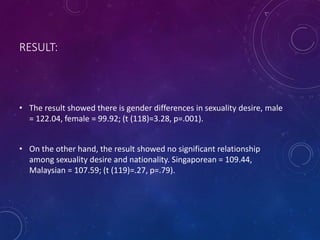
• The result showed there is gender differences in sexuality desire, male
= 122.04, female = 99.92; (t (118)=3.28, p=.001).
• On the other hand, the result showed no significant relationship
among sexuality desire and nationality. Singaporean = 109.44,
Malaysian = 107.59; (t (119)=.27, p=.79).
DISCUSSION
• There is no cultural differences in terms of sexuality
desire
• It could be the sample size is small, so it is not well-
representative
• Both Malaysia and Singapore are collectivistic culture.
CONT.
• There is gender differences in sexuality desire
• Men tend to have higher libido
• Men feel more liberated and find it more ‘appropriate’ to
express their sexual desires.
REFERENCESBem, Sandra Lipsitz. (1985). Androgyny and gender schema theory: a conceptual and empirical integration.
In Theo B. Sonderegger (Ed.), Nebraska Symposium on Motivation , 1984: Psychology and gender (pp.
179-226). Lincoln, NE; University of Nebraska Press.
Bulbeck, C. (1994). ‘Sexual dangers: Chinese women’s experiences in three cultures – Beijing, Taipei and
Hong Kong’, Women’s Studies International Forum, 17, 1:95-103.
Bussey, Kay & Bandura, Albert (1999). Social –cognitivetheory of gender development and differentiation.
Psychological Review, 106, 676-713.
Despain, James, and Jane B. Converse. 2003. And Dignity for All: Unlocking Greatness with Values-Based
Leadership. Dallas, Tx: Pearson Educational.
Evans, H. (1995) ‘Defining difference: the “scientific” construction of sexuality and gender in the People’s
Republic of China’. Signs: Journal of Women in Culture and Society, 20, 2:357-94.
REFERENCES
Gordon, Sol, and Judith Gordon, (2000). Raising a Child Responsibly in a Sexually Permissive World. Holbrook, MA: Adams Media.
Haffner, D, W., 2000. From Diapers to Dating: A Parent’s Guide to Raising Sexually Healthy Children. New York: Newmarket.
Haffner, D, W.,2002. Beyond the Big Talk: Every Parent’s Guide to Raising Sexually Healthy Teens, from Middle School to High School and
Beyond. New York: Newmarket.
Kingsberg, K., (2009). What, Exactly, Is Sexual Desire, And How Does It Fit Into A Loving Relationship? Retrieved from
http://abcnews.go.com/Health/WellnessResource/story?id=7182897
Lees, Stanley, Orla Muldoon, Noel Sheehy, and John Kremer. (Eds.). 2003. Applying Social Psychology. Indianapolis, IN: Macmillan.
Lickona, Thomas, William Boudreau, and Judy Lickona. (2003). Sex, Love and You: Making the Right Decision. South Bend, IN: Ave Maria.
REFERENCES
Martin, Carol Lynn & Halverson, Charles F., Jr. (1981). A schematic processing model of sex-typing
and stereotyping in children. Child Development, 52, 1119-1134.
Martin, Carol Lynn., Ruble, Diane N., Szkrybalo, Joel. (2002). Cognitive theories of early gender
development. Psychological Bulletin, 128, 903-933.
McMillan, J. (1999) ‘Problems for Adam and Eve: Chinese sex shops and the biomedical
construction of sexuality’, Bulletin of the British Association for Chinese Srudies, 10-26.
Scapp, Ronald. 2002. Teaching Values: Education, Politics and Culture. Florence, KY: Routledge.
Schwartz, Pepper, and Dominic Cappello. (2000). Ten Talks Parents Must Have with Their Children
about Sex and Character. Westport, CT: Hyperion.
REFERENCES
Snell, Fisher, & Walters., (1993). The Multidimensional Sexuality Questionnaire. Retrieved
on 21st July 2012 from http://www4.semo.edu/snell/scales/MSQ.htm
Somers, Cheryl L., and Jamie H. Gleason. (2001). “Does Source of Sex Education Predict
Adolescents’ Sexual Knowledge, Attitudes, and Behaviors?” Education, 121 (4):674-682
Group assignment-cross cultural.

Group assignment-cross cultural.

  • 1.
    YOUNG ADULT’S SEXUALITY ANDCULTURE DIFFERENCES
  • 2.
    INTRODUCTION • Sex refersto biological differences, while gender refers to the cultural construction of male and female characteristics. • Sexual desire is described as the ability, interest, or willingness to receive sexual stimulation (Byers & Esparza, 1997; Krozy, 1998) • Sexuality can be influenced by cultural, religious views, physical attributes, age, and environment (Krozy, 1998; Sadock & Sadock, 2003)
  • 3.
    EDUCATIONAL LEVEL • Valueseducation deepens teenagers’ understanding, motivation, and responsibility with regard to their dating and sexual lives (Lickona, Boudreau, and Lickona, 2003; Lees,Muldoon, Sheehy, and Kremer, 2003) • Effective education can teach communication skills, provide accurate sexual knowledge, explore attitudes and values, and address important sexuality issues (Somers and Gleason, 2001)
  • 4.
    SOCIOECONOMIC STATUS • Adolescent childbearingis more likely among women with low levels of income and education than among their better-off peers. • Several factors that can influence teenage sexual include lowered personal competence, skills and motivation E.g. Poor teenagers are more likely than better-off teenagers to initiate sexual activity before age 20.
  • 5.
    GENDER • Men consistentlyreport higher levels of sexual desire than women. Evolutionary theorists predict that male desire should remain perpetually high in order for them to produce many offspring, while female desire should decrease as their attention turns, historically, toward child-rearing. • According to gender schema theory Culture plays a role in gender development E.g: As children develop, they acquire schemata that guide their cognitions related to gender. They not only ready to encode and organize information about gender, but they also do so in a social environment that defines maleness and femaleness (Bem, 1985)
  • 6.
    METHODOLOGY • Multidimensional SexualityQuestionnaire (MSQ) • Develop by Snell, Fisher, and Walters (1993) • 122 adults participated in the study • 56 Singaporean • 66 Malaysian • Age range from 18 to 25 years old • 48 males • 74 females • Convenience sampling
  • 7.
    RESULT: • The resultshowed there is gender differences in sexuality desire, male = 122.04, female = 99.92; (t (118)=3.28, p=.001). • On the other hand, the result showed no significant relationship among sexuality desire and nationality. Singaporean = 109.44, Malaysian = 107.59; (t (119)=.27, p=.79).
  • 8.
    DISCUSSION • There isno cultural differences in terms of sexuality desire • It could be the sample size is small, so it is not well- representative • Both Malaysia and Singapore are collectivistic culture.
  • 9.
    CONT. • There isgender differences in sexuality desire • Men tend to have higher libido • Men feel more liberated and find it more ‘appropriate’ to express their sexual desires.
  • 10.
    REFERENCESBem, Sandra Lipsitz.(1985). Androgyny and gender schema theory: a conceptual and empirical integration. In Theo B. Sonderegger (Ed.), Nebraska Symposium on Motivation , 1984: Psychology and gender (pp. 179-226). Lincoln, NE; University of Nebraska Press. Bulbeck, C. (1994). ‘Sexual dangers: Chinese women’s experiences in three cultures – Beijing, Taipei and Hong Kong’, Women’s Studies International Forum, 17, 1:95-103. Bussey, Kay & Bandura, Albert (1999). Social –cognitivetheory of gender development and differentiation. Psychological Review, 106, 676-713. Despain, James, and Jane B. Converse. 2003. And Dignity for All: Unlocking Greatness with Values-Based Leadership. Dallas, Tx: Pearson Educational. Evans, H. (1995) ‘Defining difference: the “scientific” construction of sexuality and gender in the People’s Republic of China’. Signs: Journal of Women in Culture and Society, 20, 2:357-94.
  • 11.
    REFERENCES Gordon, Sol, andJudith Gordon, (2000). Raising a Child Responsibly in a Sexually Permissive World. Holbrook, MA: Adams Media. Haffner, D, W., 2000. From Diapers to Dating: A Parent’s Guide to Raising Sexually Healthy Children. New York: Newmarket. Haffner, D, W.,2002. Beyond the Big Talk: Every Parent’s Guide to Raising Sexually Healthy Teens, from Middle School to High School and Beyond. New York: Newmarket. Kingsberg, K., (2009). What, Exactly, Is Sexual Desire, And How Does It Fit Into A Loving Relationship? Retrieved from http://abcnews.go.com/Health/WellnessResource/story?id=7182897 Lees, Stanley, Orla Muldoon, Noel Sheehy, and John Kremer. (Eds.). 2003. Applying Social Psychology. Indianapolis, IN: Macmillan. Lickona, Thomas, William Boudreau, and Judy Lickona. (2003). Sex, Love and You: Making the Right Decision. South Bend, IN: Ave Maria.
  • 12.
    REFERENCES Martin, Carol Lynn& Halverson, Charles F., Jr. (1981). A schematic processing model of sex-typing and stereotyping in children. Child Development, 52, 1119-1134. Martin, Carol Lynn., Ruble, Diane N., Szkrybalo, Joel. (2002). Cognitive theories of early gender development. Psychological Bulletin, 128, 903-933. McMillan, J. (1999) ‘Problems for Adam and Eve: Chinese sex shops and the biomedical construction of sexuality’, Bulletin of the British Association for Chinese Srudies, 10-26. Scapp, Ronald. 2002. Teaching Values: Education, Politics and Culture. Florence, KY: Routledge. Schwartz, Pepper, and Dominic Cappello. (2000). Ten Talks Parents Must Have with Their Children about Sex and Character. Westport, CT: Hyperion.
  • 13.
    REFERENCES Snell, Fisher, &Walters., (1993). The Multidimensional Sexuality Questionnaire. Retrieved on 21st July 2012 from http://www4.semo.edu/snell/scales/MSQ.htm Somers, Cheryl L., and Jamie H. Gleason. (2001). “Does Source of Sex Education Predict Adolescents’ Sexual Knowledge, Attitudes, and Behaviors?” Education, 121 (4):674-682