B S N I I I - H A L L ( G R O U P T W O )
COMMUNITY HEALTH NURSING 2
I O S
M L I '
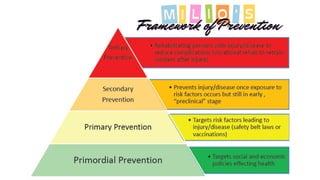
Framework of Prevention
E R
R P O E
T R S
Adiel
Johanna
Valerie
Christian
Aiah
objectives
A N
R I N
L G
E
Understand
Milio's
framework for
prevention
Understand it's
application in the
community
health setting
Explain the
connection between
the individual’s state
of health and that of
the community
At the end of this report, BSN III Hall students are
expected to:
expected to:
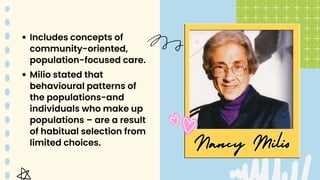
Nancy Milio
Nancy Milio
Nancy Milio, PhD, RN, was a
public health nurse who
formulated a framework for
prevention, which aimed to
explain the connection between
the individual’s state of health
and that of the community.
She proposed that an
individual’s health and lifestyle
choices are influenced by
resources, availability, cost,
and convenience more than
knowledge obtained from
education.
Nancy Milio
Nancy Milio
Includes concepts of
community-oriented,
population-focused care.
Milio stated that
behavioural patterns of
the populations-and
individuals who make up
populations – are a result
of habitual selection from
limited choices.
Nancy Milio
Nancy Milio
She challenged the common
notion that a main
determinant for unhealthful
behavioural choice is lack of
knowledge.
Milio’s framework described
a sometimes neglected role
of community health
nursing to examine the
determinants of a
community’s health and
attempt to influence those
determinants through
public policy.
FRAMEWORK OF PREVENTION
The framework provides that the health status existing in the
population occurs due to too little or excess critical health
sustaining resources whereby people who are have enough
and safe food, shelter, water and environment are
vulnerable to infectious diseases which too much food will
lead to obesity.
Population behavior patterns also affect health since
knowledge and perception is influenced by informal and
formal learning and also by experience. Health is also
influenced by organizational behavior which includes policy
makers since they provide options available to thus
influencing selections made by individuals.
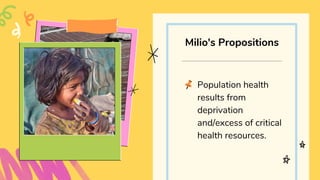
Population health
results from
deprivation
and/excess of critical
health resources.
Milio's Propositions
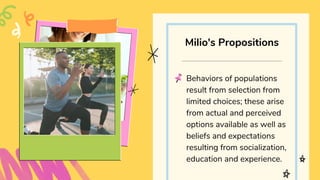
Behaviors of populations
result from selection from
limited choices; these arise
from actual and perceived
options available as well as
beliefs and expectations
resulting from socialization,
education and experience.
Milio's Propositions
Organizational
decisions and policies
dictate many of the
options available to
individuals and
populations and
influence choices.
Milio's Propositions
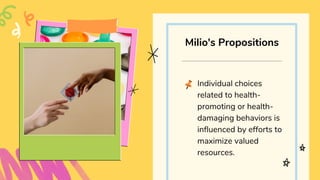
Individual choices
related to health-
promoting or health-
damaging behaviors is
influenced by efforts to
maximize valued
resources.
Milio's Propositions
Alteration in patterns
of behavior resulting
from decision making
of significant number
of people in a
population can result
in social change.
Milio's Propositions
Without concurrent
availability of alternative
health-promoting options
for investment of personal
resources, health
education will be largely
ineffective in changing
behavior patterns.
Milio's Propositions
I O S
M L I '
Framework of Prevention
primordial
primordial
level
level
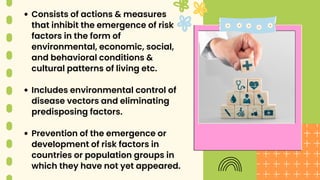
Consists of actions & measures
that inhibit the emergence of risk
factors in the form of
environmental, economic, social,
and behavioral conditions &
cultural patterns of living etc.
Includes environmental control of
disease vectors and eliminating
predisposing factors.
Prevention of the emergence or
development of risk factors in
countries or population groups in
which they have not yet appeared.
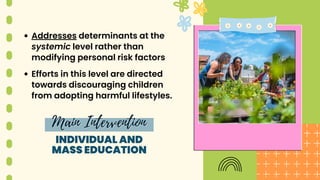
Addresses determinants at the
systemic level rather than
modifying personal risk factors
Efforts in this level are directed
towards discouraging children
from adopting harmful lifestyles.
INDIVIDUAL AND
MASS EDUCATION
Main Intervention
Main Intervention
A S
X P
M L E
E
Outlawing alcohol in
certain countries
Improving sanitation and
establishing healthy
communities
Promoting a healthy lifestyle in
childhood through prenatal
nutrition programs and
supporting early childhood
development programs
Maintaining appropriate weight,
blood pressure, glucose level and
lipids level; not smoking; having
a healthy diet
primary
primary
level
level
Primary prevention aims to prevent
disease or injury before it ever occurs.
This is done by preventing exposures to
hazards that cause disease or injury.
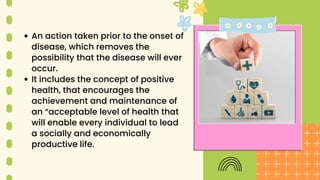
An action taken prior to the onset of
disease, which removes the
possibility that the disease will ever
occur.
It includes the concept of positive
health, that encourages the
achievement and maintenance of
an “acceptable level of health that
will enable every individual to lead
a socially and economically
productive life.
secondary
secondary
level
level
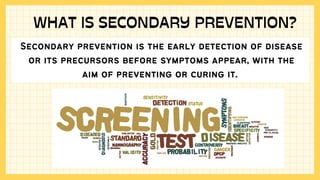
Secondary prevention is the early detection of disease
or its precursors before symptoms appear, with the
aim of preventing or curing it.
WHAT IS SECONDARY PREVENTION?
A S
X P
M L E
E
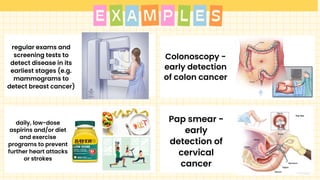
regular exams and
screening tests to
detect disease in its
earliest stages (e.g.
mammograms to
detect breast cancer)
Pap smear -
early
detection of
cervical
cancer
Colonoscopy -
early detection
of colon cancer
daily, low-dose
aspirins and/or diet
and exercise
programs to prevent
further heart attacks
or strokes
A S
X P
M L E
E
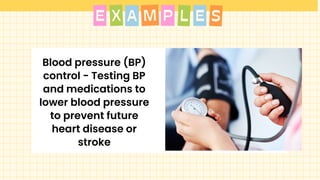
Blood pressure (BP)
control - Testing BP
and medications to
lower blood pressure
to prevent future
heart disease or
stroke
tertiary
tertiary
level
level
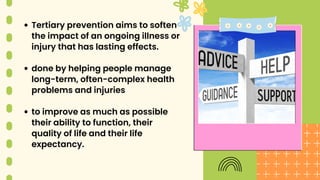
Tertiary prevention aims to soften
the impact of an ongoing illness or
injury that has lasting effects.
done by helping people manage
long-term, often-complex health
problems and injuries
to improve as much as possible
their ability to function, their
quality of life and their life
expectancy.
A S
X P
M L E
E
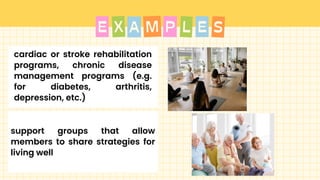
cardiac or stroke rehabilitation
programs, chronic disease
management programs (e.g.
for diabetes, arthritis,
depression, etc.)
support groups that allow
members to share strategies for
living well
THANK YOU!

Group 2 - Framework of Prevention.pdf

  • 1.
    B S NI I I - H A L L ( G R O U P T W O ) COMMUNITY HEALTH NURSING 2 I O S M L I ' Framework of Prevention Framework of Prevention
  • 2.
    E R R PO E T R S Adiel Johanna Valerie Christian Aiah
  • 3.
    objectives A N R IN L G E Understand Milio's framework for prevention Understand it's application in the community health setting Explain the connection between the individual’s state of health and that of the community At the end of this report, BSN III Hall students are At the end of this report, BSN III Hall students are expected to: expected to:
  • 4.
    Nancy Milio Nancy Milio NancyMilio, PhD, RN, was a public health nurse who formulated a framework for prevention, which aimed to explain the connection between the individual’s state of health and that of the community. She proposed that an individual’s health and lifestyle choices are influenced by resources, availability, cost, and convenience more than knowledge obtained from education.
  • 5.
    Nancy Milio Nancy Milio Includesconcepts of community-oriented, population-focused care. Milio stated that behavioural patterns of the populations-and individuals who make up populations – are a result of habitual selection from limited choices.
  • 6.
    Nancy Milio Nancy Milio Shechallenged the common notion that a main determinant for unhealthful behavioural choice is lack of knowledge. Milio’s framework described a sometimes neglected role of community health nursing to examine the determinants of a community’s health and attempt to influence those determinants through public policy.
  • 7.
    FRAMEWORK OF PREVENTION FRAMEWORKOF PREVENTION FRAMEWORK OF PREVENTION The framework provides that the health status existing in the population occurs due to too little or excess critical health sustaining resources whereby people who are have enough and safe food, shelter, water and environment are vulnerable to infectious diseases which too much food will lead to obesity. Population behavior patterns also affect health since knowledge and perception is influenced by informal and formal learning and also by experience. Health is also influenced by organizational behavior which includes policy makers since they provide options available to thus influencing selections made by individuals.
  • 8.
    Population health results from deprivation and/excessof critical health resources. Milio's Propositions
  • 9.
    Behaviors of populations resultfrom selection from limited choices; these arise from actual and perceived options available as well as beliefs and expectations resulting from socialization, education and experience. Milio's Propositions
  • 10.
    Organizational decisions and policies dictatemany of the options available to individuals and populations and influence choices. Milio's Propositions
  • 11.
    Individual choices related tohealth- promoting or health- damaging behaviors is influenced by efforts to maximize valued resources. Milio's Propositions
  • 12.
    Alteration in patterns ofbehavior resulting from decision making of significant number of people in a population can result in social change. Milio's Propositions
  • 13.
    Without concurrent availability ofalternative health-promoting options for investment of personal resources, health education will be largely ineffective in changing behavior patterns. Milio's Propositions
  • 14.
    I O S ML I ' Framework of Prevention Framework of Prevention
  • 15.
  • 16.
    Consists of actions& measures that inhibit the emergence of risk factors in the form of environmental, economic, social, and behavioral conditions & cultural patterns of living etc. Includes environmental control of disease vectors and eliminating predisposing factors. Prevention of the emergence or development of risk factors in countries or population groups in which they have not yet appeared.
  • 17.
    Addresses determinants atthe systemic level rather than modifying personal risk factors Efforts in this level are directed towards discouraging children from adopting harmful lifestyles. INDIVIDUAL AND MASS EDUCATION Main Intervention Main Intervention
  • 18.
    A S X P ML E E Outlawing alcohol in certain countries Improving sanitation and establishing healthy communities Promoting a healthy lifestyle in childhood through prenatal nutrition programs and supporting early childhood development programs Maintaining appropriate weight, blood pressure, glucose level and lipids level; not smoking; having a healthy diet
  • 19.
  • 20.
    Primary prevention aimsto prevent disease or injury before it ever occurs. This is done by preventing exposures to hazards that cause disease or injury.
  • 21.
    An action takenprior to the onset of disease, which removes the possibility that the disease will ever occur. It includes the concept of positive health, that encourages the achievement and maintenance of an “acceptable level of health that will enable every individual to lead a socially and economically productive life.
  • 22.
  • 23.
    Secondary prevention isthe early detection of disease or its precursors before symptoms appear, with the aim of preventing or curing it. WHAT IS SECONDARY PREVENTION?
  • 24.
    A S X P ML E E regular exams and screening tests to detect disease in its earliest stages (e.g. mammograms to detect breast cancer) Pap smear - early detection of cervical cancer Colonoscopy - early detection of colon cancer daily, low-dose aspirins and/or diet and exercise programs to prevent further heart attacks or strokes
  • 25.
    A S X P ML E E Blood pressure (BP) control - Testing BP and medications to lower blood pressure to prevent future heart disease or stroke
  • 26.
  • 27.
    Tertiary prevention aimsto soften the impact of an ongoing illness or injury that has lasting effects. done by helping people manage long-term, often-complex health problems and injuries to improve as much as possible their ability to function, their quality of life and their life expectancy.
  • 28.
    A S X P ML E E cardiac or stroke rehabilitation programs, chronic disease management programs (e.g. for diabetes, arthritis, depression, etc.) support groups that allow members to share strategies for living well
  • 29.