Grails
High-velocity development for Spring applications
About Me
David Jacobs
● Web Developer since '98

● Groovy since '06          Twitter
                            @MetaThis
● Grails focus in '08-'09
What is Grails?
Grails is an open-source framework for high-velocity
development of Spring applications
 ● Sensible defaults
 ● Convention-over-configuration
 ● DRY
 ● Dynamic metaprogramming
 ● End-to-end integrated stack
 ● Enables you to focus on the business problem
Best-of-Breed Java Technologies
●   Spring
●   Spring MVC
●   Hibernate
●   log4j
●   jUnit
●   SiteMesh
Integrated Stack
●   Layers and technologies integrated and wired
    out-of-the-box
●   Default configurations based on industry best
    practices
    ●   80/20 rule
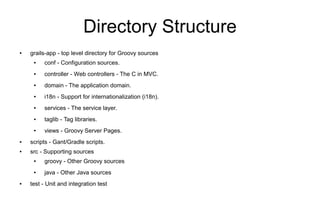
Directory Structure
●   grails-app - top level directory for Groovy sources
     ●   conf - Configuration sources.
     ●   controller - Web controllers - The C in MVC.
     ●   domain - The application domain.
     ●   i18n - Support for internationalization (i18n).
     ●   services - The service layer.
     ●   taglib - Tag libraries.
     ●   views - Groovy Server Pages.
●   scripts - Gant/Gradle scripts.
●   src - Supporting sources
     ●   groovy - Other Groovy sources
     ●   java - Other Java sources
●   test - Unit and integration test
GORM
●   Object Relational Mapping (ORM)
●   Data access layer
●   Simplifies configuration through conventions
●   Defaults to Hibernate implementation
     ● Provided as plugin, alternatives pluggable
●   Extends and simplifies data access APIs
●   Similar to ActiveRecord in Rails
GORM
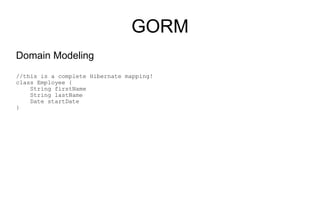
Domain Modeling
//this is a complete Hibernate mapping!
class Employee {
    String firstName
    String lastName
    Date startDate
}
GORM
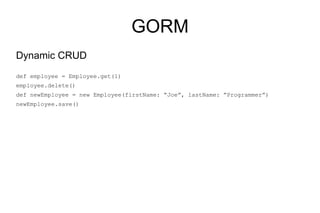
Dynamic CRUD
def employee = Employee.get(1)
employee.delete()
def newEmployee = new Employee(firstName: “Joe”, lastName: ”Programmer”)
newEmployee.save()
GORM
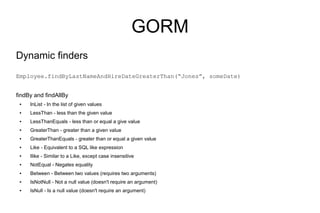
Dynamic finders
Employee.findByLastNameAndHireDateGreaterThan(“Jones”, someDate)


findBy and findAllBy
 ●   InList - In the list of given values
 ●   LessThan - less than the given value
 ●   LessThanEquals - less than or equal a give value
 ●   GreaterThan - greater than a given value
 ●   GreaterThanEquals - greater than or equal a given value
 ●   Like - Equivalent to a SQL like expression
 ●   Ilike - Similar to a Like, except case insensitive
 ●   NotEqual - Negates equality
 ●   Between - Between two values (requires two arguments)
 ●   IsNotNull - Not a null value (doesn't require an argument)
 ●   IsNull - Is a null value (doesn't require an argument)
GORM
Hibernate HQL
Employee.findAll("from Employee as e where e.lastName like :lastName", [lastName:"Jon%"])

//with pagination and sorting
Employee.findAll("from Employee as e where e.lastName like :lastName",
                 [lastName:"Jon%", max:10, offset:20, sort:"hireDate", order:"asc"])
GORM
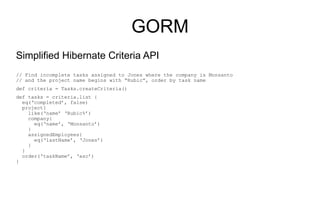
Simplified Hibernate Criteria API
// Find incomplete tasks assigned to Jones where the company is Monsanto
// and the project name begins with “Rubic”, order by task name
def criteria = Tasks.createCriteria()
def tasks = criteria.list {
  eq(‘completed’, false)
  project{
    like(‘name’ ‘Rubic%’)
    company{
      eq(‘name’, ‘Monsanto’)
    }
    assignedEmployees{
      eq(‘lastName’, ‘Jones’)
    }
  }
  order(‘taskName’, ‘asc’)
}
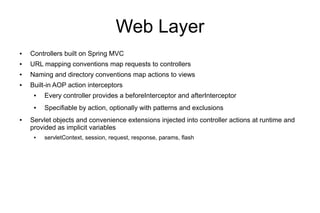
Web Layer
●   Controllers built on Spring MVC
●   URL mapping conventions map requests to controllers
●   Naming and directory conventions map actions to views
●   Built-in AOP action interceptors
     ●   Every controller provides a beforeInterceptor and afterInterceptor
     ●   Specifiable by action, optionally with patterns and exclusions
●   Servlet objects and convenience extensions injected into controller actions at runtime and
    provided as implicit variables
     ●   servletContext, session, request, response, params, flash
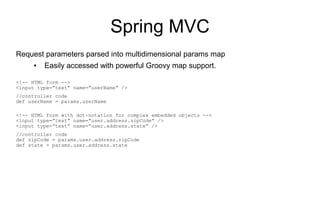
Spring MVC
Request parameters parsed into multidimensional params map
     ●   Easily accessed with powerful Groovy map support.

<!-- HTML form -->
<input type=”text” name=”userName” />
//controller code
def userName = params.userName

<!-- HTML form with dot-notation for complex embedded objects -->
<input type=”text” name=”user.address.zipCode” />
<input type=”text” name=”user.address.state” />
//controller code
def zipCode = params.user.address.zipCode
def state = params.user.address.state
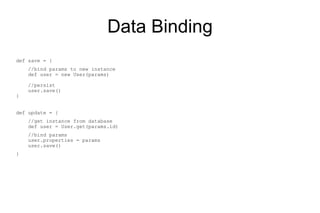
Data Binding
def save = {
    //bind params to new instance
    def user = new User(params)

    //persist
    user.save()
}


def update = {
    //get instance from database
    def user = User.get(params.id)
    //bind params
    user.properties = params
    user.save()
}
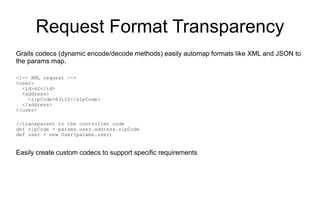
Request Format Transparency
Grails codecs (dynamic encode/decode methods) easily automap formats like XML and JSON to
the params map.

<!-- XML request -->
<user>
  <id>42</id>
  <address>
    <zipCode>63122</zipCode>
  </address>
</user>

//transparent to the controller code
def zipCode = params.user.address.zipCode
def user = new User(params.user)


Easily create custom codecs to support specific requirements
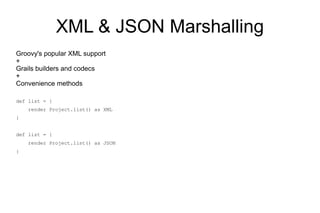
XML & JSON Marshalling
Groovy's popular XML support
+
Grails builders and codecs
+
Convenience methods

def list = {
    render Project.list() as XML
}


def list = {
    render Project.list() as JSON
}
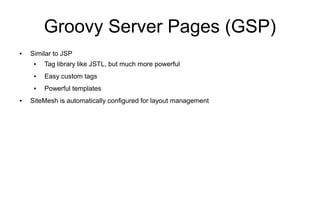
Groovy Server Pages (GSP)
●   Similar to JSP
     ●   Tag library like JSTL, but much more powerful
     ●   Easy custom tags
     ●   Powerful templates
●   SiteMesh is automatically configured for layout management
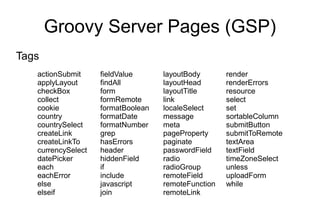
Groovy Server Pages (GSP)
Tags
   actionSubmit     fieldValue      layoutBody       render
   applyLayout      findAll         layoutHead       renderErrors
   checkBox         form            layoutTitle      resource
   collect          formRemote      link             select
   cookie           formatBoolean   localeSelect     set
   country          formatDate      message          sortableColumn
   countrySelect    formatNumber    meta             submitButton
   createLink       grep            pageProperty     submitToRemote
   createLinkTo     hasErrors       paginate         textArea
   currencySelect   header          passwordField    textField
   datePicker       hiddenField     radio            timeZoneSelect
   each             if              radioGroup       unless
   eachError        include         remoteField      uploadForm
   else             javascript      remoteFunction   while
   elseif           join            remoteLink
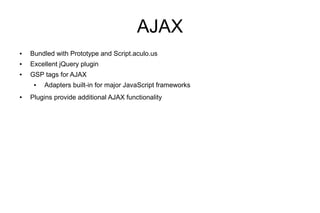
AJAX
●   Bundled with Prototype and Script.aculo.us
●   Excellent jQuery plugin
●   GSP tags for AJAX
     ●   Adapters built-in for major JavaScript frameworks
●   Plugins provide additional AJAX functionality
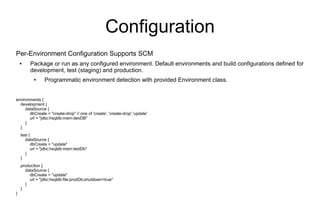
Configuration
Per-Environment Configuration Supports SCM
    ●    Package or run as any configured environment. Default environments and build configurations defined for
         development, test (staging) and production.
           ●    Programmatic environment detection with provided Environment class.


environments {
  development {
     dataSource {
       dbCreate = "create-drop" // one of 'create', 'create-drop','update'
       url = "jdbc:hsqldb:mem:devDB"
     }
  }
    test {
       dataSource {
          dbCreate = "update"
          url = "jdbc:hsqldb:mem:testDb"
       }
    }
    production {
      dataSource {
        dbCreate = "update"
        url = "jdbc:hsqldb:file:prodDb;shutdown=true"
      }
    }
}
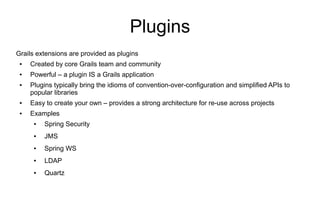
Plugins
Grails extensions are provided as plugins
 ●   Created by core Grails team and community
 ●   Powerful – a plugin IS a Grails application
 ●   Plugins typically bring the idioms of convention-over-configuration and simplified APIs to
     popular libraries
 ●   Easy to create your own – provides a strong architecture for re-use across projects
 ●   Examples
      ●   Spring Security
      ●   JMS
      ●   Spring WS
      ●   LDAP
      ●   Quartz
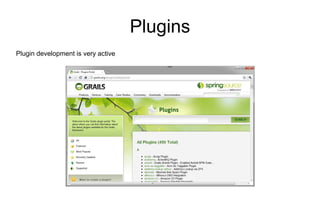
Plugins
Plugin development is very active
The Bottom Line
●   Increases developer productivity
●   less code + less configuration = easier to maintain
●   Smaller learning curve than other Java web frameworks
●   Eases the learning curve for the underlying technologies
●   Project layout conventions and a standard technology stack promote quicker ramp-up time from one
    Grails project to another
●   Increases agility potential through rapid proto-typing and quick customer feedback
●   Guides solid technology choices by providing excellent defaults
●   Developers enjoy it, which promotes morale and retention

Grails 101

  • 1.
  • 2.
    About Me David Jacobs ●Web Developer since '98 ● Groovy since '06 Twitter @MetaThis ● Grails focus in '08-'09
  • 3.
    What is Grails? Grailsis an open-source framework for high-velocity development of Spring applications ● Sensible defaults ● Convention-over-configuration ● DRY ● Dynamic metaprogramming ● End-to-end integrated stack ● Enables you to focus on the business problem
  • 4.
    Best-of-Breed Java Technologies ● Spring ● Spring MVC ● Hibernate ● log4j ● jUnit ● SiteMesh
  • 5.
    Integrated Stack ● Layers and technologies integrated and wired out-of-the-box ● Default configurations based on industry best practices ● 80/20 rule
  • 6.
    Directory Structure ● grails-app - top level directory for Groovy sources ● conf - Configuration sources. ● controller - Web controllers - The C in MVC. ● domain - The application domain. ● i18n - Support for internationalization (i18n). ● services - The service layer. ● taglib - Tag libraries. ● views - Groovy Server Pages. ● scripts - Gant/Gradle scripts. ● src - Supporting sources ● groovy - Other Groovy sources ● java - Other Java sources ● test - Unit and integration test
  • 7.
    GORM ● Object Relational Mapping (ORM) ● Data access layer ● Simplifies configuration through conventions ● Defaults to Hibernate implementation ● Provided as plugin, alternatives pluggable ● Extends and simplifies data access APIs ● Similar to ActiveRecord in Rails
  • 8.
    GORM Domain Modeling //this isa complete Hibernate mapping! class Employee { String firstName String lastName Date startDate }
  • 9.
    GORM Dynamic CRUD def employee= Employee.get(1) employee.delete() def newEmployee = new Employee(firstName: “Joe”, lastName: ”Programmer”) newEmployee.save()
  • 10.
    GORM Dynamic finders Employee.findByLastNameAndHireDateGreaterThan(“Jones”, someDate) findByand findAllBy ● InList - In the list of given values ● LessThan - less than the given value ● LessThanEquals - less than or equal a give value ● GreaterThan - greater than a given value ● GreaterThanEquals - greater than or equal a given value ● Like - Equivalent to a SQL like expression ● Ilike - Similar to a Like, except case insensitive ● NotEqual - Negates equality ● Between - Between two values (requires two arguments) ● IsNotNull - Not a null value (doesn't require an argument) ● IsNull - Is a null value (doesn't require an argument)
  • 11.
    GORM Hibernate HQL Employee.findAll("from Employeeas e where e.lastName like :lastName", [lastName:"Jon%"]) //with pagination and sorting Employee.findAll("from Employee as e where e.lastName like :lastName", [lastName:"Jon%", max:10, offset:20, sort:"hireDate", order:"asc"])
  • 12.
    GORM Simplified Hibernate CriteriaAPI // Find incomplete tasks assigned to Jones where the company is Monsanto // and the project name begins with “Rubic”, order by task name def criteria = Tasks.createCriteria() def tasks = criteria.list { eq(‘completed’, false) project{ like(‘name’ ‘Rubic%’) company{ eq(‘name’, ‘Monsanto’) } assignedEmployees{ eq(‘lastName’, ‘Jones’) } } order(‘taskName’, ‘asc’) }
  • 13.
    Web Layer ● Controllers built on Spring MVC ● URL mapping conventions map requests to controllers ● Naming and directory conventions map actions to views ● Built-in AOP action interceptors ● Every controller provides a beforeInterceptor and afterInterceptor ● Specifiable by action, optionally with patterns and exclusions ● Servlet objects and convenience extensions injected into controller actions at runtime and provided as implicit variables ● servletContext, session, request, response, params, flash
  • 14.
    Spring MVC Request parametersparsed into multidimensional params map ● Easily accessed with powerful Groovy map support. <!-- HTML form --> <input type=”text” name=”userName” /> //controller code def userName = params.userName <!-- HTML form with dot-notation for complex embedded objects --> <input type=”text” name=”user.address.zipCode” /> <input type=”text” name=”user.address.state” /> //controller code def zipCode = params.user.address.zipCode def state = params.user.address.state
  • 15.
    Data Binding def save= { //bind params to new instance def user = new User(params) //persist user.save() } def update = { //get instance from database def user = User.get(params.id) //bind params user.properties = params user.save() }
  • 16.
    Request Format Transparency Grailscodecs (dynamic encode/decode methods) easily automap formats like XML and JSON to the params map. <!-- XML request --> <user> <id>42</id> <address> <zipCode>63122</zipCode> </address> </user> //transparent to the controller code def zipCode = params.user.address.zipCode def user = new User(params.user) Easily create custom codecs to support specific requirements
  • 17.
    XML & JSONMarshalling Groovy's popular XML support + Grails builders and codecs + Convenience methods def list = { render Project.list() as XML } def list = { render Project.list() as JSON }
  • 18.
    Groovy Server Pages(GSP) ● Similar to JSP ● Tag library like JSTL, but much more powerful ● Easy custom tags ● Powerful templates ● SiteMesh is automatically configured for layout management
  • 19.
    Groovy Server Pages(GSP) Tags actionSubmit fieldValue layoutBody render applyLayout findAll layoutHead renderErrors checkBox form layoutTitle resource collect formRemote link select cookie formatBoolean localeSelect set country formatDate message sortableColumn countrySelect formatNumber meta submitButton createLink grep pageProperty submitToRemote createLinkTo hasErrors paginate textArea currencySelect header passwordField textField datePicker hiddenField radio timeZoneSelect each if radioGroup unless eachError include remoteField uploadForm else javascript remoteFunction while elseif join remoteLink
  • 20.
    AJAX ● Bundled with Prototype and Script.aculo.us ● Excellent jQuery plugin ● GSP tags for AJAX ● Adapters built-in for major JavaScript frameworks ● Plugins provide additional AJAX functionality
  • 21.
    Configuration Per-Environment Configuration SupportsSCM ● Package or run as any configured environment. Default environments and build configurations defined for development, test (staging) and production. ● Programmatic environment detection with provided Environment class. environments { development { dataSource { dbCreate = "create-drop" // one of 'create', 'create-drop','update' url = "jdbc:hsqldb:mem:devDB" } } test { dataSource { dbCreate = "update" url = "jdbc:hsqldb:mem:testDb" } } production { dataSource { dbCreate = "update" url = "jdbc:hsqldb:file:prodDb;shutdown=true" } } }
  • 22.
    Plugins Grails extensions areprovided as plugins ● Created by core Grails team and community ● Powerful – a plugin IS a Grails application ● Plugins typically bring the idioms of convention-over-configuration and simplified APIs to popular libraries ● Easy to create your own – provides a strong architecture for re-use across projects ● Examples ● Spring Security ● JMS ● Spring WS ● LDAP ● Quartz
  • 23.
  • 24.
    The Bottom Line ● Increases developer productivity ● less code + less configuration = easier to maintain ● Smaller learning curve than other Java web frameworks ● Eases the learning curve for the underlying technologies ● Project layout conventions and a standard technology stack promote quicker ramp-up time from one Grails project to another ● Increases agility potential through rapid proto-typing and quick customer feedback ● Guides solid technology choices by providing excellent defaults ● Developers enjoy it, which promotes morale and retention